Meeting Deadlines of Scientific 
Workflows in 
Public Clouds with Tasks Replication 
S.R.MUGUNTHAN SUBMITTED BY 
ASSISTANT PROFESSOR(SG)&HOD/CSE B.POORNIMA 
MECSE II YEAR 
08-09-2014 SVS COLLEGE OF ENGINEERING 
1
Outline 
• Objective 
• General architecture of workflow system 
• Issues in workflow 
• Literature survey 
• Proposed work 
• System model 
• Existing work 
• References 
08-09-2014 SVS COLLEGE OF ENGINEERING 2
Objective 
• To reduce the impact of performance variation of public cloud 
resources in the deadlines of workflow 
• Deadline constrained workflow –Its delivers the result before 
the deadline meets. 
• To minimize the workflow execution time by ignoring 
deadline and budgets. 
• To use idle time of provisioned resources and budgets surplus 
to replicate task. 
08-09-2014 SVS COLLEGE OF ENGINEERING 3
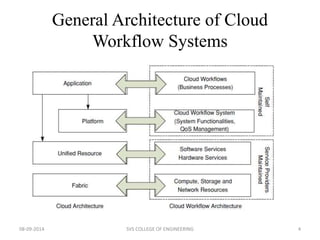
General Architecture of Cloud 
Workflow Systems 
08-09-2014 SVS COLLEGE OF ENGINEERING 4
Issues in workflow 
• Evaluate the performance of their implementations. 
• Extremely valuable for the development and comparison of 
workflow management systems. 
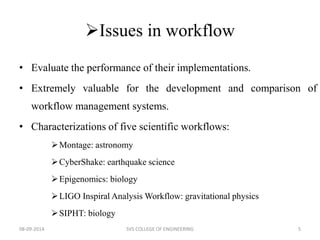
• Characterizations of five scientific workflows: 
Montage: astronomy 
CyberShake: earthquake science 
Epigenomics: biology 
LIGO Inspiral AnalysisWorkflow: gravitational physics 
SIPHT: biology 
08-09-2014 SVS COLLEGE OF ENGINEERING 5
Literature Support 
• Deadline-constrained workflow scheduling algorithms 
for Infrastructure as a Service Clouds(2013) 
• Multiple QoS Constrained Scheduling Strategy of 
MultipleWorkflows for Cloud Computing(2009) 
08-09-2014 SVS COLLEGE OF ENGINEERING 6
Deadline-constrained workflow scheduling algorithms 
for Infrastructure as a Service Clouds(2013) 
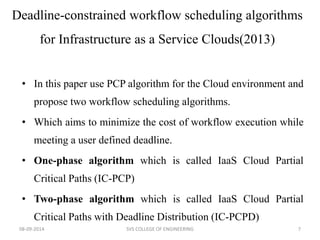
• In this paper use PCP algorithm for the Cloud environment and 
propose two workflow scheduling algorithms. 
• Which aims to minimize the cost of workflow execution while 
meeting a user defined deadline. 
• One-phase algorithm which is called IaaS Cloud Partial 
Critical Paths (IC-PCP) 
• Two-phase algorithm which is called IaaS Cloud Partial 
Critical Paths with Deadline Distribution (IC-PCPD) 
08-09-2014 SVS COLLEGE OF ENGINEERING 7
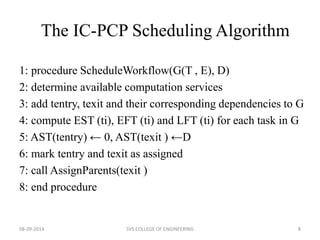
The IC-PCP Scheduling Algorithm 
1: procedure ScheduleWorkflow(G(T , E), D) 
2: determine available computation services 
3: add tentry, texit and their corresponding dependencies to G 
4: compute EST (ti), EFT (ti) and LFT (ti) for each task in G 
5: AST(tentry) ← 0, AST(texit ) ←D 
6: mark tentry and texit as assigned 
7: call AssignParents(texit ) 
8: end procedure 
08-09-2014 SVS COLLEGE OF ENGINEERING 8
Deadline-constrained workflow scheduling algorithms 
for Infrastructure as a Service Clouds(2013) 
Advantage 
• The new algorithms consider the main features of the 
current commercial Clouds such as on-demand resource 
provisioning, homogeneous networks, and the pay-as-you- 
go pricing model. 
Disadvantage 
• In accuracy of the estimated execution and transmission 
times. 
08-09-2014 SVS COLLEGE OF ENGINEERING 9
Multiple QoS Constrained Scheduling Strategy of 
Multiple Workflows for Cloud Computing(2009) 
• In this paper introduce a Multiple QoS Constrained Scheduling 
Strategy of Multi-Workflows (MQMW) to address the problem. 
• The strategy started at any time and QoS requirements are taken into 
account . 
• First, cloud provides services for multi-users. So the scheduling 
strategy must provide different QoS requirements to different users. 
• Second, there will be many workflow instances on the cloud 
platform at the same time. 
08-09-2014 SVS COLLEGE OF ENGINEERING 10
Multiple QoS Constrained Scheduling Strategy of 
Multiple Workflows for Cloud Computing(2009) 
Advantage 
• Used to develop multiple workflow with different QoS 
requirements. 
• Increase the effect of total makespan and cost of workflow 
greatly. 
Disadvantage 
• QoS constrained not include the parameters of reliability and 
availability to the workflow. 
08-09-2014 SVS COLLEGE OF ENGINEERING 11
Proposed Work 
• To increase the performances variation of the resources on the 
softdeadline of workflow application, here use an algorithm 
that uses idle time of provisioned resources. 
• Its meet and reduces the total execution time of applications as 
the budget available for replication increases. 
• The workflow model is extensively applied in diverse areas 
such as astronomy, bioinformatics, and physics. 
08-09-2014 SVS COLLEGE OF ENGINEERING 12
Proposed Work(Cont..) 
• Scientific workflows are described as direct acyclic graphs 
(DAGs)whose nodes represent tasks and vertices represent 
dependencies among tasks. 
• To being able to schedule the workflow in such a way that it 
completes before its deadline. 
• The workflow scheduler needs an estimation and run time of 
the applications. 
08-09-2014 SVS COLLEGE OF ENGINEERING 13
System Model 
• A scientific workflow application is modeled as a Direct 
Acyclic Graph (DAG) G=(T,ET). 
• Dependencies are denoted in the form of Ei,j=(ti,tj),ti,tj€ T. 
• Task ti is a parent task of tj and tj is a child task of ti. 
• Each workflow G has a soft deadline dl(G) associated to it. 
• The problem addressed in this paper consists in the execution 
of a workflow G in the cloud on or before dl(G). 
• For this problem to be solved, two subproblems have to be 
solved , namely provisioning and scheduling. 
08-09-2014 SVS COLLEGE OF ENGINEERING 14
Existing work 
• Existing research in execution of scientific workflows in 
Clouds either try to minimize the workflow execution time 
ignoring deadlines and budgets. 
• Also focus on the minimization of cost while trying to meet 
the application deadline. 
08-09-2014 SVS COLLEGE OF ENGINEERING 15
References 
• M. Xu, L. Cui, H. Wang, and Y. Bi, ‘‘AMultiple QoS 
Constrained Scheduling Strategy of Multiple Workflows for 
Cloud Computing,’’ in Proc. Int’l Symp. ISPA, 2009, pp. 629- 
634. 
• Saeid ,Mahmoud , Dick H.J,” Deadline-constrained workflow 
scheduling algorithms for Infrastructure as a Service Clouds” 
in proc. Journal In Future Generation Computer System 
29(2013) 158-169. 
• G. Juve, A. Chervenak, E. Deelman, S. Bharathi, G. Mehta, 
and K. Vahi, ‘‘Characterizing and Profiling Scientific 
Workflows,’’ Future Gener. Comput. Syst., vol. 29, no. 3, pp. 
682-692, Mar. 2013 
08-09-2014 SVS COLLEGE OF ENGINEERING 16
• J. Yu, R. Buyya, and K. Ramamohanarao, ‘‘Workflow 
Scheduling Algorithms for Grid Computing,’’ in 
Metaheuristics for Scheduling in Distributed Computing 
Environments, F. Xhafa and A.Abraham, Eds. New York, NY, 
USA: Springer-Verlag, 2008 
• Y.-K. Kwok and I. Ahmad, ‘‘Static Scheduling Algorithms 
for Allocating Directed Task Graphs to Multiprocessors,’’ 
ACM Comput. Surveys, vol. 31, no. 4, pp. 406-471, Dec. 
1999. 
08-09-2014 SVS COLLEGE OF ENGINEERING 17
Thank You 
08-09-2014 SVS COLLEGE OF ENGINEERING 18

Meeting Deadlines of Scientific Workflows in Public Clouds with Tasks Replication - 1st review

  • 1.
    Meeting Deadlines ofScientific Workflows in Public Clouds with Tasks Replication S.R.MUGUNTHAN SUBMITTED BY ASSISTANT PROFESSOR(SG)&HOD/CSE B.POORNIMA MECSE II YEAR 08-09-2014 SVS COLLEGE OF ENGINEERING 1
  • 2.
    Outline • Objective • General architecture of workflow system • Issues in workflow • Literature survey • Proposed work • System model • Existing work • References 08-09-2014 SVS COLLEGE OF ENGINEERING 2
  • 3.
    Objective • Toreduce the impact of performance variation of public cloud resources in the deadlines of workflow • Deadline constrained workflow –Its delivers the result before the deadline meets. • To minimize the workflow execution time by ignoring deadline and budgets. • To use idle time of provisioned resources and budgets surplus to replicate task. 08-09-2014 SVS COLLEGE OF ENGINEERING 3
  • 4.
    General Architecture ofCloud Workflow Systems 08-09-2014 SVS COLLEGE OF ENGINEERING 4
  • 5.
    Issues in workflow • Evaluate the performance of their implementations. • Extremely valuable for the development and comparison of workflow management systems. • Characterizations of five scientific workflows: Montage: astronomy CyberShake: earthquake science Epigenomics: biology LIGO Inspiral AnalysisWorkflow: gravitational physics SIPHT: biology 08-09-2014 SVS COLLEGE OF ENGINEERING 5
  • 6.
    Literature Support •Deadline-constrained workflow scheduling algorithms for Infrastructure as a Service Clouds(2013) • Multiple QoS Constrained Scheduling Strategy of MultipleWorkflows for Cloud Computing(2009) 08-09-2014 SVS COLLEGE OF ENGINEERING 6
  • 7.
    Deadline-constrained workflow schedulingalgorithms for Infrastructure as a Service Clouds(2013) • In this paper use PCP algorithm for the Cloud environment and propose two workflow scheduling algorithms. • Which aims to minimize the cost of workflow execution while meeting a user defined deadline. • One-phase algorithm which is called IaaS Cloud Partial Critical Paths (IC-PCP) • Two-phase algorithm which is called IaaS Cloud Partial Critical Paths with Deadline Distribution (IC-PCPD) 08-09-2014 SVS COLLEGE OF ENGINEERING 7
  • 8.
    The IC-PCP SchedulingAlgorithm 1: procedure ScheduleWorkflow(G(T , E), D) 2: determine available computation services 3: add tentry, texit and their corresponding dependencies to G 4: compute EST (ti), EFT (ti) and LFT (ti) for each task in G 5: AST(tentry) ← 0, AST(texit ) ←D 6: mark tentry and texit as assigned 7: call AssignParents(texit ) 8: end procedure 08-09-2014 SVS COLLEGE OF ENGINEERING 8
  • 9.
    Deadline-constrained workflow schedulingalgorithms for Infrastructure as a Service Clouds(2013) Advantage • The new algorithms consider the main features of the current commercial Clouds such as on-demand resource provisioning, homogeneous networks, and the pay-as-you- go pricing model. Disadvantage • In accuracy of the estimated execution and transmission times. 08-09-2014 SVS COLLEGE OF ENGINEERING 9
  • 10.
    Multiple QoS ConstrainedScheduling Strategy of Multiple Workflows for Cloud Computing(2009) • In this paper introduce a Multiple QoS Constrained Scheduling Strategy of Multi-Workflows (MQMW) to address the problem. • The strategy started at any time and QoS requirements are taken into account . • First, cloud provides services for multi-users. So the scheduling strategy must provide different QoS requirements to different users. • Second, there will be many workflow instances on the cloud platform at the same time. 08-09-2014 SVS COLLEGE OF ENGINEERING 10
  • 11.
    Multiple QoS ConstrainedScheduling Strategy of Multiple Workflows for Cloud Computing(2009) Advantage • Used to develop multiple workflow with different QoS requirements. • Increase the effect of total makespan and cost of workflow greatly. Disadvantage • QoS constrained not include the parameters of reliability and availability to the workflow. 08-09-2014 SVS COLLEGE OF ENGINEERING 11
  • 12.
    Proposed Work •To increase the performances variation of the resources on the softdeadline of workflow application, here use an algorithm that uses idle time of provisioned resources. • Its meet and reduces the total execution time of applications as the budget available for replication increases. • The workflow model is extensively applied in diverse areas such as astronomy, bioinformatics, and physics. 08-09-2014 SVS COLLEGE OF ENGINEERING 12
  • 13.
    Proposed Work(Cont..) •Scientific workflows are described as direct acyclic graphs (DAGs)whose nodes represent tasks and vertices represent dependencies among tasks. • To being able to schedule the workflow in such a way that it completes before its deadline. • The workflow scheduler needs an estimation and run time of the applications. 08-09-2014 SVS COLLEGE OF ENGINEERING 13
  • 14.
    System Model •A scientific workflow application is modeled as a Direct Acyclic Graph (DAG) G=(T,ET). • Dependencies are denoted in the form of Ei,j=(ti,tj),ti,tj€ T. • Task ti is a parent task of tj and tj is a child task of ti. • Each workflow G has a soft deadline dl(G) associated to it. • The problem addressed in this paper consists in the execution of a workflow G in the cloud on or before dl(G). • For this problem to be solved, two subproblems have to be solved , namely provisioning and scheduling. 08-09-2014 SVS COLLEGE OF ENGINEERING 14
  • 15.
    Existing work •Existing research in execution of scientific workflows in Clouds either try to minimize the workflow execution time ignoring deadlines and budgets. • Also focus on the minimization of cost while trying to meet the application deadline. 08-09-2014 SVS COLLEGE OF ENGINEERING 15
  • 16.
    References • M.Xu, L. Cui, H. Wang, and Y. Bi, ‘‘AMultiple QoS Constrained Scheduling Strategy of Multiple Workflows for Cloud Computing,’’ in Proc. Int’l Symp. ISPA, 2009, pp. 629- 634. • Saeid ,Mahmoud , Dick H.J,” Deadline-constrained workflow scheduling algorithms for Infrastructure as a Service Clouds” in proc. Journal In Future Generation Computer System 29(2013) 158-169. • G. Juve, A. Chervenak, E. Deelman, S. Bharathi, G. Mehta, and K. Vahi, ‘‘Characterizing and Profiling Scientific Workflows,’’ Future Gener. Comput. Syst., vol. 29, no. 3, pp. 682-692, Mar. 2013 08-09-2014 SVS COLLEGE OF ENGINEERING 16
  • 17.
    • J. Yu,R. Buyya, and K. Ramamohanarao, ‘‘Workflow Scheduling Algorithms for Grid Computing,’’ in Metaheuristics for Scheduling in Distributed Computing Environments, F. Xhafa and A.Abraham, Eds. New York, NY, USA: Springer-Verlag, 2008 • Y.-K. Kwok and I. Ahmad, ‘‘Static Scheduling Algorithms for Allocating Directed Task Graphs to Multiprocessors,’’ ACM Comput. Surveys, vol. 31, no. 4, pp. 406-471, Dec. 1999. 08-09-2014 SVS COLLEGE OF ENGINEERING 17
  • 18.
    Thank You 08-09-2014SVS COLLEGE OF ENGINEERING 18