















1st Conditional
more forms
If A ⇒ B
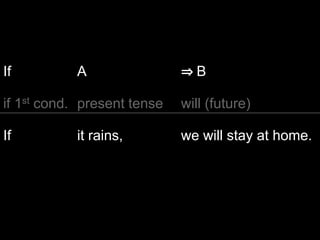
If it rains, we’ll stay at home.
If A ⇒ B
if
1st conditional
condition
present simple
result
will (future)
If it rains, we will stay at home.
varying A
If A ⇒ B
if
1st conditional
condition
present continuous
result
will (future)
If it is -ing, we will ...
you can use the
Present Continuous
in the A-part
If you are sitting comfortably,
I’ll begin.
If you are sitting comfortably,
I’ll begin.
If they’re using Windows, they’ll
need to upgrade their software.
If they’re using Windows, they’ll
need to upgrade their software.
If Pirlo’s playing well, he’ll create
problems in their midfield.
If Pirlo’s playing well, he’ll create
problems in their midfield.
you can use the
Present Perfect
in the A-part
If A ⇒ B
if
1st conditional
condition
present perfect
result
will (future)
If you have p.p., we will ...
If you’ve been to Paris, you’ll
recognise this building.
If you’ve been to Paris, you’ll
recognise this building.
If you’ve finished, you can go.
If he’s failed the exam,
he’ll have to take it again.
If he’s failed the exam,
he’ll have to take it again.
varying B
If A ⇒ B
if
1st conditional
condition
present simple
result
imperative
If it _s, do something!
you can use the
Imperative
in the B-part
If you don’t know how to do it,
ask me!
If you don’t know how to do it,
ask me!
If it rains,
take an umbrella!
If it rains,
take an umbrella!
If you visit Paris,
don’t miss the Picasso Museum!
If you visit Paris,
don’t miss the Picasso Museum!
If A ⇒ B
if
1st conditional
condition
present simple
result
present modals
If it _s, I may…
you can use
present modals
in the B-part
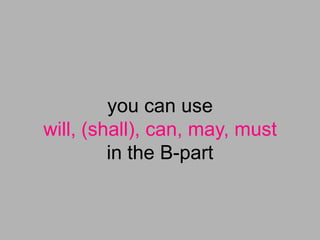
you can use
will, shall, can, may, must
in the B-part
you can use
will, (shall), can, may, must
in the B-part
If you need help, you can ask.
If you want to go to University in
England, you must pass the
IELTS exam.
If you want to go to University in
England, you must pass the
IELTS exam.
If you like the Beatles, you may
also like the Rolling Stones.
If you like the Beatles, you may
also like the Rolling Stones.
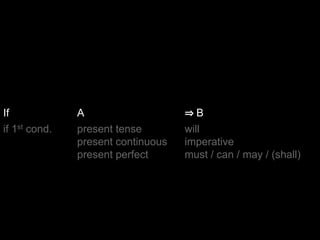
If A ⇒ B
if
1st conditional
condition
present simple
present continuous
present perfect
result
will (future)
imperative
must / can / may / (shall)
When A ⇒ B
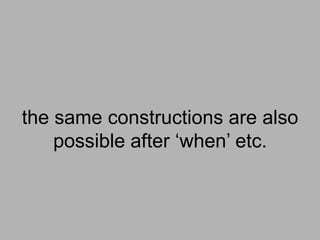
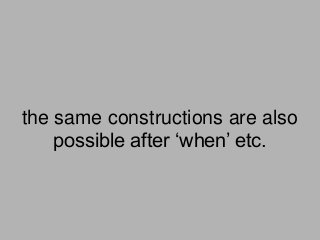
the same constructions are also
possible after ‘when’ etc.
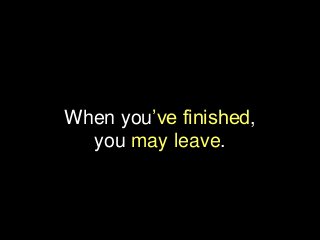
When you’ve finished,
you may leave.
When you’ve finished,
you may leave.
www.davidnicholson.it

First conditional 2