
Conditional Sentences
         By Lia Cahyati, S.Pd.
If conditional is a
pattern for
showing a
supposition.
General Rules              Special Rules

  There are three types     In special rules, there
  of conditinonal           are three types of
  sentence                  conditional
 Type 1 (Future           Inversion (without
  Conditional)              ‘if’)
 Type 2 (Present          Unless (= if + negative
  Conditional)              sentence)
 Type 3 (Past             Otherwise (= If not)
  Conditional)
TYPE 1
 If + present simple, ... will + verb-1 ...
If + present simple, imperative sentence


                    We use If Conditional Type 1
                    to talk about a possible future
                    situation and it’s consequences.

                    • If I miss the train, I will go by bus.
                    • If I have a lot of money, I will travel
                    around the world.
                    • If you meet David, please tell him
                    that i need to talk to him
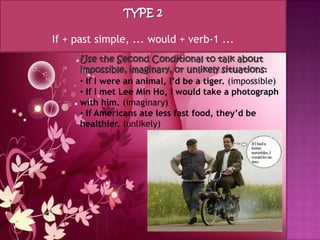
TYPE 2

If + past simple, ... would + verb-1 ...
      Use the Second Conditional to talk about
      impossible, imaginary, or unlikely situations:
      • If I were an animal, I’d be a tiger. (impossible)
      • If I met Lee Min Ho, I would take a photograph
      with him. (imaginary)
      • If Americans ate less fast food, they’d be
      healthier. (unlikely)
TYPE 3

    If + past perfect, ... would + have + verb-3 ...


The past perfect shows an
unfulfilled condition in the past.

•If you had tried, you would have won
( ~ you did not try)
• If you had been there, I would have
seen you. ( ~ you were not there)
• If I had had enough money, I would
have gone there. (~ I didn’t have
enough money at that time, i.e. in the
past)
Special Rules

Without If
• If you had tried, you would have won.
  Had you tried, you would have won.
• If you had been there, I would have seen you.
  Had you been there, I would have seen you.
• If I were you, I would say it to him.
  Were I you, I would say it to him.


Unless (If + negative sentence)
• Unless you help me, I cannot finish my work.
  If you don’t help me, I cannot finish my work.
• Unless I know the answer, I will not answer the
question.
  If I don’t know the answer, I will not answer the
question.
Conditional Sentence

Conditional Sentence

  • 1.
    Conditional Sentences By Lia Cahyati, S.Pd.
  • 2.
    If conditional isa pattern for showing a supposition.
  • 3.
    General Rules Special Rules There are three types In special rules, there of conditinonal are three types of sentence conditional  Type 1 (Future  Inversion (without Conditional) ‘if’)  Type 2 (Present  Unless (= if + negative Conditional) sentence)  Type 3 (Past  Otherwise (= If not) Conditional)
  • 4.
    TYPE 1 If+ present simple, ... will + verb-1 ... If + present simple, imperative sentence We use If Conditional Type 1 to talk about a possible future situation and it’s consequences. • If I miss the train, I will go by bus. • If I have a lot of money, I will travel around the world. • If you meet David, please tell him that i need to talk to him
  • 5.
    TYPE 2 If +past simple, ... would + verb-1 ... Use the Second Conditional to talk about impossible, imaginary, or unlikely situations: • If I were an animal, I’d be a tiger. (impossible) • If I met Lee Min Ho, I would take a photograph with him. (imaginary) • If Americans ate less fast food, they’d be healthier. (unlikely)
  • 6.
    TYPE 3 If + past perfect, ... would + have + verb-3 ... The past perfect shows an unfulfilled condition in the past. •If you had tried, you would have won ( ~ you did not try) • If you had been there, I would have seen you. ( ~ you were not there) • If I had had enough money, I would have gone there. (~ I didn’t have enough money at that time, i.e. in the past)
  • 7.
    Special Rules Without If •If you had tried, you would have won.  Had you tried, you would have won. • If you had been there, I would have seen you.  Had you been there, I would have seen you. • If I were you, I would say it to him.  Were I you, I would say it to him. Unless (If + negative sentence) • Unless you help me, I cannot finish my work.  If you don’t help me, I cannot finish my work. • Unless I know the answer, I will not answer the question.  If I don’t know the answer, I will not answer the question.