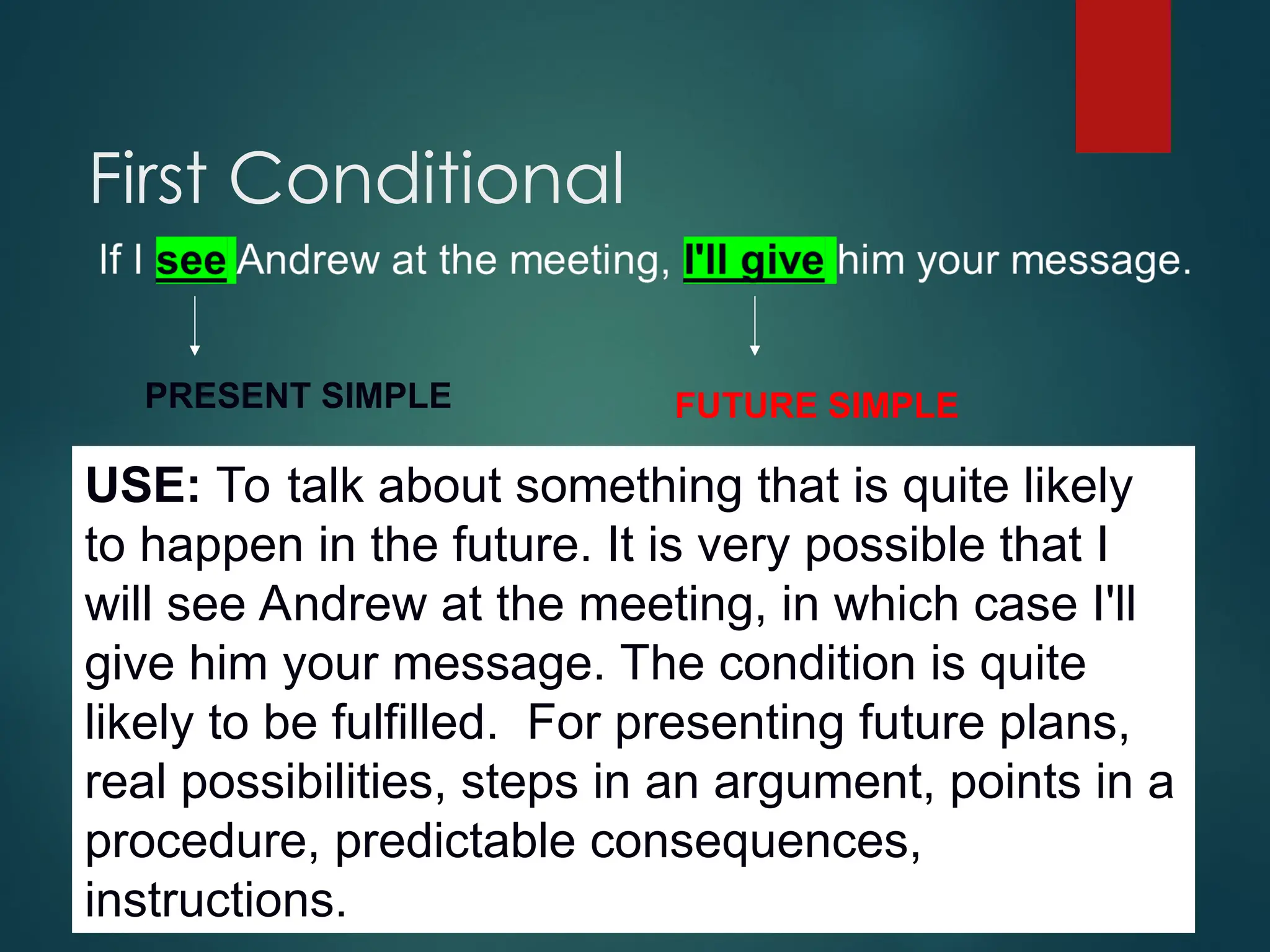
First Conditional
PRESENT SIMPLEFUTURE SIMPLE
USE: To talk about something that is quite likely
to happen in the future. It is very possible that I
will see Andrew at the meeting, in which case I'll
give him your message. The condition is quite
likely to be fulfilled. For presenting future plans,
real possibilities, steps in an argument, points in a
procedure, predictable consequences,
instructions.
4.
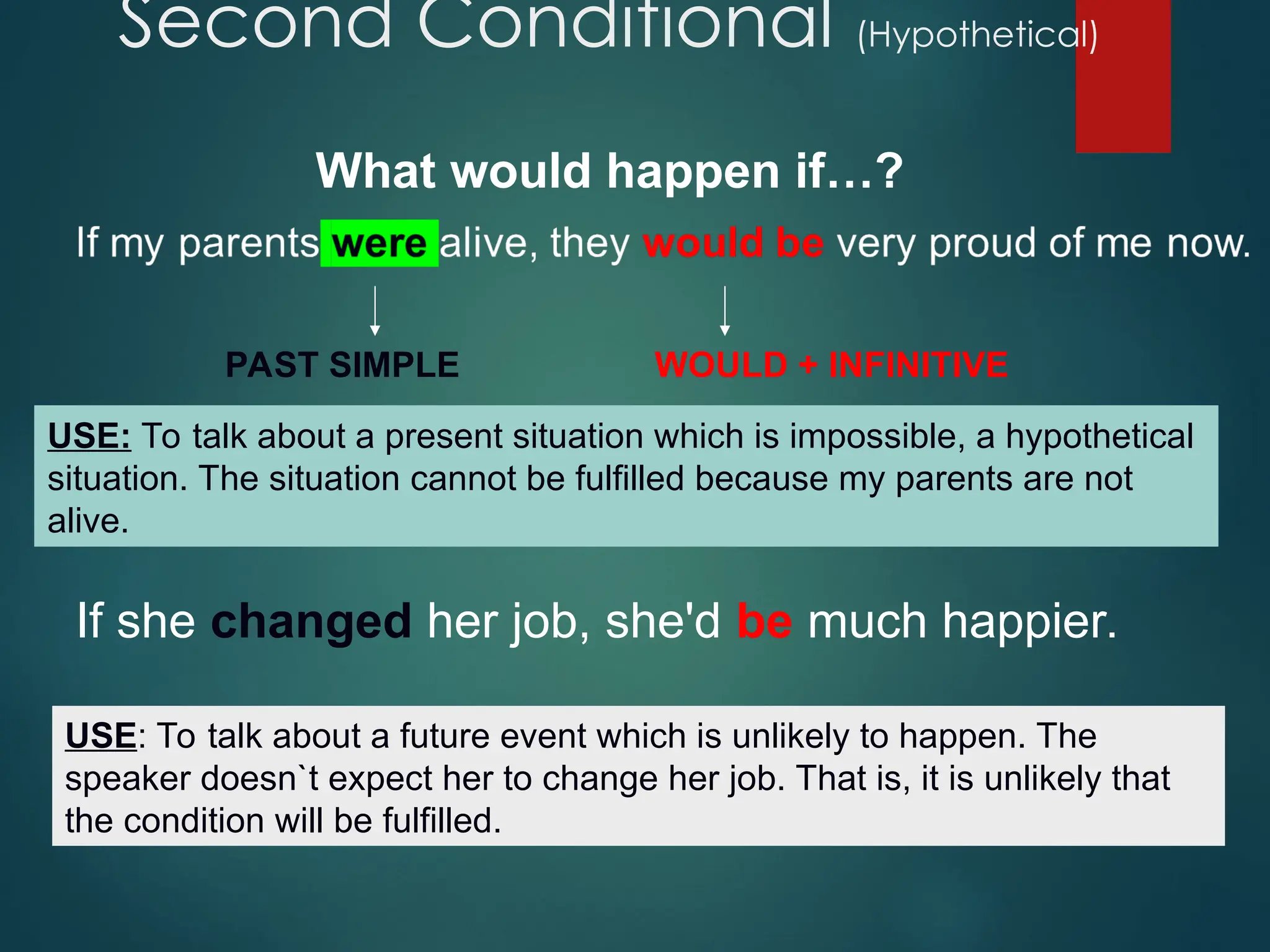
Second Conditional (Hypothetical)
PASTSIMPLE WOULD + INFINITIVE
USE: To talk about a present situation which is impossible, a hypothetical
situation. The situation cannot be fulfilled because my parents are not
alive.
If she changed her job, she'd be much happier.
USE: To talk about a future event which is unlikely to happen. The
speaker doesn`t expect her to change her job. That is, it is unlikely that
the condition will be fulfilled.
What would happen if…?
5.
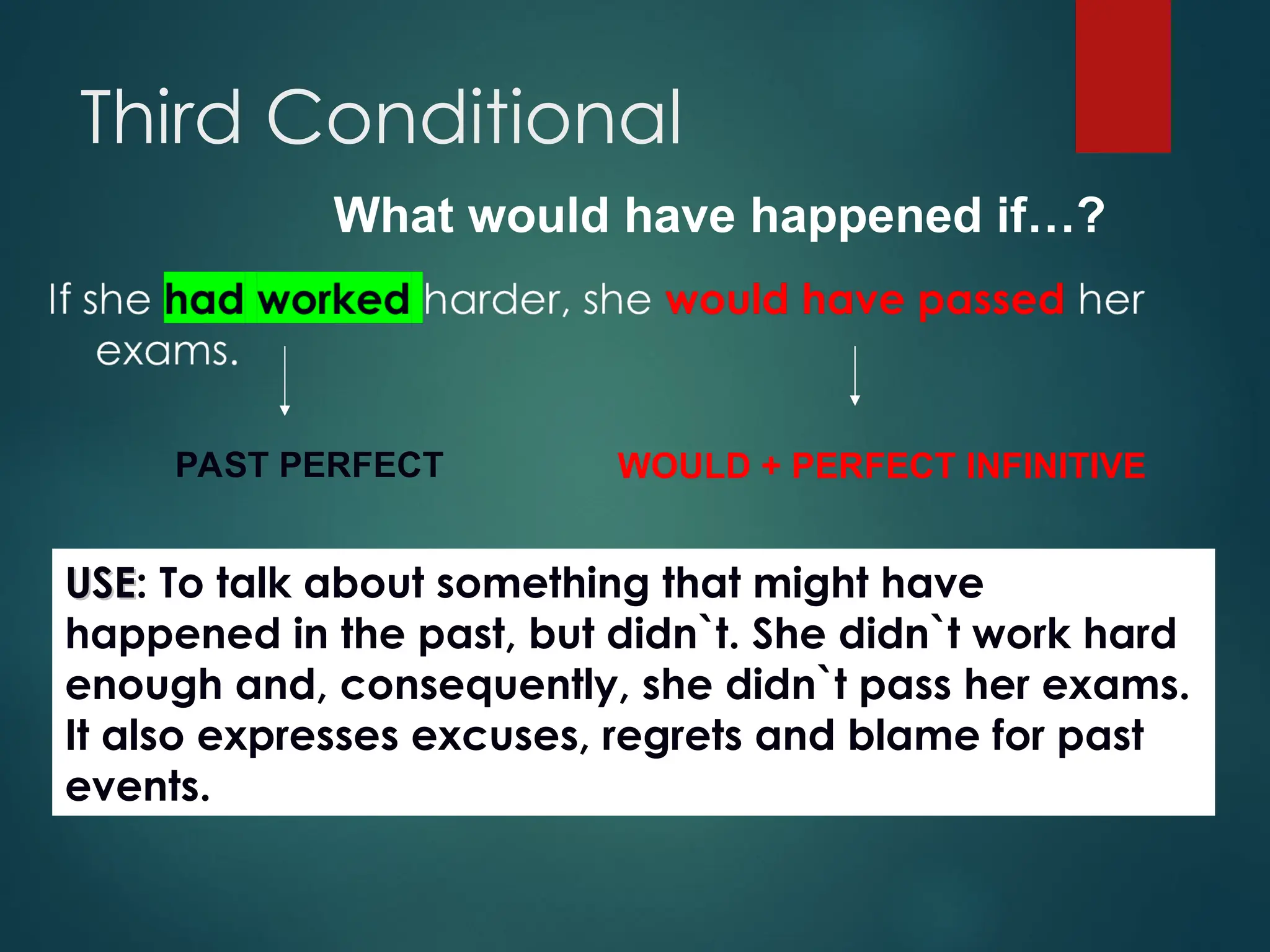
Third Conditional
PAST PERFECTWOULD + PERFECT INFINITIVE
USE
USE: To talk about something that might have
happened in the past, but didn`t. She didn`t work hard
enough and, consequently, she didn`t pass her exams.
It also expresses excuses, regrets and blame for past
events.
What would have happened if…?
6.
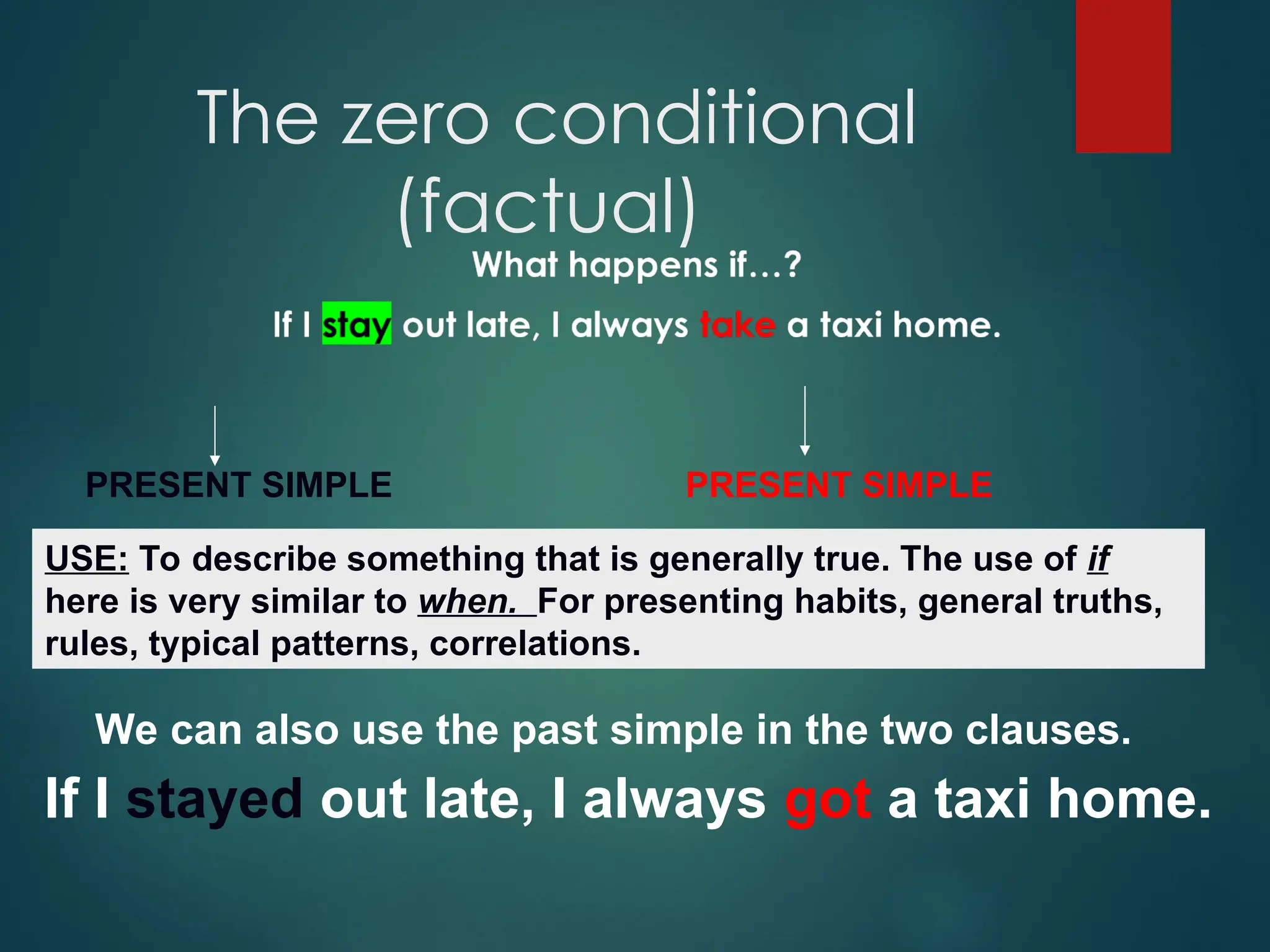
The zero conditional
(factual)
PRESENTSIMPLE PRESENT SIMPLE
USE: To describe something that is generally true. The use of if
here is very similar to when. For presenting habits, general truths,
rules, typical patterns, correlations.
We can also use the past simple in the two clauses.
If I stayed out late, I always got a taxi home.
7.
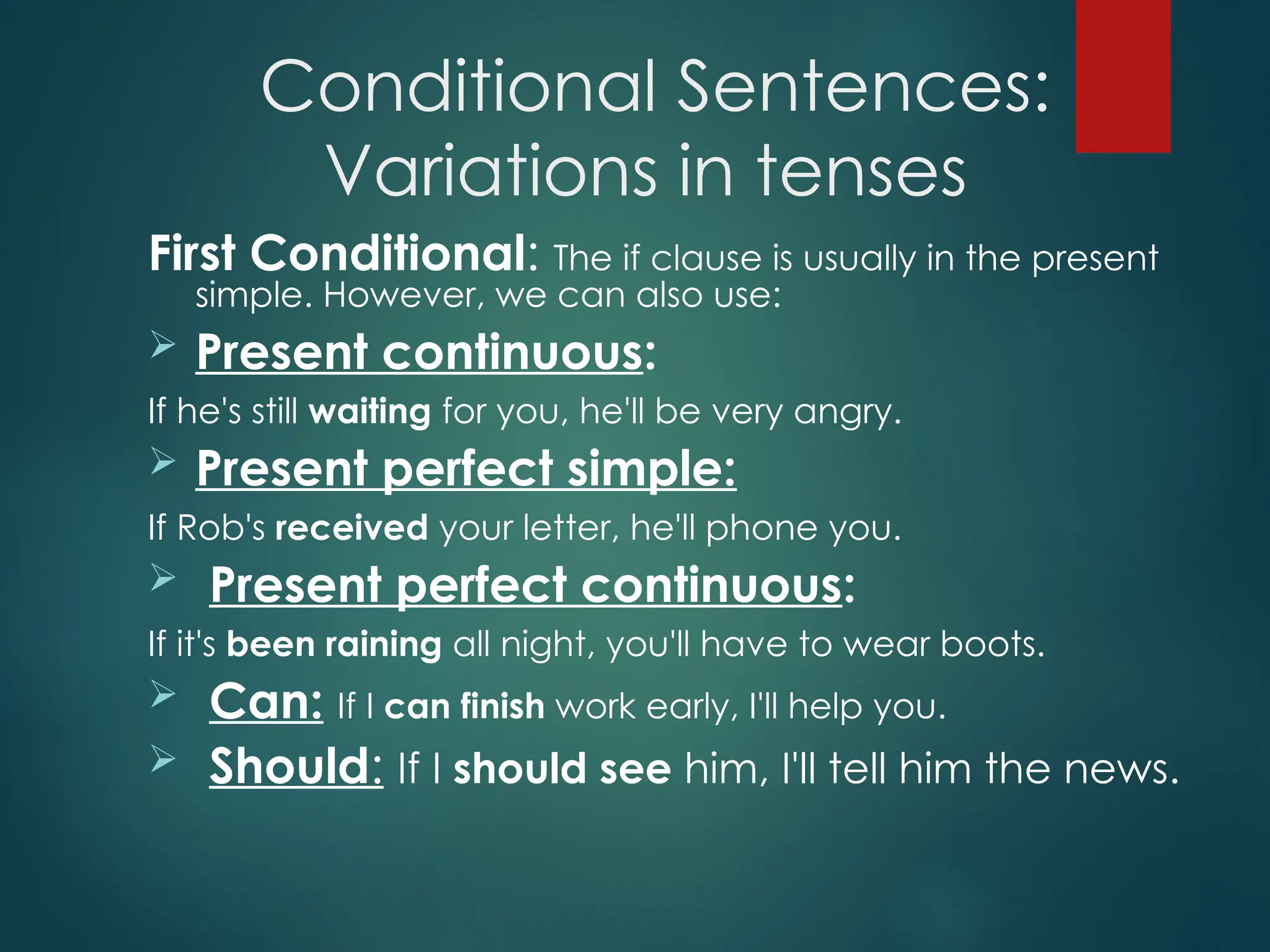
Conditional Sentences:
Variations intenses
First Conditional: The if clause is usually in the present
simple. However, we can also use:
Present continuous:
If he's still waiting for you, he'll be very angry.
Present perfect simple:
If Rob's received your letter, he'll phone you.
Present perfect continuous:
If it's been raining all night, you'll have to wear boots.
Can: If I can finish work early, I'll help you.
Should: If I should see him, I'll tell him the news.
8.
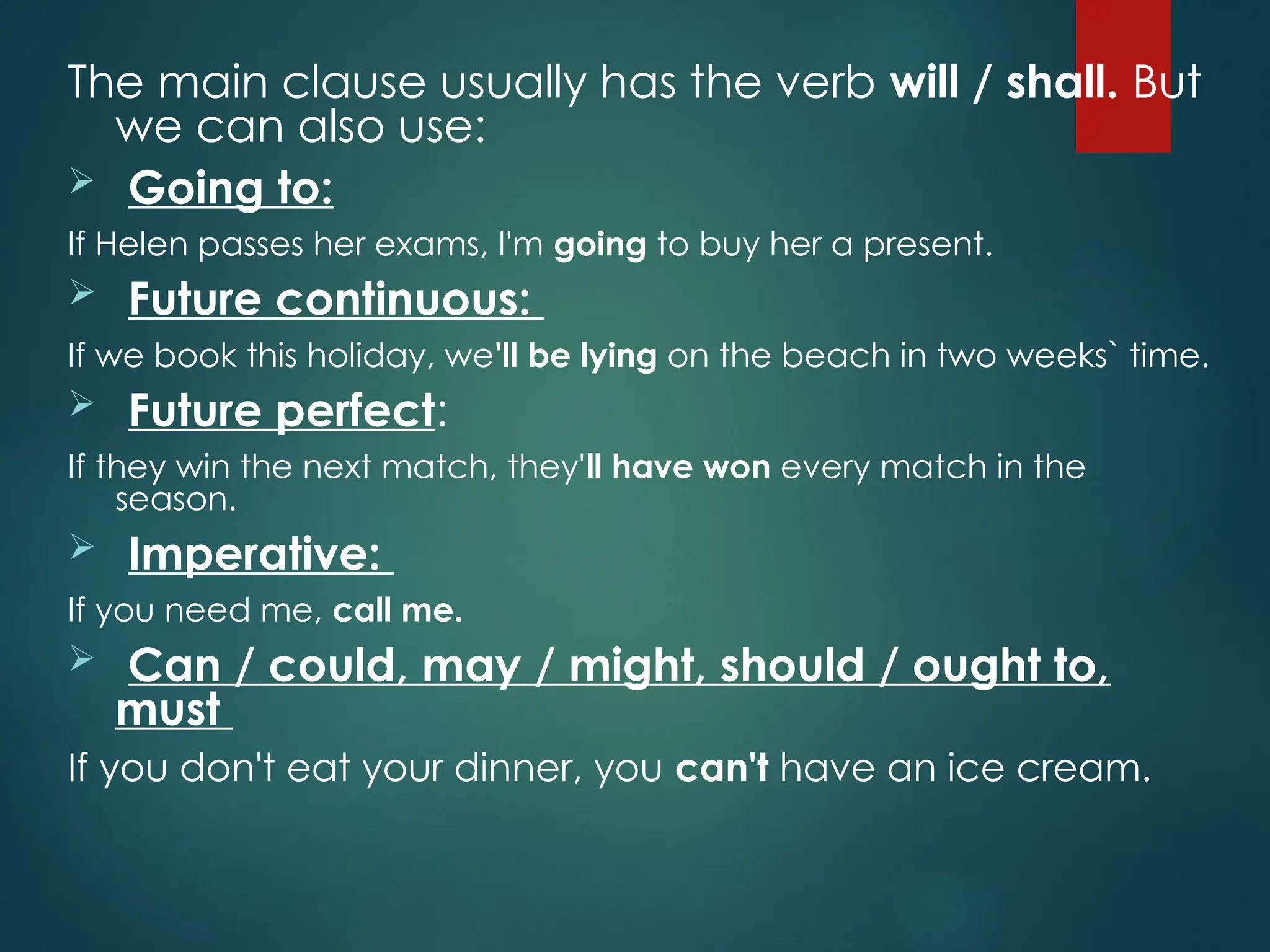
The main clauseusually has the verb will / shall. But
we can also use:
Going to:
If Helen passes her exams, I'm going to buy her a present.
Future continuous:
If we book this holiday, we'll be lying on the beach in two weeks` time.
Future perfect:
If they win the next match, they'll have won every match in the
season.
Imperative:
If you need me, call me.
Can / could, may / might, should / ought to,
must
If you don't eat your dinner, you can't have an ice cream.
9.
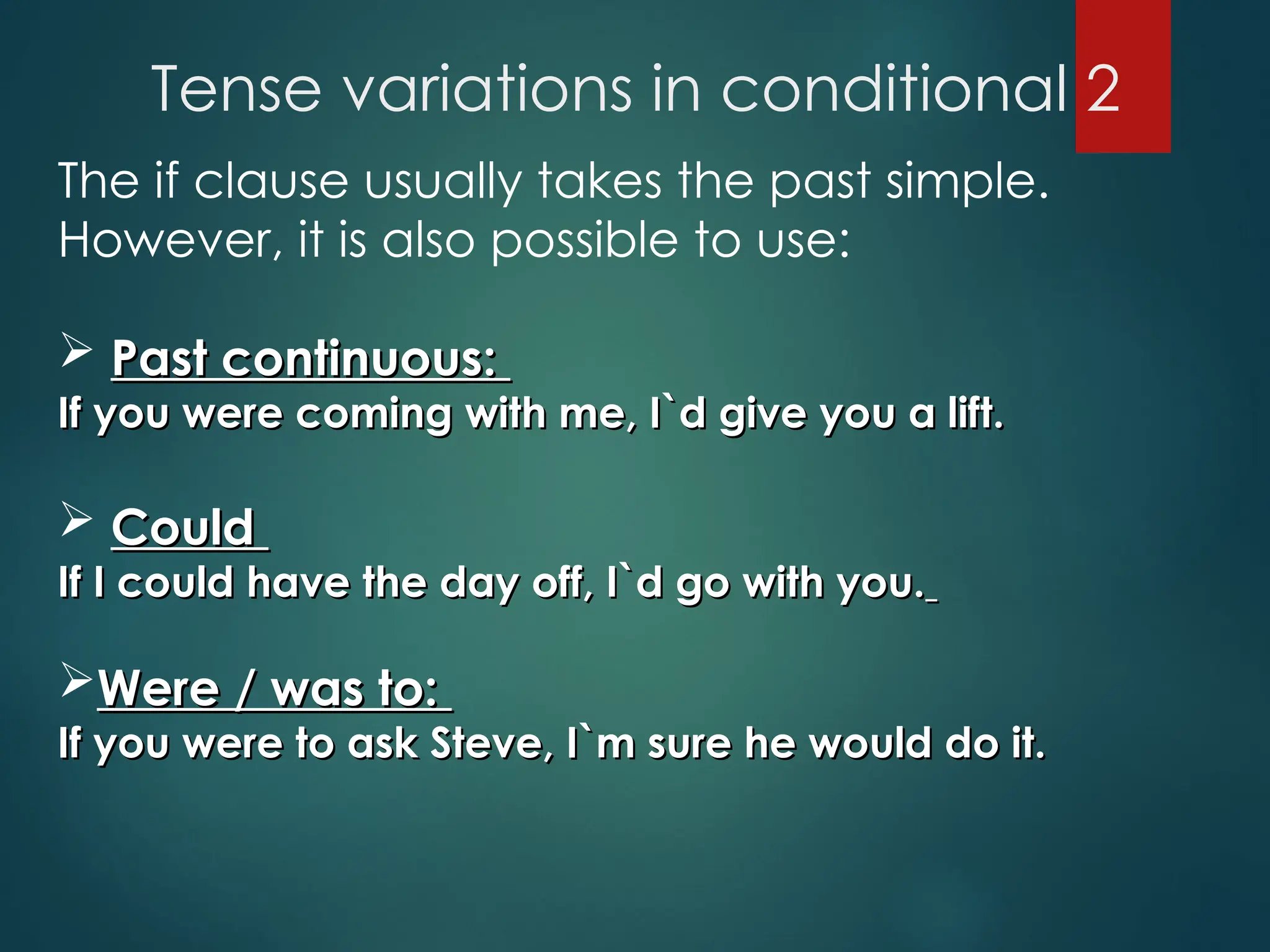
Tense variations inconditional 2
The if clause usually takes the past simple.
However, it is also possible to use:
Past continuous:
Past continuous:
If you were coming with me, I`d give you a lift.
If you were coming with me, I`d give you a lift.
Could
Could
If I could have the day off, I`d go with you.
If I could have the day off, I`d go with you.
Were / was to:
Were / was to:
If you were to ask Steve, I`m sure he would do it.
If you were to ask Steve, I`m sure he would do it.
10.
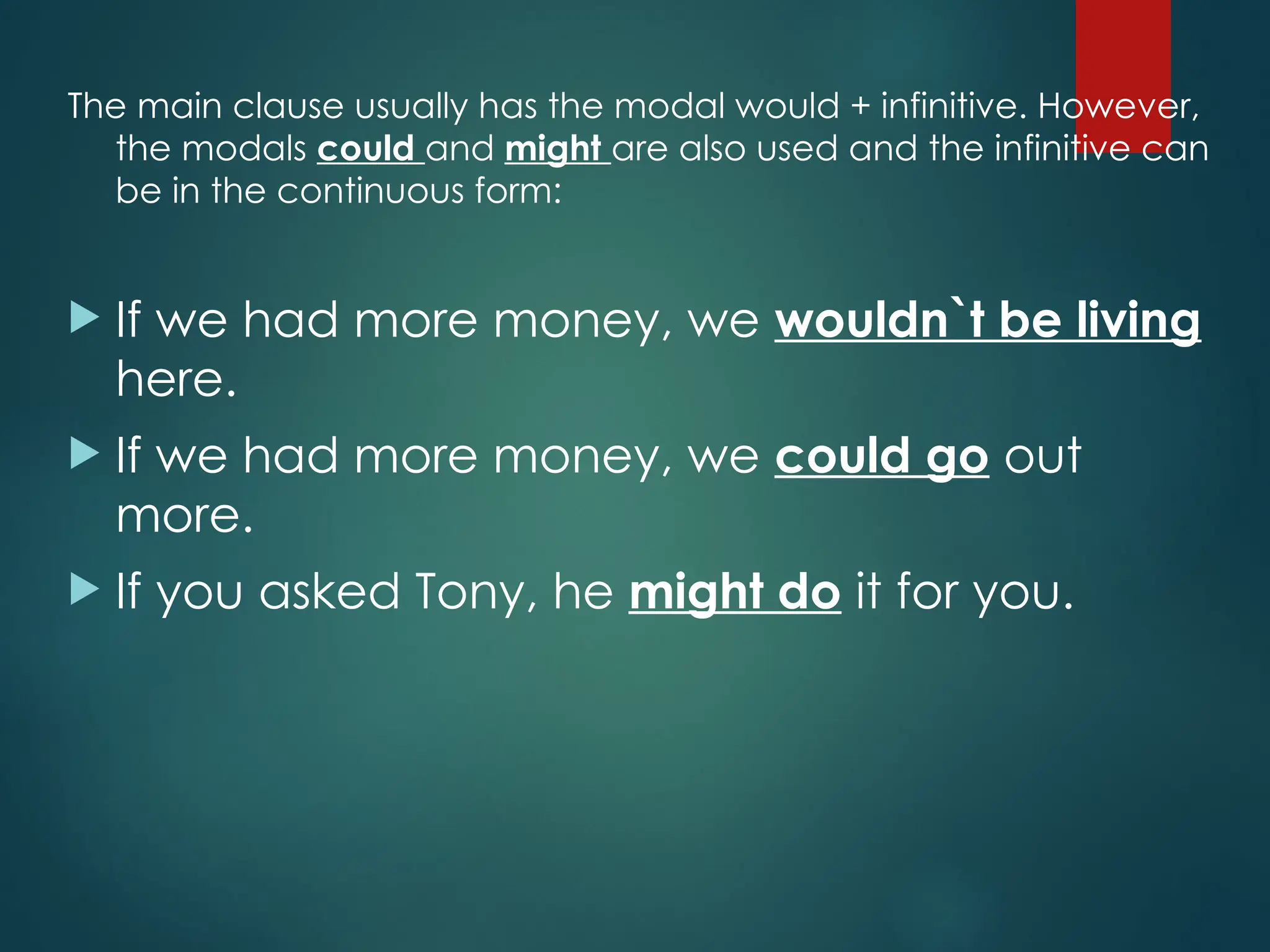
The main clauseusually has the modal would + infinitive. However,
the modals could and might are also used and the infinitive can
be in the continuous form:
If we had more money, we wouldn`t be living
here.
If we had more money, we could go out
more.
If you asked Tony, he might do it for you.
11.
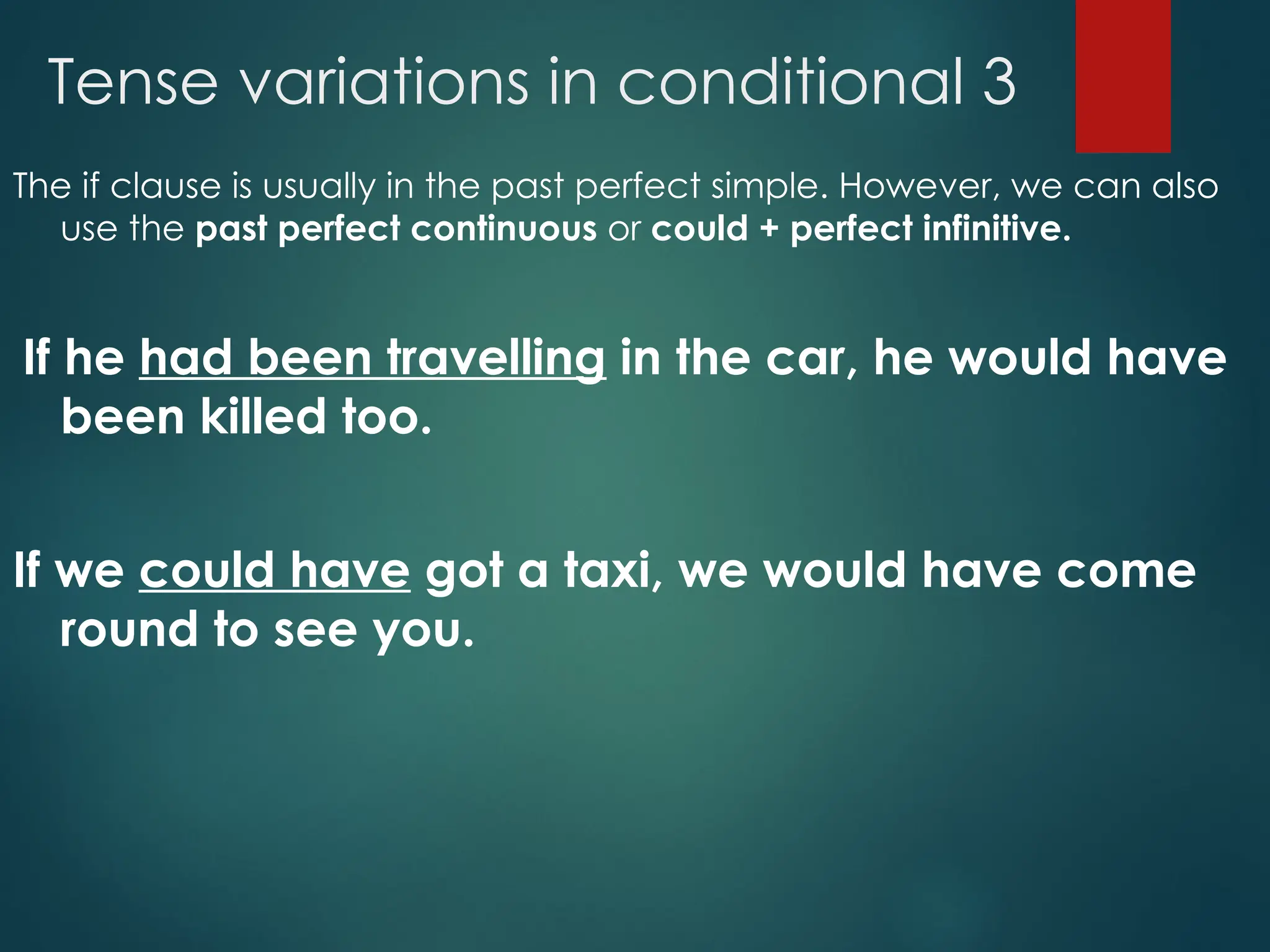
Tense variations inconditional 3
The if clause is usually in the past perfect simple. However, we can also
use the past perfect continuous or could + perfect infinitive.
If he had been travelling in the car, he would have
been killed too.
If we could have got a taxi, we would have come
round to see you.
12.
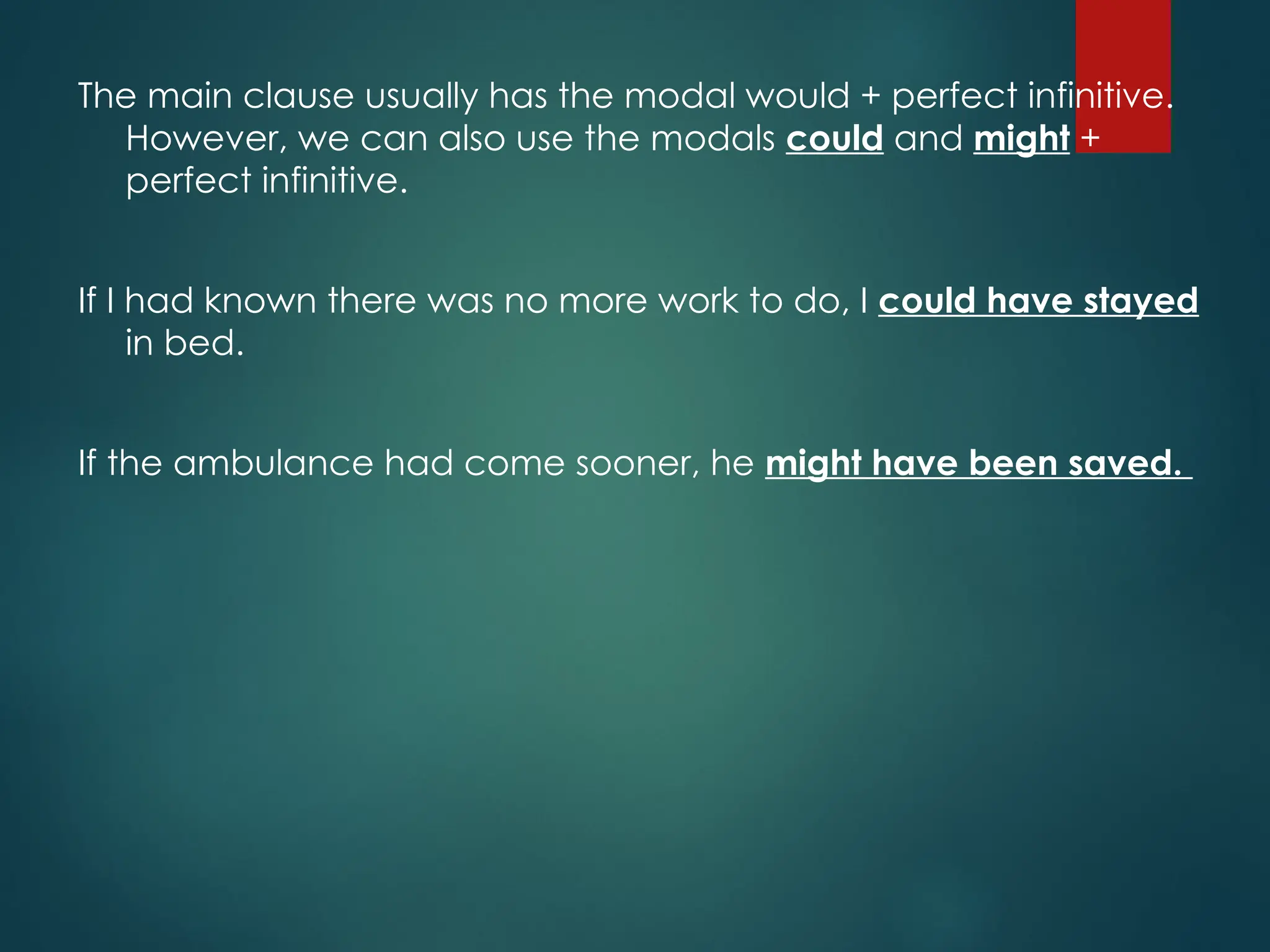
The main clauseusually has the modal would + perfect infinitive.
However, we can also use the modals could and might +
perfect infinitive.
If I had known there was no more work to do, I could have stayed
in bed.
If the ambulance had come sooner, he might have been saved.
13.
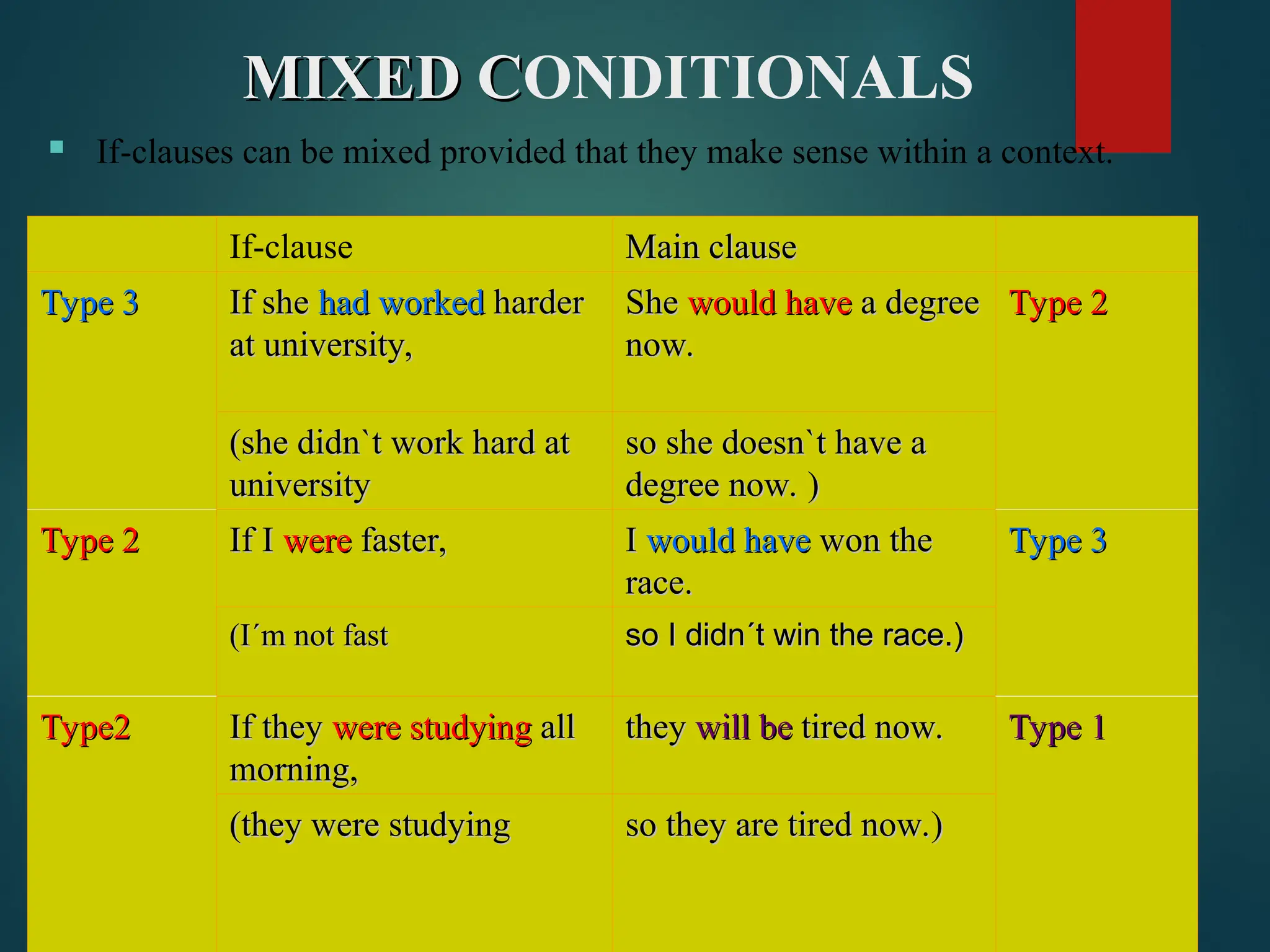
MIXED C
MIXED CONDITIONALS
If-clauses can be mixed provided that they make sense within a context.
If-clause Main clause
Main clause
Type 3
Type 3 If she
If she had worked
had worked harder
harder
at university,
at university,
She
She would have
would have a degree
a degree
now.
now.
Type 2
Type 2
(she didn`t work hard at
(she didn`t work hard at
university
university
so she doesn`t have a
so she doesn`t have a
degree now. )
degree now. )
Type 2
Type 2 If I
If I were
were faster,
faster, I
I would have
would have won the
won the
race.
race.
Type 3
Type 3
(I´m not fast
(I´m not fast so I didn´t win the race.)
so I didn´t win the race.)
Type2
Type2 If they
If they were studying
were studying all
all
morning,
morning,
they
they will be
will be tired now.
tired now. Type 1
Type 1
(they were studying
(they were studying so they are tired now.)
so they are tired now.)
14.
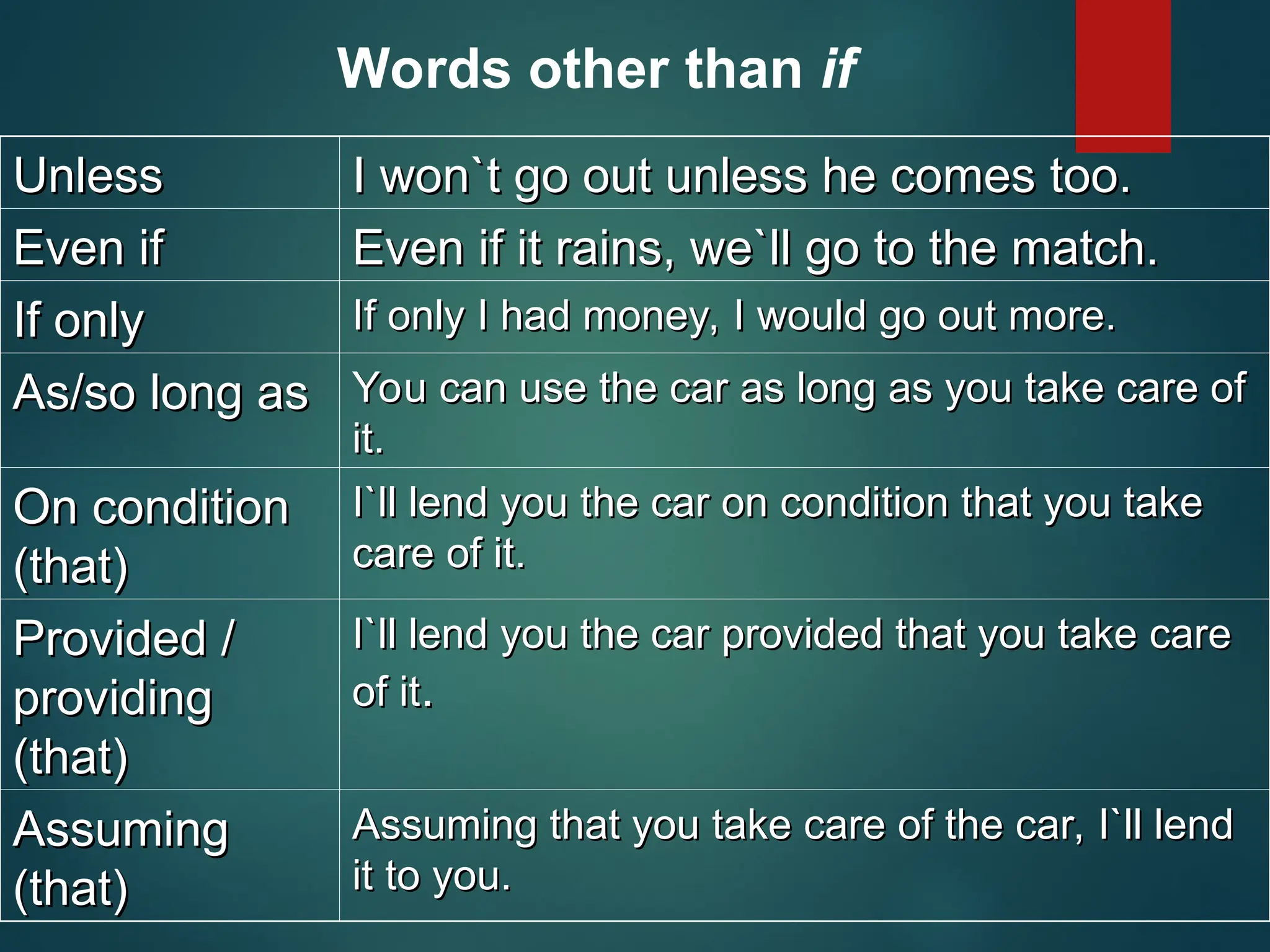
Words other thanif
Unless
Unless I won`t go out unless he comes too.
I won`t go out unless he comes too.
Even if
Even if Even if it rains, we`ll go to the match.
Even if it rains, we`ll go to the match.
If only
If only If only I had money, I would go out more.
If only I had money, I would go out more.
As/so long as
As/so long as You can use the car as long as you take care of
You can use the car as long as you take care of
it.
it.
On condition
On condition
(that)
(that)
I`ll lend you the car on condition that you take
I`ll lend you the car on condition that you take
care of it.
care of it.
Provided /
Provided /
providing
providing
(that)
(that)
I`ll lend you the car provided that you take care
I`ll lend you the car provided that you take care
of it
of it.
.
Assuming
Assuming
(that)
(that)
Assuming that you take care of the car, I`ll lend
Assuming that you take care of the car, I`ll lend
it to you.
it to you.
15.
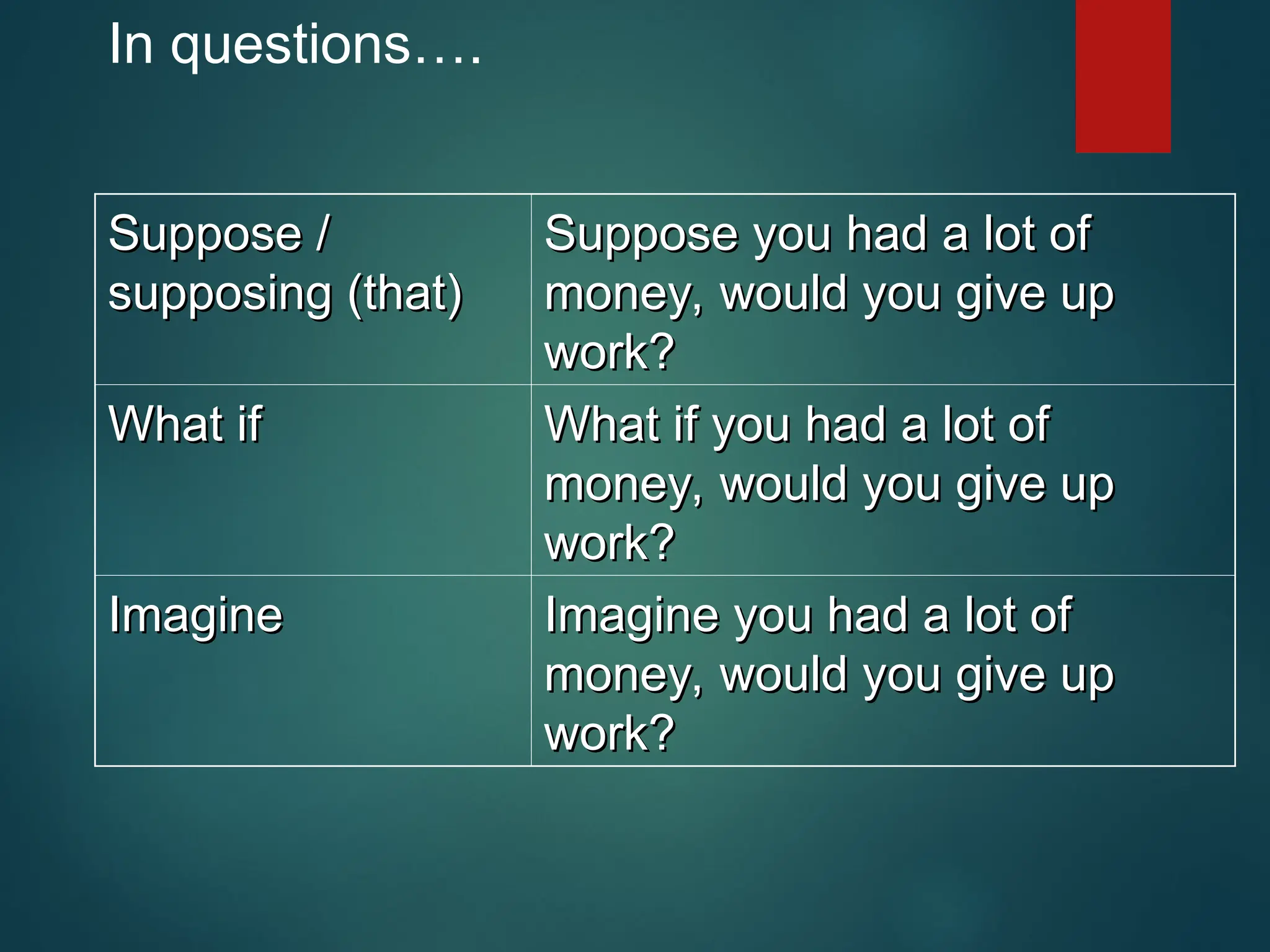
Suppose /
Suppose /
supposing(that)
supposing (that)
Suppose you had a lot of
Suppose you had a lot of
money, would you give up
money, would you give up
work?
work?
What if
What if What if you had a lot of
What if you had a lot of
money, would you give up
money, would you give up
work?
work?
Imagine
Imagine Imagine you had a lot of
Imagine you had a lot of
money, would you give up
money, would you give up
work?
work?
In questions….
16.
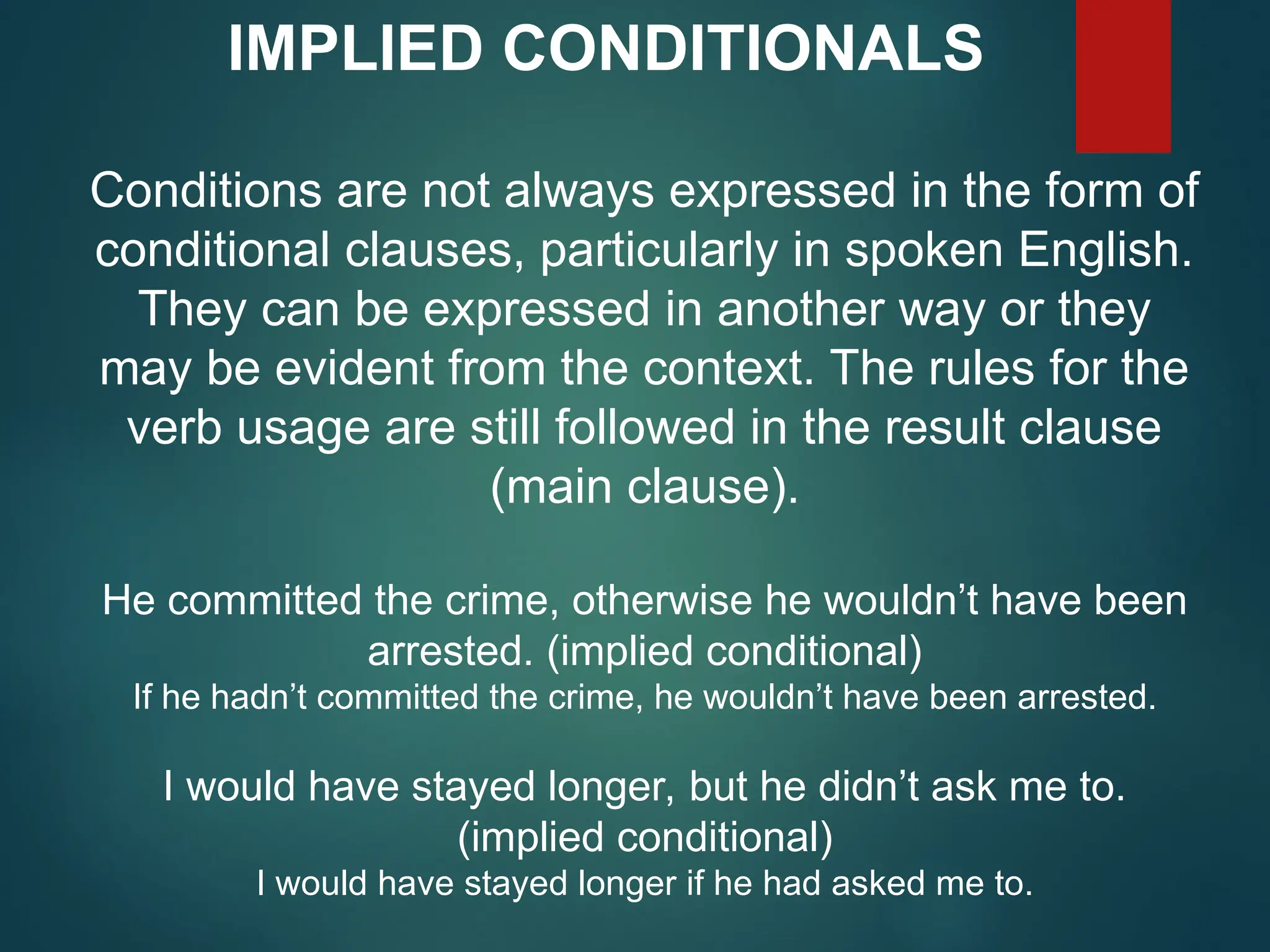
IMPLIED CONDITIONALS
Conditions arenot always expressed in the form of
conditional clauses, particularly in spoken English.
They can be expressed in another way or they
may be evident from the context. The rules for the
verb usage are still followed in the result clause
(main clause).
He committed the crime, otherwise he wouldn’t have been
arrested. (implied conditional)
If he hadn’t committed the crime, he wouldn’t have been arrested.
I would have stayed longer, but he didn’t ask me to.
(implied conditional)
I would have stayed longer if he had asked me to.
17.
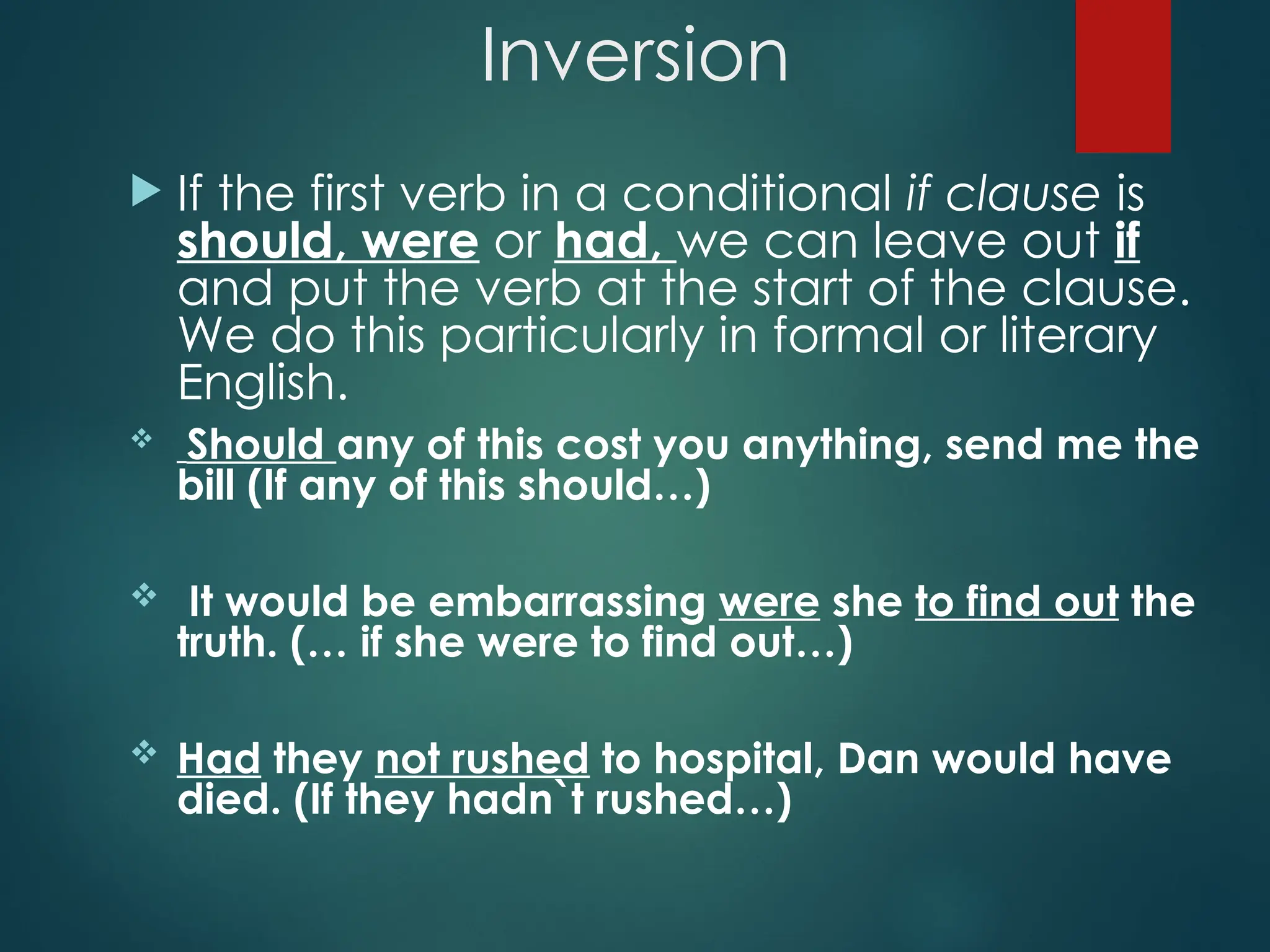
Inversion
If thefirst verb in a conditional if clause is
should, were or had, we can leave out if
and put the verb at the start of the clause.
We do this particularly in formal or literary
English.
Should any of this cost you anything, send me the
bill (If any of this should…)
It would be embarrassing were she to find out the
truth. (… if she were to find out…)
Had they not rushed to hospital, Dan would have
died. (If they hadn`t rushed…)
18.
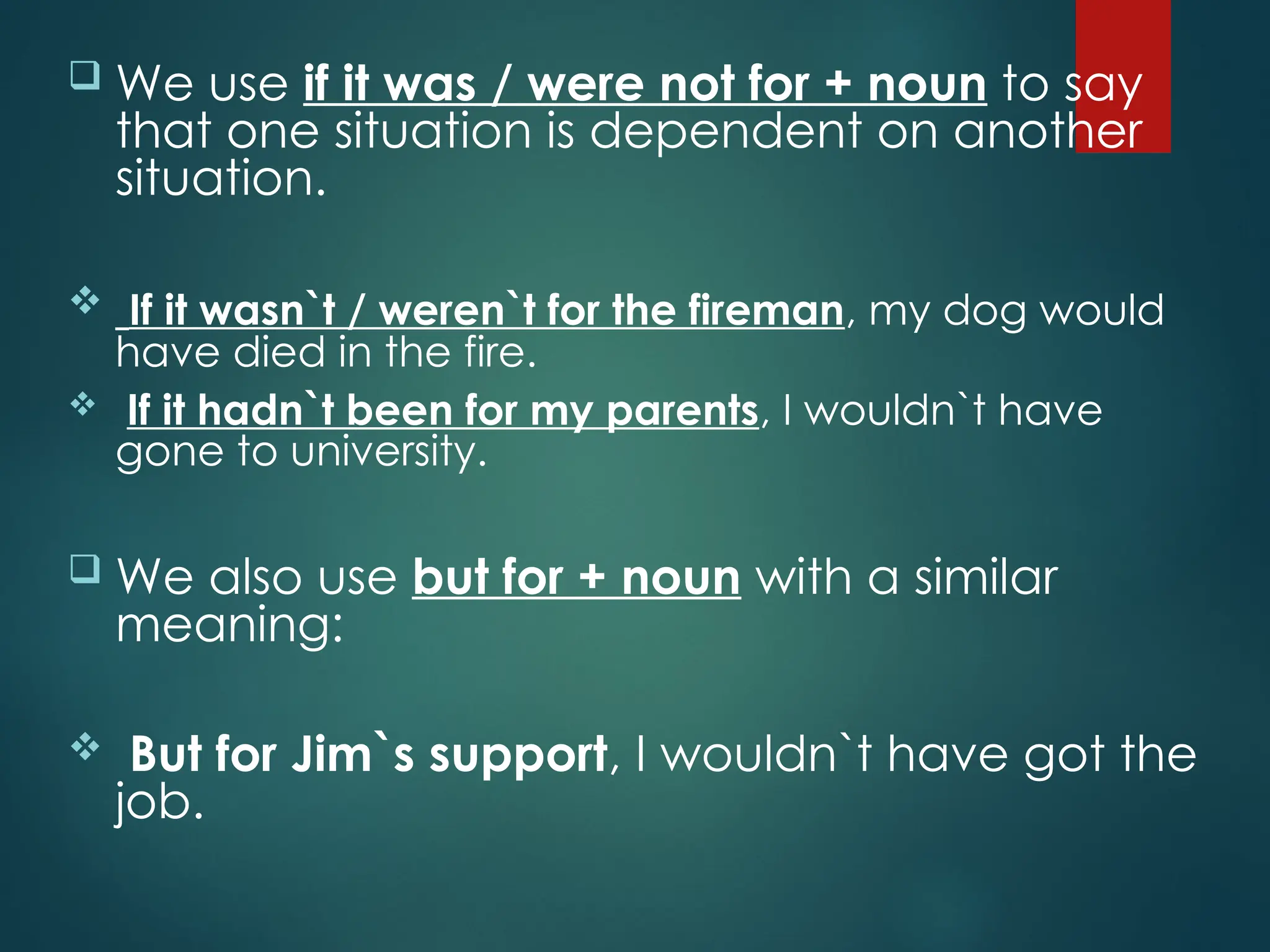
We useif it was / were not for + noun to say
that one situation is dependent on another
situation.
If it wasn`t / weren`t for the fireman, my dog would
have died in the fire.
If it hadn`t been for my parents, I wouldn`t have
gone to university.
We also use but for + noun with a similar
meaning:
But for Jim`s support, I wouldn`t have got the
job.
19.
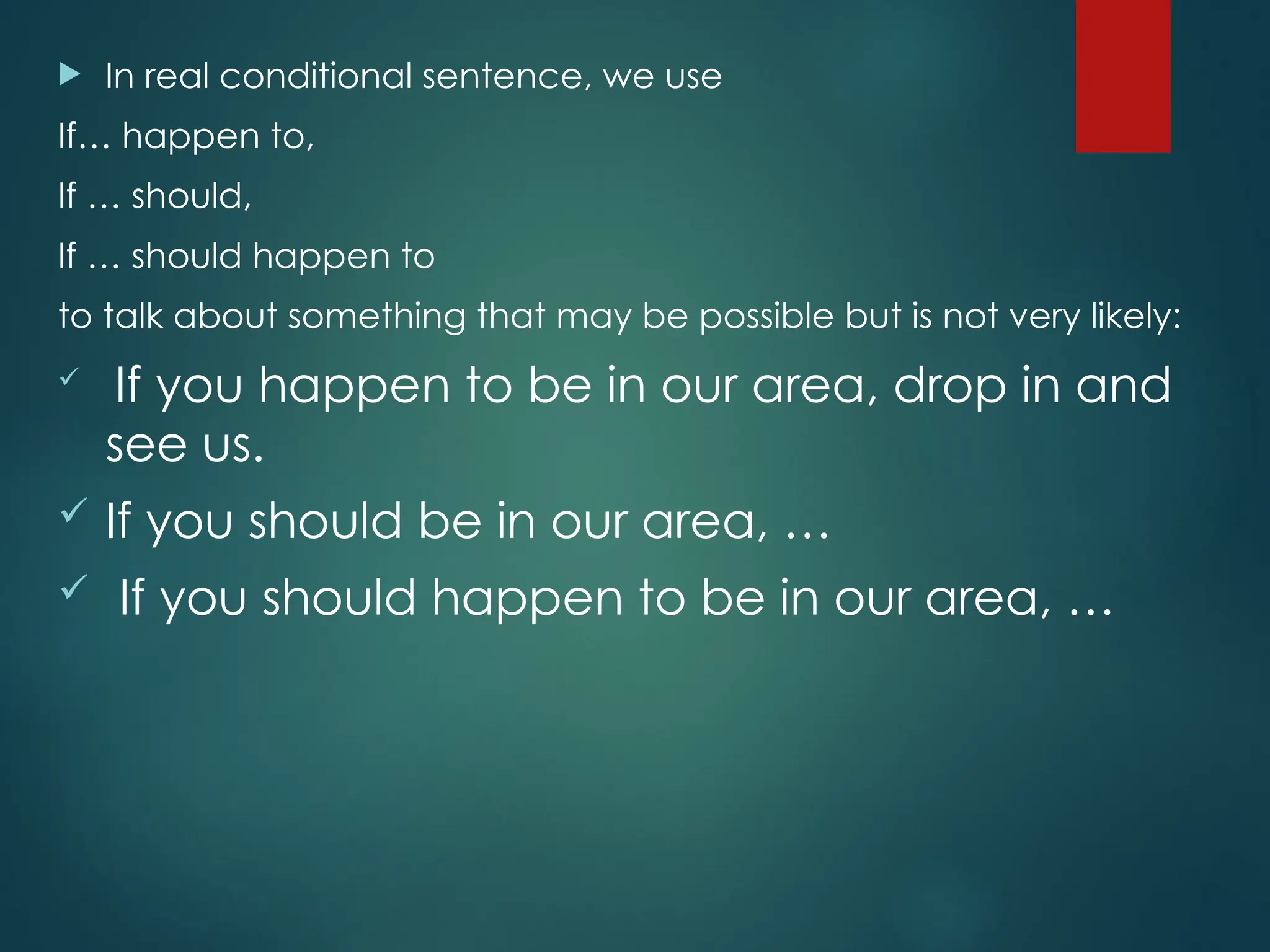
In realconditional sentence, we use
If… happen to,
If … should,
If … should happen to
to talk about something that may be possible but is not very likely:
If you happen to be in our area, drop in and
see us.
If you should be in our area, …
If you should happen to be in our area, …
20.
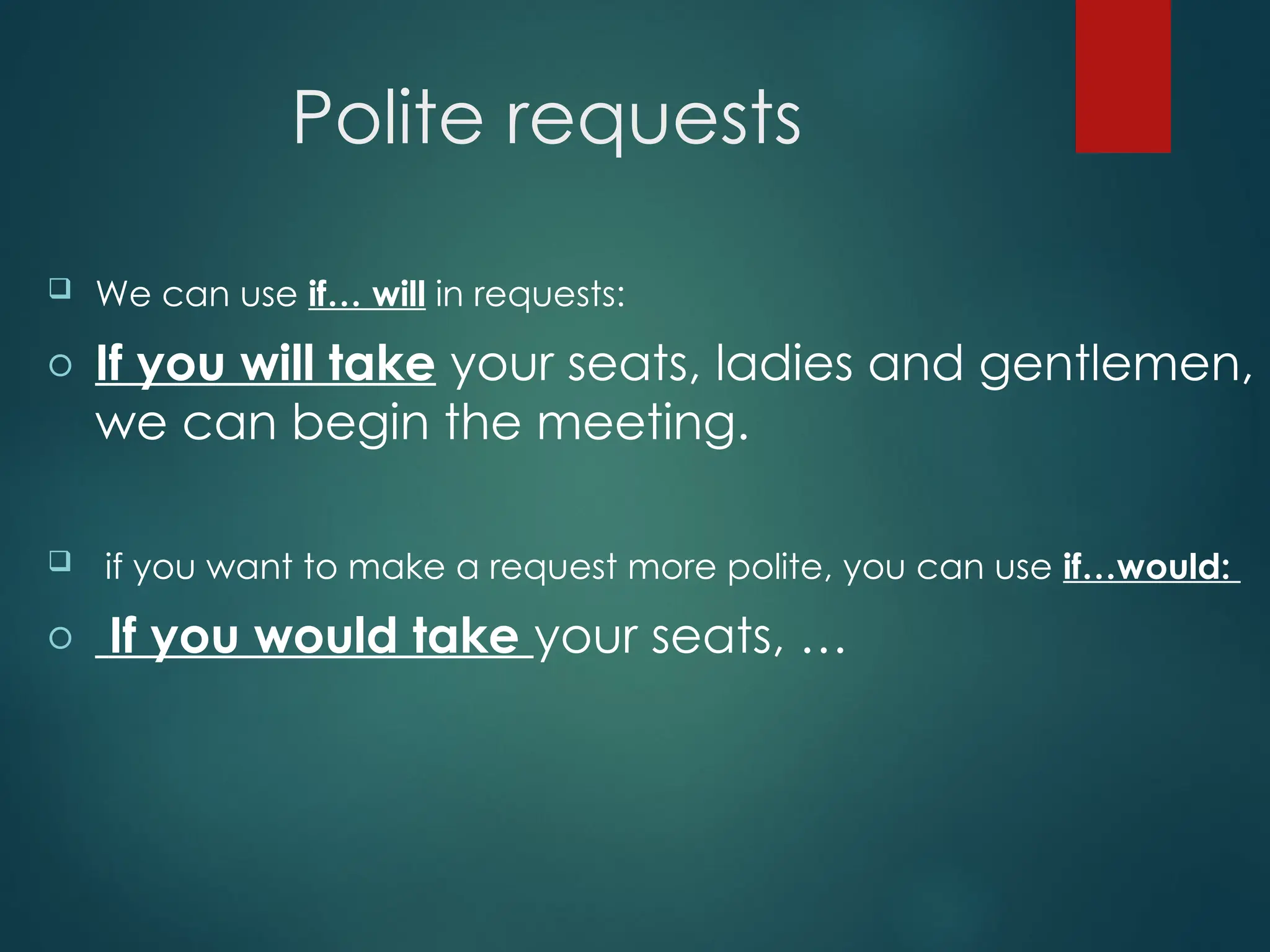
Polite requests
Wecan use if… will in requests:
o If you will take your seats, ladies and gentlemen,
we can begin the meeting.
if you want to make a request more polite, you can use if…would:
o If you would take your seats, …
21.
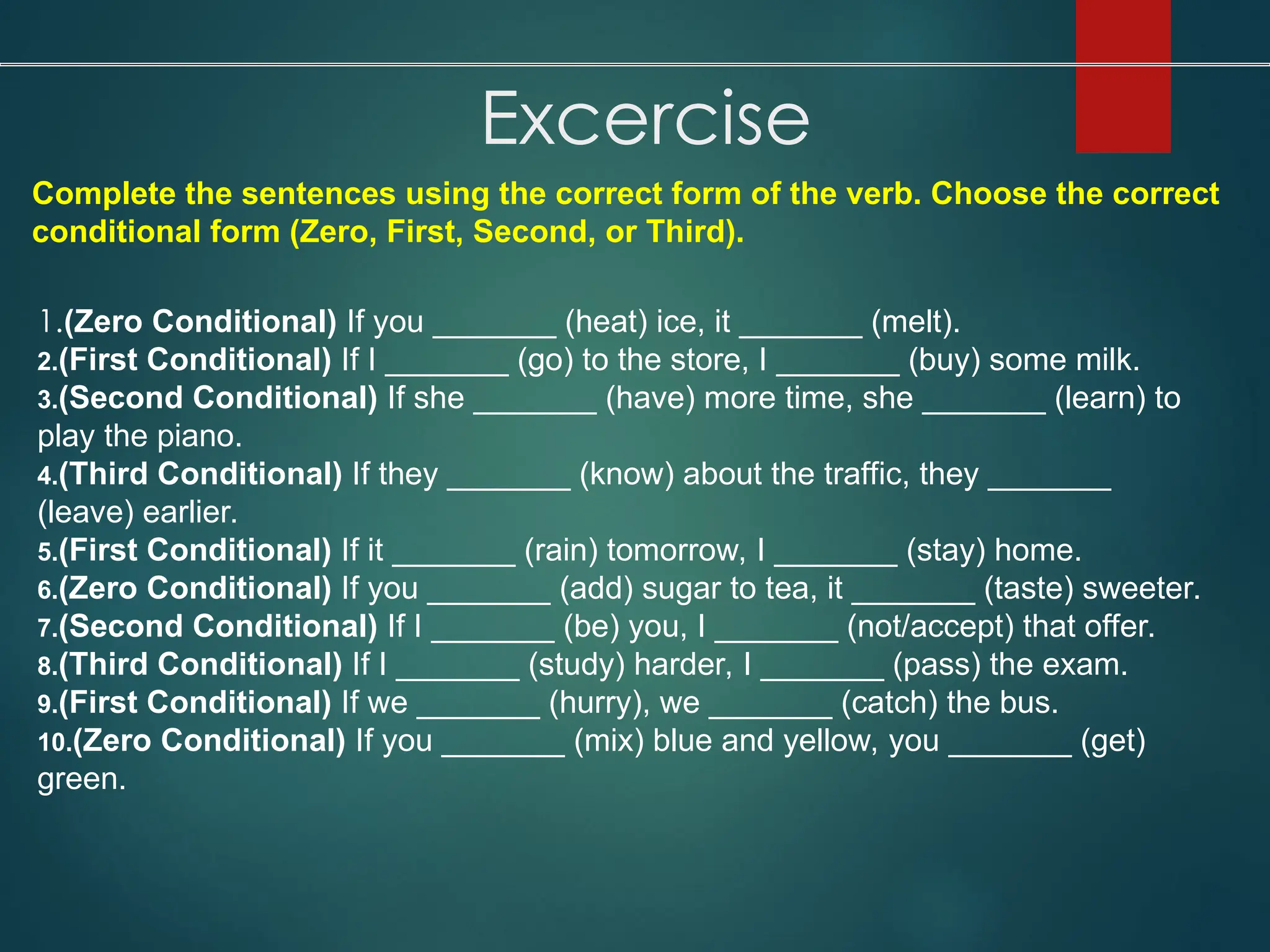
Excercise
Complete the sentencesusing the correct form of the verb. Choose the correct
conditional form (Zero, First, Second, or Third).
1.(Zero Conditional) If you _______ (heat) ice, it _______ (melt).
2.(First Conditional) If I _______ (go) to the store, I _______ (buy) some milk.
3.(Second Conditional) If she _______ (have) more time, she _______ (learn) to
play the piano.
4.(Third Conditional) If they _______ (know) about the traffic, they _______
(leave) earlier.
5.(First Conditional) If it _______ (rain) tomorrow, I _______ (stay) home.
6.(Zero Conditional) If you _______ (add) sugar to tea, it _______ (taste) sweeter.
7.(Second Conditional) If I _______ (be) you, I _______ (not/accept) that offer.
8.(Third Conditional) If I _______ (study) harder, I _______ (pass) the exam.
9.(First Conditional) If we _______ (hurry), we _______ (catch) the bus.
10.(Zero Conditional) If you _______ (mix) blue and yellow, you _______ (get)
green.