3rd Conditional
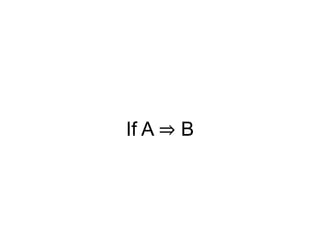
If A ⇒ B
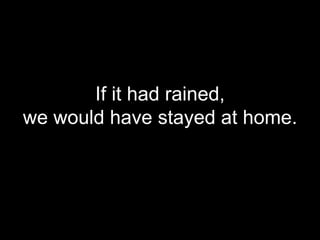
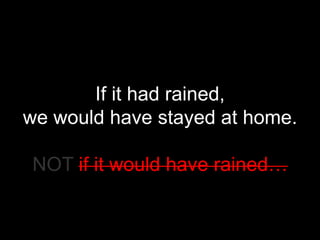
If it had rained,
we would have stayed at home.
If A ⇒ B
if condition result
If it had rained, we would have
stayed at home.
If A ⇒ B
if condition result
If it had rained, we would have
stayed at home.
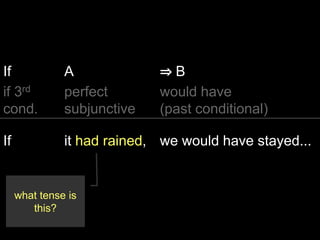
what tense is
this?
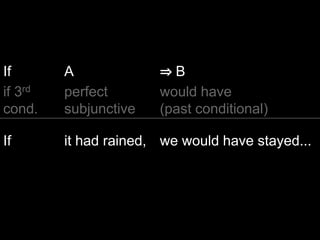
If A ⇒ B
if condition
perfect subjunctive
result
If it had rained, we would have
stayed at home.
If A ⇒ B
if condition
perfect subjunctive
result
If it had rained, we would have
stayed at home.
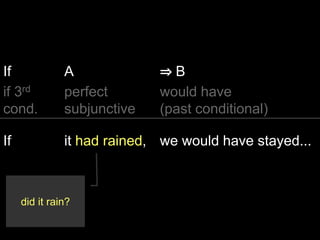
did it rain?
If A ⇒ B
if condition
perfect subjunctive
result
If it had rained, we would have
stayed at home.
and what
tense is this?
If A ⇒ B
if condition
perfect subjunctive
result
would have (past cond.)
If it had rained, we would have
stayed at home.
If A ⇒ B
if
3rd conditional
condition
perfect subjunctive
result
would have (past cond.)
If it had rained, we would have
stayed at home.
If it had rained,
we would have stayed at home.
NOT if it would have rained…
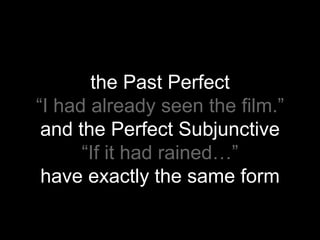
the Past Perfect
“I had already seen the film.”
and the Perfect Subjunctive
“If it had rained…”
have exactly the same form
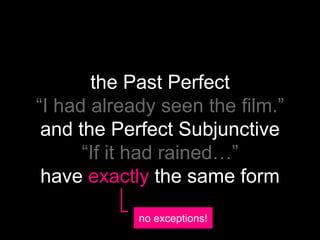
the Past Perfect
“I had already seen the film.”
and the Perfect Subjunctive
“If it had rained…”
have exactly the same form
no exceptions!
pronunciation
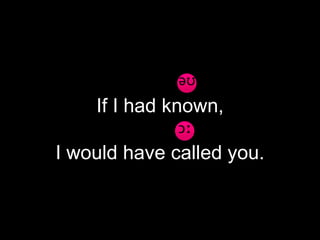
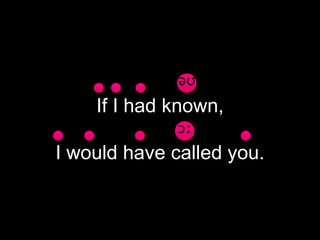
If I had known,
I would have called you.
əʊ
ɔː
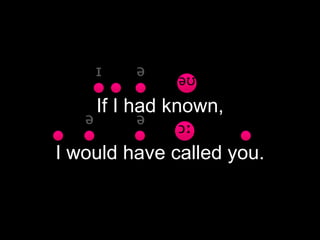
If I had known,
I would have called you.
əʊ
ɔː
If I had known,
I would have called you.
əʊ
ɔː
ə
əə
ɪ
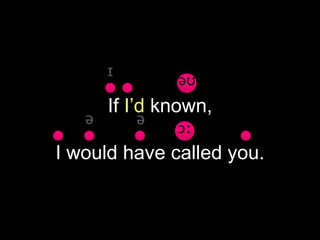
If I’d known,
I would have called you.
əʊ
ɔː
əə
ɪ
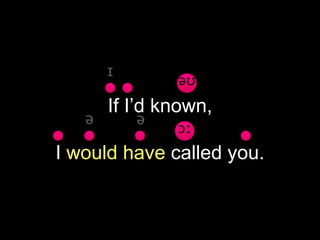
If I’d known,
I would have called you.
əʊ
ɔː
əə
ɪ
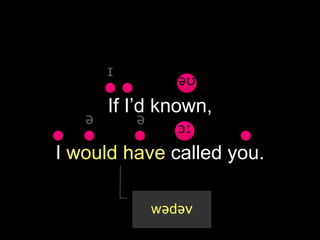
If I’d known,
I would have called you.
əʊ
ɔː
əə
ɪ
wədəv
notice the abbreviations
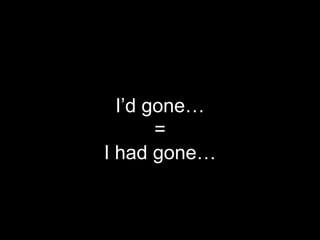
I’d gone…
I’d gone…
=
I had gone…
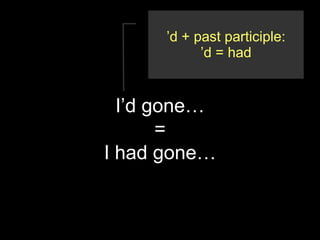
I’d gone…
=
I had gone…
’d + past participle:
’d = had
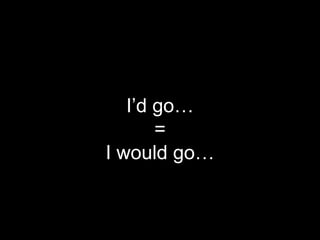
I’d go…
I’d go…
=
I would go…
I’d go…
=
I would go…
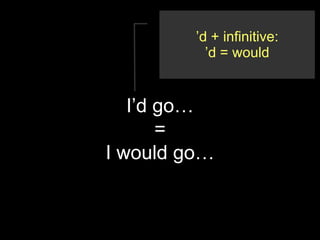
’d + infinitive:
’d = would
had or would
1. He’d say he wanted to stay.
2. He’d said he wanted to go.
3. I’d been there before.
4. I’d be the first to speak.
5. They’d taken the train.
6. They’d take everything!
7. She’d have to explain it to the police.
8. She’d had a fantastic evening.
had or would
1. He would say he wanted to stay.
2. He had said he wanted to go.
3. I had been there before.
4. I would be the first to speak.
5. They had taken the train.
6. They would take everything!
7. She would have to explain it to the police.
8. She had had a fantastic evening.
construction of the unreal past
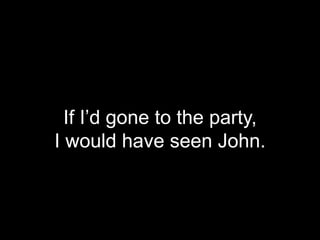
If I’d gone to the party,
I would have seen John.
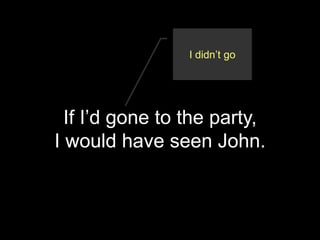
If I’d gone to the party,
I would have seen John.
I didn’t go
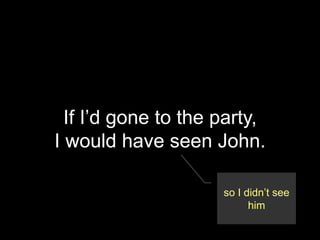
If I’d gone to the party,
I would have seen John.
so I didn’t see
him
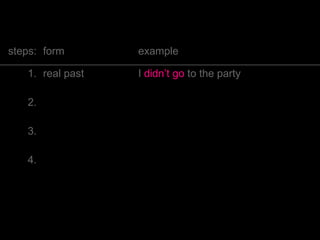
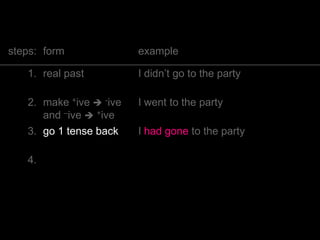
steps: form example
1. real past I didn’t go to the party
2. make +ive  -ive
and –ive  +ive
I went to the party
3. go 1 tense back I had gone to the party
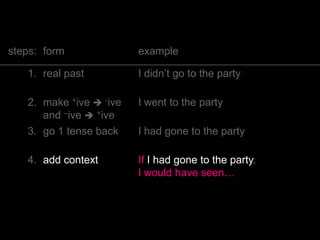
4. add context If I had gone to the party,
I would have seen…
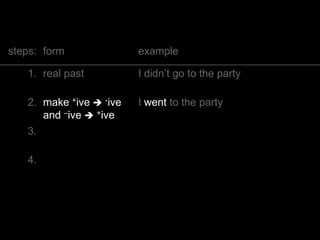
steps: form example
1. real past I didn’t go to the party
2. make +ive  -ive
and –ive  +ive
I went to the party
3. go 1 tense back I had gone to the party
4. add context If I had gone to the party,
I would have seen…
steps: form example
1. real past I didn’t go to the party
2. make +ive  -ive
and –ive  +ive
I went to the party
3. go 1 tense back I had gone to the party
4. add context If I had gone to the party,
I would have seen…
steps: form example
1. real past I didn’t go to the party
2. make +ive  -ive
and –ive  +ive
I went to the party
3. go 1 tense back I had gone to the party
4. add context If I had gone to the party,
I would have seen…
make some unreal pasts
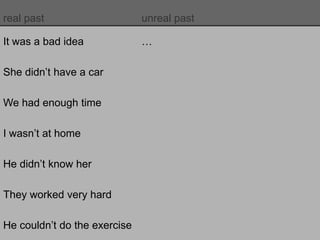
real past unreal past
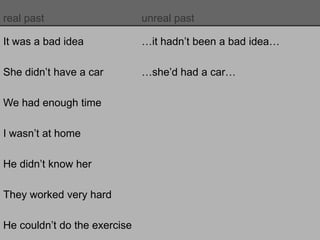
It was a bad idea …
She didn’t have a car
We had enough time
I wasn’t at home
He didn’t know her
They worked very hard
He couldn’t do the exercise
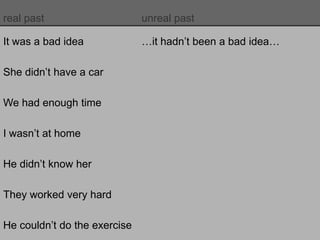
real past unreal past
It was a bad idea …it hadn’t been a bad idea…
She didn’t have a car
We had enough time
I wasn’t at home
He didn’t know her
They worked very hard
He couldn’t do the exercise
real past unreal past
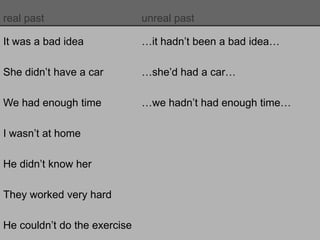
It was a bad idea …it hadn’t been a bad idea…
She didn’t have a car …she’d had a car…
We had enough time
I wasn’t at home
He didn’t know her
They worked very hard
He couldn’t do the exercise
real past unreal past
It was a bad idea …it hadn’t been a bad idea…
She didn’t have a car …she’d had a car…
We had enough time …we hadn’t had enough time…
I wasn’t at home
He didn’t know her
They worked very hard
He couldn’t do the exercise
real past unreal past
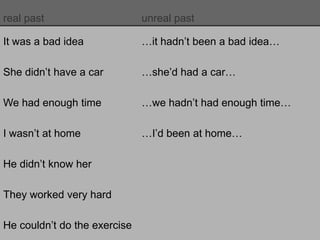
It was a bad idea …it hadn’t been a bad idea…
She didn’t have a car …she’d had a car…
We had enough time …we hadn’t had enough time…
I wasn’t at home …I’d been at home…
He didn’t know her
They worked very hard
He couldn’t do the exercise
real past unreal past
It was a bad idea …it hadn’t been a bad idea…
She didn’t have a car …she’d had a car…
We had enough time …we hadn’t had enough time…
I wasn’t at home …I’d been at home…
He didn’t know her …he’d known her…
They worked very hard
He couldn’t do the exercise
real past unreal past
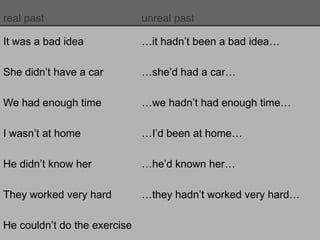
It was a bad idea …it hadn’t been a bad idea…
She didn’t have a car …she’d had a car…
We had enough time …we hadn’t had enough time…
I wasn’t at home …I’d been at home…
He didn’t know her …he’d known her…
They worked very hard …they hadn’t worked very hard…
He couldn’t do the exercise
real past unreal past
It was a bad idea …it hadn’t been a bad idea…
She didn’t have a car …she’d had a car…
We had enough time …we hadn’t had enough time…
I wasn’t at home …I’d been at home…
He didn’t know her …he’d known her…
They worked very hard …they hadn’t worked very hard…
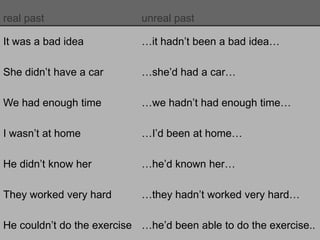
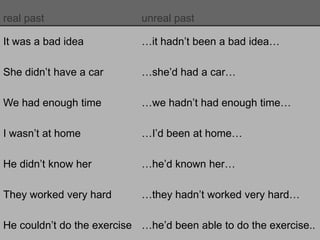
He couldn’t do the exercise …he’d been able to do the exercise..
now write some 3rd conditionals
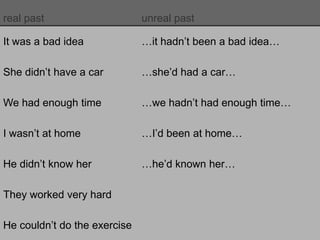
real past unreal past
It was a bad idea …it hadn’t been a bad idea…
She didn’t have a car …she’d had a car…
We had enough time …we hadn’t had enough time…
I wasn’t at home …I’d been at home…
He didn’t know her …he’d known her…
They worked very hard …they hadn’t worked very hard…
He couldn’t do the exercise …he’d been able to do the exercise..
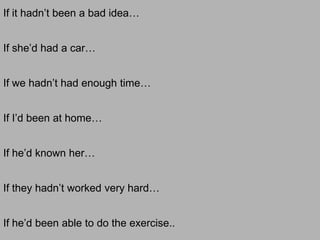
If it hadn’t been a bad idea…
If she’d had a car…
If we hadn’t had enough time…
If I’d been at home…
If he’d known her…
If they hadn’t worked very hard…
If he’d been able to do the exercise..
all the conditionals
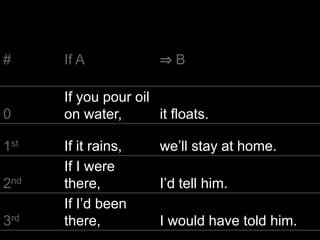
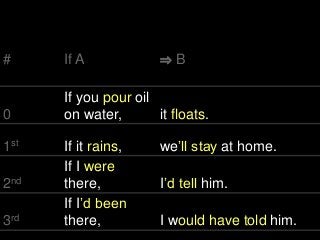
# If A ⇒ B
0
If you pour oil
on water, it floats.
1st If it rains, we’ll stay at home.
2nd
If I were
there, I’d tell him.
3rd
If I’d been
there, I would have told him.
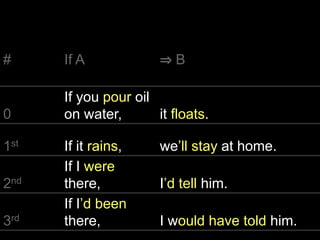
# If A ⇒ B
0
If you pour oil
on water, it floats.
1st If it rains, we’ll stay at home.
2nd
If I were
there, I’d tell him.
3rd
If I’d been
there, I would have told him.
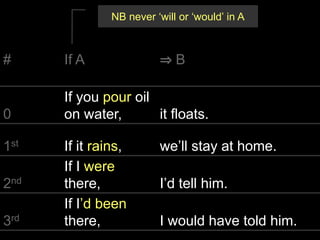
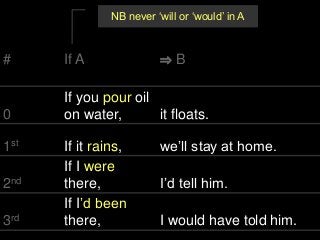
# If A ⇒ B
0
If you pour oil
on water, it floats.
1st If it rains, we’ll stay at home.
2nd
If I were
there, I’d tell him.
3rd
If I’d been
there, I would have told him.
NB never ‘will or ‘would’ in A
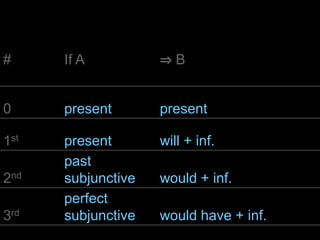
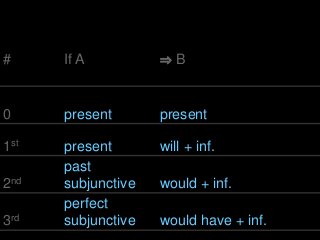
# If A ⇒ B
0 present present
1st present will + inf.
2nd
past
subjunctive would + inf.
3rd
perfect
subjunctive would have + inf.
module 7, parts 18, 19, 20
www.davidnicholson.it

Third conditional

  • 1.
  • 2.
  • 3.
    If it hadrained, we would have stayed at home.
  • 4.
    If A ⇒B if condition result If it had rained, we would have stayed at home.
  • 5.
    If A ⇒B if condition result If it had rained, we would have stayed at home. what tense is this?
  • 6.
    If A ⇒B if condition perfect subjunctive result If it had rained, we would have stayed at home.
  • 7.
    If A ⇒B if condition perfect subjunctive result If it had rained, we would have stayed at home. did it rain?
  • 8.
    If A ⇒B if condition perfect subjunctive result If it had rained, we would have stayed at home. and what tense is this?
  • 9.
    If A ⇒B if condition perfect subjunctive result would have (past cond.) If it had rained, we would have stayed at home.
  • 10.
    If A ⇒B if 3rd conditional condition perfect subjunctive result would have (past cond.) If it had rained, we would have stayed at home.
  • 11.
    If it hadrained, we would have stayed at home. NOT if it would have rained…
  • 12.
    the Past Perfect “Ihad already seen the film.” and the Perfect Subjunctive “If it had rained…” have exactly the same form
  • 13.
    the Past Perfect “Ihad already seen the film.” and the Perfect Subjunctive “If it had rained…” have exactly the same form no exceptions!
  • 14.
  • 15.
    If I hadknown, I would have called you. əʊ ɔː
  • 16.
    If I hadknown, I would have called you. əʊ ɔː
  • 17.
    If I hadknown, I would have called you. əʊ ɔː ə əə ɪ
  • 18.
    If I’d known, Iwould have called you. əʊ ɔː əə ɪ
  • 19.
    If I’d known, Iwould have called you. əʊ ɔː əə ɪ
  • 20.
    If I’d known, Iwould have called you. əʊ ɔː əə ɪ wədəv
  • 21.
  • 22.
  • 23.
  • 24.
    I’d gone… = I hadgone… ’d + past participle: ’d = had
  • 25.
  • 26.
  • 27.
    I’d go… = I wouldgo… ’d + infinitive: ’d = would
  • 28.
    had or would 1.He’d say he wanted to stay. 2. He’d said he wanted to go. 3. I’d been there before. 4. I’d be the first to speak. 5. They’d taken the train. 6. They’d take everything! 7. She’d have to explain it to the police. 8. She’d had a fantastic evening.
  • 29.
    had or would 1.He would say he wanted to stay. 2. He had said he wanted to go. 3. I had been there before. 4. I would be the first to speak. 5. They had taken the train. 6. They would take everything! 7. She would have to explain it to the police. 8. She had had a fantastic evening.
  • 30.
  • 31.
    If I’d goneto the party, I would have seen John.
  • 32.
    If I’d goneto the party, I would have seen John. I didn’t go
  • 33.
    If I’d goneto the party, I would have seen John. so I didn’t see him
  • 34.
    steps: form example 1.real past I didn’t go to the party 2. make +ive  -ive and –ive  +ive I went to the party 3. go 1 tense back I had gone to the party 4. add context If I had gone to the party, I would have seen…
  • 35.
    steps: form example 1.real past I didn’t go to the party 2. make +ive  -ive and –ive  +ive I went to the party 3. go 1 tense back I had gone to the party 4. add context If I had gone to the party, I would have seen…
  • 36.
    steps: form example 1.real past I didn’t go to the party 2. make +ive  -ive and –ive  +ive I went to the party 3. go 1 tense back I had gone to the party 4. add context If I had gone to the party, I would have seen…
  • 37.
    steps: form example 1.real past I didn’t go to the party 2. make +ive  -ive and –ive  +ive I went to the party 3. go 1 tense back I had gone to the party 4. add context If I had gone to the party, I would have seen…
  • 38.
  • 39.
    real past unrealpast It was a bad idea … She didn’t have a car We had enough time I wasn’t at home He didn’t know her They worked very hard He couldn’t do the exercise
  • 40.
    real past unrealpast It was a bad idea …it hadn’t been a bad idea… She didn’t have a car We had enough time I wasn’t at home He didn’t know her They worked very hard He couldn’t do the exercise
  • 41.
    real past unrealpast It was a bad idea …it hadn’t been a bad idea… She didn’t have a car …she’d had a car… We had enough time I wasn’t at home He didn’t know her They worked very hard He couldn’t do the exercise
  • 42.
    real past unrealpast It was a bad idea …it hadn’t been a bad idea… She didn’t have a car …she’d had a car… We had enough time …we hadn’t had enough time… I wasn’t at home He didn’t know her They worked very hard He couldn’t do the exercise
  • 43.
    real past unrealpast It was a bad idea …it hadn’t been a bad idea… She didn’t have a car …she’d had a car… We had enough time …we hadn’t had enough time… I wasn’t at home …I’d been at home… He didn’t know her They worked very hard He couldn’t do the exercise
  • 44.
    real past unrealpast It was a bad idea …it hadn’t been a bad idea… She didn’t have a car …she’d had a car… We had enough time …we hadn’t had enough time… I wasn’t at home …I’d been at home… He didn’t know her …he’d known her… They worked very hard He couldn’t do the exercise
  • 45.
    real past unrealpast It was a bad idea …it hadn’t been a bad idea… She didn’t have a car …she’d had a car… We had enough time …we hadn’t had enough time… I wasn’t at home …I’d been at home… He didn’t know her …he’d known her… They worked very hard …they hadn’t worked very hard… He couldn’t do the exercise
  • 46.
    real past unrealpast It was a bad idea …it hadn’t been a bad idea… She didn’t have a car …she’d had a car… We had enough time …we hadn’t had enough time… I wasn’t at home …I’d been at home… He didn’t know her …he’d known her… They worked very hard …they hadn’t worked very hard… He couldn’t do the exercise …he’d been able to do the exercise..
  • 47.
    now write some3rd conditionals
  • 48.
    real past unrealpast It was a bad idea …it hadn’t been a bad idea… She didn’t have a car …she’d had a car… We had enough time …we hadn’t had enough time… I wasn’t at home …I’d been at home… He didn’t know her …he’d known her… They worked very hard …they hadn’t worked very hard… He couldn’t do the exercise …he’d been able to do the exercise..
  • 49.
    If it hadn’tbeen a bad idea… If she’d had a car… If we hadn’t had enough time… If I’d been at home… If he’d known her… If they hadn’t worked very hard… If he’d been able to do the exercise..
  • 50.
  • 51.
    # If A⇒ B 0 If you pour oil on water, it floats. 1st If it rains, we’ll stay at home. 2nd If I were there, I’d tell him. 3rd If I’d been there, I would have told him.
  • 52.
    # If A⇒ B 0 If you pour oil on water, it floats. 1st If it rains, we’ll stay at home. 2nd If I were there, I’d tell him. 3rd If I’d been there, I would have told him.
  • 53.
    # If A⇒ B 0 If you pour oil on water, it floats. 1st If it rains, we’ll stay at home. 2nd If I were there, I’d tell him. 3rd If I’d been there, I would have told him. NB never ‘will or ‘would’ in A
  • 54.
    # If A⇒ B 0 present present 1st present will + inf. 2nd past subjunctive would + inf. 3rd perfect subjunctive would have + inf.
  • 56.
    module 7, parts18, 19, 20
  • 57.