8

Respiratory
Emergencies
Anas Bahnassi PhD
Anas Bahnassi PhD CDM CDE

2
Respiratory System:
• The primary function of the respiratory system is to
supply the blood with oxygen in order for the blood
to deliver oxygen to all parts of the body.
• Respiration is achieved through the mouth, nose,
trachea, lungs, and diaphragm.
• Oxygen enters through the mouth and the nose.
• The oxygen then passes through the larynx and the
trachea which is a tube that enters the chest cavity.
• The trachea splits into two smaller tubes called the
bronchi.
• Each bronchus then divides again forming the bronchial tubes. These divide
into many smaller tubes which connect to tiny sacs called alveoli.
• The inhaled oxygen passes into the alveoli and then diffuses through the
capillaries into the arterial blood.
• The waste-rich blood from the veins releases its carbon dioxide into the
alveoli.
Anas Bahnassi PhD CDM CDE

3
Respiratory System:
Adequate Breathing Rates:

o Adults
o Children
o Infant
Anas Bahnassi PhD CDM CDE

12-20/min.
15-30/min.
25-50/min.
4
Adequate breathing:
o Usually regular rhythm
o Rhythm may be slightly
irregular influenced by
talking
o Breath sounds are present
and equal.
o Chest expansion is
adequate and equal.
o Minimal effort.
o Adequate tidal volume.
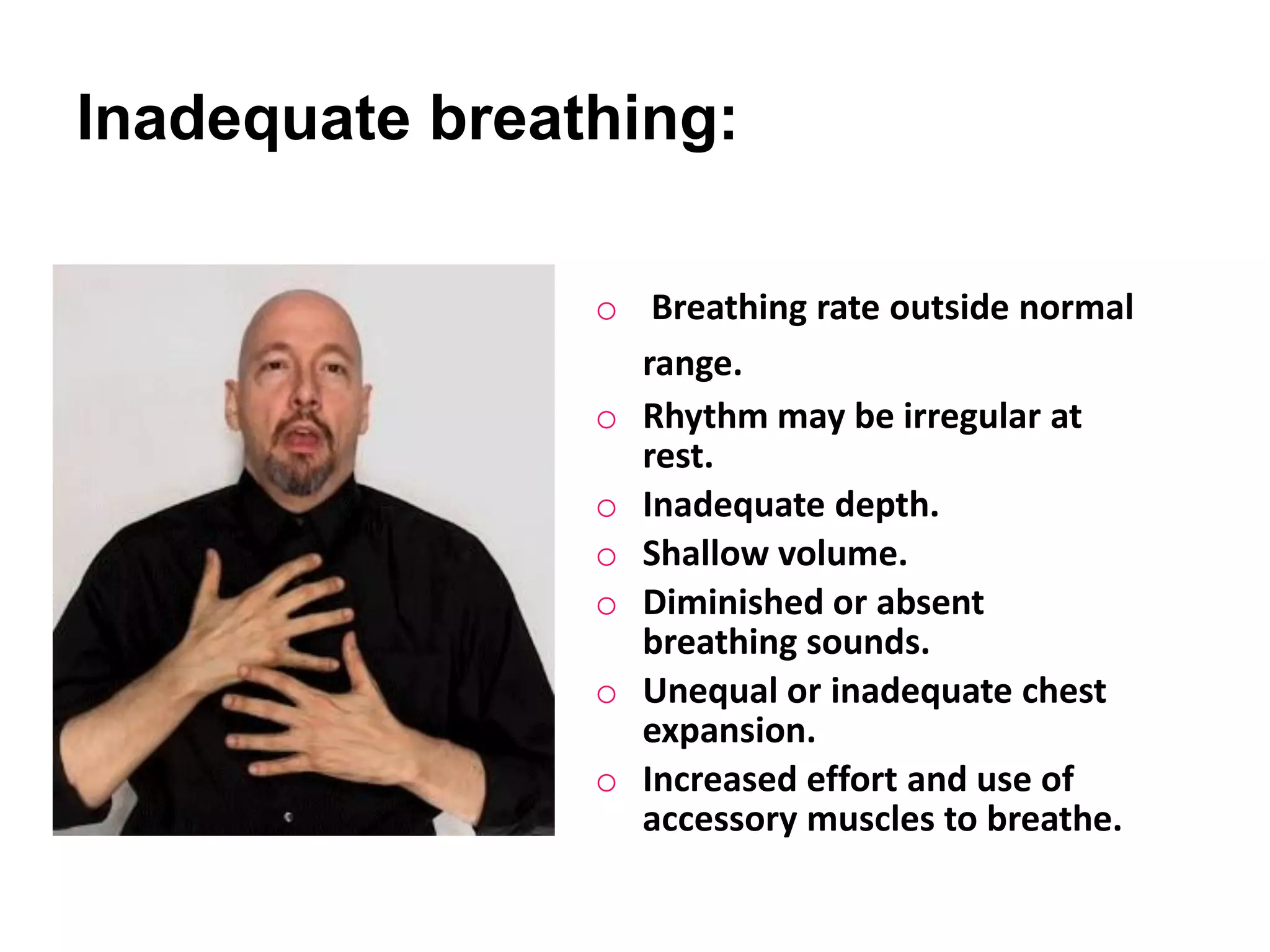
Inadequate breathing:
o Breathing rate outside normal
range.
o Rhythm may be irregular at
rest.
o Inadequate depth.
o Shallow volume.
o Diminished or absent
breathing sounds.
o Unequal or inadequate chest
expansion.
o Increased effort and use of
accessory muscles to breathe.
Inadequate breathing:

o Pale or blue skin.
o Cool clammy skin.
o Occasional gasp.
Respiratory Emergencies:
Primary Assessment:
Scene Size-up:
Scene safety:
1. Ensure safe access to patient.
2. Consider that the patient may
be in distress because of
exposure to toxic materials.
3. Use a HEPA respirator if there is
evidence of communicable
diseases.
4. Assess the need for additional
resources.
Anas Bahnassi PhD CDM CDE

8
Respiratory Emergencies:
Primary Assessment:
Scene Size-up:

Mechanism of Injury:
1. Observe the scene and look for
possible MoI.
2. Ensure that the RE is not a
result of traumatic injury.
3. Question the patient, family
members, or bystanders for
possible MoI.
4. Observe for signs of urticaria,
chest pain, and fever.
Anas Bahnassi PhD CDM CDE

9
Respiratory Emergencies:
Primary Assessment:
Form a general impression:
1. Perform a rapid scan to the
patient.
2. Is the patient in a tripod
position?
3. Does the patient have a barrel
chest?
4. AVPU?
5. Set priorities depending on
MoI.
6. Call emergency…
Anas Bahnassi PhD CDM CDE

10
Respiratory Emergencies:
Primary Assessment:
Airway and Breathing:
1. Ensure airways are open.
2. If closed open using jaw thrust.
3. A person with altered level of
consciousness, may need
emergency help.
4. Consider nasopharyngeal or
oropharyngeal airway.
5. Assess for gurgling or stridor.
6. Suction as needed.
Anas Bahnassi PhD CDM CDE

11
Respiratory Emergencies:
Primary Assessment:
Airway and Breathing:
1. Evaluate the patient’s ventilatory status for rate,
depth, effort, and tidal volume.
2. Inspect the chest for DCAP-BTLS
1. Deformities
2. Contustions
3. Abrasions
Determine if the
4. Punctures/Penetrations
breathing is adequate
5. Burns
or not…
6. Tenderness
7. Lacerations
8. Swelling
Anas Bahnassi PhD CDM CDE

12
Respiratory Emergencies:
Primary Assessment:
Circulation:
1. Evaluate distal pulse rate, strength, and rhythm.
2. Tachycardia
 respiratory distress.
 shock.
3. Bradycardia
 possible cardiac emergency.
 medication reaction or poisoning.
4. Observe skin color, temperature, and condition.
5. Look for life-threatening bleeding and treat accordingly.
6. Transport of O2 may be reduced due to lack or RBC.
7. If distal pulse is not palpable, assess central pulse.
Anas Bahnassi PhD CDM CDE

13
Respiratory Emergencies:
Primary Assessment:
Transport Decision:

Airway or
Breathing
Problem?

Lifethreat?

Internal
Bleeding?

Anas Bahnassi PhD CDM CDE

14
Respiratory Emergencies:
History Taking:
Investigate the chief complaint:
1. Monitor patient for mental changes.
2. Ask OPQRST, and SAMPLE
questions.
3. Identify pertinent negatives.
4. Has the patient done anything for
their breathing problem?
5. If inhaler was used, how many
does?
6. Is the patient coughing?
7. Can he sleep lying down?
Anas Bahnassi PhD CDM CDE

15
Respiratory Emergencies:
Secondary Assessment:
Physical Exam:
1.
2.
3.
4.
5.
6.
7.
8.

Perform Head-to-Toe exam.
Check for DCAP-BTLS.
Focus on respiratory efforts, and respiratory adequacy.
The sounds you hear when you auscultate will help you
determine lung function.
Accessory muscle use, nasal flaring, pursed lips,
confusion, and tachypnea are signs of respiratory distress.
Look for hives.
Examine skin color, cyanosis is a sign of hypoxia.
Monitor mental status.
Anas Bahnassi PhD CDM CDE

16
Respiratory Emergencies:
Secondary Assessment:
Vital signs:
1. Obtain baseline vital signs.
2. Repeat every 5-15 mins.
3. Vital signs should include BP by
ausculation, pulse rate and quality,
respiration rate and quality, and
skin assessment for perfusion.
4. Level of concousness.
5. Pulse oximeter to determine
perfusion status.
Anas Bahnassi PhD CDM CDE

17
Respiratory Emergencies:
Reassessment:
Interventions:
1. Reassess the primary examination,
vital signs, and chief complaint.
2. Assist breathing as required.
3. Administer high flow O2.
4. Assist patient with prescribed meds.
5. Check interventions rendered.
6. Be prepared to modify treatment.
7. Support the cardio-vascular system.
8. Do not delay transport.
Anas Bahnassi PhD CDM CDE

18
Respiratory Emergencies:
General Management of RE:
1. Managing life-threatening ABCs and
ensuring high flow O2 delivery are
the major concerns.
2. Patients breathing with less than 8
breaths/min or more than 30
breaths/min should have
ventilations assisted with a bagmask device.
3. Continually assess mental health.
4. Transport in the position of comfort.
5. Use precautions (HEPA mask).
Anas Bahnassi PhD CDM CDE

19
Respiratory Emergencies:
Upper or lower airway infections:
1. Dyspnea may be from croup or epiglottitis.
2. Patient should receive humidified O2 if
available,
3. Patient sitting forward, seem lethargic, or
are drooling may have epiglottitis.
4. Don’t force patient to lie down or to insert
an oropharyngeal tube. It may cause spasm
and complete obstriction. Transport rapidly.
5. In lower infections, provide O2, monitor
signs, and transport to hospital
Anas Bahnassi PhD CDM CDE

20
Respiratory Emergencies:
Acute pulmonary edema:
1. Congestive heart failure or toxic inhalation
may cause pulmonary edema.
2. Place the patient in position of comfort
(sitting-up).
3. Administer high flow O2.
4. Provide ventilatory support and suction.
5. Continuous positive air can be provided.
6. Transport quickly to hospital.

Anas Bahnassi PhD CDM CDE

21
Respiratory Emergencies:
COPD:
1. Patient maybe semiconscious or unconscious due to
hypoxia.
2. They may appear to have respiratory distress or
cyanotic.
3. They may have pursed lips and may be using
accessory muscles to breathe (shoulders and neck).
4. Assist with patient’s prescribed inhaler. Document
time and effect of each use.
5. Many may overuse their inhalers.
6. Keep patient in sit-upright position.
7. Treat with full-flow oxygen using a non-rebreathing
mask.
Anas Bahnassi PhD CDM CDE

22
Respiratory Emergencies:
Asthma, hay fever, and anaphylaxis:
1. Not all wheezing is related to asthma….
2. If patient is asthmatic help with
inhaler/nebulizer.
3. Hay fever requires support. If
accompanied with cold symptoms,
oxygen might be needed.
4. Anaphylaxis is a true emergency that
requires transporting the patient to the
hospital.
5. Use epinephrine shot if the patient was prescribed it.
6. Inject the epinephrine in the thigh at 90° angle.
Anas Bahnassi PhD CDM CDE

23
Respiratory Emergencies:
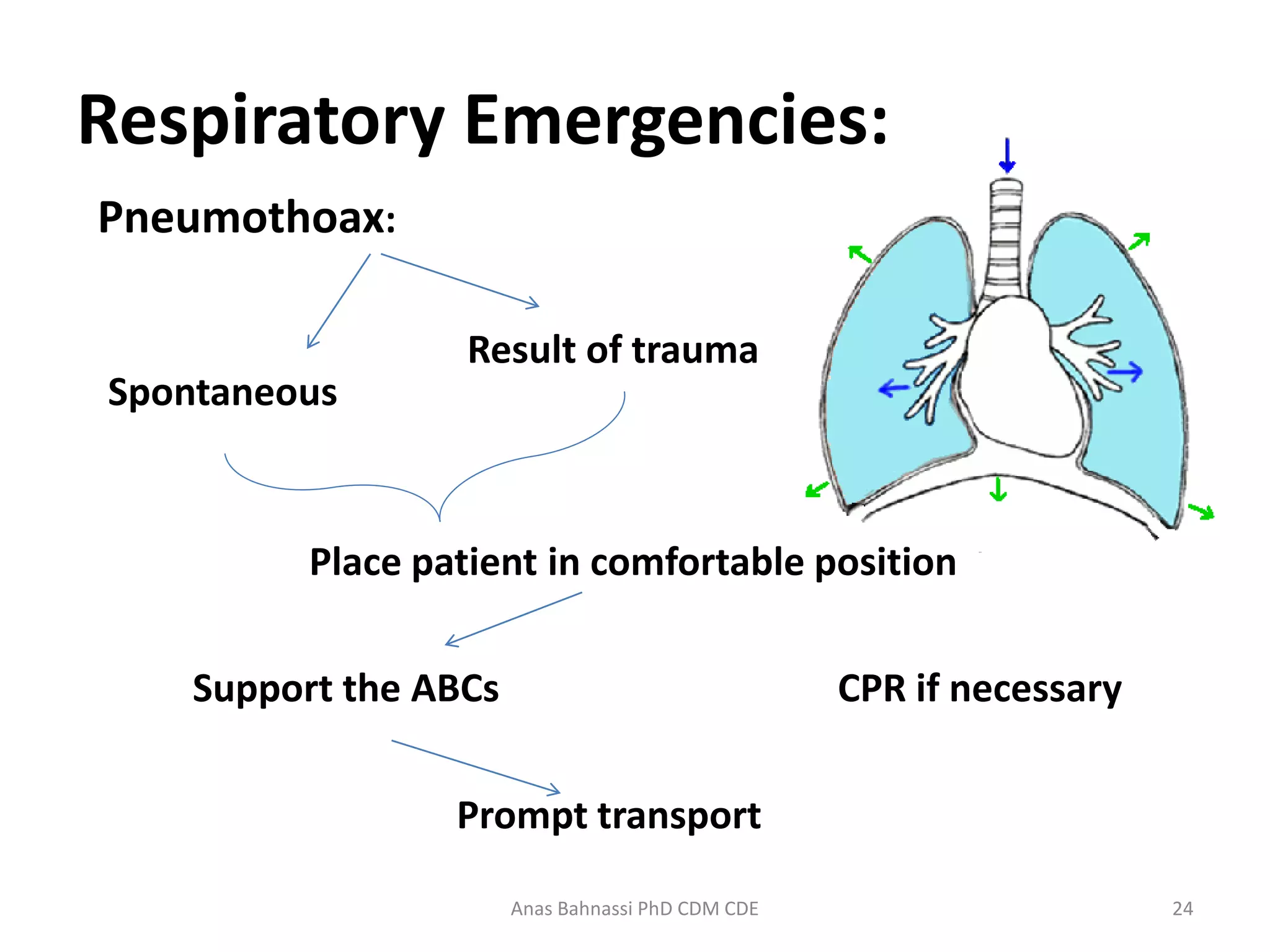
Pneumothoax:
Result of trauma

Spontaneous

Place patient in comfortable position
Support the ABCs

CPR if necessary

Prompt transport
Anas Bahnassi PhD CDM CDE

24
Respiratory Emergencies:
Pleural effusion:

Removal of fluid collected outside the
Lungs.
Provide Oxygen
Support the ABCs
Prompt transport
Anas Bahnassi PhD CDM CDE

25
Respiratory Emergencies:
Airway obstruction:
Use age-appropriate foreign body to
maneuver and clear the airway.
Provide Oxygen
Prompt transport

Anas Bahnassi PhD CDM CDE

26
Respiratory Emergencies:
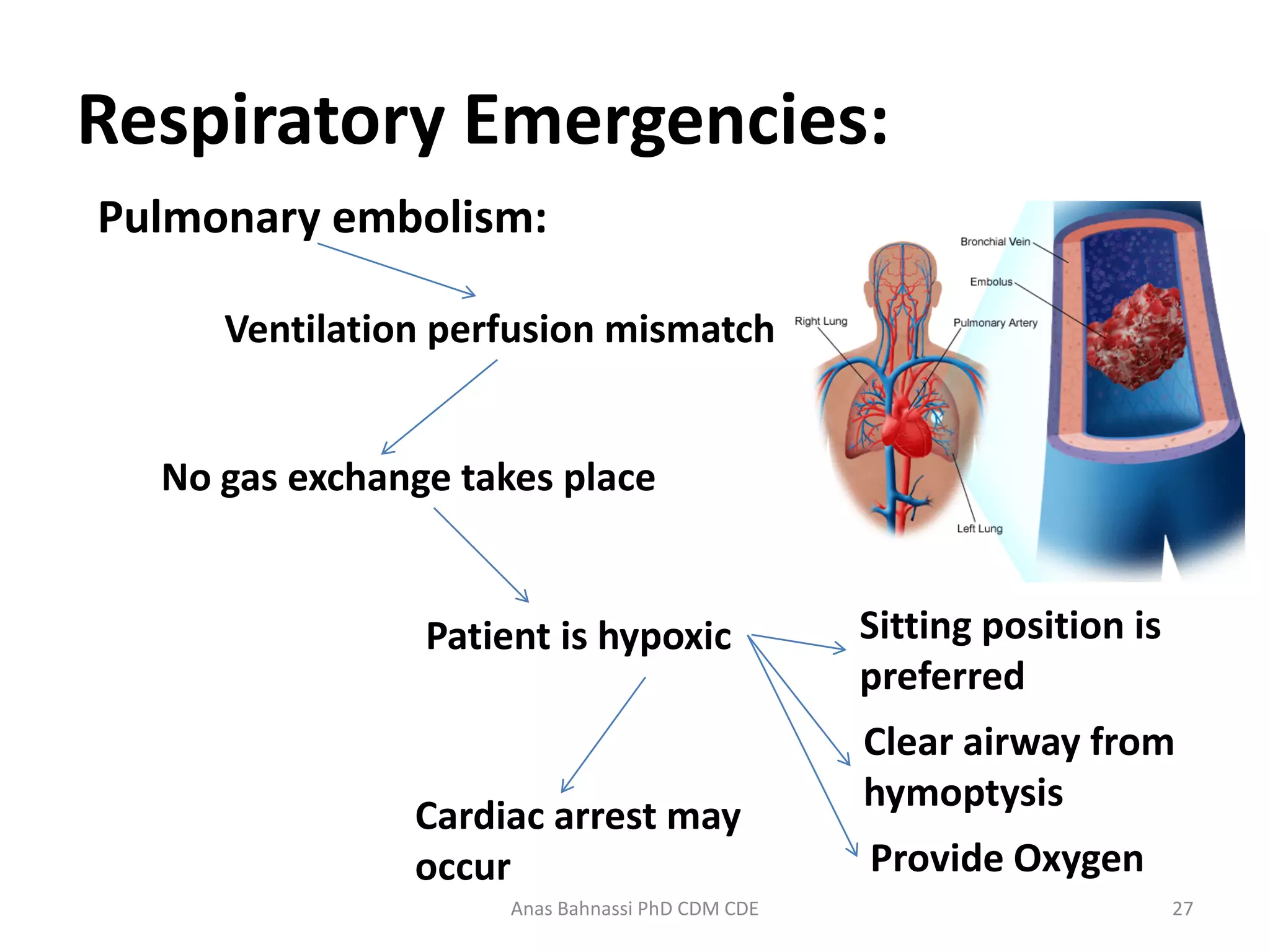
Pulmonary embolism:
Ventilation perfusion mismatch

No gas exchange takes place

Patient is hypoxic

Cardiac arrest may
occur
Anas Bahnassi PhD CDM CDE

Sitting position is
preferred
Clear airway from
hymoptysis
Provide Oxygen
27
Respiratory Emergencies:
Hyperventilation:
Investigate history to determine
cause
Don’t have the patient breathe into
paper bag

Reassure patient
Provide Oxygen

Prompt transport
Anas Bahnassi PhD CDM CDE

28
Clinical Pharmacy VI:
First Aid
Anas Bahnassi PhD CDM CDE
abahnassi@gmail.com
http://www.twitter.com/abpharm

http://www.facebook.com/pharmaprof
http://www.linkedin.com/in/abahnassi

First Aid: Respiratory Emeregencies

  • 1.
  • 2.
  • 3.
    Respiratory System: • Theprimary function of the respiratory system is to supply the blood with oxygen in order for the blood to deliver oxygen to all parts of the body. • Respiration is achieved through the mouth, nose, trachea, lungs, and diaphragm. • Oxygen enters through the mouth and the nose. • The oxygen then passes through the larynx and the trachea which is a tube that enters the chest cavity. • The trachea splits into two smaller tubes called the bronchi. • Each bronchus then divides again forming the bronchial tubes. These divide into many smaller tubes which connect to tiny sacs called alveoli. • The inhaled oxygen passes into the alveoli and then diffuses through the capillaries into the arterial blood. • The waste-rich blood from the veins releases its carbon dioxide into the alveoli. Anas Bahnassi PhD CDM CDE 3
  • 4.
    Respiratory System: Adequate BreathingRates: o Adults o Children o Infant Anas Bahnassi PhD CDM CDE 12-20/min. 15-30/min. 25-50/min. 4
  • 5.
    Adequate breathing: o Usuallyregular rhythm o Rhythm may be slightly irregular influenced by talking o Breath sounds are present and equal. o Chest expansion is adequate and equal. o Minimal effort. o Adequate tidal volume.
  • 6.
    Inadequate breathing: o Breathingrate outside normal range. o Rhythm may be irregular at rest. o Inadequate depth. o Shallow volume. o Diminished or absent breathing sounds. o Unequal or inadequate chest expansion. o Increased effort and use of accessory muscles to breathe.
  • 7.
    Inadequate breathing: o Paleor blue skin. o Cool clammy skin. o Occasional gasp.
  • 8.
    Respiratory Emergencies: Primary Assessment: SceneSize-up: Scene safety: 1. Ensure safe access to patient. 2. Consider that the patient may be in distress because of exposure to toxic materials. 3. Use a HEPA respirator if there is evidence of communicable diseases. 4. Assess the need for additional resources. Anas Bahnassi PhD CDM CDE 8
  • 9.
    Respiratory Emergencies: Primary Assessment: SceneSize-up: Mechanism of Injury: 1. Observe the scene and look for possible MoI. 2. Ensure that the RE is not a result of traumatic injury. 3. Question the patient, family members, or bystanders for possible MoI. 4. Observe for signs of urticaria, chest pain, and fever. Anas Bahnassi PhD CDM CDE 9
  • 10.
    Respiratory Emergencies: Primary Assessment: Forma general impression: 1. Perform a rapid scan to the patient. 2. Is the patient in a tripod position? 3. Does the patient have a barrel chest? 4. AVPU? 5. Set priorities depending on MoI. 6. Call emergency… Anas Bahnassi PhD CDM CDE 10
  • 11.
    Respiratory Emergencies: Primary Assessment: Airwayand Breathing: 1. Ensure airways are open. 2. If closed open using jaw thrust. 3. A person with altered level of consciousness, may need emergency help. 4. Consider nasopharyngeal or oropharyngeal airway. 5. Assess for gurgling or stridor. 6. Suction as needed. Anas Bahnassi PhD CDM CDE 11
  • 12.
    Respiratory Emergencies: Primary Assessment: Airwayand Breathing: 1. Evaluate the patient’s ventilatory status for rate, depth, effort, and tidal volume. 2. Inspect the chest for DCAP-BTLS 1. Deformities 2. Contustions 3. Abrasions Determine if the 4. Punctures/Penetrations breathing is adequate 5. Burns or not… 6. Tenderness 7. Lacerations 8. Swelling Anas Bahnassi PhD CDM CDE 12
  • 13.
    Respiratory Emergencies: Primary Assessment: Circulation: 1.Evaluate distal pulse rate, strength, and rhythm. 2. Tachycardia  respiratory distress.  shock. 3. Bradycardia  possible cardiac emergency.  medication reaction or poisoning. 4. Observe skin color, temperature, and condition. 5. Look for life-threatening bleeding and treat accordingly. 6. Transport of O2 may be reduced due to lack or RBC. 7. If distal pulse is not palpable, assess central pulse. Anas Bahnassi PhD CDM CDE 13
  • 14.
    Respiratory Emergencies: Primary Assessment: TransportDecision: Airway or Breathing Problem? Lifethreat? Internal Bleeding? Anas Bahnassi PhD CDM CDE 14
  • 15.
    Respiratory Emergencies: History Taking: Investigatethe chief complaint: 1. Monitor patient for mental changes. 2. Ask OPQRST, and SAMPLE questions. 3. Identify pertinent negatives. 4. Has the patient done anything for their breathing problem? 5. If inhaler was used, how many does? 6. Is the patient coughing? 7. Can he sleep lying down? Anas Bahnassi PhD CDM CDE 15
  • 16.
    Respiratory Emergencies: Secondary Assessment: PhysicalExam: 1. 2. 3. 4. 5. 6. 7. 8. Perform Head-to-Toe exam. Check for DCAP-BTLS. Focus on respiratory efforts, and respiratory adequacy. The sounds you hear when you auscultate will help you determine lung function. Accessory muscle use, nasal flaring, pursed lips, confusion, and tachypnea are signs of respiratory distress. Look for hives. Examine skin color, cyanosis is a sign of hypoxia. Monitor mental status. Anas Bahnassi PhD CDM CDE 16
  • 17.
    Respiratory Emergencies: Secondary Assessment: Vitalsigns: 1. Obtain baseline vital signs. 2. Repeat every 5-15 mins. 3. Vital signs should include BP by ausculation, pulse rate and quality, respiration rate and quality, and skin assessment for perfusion. 4. Level of concousness. 5. Pulse oximeter to determine perfusion status. Anas Bahnassi PhD CDM CDE 17
  • 18.
    Respiratory Emergencies: Reassessment: Interventions: 1. Reassessthe primary examination, vital signs, and chief complaint. 2. Assist breathing as required. 3. Administer high flow O2. 4. Assist patient with prescribed meds. 5. Check interventions rendered. 6. Be prepared to modify treatment. 7. Support the cardio-vascular system. 8. Do not delay transport. Anas Bahnassi PhD CDM CDE 18
  • 19.
    Respiratory Emergencies: General Managementof RE: 1. Managing life-threatening ABCs and ensuring high flow O2 delivery are the major concerns. 2. Patients breathing with less than 8 breaths/min or more than 30 breaths/min should have ventilations assisted with a bagmask device. 3. Continually assess mental health. 4. Transport in the position of comfort. 5. Use precautions (HEPA mask). Anas Bahnassi PhD CDM CDE 19
  • 20.
    Respiratory Emergencies: Upper orlower airway infections: 1. Dyspnea may be from croup or epiglottitis. 2. Patient should receive humidified O2 if available, 3. Patient sitting forward, seem lethargic, or are drooling may have epiglottitis. 4. Don’t force patient to lie down or to insert an oropharyngeal tube. It may cause spasm and complete obstriction. Transport rapidly. 5. In lower infections, provide O2, monitor signs, and transport to hospital Anas Bahnassi PhD CDM CDE 20
  • 21.
    Respiratory Emergencies: Acute pulmonaryedema: 1. Congestive heart failure or toxic inhalation may cause pulmonary edema. 2. Place the patient in position of comfort (sitting-up). 3. Administer high flow O2. 4. Provide ventilatory support and suction. 5. Continuous positive air can be provided. 6. Transport quickly to hospital. Anas Bahnassi PhD CDM CDE 21
  • 22.
    Respiratory Emergencies: COPD: 1. Patientmaybe semiconscious or unconscious due to hypoxia. 2. They may appear to have respiratory distress or cyanotic. 3. They may have pursed lips and may be using accessory muscles to breathe (shoulders and neck). 4. Assist with patient’s prescribed inhaler. Document time and effect of each use. 5. Many may overuse their inhalers. 6. Keep patient in sit-upright position. 7. Treat with full-flow oxygen using a non-rebreathing mask. Anas Bahnassi PhD CDM CDE 22
  • 23.
    Respiratory Emergencies: Asthma, hayfever, and anaphylaxis: 1. Not all wheezing is related to asthma…. 2. If patient is asthmatic help with inhaler/nebulizer. 3. Hay fever requires support. If accompanied with cold symptoms, oxygen might be needed. 4. Anaphylaxis is a true emergency that requires transporting the patient to the hospital. 5. Use epinephrine shot if the patient was prescribed it. 6. Inject the epinephrine in the thigh at 90° angle. Anas Bahnassi PhD CDM CDE 23
  • 24.
    Respiratory Emergencies: Pneumothoax: Result oftrauma Spontaneous Place patient in comfortable position Support the ABCs CPR if necessary Prompt transport Anas Bahnassi PhD CDM CDE 24
  • 25.
    Respiratory Emergencies: Pleural effusion: Removalof fluid collected outside the Lungs. Provide Oxygen Support the ABCs Prompt transport Anas Bahnassi PhD CDM CDE 25
  • 26.
    Respiratory Emergencies: Airway obstruction: Useage-appropriate foreign body to maneuver and clear the airway. Provide Oxygen Prompt transport Anas Bahnassi PhD CDM CDE 26
  • 27.
    Respiratory Emergencies: Pulmonary embolism: Ventilationperfusion mismatch No gas exchange takes place Patient is hypoxic Cardiac arrest may occur Anas Bahnassi PhD CDM CDE Sitting position is preferred Clear airway from hymoptysis Provide Oxygen 27
  • 28.
    Respiratory Emergencies: Hyperventilation: Investigate historyto determine cause Don’t have the patient breathe into paper bag Reassure patient Provide Oxygen Prompt transport Anas Bahnassi PhD CDM CDE 28
  • 29.
    Clinical Pharmacy VI: FirstAid Anas Bahnassi PhD CDM CDE abahnassi@gmail.com http://www.twitter.com/abpharm http://www.facebook.com/pharmaprof http://www.linkedin.com/in/abahnassi