By
Mr. M. Shivanandha Reddy
EXERCISE - Definition
Exercise is physical activity for
conditioning the body, improving health,
and maintaining fitness.
Benefits of Physical Exercise
1. Improved cardiopulmonary function
2. Reduced blood pressure
3. Increased muscle tone and strength
4. Greater physical endurance
5. Increased weight loss
6. Reduced blood glucose level
Benefits of Physical Exercise
7. Decreased low-density blood lipids
8. Improved physical appearance
9. Increased bone density
10.Regularity of bowel elimination
11. Promotion of sleep
12.Reduced tension and depression
CLASSIFICATION OF EXERCISE
EXERCISE
BASED ON
MUSCLE
CONTRACTION
ISOTONIC
ISOMETRIC
ISOKINETIC
BASED ON
SOURCE OF
ENERGY
ACTIVE
PASSIVE
BASED ON MUSCLE CONTRACTION
Isotonic exercise :
cause muscle contraction and active movement.
Example: walking, aerobics, moving arms &
Legs.
Isometric exercise:
tightening or tensing of muscles without
shortening (there is no movement). This
increases muscle tension but do not change
the length of muscle fibers.
Example: contraction of gluteal muscles.
BASED ON MUSCLE CONTRACTION
Isokinetic Exercise:
Involves muscle contractions with
resistance.
Resistance is provided by an external source
Example: movement of leg against
resistance.
BASED ON SOURCE OF ENERGY
• Active exercise is therapeutic activity
that the client performs independently.
• Passive exercise is therapeutic activity
that the client performs with assistance
and is provided when a client cannot move
one or more parts of the body.
Range Of Motion Exercises
Definition:
The movement of a joint to the
extent possible without causing pain
Purposes:
• Promote and maintain joint mobility
• Prevent contractures and shortening of
muscles and tendons
• Increase circulation to extremities.
• Facilitate comfort for the patient
Contraindications To ROM
• Any illness/disorder where increased use
of energy or increased circulation is
hazardous.
• Example: Myocardial infarction.
swollen, inflamed joints
Types Of ROM Exercises
• Active ROM exercises – Exercises the
client is able to perform independently.
• Passive ROM exercises – Exercises
performed for the client by someone else.
• Active assisted ROM exercises –
Performed by a client with some assistance.
Client can move a limb partially through its
ROM, but needs help completing the ROM.
Guidelines For Performing ROM Exercises
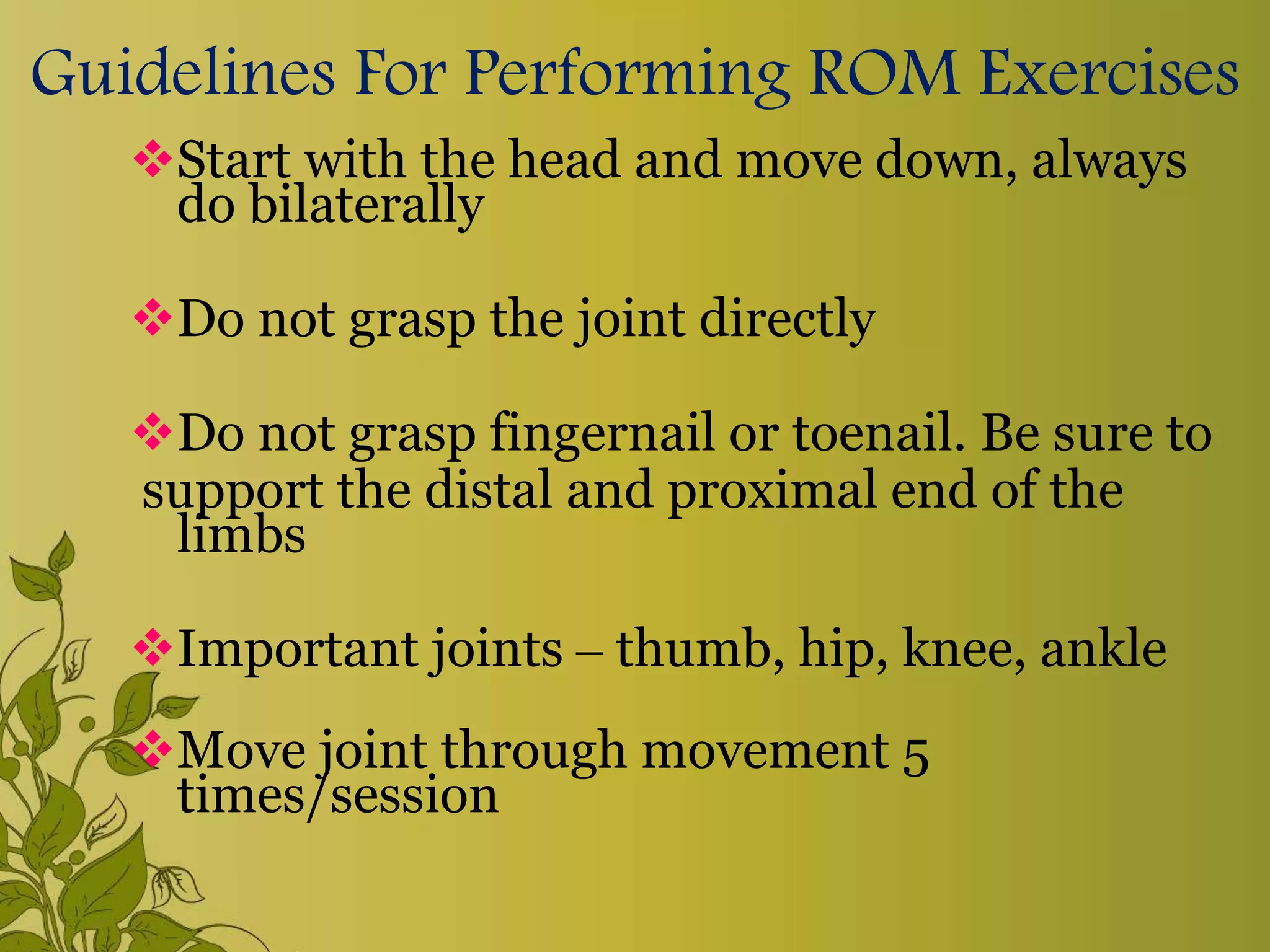
Start with the head and move down, always
do bilaterally
Do not grasp the joint directly
Do not grasp fingernail or toenail. Be sure to
support the distal and proximal end of the
limbs
Important joints – thumb, hip, knee, ankle
Move joint through movement 5
times/session
Guidelines For Performing ROM Exercises
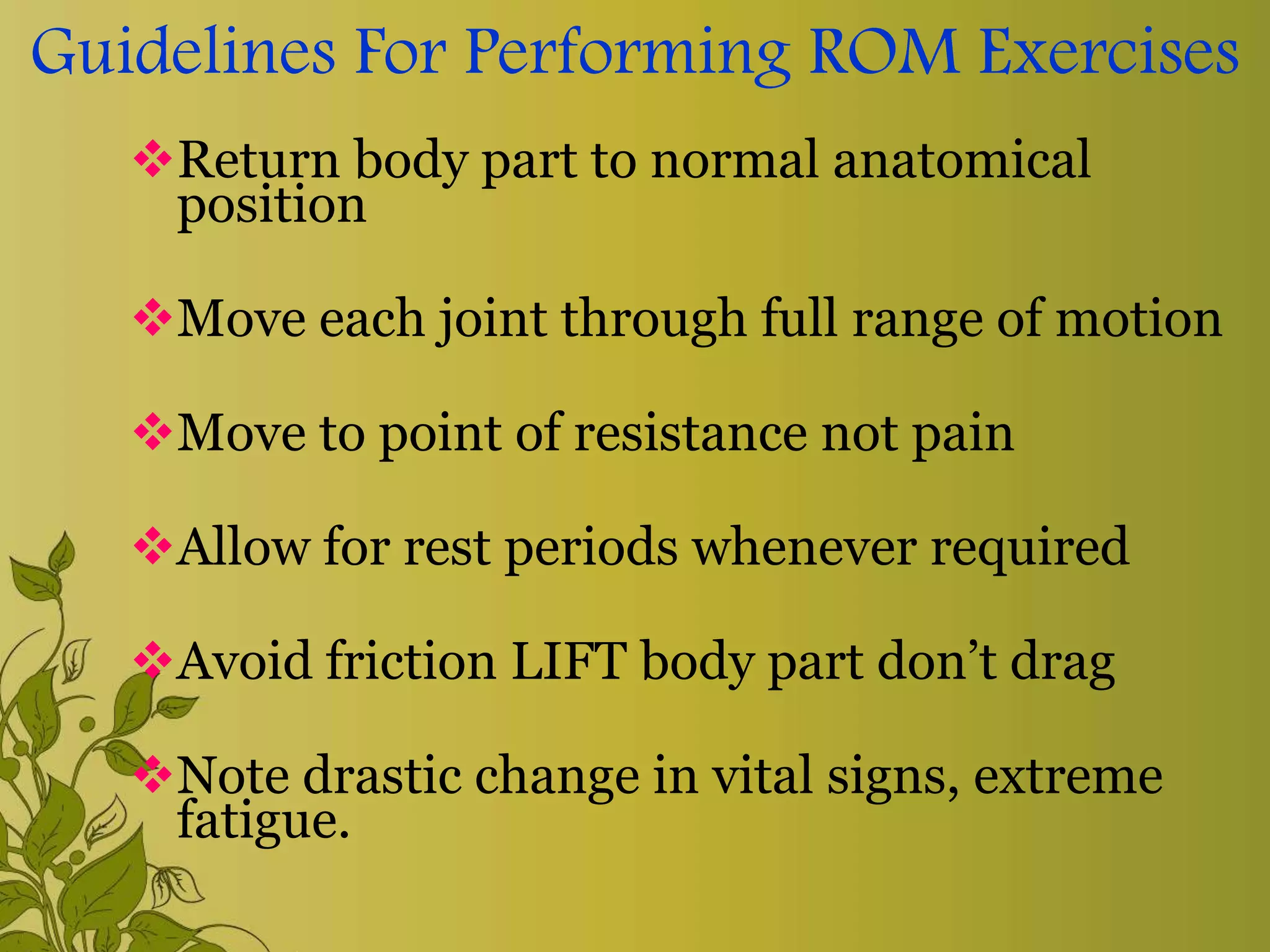
Return body part to normal anatomical
position
Move each joint through full range of motion
Move to point of resistance not pain
Allow for rest periods whenever required
Avoid friction LIFT body part don’t drag
Note drastic change in vital signs, extreme
fatigue.
Guidelines For Performing ROM Exercises
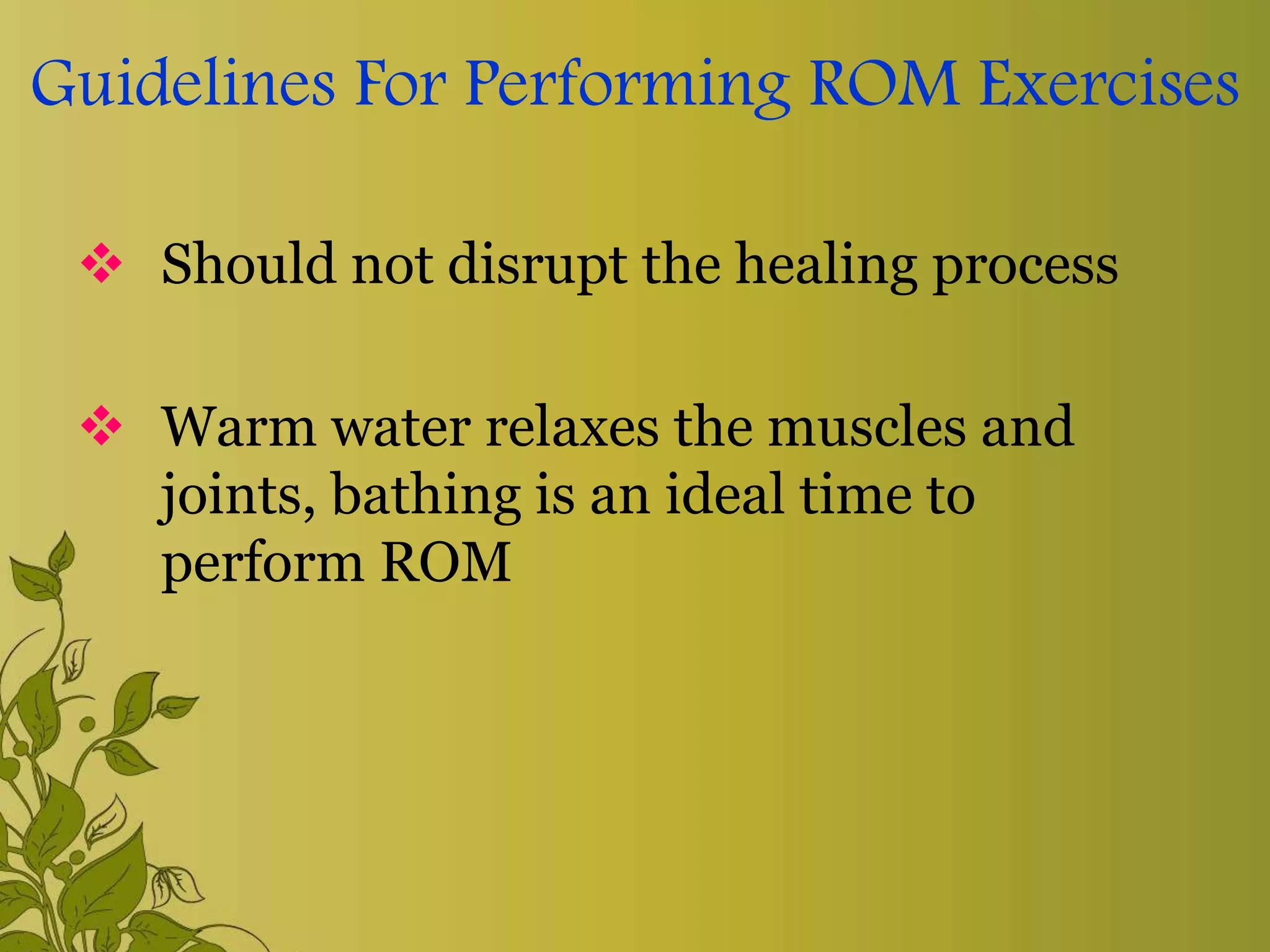
 Should not disrupt the healing process
 Warm water relaxes the muscles and
joints, bathing is an ideal time to
perform ROM
Patient Preparation
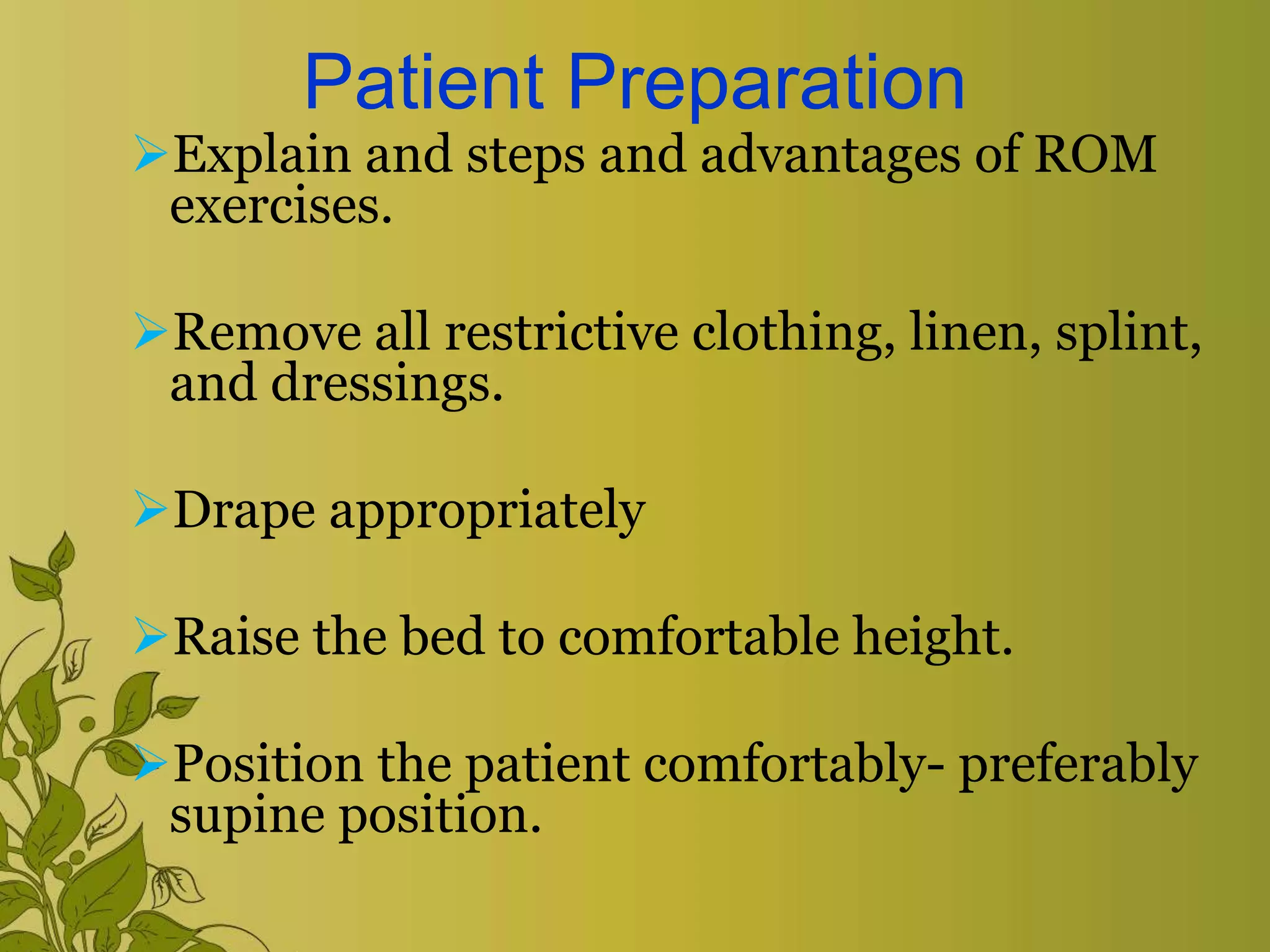
Explain and steps and advantages of ROM
exercises.
Remove all restrictive clothing, linen, splint,
and dressings.
Drape appropriately
Raise the bed to comfortable height.
Position the patient comfortably- preferably
supine position.
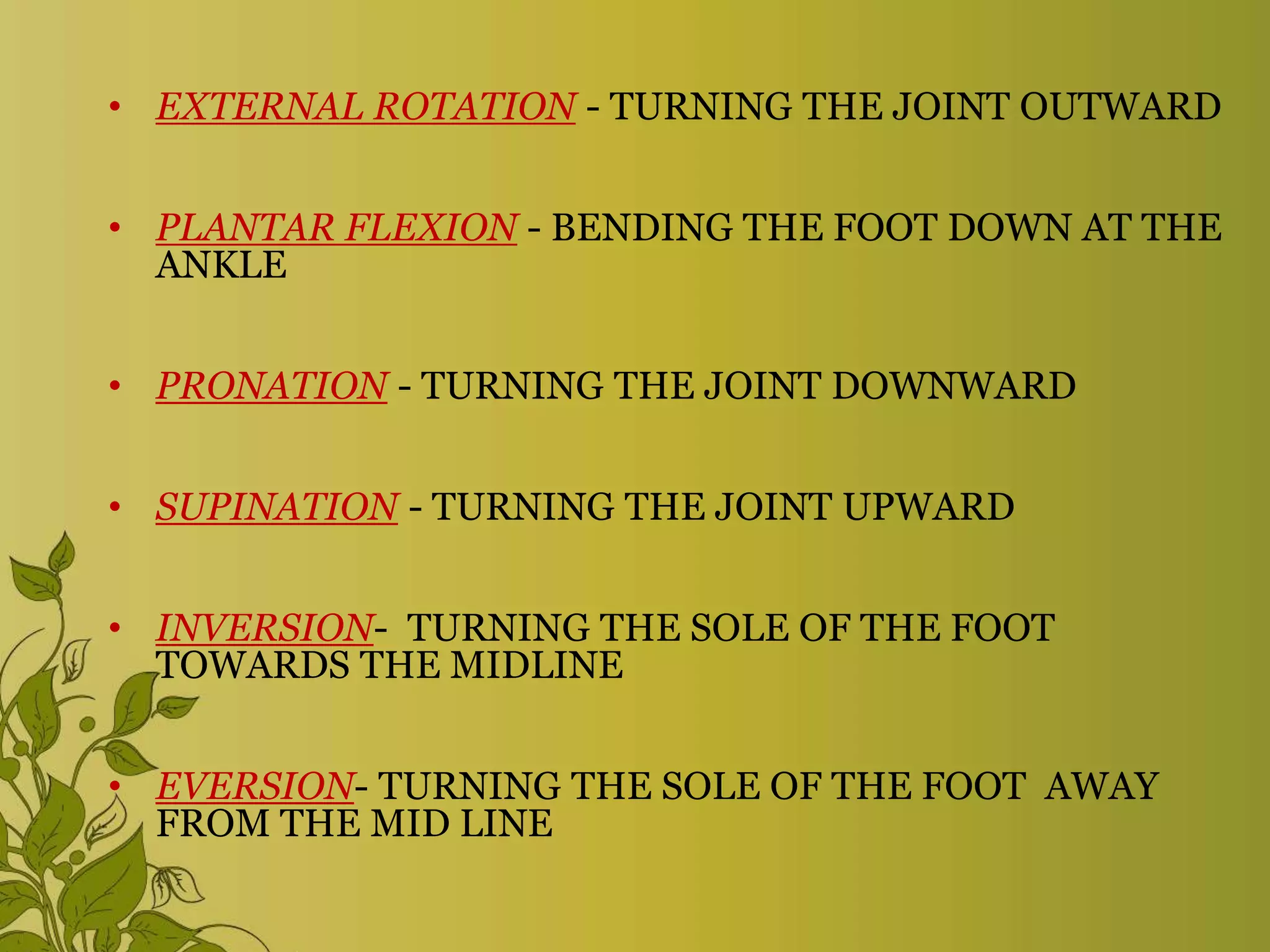
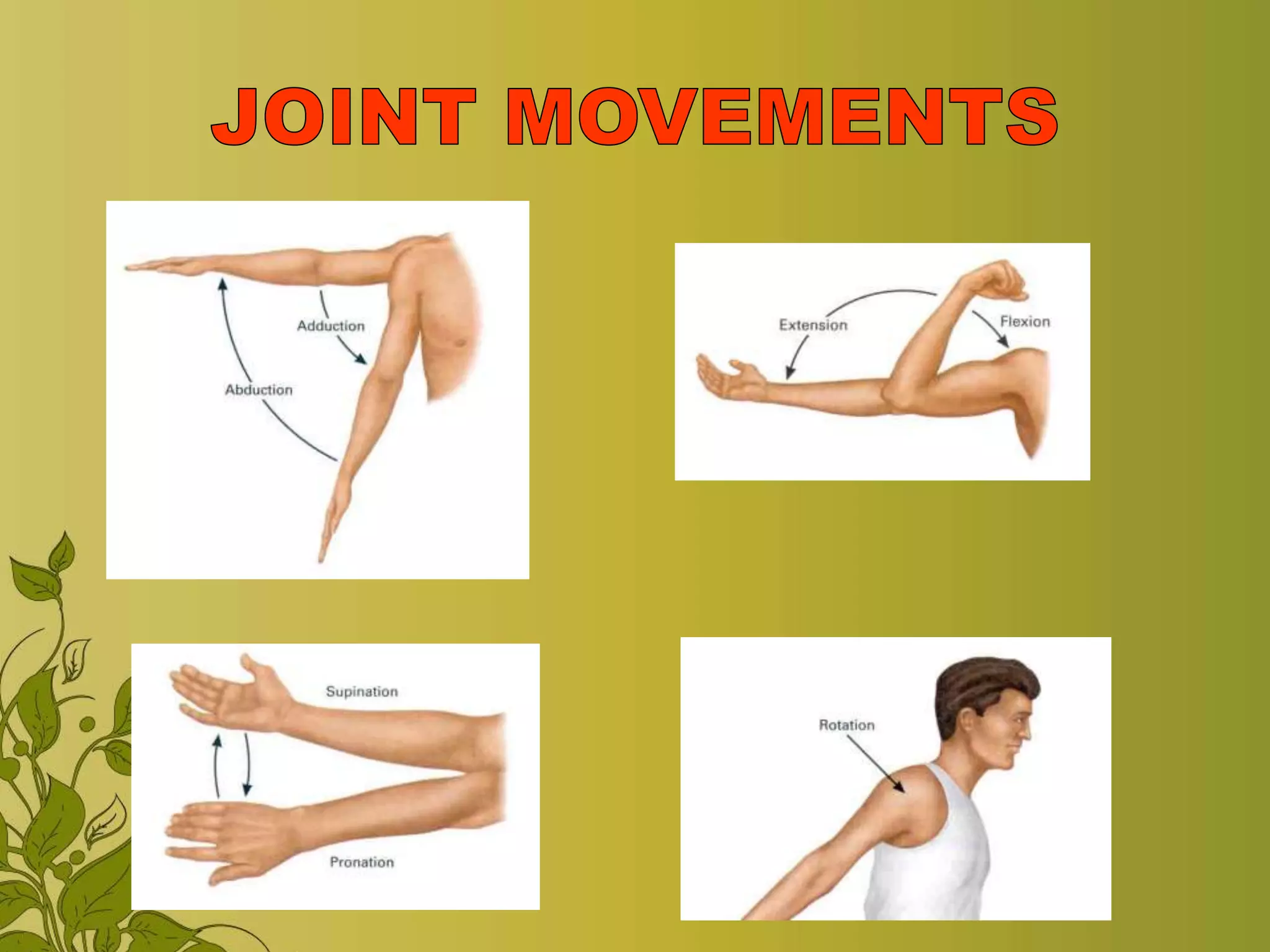
• ABDUCTION - MOVING A BODY PART AWAY FROM THE
MIDLINE OF THE BODY
• ADDUCTION - MOVING A BODY PART TOWARD THE
MIDLINE OF THE BODY
• EXTENSION - STRAIGHTENING A BODY PART
• FLEXION - BENDING A BODY PART
• ROTATION - TURNING THE JOINT
• INTERNAL ROTATION - TURNING THE JOINT INWARD
• EXTERNAL ROTATION - TURNING THE JOINT OUTWARD
• PLANTAR FLEXION - BENDING THE FOOT DOWN AT THE
ANKLE
• PRONATION - TURNING THE JOINT DOWNWARD
• SUPINATION - TURNING THE JOINT UPWARD
• INVERSION- TURNING THE SOLE OF THE FOOT
TOWARDS THE MIDLINE
• EVERSION- TURNING THE SOLE OF THE FOOT AWAY
FROM THE MID LINE
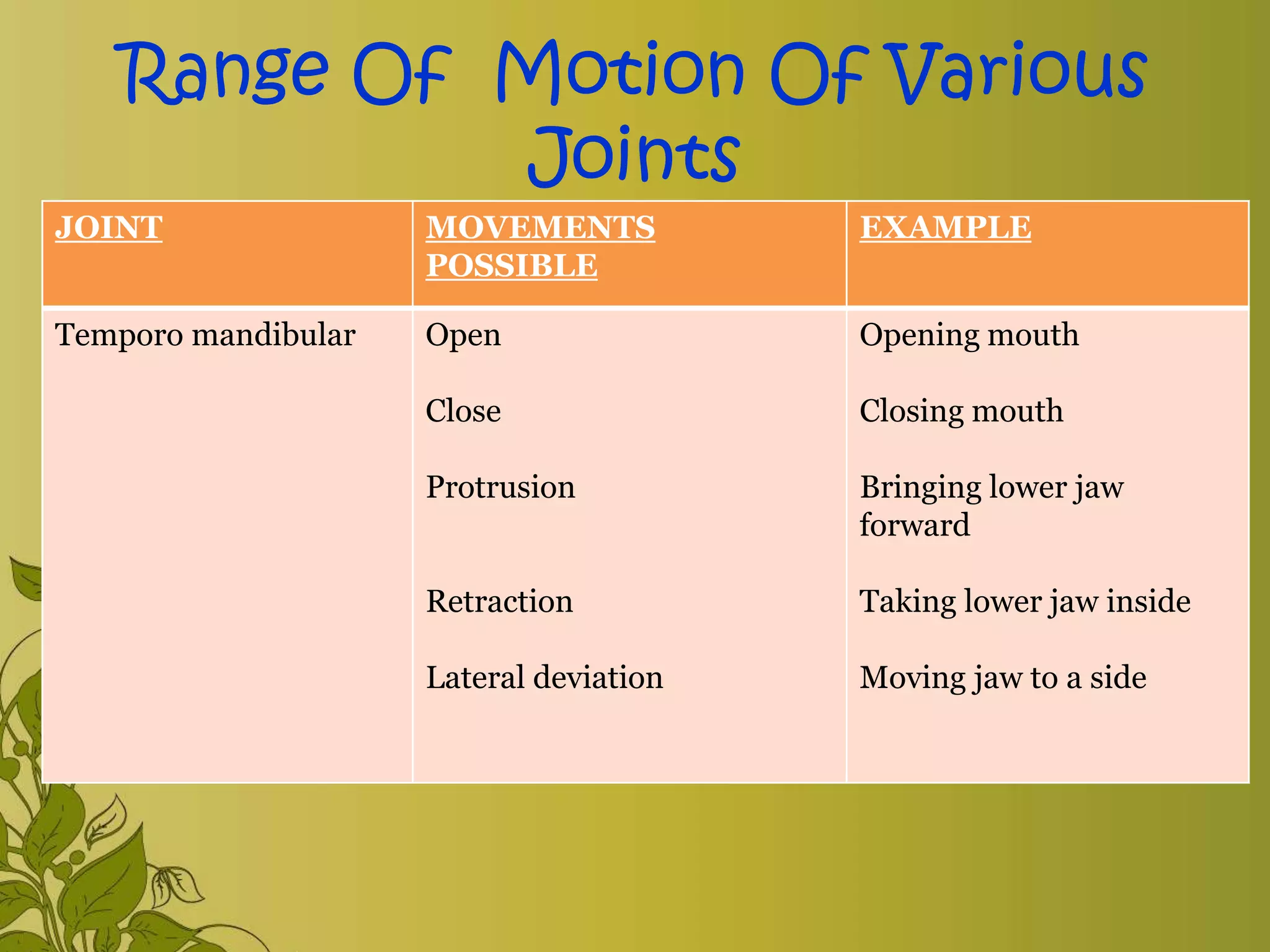
Range Of Motion Of Various
Joints
JOINT MOVEMENTS
POSSIBLE
EXAMPLE
Temporo mandibular Open
Close
Protrusion
Retraction
Lateral deviation
Opening mouth
Closing mouth
Bringing lower jaw
forward
Taking lower jaw inside
Moving jaw to a side
Range Of Motion Of Various
Joints
JOINT MOVEMENTS
POSSIBLE
EXAMPLE
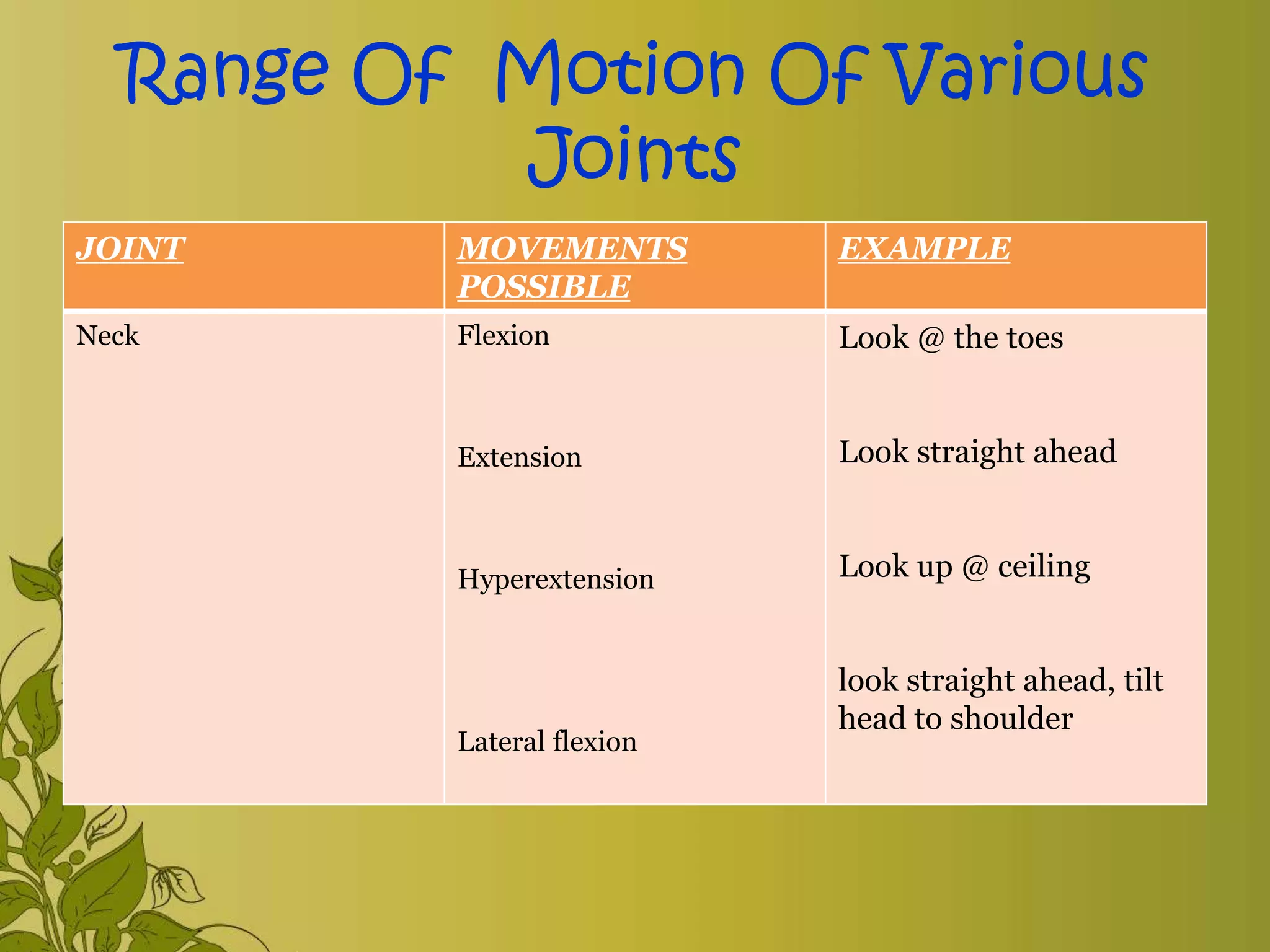
Neck Flexion
Extension
Hyperextension
Lateral flexion
Look @ the toes
Look straight ahead
Look up @ ceiling
look straight ahead, tilt
head to shoulder
Joint Movements
possible
Example
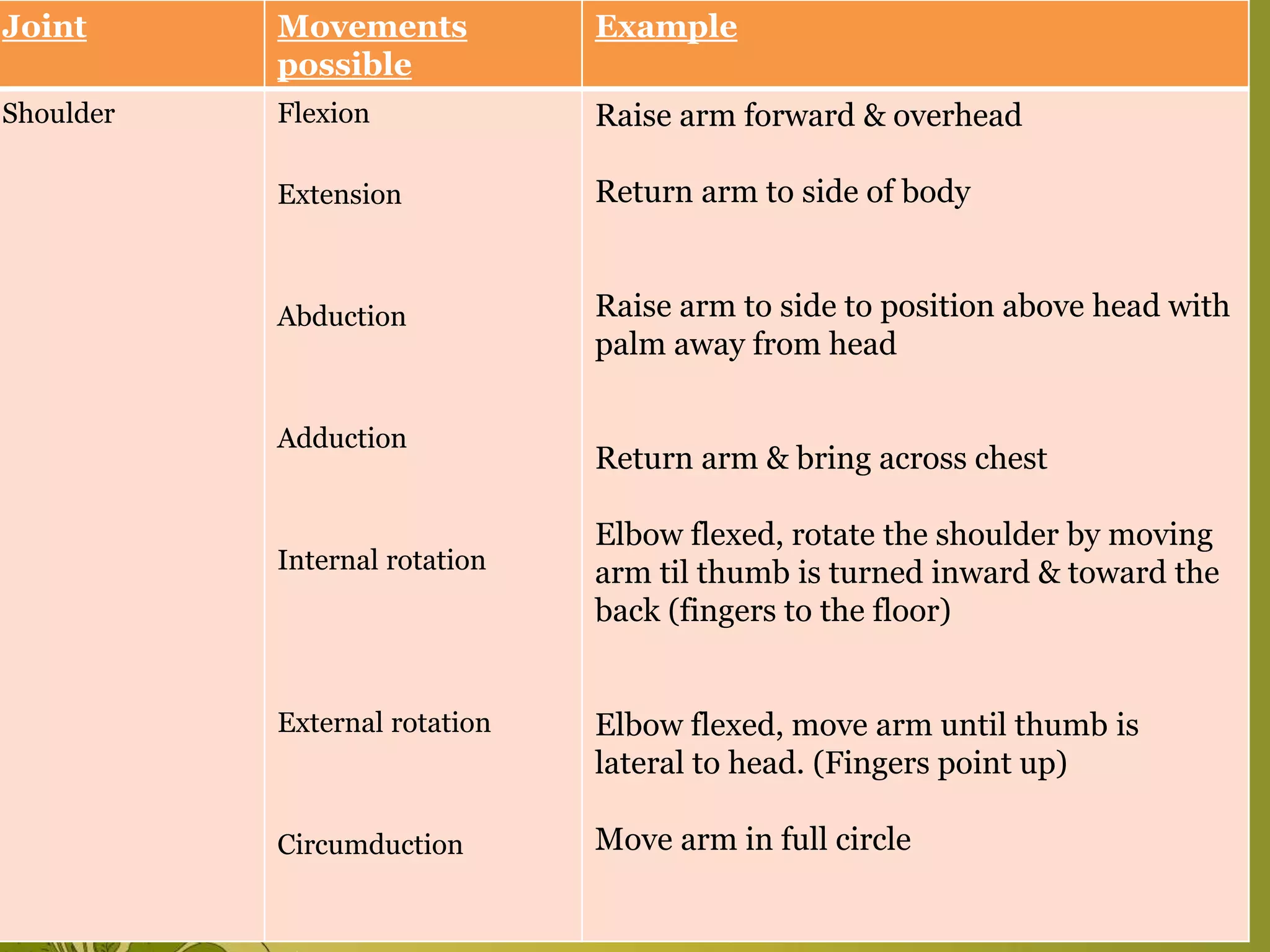
Shoulder Flexion
Extension
Abduction
Adduction
Internal rotation
External rotation
Circumduction
Raise arm forward & overhead
Return arm to side of body
Raise arm to side to position above head with
palm away from head
Return arm & bring across chest
Elbow flexed, rotate the shoulder by moving
arm til thumb is turned inward & toward the
back (fingers to the floor)
Elbow flexed, move arm until thumb is
lateral to head. (Fingers point up)
Move arm in full circle
Range Of Motion Of Various
Joints
Joint Movements possible Example
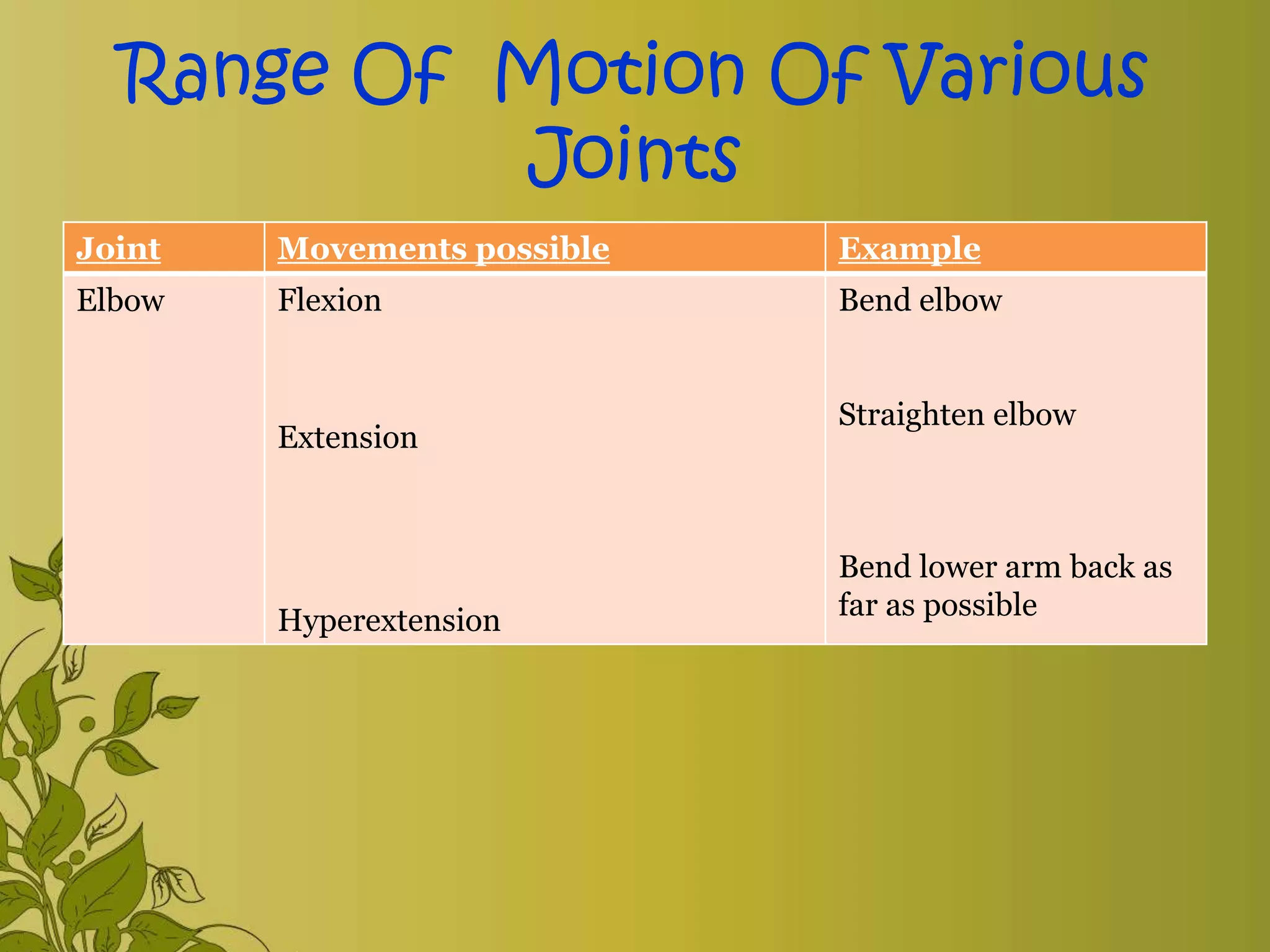
Elbow Flexion
Extension
Hyperextension
Bend elbow
Straighten elbow
Bend lower arm back as
far as possible
Range Of Motion Of Various
Joints
Joint Movements possible Example
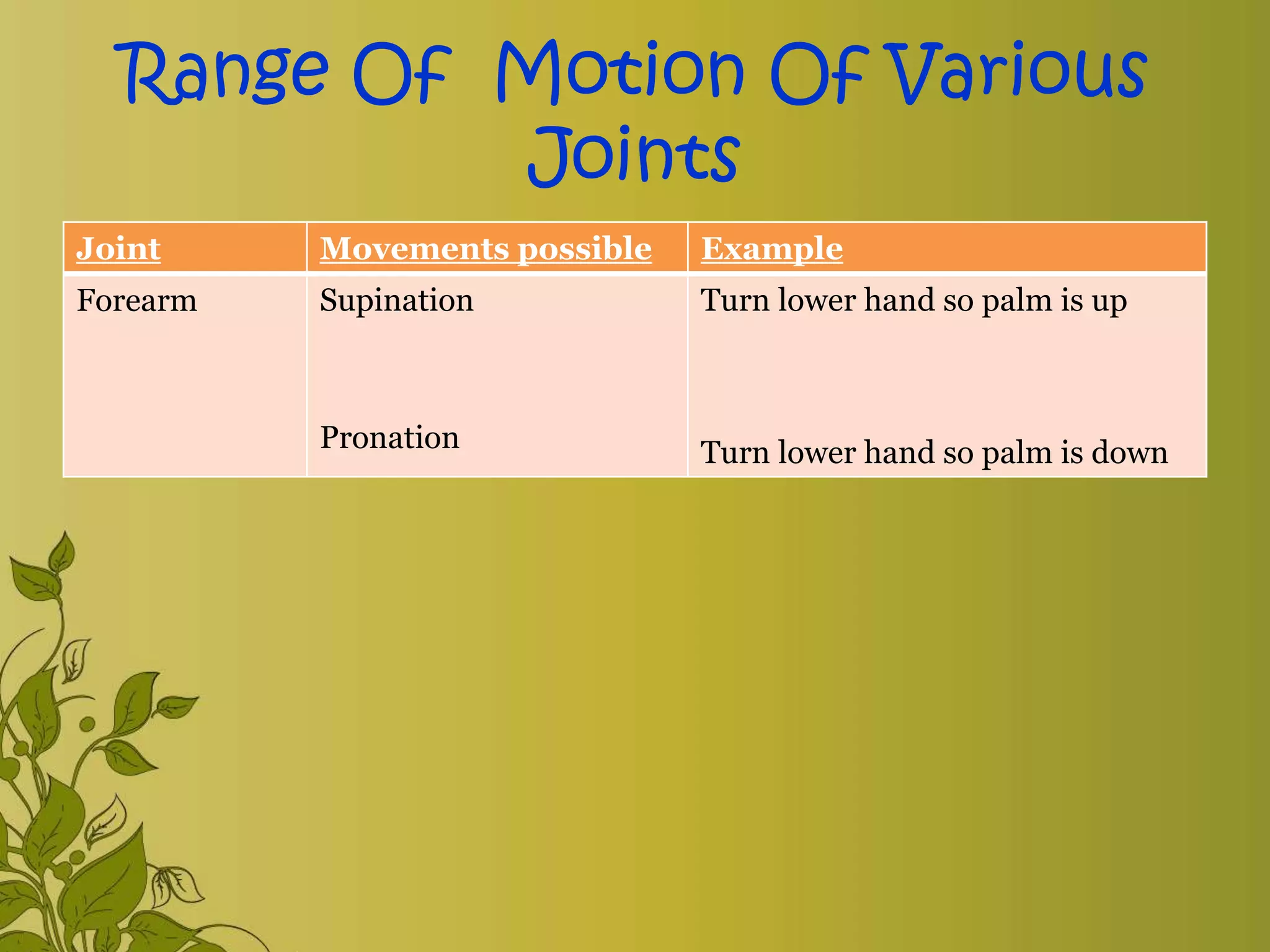
Forearm Supination
Pronation
Turn lower hand so palm is up
Turn lower hand so palm is down
Joint Movements
possible
Example
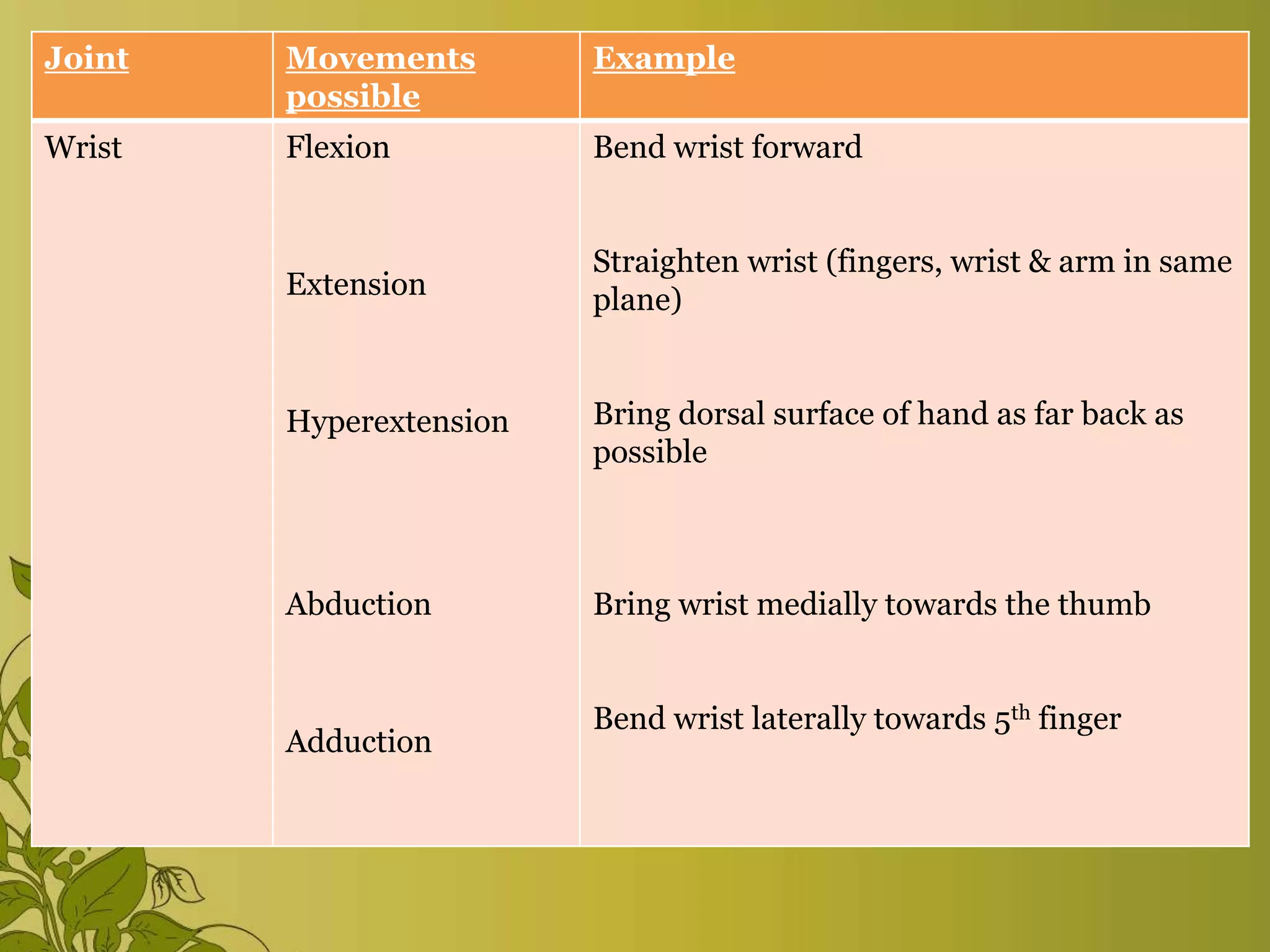
Wrist Flexion
Extension
Hyperextension
Abduction
Adduction
Bend wrist forward
Straighten wrist (fingers, wrist & arm in same
plane)
Bring dorsal surface of hand as far back as
possible
Bring wrist medially towards the thumb
Bend wrist laterally towards 5th finger
Joint Movements possible Example
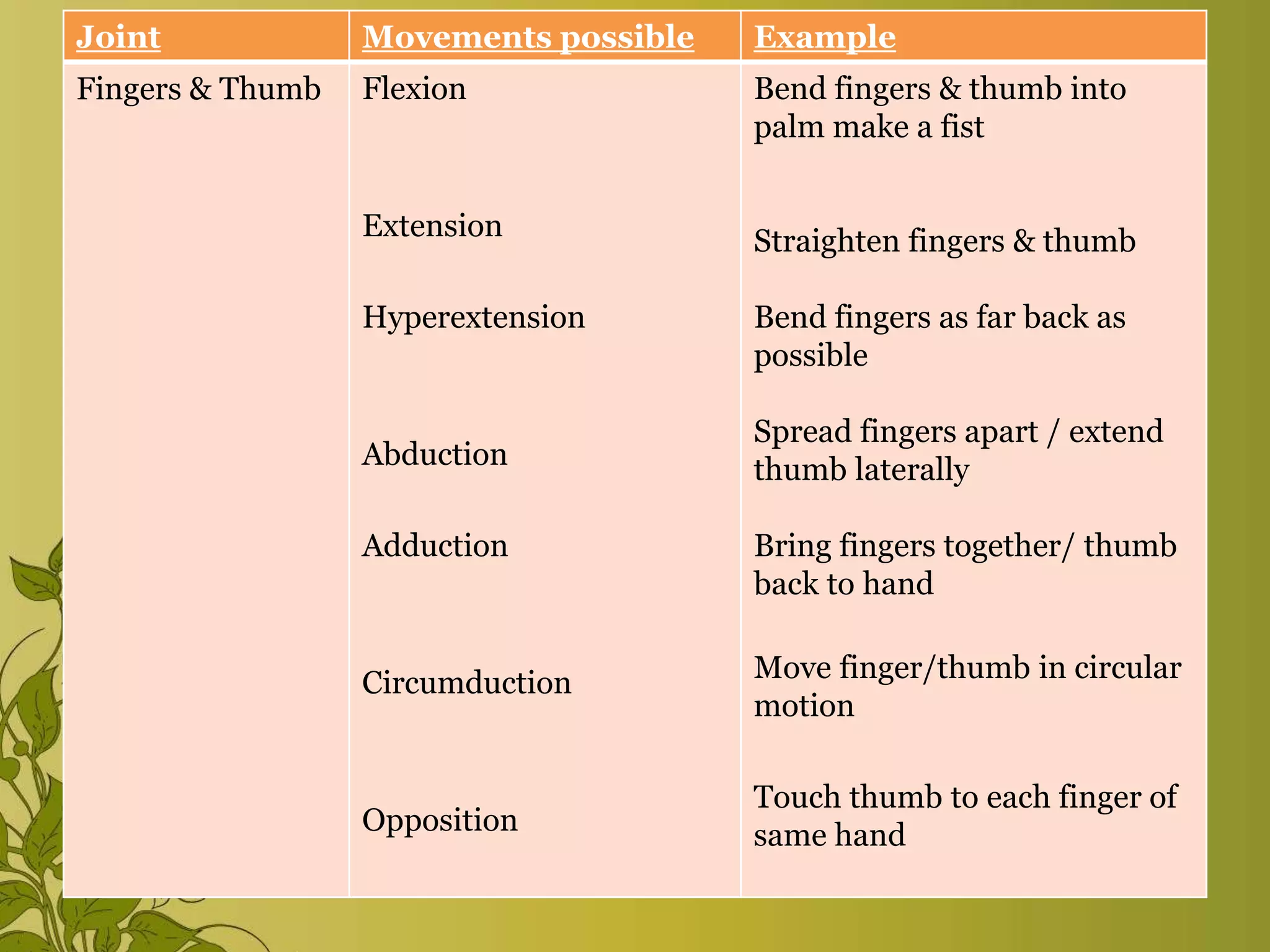
Fingers & Thumb Flexion
Extension
Hyperextension
Abduction
Adduction
Circumduction
Opposition
Bend fingers & thumb into
palm make a fist
Straighten fingers & thumb
Bend fingers as far back as
possible
Spread fingers apart / extend
thumb laterally
Bring fingers together/ thumb
back to hand
Move finger/thumb in circular
motion
Touch thumb to each finger of
same hand
Range Of Motion Of Various
Joints
Joint Movements possible Example
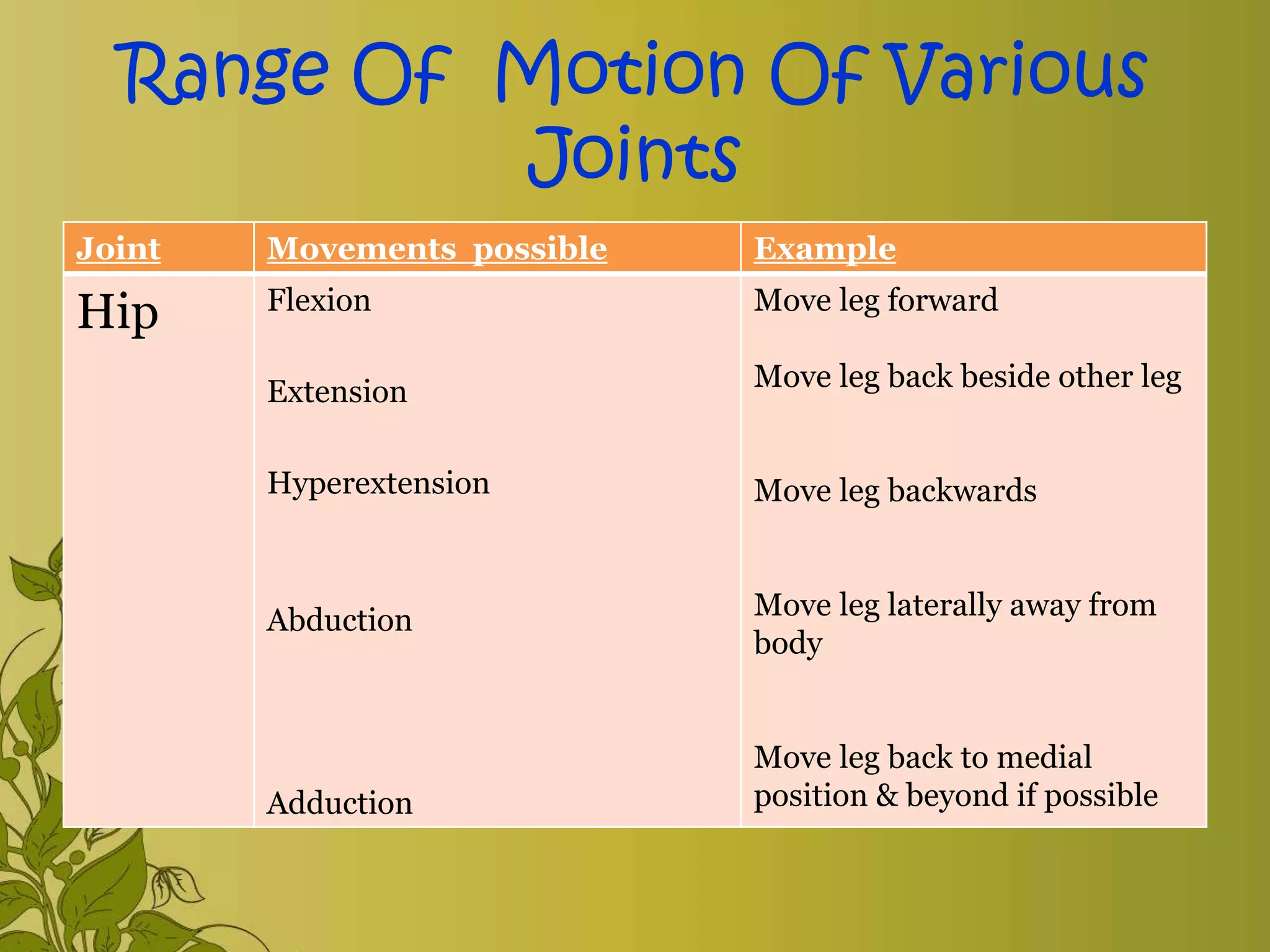
Hip Flexion
Extension
Hyperextension
Abduction
Adduction
Move leg forward
Move leg back beside other leg
Move leg backwards
Move leg laterally away from
body
Move leg back to medial
position & beyond if possible
Range Of Motion Of Various
Joints
Joint Movements possible Example
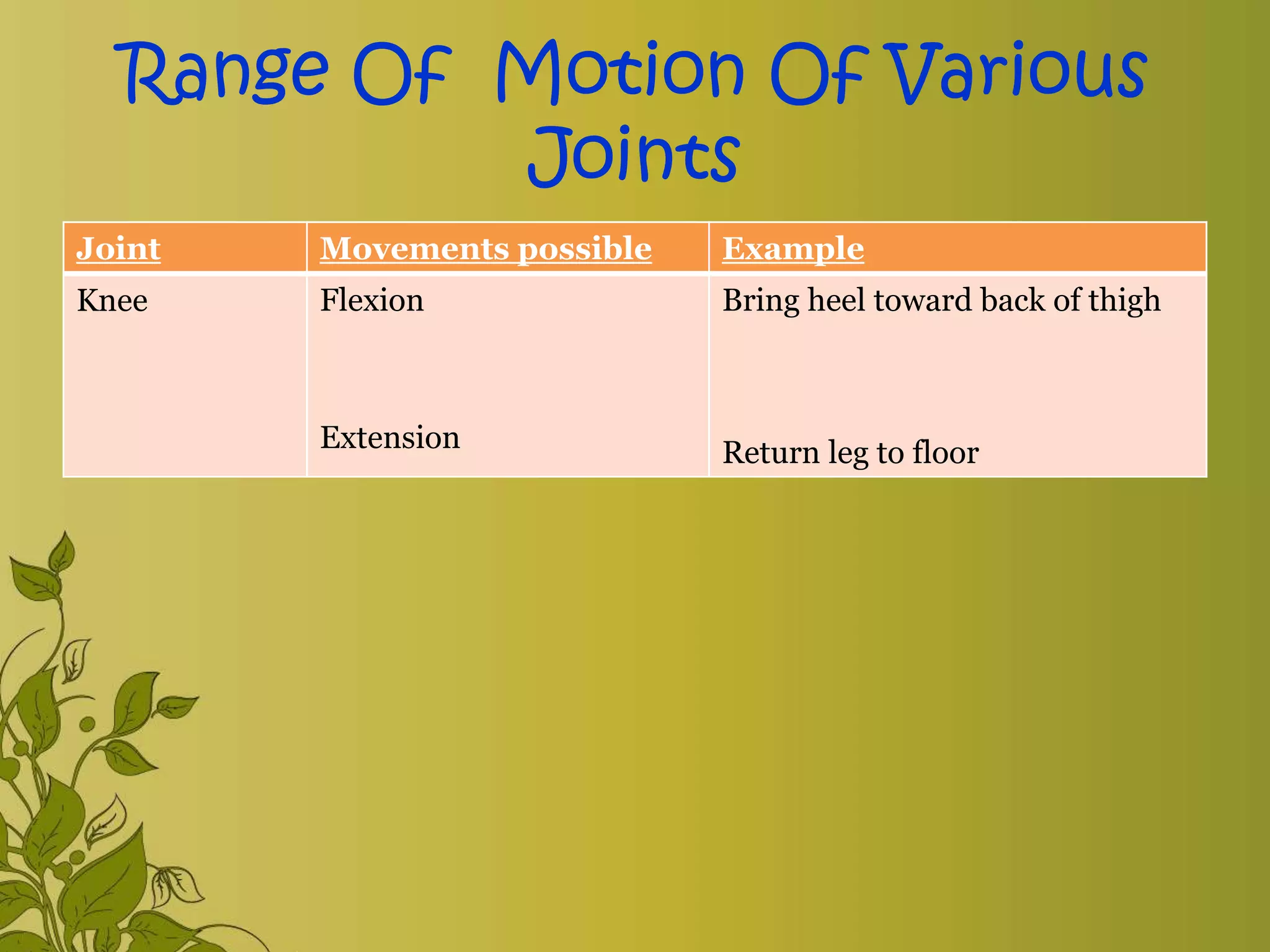
Knee Flexion
Extension
Bring heel toward back of thigh
Return leg to floor
Range Of Motion Of Various
Joints
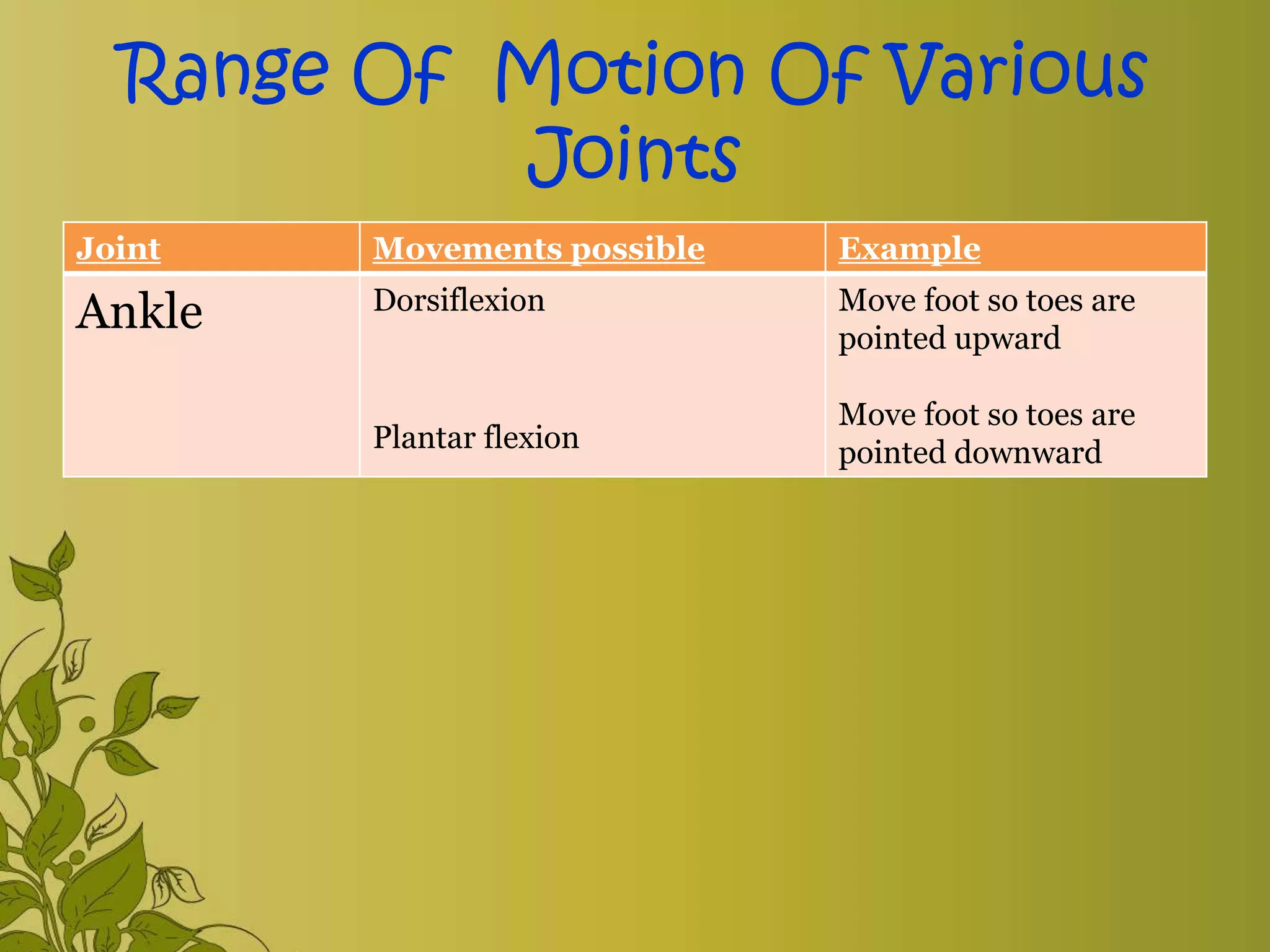
Joint Movements possible Example
Ankle Dorsiflexion
Plantar flexion
Move foot so toes are
pointed upward
Move foot so toes are
pointed downward
Range Of Motion Of Various
Joints
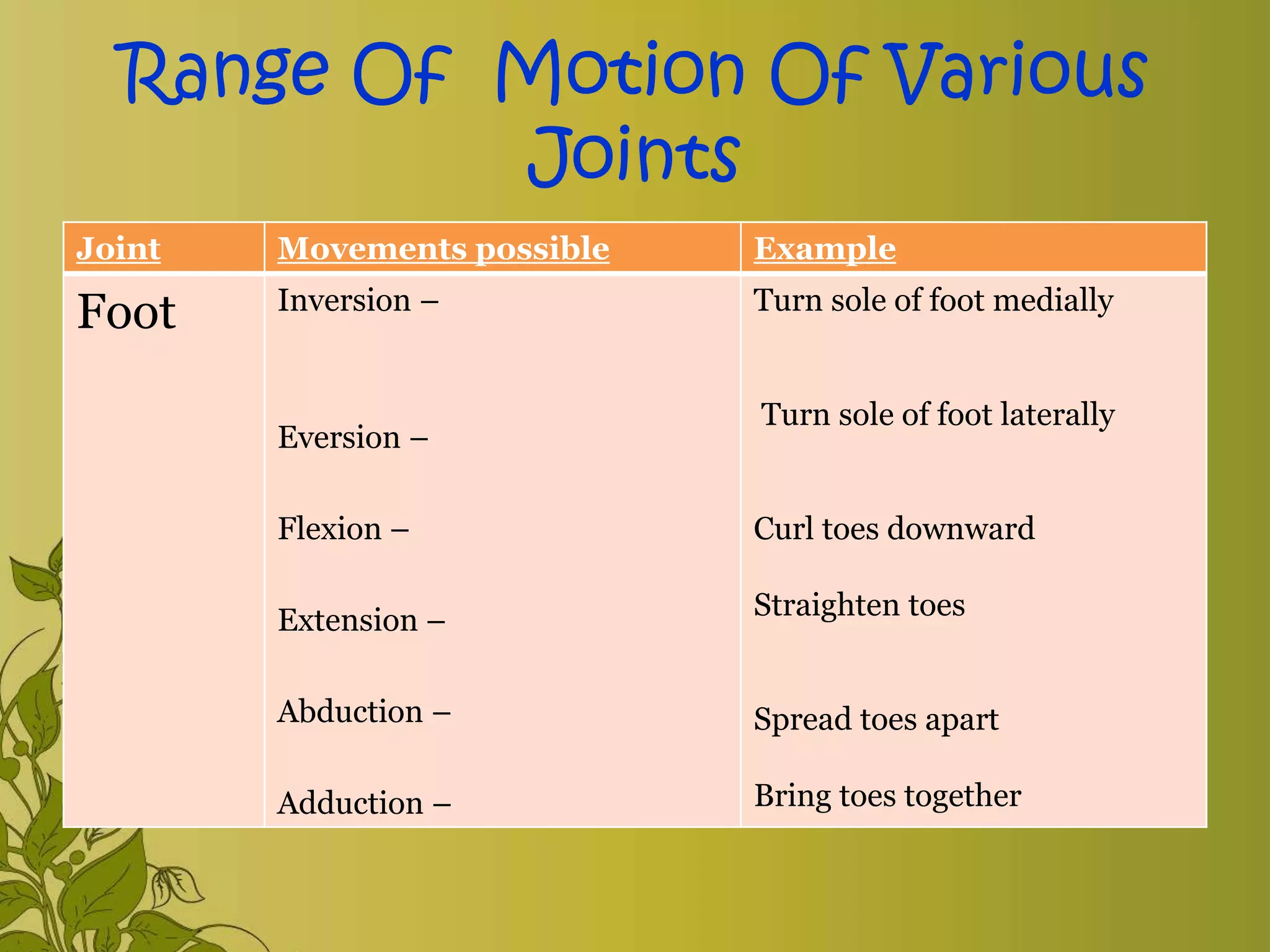
Joint Movements possible Example
Foot Inversion –
Eversion –
Flexion –
Extension –
Abduction –
Adduction –
Turn sole of foot medially
Turn sole of foot laterally
Curl toes downward
Straighten toes
Spread toes apart
Bring toes together
Range Of Motion Of Various
Joints
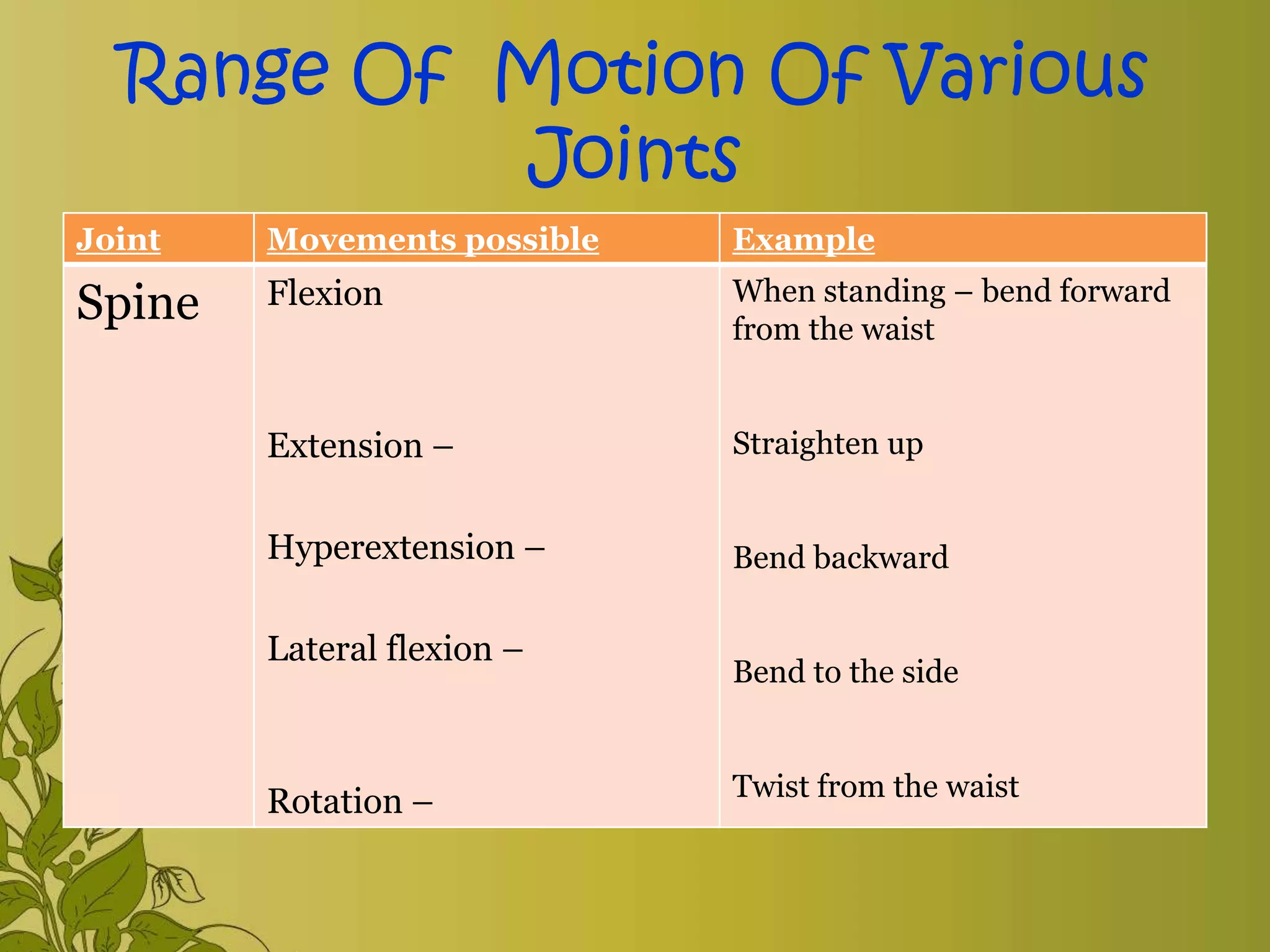
Joint Movements possible Example
Spine Flexion
Extension –
Hyperextension –
Lateral flexion –
Rotation –
When standing – bend forward
from the waist
Straighten up
Bend backward
Bend to the side
Twist from the waist
• Thank you

Exercise & range of motion exercise

  • 1.
  • 2.
    EXERCISE - Definition Exerciseis physical activity for conditioning the body, improving health, and maintaining fitness.
  • 3.
    Benefits of PhysicalExercise 1. Improved cardiopulmonary function 2. Reduced blood pressure 3. Increased muscle tone and strength 4. Greater physical endurance 5. Increased weight loss 6. Reduced blood glucose level
  • 4.
    Benefits of PhysicalExercise 7. Decreased low-density blood lipids 8. Improved physical appearance 9. Increased bone density 10.Regularity of bowel elimination 11. Promotion of sleep 12.Reduced tension and depression
  • 5.
    CLASSIFICATION OF EXERCISE EXERCISE BASEDON MUSCLE CONTRACTION ISOTONIC ISOMETRIC ISOKINETIC BASED ON SOURCE OF ENERGY ACTIVE PASSIVE
  • 6.
    BASED ON MUSCLECONTRACTION Isotonic exercise : cause muscle contraction and active movement. Example: walking, aerobics, moving arms & Legs. Isometric exercise: tightening or tensing of muscles without shortening (there is no movement). This increases muscle tension but do not change the length of muscle fibers. Example: contraction of gluteal muscles.
  • 7.
    BASED ON MUSCLECONTRACTION Isokinetic Exercise: Involves muscle contractions with resistance. Resistance is provided by an external source Example: movement of leg against resistance.
  • 8.
    BASED ON SOURCEOF ENERGY • Active exercise is therapeutic activity that the client performs independently. • Passive exercise is therapeutic activity that the client performs with assistance and is provided when a client cannot move one or more parts of the body.
  • 9.
    Range Of MotionExercises Definition: The movement of a joint to the extent possible without causing pain Purposes: • Promote and maintain joint mobility • Prevent contractures and shortening of muscles and tendons • Increase circulation to extremities. • Facilitate comfort for the patient
  • 10.
    Contraindications To ROM •Any illness/disorder where increased use of energy or increased circulation is hazardous. • Example: Myocardial infarction. swollen, inflamed joints
  • 11.
    Types Of ROMExercises • Active ROM exercises – Exercises the client is able to perform independently. • Passive ROM exercises – Exercises performed for the client by someone else. • Active assisted ROM exercises – Performed by a client with some assistance. Client can move a limb partially through its ROM, but needs help completing the ROM.
  • 12.
    Guidelines For PerformingROM Exercises Start with the head and move down, always do bilaterally Do not grasp the joint directly Do not grasp fingernail or toenail. Be sure to support the distal and proximal end of the limbs Important joints – thumb, hip, knee, ankle Move joint through movement 5 times/session
  • 13.
    Guidelines For PerformingROM Exercises Return body part to normal anatomical position Move each joint through full range of motion Move to point of resistance not pain Allow for rest periods whenever required Avoid friction LIFT body part don’t drag Note drastic change in vital signs, extreme fatigue.
  • 14.
    Guidelines For PerformingROM Exercises  Should not disrupt the healing process  Warm water relaxes the muscles and joints, bathing is an ideal time to perform ROM
  • 15.
    Patient Preparation Explain andsteps and advantages of ROM exercises. Remove all restrictive clothing, linen, splint, and dressings. Drape appropriately Raise the bed to comfortable height. Position the patient comfortably- preferably supine position.
  • 16.
    • ABDUCTION -MOVING A BODY PART AWAY FROM THE MIDLINE OF THE BODY • ADDUCTION - MOVING A BODY PART TOWARD THE MIDLINE OF THE BODY • EXTENSION - STRAIGHTENING A BODY PART • FLEXION - BENDING A BODY PART • ROTATION - TURNING THE JOINT • INTERNAL ROTATION - TURNING THE JOINT INWARD
  • 17.
    • EXTERNAL ROTATION- TURNING THE JOINT OUTWARD • PLANTAR FLEXION - BENDING THE FOOT DOWN AT THE ANKLE • PRONATION - TURNING THE JOINT DOWNWARD • SUPINATION - TURNING THE JOINT UPWARD • INVERSION- TURNING THE SOLE OF THE FOOT TOWARDS THE MIDLINE • EVERSION- TURNING THE SOLE OF THE FOOT AWAY FROM THE MID LINE
  • 19.
    Range Of MotionOf Various Joints JOINT MOVEMENTS POSSIBLE EXAMPLE Temporo mandibular Open Close Protrusion Retraction Lateral deviation Opening mouth Closing mouth Bringing lower jaw forward Taking lower jaw inside Moving jaw to a side
  • 20.
    Range Of MotionOf Various Joints JOINT MOVEMENTS POSSIBLE EXAMPLE Neck Flexion Extension Hyperextension Lateral flexion Look @ the toes Look straight ahead Look up @ ceiling look straight ahead, tilt head to shoulder
  • 21.
    Joint Movements possible Example Shoulder Flexion Extension Abduction Adduction Internalrotation External rotation Circumduction Raise arm forward & overhead Return arm to side of body Raise arm to side to position above head with palm away from head Return arm & bring across chest Elbow flexed, rotate the shoulder by moving arm til thumb is turned inward & toward the back (fingers to the floor) Elbow flexed, move arm until thumb is lateral to head. (Fingers point up) Move arm in full circle
  • 22.
    Range Of MotionOf Various Joints Joint Movements possible Example Elbow Flexion Extension Hyperextension Bend elbow Straighten elbow Bend lower arm back as far as possible
  • 23.
    Range Of MotionOf Various Joints Joint Movements possible Example Forearm Supination Pronation Turn lower hand so palm is up Turn lower hand so palm is down
  • 24.
    Joint Movements possible Example Wrist Flexion Extension Hyperextension Abduction Adduction Bendwrist forward Straighten wrist (fingers, wrist & arm in same plane) Bring dorsal surface of hand as far back as possible Bring wrist medially towards the thumb Bend wrist laterally towards 5th finger
  • 25.
    Joint Movements possibleExample Fingers & Thumb Flexion Extension Hyperextension Abduction Adduction Circumduction Opposition Bend fingers & thumb into palm make a fist Straighten fingers & thumb Bend fingers as far back as possible Spread fingers apart / extend thumb laterally Bring fingers together/ thumb back to hand Move finger/thumb in circular motion Touch thumb to each finger of same hand
  • 26.
    Range Of MotionOf Various Joints Joint Movements possible Example Hip Flexion Extension Hyperextension Abduction Adduction Move leg forward Move leg back beside other leg Move leg backwards Move leg laterally away from body Move leg back to medial position & beyond if possible
  • 27.
    Range Of MotionOf Various Joints Joint Movements possible Example Knee Flexion Extension Bring heel toward back of thigh Return leg to floor
  • 28.
    Range Of MotionOf Various Joints Joint Movements possible Example Ankle Dorsiflexion Plantar flexion Move foot so toes are pointed upward Move foot so toes are pointed downward
  • 29.
    Range Of MotionOf Various Joints Joint Movements possible Example Foot Inversion – Eversion – Flexion – Extension – Abduction – Adduction – Turn sole of foot medially Turn sole of foot laterally Curl toes downward Straighten toes Spread toes apart Bring toes together
  • 30.
    Range Of MotionOf Various Joints Joint Movements possible Example Spine Flexion Extension – Hyperextension – Lateral flexion – Rotation – When standing – bend forward from the waist Straighten up Bend backward Bend to the side Twist from the waist
  • 31.