MUNEERA. TV
FIRST AID AND ITS IMPORTANCE
First aid is the assistance given to any person
suffering a sudden illness or injury, with care
provided to preserve life, prevent the condition
from worsening, or to promote recovery. It
includes initial intervention in a serious
condition prior to professional medical help
being available, such as performing CPR while
awaiting an ambulance, as well as the complete
treatment of minor conditions, such as applying
a plaster to a cut.
WHAT IS FIRST AID?
First aid is generally performed by the
layperson, with many people trained in
providing basic levels of first aid, and
others willing to do so from acquired
knowledge. Mental health first aid is an
extension of the concept of first aid to
cover mental health.
Aims
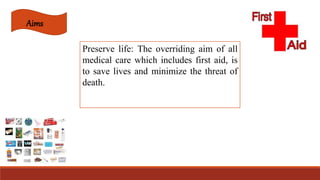
Preserve life: The overriding aim of all
medical care which includes first aid, is
to save lives and minimize the threat of
death.
Prevent further harm: Prevent further harm also
sometimes called prevent the condition from
worsening, or danger of further injury, this
covers both external factors, such as moving a
patient away from any cause of harm, and
applying first aid techniques to prevent
worsening of the condition, such as applying
pressure to stop a bleed becoming dangerous
Promote recovery: First aid also
involves trying to start the recovery
process from the illness or injury, and in
some cases might involve completing a
treatment, such as in the case of applying
a plaster to a small wound.
Keyskills
Certain skills are considered essential to the
provision of first aid and are taught
ubiquitously. Particularly the "ABC"s of first
aid, which focus on critical life-saving
intervention, must be rendered before treatment
of less serious injuries. ABC stands for
Airway,
Breathing
Circulation
Some organizations teach the
same order of priority using
the "3Bs":
“4Bs”
Breathing
Bleeding
Burns
Bones.
Preserving life
In order to stay alive, all persons need to have
an open airway—a clear passage where air can
move in through the mouth or nose through the
pharynx and down into the lungs, without
obstruction. Conscious people will maintain
their own airway automatically, but those who
are unconscious may be unable to maintain a
patent airway, as the part of the brain which
automatically controls breathing in normal
situations may not be functioning.
Training
Basic principles, such as knowing to use an
adhesive bandage or applying direct pressure on
a bleed, are often acquired passively through
life experiences. However, to provide effective,
life-saving first aid interventions requires
instruction and practical training. This is
especially true where it relates to potentially
fatal illnesses and injuries, such as those that
require cardiopulmonary resuscitation (CPR);
these procedures may be invasive, and carry a
risk of further injury to the patient and the
provider
Specific disciplines
There are several types of first aid (and
first aider) which require specific
additional training. These are usually
undertaken to fulfill the demands of the
work or activity undertaken.
There are several types of first aid (and
first aider) which require specific
additional training. These are usually
undertaken to fulfill the demands of the
work or activity undertaken.
Types Of First Aid
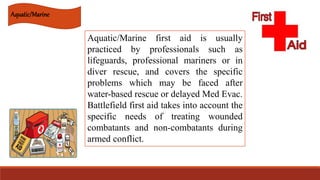
Aquatic/Marine
Aquatic/Marine first aid is usually
practiced by professionals such as
lifeguards, professional mariners or in
diver rescue, and covers the specific
problems which may be faced after
water-based rescue or delayed Med Evac.
Battlefield first aid takes into account the
specific needs of treating wounded
combatants and non-combatants during
armed conflict.
Hyperbaric
Hyperbaric first aid may be practiced by
SCUBA diving professionals, who need to treat
conditions such as the bends.
Oxygen first aid is the providing of oxygen to
casualties who suffer from conditions resulting
in hypoxia.
Wilderness
Wilderness first aid is the provision of
first aid under conditions where the
arrival of emergency responders or the
evacuation of an injured person may be
delayed due to constraints of terrain,
weather, and available persons or
equipment. It may be necessary to care
for an injured person for several hours
or days.
Mental health
Mental health first aid is taught
independently of physical first aid.
How to support someone
experiencing a mental health
problem or in a crisis situation. Also
how to identify the first signs of
someone developing mental ill
health and guide people towards
appropriate help.
First aid services
Some people undertake specific training in order to
provide first aid at public or private events, during
filming, or other places where people gather. They
may be designated as a first aider, or use some
other title. This role may be undertaken on a
voluntary basis, with organizations such as the Red
Cross and St John Ambulance, or as paid
employment with a medical contractor.
acetaminophen and ibuprofen
extra prescription medications (if traveling)
tweezers
sharp scissors
safety pins
disposable instant cold packs
calamine lotion
alcohol wipes or ethyl alcohol
thermometer
tooth preservation kit
First Aid Kit
A First Aid Kit should have the following contents
first-aid manual different sizes
adhesive tape
adhesive bandages in several sizes
elastic bandage
a splint
antiseptic wipes
soap
antibiotic ointment
antiseptic solution
plastic non-latex gloves(at least 2 pairs)
flashlight and extra batteries
thermal shock blanket
mouthpiece for administering CPR (can
be obtained from your local Red Cross)
blanket (stored nearby)
First Aid Card containing emergency
personal information, phone numbers,
medications, manual,
pocket defibrillator
THANKYOU

First aid

  • 1.
    MUNEERA. TV FIRST AIDAND ITS IMPORTANCE
  • 2.
    First aid isthe assistance given to any person suffering a sudden illness or injury, with care provided to preserve life, prevent the condition from worsening, or to promote recovery. It includes initial intervention in a serious condition prior to professional medical help being available, such as performing CPR while awaiting an ambulance, as well as the complete treatment of minor conditions, such as applying a plaster to a cut. WHAT IS FIRST AID?
  • 3.
    First aid isgenerally performed by the layperson, with many people trained in providing basic levels of first aid, and others willing to do so from acquired knowledge. Mental health first aid is an extension of the concept of first aid to cover mental health.
  • 4.
    Aims Preserve life: Theoverriding aim of all medical care which includes first aid, is to save lives and minimize the threat of death.
  • 5.
    Prevent further harm:Prevent further harm also sometimes called prevent the condition from worsening, or danger of further injury, this covers both external factors, such as moving a patient away from any cause of harm, and applying first aid techniques to prevent worsening of the condition, such as applying pressure to stop a bleed becoming dangerous
  • 6.
    Promote recovery: Firstaid also involves trying to start the recovery process from the illness or injury, and in some cases might involve completing a treatment, such as in the case of applying a plaster to a small wound.
  • 7.
    Keyskills Certain skills areconsidered essential to the provision of first aid and are taught ubiquitously. Particularly the "ABC"s of first aid, which focus on critical life-saving intervention, must be rendered before treatment of less serious injuries. ABC stands for Airway, Breathing Circulation
  • 8.
    Some organizations teachthe same order of priority using the "3Bs": “4Bs” Breathing Bleeding Burns Bones.
  • 9.
    Preserving life In orderto stay alive, all persons need to have an open airway—a clear passage where air can move in through the mouth or nose through the pharynx and down into the lungs, without obstruction. Conscious people will maintain their own airway automatically, but those who are unconscious may be unable to maintain a patent airway, as the part of the brain which automatically controls breathing in normal situations may not be functioning.
  • 10.
    Training Basic principles, suchas knowing to use an adhesive bandage or applying direct pressure on a bleed, are often acquired passively through life experiences. However, to provide effective, life-saving first aid interventions requires instruction and practical training. This is especially true where it relates to potentially fatal illnesses and injuries, such as those that require cardiopulmonary resuscitation (CPR); these procedures may be invasive, and carry a risk of further injury to the patient and the provider
  • 11.
    Specific disciplines There areseveral types of first aid (and first aider) which require specific additional training. These are usually undertaken to fulfill the demands of the work or activity undertaken.
  • 12.
    There are severaltypes of first aid (and first aider) which require specific additional training. These are usually undertaken to fulfill the demands of the work or activity undertaken. Types Of First Aid
  • 13.
    Aquatic/Marine Aquatic/Marine first aidis usually practiced by professionals such as lifeguards, professional mariners or in diver rescue, and covers the specific problems which may be faced after water-based rescue or delayed Med Evac. Battlefield first aid takes into account the specific needs of treating wounded combatants and non-combatants during armed conflict.
  • 14.
    Hyperbaric Hyperbaric first aidmay be practiced by SCUBA diving professionals, who need to treat conditions such as the bends. Oxygen first aid is the providing of oxygen to casualties who suffer from conditions resulting in hypoxia.
  • 15.
    Wilderness Wilderness first aidis the provision of first aid under conditions where the arrival of emergency responders or the evacuation of an injured person may be delayed due to constraints of terrain, weather, and available persons or equipment. It may be necessary to care for an injured person for several hours or days.
  • 16.
    Mental health Mental healthfirst aid is taught independently of physical first aid. How to support someone experiencing a mental health problem or in a crisis situation. Also how to identify the first signs of someone developing mental ill health and guide people towards appropriate help.
  • 17.
    First aid services Somepeople undertake specific training in order to provide first aid at public or private events, during filming, or other places where people gather. They may be designated as a first aider, or use some other title. This role may be undertaken on a voluntary basis, with organizations such as the Red Cross and St John Ambulance, or as paid employment with a medical contractor.
  • 18.
    acetaminophen and ibuprofen extraprescription medications (if traveling) tweezers sharp scissors safety pins disposable instant cold packs calamine lotion alcohol wipes or ethyl alcohol thermometer tooth preservation kit
  • 19.
    First Aid Kit AFirst Aid Kit should have the following contents first-aid manual different sizes adhesive tape adhesive bandages in several sizes elastic bandage a splint antiseptic wipes soap antibiotic ointment antiseptic solution
  • 20.
    plastic non-latex gloves(atleast 2 pairs) flashlight and extra batteries thermal shock blanket mouthpiece for administering CPR (can be obtained from your local Red Cross) blanket (stored nearby) First Aid Card containing emergency personal information, phone numbers, medications, manual, pocket defibrillator
  • 21.