CHILDGUIDANCE
MUNEERA. TV
PRINCIPLES
CHILD GUIDANCE
CHILD GUIDANCE IS
PSYCHOLOGICALLY OR
EMOTIONALLY DISTURBED
CHILDREN, ESPECIALLY
THROUGH COUNSELLING
CHILD GUIDANCE
PRINCIPLES OF CHILD GUIDANCE
1. Mutual respect
2. Encouragement
3. Be responsible for your own behavior and feelings
4. Natural consequences
5. Logical consequences
6. Punishment
7. Action is more effective than words
8. Withdrawing from struggles
9. Withdraw from the struggle , not from the child
10.Resist interfering
11.Take the time for training
12.Resist doing for children what they can do for
themselves
13.Children’s behavior has purpose
14.Children are keen observers of situations
CHILD GUIDANCE
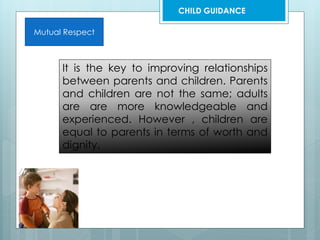
Mutual Respect
It is the key to improving relationships
between parents and children. Parents
and children are not the same; adults
are are more knowledgeable and
experienced. However , children are
equal to parents in terms of worth and
dignity.
CHILD GUIDANCE
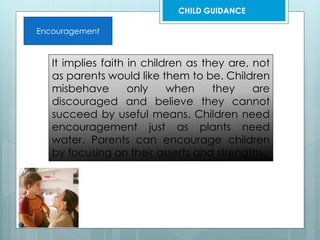
Encouragement
It implies faith in children as they are, not
as parents would like them to be. Children
misbehave only when they are
discouraged and believe they cannot
succeed by useful means. Children need
encouragement just as plants need
water. Parents can encourage children
by focusing on their asserts and strengths.
CHILD GUIDANCE
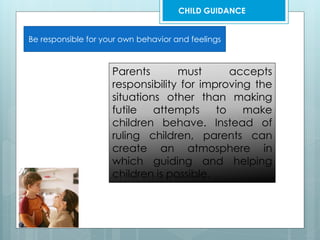
Be responsible for your own behavior and feelings
Parents must accepts
responsibility for improving the
situations other than making
futile attempts to make
children behave. Instead of
ruling children, parents can
create an atmosphere in
which guiding and helping
children is possible.
CHILD GUIDANCE
Natural consequences
It allow the children to learn from the
physical reality or situation rather than
parental authority. The consequences of
the situation can often exert the
necessary pressure to stimulate useful
motivations. Only in moments of real
danger is it necessary to protect children
from the natural consequences of their
own disturbing behavior.
CHILD GUIDANCE
Logical consequences
Allow children to learn from the physical
reality of the social world. Parents can
intervene with consequences that both
the parents and children can see as
logically related to mis behavior and as
respectful and reasonable. Through
logical consequences children are
offered choices and are encouraged to
make responsible decision rather than
being forced submit.
CHILD GUIDANCE
Punishment
It is outdated. Children consider punishment
as license to punish other or to retaliate
against their parents. Encouragement and
natural and logical consequences can be
more effective methods of child discipline
CHILD GUIDANCE
Action is more effective than
words
It is in times of conflict. Children
tend to become “parent-
deaf” and act only when
raised voices imply some
impending action, and then
respond only momentarily.
Usually children know very well
what is expected of them.
CHILD GUIDANCE
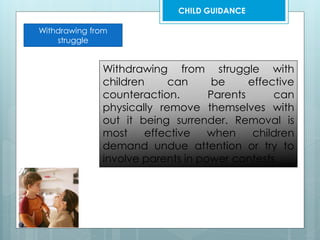
Withdrawing from
struggle
Withdrawing from struggle with
children can be effective
counteraction. Parents can
physically remove themselves with
out it being surrender. Removal is
most effective when children
demand undue attention or try to
involve parents in power contests
CHILD GUIDANCE
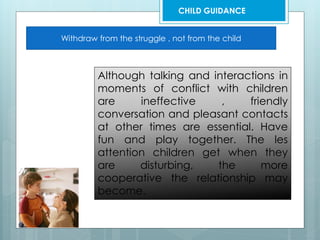
Withdraw from the struggle , not from the child
Although talking and interactions in
moments of conflict with children
are ineffective , friendly
conversation and pleasant contacts
at other times are essential. Have
fun and play together. The les
attention children get when they
are disturbing, the more
cooperative the relationship may
become.
CHILD GUIDANCE
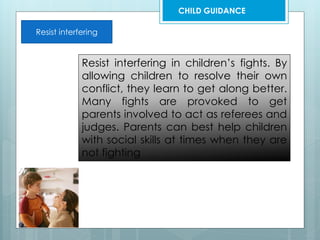
Resist interfering
Resist interfering in children’s fights. By
allowing children to resolve their own
conflict, they learn to get along better.
Many fights are provoked to get
parents involved to act as referees and
judges. Parents can best help children
with social skills at times when they are
not fighting
CHILD GUIDANCE
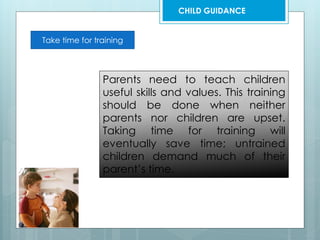
Take time for training
Parents need to teach children
useful skills and values. This training
should be done when neither
parents nor children are upset.
Taking time for training will
eventually save time; untrained
children demand much of their
parent’s time.
CHILD GUIDANCE
Children’s behavior as purpose
Their basic purpose is to find their place in
the social group, such as the family. Well-
adjusted children have found their way
towards social acceptance by
understanding the requirements of the group
or social situation and making useful
contributions to it. Misbehaving children are
still trying, in mistaken ways, to gain social
status.
CHILD GUIDANCE
THANK YOU

child guidance and its principles

  • 1.
  • 2.
  • 3.
    CHILD GUIDANCE IS PSYCHOLOGICALLYOR EMOTIONALLY DISTURBED CHILDREN, ESPECIALLY THROUGH COUNSELLING CHILD GUIDANCE
  • 4.
    PRINCIPLES OF CHILDGUIDANCE 1. Mutual respect 2. Encouragement 3. Be responsible for your own behavior and feelings 4. Natural consequences 5. Logical consequences 6. Punishment 7. Action is more effective than words 8. Withdrawing from struggles 9. Withdraw from the struggle , not from the child 10.Resist interfering 11.Take the time for training 12.Resist doing for children what they can do for themselves 13.Children’s behavior has purpose 14.Children are keen observers of situations CHILD GUIDANCE
  • 5.
    Mutual Respect It isthe key to improving relationships between parents and children. Parents and children are not the same; adults are are more knowledgeable and experienced. However , children are equal to parents in terms of worth and dignity. CHILD GUIDANCE
  • 6.
    Encouragement It implies faithin children as they are, not as parents would like them to be. Children misbehave only when they are discouraged and believe they cannot succeed by useful means. Children need encouragement just as plants need water. Parents can encourage children by focusing on their asserts and strengths. CHILD GUIDANCE
  • 7.
    Be responsible foryour own behavior and feelings Parents must accepts responsibility for improving the situations other than making futile attempts to make children behave. Instead of ruling children, parents can create an atmosphere in which guiding and helping children is possible. CHILD GUIDANCE
  • 8.
    Natural consequences It allowthe children to learn from the physical reality or situation rather than parental authority. The consequences of the situation can often exert the necessary pressure to stimulate useful motivations. Only in moments of real danger is it necessary to protect children from the natural consequences of their own disturbing behavior. CHILD GUIDANCE
  • 9.
    Logical consequences Allow childrento learn from the physical reality of the social world. Parents can intervene with consequences that both the parents and children can see as logically related to mis behavior and as respectful and reasonable. Through logical consequences children are offered choices and are encouraged to make responsible decision rather than being forced submit. CHILD GUIDANCE
  • 10.
    Punishment It is outdated.Children consider punishment as license to punish other or to retaliate against their parents. Encouragement and natural and logical consequences can be more effective methods of child discipline CHILD GUIDANCE
  • 11.
    Action is moreeffective than words It is in times of conflict. Children tend to become “parent- deaf” and act only when raised voices imply some impending action, and then respond only momentarily. Usually children know very well what is expected of them. CHILD GUIDANCE
  • 12.
    Withdrawing from struggle Withdrawing fromstruggle with children can be effective counteraction. Parents can physically remove themselves with out it being surrender. Removal is most effective when children demand undue attention or try to involve parents in power contests CHILD GUIDANCE
  • 13.
    Withdraw from thestruggle , not from the child Although talking and interactions in moments of conflict with children are ineffective , friendly conversation and pleasant contacts at other times are essential. Have fun and play together. The les attention children get when they are disturbing, the more cooperative the relationship may become. CHILD GUIDANCE
  • 14.
    Resist interfering Resist interferingin children’s fights. By allowing children to resolve their own conflict, they learn to get along better. Many fights are provoked to get parents involved to act as referees and judges. Parents can best help children with social skills at times when they are not fighting CHILD GUIDANCE
  • 15.
    Take time fortraining Parents need to teach children useful skills and values. This training should be done when neither parents nor children are upset. Taking time for training will eventually save time; untrained children demand much of their parent’s time. CHILD GUIDANCE
  • 16.
    Children’s behavior aspurpose Their basic purpose is to find their place in the social group, such as the family. Well- adjusted children have found their way towards social acceptance by understanding the requirements of the group or social situation and making useful contributions to it. Misbehaving children are still trying, in mistaken ways, to gain social status. CHILD GUIDANCE
  • 17.