FIRST AID SEMINAR
The ABC of First Aid
D Danger
R Response
A Airway
B Breathing
A
C
CirculationC
4
ARE YOU READY FOR FIRST AID?
First Aid is
The applications which are done without medical equipments or medications in
the case spot for saving life or preventing the situation go worse until the
Emergency Medical Services’ (EMS) help is provided when there’s an accident
or a situation which threatens life occurs.
(Ministry of Health First Aid Guide)
Emergency Care
The medical applications which are done by the
medical professionals, require all kinds of medicines
and medical equipments in emergency health care
units.
First-aider is
The person who is trained for the
applications which are described in
the first aid guideline.
Goals of First Aid
Basic Principles of First Aid
Protection
Information
Rescue
Protection
YOURSELF BYSTANDERS THE VICTIM
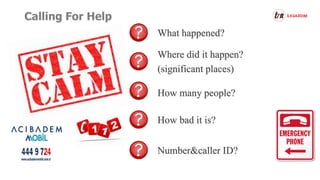
Calling For Help
What happened?
Where did it happen?
(significant places)
How many people?
How bad it is?
Number&caller ID?
Rescue
Simple technical rescue
Medical rescue (first aid)
Duties of the First Aider
A
C
Evaluating the condition of the victim
Handling the worries and fears
Priority determination
To lead
Keeping the victim warm
Not to move the victim
Calling EMS
Upgrading the first aid knowledge
Features of the Helper
A
C
Introduce yourself, take approval!
Leading
Chain Of Survival
Rescue
3
Calling EMS
2
First aid
1
4
EMS
5
Hospital
Evaluating The Spot
DANGERS VICTIM RECORD
Number types
Response Airway
Breathing Circulation
First Evaluation
Syncope
Inefficient brain circulation
Unconciousness, the victim falls
Brain circulation flow increases
The victim recovers immediately
PROBLEM
 Uncontrolled fall !
 Other problems ?
First Aid For Syncope
DANGER RESPONCE ABC
Recovery
position
Call EMS Observation
Recovery Position
Shock
Inefficient blood circulation
 Cardiogenic (heart attack)
 Hipovolemic (bleeding, burns, edema)
 Toxic
 Anaphylactic (bees, drugs)
Causes
Seizures
 Electrical discharge
 Bleeding
 Infection
 Intoxication
 Between 6 months-6 ages
 When the temperature is over 38C.
High fever convulsion Epilepsia
Drug addicts may show clinical features like seizures
First Aid For Seizures
Danger !
Call EMS
Keep the head safe
Put the environment away
Don’t try to stop the contractions
Don’t open the jaws
Observe
Colden
Call EMS
High Fever Convulsion
Convulsion
Chest Pain
A pain in the middle of the chest which radiates to the
arms, back and neck.
Shortness of breath Moist skin Feeling sick Vomiting
Cardiac Spasm:
Contraction of cardiac vessels
Heart attack:
Obstruction in cardiac vessels
Role of the First-aider:
Semi-sitting position
Call EMS
Observe!
Reasons of Choking
Tongue
Foreign objects
Water
Hanging
Lung injury
Gases, smoke
Insufficient O2
Stucking!
Incomplete obstruction
The victim;
 Coughs
 Can breath
 Can talk
Encourage coughing!
Complete Obstruction
The victim;
 Can’t breath
 Can’t talk
 Try to cough but can not
 Blushes
 Hands on the neck!
Back Blow
• Position !
• Try 5 times
• Give it up when he/she can breath.
• If it’s not enough for making the victim breath,
try the Manuever of Heimlich.
Manuever of Heimlich
 Hold the victim from back
 Make him/her lean front
 Put your fist below the chest bone
 Hold your fist with the other hand
 Pull 5 times upwards
 If he/she can’t breath try back blow again
 If the victim falls unconcious:
 Call EMS
 Apply BLS
 If the obstruction is over, take the victim to hospital
Application on Babies
 Support the head
 Position !
 5 times back blow
 Push the chest 5 times (like chest
compression; more powerful, slower).
 Continue one following the other
 If he/she falls unconcious:
 Call EMS
 BLS
 If the obstruction is over take the baby to
hospital
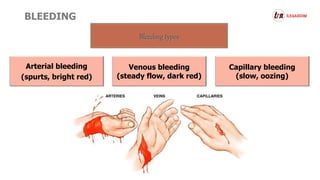
BLEEDING
Bleeding types
Arterial bleeding
(spurts, bright red)
Venous bleeding
(steady flow, dark red)
Capillary bleeding
(slow, oozing)
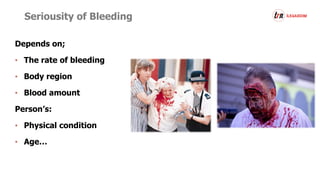
Seriousity of Bleeding
Depends on;
• The rate of bleeding
• Body region
• Blood amount
Person’s:
• Physical condition
• Age…
Role of the First Aider
A
C
Danger, response, ABC
Call EMS
Tamponade
Arterial pressure
Tourniquet
Elevation, stabilize
Shock position
Observation
Tamponade
On the wound:
Cover:
• Sterilize
• Clean
• Other
• Pressure with hand (glove!)
• If going to hospital, wound should be covered
If there’s a foreign body or open fracture, it cannot be applied !!!
Arterial Pressure Points
Pressure is applied on the arteries with fingers;
On the arm
On the groin
Tourniquet
Last hope !
On the single boned
extremities
Wide material which is not
elastical is used
Must be recorded !
Injuries
Soft tissue injury First aid
Resting
Ice Compress
Elevation
Elastical bandage
Swelling
Pain
Change of colour
Sprain
Injury of the ligaments: First aid
Resting
Ice Compress
Elevation
Take to the hospital
The bone is in the joint
Might be with fracture!
Dislocation
The bone dislocates from the joint
Stabilised as it’s seen
Call EMS!
Fracture
The intactness of the bone is corrupted:
(pain, swelling, colour change, deformation)
Closed fracture Open fracture
• Bleeding
• Paralysis
• Infection
First aid according to the region!
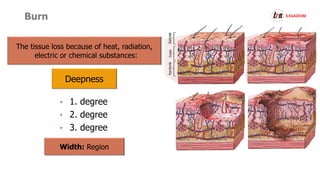
Burn
The tissue loss because of heat, radiation,
electric or chemical substances:
Deepness
• 1. degree
• 2. degree
• 3. degree
Width: Region
Heat
• 1. degree: Sun Cream
• 2. degree: Don’t pop the bubbles!
• 2. degree: More than 10%, Sensitive region: Call EMS!
• 3. degree: Call EMS!
Danger, response, ABC
Distinguishing!
Strip, cool
Stabilising, elevation
Frost Bite
• Sticks
• Sudden deaht
Freezers, car doors
Protect yourself with clothes
Call EMS!
Freezing, hipotermia!
• Warm up slowly
• Dry, closed places
• Wet clothes
• Foil
No movement or massage
Tight jewellery !
Responce 1
Touch the patient’s shoulder keeping a
distance of an arm length and shout as,
“Are you OK?”
If he/she responds, talk and help if necessary;
call an ambulance, keep him/her as you’ve
found, observe.
Responce 2
If the patient does not response, shout
for help
Open the airway
Airway
Tilt the head and lift the chin
Breathing 1
Look, listen and feel for 5-10 seconds
If the breathing is normal; Call EMS
If he/she should be left alone, give recovery position
Observe
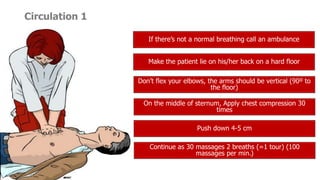
Circulation 1
If there’s not a normal breathing call an ambulance
Make the patient lie on his/her back on a hard floor
Don’t flex your elbows, the arms should be vertical (90º to
the floor)
On the middle of sternum, Apply chest compression 30
times
Push down 4-5 cm
Continue as 30 massages 2 breaths (=1 tour) (100
massages per min.)
Breathing 2
Apply respiratory support (mouth to mouth,
mouth to nose) without losing time
Give air for 1 sec. (Chest movement!)
(% 16 O2)
Watch the chest go down
Repeat ventilation
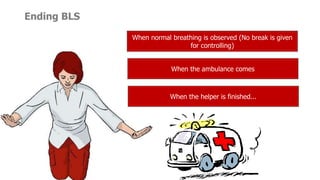
Ending BLS
When normal breathing is observed (No break is given
for controlling)
When the ambulance comes
When the helper is finished...
Application on Babies 1
Response is checked from the foot!
Chin upwards without pushing the head back!
Mouth anad nose together!
5 breaths is given.
Application on Babies 2
1 inch down the line which connects two nipples
Apply for babies with two fingers, for children with
one/two hands
Chest depth is pressed 1/3 of its width
The rhythm should be 30:2 for both babies and children
Chest Compression:
If the helper is alone:
1 min.of BLS then call an ambulance!
Adress
Aydınlı Yolu Street Number: 137
Pendik İSTANBUL
Phone
Phone Number: 0 216 483 20 23
Fax : 0 216 483 20 23
info@trnilkyardim.com
Social Media
www.trnilkyardim.com
Twitter.com/trnilkyardim
Facebook/trnilkyardim
İnstagram/trnilkyardim
THANK YOU

First aid seminar

  • 1.
  • 3.
    The ABC ofFirst Aid D Danger R Response A Airway B Breathing A C CirculationC
  • 4.
    4 ARE YOU READYFOR FIRST AID?
  • 5.
    First Aid is Theapplications which are done without medical equipments or medications in the case spot for saving life or preventing the situation go worse until the Emergency Medical Services’ (EMS) help is provided when there’s an accident or a situation which threatens life occurs. (Ministry of Health First Aid Guide)
  • 6.
    Emergency Care The medicalapplications which are done by the medical professionals, require all kinds of medicines and medical equipments in emergency health care units.
  • 7.
    First-aider is The personwho is trained for the applications which are described in the first aid guideline.
  • 8.
  • 9.
    Basic Principles ofFirst Aid Protection Information Rescue
  • 10.
  • 11.
    Calling For Help Whathappened? Where did it happen? (significant places) How many people? How bad it is? Number&caller ID?
  • 12.
  • 13.
    Duties of theFirst Aider A C Evaluating the condition of the victim Handling the worries and fears Priority determination To lead Keeping the victim warm Not to move the victim Calling EMS Upgrading the first aid knowledge
  • 14.
    Features of theHelper A C Introduce yourself, take approval! Leading
  • 15.
    Chain Of Survival Rescue 3 CallingEMS 2 First aid 1 4 EMS 5 Hospital
  • 16.
    Evaluating The Spot DANGERSVICTIM RECORD Number types
  • 17.
  • 18.
    Syncope Inefficient brain circulation Unconciousness,the victim falls Brain circulation flow increases The victim recovers immediately PROBLEM  Uncontrolled fall !  Other problems ?
  • 19.
    First Aid ForSyncope DANGER RESPONCE ABC Recovery position Call EMS Observation
  • 20.
  • 21.
    Shock Inefficient blood circulation Cardiogenic (heart attack)  Hipovolemic (bleeding, burns, edema)  Toxic  Anaphylactic (bees, drugs) Causes
  • 22.
    Seizures  Electrical discharge Bleeding  Infection  Intoxication  Between 6 months-6 ages  When the temperature is over 38C. High fever convulsion Epilepsia Drug addicts may show clinical features like seizures
  • 23.
    First Aid ForSeizures Danger ! Call EMS Keep the head safe Put the environment away Don’t try to stop the contractions Don’t open the jaws Observe Colden Call EMS High Fever Convulsion Convulsion
  • 24.
    Chest Pain A painin the middle of the chest which radiates to the arms, back and neck. Shortness of breath Moist skin Feeling sick Vomiting Cardiac Spasm: Contraction of cardiac vessels Heart attack: Obstruction in cardiac vessels Role of the First-aider: Semi-sitting position Call EMS Observe!
  • 25.
    Reasons of Choking Tongue Foreignobjects Water Hanging Lung injury Gases, smoke Insufficient O2 Stucking!
  • 26.
    Incomplete obstruction The victim; Coughs  Can breath  Can talk Encourage coughing! Complete Obstruction The victim;  Can’t breath  Can’t talk  Try to cough but can not  Blushes  Hands on the neck!
  • 27.
    Back Blow • Position! • Try 5 times • Give it up when he/she can breath. • If it’s not enough for making the victim breath, try the Manuever of Heimlich.
  • 28.
    Manuever of Heimlich Hold the victim from back  Make him/her lean front  Put your fist below the chest bone  Hold your fist with the other hand  Pull 5 times upwards  If he/she can’t breath try back blow again  If the victim falls unconcious:  Call EMS  Apply BLS  If the obstruction is over, take the victim to hospital
  • 29.
    Application on Babies Support the head  Position !  5 times back blow  Push the chest 5 times (like chest compression; more powerful, slower).  Continue one following the other  If he/she falls unconcious:  Call EMS  BLS  If the obstruction is over take the baby to hospital
  • 30.
    BLEEDING Bleeding types Arterial bleeding (spurts,bright red) Venous bleeding (steady flow, dark red) Capillary bleeding (slow, oozing)
  • 31.
    Seriousity of Bleeding Dependson; • The rate of bleeding • Body region • Blood amount Person’s: • Physical condition • Age…
  • 32.
    Role of theFirst Aider A C Danger, response, ABC Call EMS Tamponade Arterial pressure Tourniquet Elevation, stabilize Shock position Observation
  • 33.
    Tamponade On the wound: Cover: •Sterilize • Clean • Other • Pressure with hand (glove!) • If going to hospital, wound should be covered If there’s a foreign body or open fracture, it cannot be applied !!!
  • 34.
    Arterial Pressure Points Pressureis applied on the arteries with fingers; On the arm On the groin
  • 35.
    Tourniquet Last hope ! Onthe single boned extremities Wide material which is not elastical is used Must be recorded !
  • 36.
    Injuries Soft tissue injuryFirst aid Resting Ice Compress Elevation Elastical bandage Swelling Pain Change of colour
  • 37.
    Sprain Injury of theligaments: First aid Resting Ice Compress Elevation Take to the hospital The bone is in the joint Might be with fracture!
  • 38.
    Dislocation The bone dislocatesfrom the joint Stabilised as it’s seen Call EMS!
  • 39.
    Fracture The intactness ofthe bone is corrupted: (pain, swelling, colour change, deformation) Closed fracture Open fracture • Bleeding • Paralysis • Infection First aid according to the region!
  • 40.
    Burn The tissue lossbecause of heat, radiation, electric or chemical substances: Deepness • 1. degree • 2. degree • 3. degree Width: Region
  • 41.
    Heat • 1. degree:Sun Cream • 2. degree: Don’t pop the bubbles! • 2. degree: More than 10%, Sensitive region: Call EMS! • 3. degree: Call EMS! Danger, response, ABC Distinguishing! Strip, cool Stabilising, elevation
  • 42.
    Frost Bite • Sticks •Sudden deaht Freezers, car doors Protect yourself with clothes Call EMS! Freezing, hipotermia! • Warm up slowly • Dry, closed places • Wet clothes • Foil No movement or massage Tight jewellery !
  • 43.
    Responce 1 Touch thepatient’s shoulder keeping a distance of an arm length and shout as, “Are you OK?” If he/she responds, talk and help if necessary; call an ambulance, keep him/her as you’ve found, observe.
  • 44.
    Responce 2 If thepatient does not response, shout for help Open the airway Airway Tilt the head and lift the chin
  • 45.
    Breathing 1 Look, listenand feel for 5-10 seconds If the breathing is normal; Call EMS If he/she should be left alone, give recovery position Observe
  • 46.
    Circulation 1 If there’snot a normal breathing call an ambulance Make the patient lie on his/her back on a hard floor Don’t flex your elbows, the arms should be vertical (90º to the floor) On the middle of sternum, Apply chest compression 30 times Push down 4-5 cm Continue as 30 massages 2 breaths (=1 tour) (100 massages per min.)
  • 47.
    Breathing 2 Apply respiratorysupport (mouth to mouth, mouth to nose) without losing time Give air for 1 sec. (Chest movement!) (% 16 O2) Watch the chest go down Repeat ventilation
  • 48.
    Ending BLS When normalbreathing is observed (No break is given for controlling) When the ambulance comes When the helper is finished...
  • 49.
    Application on Babies1 Response is checked from the foot! Chin upwards without pushing the head back! Mouth anad nose together! 5 breaths is given.
  • 50.
    Application on Babies2 1 inch down the line which connects two nipples Apply for babies with two fingers, for children with one/two hands Chest depth is pressed 1/3 of its width The rhythm should be 30:2 for both babies and children Chest Compression: If the helper is alone: 1 min.of BLS then call an ambulance!
  • 52.
    Adress Aydınlı Yolu StreetNumber: 137 Pendik İSTANBUL Phone Phone Number: 0 216 483 20 23 Fax : 0 216 483 20 23 info@trnilkyardim.com Social Media www.trnilkyardim.com Twitter.com/trnilkyardim Facebook/trnilkyardim İnstagram/trnilkyardim THANK YOU