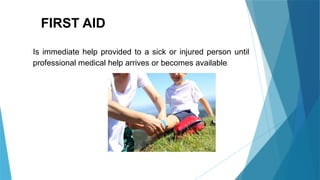
FIRST AID
Is immediatehelp provided to a sick or injured person until
professional medical help arrives or becomes available.
4.
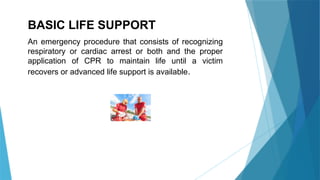
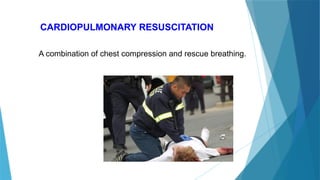
An emergency procedurethat consists of recognizing
respiratory or cardiac arrest or both and the proper
application of CPR to maintain life until a victim
recovers or advanced life support is available.
BASIC LIFE SUPPORT
5.
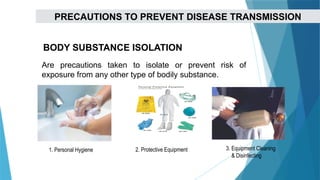
BODY SUBSTANCE ISOLATION
Areprecautions taken to isolate or prevent risk of
exposure from any other type of bodily substance.
1. Personal Hygiene 2. Protective Equipment 3. Equipment Cleaning
& Disinfecting
PRECAUTIONS TO PREVENT DISEASE TRANSMISSION
1. Plan ofAction
2. Provision of Logistics
The emergency response begins with the preparation of equipment and
personnel before any emergency occurs.
GETTING STARTED
Emergency plans should be established based on anticipated needs and
available resources.
10.
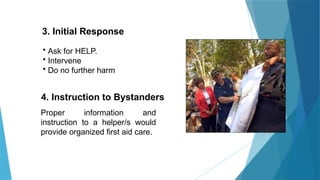
3. Initial Response
•Ask for HELP.
• Intervene
• Do no further harm
4. Instruction to Bystanders
Proper information and
instruction to a helper/s would
provide organized first aid care.
11.
1. Scene Size-Up
Once you recognized that an emergency has occurred and decide to act,
you must make sure the scene of the emergency is safe for you, the
victim/s, and any bystander/s.
EMERGENCY ACTION PRINCIPLES
12.
Ensure Scene Safety
If the scene is unsafe, make it safe.
If this is not possible, do not enter.
Request law enforcement or other assistance.
Beware of scenes with potential for violence.
13.
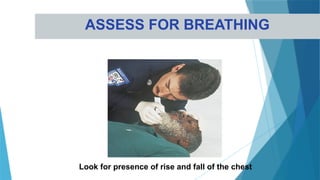
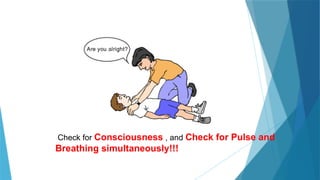
If a victimis unresponsive, with absent or abnormal
breathing (agonal gasping), the lay rescuer should
assume the victim is in cardiac arrest or the
healthcare provider should check for a pulse for no
more than 10 seconds, if no definitive pulse is felt,
should assume the victim s in cardiac arrest.
2. Assess Responsiveness
14.
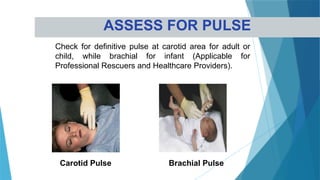
ASSESS FOR PULSE
CarotidPulse Brachial Pulse
Check for definitive pulse at carotid area for adult or
child, while brachial for infant (Applicable for
Professional Rescuers and Healthcare Providers).
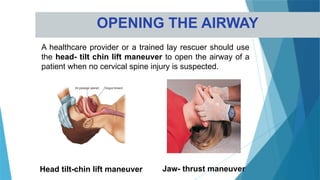
OPENING THE AIRWAY
Ahealthcare provider or a trained lay rescuer should use
the head- tilt chin lift maneuver to open the airway of a
patient when no cervical spine injury is suspected.
Head tilt-chin lift maneuver Jaw- thrust maneuver
18.
3. Activate MedicalHelp
Ask someone to call for local emergency number and get
and Automated External Defibrillator (AED).
19.
Information to beremembered in activating medical help:
What happened?
Location of emergency?
Number of persons injured or ill?
Cause and extent of injury and nature of illness and first
aid given?
Telephone number from where call is made?
Name of person who called medical help (must identify
him/herself and hang up phone last).
20.
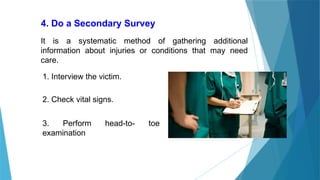
4. Do aSecondary Survey
It is a systematic method of gathering additional
information about injuries or conditions that may need
care.
1. Interview the victim.
2. Check vital signs.
3. Perform head-to- toe
examination
21.
INTERVIEW
S- Signs andSymptoms
A- Allergies
M- Medications
P- Past Medical History
L- Last Meal Taken
E- Events prior to Injury
22.
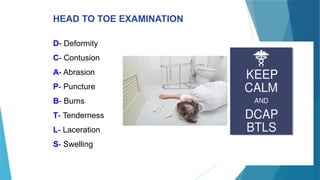
D- Deformity
C- Contusion
A-Abrasion
P- Puncture
B- Burns
T- Tenderness
L- Laceration
S- Swelling
HEAD TO TOE EXAMINATION
23.
GOLDEN RULES INGIVING
EMERGENCY CARE
Do’s
Remember to identify yourself to the victim.
Respect the victim’s modesty and physical privacy.
Be as calm and as direct as possible.
Care for the most severe injuries first.
Loosen all tight clothing.
24.
Don'ts
Letthe victim see his/her own injury.
Leave the victim alone except to get help.
Assume that the victim’s obvious injuries are the only ones.
Make any unrealistic promises.
Trust the judgment of a confused victim and require them to make decision.
HEART ATTACK (Myocardial Infarction)
It occurs when the oxygen supply to the heart muscle (myocardium) is cut-
off for a prolonged period of time. This cut-off results from a reduced blood
supply due to severe narrowing or complete blockage of the diseased artery.
The result is death (infarction) of the affected part of the heart.
27.
Warning Signals:
Chest discomfortcharacterized by:
Uncomfortable pressure
• Squeezing
• Fullness or tightness
• Aching
• Crushing
• Constricting
• Oppressive or heavy
Sweating
Nausea
Shortness of breathe
28.
First Aid Managementof Heart Attack
1. Recognized the signals of heart attack and take action.
2. Have patient stop what he or she is doing and sit or lie him/her down in
a comfortable position. Do not let the patient move around.
3. Have someone call the physician or ambulance for help.
4. If patient is under medical care, assist him/her in taking his/her prescribed
medicine/s.
29.
CARDIAC ARREST
Is acondition occurs when the heart stops contracting and no blood
circulates thru the blood vessels and vital organs are deprived of
oxygen
CHEST COMPRESSION ONLY(HANDS ONLY) CPR
Done when a person or rescuer is unwilling or unable to perform mouth to
mouth or rescue breathing.
For use in dispatcher assisted CPR instructions wherein the simplicity of this
modified technique allow untrained bystanders to rapidly intervene.
32.
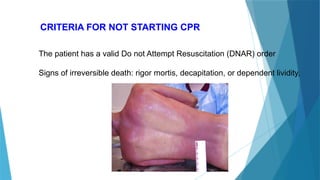
CRITERIA FOR NOTSTARTING CPR
The patient has a valid Do not Attempt Resuscitation (DNAR) order
Signs of irreversible death: rigor mortis, decapitation, or dependent lividity,
33.
WHEN TO STOPCPR
Spontaneous signs of breathing and circulation.
Turned over to professional provider.
Operator is exhausted.
Physician assumes responsibility.
Scene become unsafe.
34.
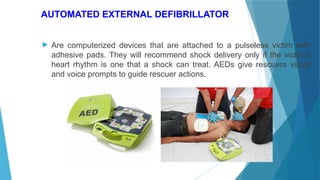
AUTOMATED EXTERNAL DEFIBRILLATOR
Are computerized devices that are attached to a pulseless victim with
adhesive pads. They will recommend shock delivery only if the victim’s
heart rhythm is one that a shock can treat. AEDs give rescuers visual
and voice prompts to guide rescuer actions.
FOREIGN BODY AIRWAYOBSTRUCTIONS
• Also known as choking, is a common breathing emergency that
occurs when the person’s airway is partially or completely blocked
by a foreign object, such as a piece of food or a small toy; by
swelling in the mouth or throat; or by fluids, such as vomit or
blood.
37.
FBAO COMMON CAUSES:
•Swallowing large pieces of poorly chewed food
• Drinking alcohol
• Wearing dentures
• Eating while talking excitedly, laughing, or eating too fast
• Walking, playing or running with food or objects in the mouth
• In infants and children, choking occurs while eating or by
putting non-food items such as coins, toys inside the mouth
while playing
38.
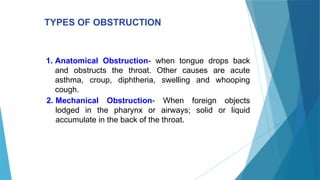
TYPES OF OBSTRUCTION
1.Anatomical Obstruction- when tongue drops back
and obstructs the throat. Other causes are acute
asthma, croup, diphtheria, swelling and whooping
cough.
2. Mechanical Obstruction- When foreign objects
lodged in the pharynx or airways; solid or liquid
accumulate in the back of the throat.
39.
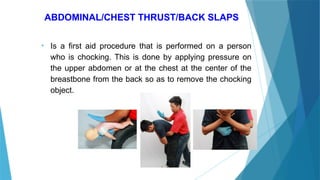
ABDOMINAL/CHEST THRUST/BACK SLAPS
•Is a first aid procedure that is performed on a person
who is chocking. This is done by applying pressure on
the upper abdomen or at the chest at the center of the
breastbone from the back so as to remove the chocking
object.
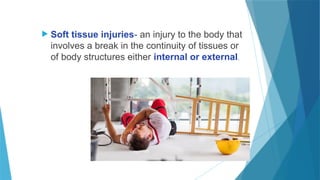
Soft tissueinjuries- an injury to the body that
involves a break in the continuity of tissues or
of body structures either internal or external.
42.
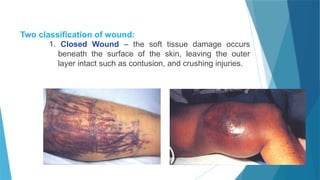
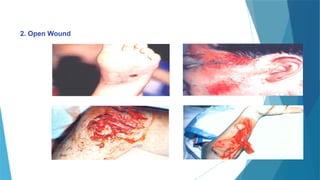
Two classification ofwound:
1. Closed Wound – the soft tissue damage occurs
beneath the surface of the skin, leaving the outer
layer intact such as contusion, and crushing injuries.
43.
Signs andSymptoms:
Pain
Swelling
Discoloration
Vomiting or coughing up of blood
Passage of blood in urine or feces
Sign of blood along mouth, nose and ear canal
Restlessness and symptoms of Shock (Fainting)
44.
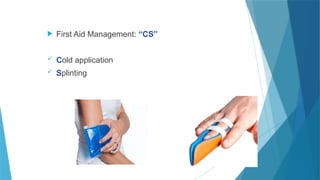
First AidManagement: “CS”
Cold application
Splinting
First AidManagement: “4 C’s”
Control bleeding- RICE (Rest, Ice, Compress, and Elevate)
Cover the wound with dressing and secure with a bandage
Care for Shock/Fainting: 3 P’s (Proper body position- feet elevated
above the level of the heart, Proper body heat, and Proper transfer)
Consult Physician
47.
Burns- isan injury involving the skin, muscles, bones,
nerves, and blood vessels. This results from heat,
chemicals, electricity and other forms of radiation.
48.
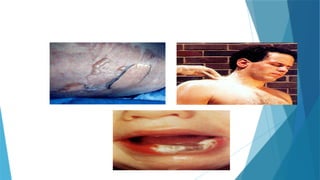
Depth:
1st
Degree/ Superficial-tissue destruction involving epidermis
only.
2nd
Degree/Partial Thickness- involves epidermis and part of
dermis.
3rd
Degree/Full Thickness- involves epidermis, dermis, and
underlying organs.
50.
First AidManagement:
1st
Degree and 2nd
Degree Burns:
Immerse burned area in cold water or apply wet cold cloth
for 10-15
Cover the burn with a dry, non sticking sterile dressing or
a clean cloth
Treat the victim for shock by elevating the legs
51.
3rd
Degree Burns:
Cover the burn with a dry, non sticking sterile
dressing or a clean cloth
Treat the victim for shock by elevating the legs
*Note:
Remove clothing if there is chemical
contamination, brush off chemical if in powder
form and flush for 20 minutes
Take not to Unplug or disconnect power supply if
electrical in nature, then monitor ABC’s
52.
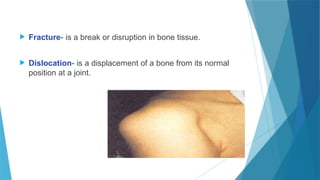
Fracture- isa break or disruption in bone tissue.
Dislocation- is a displacement of a bone from its normal
position at a joint.
53.
Signs andSymptoms:
Severe pain
Swelling
Misshapen appearance or obvious deformity
Loss of function
Loss/diminished pulse in an injured limb
Numbness furthers down the arm or leg
54.
First AidManagement:
Stabilize the patient’s ABC’s
Keep the patient still
Check the patient’s Pulse, Motor, and Sensory (PMS) before
and after immobilization
Immobilize the injury in the position which you found it before
applying cold compress for closed fracture except for open
fracture
#8 Slide Show Notes
Just imagine:
A co-worker is hurt in an accident and blood is gushing from the wound.
One of your friends chokes on a piece of food and can’t breathe.
Someone goes into cardiac arrest right at his workstation.
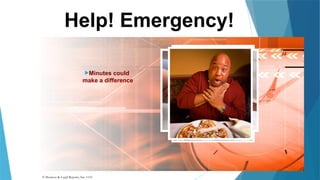
Any one of these things is possible, and it could happen any time. If it did, you’d have to act fast. A few critical minutes one way or the other could make the difference between life and death. Would you be ready to act with speed and competence in a workplace medical emergency?
There are medical emergencies in workplaces across the country every day. Situations calling for first aid range from burns to cuts and amputations, eye injuries, chemical overexposures, and much more.
Do you know how to report a workplace medical emergency? Besides calling 911, you also need to notify a supervisor or manager and provide as much information as you can about the accident.
Describe the procedure for reporting workplace accidents and the information trainees should be prepared to provide about the incident.