GRAPH
PRESENTED BY
R.RAMADEVI
M.sc(CS & IT)
NADAR SARASWATHI COLLEGE OF ARTS & SCIENCE
THENI
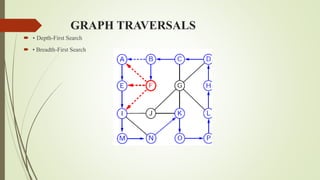
GRAPH TRAVERSALS
 • Depth-First Search
 • Breadth-First Search
Depth-first search (DFS)
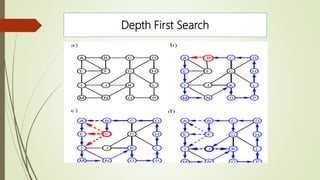
• A depth-first search (DFS) in an undirected graph G is like
wandering in a labyrinth with a string and a can of red paint without
getting lost.
• We start at vertex s, tying the end of our string to the point and
paintings “visited”. Next we label s as our current vertex called u.
• Now we travel along an arbitrary edge (u,v)
.If edge (u,v) leads us to an already visited vertex v we return to u.
Depth-first search (DFS)
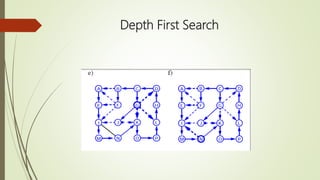
1. If vertex v is unvisited, we unroll our string and move to v, paint v
“visited”, set v as our current vertex, and repeat the previous steps.
2.Eventually, we will get to a point where all incident edges on u lead
to visited vertices.
3.We then backtrack by unrolling our string to a previously visited
vertex v.
4.Then v becomes our current vertex and we repeat the previous steps
Depth-First Search
 Algorithm DFS(v);
 Input: A vertex v in a graph
 Output: A labeling of the edges as “discovery” edges
and “backedges”
for each edge e incident on v do
if edge e is unexplored then
let w be the other endpoint of e
if vertex w is unexplored then
label e as a discovery edge
recursively call DFS(w)
else
label e as a backedge
Depth First Search
Depth First Search
Generic Depth First Search
public abstract class DFS {
protected Object dfsVisit(Vertex v) {
protected InspectableGraph graph;
protected Object visitResult;
initResult();
startVisit(v);
mark(v);
for (Enumeration inEdges = graph.incidentEdges(v);
inEdges.hasMoreElements();) {
Edge nextEdge = (Edge) inEdges.nextElement();
if (!isMarked(nextEdge)) { // found an unexplored edge
mark(nextEdge);
Vertex w = graph.opposite(v, nextEdge);
if (!isMarked(w)) { // discovery edge
mark(nextEdge);
traverseDiscovery(nextEdge, v);
if (!isDone())
VisitResult = dfVisit(w); }
else // back edge
TraverseBack(nextEdge, v);
}
}
FinishVisit(v);
return result();
}
Breadth-First Search
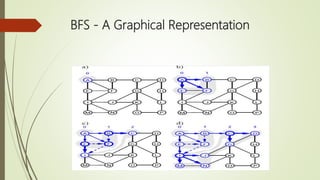
 Like DFS, a Breadth-First Search (BFS) traverses a connected
component of a graph, and in doing so defines a spanning tree with
several useful properties
 The starting vertex s has level 0, and, as in DFS , defines that point as
an “anchor.”
 In the first round, the string is unrolled the length of one edge, and all of
the edges that are only one edge away from the anchor are visited.
 These edges are placed into level 1
Breadth-First Search
 In the second round, all the new edges that can be reached by
unrolling the string 2 edges are visited and placed in level 2.
 This continues until every vertex has been assigned a level.
 The label of any vertex v corresponds to the length of the shortest
path from s to v.
BFS - A Graphical Representation
More BFS
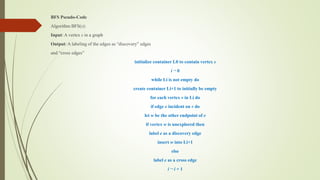
BFS Pseudo-Code
Algorithm BFS(s):
Input: A vertex s in a graph
Output: A labeling of the edges as “discovery” edges
and “cross edges”
initialize container L0 to contain vertex s
i ¬ 0
while Li is not empty do
create container Li+1 to initially be empty
for each vertex v in Li do
if edge e incident on v do
let w be the other endpoint of e
if vertex w is unexplored then
label e as a discovery edge
insert w into Li+1
else
label e as a cross edge
i ¬ i + 1
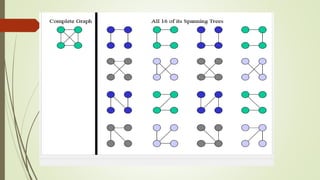
Spanning tree
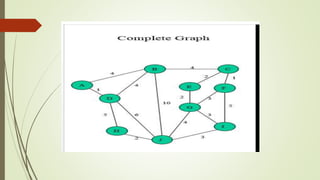
A spanning tree of a graph is just a subgraph that contains all the vertices and is a
tree.
A graph may have many spanning trees.
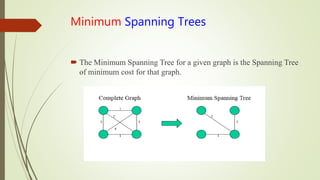
Minimum Spanning Trees
 The Minimum Spanning Tree for a given graph is the Spanning Tree
of minimum cost for that graph.
Algorithms for Obtaining the Minimum
Spanning Tree
 Kruskal's Algorithm
 Prim's Algorithm
 Boruvka's Algorithm
Kruskal's Algorithm
 This algorithm creates a forest of trees. Initially the forest consists of n single
node trees (and no edges).
 At each step, we add one edge (the cheapest one) so that it joins two trees
together.
 If it were to form a cycle, it would simply link two nodes that were already part of
a single connected tree, so that this edge would not be needed.
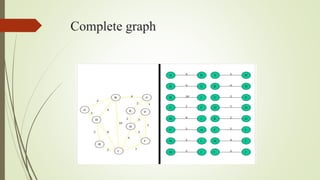
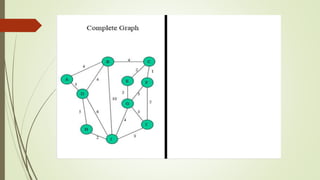
Complete graph
Prim's Algorithm
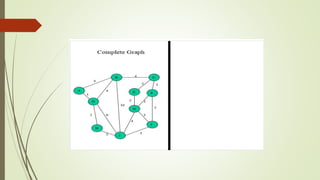
 This algorithm starts with one node.
 It then, one by one, adds a node that is unconnected to the new
graph to the new graph, each time selecting the node.
 whose connecting edge has the smallest weight out of the available
nodes’ connecting edges.
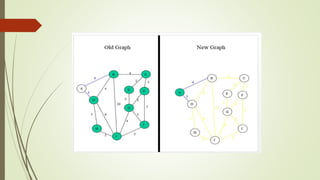
Boruvka's Algorithm
 This algorithm is similar to Prim’s, but nodes are added to the new
graph in parallel all around the graph.
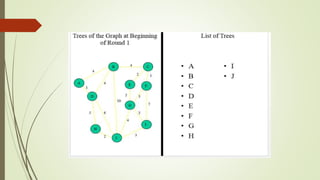
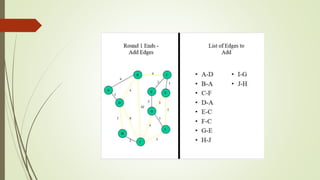
 It creates a list of trees, each containing one node from the original
graph and proceeds to merge them along the smallest-weight
connecting edges until there’s only one tree, which is, of course, the
MST.
 It works rather like a merge sort.
THANKYOU!!!!!

Graphs in Data Structure

  • 1.
    GRAPH PRESENTED BY R.RAMADEVI M.sc(CS &IT) NADAR SARASWATHI COLLEGE OF ARTS & SCIENCE THENI
  • 2.
    GRAPH TRAVERSALS  •Depth-First Search  • Breadth-First Search
  • 3.
    Depth-first search (DFS) •A depth-first search (DFS) in an undirected graph G is like wandering in a labyrinth with a string and a can of red paint without getting lost. • We start at vertex s, tying the end of our string to the point and paintings “visited”. Next we label s as our current vertex called u. • Now we travel along an arbitrary edge (u,v) .If edge (u,v) leads us to an already visited vertex v we return to u.
  • 4.
    Depth-first search (DFS) 1.If vertex v is unvisited, we unroll our string and move to v, paint v “visited”, set v as our current vertex, and repeat the previous steps. 2.Eventually, we will get to a point where all incident edges on u lead to visited vertices. 3.We then backtrack by unrolling our string to a previously visited vertex v. 4.Then v becomes our current vertex and we repeat the previous steps
  • 5.
    Depth-First Search  AlgorithmDFS(v);  Input: A vertex v in a graph  Output: A labeling of the edges as “discovery” edges and “backedges” for each edge e incident on v do if edge e is unexplored then let w be the other endpoint of e if vertex w is unexplored then label e as a discovery edge recursively call DFS(w) else label e as a backedge
  • 6.
  • 7.
  • 8.
    Generic Depth FirstSearch public abstract class DFS { protected Object dfsVisit(Vertex v) { protected InspectableGraph graph; protected Object visitResult; initResult(); startVisit(v); mark(v); for (Enumeration inEdges = graph.incidentEdges(v); inEdges.hasMoreElements();) { Edge nextEdge = (Edge) inEdges.nextElement(); if (!isMarked(nextEdge)) { // found an unexplored edge
  • 9.
    mark(nextEdge); Vertex w =graph.opposite(v, nextEdge); if (!isMarked(w)) { // discovery edge mark(nextEdge); traverseDiscovery(nextEdge, v); if (!isDone()) VisitResult = dfVisit(w); } else // back edge TraverseBack(nextEdge, v); } } FinishVisit(v); return result(); }
  • 10.
    Breadth-First Search  LikeDFS, a Breadth-First Search (BFS) traverses a connected component of a graph, and in doing so defines a spanning tree with several useful properties  The starting vertex s has level 0, and, as in DFS , defines that point as an “anchor.”  In the first round, the string is unrolled the length of one edge, and all of the edges that are only one edge away from the anchor are visited.  These edges are placed into level 1
  • 11.
    Breadth-First Search  Inthe second round, all the new edges that can be reached by unrolling the string 2 edges are visited and placed in level 2.  This continues until every vertex has been assigned a level.  The label of any vertex v corresponds to the length of the shortest path from s to v.
  • 12.
    BFS - AGraphical Representation
  • 13.
  • 14.
    BFS Pseudo-Code Algorithm BFS(s): Input:A vertex s in a graph Output: A labeling of the edges as “discovery” edges and “cross edges” initialize container L0 to contain vertex s i ¬ 0 while Li is not empty do create container Li+1 to initially be empty for each vertex v in Li do if edge e incident on v do let w be the other endpoint of e if vertex w is unexplored then label e as a discovery edge insert w into Li+1 else label e as a cross edge i ¬ i + 1
  • 15.
    Spanning tree A spanningtree of a graph is just a subgraph that contains all the vertices and is a tree. A graph may have many spanning trees.
  • 17.
    Minimum Spanning Trees The Minimum Spanning Tree for a given graph is the Spanning Tree of minimum cost for that graph.
  • 18.
    Algorithms for Obtainingthe Minimum Spanning Tree  Kruskal's Algorithm  Prim's Algorithm  Boruvka's Algorithm
  • 19.
    Kruskal's Algorithm  Thisalgorithm creates a forest of trees. Initially the forest consists of n single node trees (and no edges).  At each step, we add one edge (the cheapest one) so that it joins two trees together.  If it were to form a cycle, it would simply link two nodes that were already part of a single connected tree, so that this edge would not be needed.
  • 21.
  • 22.
    Prim's Algorithm  Thisalgorithm starts with one node.  It then, one by one, adds a node that is unconnected to the new graph to the new graph, each time selecting the node.  whose connecting edge has the smallest weight out of the available nodes’ connecting edges.
  • 25.
    Boruvka's Algorithm  Thisalgorithm is similar to Prim’s, but nodes are added to the new graph in parallel all around the graph.  It creates a list of trees, each containing one node from the original graph and proceeds to merge them along the smallest-weight connecting edges until there’s only one tree, which is, of course, the MST.  It works rather like a merge sort.
  • 31.