Firebird 3: provider-based architecture, plugins and OO approach to API Alex Peshkov Firebird Foundation 2011
Architectural goals of Firebird3 Provide more and better ways for users to extend functionality of firebird How to do it: Introduce (or may be restore ?) provider-based architecture Introduce (or may be extend ?) plugins
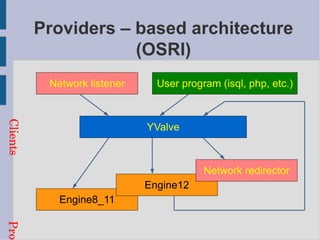
Providers – based architecture (OSRI) Providers Clients YValve Network listener User program (isql, php, etc.) Engine8_11 Engine12 Network redirector
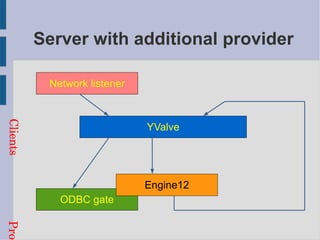
Server with additional provider Providers Clients YValve Network listener ODBC gate Engine12
Server with additional provider EXECUTE STATEMENT 'ODBC SPECIFIC OPERATOR' ON EXTERNAL 'ODBC://odbc_datasource_name' Engine12: Attach Database 'ODBC://odbc_datasource_name' YValve: Tries known providers, including ODBC gate ODBC gate: Recognizes 'ODBC://' prefix Calls appropriate ODBC function to establish connection
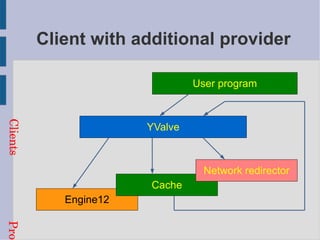
Client with additional provider Providers Clients YValve User program Engine12 Cache Network redirector
Client with additional provider Client: Attach Database 'CACHE://SRV/dbAlias' Yvalve: Tries known providers, including CACHE CACHE: Recognizes 'CACHE://' prefix Can use 'INET://somehost/dbAlias' to access remote data Can use embedded connection to access cached data
Plugins Provide almost unlimited capabilities of extending firebird with what user needs UDFs and blob filters are also a kind of plugins with specific interface and calling rules Require (like UDFs) special care to avoid malicious code, executed in server context all plugins, not described explicitly in configuration file, are loaded from $(root)/plugins, slash in names is not permitted if one provides path information in explicit plugin description – he should care about it himself
Plugins May be plugged only into specially prepared points of main firebird code Firebird 3 will support the following types of plugins: Trace; External engines; Authentication (server/client) and users' management; Crypt (network and may be database).
Plugins Have interface, specific for each predefined point in firebird code Have common rules of load/unload and configuration Have common interface, controlling that common features
Plugins and providers-base architecture Provider is invoked from specific point of a code (from yValve) Providers should be loaded/unloaded to/from firebird process address space Providers can and should be treated as a special kind of plugins this avoids adding special code, duplicating one for plugins
Choosing API Functional API Follows existing (isc_attach_database) style Object-oriented API Used in a lot of modern software Saves resources when loading plugin Backward compatibility at yValve level for providers API
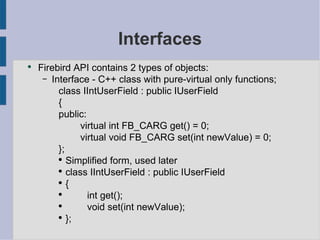
Firebird API contains 2 types of objects: Interface - C++ class with pure-virtual only functions; class IIntUserField : public IUserField { public: virtual int FB_CARG get() = 0; virtual void FB_CARG set(int newValue) = 0; }; Simplified form, used later class IIntUserField : public IUserField { int get(); void set(int newValue); }; Interfaces
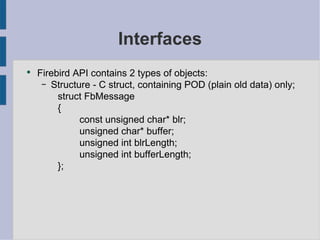
Firebird API contains 2 types of objects: Structure - C struct, containing POD (plain old data) only; struct FbMessage { const unsigned char* blr; unsigned char* buffer; unsigned int blrLength; unsigned int bufferLength; }; Interfaces
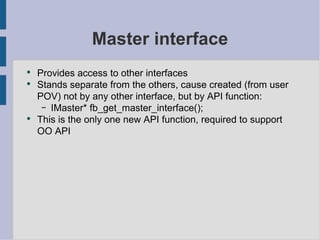
Provides access to other interfaces Stands separate from the others, cause created (from user POV) not by any other interface, but by API function: IMaster* fb_get_master_interface(); This is the only one new API function, required to support OO API Master interface
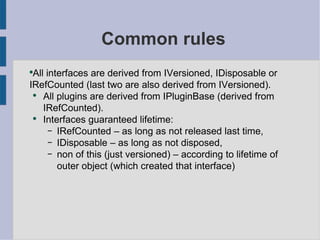
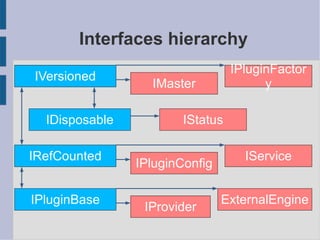
Common rules All interfaces are derived from IVersioned, IDisposable or IRefCounted (last two are also derived from IVersioned). All plugins are derived from IPluginBase (derived from IRefCounted). Interfaces guaranteed lifetime: IRefCounted – as long as not released last time, IDisposable – as long as not disposed, non of this (just versioned) – according to lifetime of outer object (which created that interface)
IVersioned – version of interface Firebird interfaces are not COM interfaces – we support multiple versions of same interface. Interface version can be upgraded by code, receiving interface from other module. Interface version is always equal to total number of virtual functions in it. Use of upgraded interface does not cause any delays when using it's functions.
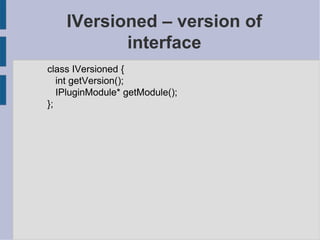
IVersioned – version of interface class IVersioned { int getVersion(); IPluginModule* getModule(); };
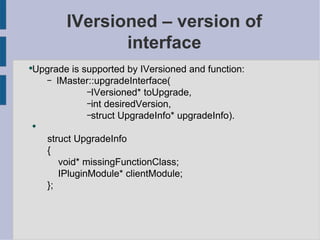
IVersioned – version of interface Upgrade is supported by IVersioned and function: IMaster::upgradeInterface( IVersioned* toUpgrade, int desiredVersion, struct UpgradeInfo* upgradeInfo). struct UpgradeInfo { void* missingFunctionClass; IPluginModule* clientModule;  };
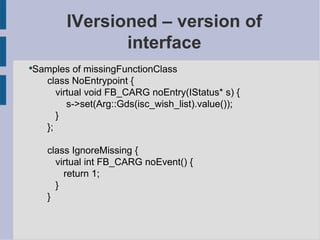
IVersioned – version of interface Samples of missingFunctionClass class NoEntrypoint { virtual void FB_CARG noEntry(IStatus* s) { s->set(Arg::Gds(isc_wish_list).value()); } }; class IgnoreMissing { virtual int FB_CARG noEvent() { return 1; } }
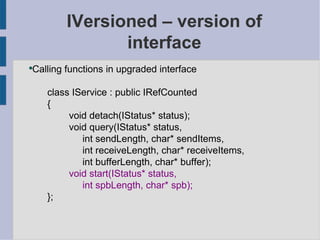
IVersioned – version of interface Calling functions in upgraded interface class IService : public IRefCounted { void detach(IStatus* status); void query(IStatus* status, int sendLength, char* sendItems, int receiveLength, char* receiveItems, int bufferLength, char* buffer); void start(IStatus* status, int spbLength, char* spb); };
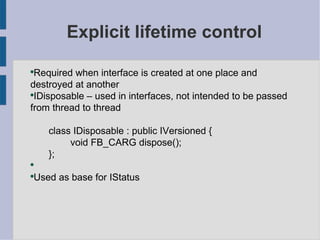
Explicit lifetime control Required when interface is created at one place and destroyed at another IDisposable – used in interfaces, not intended to be passed from thread to thread class IDisposable : public IVersioned { void FB_CARG dispose(); }; Used as base for IStatus
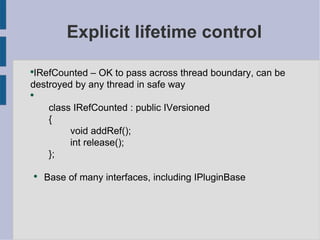
Explicit lifetime control IRefCounted – OK to pass across thread boundary, can be destroyed by any thread in safe way class IRefCounted : public IVersioned { void addRef(); int release(); }; Base of many interfaces, including IPluginBase
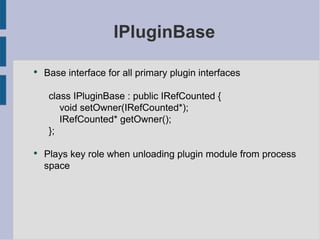
IPluginBase Base interface for all primary plugin interfaces class IPluginBase : public IRefCounted { void setOwner(IRefCounted*); IRefCounted* getOwner(); }; Plays key role when unloading plugin module from process space
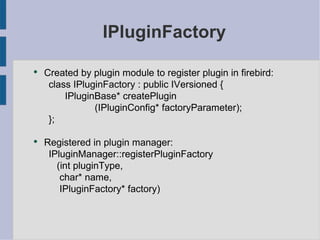
IPluginFactory Created by plugin module to register plugin in firebird: class IPluginFactory : public IVersioned { IPluginBase* createPlugin (IPluginConfig* factoryParameter); }; Registered in plugin manager: IPluginManager::registerPluginFactory (int pluginType, char* name, IPluginFactory* factory)
Interfaces hierarchy IVersioned IMaster IDisposable IRefCounted IPluginBase IPluginFactory IStatus IPluginConfig IService IProvider ExternalEngine
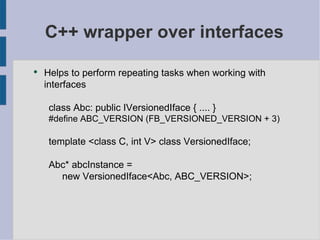
C++ wrapper over interfaces Helps to perform repeating tasks when working with interfaces class Abc: public IVersionedIface { .... } #define ABC_VERSION (FB_VERSIONED_VERSION + 3) template <class C, int V> class VersionedIface; Abc* abcInstance = new VersionedIface<Abc, ABC_VERSION>;
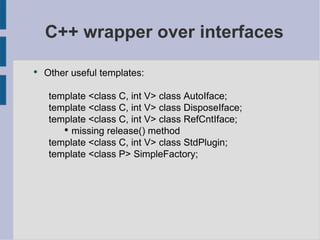
C++ wrapper over interfaces Other useful templates: template <class C, int V> class AutoIface; template <class C, int V> class DisposeIface; template <class C, int V> class RefCntIface; missing release() method template <class C, int V> class StdPlugin; template <class P> SimpleFactory;
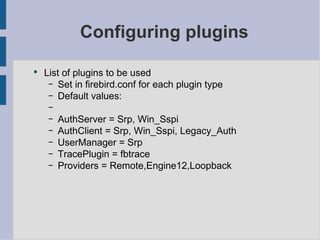
Configuring plugins List of plugins to be used Set in firebird.conf for each plugin type Default values: AuthServer = Srp, Win_Sspi AuthClient = Srp, Win_Sspi, Legacy_Auth UserManager = Srp TracePlugin = fbtrace Providers = Remote,Engine12,Loopback
Configuring plugins Plugin's specific configuration Depends only upon plugin itself Advantages of using standard configuration Saves time/efforts when writing plugin code Plugin's users configure it in familiar manner Standard configuration methods File of predefined format [param=value] in predefined place [$(root)/plugins/] Record in common for all plugins file
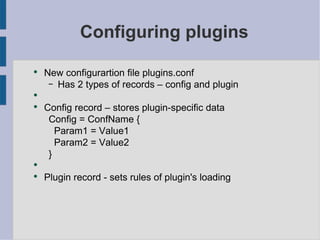
Configuring plugins New configurartion file plugins.conf Has 2 types of records – config and plugin Config record – stores plugin-specific data Config = ConfName { Param1 = Value1 Param2 = Value2 } Plugin record - sets rules of plugin's loading
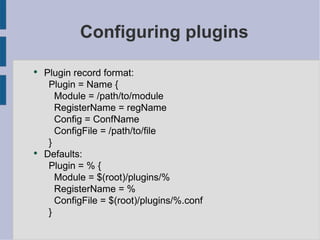
Configuring plugins Plugin record format: Plugin = Name { Module = /path/to/module RegisterName = regName Config = ConfName ConfigFile = /path/to/file } Defaults: Plugin = % { Module = $(root)/plugins/% RegisterName = % ConfigFile = $(root)/plugins/%.conf }
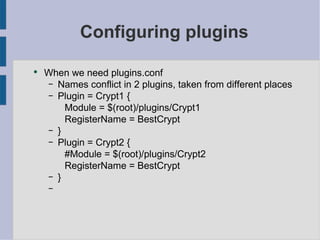
Configuring plugins When we need plugins.conf Names conflict in 2 plugins, taken from different places Plugin = Crypt1 { Module = $(root)/plugins/Crypt1 RegisterName = BestCrypt } Plugin = Crypt2 { #Module = $(root)/plugins/Crypt2 RegisterName = BestCrypt }
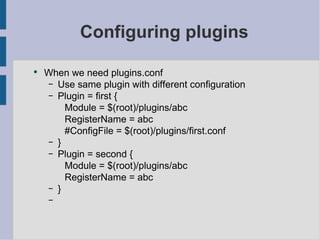
Configuring plugins When we need plugins.conf Use same plugin with different configuration Plugin = first { Module = $(root)/plugins/abc RegisterName = abc #ConfigFile = $(root)/plugins/first.conf } Plugin = second { Module = $(root)/plugins/abc RegisterName = abc }
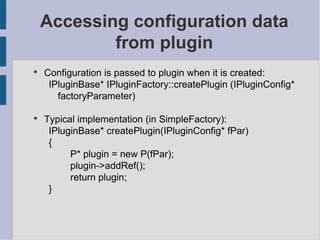
Accessing configuration data from plugin Configuration is passed to plugin when it is created: IPluginBase* IPluginFactory::createPlugin (IPluginConfig* factoryParameter) Typical implementation (in SimpleFactory): IPluginBase* createPlugin(IPluginConfig* fPar) { P* plugin = new P(fPar); plugin->addRef(); return plugin; }
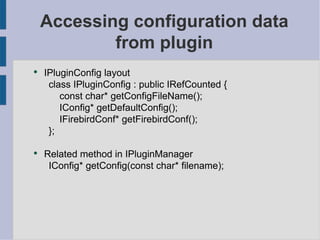
Accessing configuration data from plugin IPluginConfig layout class IPluginConfig : public IRefCounted { const char* getConfigFileName(); IConfig* getDefaultConfig(); IFirebirdConf* getFirebirdConf(); }; Related method in IPluginManager IConfig* getConfig(const char* filename);
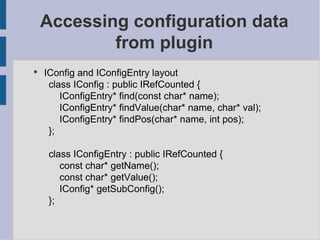
Accessing configuration data from plugin IConfig and IConfigEntry layout class IConfig : public IRefCounted { IConfigEntry* find(const char* name); IConfigEntry* findValue(char* name, char* val); IConfigEntry* findPos(char* name, int pos); }; class IConfigEntry : public IRefCounted { const char* getName(); const char* getValue(); IConfig* getSubConfig(); };
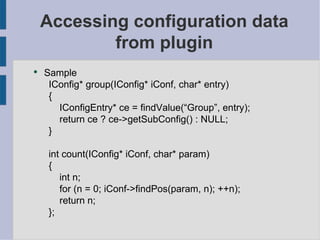
Accessing configuration data from plugin Sample IConfig* group(IConfig* iConf, char* entry) { IConfigEntry* ce = findValue(“Group”, entry); return ce ? ce->getSubConfig() : NULL; } int count(IConfig* iConf, char* param) { int n; for (n = 0; iConf->findPos(param, n); ++n); return n; };
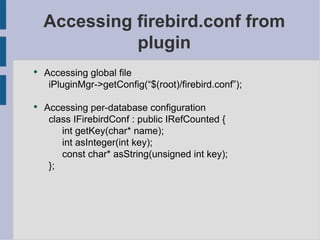
Accessing firebird.conf from plugin Accessing global file iPluginMgr->getConfig(“$(root)/firebird.conf”); Accessing per-database configuration class IFirebirdConf : public IRefCounted { int getKey(char* name); int asInteger(int key); const char* asString(unsigned int key); };
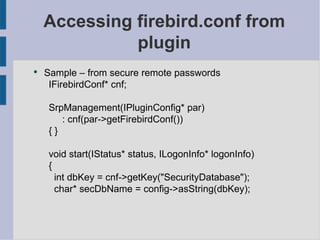
Accessing firebird.conf from plugin Sample – from secure remote passwords IFirebirdConf* cnf; SrpManagement(IPluginConfig* par) : cnf(par->getFirebirdConf()) { } void start(IStatus* status, ILogonInfo* logonInfo) { int dbKey = cnf->getKey(&quot;SecurityDatabase&quot;); char* secDbName = config->asString(dbKey);
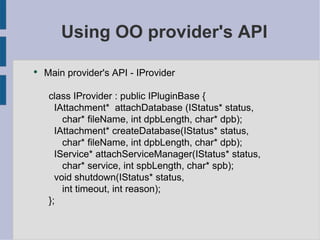
Using OO provider's API Main provider's API - IProvider class IProvider : public IPluginBase { IAttachment*  attachDatabase (IStatus* status, char* fileName, int dpbLength, char* dpb); IAttachment* createDatabase(IStatus* status, char* fileName, int dpbLength, char* dpb); IService* attachServiceManager(IStatus* status, char* service, int spbLength, char* spb); void shutdown(IStatus* status, int timeout, int reason); };
Using OO provider's API Clients get access to provider's API using IMaster interface: IStatus* status = iMaster->getStatus(); IProvider* dispatch = iMaster->getDispatcher(); IAttachment *att = dispatch->attachDatabase (status, “employee”, dpbLength, dpb); dispatch->release(); // work with attachment ... att->detach(status); status->release();
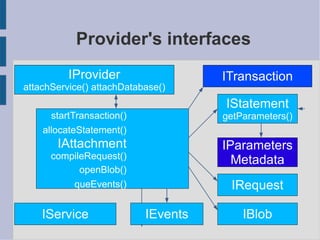
Provider's interfaces IProvider attachService() attachDatabase() startTransaction() allocateStatement() IAttachment compileRequest() openBlob() queEvents() IService ITransaction IStatement getParameters() IRequest IBlob IEvents IParameters Metadata
Provider's interfaces IStatement – new message description class IStatement : public IVersioned { int fetch(IStatus* status, FbMessage* msg); // … other functions }; isc_dsql_fetch_m(STATUS*, FB_API_HANDLE*, USHORT blr_length, SCHAR* blr, USHORT msg_length, SCHAR* msg);
Provider's interfaces IEvents – new name, old object class IEventCallback : public Iversioned { void callbackFunction(int length, char* events); }; IEvents* IAttachment::queEvents(IStatus* status, IEventCallback* callback, int len, char* events); class IEvents : public IRefCounted { void cancel(IStatus* status); };
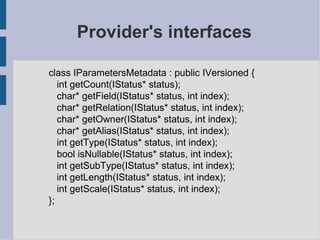
Provider's interfaces class IParametersMetadata : public IVersioned { int getCount(IStatus* status); char* getField(IStatus* status, int index); char* getRelation(IStatus* status, int index); char* getOwner(IStatus* status, int index); char* getAlias(IStatus* status, int index); int getType(IStatus* status, int index); bool isNullable(IStatus* status, int index); int getSubType(IStatus* status, int index); int getLength(IStatus* status, int index); int getScale(IStatus* status, int index); };
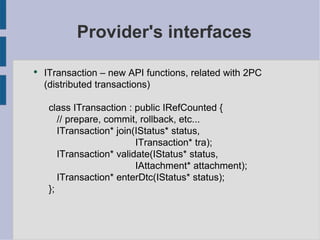
Provider's interfaces ITransaction – new API functions, related with 2PC (distributed transactions) class ITransaction : public IRefCounted { // prepare, commit, rollback, etc... ITransaction* join(IStatus* status, ITransaction* tra); ITransaction* validate(IStatus* status, IAttachment* attachment); ITransaction* enterDtc(IStatus* status); };
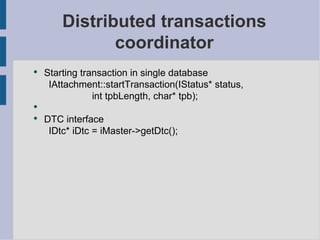
Distributed transactions coordinator Starting transaction in single database IAttachment::startTransaction(IStatus* status, int tpbLength, char* tpb); DTC interface IDtc* iDtc = iMaster->getDtc();
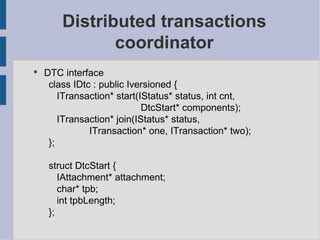
Distributed transactions coordinator DTC interface class IDtc : public Iversioned { ITransaction* start(IStatus* status, int cnt, DtcStart* components); ITransaction* join(IStatus* status, ITransaction* one, ITransaction* two); }; struct DtcStart { IAttachment* attachment; char* tpb; int tpbLength; };
Distributed transactions coordinator Sample A DtcStart comp[2] = { {att1, 0, 0}, {att2, 0, 0} }; ITransaction* distr = iDtc->start(status, 2, comp); Sample B ITransaction* t1 = att1->startTransaction(status, 0, 0); ITransaction* t2 = att2->startTransaction(status, 0, 0); ITransaction* distr = t1->join(status, t2);
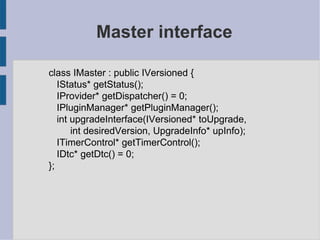
Master interface class IMaster : public IVersioned { IStatus* getStatus(); IProvider* getDispatcher() = 0; IPluginManager* getPluginManager(); int upgradeInterface(IVersioned* toUpgrade, int desiredVersion, UpgradeInfo* upInfo); ITimerControl* getTimerControl(); IDtc* getDtc() = 0; };
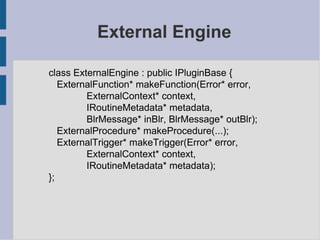
External Engine class ExternalEngine : public IPluginBase { ExternalFunction* makeFunction(Error* error, ExternalContext* context, IRoutineMetadata* metadata, BlrMessage* inBlr, BlrMessage* outBlr); ExternalProcedure* makeProcedure(...); ExternalTrigger* makeTrigger(Error* error, ExternalContext* context, IRoutineMetadata* metadata); };
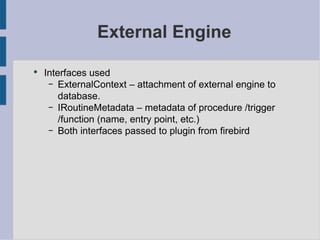
External Engine Interfaces used ExternalContext – attachment of external engine to database. IRoutineMetadata – metadata of procedure /trigger /function (name, entry point, etc.) Both interfaces passed to plugin from firebird
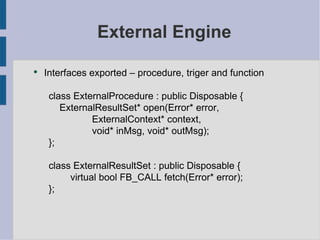
External Engine Interfaces exported – procedure, triger and function class ExternalProcedure : public Disposable { ExternalResultSet* open(Error* error, ExternalContext* context, void* inMsg, void* outMsg); }; class ExternalResultSet : public Disposable { virtual bool FB_CALL fetch(Error* error); };
External Engine Existing plugins: UDR – user defined routines on C/C++ will be install with firebird server JAVA will be isntalled with jaybird
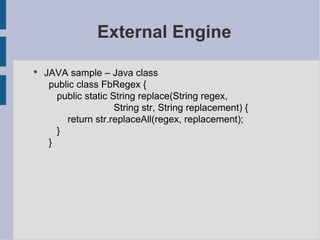
External Engine JAVA sample – Java class public class FbRegex { public static String replace(String regex, String str, String replacement) { return str.replaceAll(regex, replacement); } }
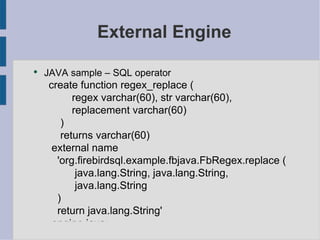
External Engine JAVA sample – SQL operator create function regex_replace ( regex varchar(60), str varchar(60), replacement varchar(60) ) returns varchar(60) external name 'org.firebirdsql.example.fbjava.FbRegex.replace ( java.lang.String, java.lang.String, java.lang.String ) return java.lang.String' engine java;
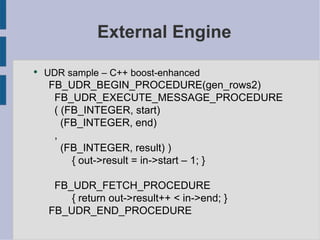
External Engine UDR sample – C++ boost-enhanced FB_UDR_BEGIN_PROCEDURE(gen_rows2) FB_UDR_EXECUTE_MESSAGE_PROCEDURE ( (FB_INTEGER, start)  (FB_INTEGER, end)  , (FB_INTEGER, result) ) { out->result = in->start – 1; } FB_UDR_FETCH_PROCEDURE { return out->result++ < in->end; } FB_UDR_END_PROCEDURE
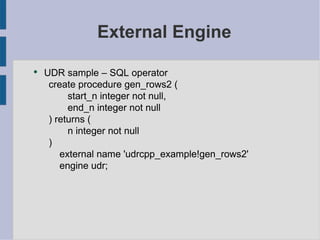
External Engine UDR sample – SQL operator create procedure gen_rows2 ( start_n integer not null, end_n integer not null ) returns ( n integer not null ) external name 'udrcpp_example!gen_rows2' engine udr;
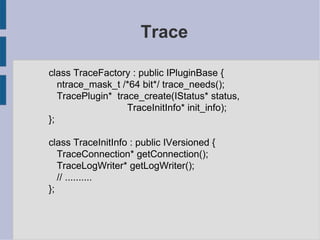
Trace class TraceFactory : public IPluginBase { ntrace_mask_t /*64 bit*/ trace_needs(); TracePlugin*  trace_create(IStatus* status, TraceInitInfo* init_info); }; class TraceInitInfo : public IVersioned { TraceConnection* getConnection(); TraceLogWriter* getLogWriter(); // .......... };
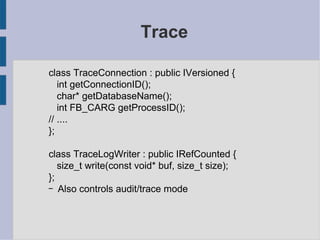
Trace class TraceConnection : public IVersioned { int getConnectionID(); char* getDatabaseName(); int FB_CARG getProcessID(); // .... }; class TraceLogWriter : public IRefCounted { size_t write(const void* buf, size_t size); }; Also controls audit/trace mode
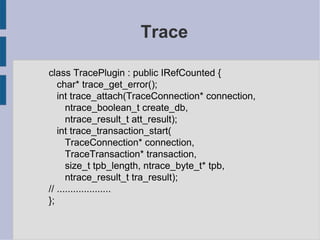
Trace class TracePlugin : public IRefCounted { char* trace_get_error(); int trace_attach(TraceConnection* connection, ntrace_boolean_t create_db, ntrace_result_t att_result); int trace_transaction_start( TraceConnection* connection, TraceTransaction* transaction, size_t tpb_length, ntrace_byte_t* tpb, ntrace_result_t tra_result); // .................... };
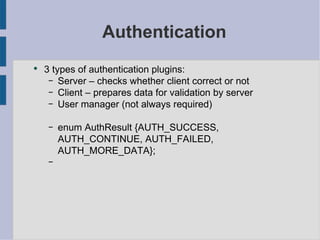
Authentication 3 types of authentication plugins: Server – checks whether client correct or not Client – prepares data for validation by server User manager (not always required) enum AuthResult {AUTH_SUCCESS, AUTH_CONTINUE, AUTH_FAILED, AUTH_MORE_DATA};
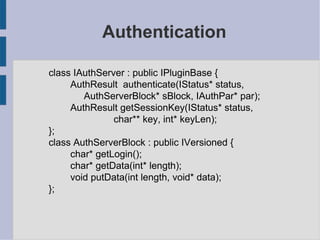
Authentication class IAuthServer : public IPluginBase { AuthResult  authenticate(IStatus* status, AuthServerBlock* sBlock, IAuthPar* par); AuthResult getSessionKey(IStatus* status, char** key, int* keyLen); }; class AuthServerBlock : public IVersioned { char* getLogin(); char* getData(int* length); void putData(int length, void* data); };
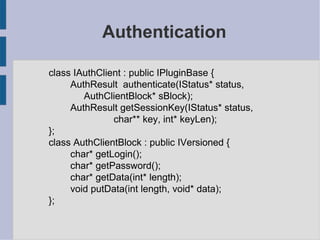
Authentication class IAuthClient : public IPluginBase { AuthResult  authenticate(IStatus* status, AuthClientBlock* sBlock); AuthResult getSessionKey(IStatus* status, char** key, int* keyLen); }; class AuthClientBlock : public IVersioned { char* getLogin(); char* getPassword(); char* getData(int* length); void putData(int length, void* data); };
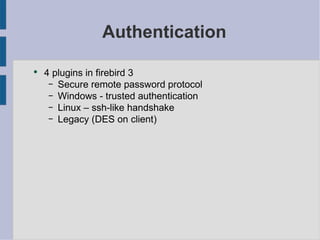
Authentication 4 plugins in firebird 3 Secure remote password protocol Windows - trusted authentication Linux – ssh-like handshake Legacy (DES on client)
Secure remote password Up to 20 symbols in password Password is never passed over the wire Resistant to many attacks, including 'man in the middle' Can generate strong crypt keys on both client and server during authentication Does not require additional client-server roundtrips due to changes in network protocol
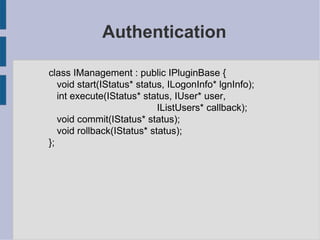
Authentication class IManagement : public IPluginBase { void start(IStatus* status, ILogonInfo* lgnInfo); int execute(IStatus* status, IUser* user, IListUsers* callback); void commit(IStatus* status); void rollback(IStatus* status); };
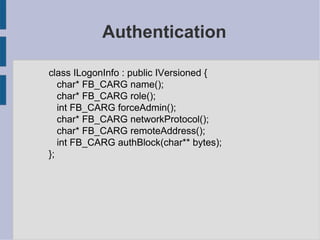
Authentication class ILogonInfo : public IVersioned { char* FB_CARG name(); char* FB_CARG role(); int FB_CARG forceAdmin(); char* FB_CARG networkProtocol(); char* FB_CARG remoteAddress(); int FB_CARG authBlock(char** bytes); };
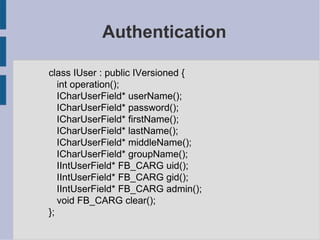
Authentication class IUser : public IVersioned { int operation(); ICharUserField* userName(); ICharUserField* password(); ICharUserField* firstName(); ICharUserField* lastName(); ICharUserField* middleName(); ICharUserField* groupName(); IIntUserField* FB_CARG uid(); IIntUserField* FB_CARG gid(); IIntUserField* FB_CARG admin(); void FB_CARG clear(); };
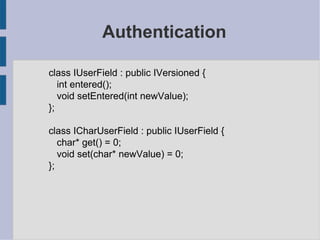
Authentication class IUserField : public IVersioned { int entered(); void setEntered(int newValue); }; class ICharUserField : public IUserField { char* get() = 0; void set(char* newValue) = 0; };
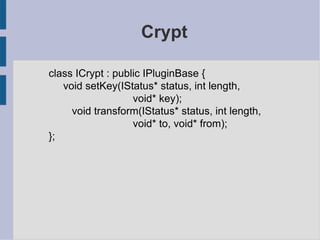
Crypt class ICrypt : public IPluginBase { void setKey(IStatus* status, int length, void* key); void transform(IStatus* status, int length, void* to, void* from); };
Thanks for your attention!

Firebird 3: provider-based architecture, plugins and OO approach to API

  • 1.
    Firebird 3: provider-basedarchitecture, plugins and OO approach to API Alex Peshkov Firebird Foundation 2011
  • 2.
    Architectural goals ofFirebird3 Provide more and better ways for users to extend functionality of firebird How to do it: Introduce (or may be restore ?) provider-based architecture Introduce (or may be extend ?) plugins
  • 3.
    Providers – basedarchitecture (OSRI) Providers Clients YValve Network listener User program (isql, php, etc.) Engine8_11 Engine12 Network redirector
  • 4.
    Server with additionalprovider Providers Clients YValve Network listener ODBC gate Engine12
  • 5.
    Server with additionalprovider EXECUTE STATEMENT 'ODBC SPECIFIC OPERATOR' ON EXTERNAL 'ODBC://odbc_datasource_name' Engine12: Attach Database 'ODBC://odbc_datasource_name' YValve: Tries known providers, including ODBC gate ODBC gate: Recognizes 'ODBC://' prefix Calls appropriate ODBC function to establish connection
  • 6.
    Client with additionalprovider Providers Clients YValve User program Engine12 Cache Network redirector
  • 7.
    Client with additionalprovider Client: Attach Database 'CACHE://SRV/dbAlias' Yvalve: Tries known providers, including CACHE CACHE: Recognizes 'CACHE://' prefix Can use 'INET://somehost/dbAlias' to access remote data Can use embedded connection to access cached data
  • 8.
    Plugins Provide almostunlimited capabilities of extending firebird with what user needs UDFs and blob filters are also a kind of plugins with specific interface and calling rules Require (like UDFs) special care to avoid malicious code, executed in server context all plugins, not described explicitly in configuration file, are loaded from $(root)/plugins, slash in names is not permitted if one provides path information in explicit plugin description – he should care about it himself
  • 9.
    Plugins May beplugged only into specially prepared points of main firebird code Firebird 3 will support the following types of plugins: Trace; External engines; Authentication (server/client) and users' management; Crypt (network and may be database).
  • 10.
    Plugins Have interface,specific for each predefined point in firebird code Have common rules of load/unload and configuration Have common interface, controlling that common features
  • 11.
    Plugins and providers-basearchitecture Provider is invoked from specific point of a code (from yValve) Providers should be loaded/unloaded to/from firebird process address space Providers can and should be treated as a special kind of plugins this avoids adding special code, duplicating one for plugins
  • 12.
    Choosing API FunctionalAPI Follows existing (isc_attach_database) style Object-oriented API Used in a lot of modern software Saves resources when loading plugin Backward compatibility at yValve level for providers API
  • 13.
    Firebird API contains2 types of objects: Interface - C++ class with pure-virtual only functions; class IIntUserField : public IUserField { public: virtual int FB_CARG get() = 0; virtual void FB_CARG set(int newValue) = 0; }; Simplified form, used later class IIntUserField : public IUserField { int get(); void set(int newValue); }; Interfaces
  • 14.
    Firebird API contains2 types of objects: Structure - C struct, containing POD (plain old data) only; struct FbMessage { const unsigned char* blr; unsigned char* buffer; unsigned int blrLength; unsigned int bufferLength; }; Interfaces
  • 15.
    Provides access toother interfaces Stands separate from the others, cause created (from user POV) not by any other interface, but by API function: IMaster* fb_get_master_interface(); This is the only one new API function, required to support OO API Master interface
  • 16.
    Common rules Allinterfaces are derived from IVersioned, IDisposable or IRefCounted (last two are also derived from IVersioned). All plugins are derived from IPluginBase (derived from IRefCounted). Interfaces guaranteed lifetime: IRefCounted – as long as not released last time, IDisposable – as long as not disposed, non of this (just versioned) – according to lifetime of outer object (which created that interface)
  • 17.
    IVersioned – versionof interface Firebird interfaces are not COM interfaces – we support multiple versions of same interface. Interface version can be upgraded by code, receiving interface from other module. Interface version is always equal to total number of virtual functions in it. Use of upgraded interface does not cause any delays when using it's functions.
  • 18.
    IVersioned – versionof interface class IVersioned { int getVersion(); IPluginModule* getModule(); };
  • 19.
    IVersioned – versionof interface Upgrade is supported by IVersioned and function: IMaster::upgradeInterface( IVersioned* toUpgrade, int desiredVersion, struct UpgradeInfo* upgradeInfo). struct UpgradeInfo { void* missingFunctionClass; IPluginModule* clientModule; };
  • 20.
    IVersioned – versionof interface Samples of missingFunctionClass class NoEntrypoint { virtual void FB_CARG noEntry(IStatus* s) { s->set(Arg::Gds(isc_wish_list).value()); } }; class IgnoreMissing { virtual int FB_CARG noEvent() { return 1; } }
  • 21.
    IVersioned – versionof interface Calling functions in upgraded interface class IService : public IRefCounted { void detach(IStatus* status); void query(IStatus* status, int sendLength, char* sendItems, int receiveLength, char* receiveItems, int bufferLength, char* buffer); void start(IStatus* status, int spbLength, char* spb); };
  • 22.
    Explicit lifetime controlRequired when interface is created at one place and destroyed at another IDisposable – used in interfaces, not intended to be passed from thread to thread class IDisposable : public IVersioned { void FB_CARG dispose(); }; Used as base for IStatus
  • 23.
    Explicit lifetime controlIRefCounted – OK to pass across thread boundary, can be destroyed by any thread in safe way class IRefCounted : public IVersioned { void addRef(); int release(); }; Base of many interfaces, including IPluginBase
  • 24.
    IPluginBase Base interfacefor all primary plugin interfaces class IPluginBase : public IRefCounted { void setOwner(IRefCounted*); IRefCounted* getOwner(); }; Plays key role when unloading plugin module from process space
  • 25.
    IPluginFactory Created byplugin module to register plugin in firebird: class IPluginFactory : public IVersioned { IPluginBase* createPlugin (IPluginConfig* factoryParameter); }; Registered in plugin manager: IPluginManager::registerPluginFactory (int pluginType, char* name, IPluginFactory* factory)
  • 26.
    Interfaces hierarchy IVersionedIMaster IDisposable IRefCounted IPluginBase IPluginFactory IStatus IPluginConfig IService IProvider ExternalEngine
  • 27.
    C++ wrapper overinterfaces Helps to perform repeating tasks when working with interfaces class Abc: public IVersionedIface { .... } #define ABC_VERSION (FB_VERSIONED_VERSION + 3) template <class C, int V> class VersionedIface; Abc* abcInstance = new VersionedIface<Abc, ABC_VERSION>;
  • 28.
    C++ wrapper overinterfaces Other useful templates: template <class C, int V> class AutoIface; template <class C, int V> class DisposeIface; template <class C, int V> class RefCntIface; missing release() method template <class C, int V> class StdPlugin; template <class P> SimpleFactory;
  • 29.
    Configuring plugins Listof plugins to be used Set in firebird.conf for each plugin type Default values: AuthServer = Srp, Win_Sspi AuthClient = Srp, Win_Sspi, Legacy_Auth UserManager = Srp TracePlugin = fbtrace Providers = Remote,Engine12,Loopback
  • 30.
    Configuring plugins Plugin'sspecific configuration Depends only upon plugin itself Advantages of using standard configuration Saves time/efforts when writing plugin code Plugin's users configure it in familiar manner Standard configuration methods File of predefined format [param=value] in predefined place [$(root)/plugins/] Record in common for all plugins file
  • 31.
    Configuring plugins Newconfigurartion file plugins.conf Has 2 types of records – config and plugin Config record – stores plugin-specific data Config = ConfName { Param1 = Value1 Param2 = Value2 } Plugin record - sets rules of plugin's loading
  • 32.
    Configuring plugins Pluginrecord format: Plugin = Name { Module = /path/to/module RegisterName = regName Config = ConfName ConfigFile = /path/to/file } Defaults: Plugin = % { Module = $(root)/plugins/% RegisterName = % ConfigFile = $(root)/plugins/%.conf }
  • 33.
    Configuring plugins Whenwe need plugins.conf Names conflict in 2 plugins, taken from different places Plugin = Crypt1 { Module = $(root)/plugins/Crypt1 RegisterName = BestCrypt } Plugin = Crypt2 { #Module = $(root)/plugins/Crypt2 RegisterName = BestCrypt }
  • 34.
    Configuring plugins Whenwe need plugins.conf Use same plugin with different configuration Plugin = first { Module = $(root)/plugins/abc RegisterName = abc #ConfigFile = $(root)/plugins/first.conf } Plugin = second { Module = $(root)/plugins/abc RegisterName = abc }
  • 35.
    Accessing configuration datafrom plugin Configuration is passed to plugin when it is created: IPluginBase* IPluginFactory::createPlugin (IPluginConfig* factoryParameter) Typical implementation (in SimpleFactory): IPluginBase* createPlugin(IPluginConfig* fPar) { P* plugin = new P(fPar); plugin->addRef(); return plugin; }
  • 36.
    Accessing configuration datafrom plugin IPluginConfig layout class IPluginConfig : public IRefCounted { const char* getConfigFileName(); IConfig* getDefaultConfig(); IFirebirdConf* getFirebirdConf(); }; Related method in IPluginManager IConfig* getConfig(const char* filename);
  • 37.
    Accessing configuration datafrom plugin IConfig and IConfigEntry layout class IConfig : public IRefCounted { IConfigEntry* find(const char* name); IConfigEntry* findValue(char* name, char* val); IConfigEntry* findPos(char* name, int pos); }; class IConfigEntry : public IRefCounted { const char* getName(); const char* getValue(); IConfig* getSubConfig(); };
  • 38.
    Accessing configuration datafrom plugin Sample IConfig* group(IConfig* iConf, char* entry) { IConfigEntry* ce = findValue(“Group”, entry); return ce ? ce->getSubConfig() : NULL; } int count(IConfig* iConf, char* param) { int n; for (n = 0; iConf->findPos(param, n); ++n); return n; };
  • 39.
    Accessing firebird.conf fromplugin Accessing global file iPluginMgr->getConfig(“$(root)/firebird.conf”); Accessing per-database configuration class IFirebirdConf : public IRefCounted { int getKey(char* name); int asInteger(int key); const char* asString(unsigned int key); };
  • 40.
    Accessing firebird.conf fromplugin Sample – from secure remote passwords IFirebirdConf* cnf; SrpManagement(IPluginConfig* par) : cnf(par->getFirebirdConf()) { } void start(IStatus* status, ILogonInfo* logonInfo) { int dbKey = cnf->getKey(&quot;SecurityDatabase&quot;); char* secDbName = config->asString(dbKey);
  • 41.
    Using OO provider'sAPI Main provider's API - IProvider class IProvider : public IPluginBase { IAttachment* attachDatabase (IStatus* status, char* fileName, int dpbLength, char* dpb); IAttachment* createDatabase(IStatus* status, char* fileName, int dpbLength, char* dpb); IService* attachServiceManager(IStatus* status, char* service, int spbLength, char* spb); void shutdown(IStatus* status, int timeout, int reason); };
  • 42.
    Using OO provider'sAPI Clients get access to provider's API using IMaster interface: IStatus* status = iMaster->getStatus(); IProvider* dispatch = iMaster->getDispatcher(); IAttachment *att = dispatch->attachDatabase (status, “employee”, dpbLength, dpb); dispatch->release(); // work with attachment ... att->detach(status); status->release();
  • 43.
    Provider's interfaces IProviderattachService() attachDatabase() startTransaction() allocateStatement() IAttachment compileRequest() openBlob() queEvents() IService ITransaction IStatement getParameters() IRequest IBlob IEvents IParameters Metadata
  • 44.
    Provider's interfaces IStatement– new message description class IStatement : public IVersioned { int fetch(IStatus* status, FbMessage* msg); // … other functions }; isc_dsql_fetch_m(STATUS*, FB_API_HANDLE*, USHORT blr_length, SCHAR* blr, USHORT msg_length, SCHAR* msg);
  • 45.
    Provider's interfaces IEvents– new name, old object class IEventCallback : public Iversioned { void callbackFunction(int length, char* events); }; IEvents* IAttachment::queEvents(IStatus* status, IEventCallback* callback, int len, char* events); class IEvents : public IRefCounted { void cancel(IStatus* status); };
  • 46.
    Provider's interfaces classIParametersMetadata : public IVersioned { int getCount(IStatus* status); char* getField(IStatus* status, int index); char* getRelation(IStatus* status, int index); char* getOwner(IStatus* status, int index); char* getAlias(IStatus* status, int index); int getType(IStatus* status, int index); bool isNullable(IStatus* status, int index); int getSubType(IStatus* status, int index); int getLength(IStatus* status, int index); int getScale(IStatus* status, int index); };
  • 47.
    Provider's interfaces ITransaction– new API functions, related with 2PC (distributed transactions) class ITransaction : public IRefCounted { // prepare, commit, rollback, etc... ITransaction* join(IStatus* status, ITransaction* tra); ITransaction* validate(IStatus* status, IAttachment* attachment); ITransaction* enterDtc(IStatus* status); };
  • 48.
    Distributed transactions coordinatorStarting transaction in single database IAttachment::startTransaction(IStatus* status, int tpbLength, char* tpb); DTC interface IDtc* iDtc = iMaster->getDtc();
  • 49.
    Distributed transactions coordinatorDTC interface class IDtc : public Iversioned { ITransaction* start(IStatus* status, int cnt, DtcStart* components); ITransaction* join(IStatus* status, ITransaction* one, ITransaction* two); }; struct DtcStart { IAttachment* attachment; char* tpb; int tpbLength; };
  • 50.
    Distributed transactions coordinatorSample A DtcStart comp[2] = { {att1, 0, 0}, {att2, 0, 0} }; ITransaction* distr = iDtc->start(status, 2, comp); Sample B ITransaction* t1 = att1->startTransaction(status, 0, 0); ITransaction* t2 = att2->startTransaction(status, 0, 0); ITransaction* distr = t1->join(status, t2);
  • 51.
    Master interface classIMaster : public IVersioned { IStatus* getStatus(); IProvider* getDispatcher() = 0; IPluginManager* getPluginManager(); int upgradeInterface(IVersioned* toUpgrade, int desiredVersion, UpgradeInfo* upInfo); ITimerControl* getTimerControl(); IDtc* getDtc() = 0; };
  • 52.
    External Engine classExternalEngine : public IPluginBase { ExternalFunction* makeFunction(Error* error, ExternalContext* context, IRoutineMetadata* metadata, BlrMessage* inBlr, BlrMessage* outBlr); ExternalProcedure* makeProcedure(...); ExternalTrigger* makeTrigger(Error* error, ExternalContext* context, IRoutineMetadata* metadata); };
  • 53.
    External Engine Interfacesused ExternalContext – attachment of external engine to database. IRoutineMetadata – metadata of procedure /trigger /function (name, entry point, etc.) Both interfaces passed to plugin from firebird
  • 54.
    External Engine Interfacesexported – procedure, triger and function class ExternalProcedure : public Disposable { ExternalResultSet* open(Error* error, ExternalContext* context, void* inMsg, void* outMsg); }; class ExternalResultSet : public Disposable { virtual bool FB_CALL fetch(Error* error); };
  • 55.
    External Engine Existingplugins: UDR – user defined routines on C/C++ will be install with firebird server JAVA will be isntalled with jaybird
  • 56.
    External Engine JAVAsample – Java class public class FbRegex { public static String replace(String regex, String str, String replacement) { return str.replaceAll(regex, replacement); } }
  • 57.
    External Engine JAVAsample – SQL operator create function regex_replace ( regex varchar(60), str varchar(60), replacement varchar(60) ) returns varchar(60) external name 'org.firebirdsql.example.fbjava.FbRegex.replace ( java.lang.String, java.lang.String, java.lang.String ) return java.lang.String' engine java;
  • 58.
    External Engine UDRsample – C++ boost-enhanced FB_UDR_BEGIN_PROCEDURE(gen_rows2) FB_UDR_EXECUTE_MESSAGE_PROCEDURE ( (FB_INTEGER, start) (FB_INTEGER, end) , (FB_INTEGER, result) ) { out->result = in->start – 1; } FB_UDR_FETCH_PROCEDURE { return out->result++ < in->end; } FB_UDR_END_PROCEDURE
  • 59.
    External Engine UDRsample – SQL operator create procedure gen_rows2 ( start_n integer not null, end_n integer not null ) returns ( n integer not null ) external name 'udrcpp_example!gen_rows2' engine udr;
  • 60.
    Trace class TraceFactory: public IPluginBase { ntrace_mask_t /*64 bit*/ trace_needs(); TracePlugin* trace_create(IStatus* status, TraceInitInfo* init_info); }; class TraceInitInfo : public IVersioned { TraceConnection* getConnection(); TraceLogWriter* getLogWriter(); // .......... };
  • 61.
    Trace class TraceConnection: public IVersioned { int getConnectionID(); char* getDatabaseName(); int FB_CARG getProcessID(); // .... }; class TraceLogWriter : public IRefCounted { size_t write(const void* buf, size_t size); }; Also controls audit/trace mode
  • 62.
    Trace class TracePlugin: public IRefCounted { char* trace_get_error(); int trace_attach(TraceConnection* connection, ntrace_boolean_t create_db, ntrace_result_t att_result); int trace_transaction_start( TraceConnection* connection, TraceTransaction* transaction, size_t tpb_length, ntrace_byte_t* tpb, ntrace_result_t tra_result); // .................... };
  • 63.
    Authentication 3 typesof authentication plugins: Server – checks whether client correct or not Client – prepares data for validation by server User manager (not always required) enum AuthResult {AUTH_SUCCESS, AUTH_CONTINUE, AUTH_FAILED, AUTH_MORE_DATA};
  • 64.
    Authentication class IAuthServer: public IPluginBase { AuthResult authenticate(IStatus* status, AuthServerBlock* sBlock, IAuthPar* par); AuthResult getSessionKey(IStatus* status, char** key, int* keyLen); }; class AuthServerBlock : public IVersioned { char* getLogin(); char* getData(int* length); void putData(int length, void* data); };
  • 65.
    Authentication class IAuthClient: public IPluginBase { AuthResult authenticate(IStatus* status, AuthClientBlock* sBlock); AuthResult getSessionKey(IStatus* status, char** key, int* keyLen); }; class AuthClientBlock : public IVersioned { char* getLogin(); char* getPassword(); char* getData(int* length); void putData(int length, void* data); };
  • 66.
    Authentication 4 pluginsin firebird 3 Secure remote password protocol Windows - trusted authentication Linux – ssh-like handshake Legacy (DES on client)
  • 67.
    Secure remote passwordUp to 20 symbols in password Password is never passed over the wire Resistant to many attacks, including 'man in the middle' Can generate strong crypt keys on both client and server during authentication Does not require additional client-server roundtrips due to changes in network protocol
  • 68.
    Authentication class IManagement: public IPluginBase { void start(IStatus* status, ILogonInfo* lgnInfo); int execute(IStatus* status, IUser* user, IListUsers* callback); void commit(IStatus* status); void rollback(IStatus* status); };
  • 69.
    Authentication class ILogonInfo: public IVersioned { char* FB_CARG name(); char* FB_CARG role(); int FB_CARG forceAdmin(); char* FB_CARG networkProtocol(); char* FB_CARG remoteAddress(); int FB_CARG authBlock(char** bytes); };
  • 70.
    Authentication class IUser: public IVersioned { int operation(); ICharUserField* userName(); ICharUserField* password(); ICharUserField* firstName(); ICharUserField* lastName(); ICharUserField* middleName(); ICharUserField* groupName(); IIntUserField* FB_CARG uid(); IIntUserField* FB_CARG gid(); IIntUserField* FB_CARG admin(); void FB_CARG clear(); };
  • 71.
    Authentication class IUserField: public IVersioned { int entered(); void setEntered(int newValue); }; class ICharUserField : public IUserField { char* get() = 0; void set(char* newValue) = 0; };
  • 72.
    Crypt class ICrypt: public IPluginBase { void setKey(IStatus* status, int length, void* key); void transform(IStatus* status, int length, void* to, void* from); };
  • 73.
    Thanks for yourattention!