Win32/Flamer: Reverse Engineering and
      Framework Reconstruction


    Aleksandr Matrosov
    Eugene Rodionov
Outline of The Presentation

 Typical malware vs. Stuxnet/Flame
    What the difference?

 Flamer code reconstruction problems
    C++ code reconstruction
    Library code identification


 Flamer framework overview

 Object oriented code reconstruction

 Relationship Stuxnet/Duqu/Flamer
Typical Malware vs. Stuxnet/Flamer
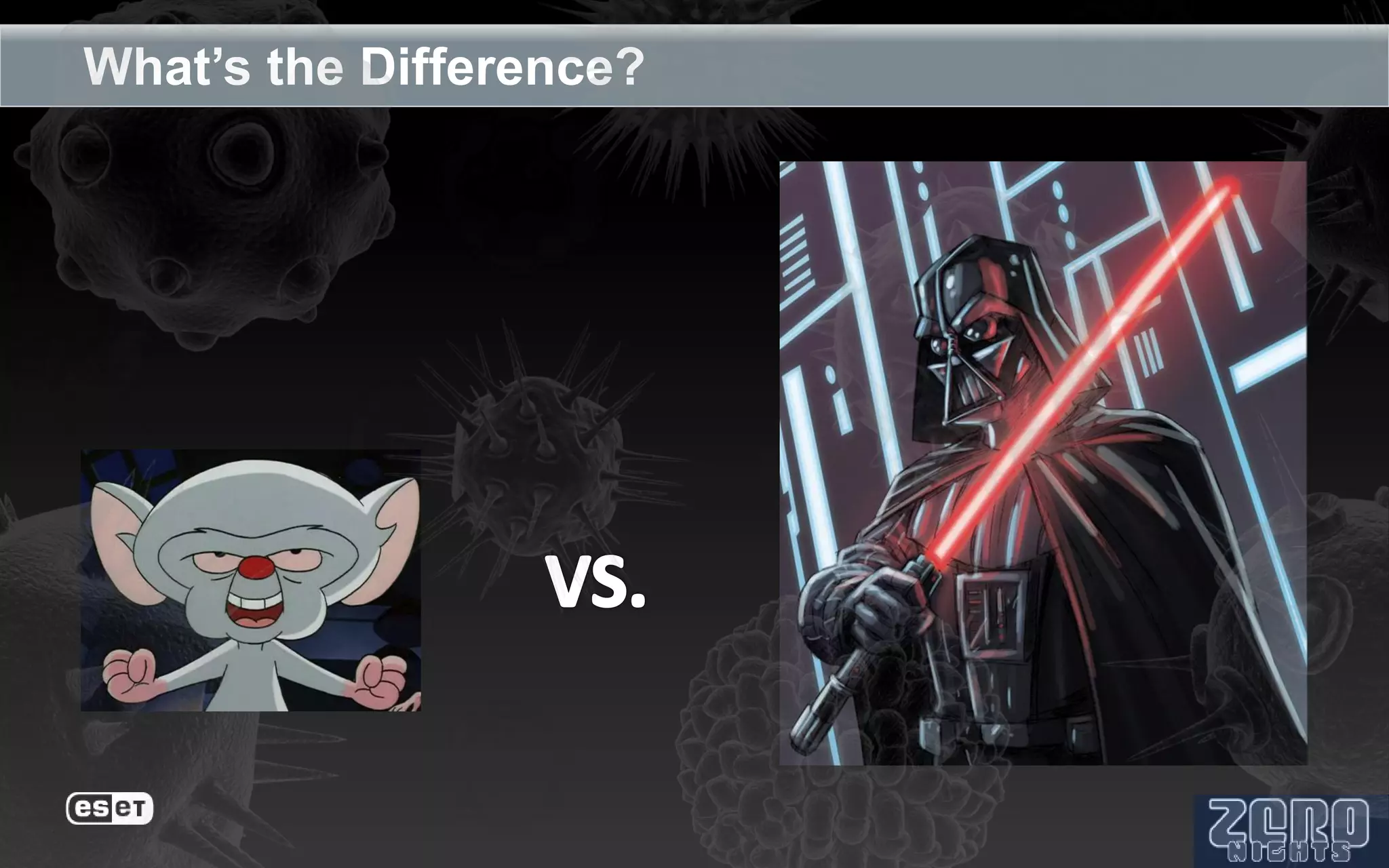
What’s the Difference?

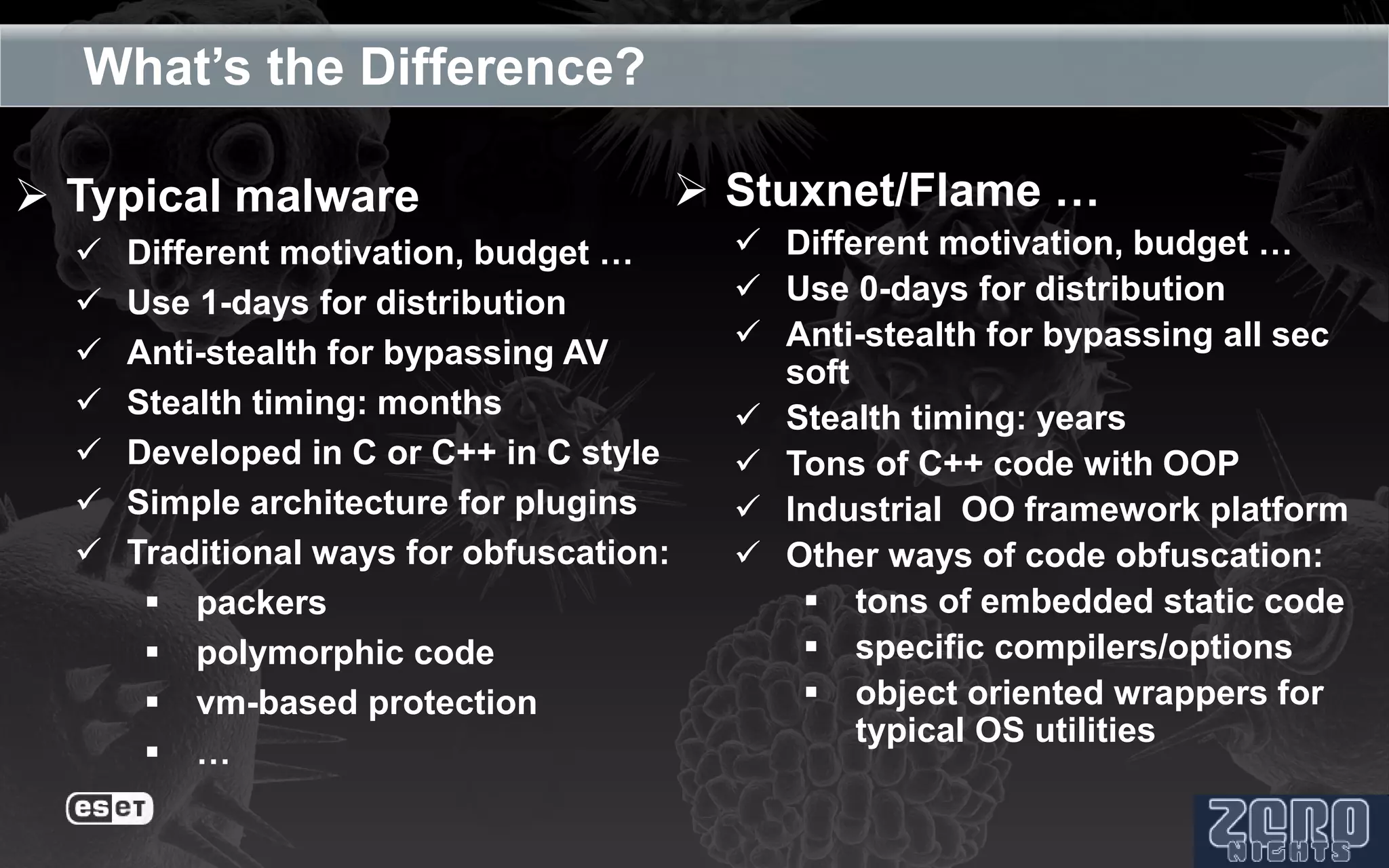
 Typical malware                          Stuxnet/Flame …
     Different motivation, budget …         Different motivation, budget …
     Use 1-days for distribution            Use 0-days for distribution
                                             Anti-stealth for bypassing all sec
     Anti-stealth for bypassing AV
                                              soft
     Stealth timing: months                 Stealth timing: years
     Developed in C or C++ in C style       Tons of C++ code with OOP
     Simple architecture for plugins        Industrial OO framework platform
     Traditional ways for obfuscation:      Other ways of code obfuscation:
        packers                                tons of embedded static code
        polymorphic code                       specific compilers/options
        vm-based protection                    object oriented wrappers for
                                                   typical OS utilities
        …
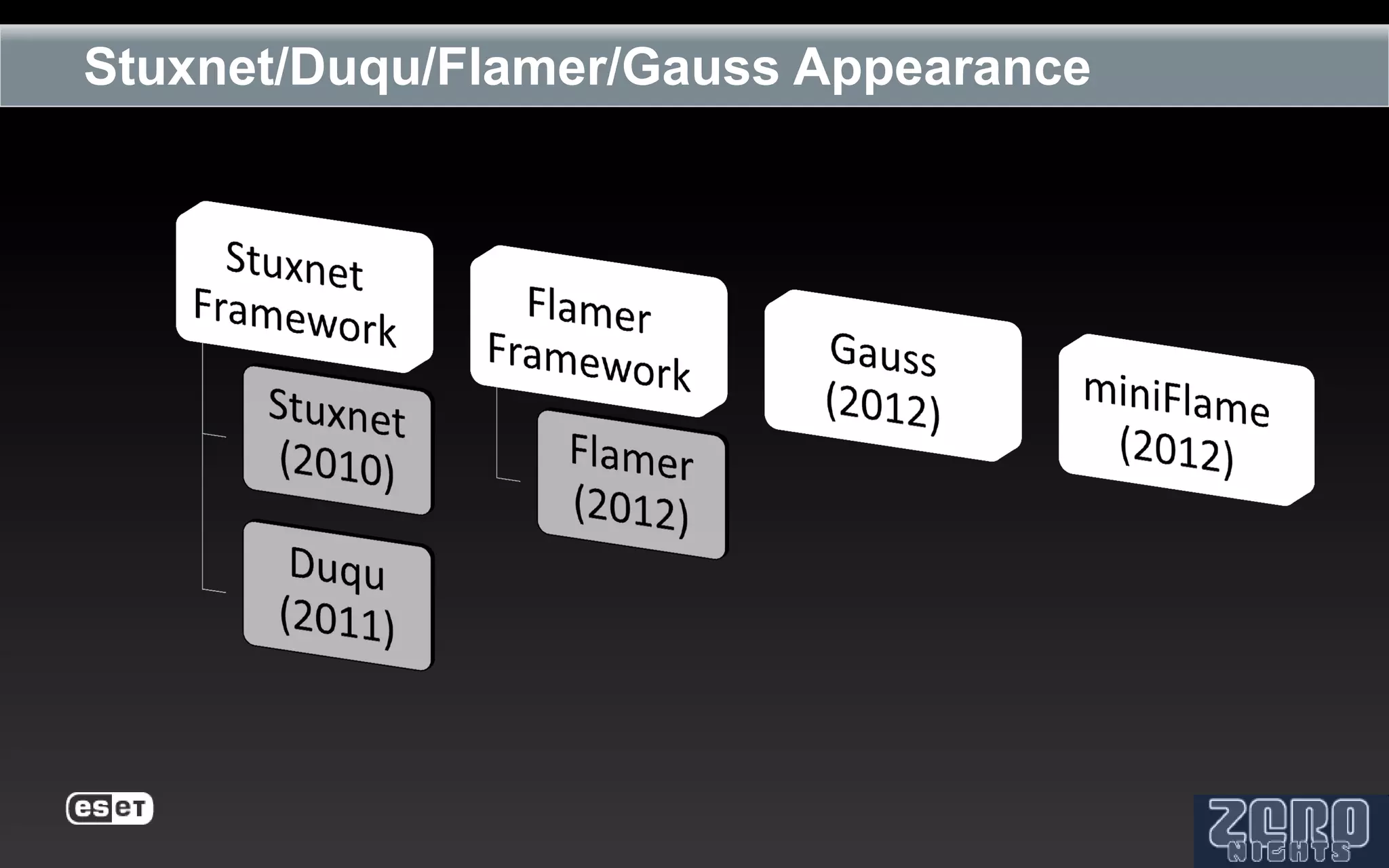
Stuxnet/Duqu/Flamer/Gauss Appearance
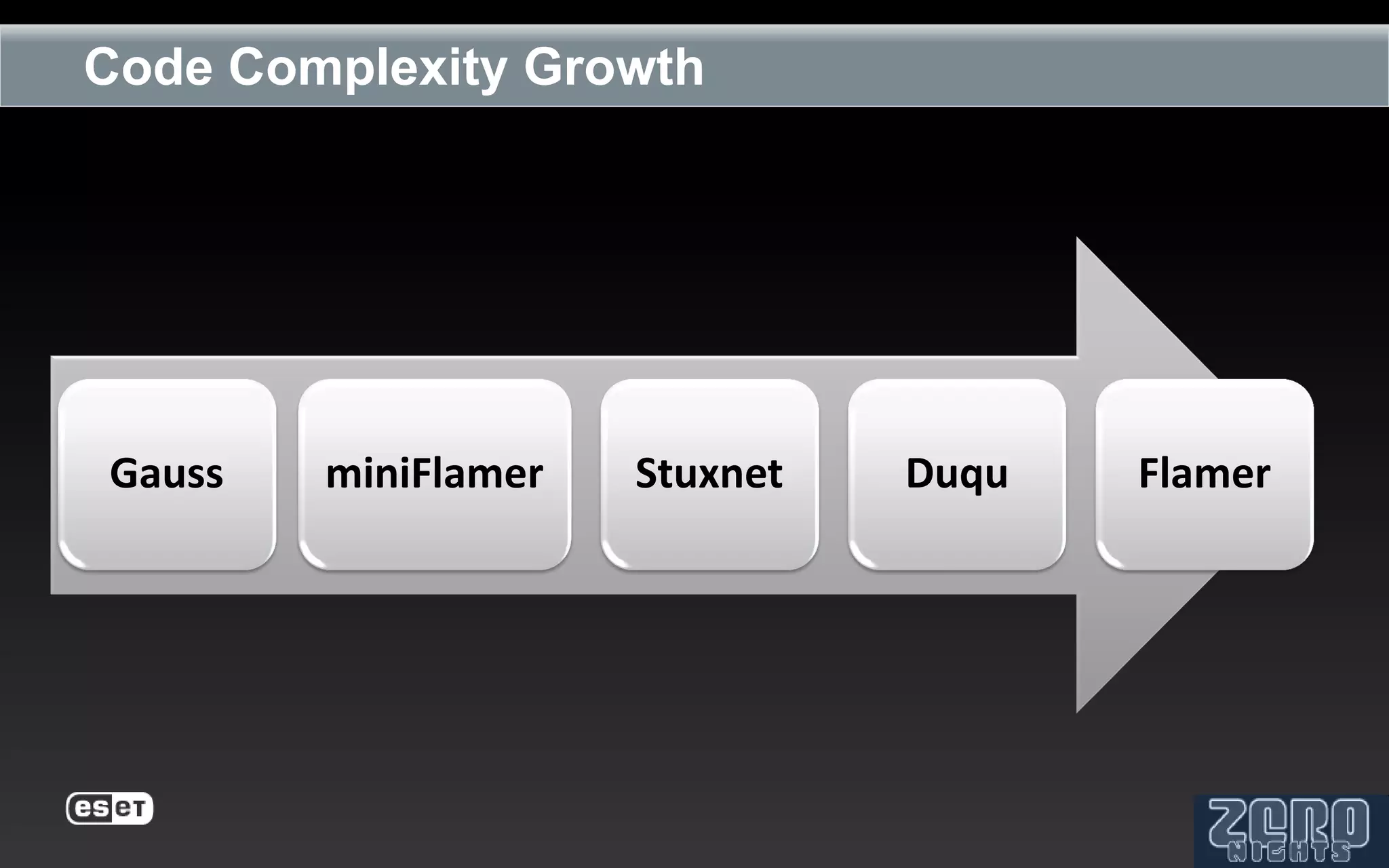
Code Complexity Growth


Gauss   miniFlamer   Stuxnet   Duqu   Flamer
Code Complexity Growth
C++ Code REconstruction
       Problems
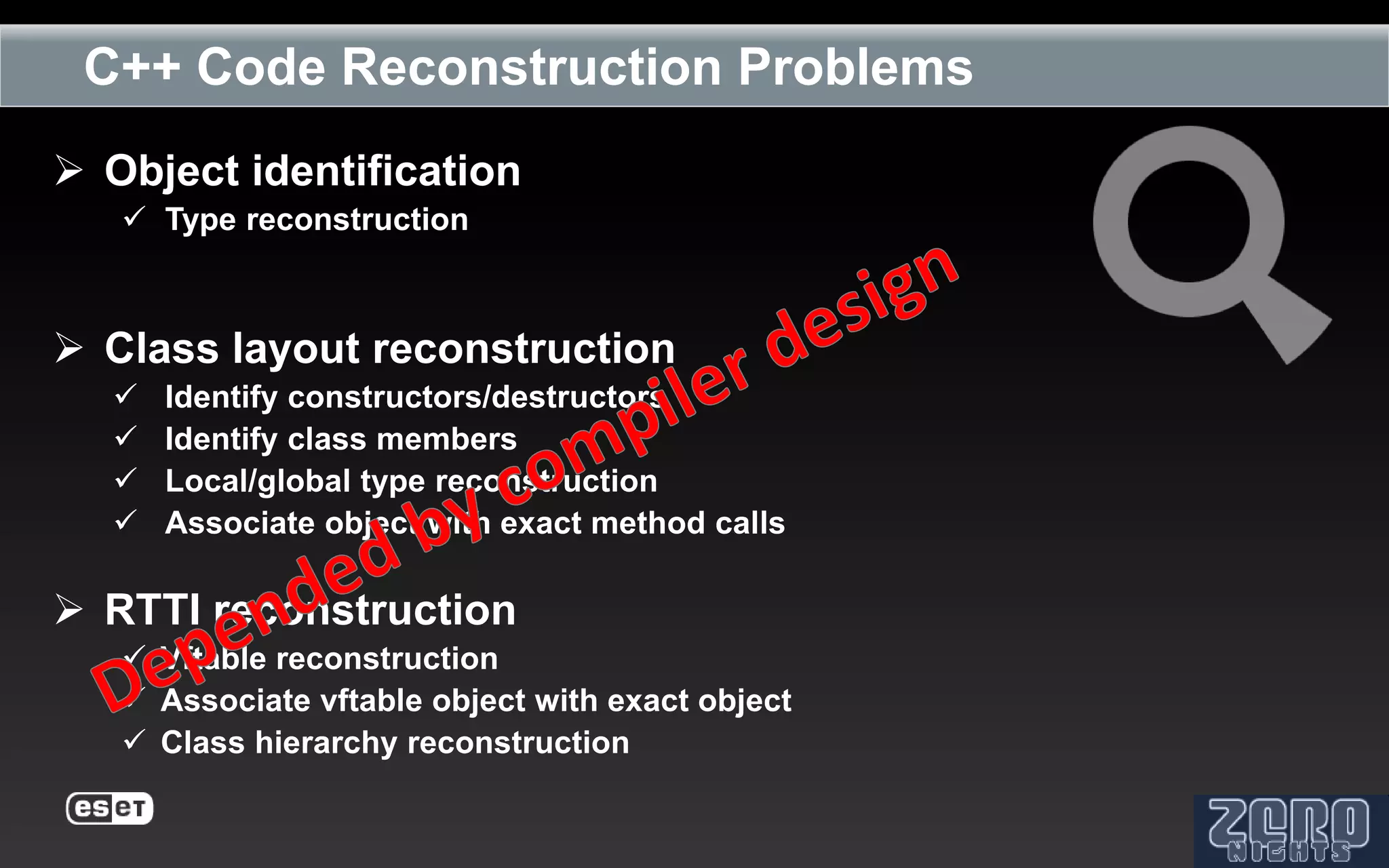
C++ Code Reconstruction Problems
 Object identification
    Type reconstruction


 Class layout reconstruction
     Identify constructors/destructors
     Identify class members
     Local/global type reconstruction
     Associate object with exact method calls

 RTTI reconstruction
    Vftable reconstruction
    Associate vftable object with exact object
    Class hierarchy reconstruction
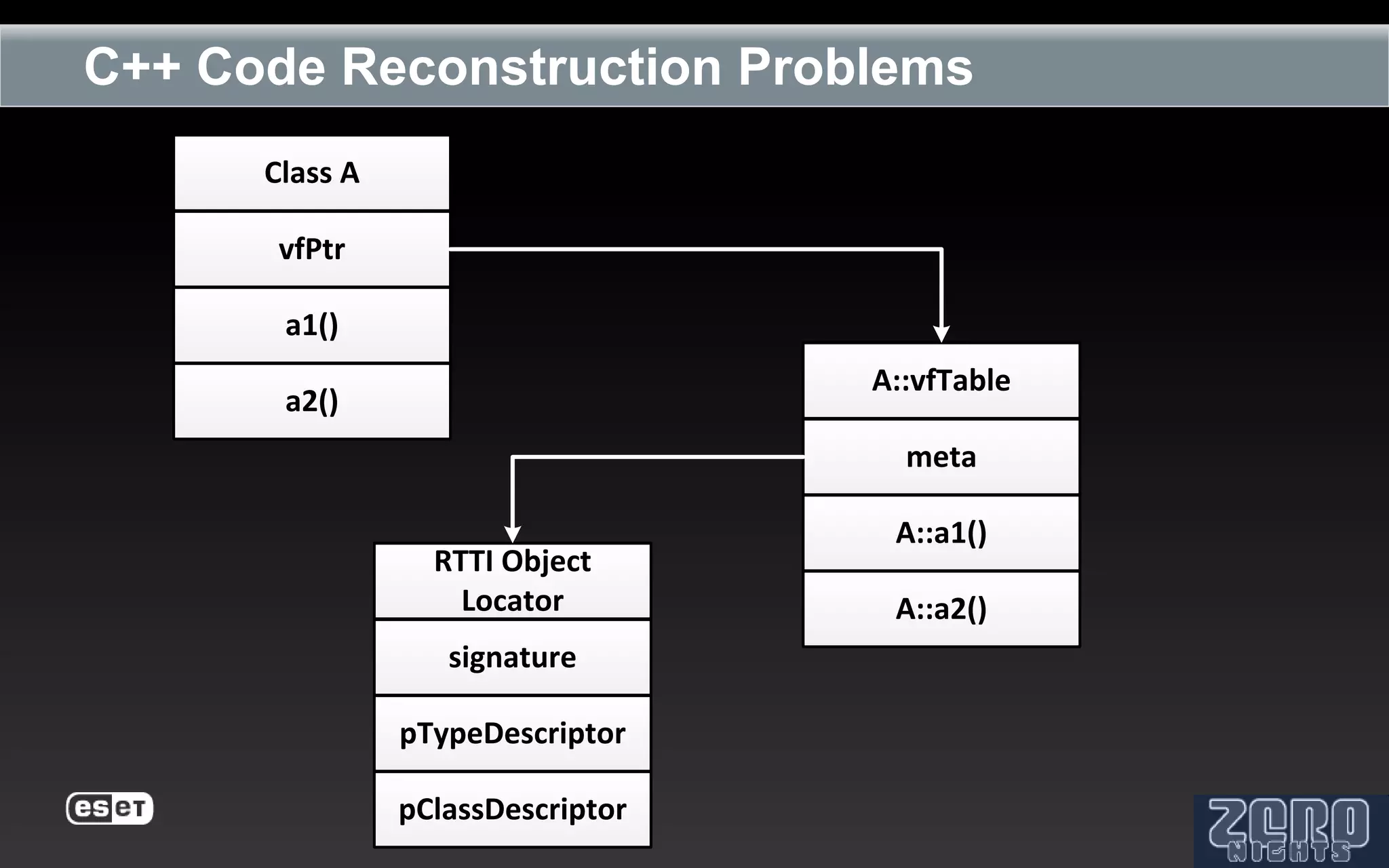
C++ Code Reconstruction Problems
      Class A

       vfPtr

       a1()
                                   A::vfTable
       a2()
                                     meta

                                    A::a1()
                  RTTI Object
                    Locator         A::a2()
                   signature

                pTypeDescriptor

                pClassDescriptor
C++ Code Reconstruction Problems
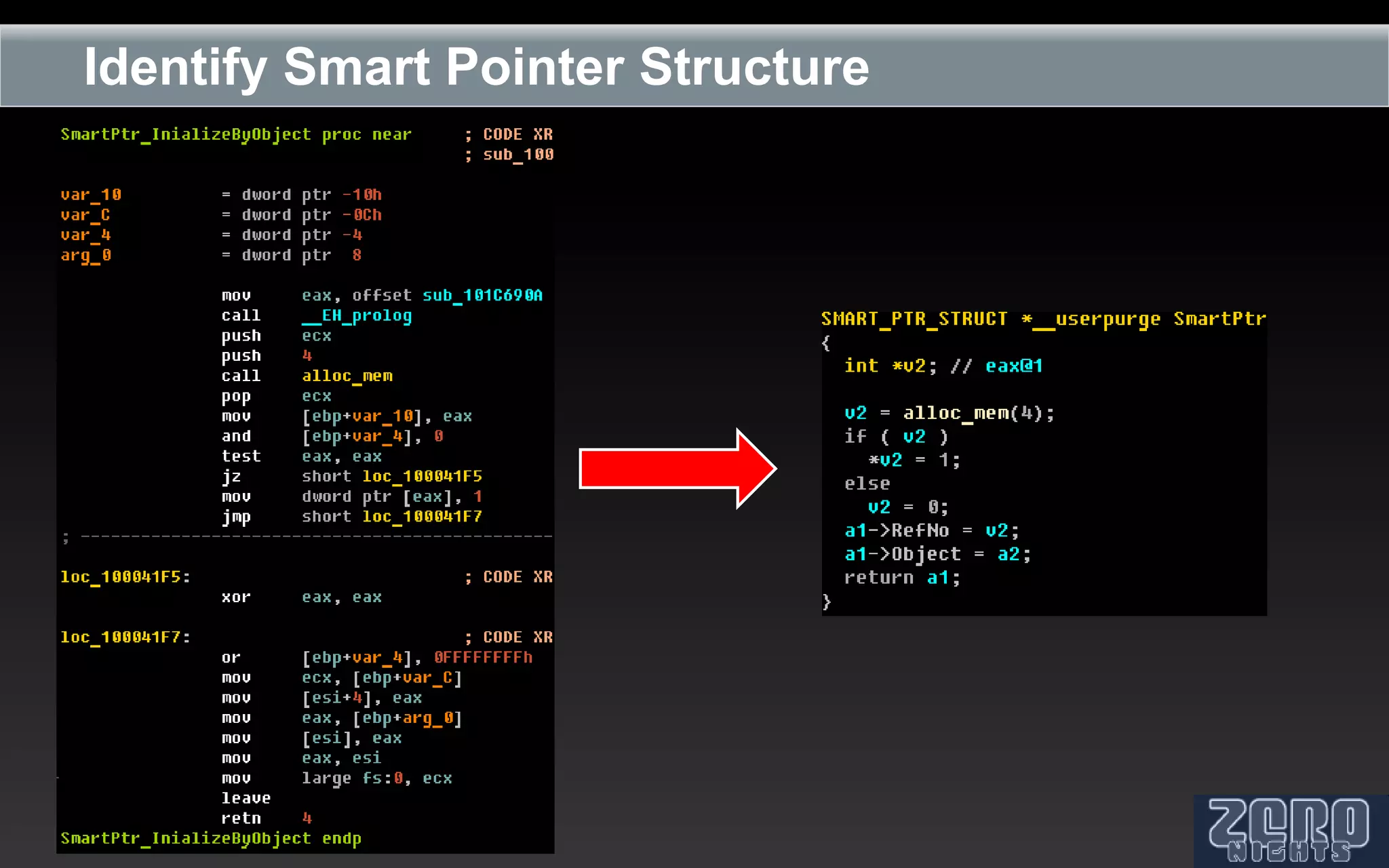
Identify Smart Pointer Structure
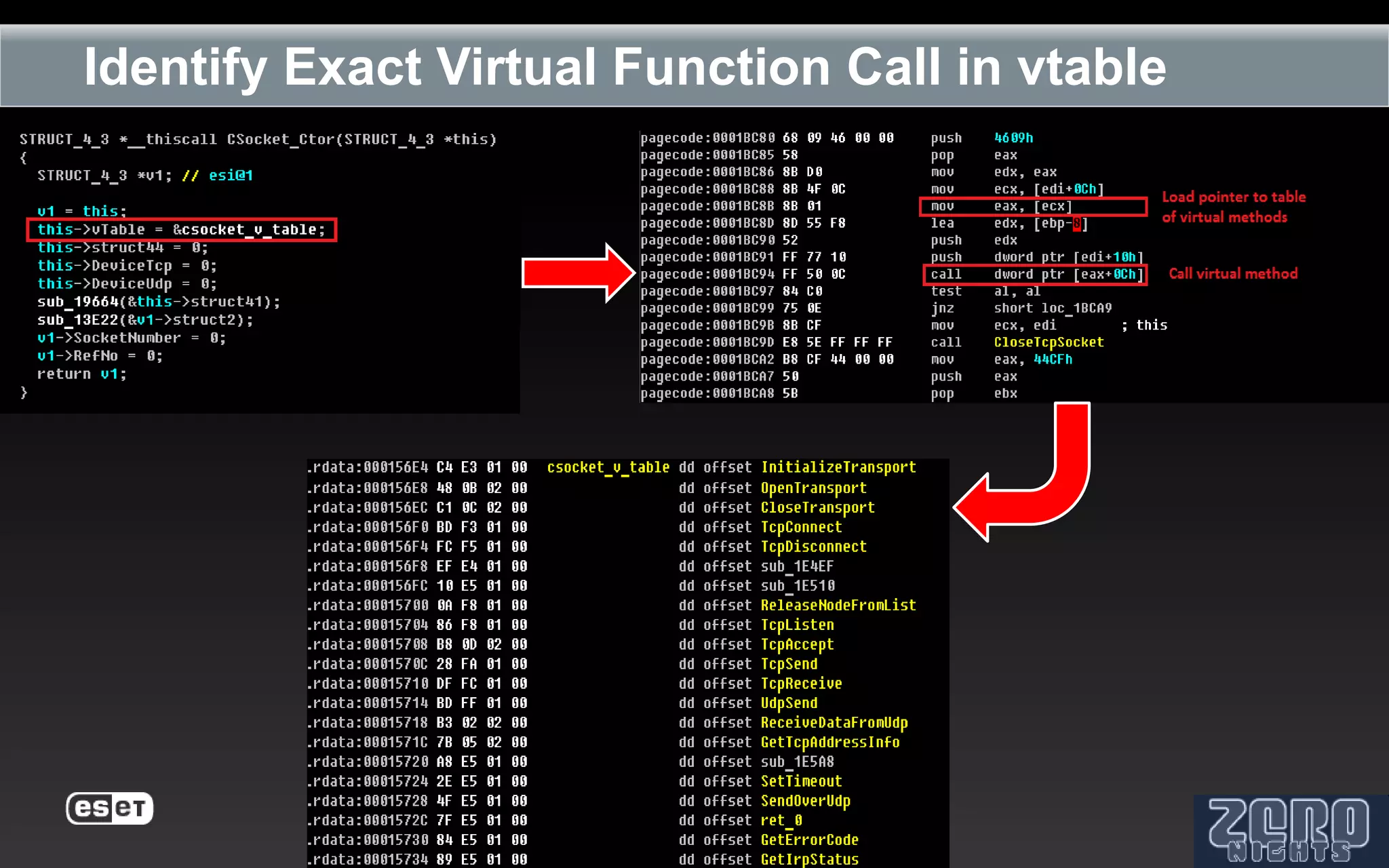
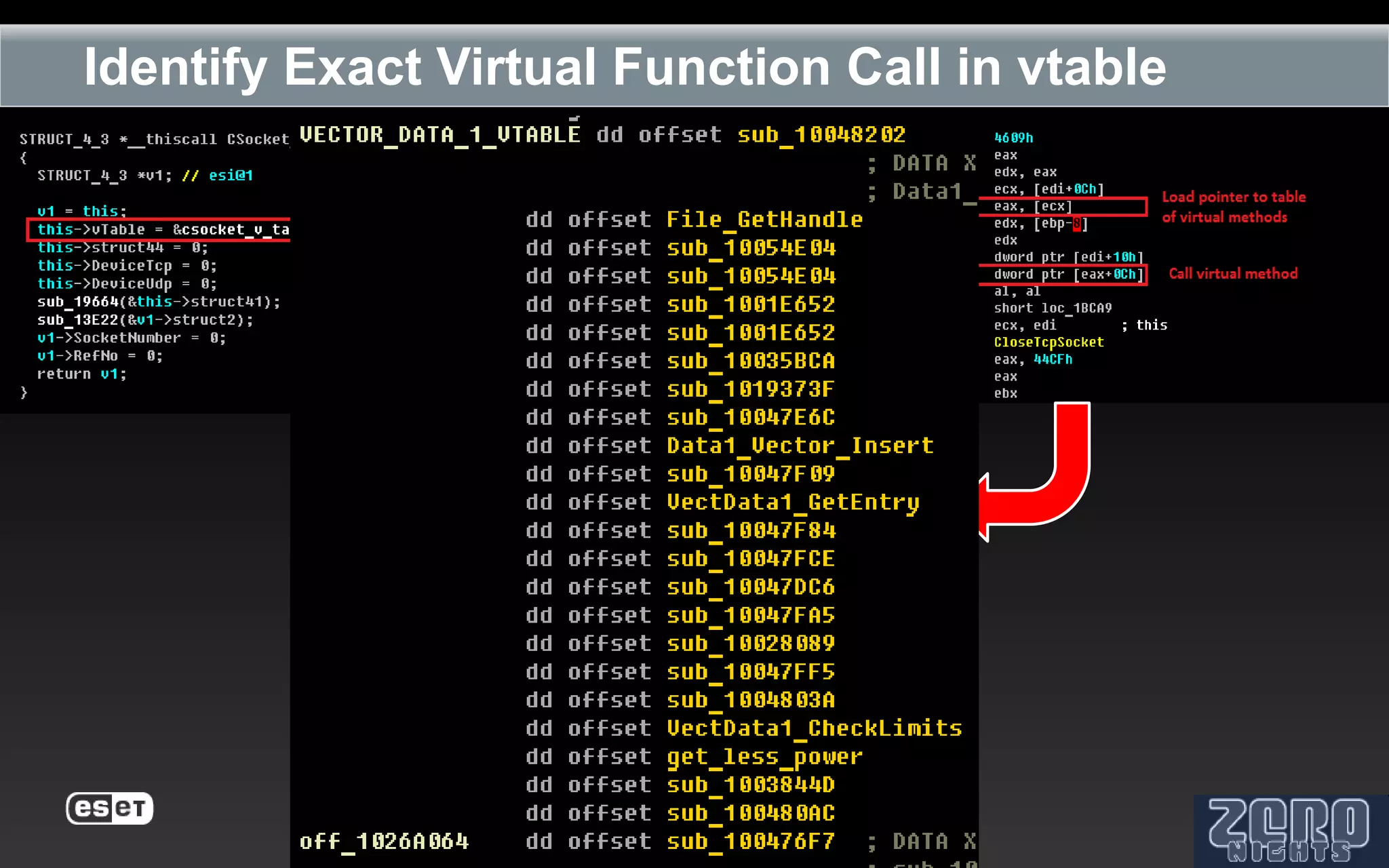
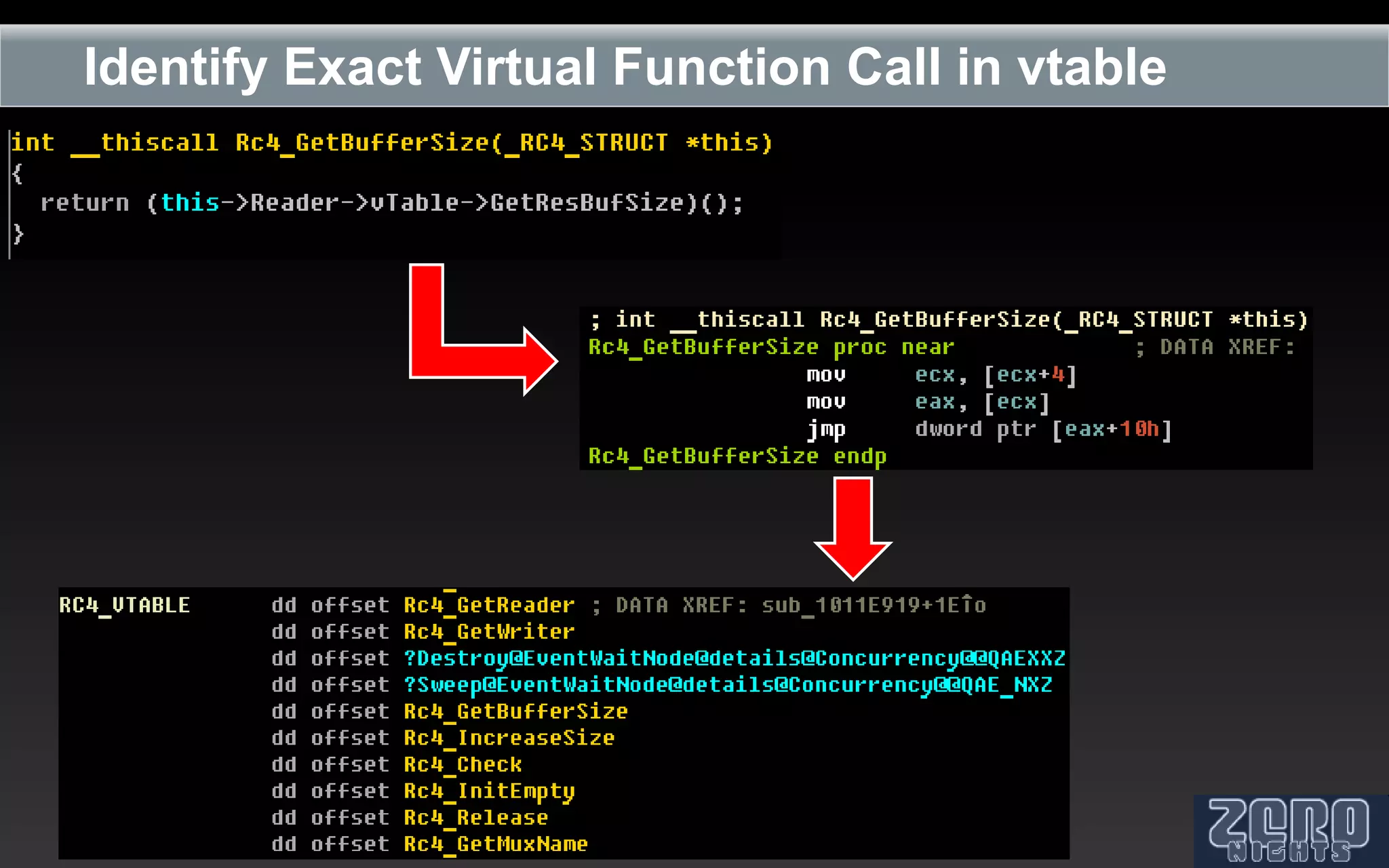
Identify Exact Virtual Function Call in vtable
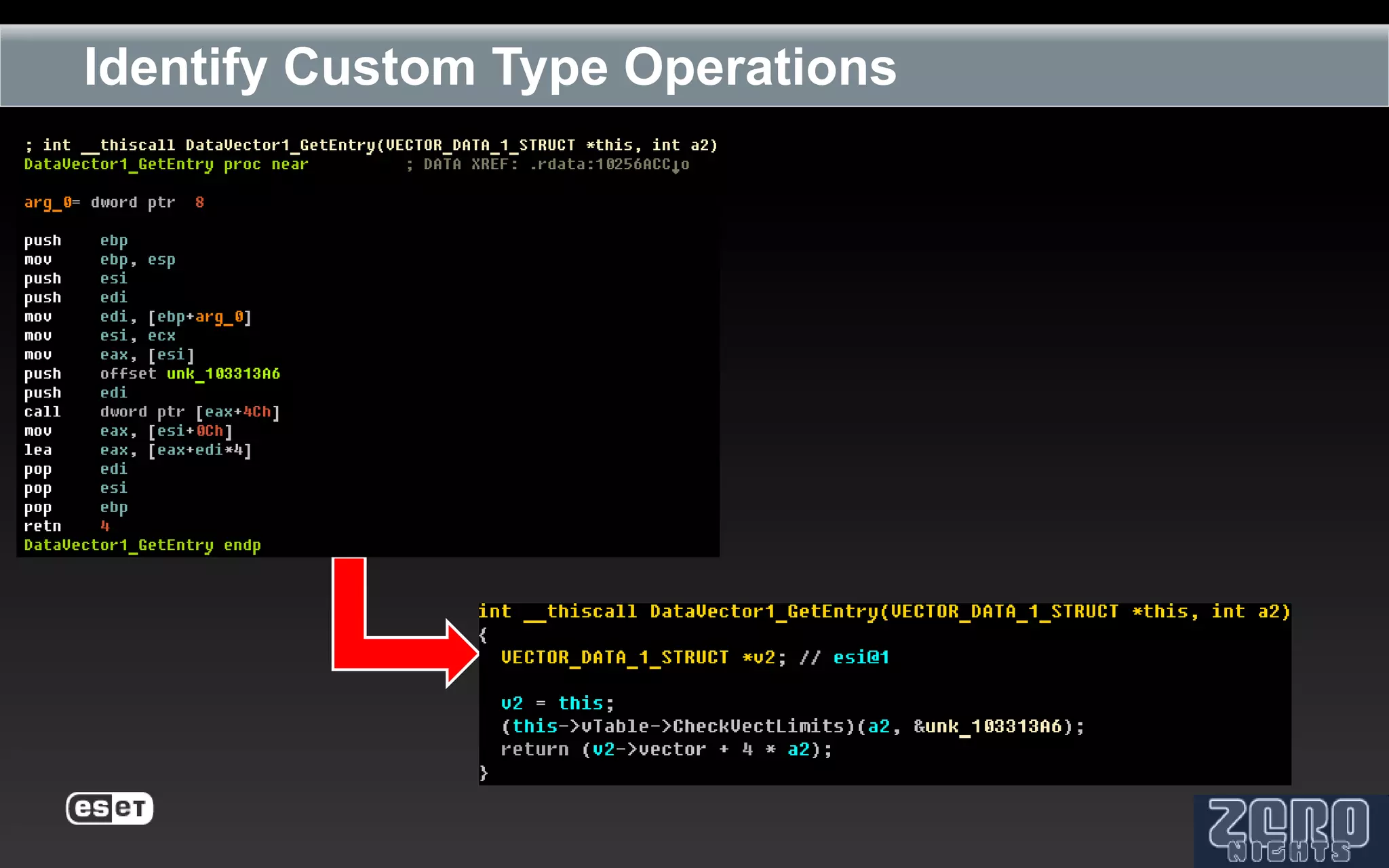
Identify Custom Type Operations
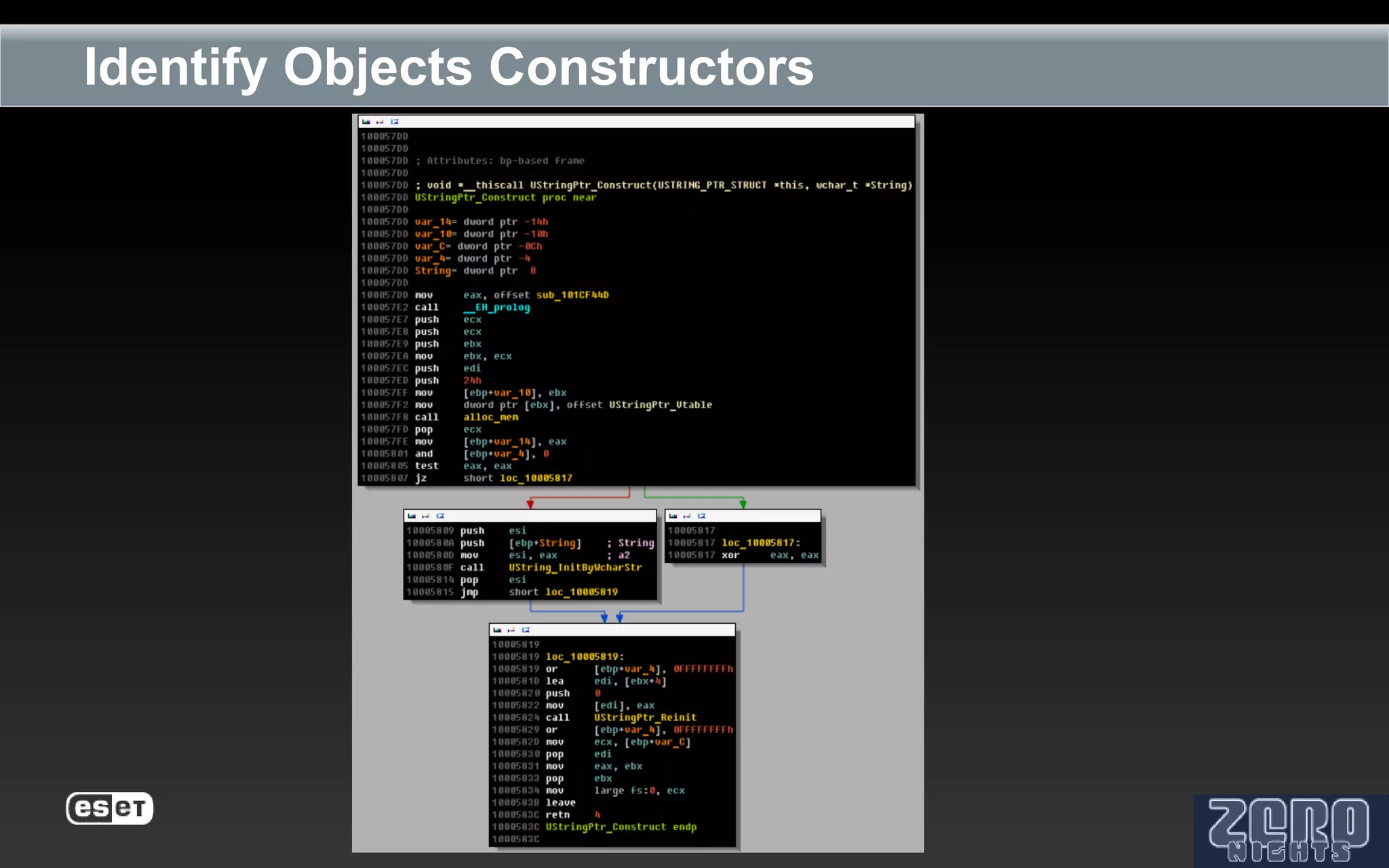
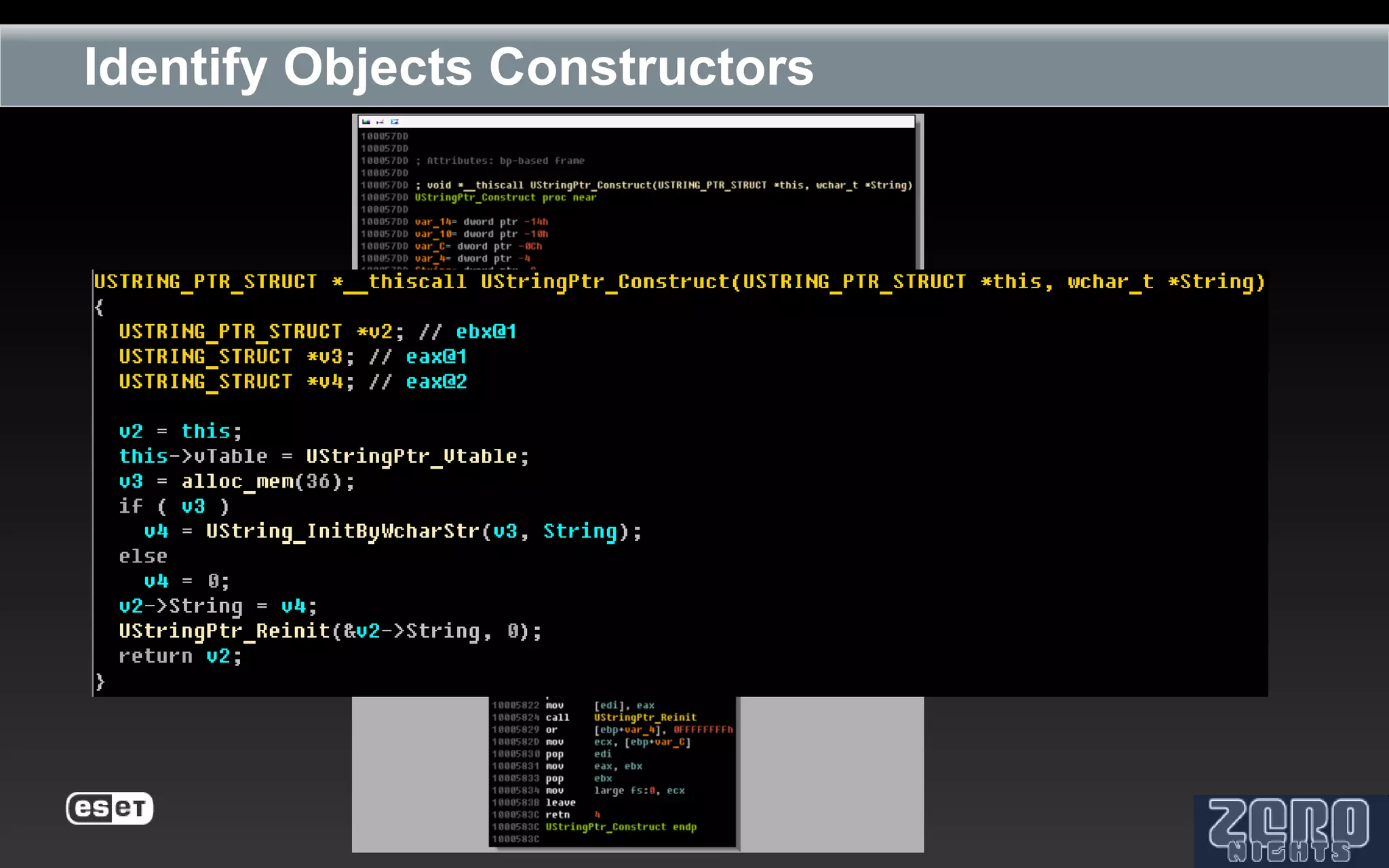
Identify Objects Constructors
Library code identification
         problems
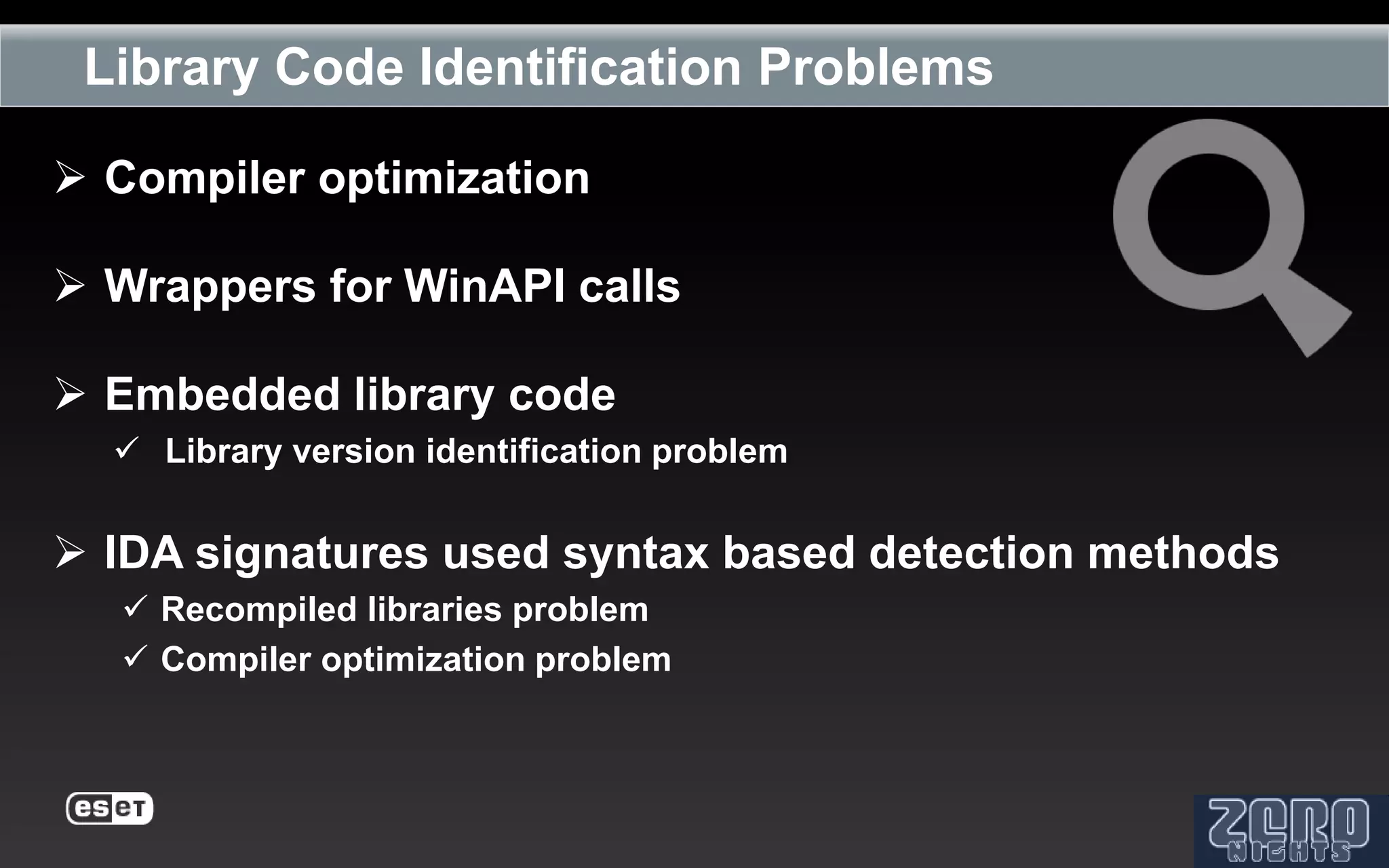
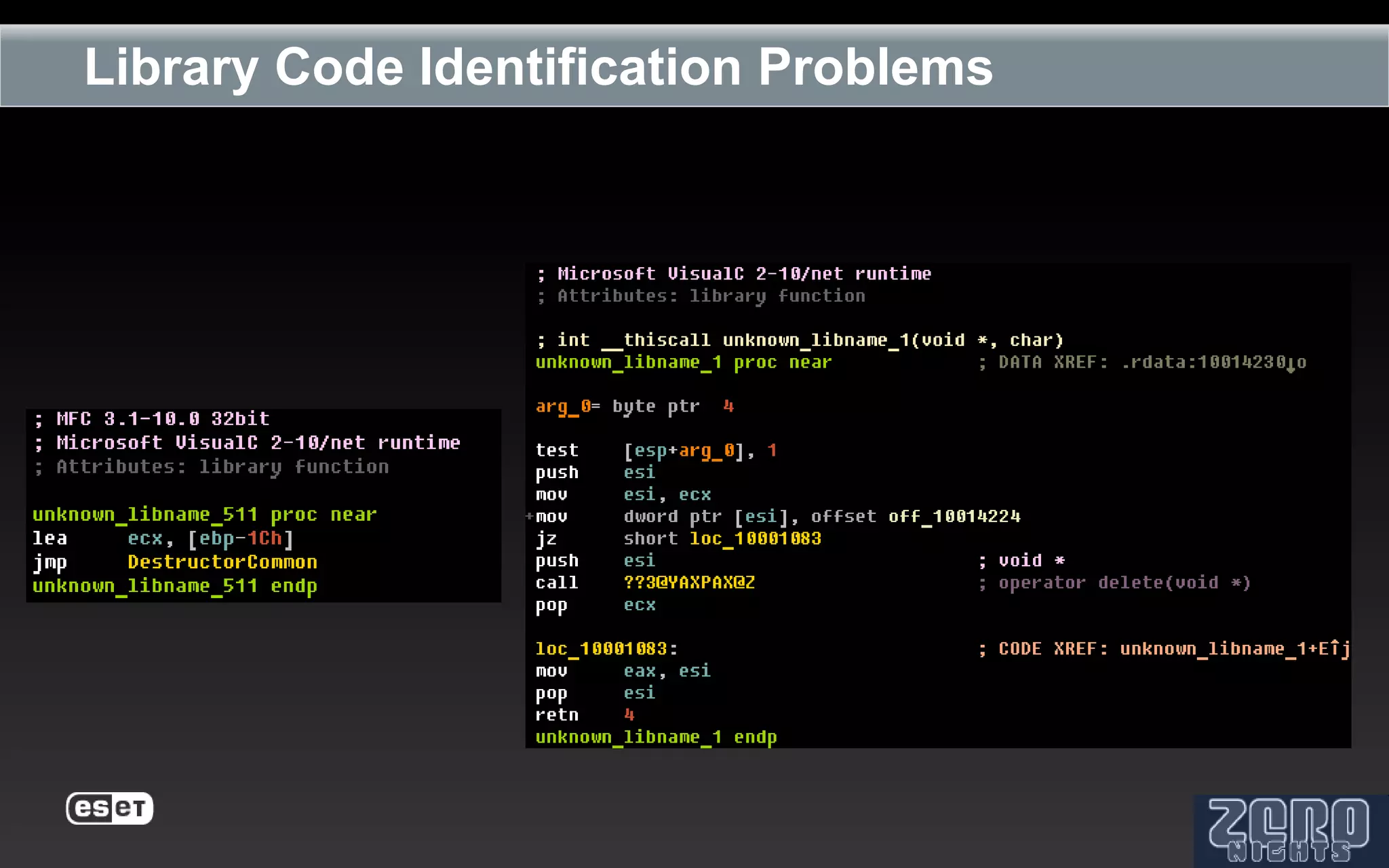
Library Code Identification Problems

 Compiler optimization

 Wrappers for WinAPI calls

 Embedded library code
   Library version identification problem


 IDA signatures used syntax based detection methods
   Recompiled libraries problem
   Compiler optimization problem
Library Code Identification Problems
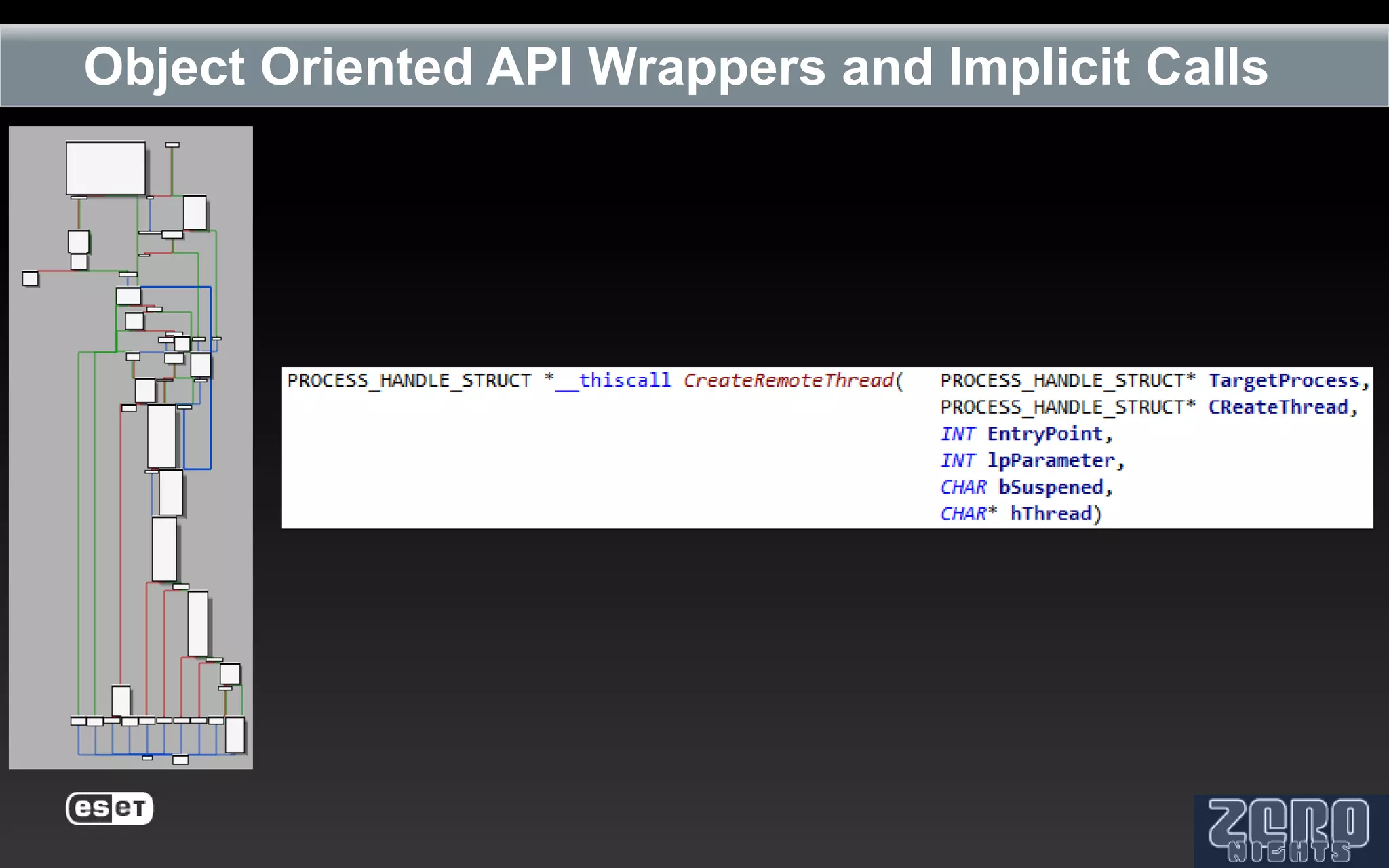
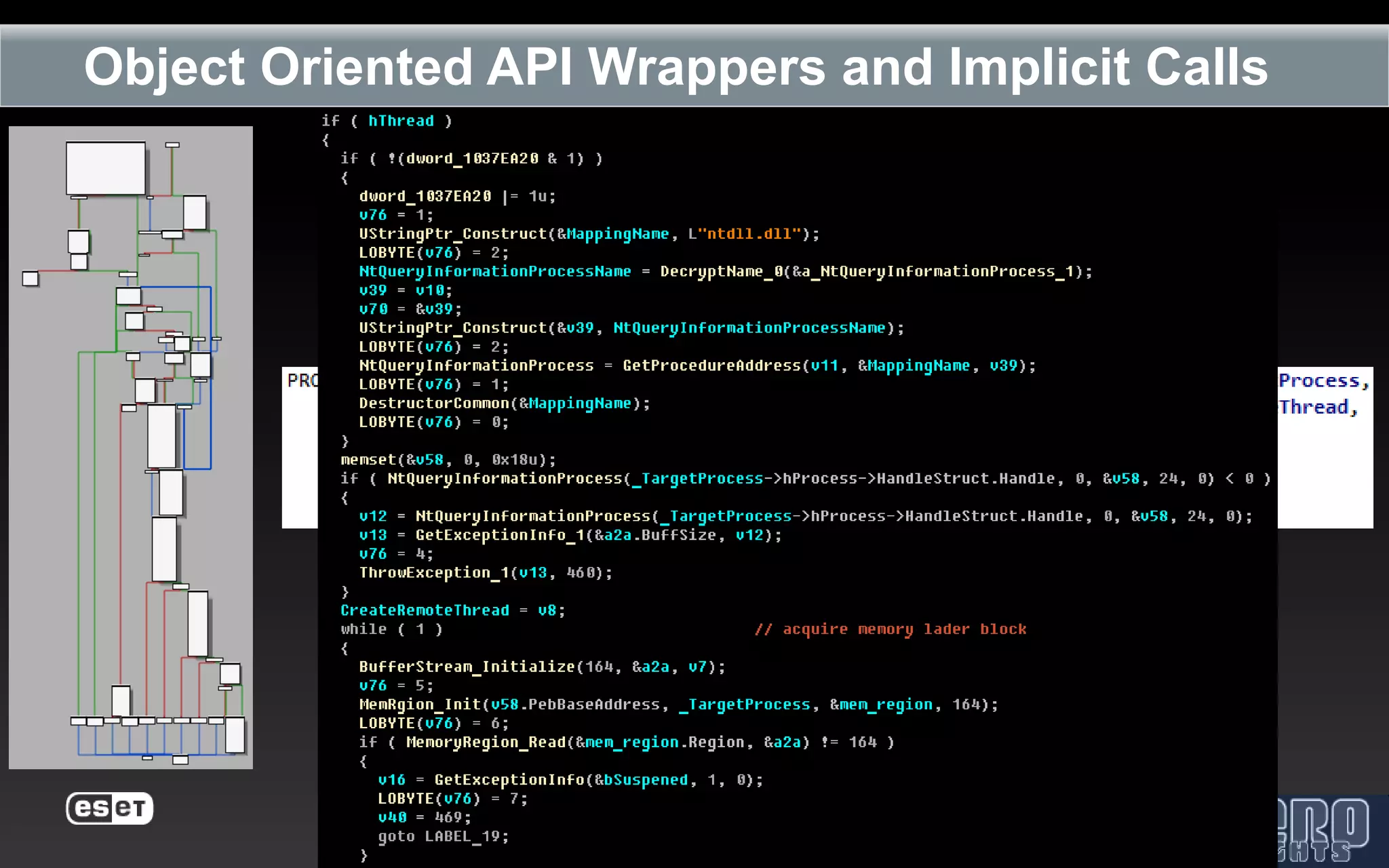
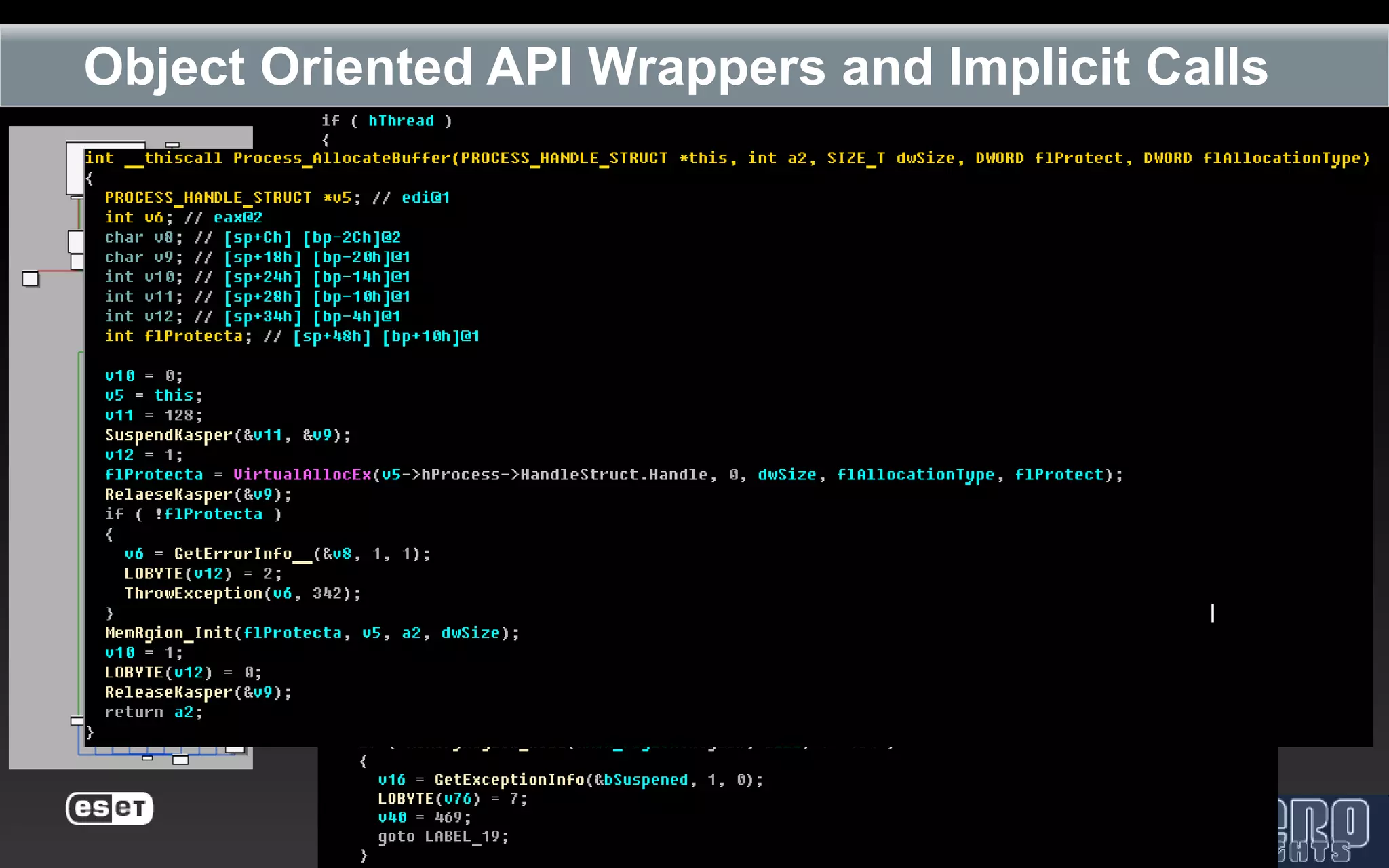
Object Oriented API Wrappers and Implicit Calls
Festi: OOP in kernel-mode
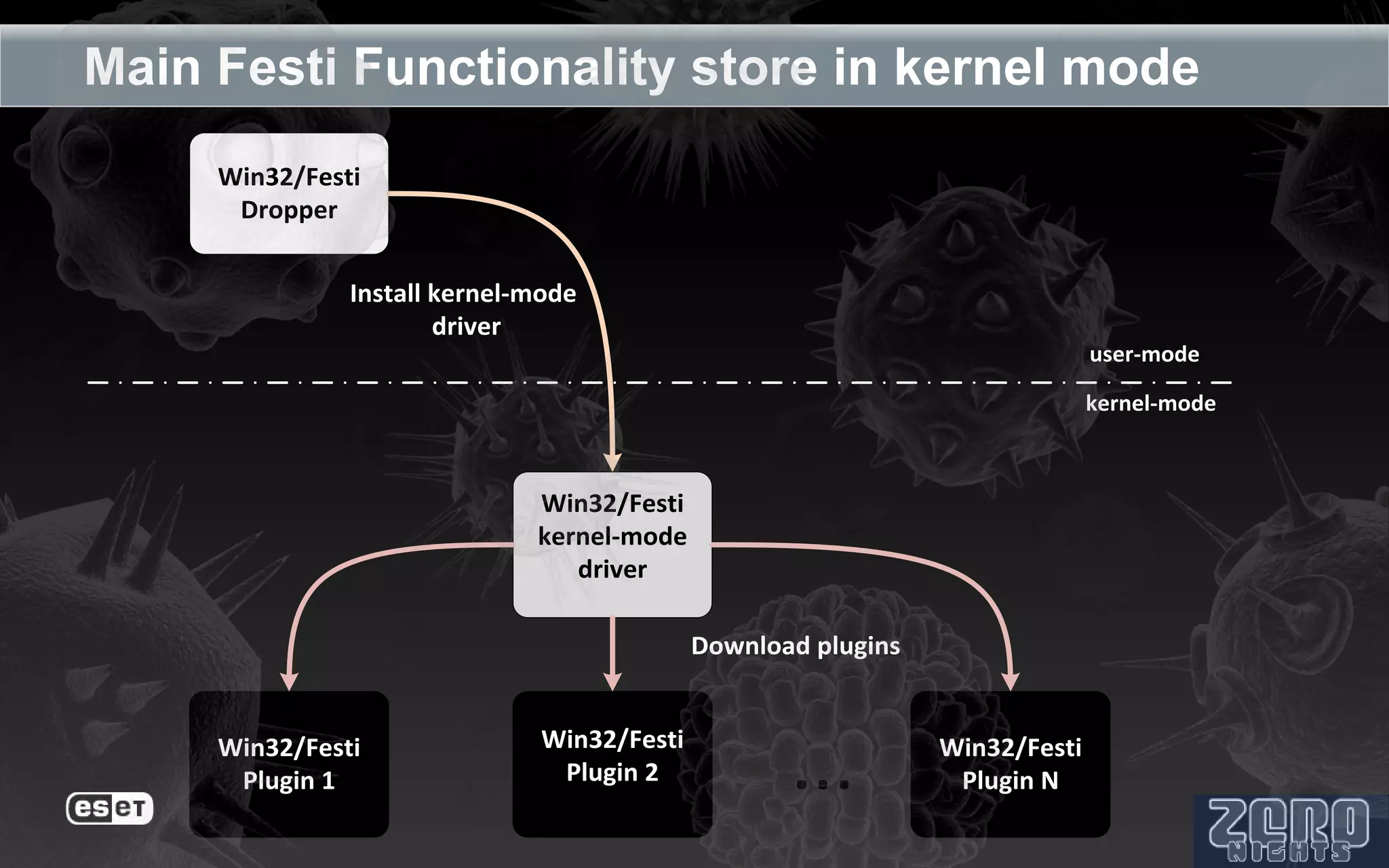
Main Festi Functionality store in kernel mode
     Win32/Festi
      Dropper


               Install kernel-mode
                       driver
                                                                              user-mode

                                                                              kernel-mode


                              Win32/Festi
                              kernel-mode
                                 driver

                                             Download plugins


                               Win32/Festi
     Win32/Festi
      Plugin 1                  Plugin 2            ...         Win32/Festi
                                                                 Plugin N
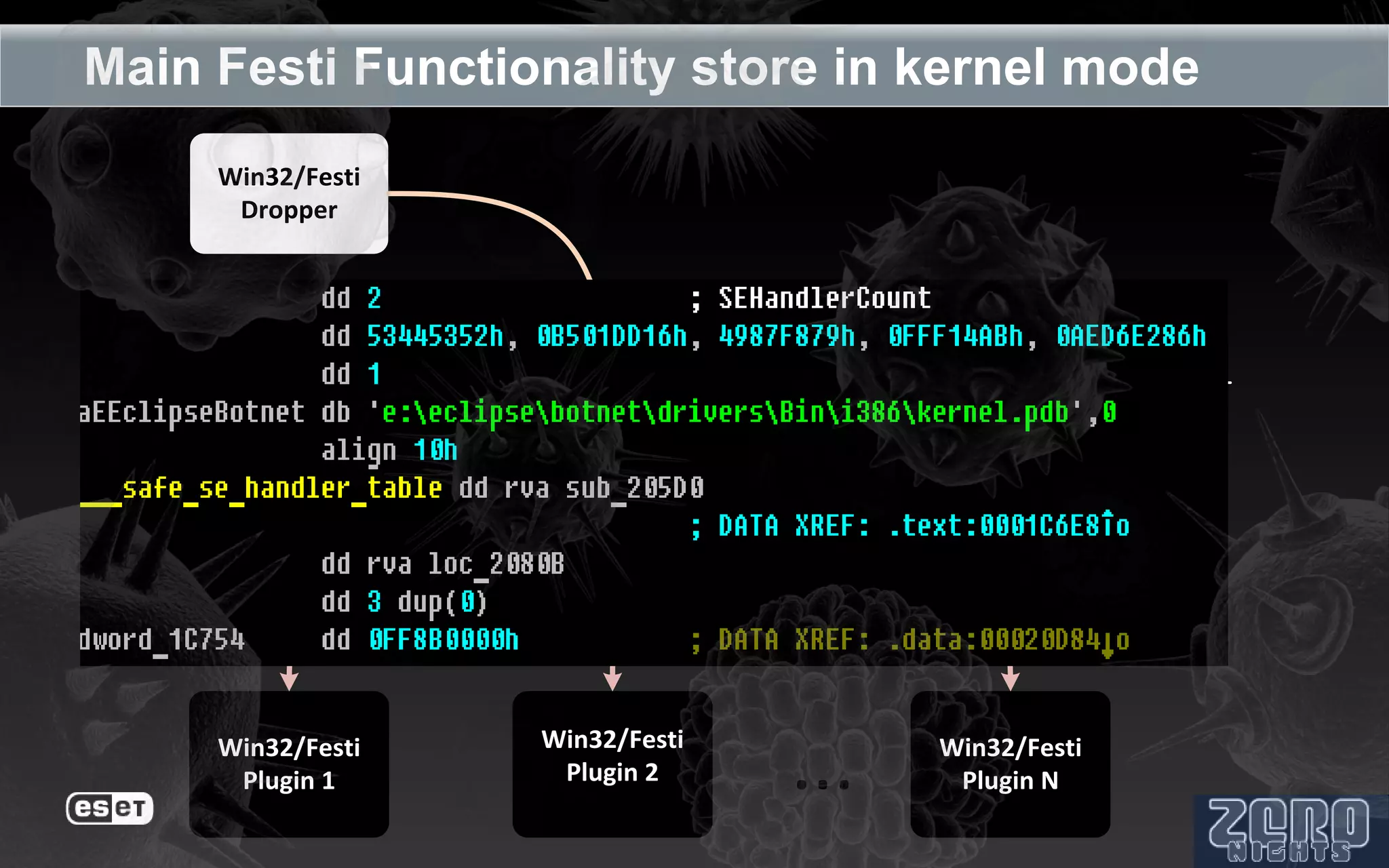
Main Festi Functionality store in kernel mode
     Win32/Festi
      Dropper


               Install kernel-mode
                       driver
                                                                              user-mode

                                                                              kernel-mode


                              Win32/Festi
                              kernel-mode
                                 driver

                                             Download plugins


                               Win32/Festi
     Win32/Festi
      Plugin 1                  Plugin 2            ...         Win32/Festi
                                                                 Plugin N
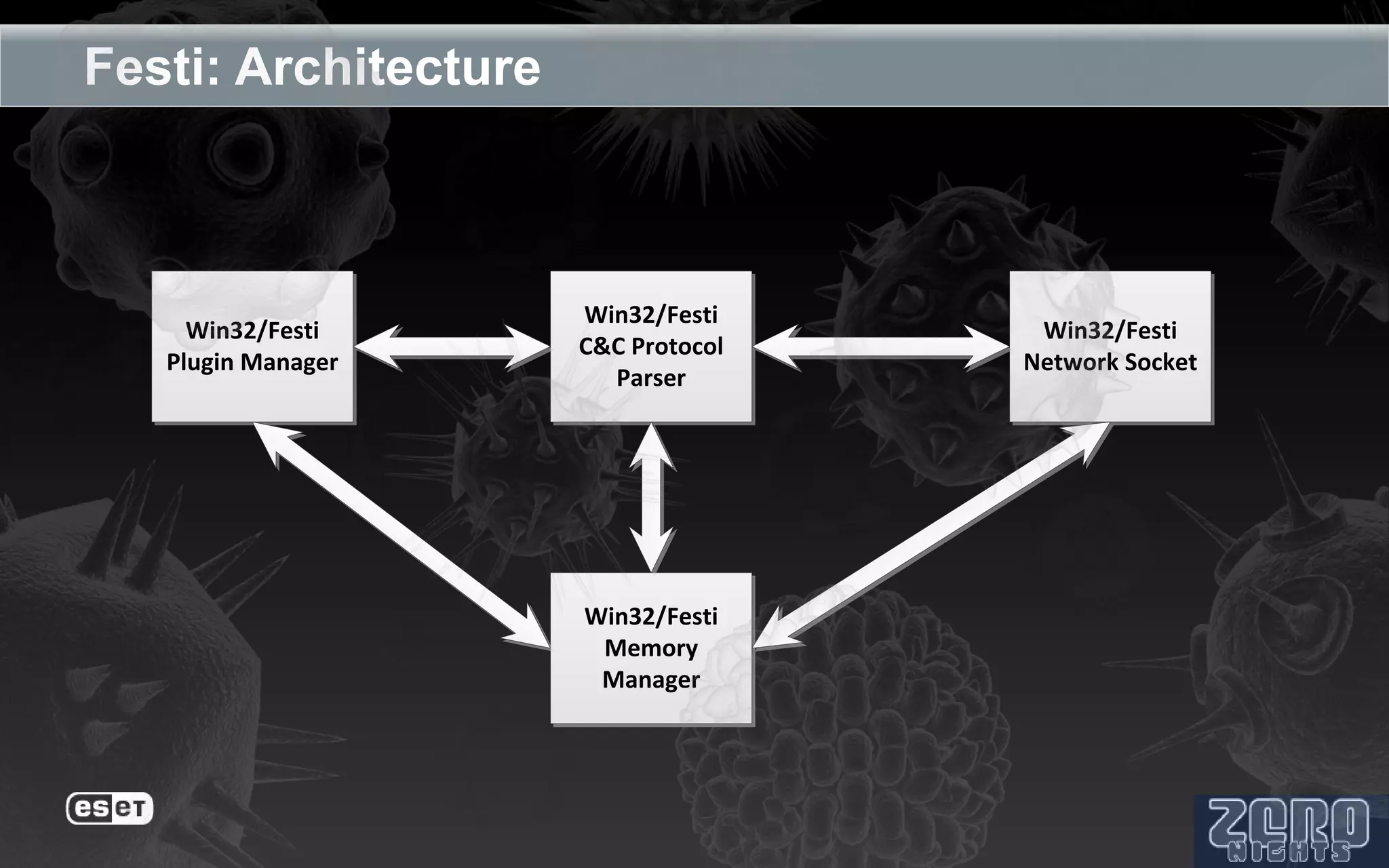
Festi: Architecture


                      Win32/Festi
     Win32/Festi                      Win32/Festi
                      C&C Protocol
   Plugin Manager                    Network Socket
                        Parser


                      Win32/Festi
                       Memory
                       Manager
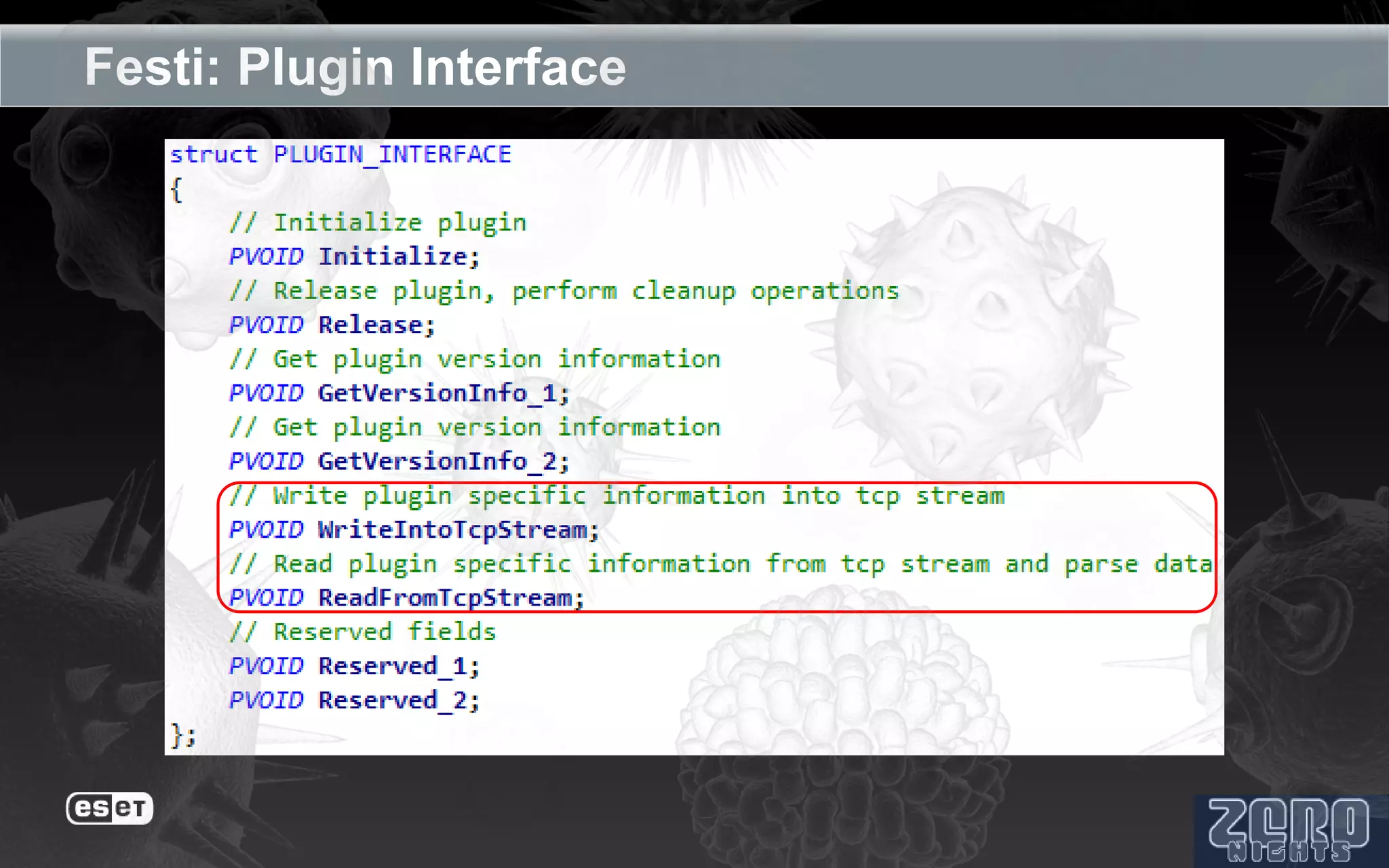
Festi: Plugin Interface


         Array of pointers
            to plugins
                                     Plugin 1
              Plugin1        struct PLUGIN_INTERFACE
                                     Plugin 2
              Plugin2        struct PLUGIN_INTERFACE
                                     Plugin 3
              Plugin3        struct PLUGIN_INTERFACE

                ...
                                     Plugin N
              PluginN        struct PLUGIN_INTERFACE
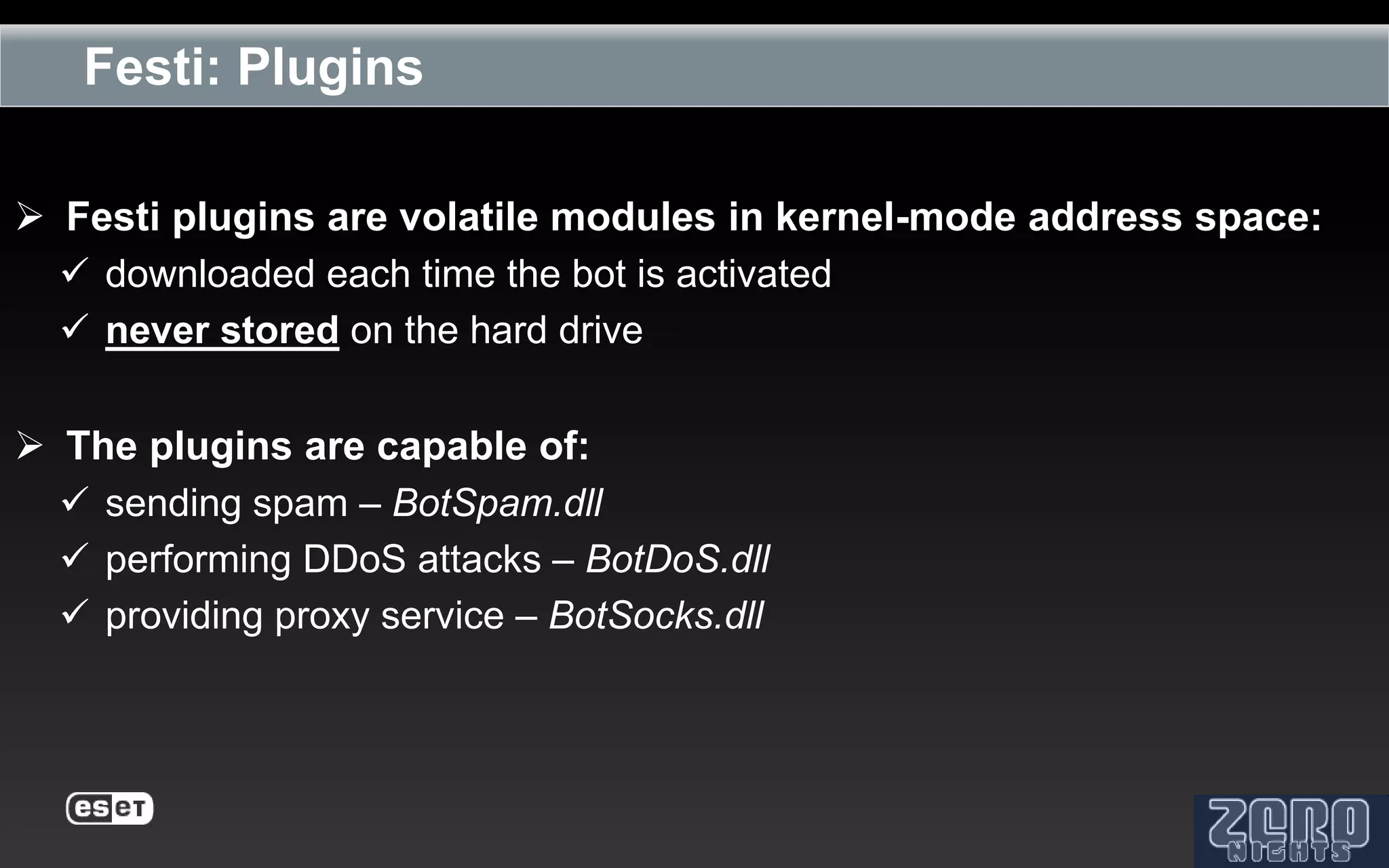
Festi: Plugins

 Festi plugins are volatile modules in kernel-mode address space:
   downloaded each time the bot is activated
   never stored on the hard drive

 The plugins are capable of:
   sending spam – BotSpam.dll
   performing DDoS attacks – BotDoS.dll
   providing proxy service – BotSocks.dll
Flamer Framework Overview
An overview of the Flamer Framework
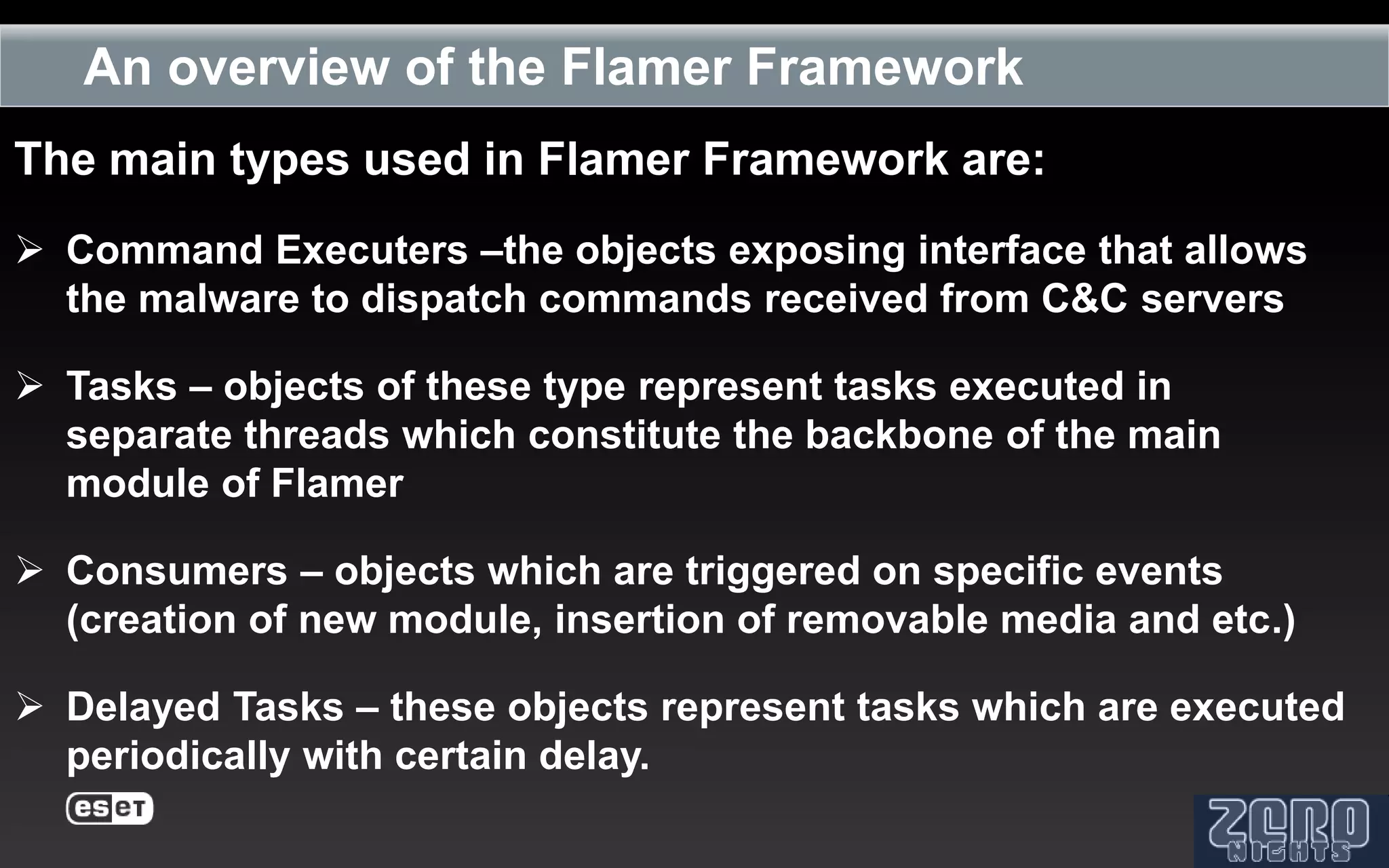
The main types used in Flamer Framework are:
 Command Executers –the objects exposing interface that allows
  the malware to dispatch commands received from C&C servers

 Tasks – objects of these type represent tasks executed in
  separate threads which constitute the backbone of the main
  module of Flamer

 Consumers – objects which are triggered on specific events
  (creation of new module, insertion of removable media and etc.)

 Delayed Tasks – these objects represent tasks which are executed
  periodically with certain delay.
An overview of the Flamer Framework
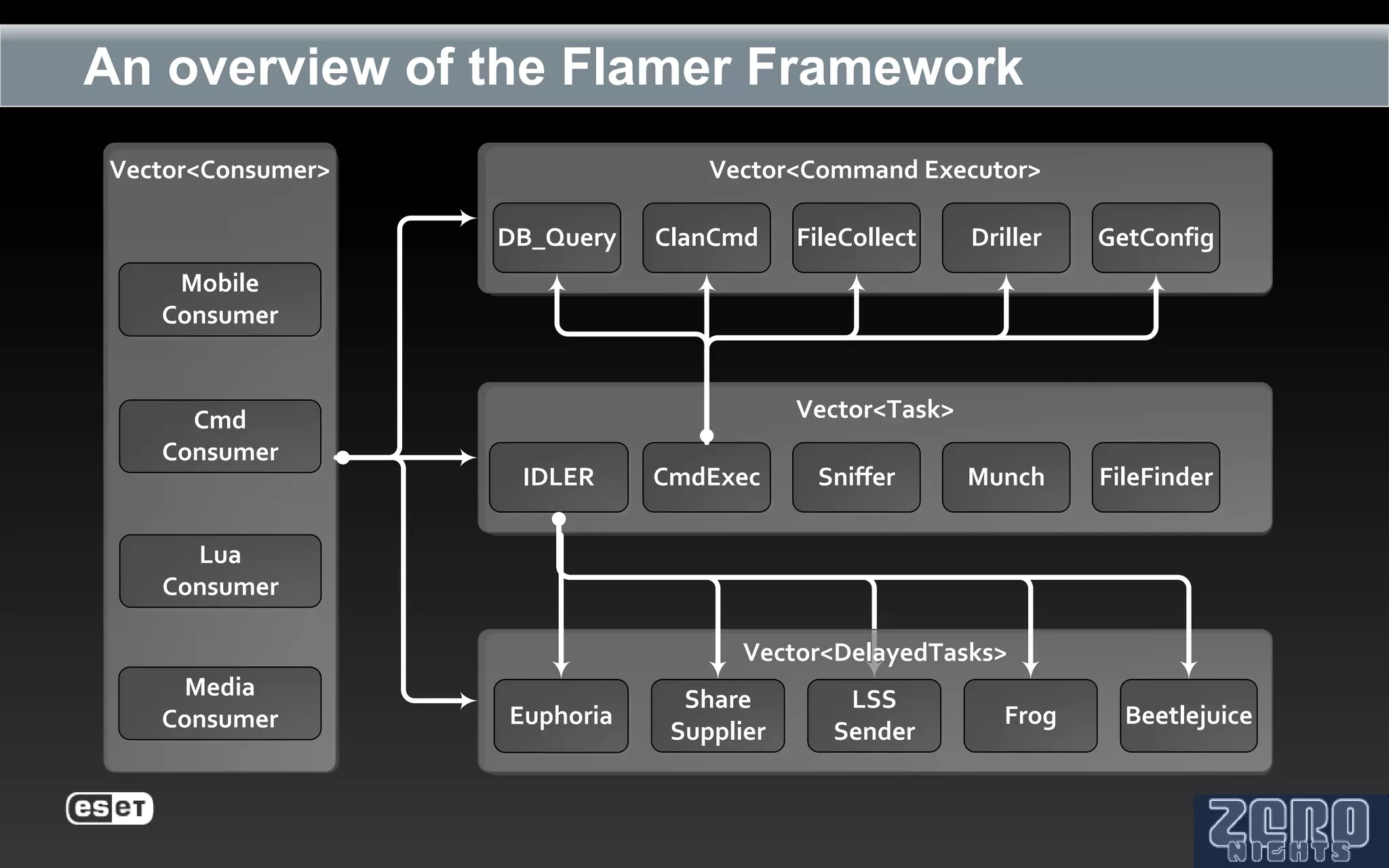
Vector<Consumer>                  Vector<Command Executor>

                   DB_Query   ClanCmd     FileCollect    Driller   GetConfig
    Mobile
   Consumer


     Cmd                                  Vector<Task>
   Consumer
                    IDLER     CmdExec      Sniffer       Munch     FileFinder

     Lua
   Consumer

                                     Vector<DelayedTasks>
    Media                       Share         LSS
   Consumer        Euphoria                                 Frog     Beetlejuice
                               Supplier      Sender
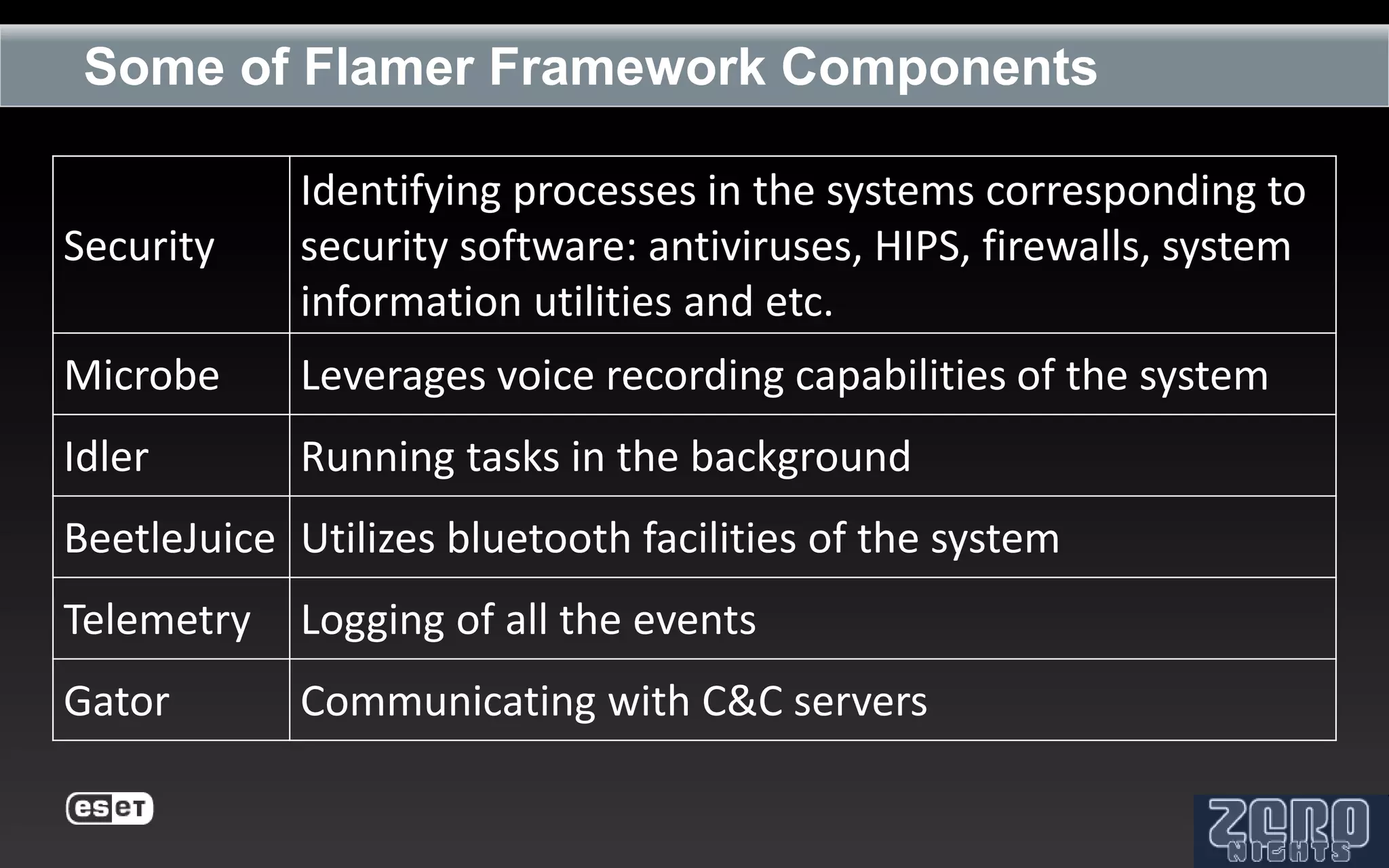
Some of Flamer Framework Components

             Identifying processes in the systems corresponding to
Security     security software: antiviruses, HIPS, firewalls, system
             information utilities and etc.
Microbe      Leverages voice recording capabilities of the system
Idler        Running tasks in the background
BeetleJuice Utilizes bluetooth facilities of the system
Telemetry    Logging of all the events
Gator        Communicating with C&C servers
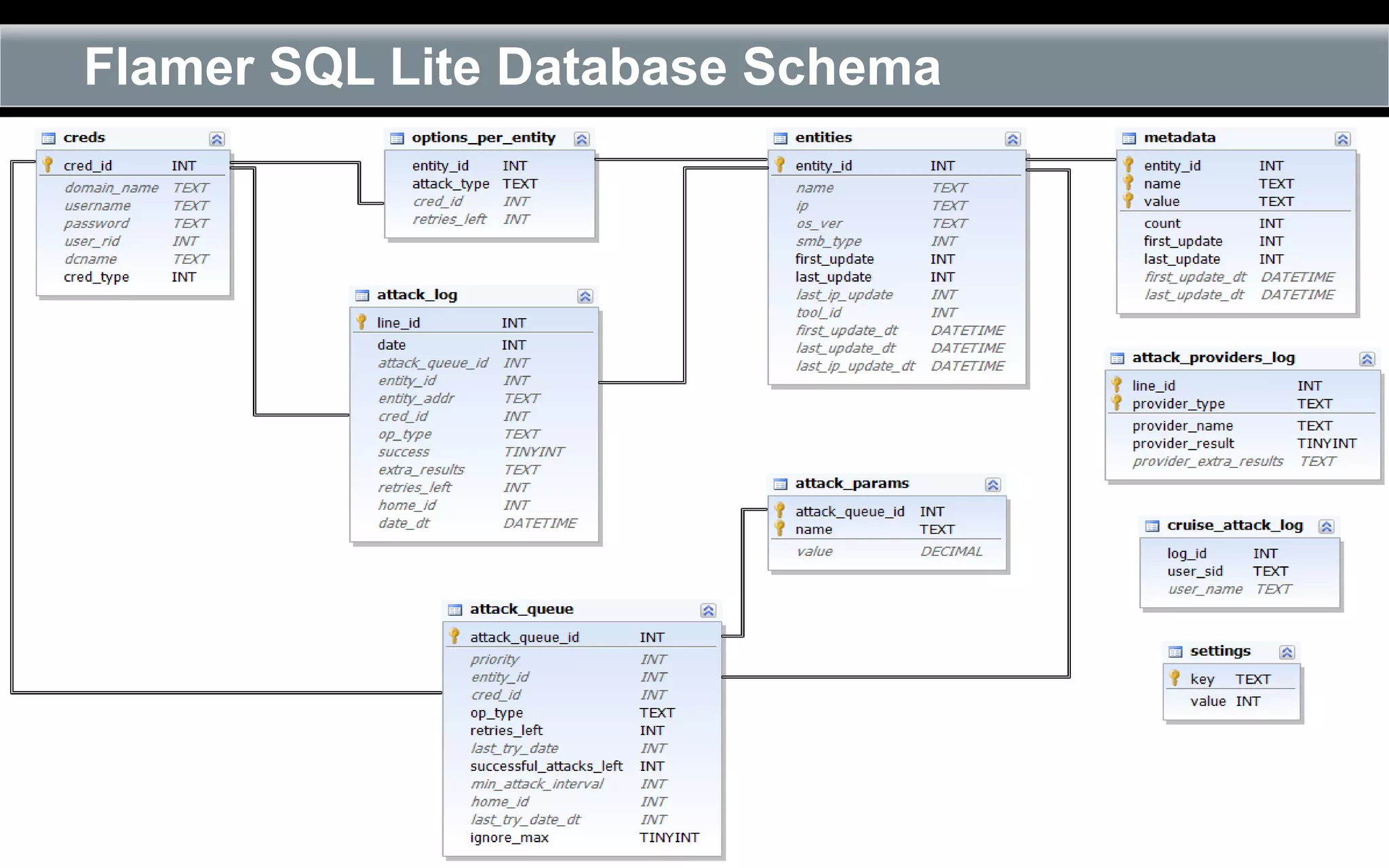
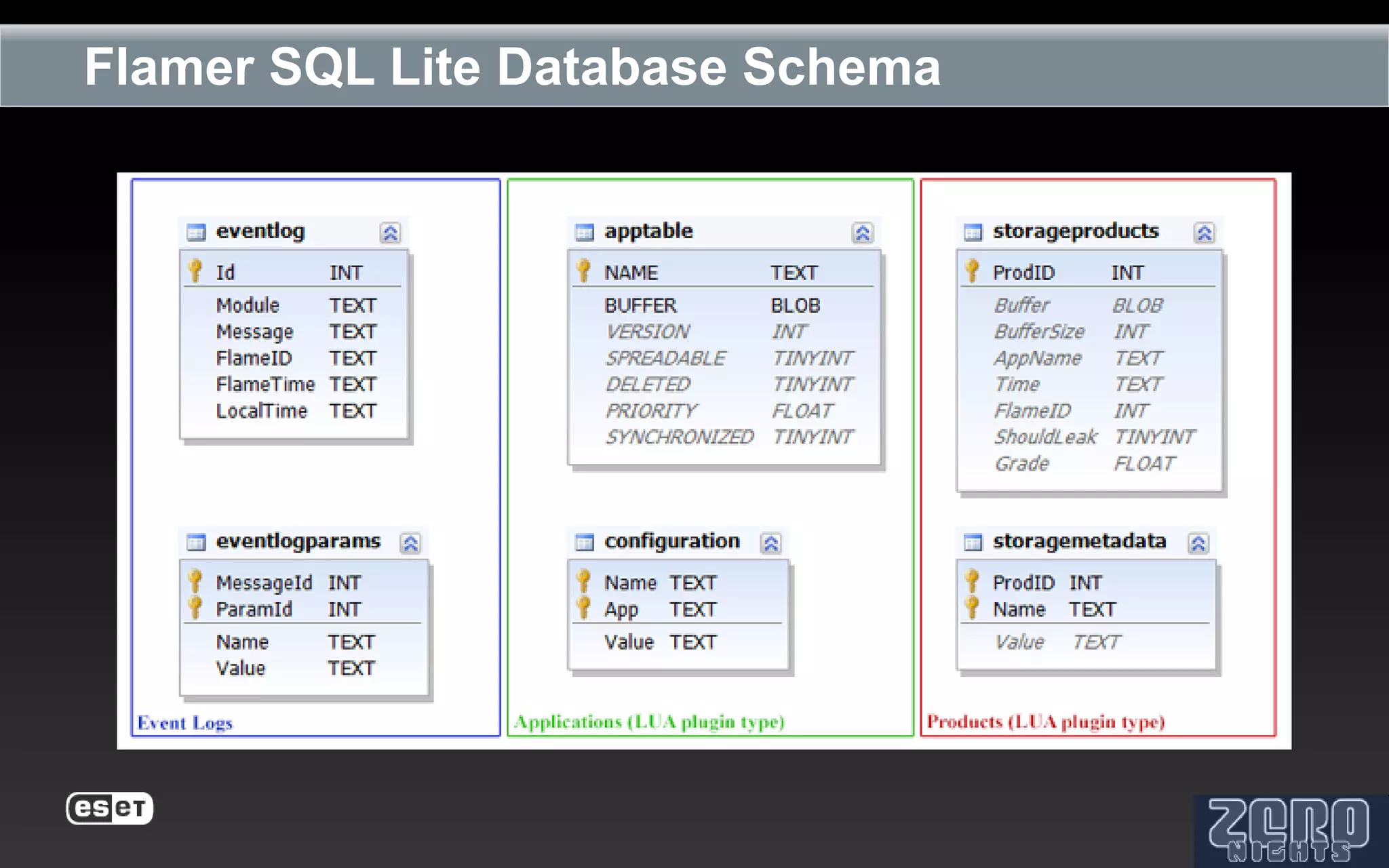
Flamer SQL Lite Database Schema
REconstructing Flamer Framework
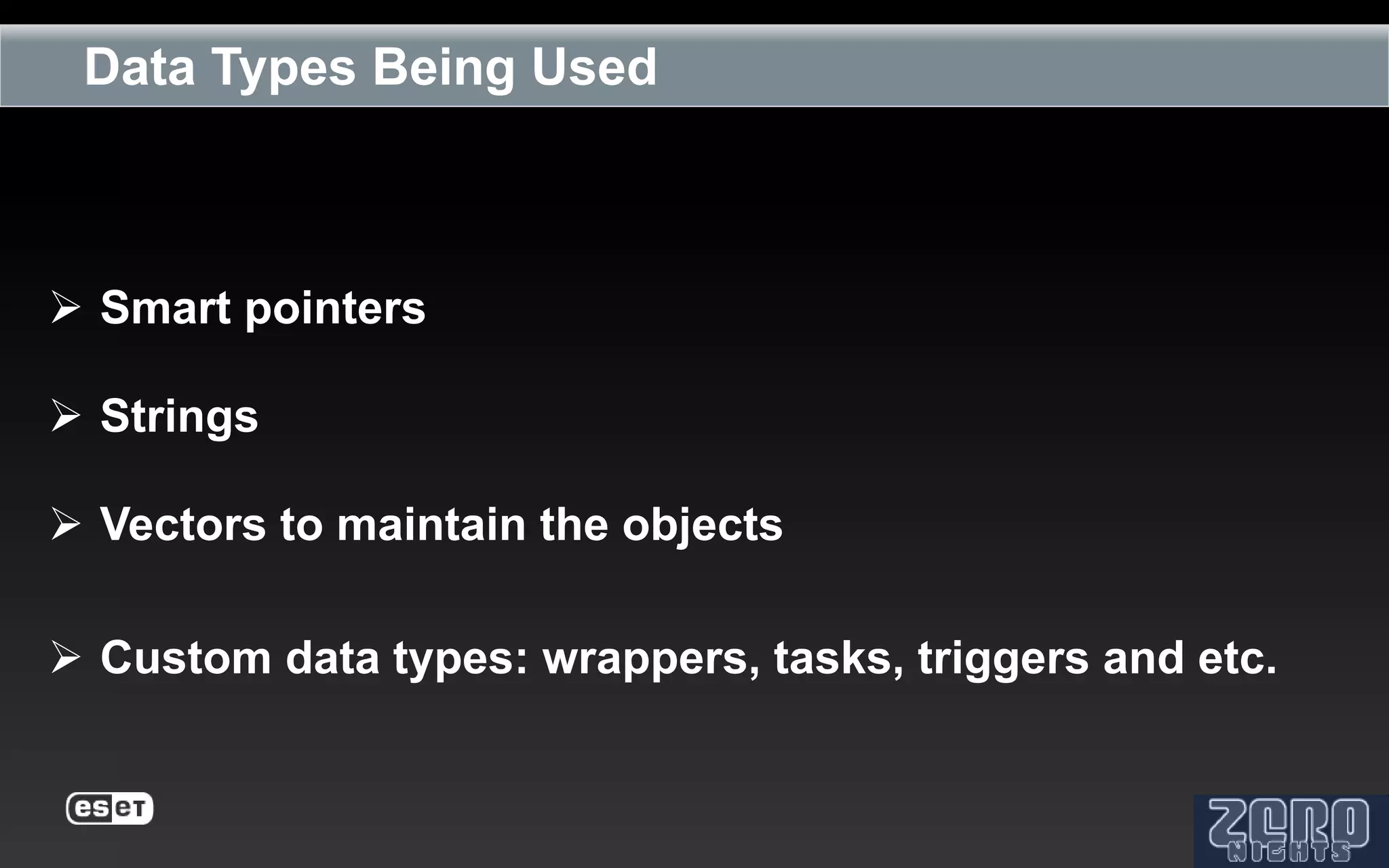
Data Types Being Used


 Smart pointers

 Strings

 Vectors to maintain the objects

 Custom data types: wrappers, tasks, triggers and etc.
Data Types Being Used: Smart pointers
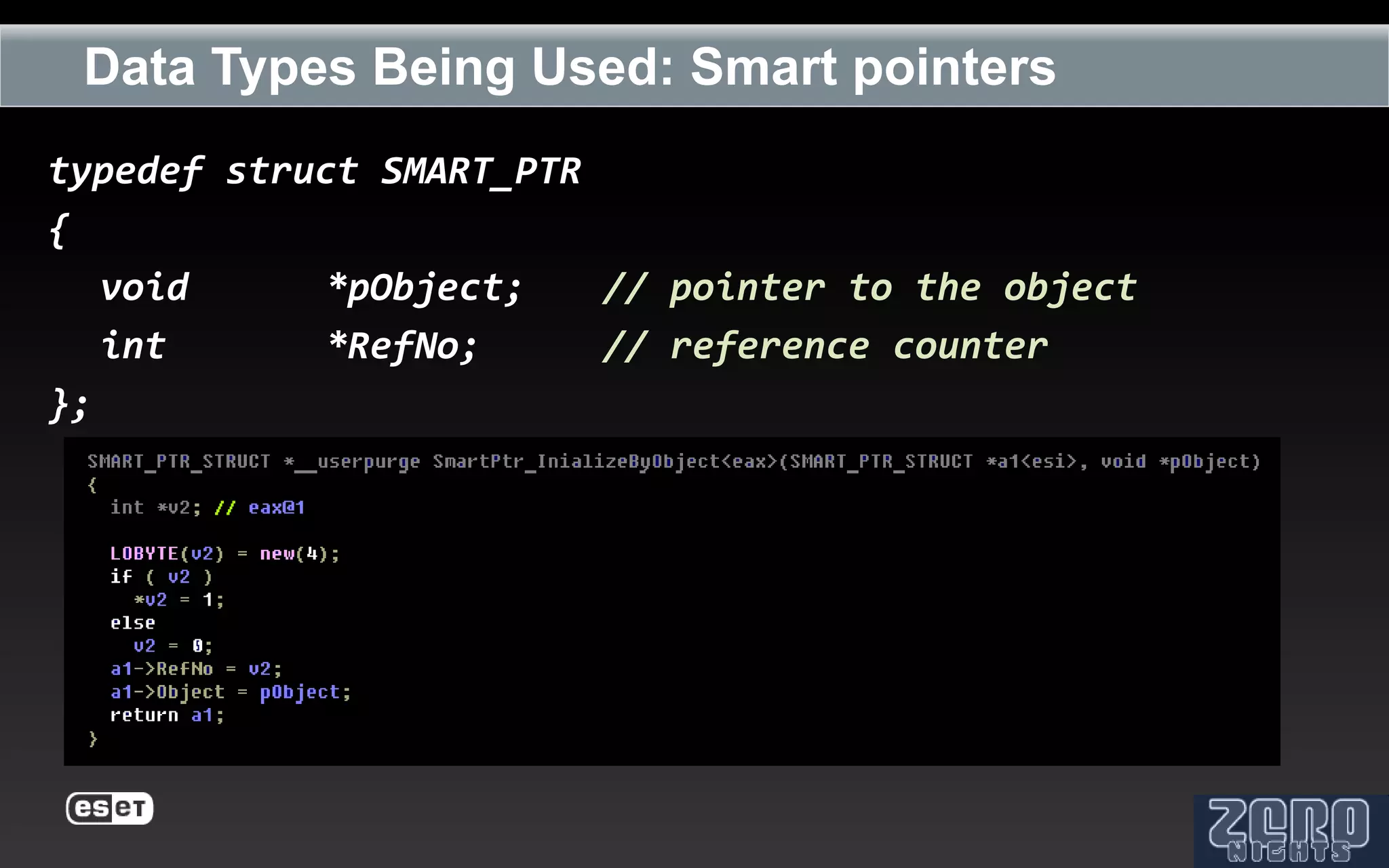
typedef struct SMART_PTR
{
   void     *pObject;    // pointer to the object
   int      *RefNo;      // reference counter
};
Data Types Being Used: Strings
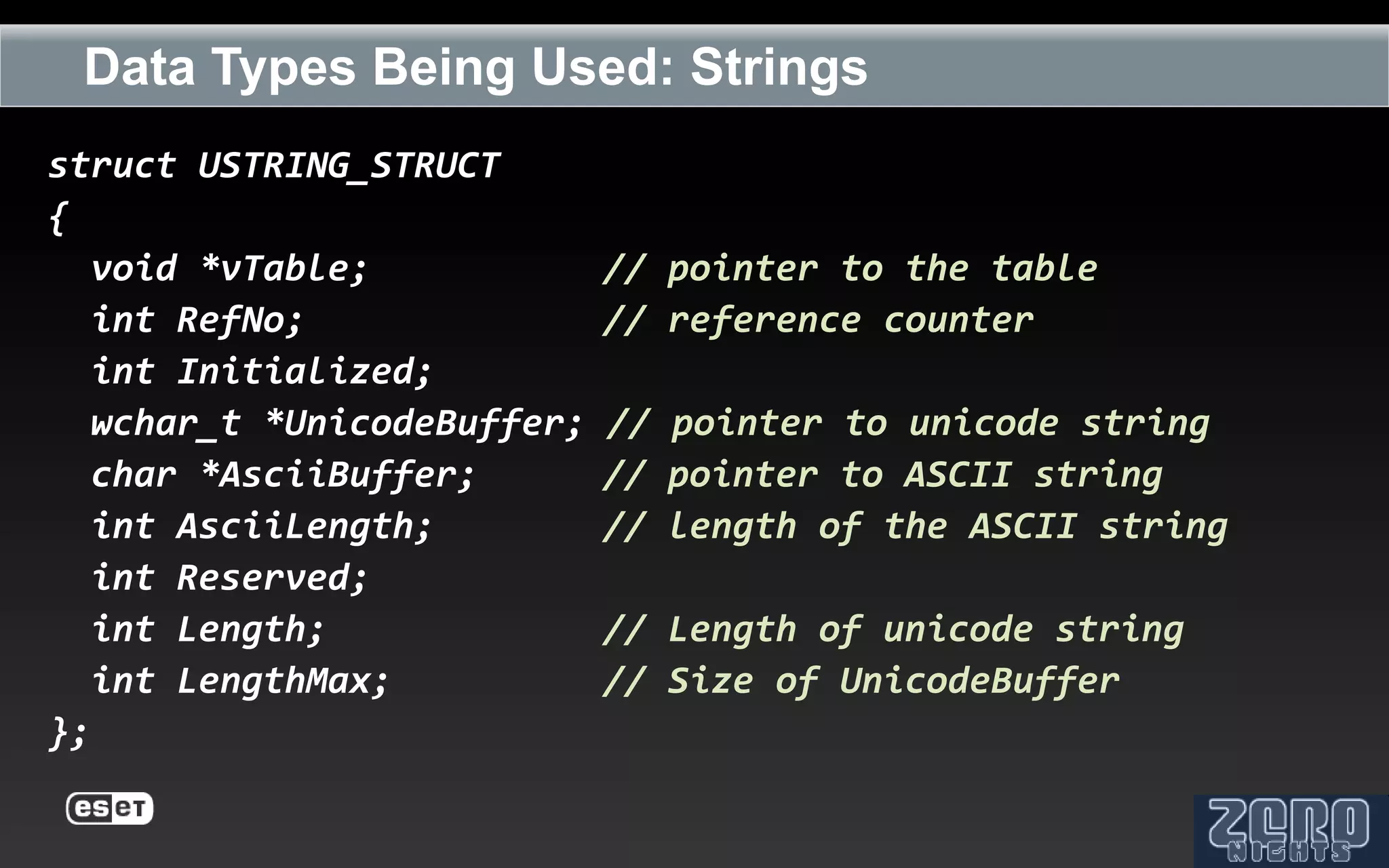
struct USTRING_STRUCT
{
   void *vTable;             // pointer to the table
   int RefNo;                // reference counter
   int Initialized;
   wchar_t *UnicodeBuffer;   // pointer to unicode string
   char *AsciiBuffer;        // pointer to ASCII string
   int AsciiLength;          // length of the ASCII string
   int Reserved;
   int Length;               // Length of unicode string
   int LengthMax;            // Size of UnicodeBuffer
};
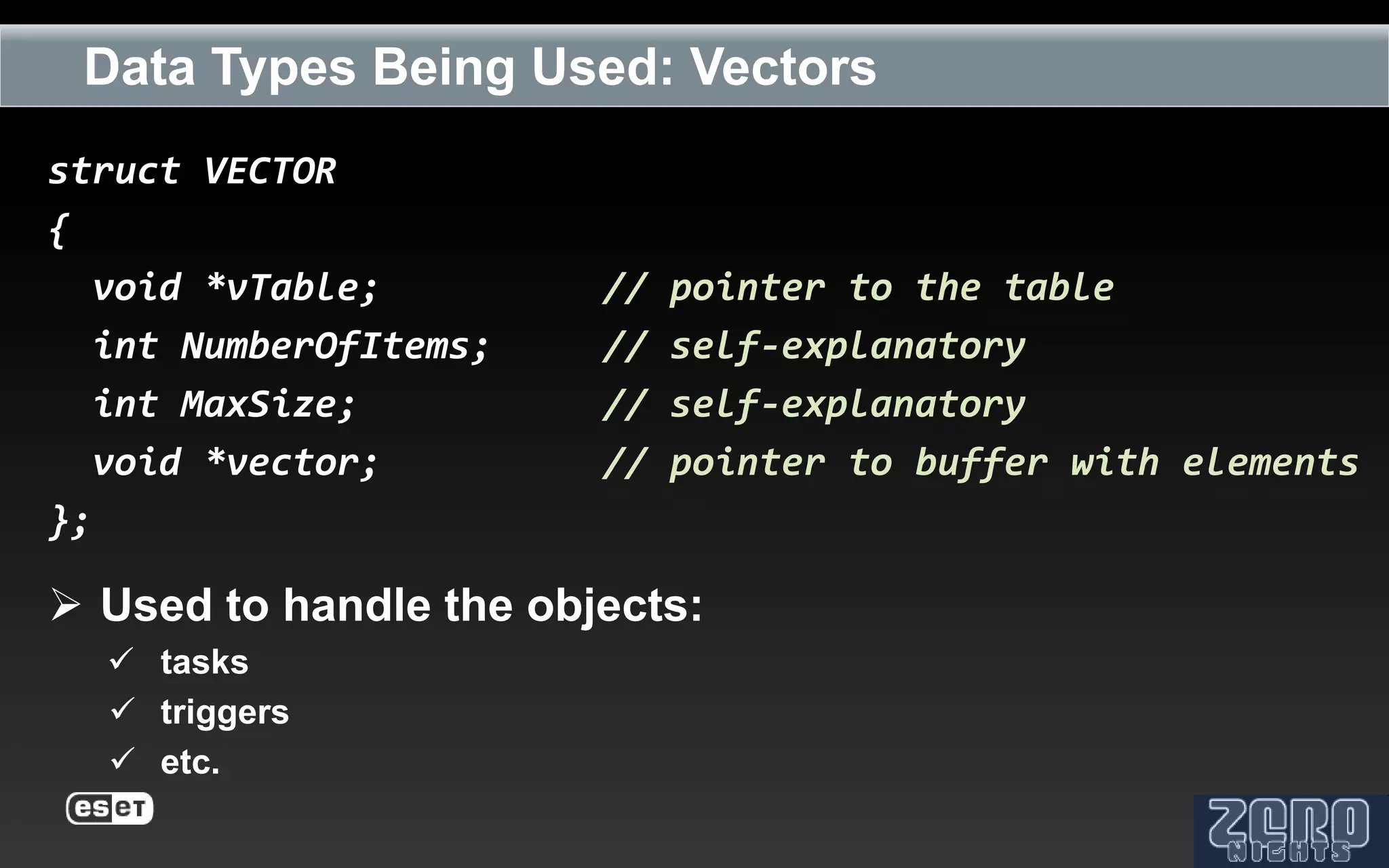
Data Types Being Used: Vectors
struct VECTOR
{
  void *vTable;         //   pointer to the table
  int NumberOfItems;    //   self-explanatory
  int MaxSize;          //   self-explanatory
  void *vector;         //   pointer to buffer with elements
};

 Used to handle the objects:
   tasks
   triggers
   etc.
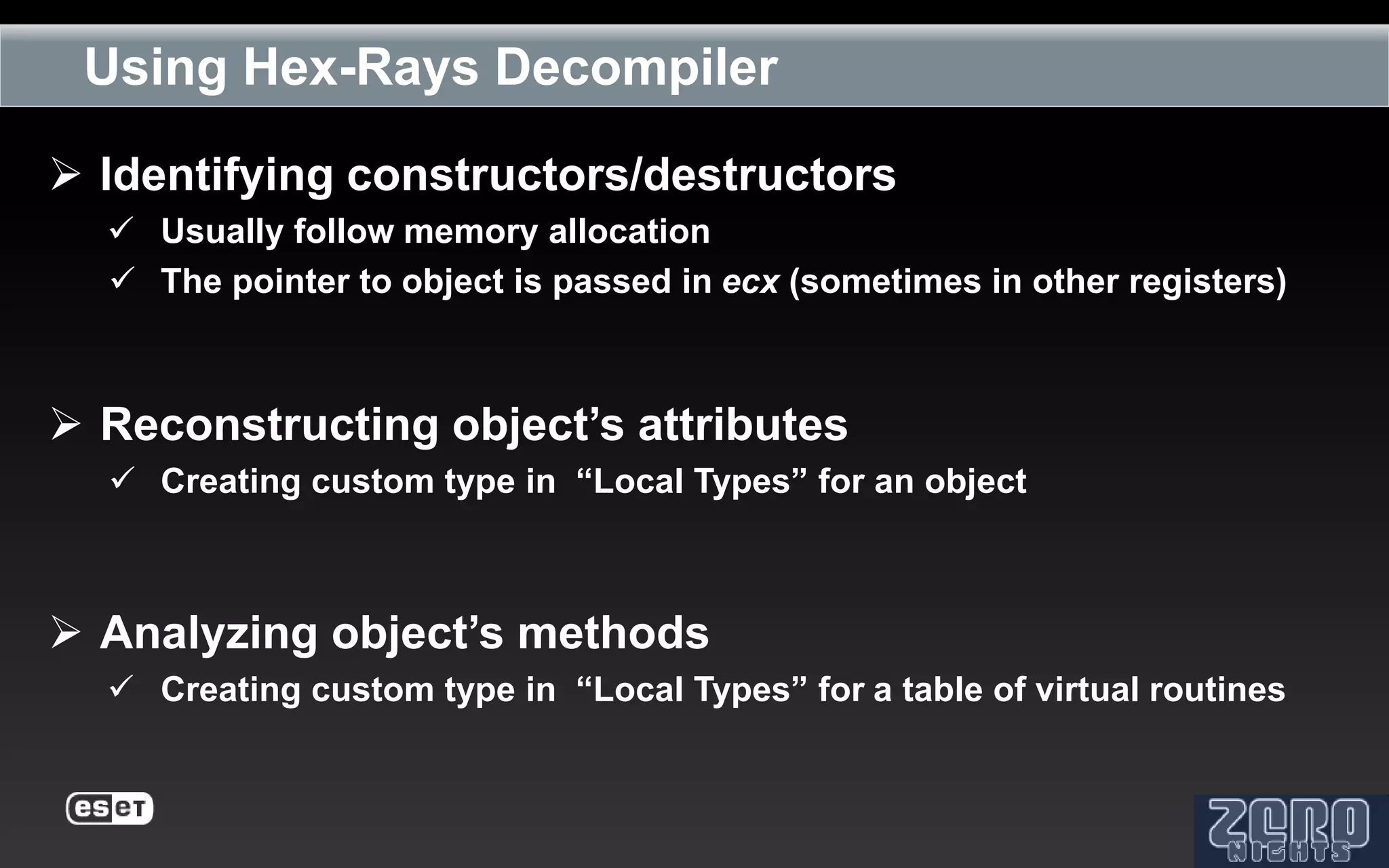
Using Hex-Rays Decompiler

 Identifying constructors/destructors
   Usually follow memory allocation
   The pointer to object is passed in ecx (sometimes in other registers)


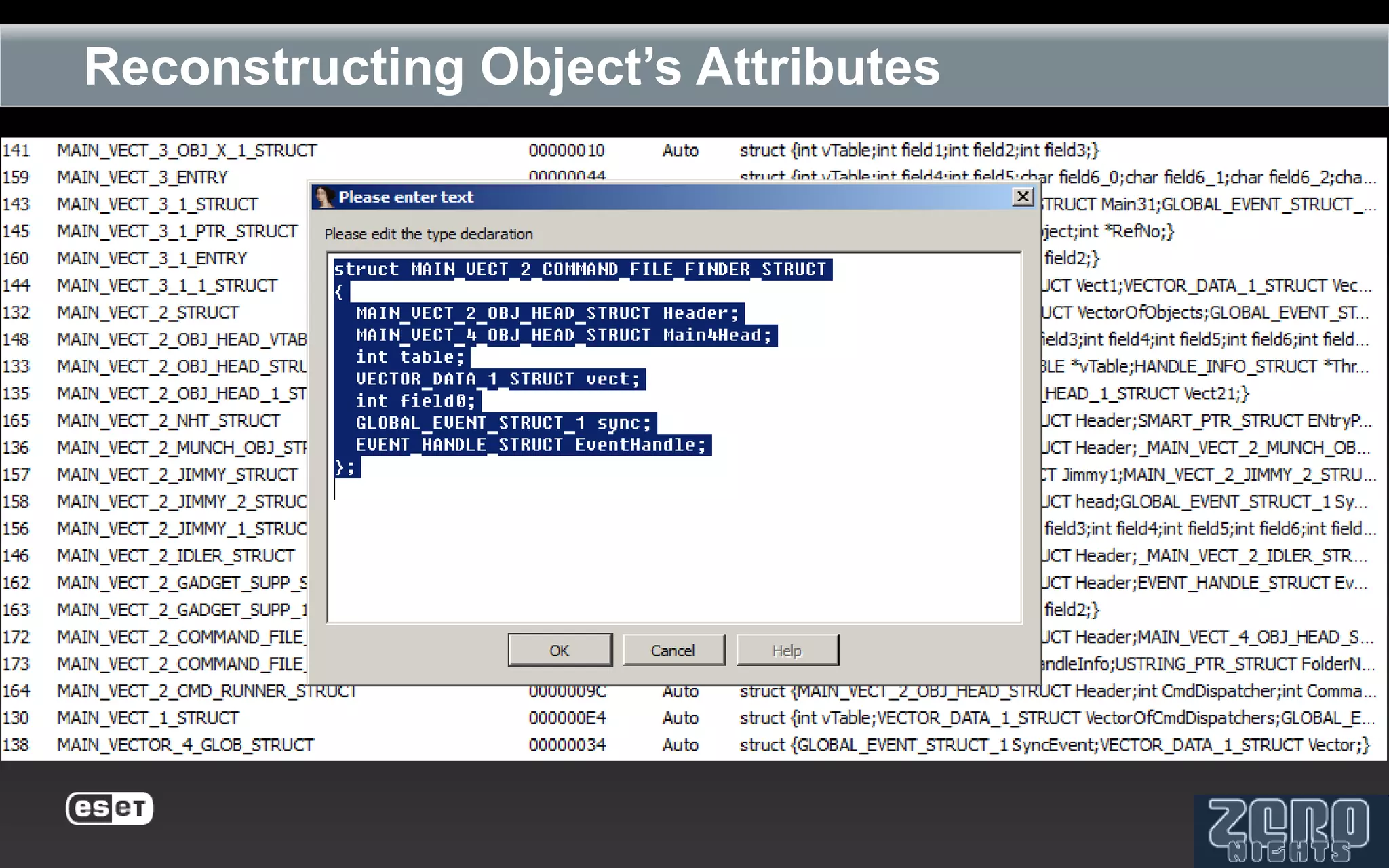
 Reconstructing object’s attributes
   Creating custom type in “Local Types” for an object


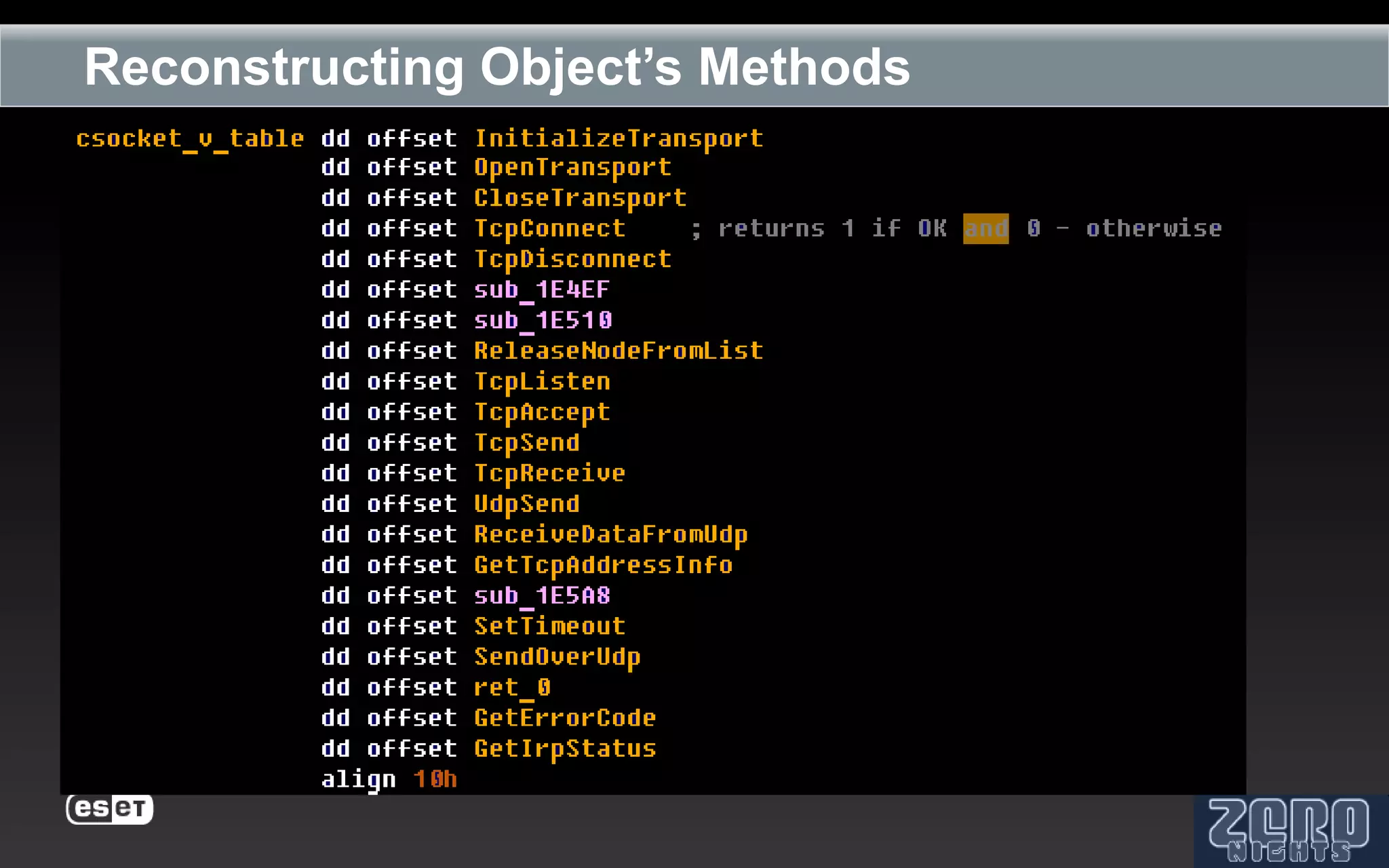
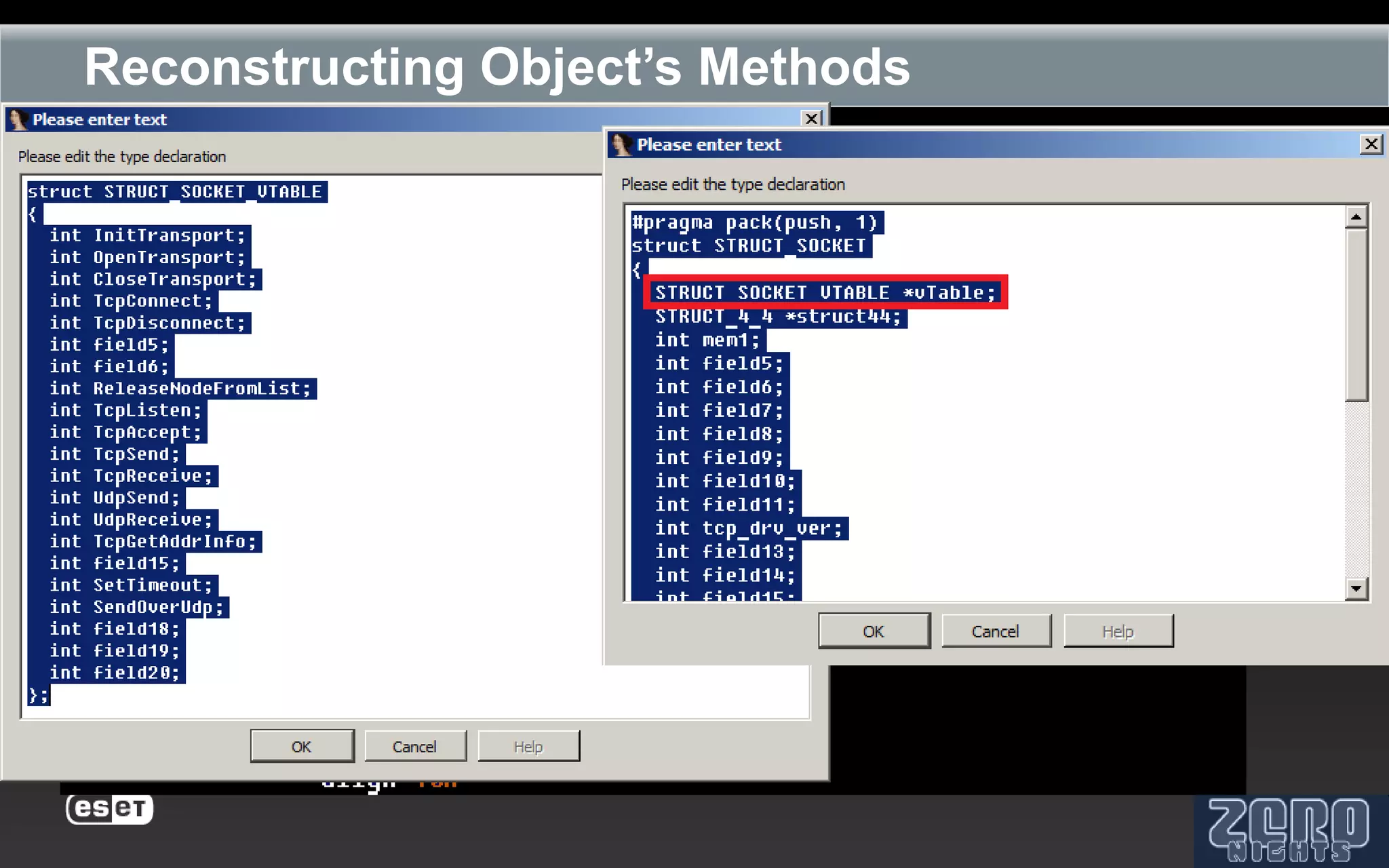
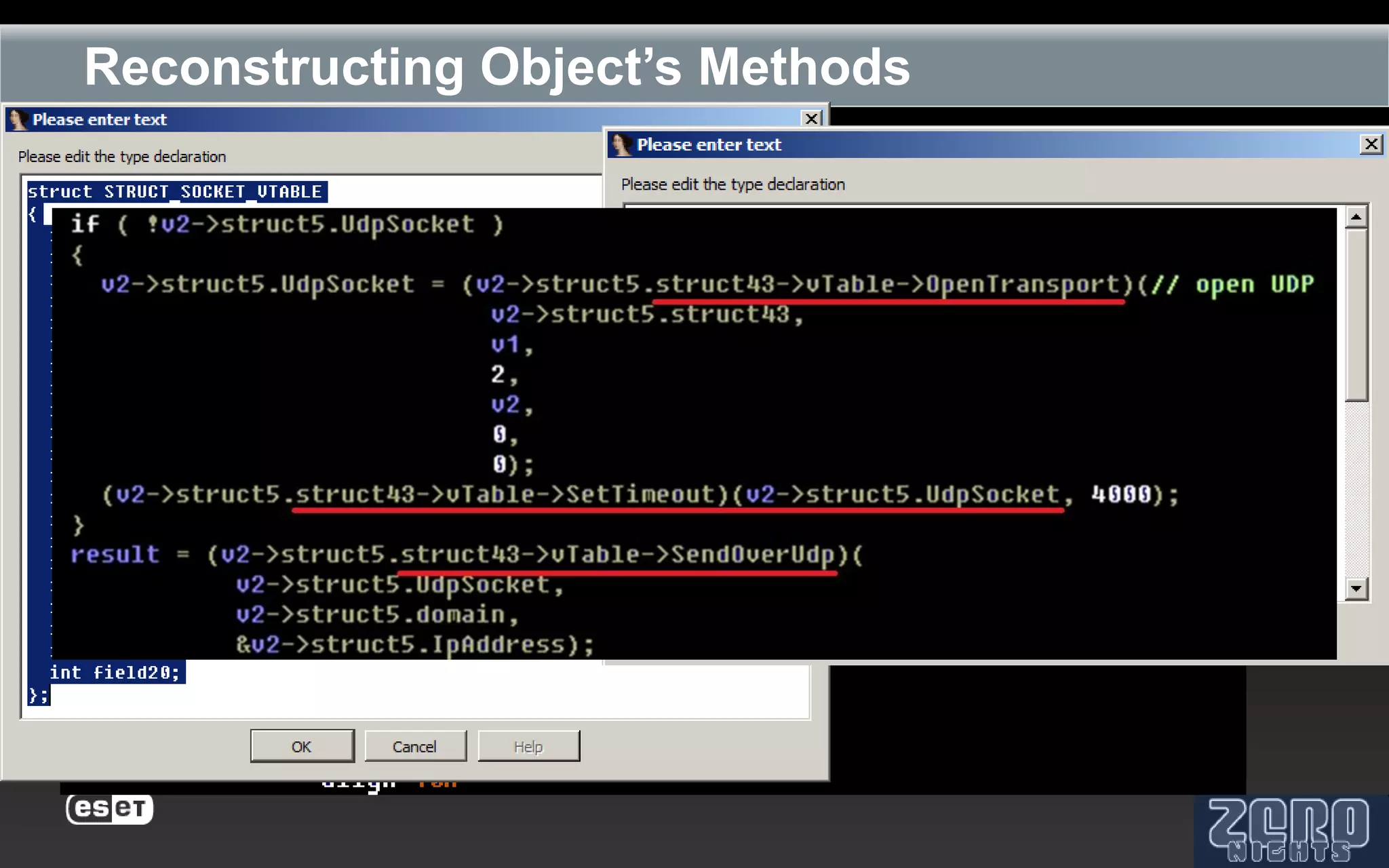
 Analyzing object’s methods
   Creating custom type in “Local Types” for a table of virtual routines
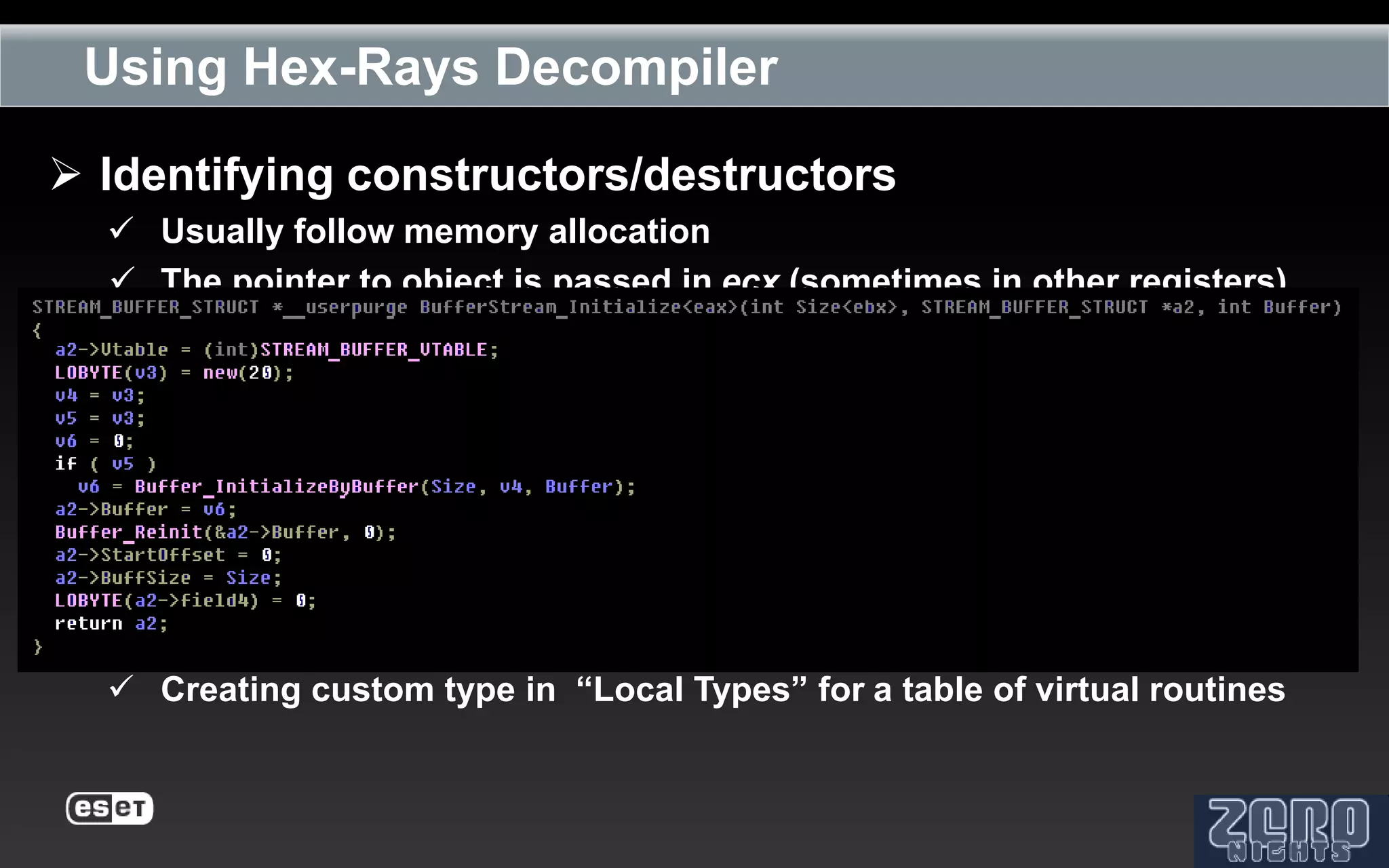
Using Hex-Rays Decompiler

 Identifying constructors/destructors
   Usually follow memory allocation
   The pointer to object is passed in ecx (sometimes in other registers)


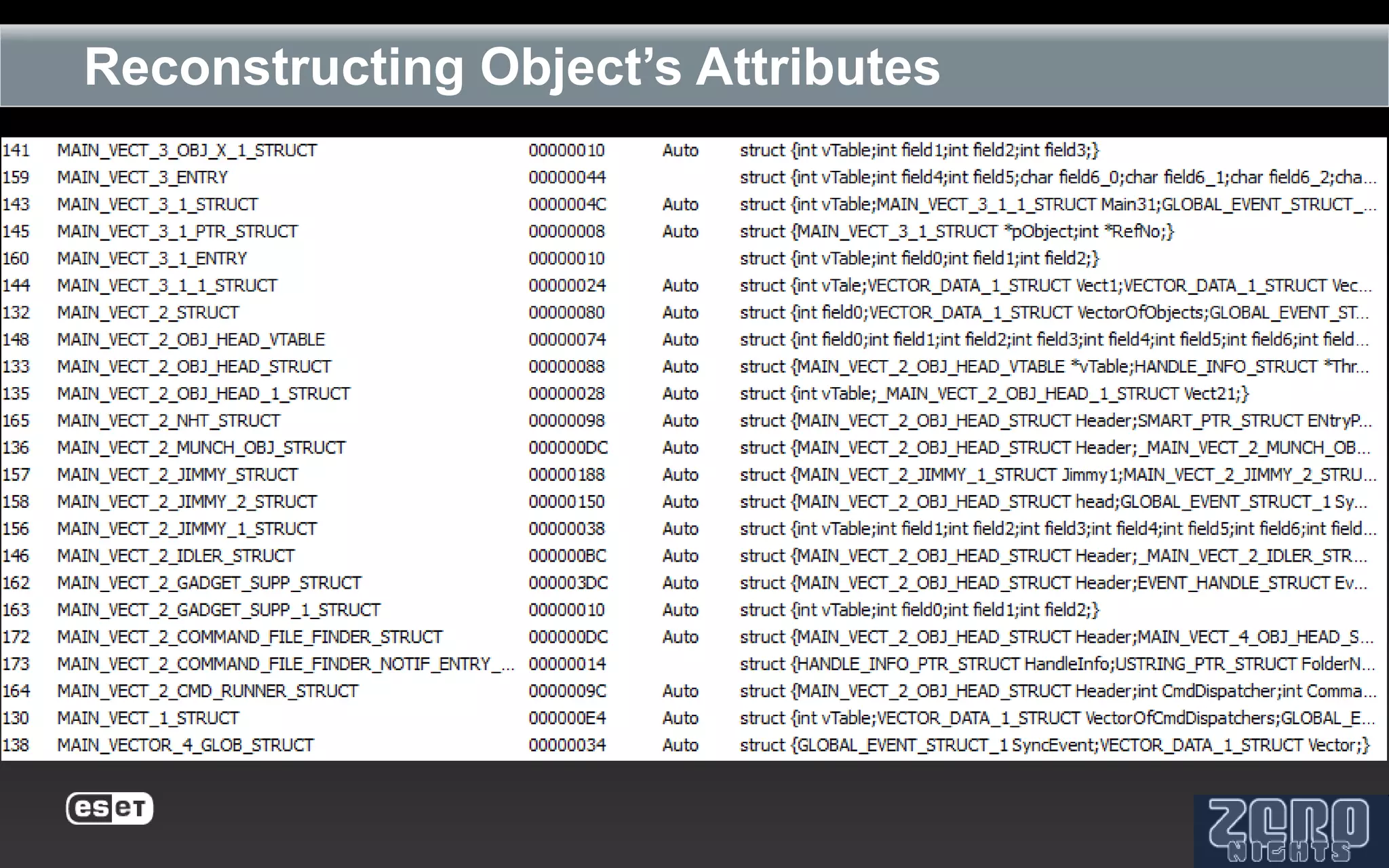
 Reconstructing object’s attributes
   Creating custom type in “Local Types” for an object


 Analyzing object’s methods
   Creating custom type in “Local Types” for a table of virtual routines
Reconstructing Object’s Attributes
Reconstructing Object’s Methods
DEMO
Relationship
Stuxnet/Duqu/Gauss/Flamer
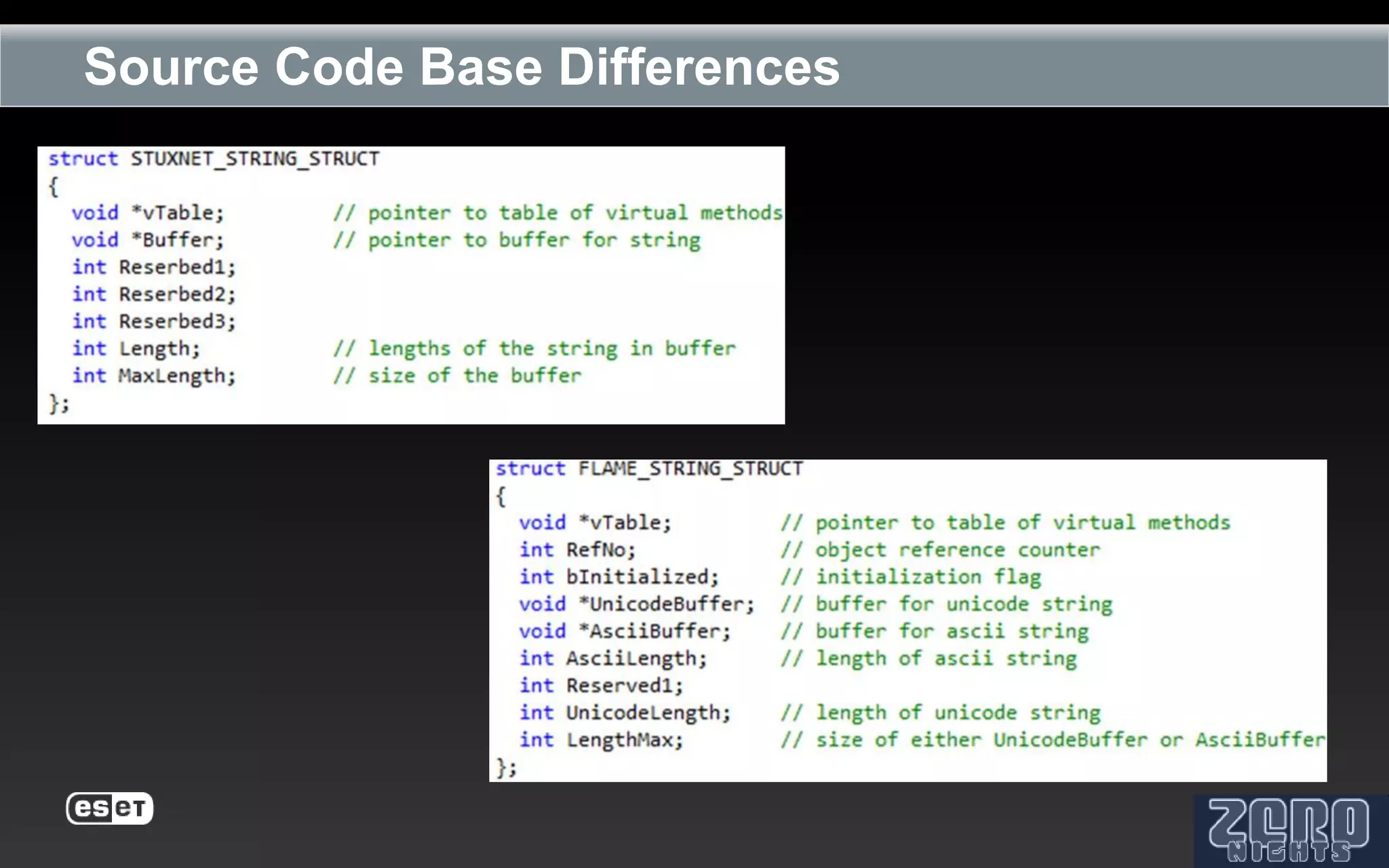
Source Code Base Differences
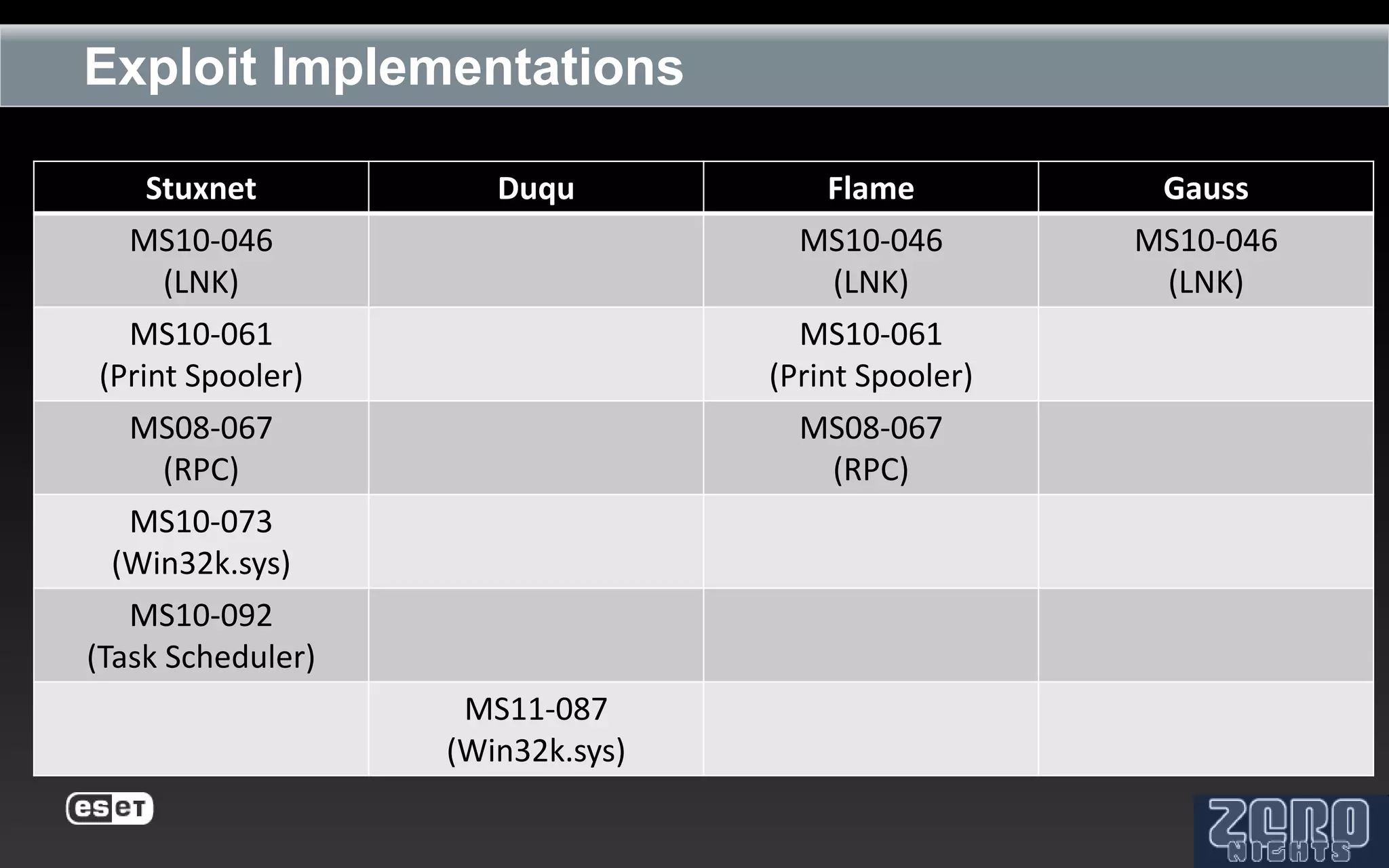
Exploit Implementations

     Stuxnet          Duqu             Flame         Gauss
   MS10-046                         MS10-046        MS10-046
      (LNK)                            (LNK)         (LNK)
   MS10-061                         MS10-061
 (Print Spooler)                  (Print Spooler)
   MS08-067                         MS08-067
      (RPC)                            (RPC)
   MS10-073
  (Win32k.sys)
   MS10-092
(Task Scheduler)
                    MS11-087
                   (Win32k.sys)
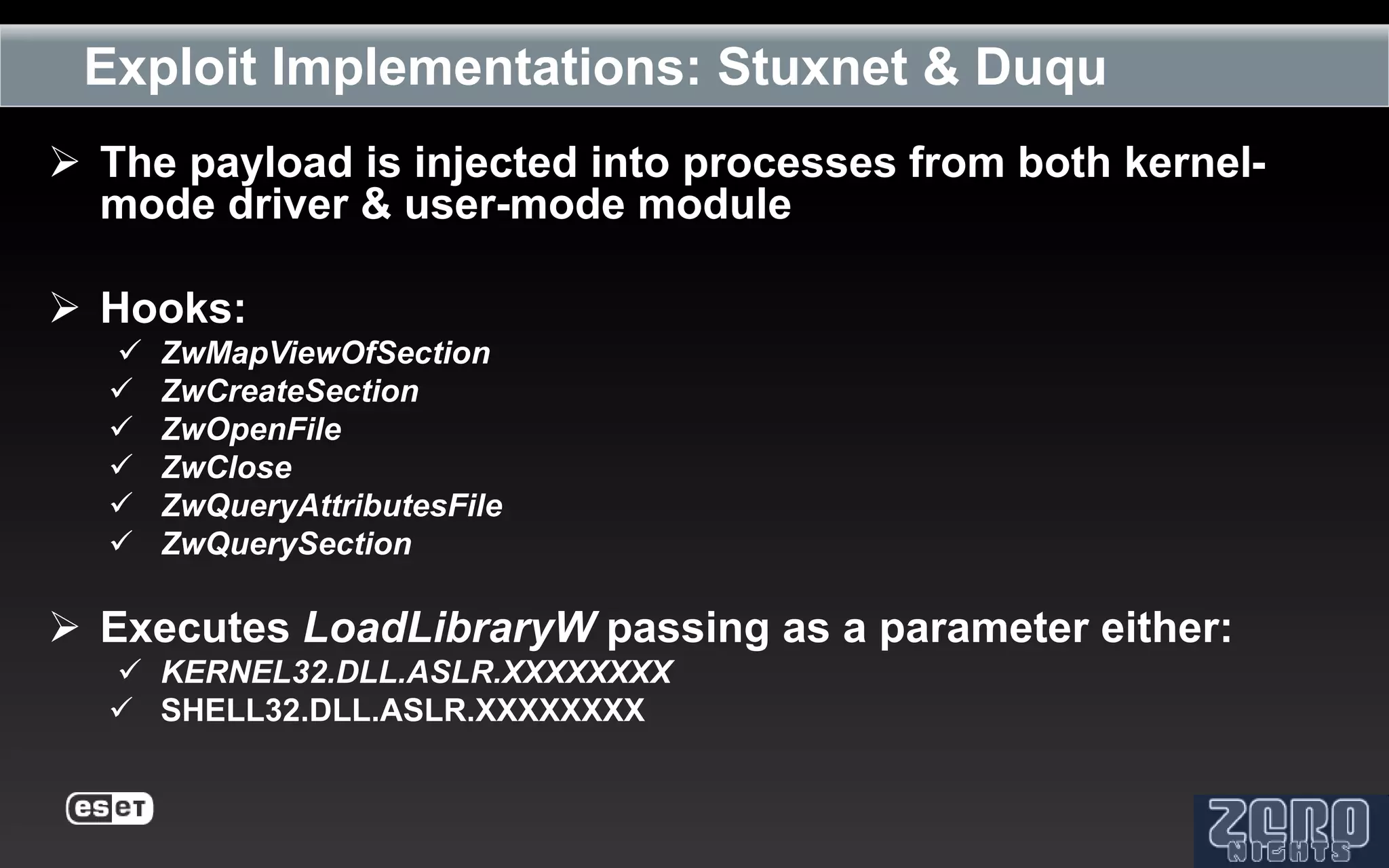
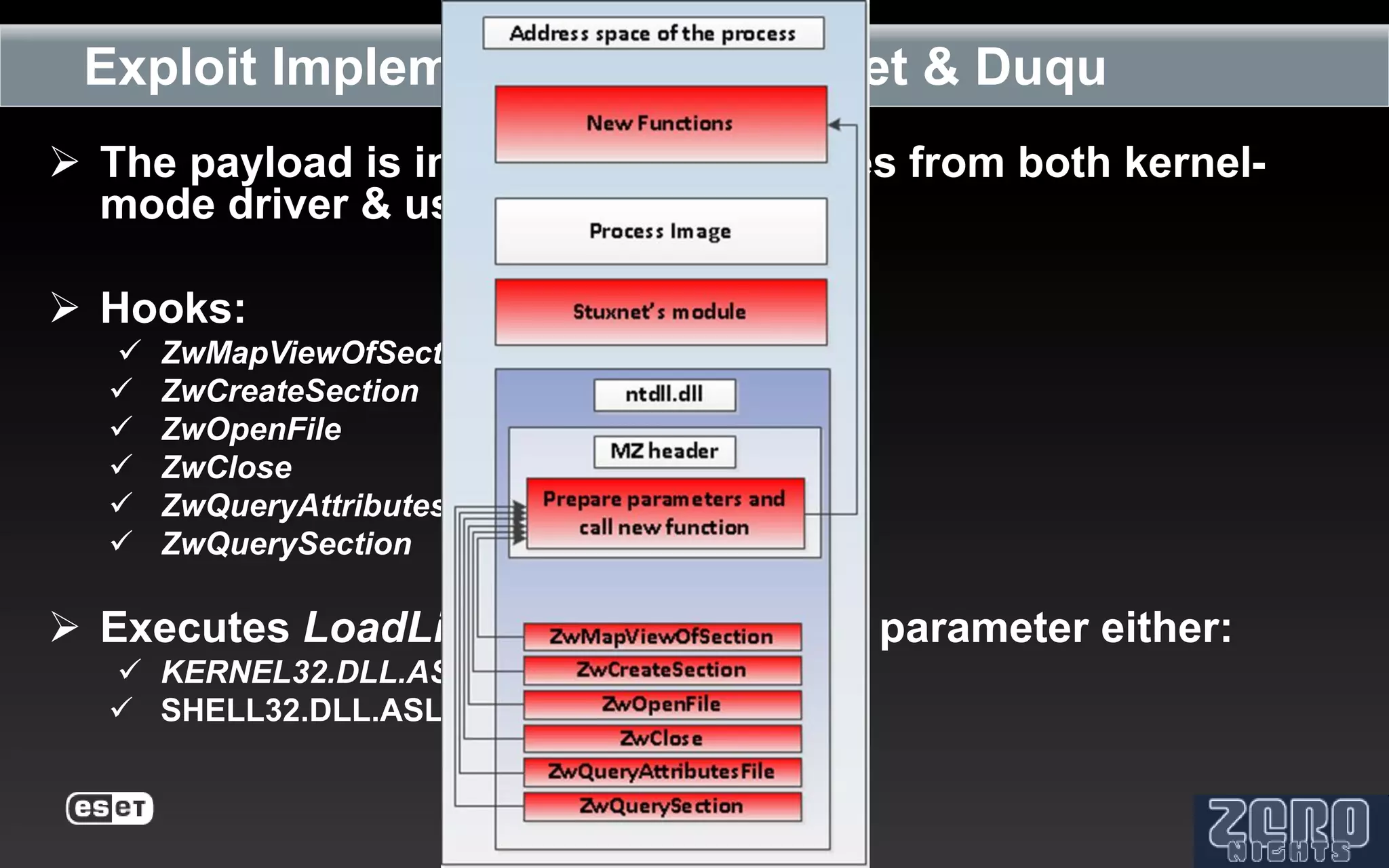
Exploit Implementations: Stuxnet & Duqu
 The payload is injected into processes from both kernel-
  mode driver & user-mode module

 Hooks:
     ZwMapViewOfSection
     ZwCreateSection
     ZwOpenFile
     ZwClose
     ZwQueryAttributesFile
     ZwQuerySection

 Executes LoadLibraryW passing as a parameter either:
   KERNEL32.DLL.ASLR.XXXXXXXX
   SHELL32.DLL.ASLR.XXXXXXXX
Exploit Implementations: Stuxnet & Duqu
 The payload is injected into processes from both kernel-
  mode driver & user-mode module

 Hooks:
     ZwMapViewOfSection
     ZwCreateSection
     ZwOpenFile
     ZwClose
     ZwQueryAttributesFile
     ZwQuerySection

 Executes LoadLibraryW passing as a parameter either:
   KERNEL32.DLL.ASLR.XXXXXXXX
   SHELL32.DLL.ASLR.XXXXXXXX
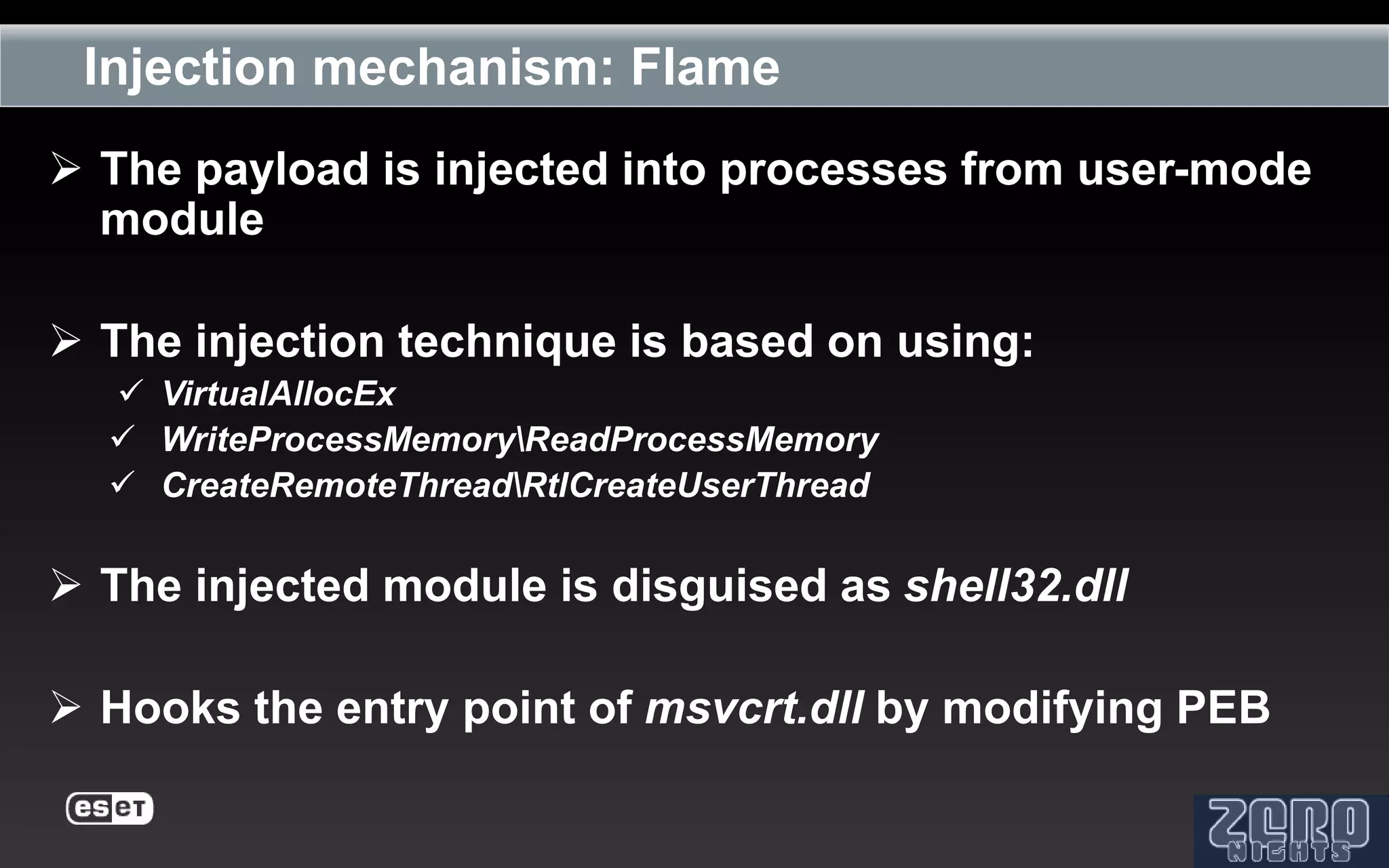
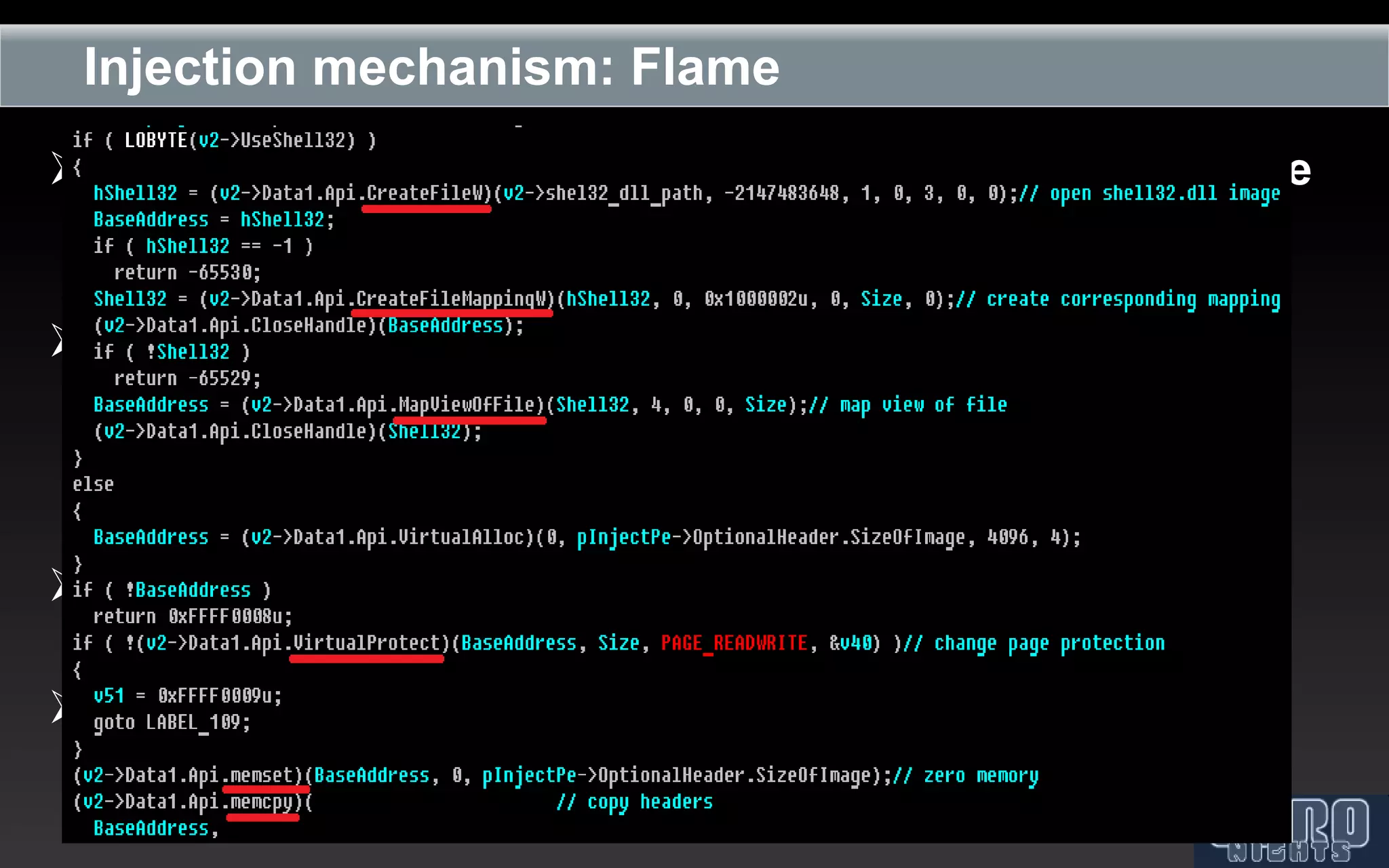
Injection mechanism: Flame
 The payload is injected into processes from user-mode
  module

 The injection technique is based on using:
   VirtualAllocEx
   WriteProcessMemoryReadProcessMemory
   CreateRemoteThreadRtlCreateUserThread


 The injected module is disguised as shell32.dll

 Hooks the entry point of msvcrt.dll by modifying PEB
Injection mechanism: Flame
 The payload is injected into processes from user-mode
  module

 The injection technique is based on using:
   VirtualAllocEx
   WriteProcessMemoryReadProcessMemory
   CreateRemoteThreadRtlCreateUserThread


 The injected module is disguised as shell32.dll

 Hooks the entry point of msvcrt.dll by modifying PEB
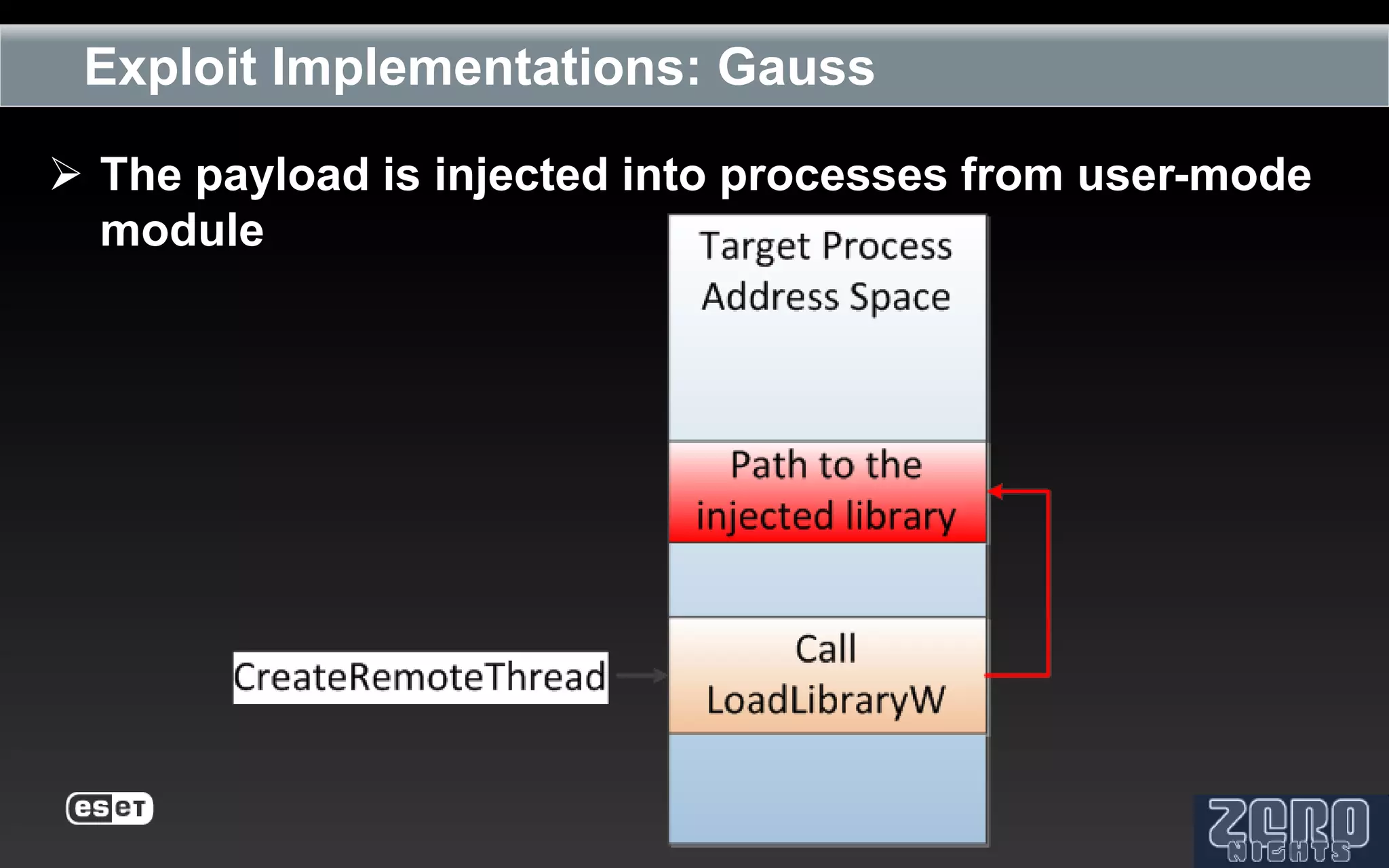
Exploit Implementations: Gauss

 The payload is injected into processes from user-mode
  module
Thank you for your attention!


Eugene Rodionov         Aleksandr Matrosov
rodionov@eset.sk        matrosov@eset.sk
@vxradius               @matrosov

Win32/Flamer: Reverse Engineering and Framework Reconstruction

  • 1.
    Win32/Flamer: Reverse Engineeringand Framework Reconstruction Aleksandr Matrosov Eugene Rodionov
  • 2.
    Outline of ThePresentation  Typical malware vs. Stuxnet/Flame  What the difference?  Flamer code reconstruction problems  C++ code reconstruction  Library code identification  Flamer framework overview  Object oriented code reconstruction  Relationship Stuxnet/Duqu/Flamer
  • 3.
    Typical Malware vs.Stuxnet/Flamer
  • 4.
  • 5.
    What’s the Difference? Typical malware  Stuxnet/Flame …  Different motivation, budget …  Different motivation, budget …  Use 1-days for distribution  Use 0-days for distribution  Anti-stealth for bypassing all sec  Anti-stealth for bypassing AV soft  Stealth timing: months  Stealth timing: years  Developed in C or C++ in C style  Tons of C++ code with OOP  Simple architecture for plugins  Industrial OO framework platform  Traditional ways for obfuscation:  Other ways of code obfuscation:  packers  tons of embedded static code  polymorphic code  specific compilers/options  vm-based protection  object oriented wrappers for typical OS utilities  …
  • 6.
  • 7.
    Code Complexity Growth Gauss miniFlamer Stuxnet Duqu Flamer
  • 8.
  • 9.
  • 10.
    C++ Code ReconstructionProblems  Object identification  Type reconstruction  Class layout reconstruction  Identify constructors/destructors  Identify class members  Local/global type reconstruction  Associate object with exact method calls  RTTI reconstruction  Vftable reconstruction  Associate vftable object with exact object  Class hierarchy reconstruction
  • 11.
    C++ Code ReconstructionProblems Class A vfPtr a1() A::vfTable a2() meta A::a1() RTTI Object Locator A::a2() signature pTypeDescriptor pClassDescriptor
  • 12.
  • 13.
  • 14.
    Identify Exact VirtualFunction Call in vtable
  • 15.
    Identify Exact VirtualFunction Call in vtable
  • 16.
    Identify Exact VirtualFunction Call in vtable
  • 17.
  • 18.
  • 19.
  • 20.
  • 21.
    Library Code IdentificationProblems  Compiler optimization  Wrappers for WinAPI calls  Embedded library code  Library version identification problem  IDA signatures used syntax based detection methods  Recompiled libraries problem  Compiler optimization problem
  • 22.
  • 23.
    Object Oriented APIWrappers and Implicit Calls
  • 24.
    Object Oriented APIWrappers and Implicit Calls
  • 25.
    Object Oriented APIWrappers and Implicit Calls
  • 26.
    Festi: OOP inkernel-mode
  • 27.
    Main Festi Functionalitystore in kernel mode Win32/Festi Dropper Install kernel-mode driver user-mode kernel-mode Win32/Festi kernel-mode driver Download plugins Win32/Festi Win32/Festi Plugin 1 Plugin 2 ... Win32/Festi Plugin N
  • 28.
    Main Festi Functionalitystore in kernel mode Win32/Festi Dropper Install kernel-mode driver user-mode kernel-mode Win32/Festi kernel-mode driver Download plugins Win32/Festi Win32/Festi Plugin 1 Plugin 2 ... Win32/Festi Plugin N
  • 29.
    Festi: Architecture Win32/Festi Win32/Festi Win32/Festi C&C Protocol Plugin Manager Network Socket Parser Win32/Festi Memory Manager
  • 30.
    Festi: Plugin Interface Array of pointers to plugins Plugin 1 Plugin1 struct PLUGIN_INTERFACE Plugin 2 Plugin2 struct PLUGIN_INTERFACE Plugin 3 Plugin3 struct PLUGIN_INTERFACE ... Plugin N PluginN struct PLUGIN_INTERFACE
  • 31.
    Festi: Plugins  Festiplugins are volatile modules in kernel-mode address space:  downloaded each time the bot is activated  never stored on the hard drive  The plugins are capable of:  sending spam – BotSpam.dll  performing DDoS attacks – BotDoS.dll  providing proxy service – BotSocks.dll
  • 32.
  • 33.
    An overview ofthe Flamer Framework The main types used in Flamer Framework are:  Command Executers –the objects exposing interface that allows the malware to dispatch commands received from C&C servers  Tasks – objects of these type represent tasks executed in separate threads which constitute the backbone of the main module of Flamer  Consumers – objects which are triggered on specific events (creation of new module, insertion of removable media and etc.)  Delayed Tasks – these objects represent tasks which are executed periodically with certain delay.
  • 34.
    An overview ofthe Flamer Framework Vector<Consumer> Vector<Command Executor> DB_Query ClanCmd FileCollect Driller GetConfig Mobile Consumer Cmd Vector<Task> Consumer IDLER CmdExec Sniffer Munch FileFinder Lua Consumer Vector<DelayedTasks> Media Share LSS Consumer Euphoria Frog Beetlejuice Supplier Sender
  • 35.
    Some of FlamerFramework Components Identifying processes in the systems corresponding to Security security software: antiviruses, HIPS, firewalls, system information utilities and etc. Microbe Leverages voice recording capabilities of the system Idler Running tasks in the background BeetleJuice Utilizes bluetooth facilities of the system Telemetry Logging of all the events Gator Communicating with C&C servers
  • 36.
    Flamer SQL LiteDatabase Schema
  • 37.
    Flamer SQL LiteDatabase Schema
  • 38.
  • 39.
    Data Types BeingUsed  Smart pointers  Strings  Vectors to maintain the objects  Custom data types: wrappers, tasks, triggers and etc.
  • 40.
    Data Types BeingUsed: Smart pointers typedef struct SMART_PTR { void *pObject; // pointer to the object int *RefNo; // reference counter };
  • 41.
    Data Types BeingUsed: Strings struct USTRING_STRUCT { void *vTable; // pointer to the table int RefNo; // reference counter int Initialized; wchar_t *UnicodeBuffer; // pointer to unicode string char *AsciiBuffer; // pointer to ASCII string int AsciiLength; // length of the ASCII string int Reserved; int Length; // Length of unicode string int LengthMax; // Size of UnicodeBuffer };
  • 42.
    Data Types BeingUsed: Vectors struct VECTOR { void *vTable; // pointer to the table int NumberOfItems; // self-explanatory int MaxSize; // self-explanatory void *vector; // pointer to buffer with elements };  Used to handle the objects:  tasks  triggers  etc.
  • 43.
    Using Hex-Rays Decompiler Identifying constructors/destructors  Usually follow memory allocation  The pointer to object is passed in ecx (sometimes in other registers)  Reconstructing object’s attributes  Creating custom type in “Local Types” for an object  Analyzing object’s methods  Creating custom type in “Local Types” for a table of virtual routines
  • 44.
    Using Hex-Rays Decompiler Identifying constructors/destructors  Usually follow memory allocation  The pointer to object is passed in ecx (sometimes in other registers)  Reconstructing object’s attributes  Creating custom type in “Local Types” for an object  Analyzing object’s methods  Creating custom type in “Local Types” for a table of virtual routines
  • 45.
  • 46.
  • 47.
  • 48.
  • 49.
  • 50.
  • 51.
  • 52.
    Source Code BaseDifferences
  • 53.
    Exploit Implementations Stuxnet Duqu Flame Gauss MS10-046 MS10-046 MS10-046 (LNK) (LNK) (LNK) MS10-061 MS10-061 (Print Spooler) (Print Spooler) MS08-067 MS08-067 (RPC) (RPC) MS10-073 (Win32k.sys) MS10-092 (Task Scheduler) MS11-087 (Win32k.sys)
  • 54.
    Exploit Implementations: Stuxnet& Duqu  The payload is injected into processes from both kernel- mode driver & user-mode module  Hooks:  ZwMapViewOfSection  ZwCreateSection  ZwOpenFile  ZwClose  ZwQueryAttributesFile  ZwQuerySection  Executes LoadLibraryW passing as a parameter either:  KERNEL32.DLL.ASLR.XXXXXXXX  SHELL32.DLL.ASLR.XXXXXXXX
  • 55.
    Exploit Implementations: Stuxnet& Duqu  The payload is injected into processes from both kernel- mode driver & user-mode module  Hooks:  ZwMapViewOfSection  ZwCreateSection  ZwOpenFile  ZwClose  ZwQueryAttributesFile  ZwQuerySection  Executes LoadLibraryW passing as a parameter either:  KERNEL32.DLL.ASLR.XXXXXXXX  SHELL32.DLL.ASLR.XXXXXXXX
  • 56.
    Injection mechanism: Flame The payload is injected into processes from user-mode module  The injection technique is based on using:  VirtualAllocEx  WriteProcessMemoryReadProcessMemory  CreateRemoteThreadRtlCreateUserThread  The injected module is disguised as shell32.dll  Hooks the entry point of msvcrt.dll by modifying PEB
  • 57.
    Injection mechanism: Flame The payload is injected into processes from user-mode module  The injection technique is based on using:  VirtualAllocEx  WriteProcessMemoryReadProcessMemory  CreateRemoteThreadRtlCreateUserThread  The injected module is disguised as shell32.dll  Hooks the entry point of msvcrt.dll by modifying PEB
  • 58.
    Exploit Implementations: Gauss The payload is injected into processes from user-mode module
  • 60.
    Thank you foryour attention! Eugene Rodionov Aleksandr Matrosov rodionov@eset.sk matrosov@eset.sk @vxradius @matrosov