TTC/ RCF
1
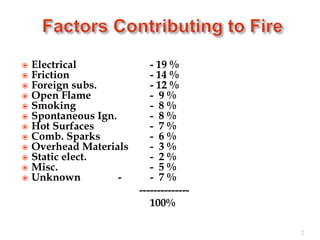
 Electrical - 19 %
 Friction - 14 %
 Foreign subs. - 12 %
 Open Flame - 9 %
 Smoking - 8 %
 Spontaneous Ign. - 8 %
 Hot Surfaces - 7 %
 Comb. Sparks - 6 %
 Overhead Materials - 3 %
 Static elect. - 2 %
 Misc. - 5 %
 Unknown - - 7 %
--------------
100%
2
 What is Fire ?
 Fire Triangle / Tetrahedrons
 Class of Fire
 Types of Portable Fire Extinguishers
 Suitability of Portable Fire Extinguishers
 Use of Fire Extinguishers
 Rules for Fire Fighting
 Installation / Scale of Deployment of Extinguishers
 Maintenance of Fire Extinguishers
 Other Portable & Fixed Fire Fighting Installations
3
F - FIND
I - INFORM
R - RESTRICT / RESCUE
E - EXTINGUISH
4
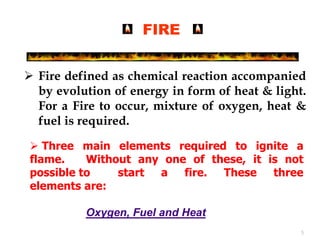
 Fire defined as chemical reaction accompanied
by evolution of energy in form of heat & light.
For a Fire to occur, mixture of oxygen, heat &
fuel is required.
5
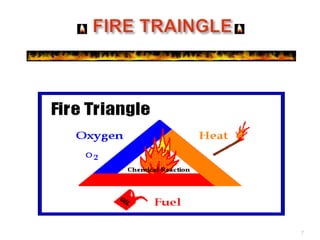
 Three main elements required to ignite a
flame. Without any one of these, it is not
possible to start a fire. These three
elements are:
Oxygen, Fuel and Heat
FIRE
FIRE
6
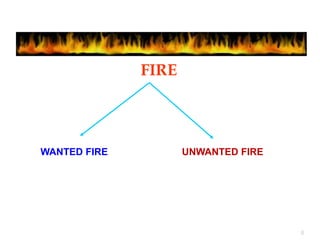
WANTED FIRE UNWANTED FIRE
7
8
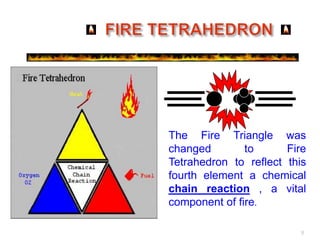
The Fire Triangle was
changed to Fire
Tetrahedron to reflect this
fourth element a chemical
chain reaction , a vital
component of fire.
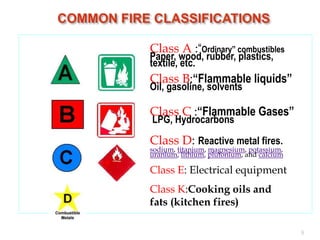
Class A :“Ordinary” combustibles
Paper, wood, rubber, plastics,
textile, etc.
Class B:“Flammable liquids”
Oil, gasoline, solvents
Class C :“Flammable Gases”
LPG, Hydrocarbons
Class D: Reactive metal fires.
sodium, titanium, magnesium, potassium,
uranium, lithium, plutonium, and calcium
Class E: Electrical equipment
Class K:Cooking oils and
fats (kitchen fires)
9
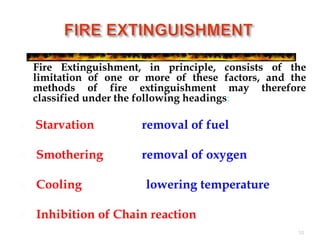
Fire Extinguishment, in principle, consists of the
limitation of one or more of these factors, and the
methods of fire extinguishment may therefore
classified under the following headings:
 Starvation - removal of fuel
 Smothering - removal of oxygen.
 Cooling -lowering temperature
 Inhibition of Chain reaction
10
Spontaneous Combustion occurs
as a result of the heat generated
by the reacting substance
themselves.
Example- Hot Glycerin poured on crystals of
Potassium permanganate.
11
 Water
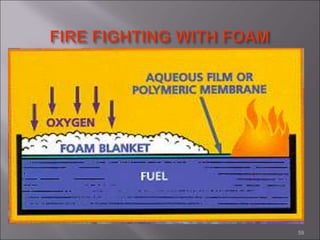
 Foam
 Dry Chemical Powder (DCP)
 Carbon Dioxide & other Gas Flooding
Systems like Inerter, FM 200 etc
 Sand
 Beating out
12
13
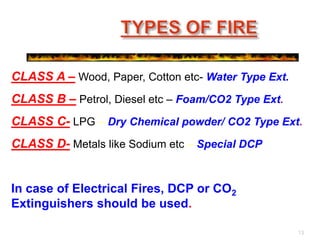
CLASS A – Wood, Paper, Cotton etc- Water Type Ext.
CLASS B – Petrol, Diesel etc – Foam/CO2 Type Ext.
CLASS C- LPG – Dry Chemical powder/ CO2 Type Ext.
CLASS D- Metals like Sodium etc – Special DCP
In case of Electrical Fires, DCP or CO2
Extinguishers should be used.
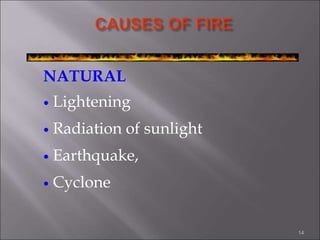
NATURAL
 Lightening
 Radiation of sunlight
 Earthquake,
 Cyclone
14
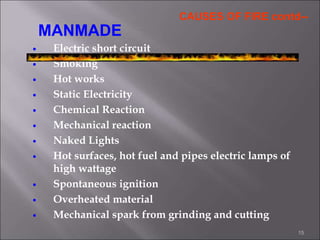
 Electric short circuit
 Smoking
 Hot works
 Static Electricity
 Chemical Reaction
 Mechanical reaction
 Naked Lights
 Hot surfaces, hot fuel and pipes electric lamps of
high wattage
 Spontaneous ignition
 Overheated material
 Mechanical spark from grinding and cutting
15
MANMADE
CAUSES OF FIRE contd--
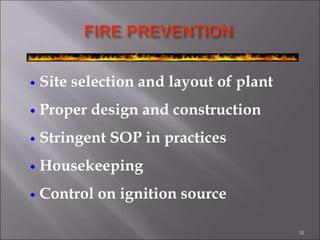
 Site selection and layout of plant
 Proper design and construction
 Stringent SOP in practices
 Housekeeping
 Control on ignition source
16
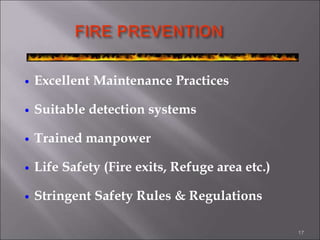
 Excellent Maintenance Practices
 Suitable detection systems
 Trained manpower
 Life Safety (Fire exits, Refuge area etc.)
 Stringent Safety Rules & Regulations
17
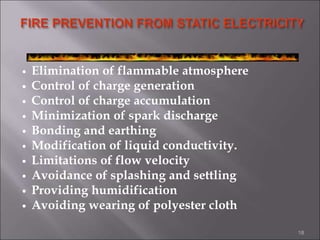
 Elimination of flammable atmosphere
 Control of charge generation
 Control of charge accumulation
 Minimization of spark discharge
 Bonding and earthing
 Modification of liquid conductivity.
 Limitations of flow velocity
 Avoidance of splashing and settling
 Providing humidification
 Avoiding wearing of polyester cloth
18
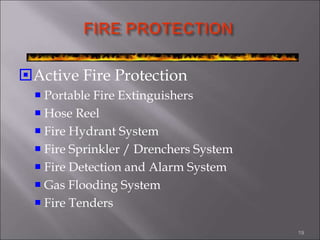
Active Fire Protection
 Portable Fire Extinguishers
 Hose Reel
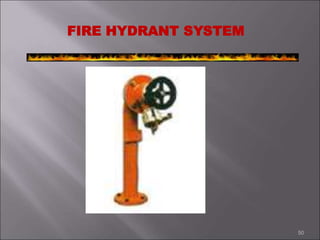
 Fire Hydrant System
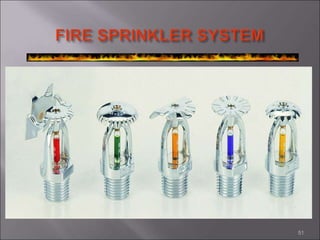
 Fire Sprinkler / Drenchers System
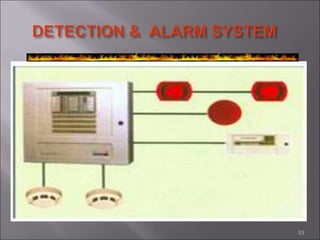
 Fire Detection and Alarm System
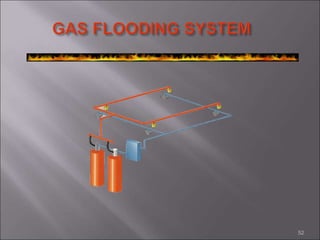
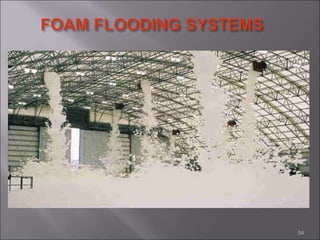
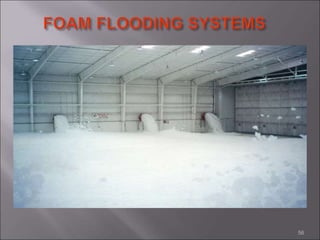
 Gas Flooding System
 Fire Tenders
19
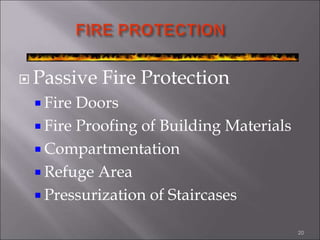
 Passive Fire Protection
 Fire Doors
 Fire Proofing of Building Materials
 Compartmentation
 Refuge Area
 Pressurization of Staircases
20
21
 First Aid Fire Fighting Equipment
 First Line of Defense
 Controls the fire at its early stage
 Useless on large fires
 Available in various capacities like 2 kg, 5
kg, 10 kg, 50 kg, 100 kg, 150 kg.
22
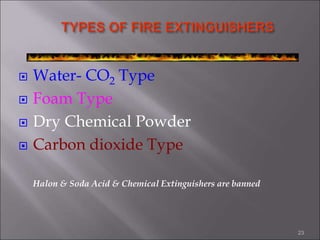
 Water- CO2 Type
 Foam Type
 Dry Chemical Powder
 Carbon dioxide Type
Halon & Soda Acid & Chemical Extinguishers are banned
23
24
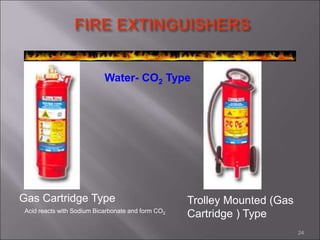
Water- CO2 Type
Trolley Mounted (Gas
Cartridge ) Type
Gas Cartridge Type
Acid reacts with Sodium Bicarbonate and form CO2
25
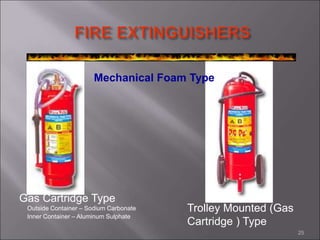
Mechanical Foam Type
Trolley Mounted (Gas
Cartridge ) Type
Gas Cartridge Type
Outside Container – Sodium Carbonate
Inner Container – Aluminum Sulphate
26
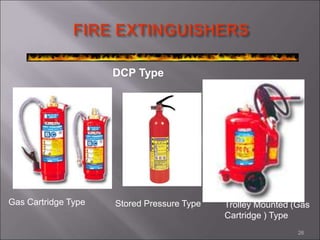
Trolley Mounted (Gas
Cartridge ) Type
Gas Cartridge Type Stored Pressure Type
DCP Type
27
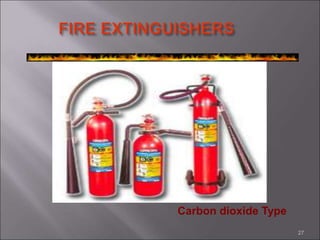
Carbon dioxide Type
28
29
30
31
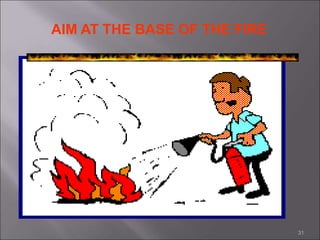
AIM AT THE BASE OF THE FIRE
32
33
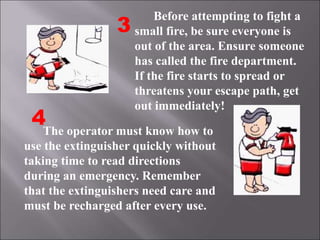
The operator must know how to
use the extinguisher quickly without
taking time to read directions
during an emergency. Remember
that the extinguishers need care and
must be recharged after every use.
3
4
Before attempting to fight a
small fire, be sure everyone is
out of the area. Ensure someone
has called the fire department.
If the fire starts to spread or
threatens your escape path, get
out immediately!
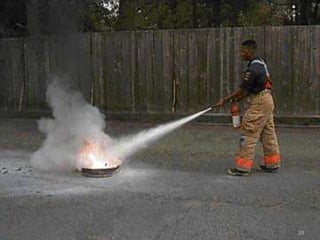
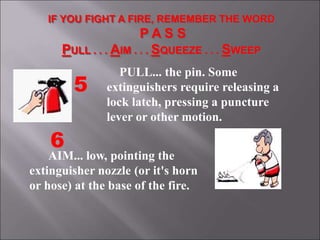
IF YOU FIGHT A FIRE, REMEMBER THE WORD
P A S S
PULL . . . AIM . . . SQUEEZE . . . SWEEP
AIM... low, pointing the
extinguisher nozzle (or it's horn
or hose) at the base of the fire.
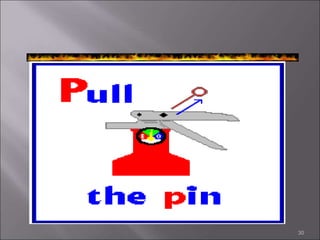
PULL... the pin. Some
extinguishers require releasing a
lock latch, pressing a puncture
lever or other motion.
5
6
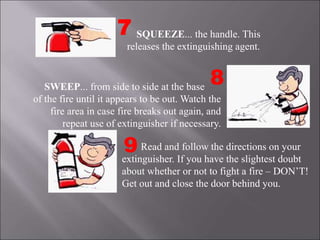
Read and follow the directions on your
extinguisher. If you have the slightest doubt
about whether or not to fight a fire – DON’T!
Get out and close the door behind you.
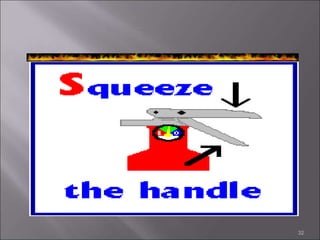
SQUEEZE... the handle. This
releases the extinguishing agent.
7
8
9
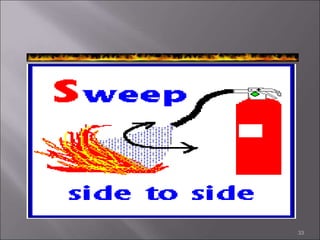
SWEEP... from side to side at the base
of the fire until it appears to be out. Watch the
fire area in case fire breaks out again, and
repeat use of extinguisher if necessary.
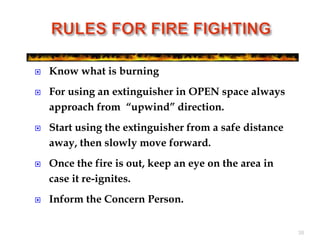
 Know what is burning
 For using an extinguisher in OPEN space always
approach from “upwind” direction.
 Start using the extinguisher from a safe distance
away, then slowly move forward.
 Once the fire is out, keep an eye on the area in
case it re-ignites.
 Inform the Concern Person.
38
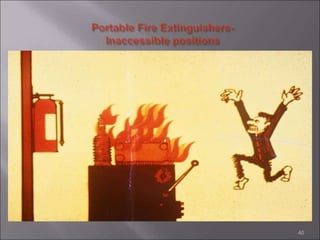
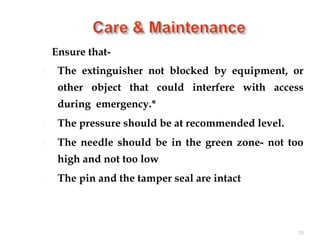
Ensure that-
 The extinguisher not blocked by equipment, or
other object that could interfere with access
during emergency.*
 The pressure should be at recommended level.
 The needle should be in the green zone- not too
high and not too low
 The pin and the tamper seal are intact
39
40
 Fire extinguishers are intended to control the fire at
early stages.
 Fire Extinguishers should be placed as near as
possible to exits without hindering the escape routes.
 The Extinguishers should be mounted at 1 mts from
the ground level.
 It is necessary to construct suitable shades to protect
the extinguishers from excessive heat, cold as well as
corrosive environment.
 The location where the extinguishers are installed
should be clearly marked with proper sign.
41
Placement of Extinguishers
 While installing any trolley mounted fire extinguishers,
the mobility of the extinguisher within the area should be
considered.
 Extinguishers should be sited in such a way that it is not
necessary to travel more than 15 metres from the fire to
reach the extinguisher.
 There are no leaks, rust, chemical deposits or other signs
of abuse. Wipe off any corrosive chemicals that may have
deposited on the extinguisher
42
Placement of Extinguishers (Contd…)
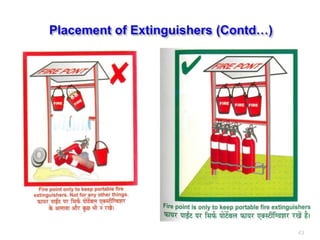
43
 Maintenance and recharging of fire extinguishers shall
be performed by qualified persons having proper types
of tools, recharge materials, lubricants.
 Maintenance is a through check of fire extinguisher.
 It is intended to give maximum assurance that an
extinguisher will operate effectively and safely.
 Maintenance procedure shall include 3 basic elements-
Mechanical parts, Extinguishing agent and expelling
means
44
MONTHLY MAINTENANCE – (Gas Cartridge Type)
 Clean the exterior of the extinguisher, polish the
painted portion with the wax polish. Examine the
extinguisher for any corrosion.
 Check the vent hole, nozzle outlet, strainer & safety
clip.
 Check the plunger is clean & moving freely
 Make sure the extinguishers are not accidentally
discharged.
45
46
• Ensure that the cap washer is intact and also
grease the treads of the cap, plunger etc.
• Check for the gas cartridge, weigh it, if the
weight loss is more than 10% it should be
replaced.
• Refill the extinguisher with suitable
extinguishing media. (Water, DCP, Foam)
MONTHLY MAINTENANCE (contd..)
WHILE OPENING ANY EXTINGUISHER
 Ensure that there is no any residual pressure
in the hose/ cylinder.
 Unscrew the cap or valve assembly slowly for
two or three turns only, to allow any residual
pressure to escape via the vent holes.
 Under no circumstances should the valve of
Carbon dioxide extinguishers be attempted to
be removed under field conditions.
47
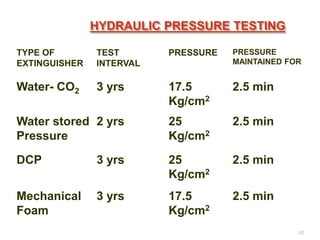
TYPE OF
EXTINGUISHER
TEST
INTERVAL
PRESSURE PRESSURE
MAINTAINED FOR
Water- CO2 3 yrs 17.5
Kg/cm2
2.5 min
Water stored
Pressure
2 yrs 25
Kg/cm2
2.5 min
DCP 3 yrs 25
Kg/cm2
2.5 min
Mechanical
Foam
3 yrs 17.5
Kg/cm2
2.5 min
48
49
50
FIRE HYDRANT SYSTEM
51
52
53
54
55
56
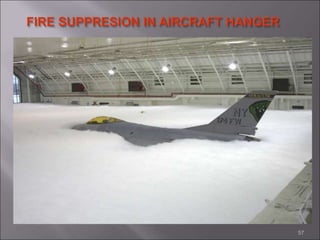
57
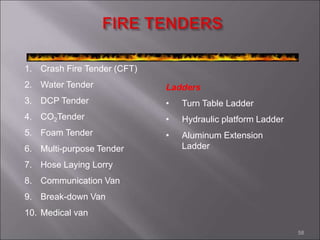
58
1. Crash Fire Tender (CFT)
2. Water Tender
3. DCP Tender
4. CO2Tender
5. Foam Tender
6. Multi-purpose Tender
7. Hose Laying Lorry
8. Communication Van
9. Break-down Van
10. Medical van
Ladders
• Turn Table Ladder
• Hydraulic platform Ladder
• Aluminum Extension
Ladder
59
60
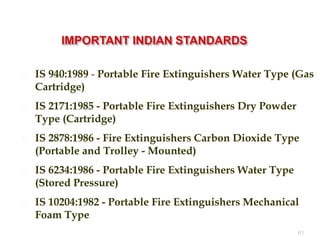
 IS 940:1989 - Portable Fire Extinguishers Water Type (Gas
Cartridge)
 IS 2171:1985 - Portable Fire Extinguishers Dry Powder
Type (Cartridge)
 IS 2878:1986 - Fire Extinguishers Carbon Dioxide Type
(Portable and Trolley - Mounted)
 IS 6234:1986 - Portable Fire Extinguishers Water Type
(Stored Pressure)
 IS 10204:1982 - Portable Fire Extinguishers Mechanical
Foam Type
61
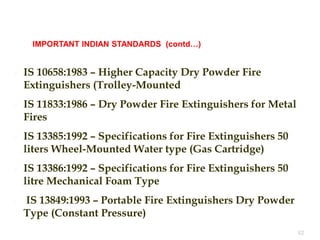
 IS 10658:1983 – Higher Capacity Dry Powder Fire
Extinguishers (Trolley-Mounted
 IS 11833:1986 – Dry Powder Fire Extinguishers for Metal
Fires
 IS 13385:1992 – Specifications for Fire Extinguishers 50
liters Wheel-Mounted Water type (Gas Cartridge)
 IS 13386:1992 – Specifications for Fire Extinguishers 50
litre Mechanical Foam Type
 IS 13849:1993 – Portable Fire Extinguishers Dry Powder
Type (Constant Pressure)
62
IMPORTANT INDIAN STANDARDS (contd…)
63
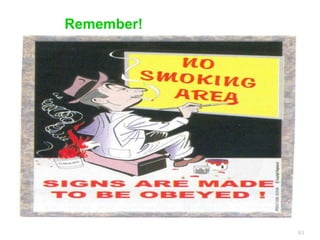
Remember!
64
THE END

Fire Prevention & Protection or Fire Fighting.ppt

  • 1.
  • 2.
     Electrical -19 %  Friction - 14 %  Foreign subs. - 12 %  Open Flame - 9 %  Smoking - 8 %  Spontaneous Ign. - 8 %  Hot Surfaces - 7 %  Comb. Sparks - 6 %  Overhead Materials - 3 %  Static elect. - 2 %  Misc. - 5 %  Unknown - - 7 % -------------- 100% 2
  • 3.
     What isFire ?  Fire Triangle / Tetrahedrons  Class of Fire  Types of Portable Fire Extinguishers  Suitability of Portable Fire Extinguishers  Use of Fire Extinguishers  Rules for Fire Fighting  Installation / Scale of Deployment of Extinguishers  Maintenance of Fire Extinguishers  Other Portable & Fixed Fire Fighting Installations 3
  • 4.
    F - FIND I- INFORM R - RESTRICT / RESCUE E - EXTINGUISH 4
  • 5.
     Fire definedas chemical reaction accompanied by evolution of energy in form of heat & light. For a Fire to occur, mixture of oxygen, heat & fuel is required. 5  Three main elements required to ignite a flame. Without any one of these, it is not possible to start a fire. These three elements are: Oxygen, Fuel and Heat FIRE
  • 6.
  • 7.
  • 8.
    8 The Fire Trianglewas changed to Fire Tetrahedron to reflect this fourth element a chemical chain reaction , a vital component of fire.
  • 9.
    Class A :“Ordinary”combustibles Paper, wood, rubber, plastics, textile, etc. Class B:“Flammable liquids” Oil, gasoline, solvents Class C :“Flammable Gases” LPG, Hydrocarbons Class D: Reactive metal fires. sodium, titanium, magnesium, potassium, uranium, lithium, plutonium, and calcium Class E: Electrical equipment Class K:Cooking oils and fats (kitchen fires) 9
  • 10.
    Fire Extinguishment, inprinciple, consists of the limitation of one or more of these factors, and the methods of fire extinguishment may therefore classified under the following headings:  Starvation - removal of fuel  Smothering - removal of oxygen.  Cooling -lowering temperature  Inhibition of Chain reaction 10
  • 11.
    Spontaneous Combustion occurs asa result of the heat generated by the reacting substance themselves. Example- Hot Glycerin poured on crystals of Potassium permanganate. 11
  • 12.
     Water  Foam Dry Chemical Powder (DCP)  Carbon Dioxide & other Gas Flooding Systems like Inerter, FM 200 etc  Sand  Beating out 12
  • 13.
    13 CLASS A –Wood, Paper, Cotton etc- Water Type Ext. CLASS B – Petrol, Diesel etc – Foam/CO2 Type Ext. CLASS C- LPG – Dry Chemical powder/ CO2 Type Ext. CLASS D- Metals like Sodium etc – Special DCP In case of Electrical Fires, DCP or CO2 Extinguishers should be used.
  • 14.
    NATURAL  Lightening  Radiationof sunlight  Earthquake,  Cyclone 14
  • 15.
     Electric shortcircuit  Smoking  Hot works  Static Electricity  Chemical Reaction  Mechanical reaction  Naked Lights  Hot surfaces, hot fuel and pipes electric lamps of high wattage  Spontaneous ignition  Overheated material  Mechanical spark from grinding and cutting 15 MANMADE CAUSES OF FIRE contd--
  • 16.
     Site selectionand layout of plant  Proper design and construction  Stringent SOP in practices  Housekeeping  Control on ignition source 16
  • 17.
     Excellent MaintenancePractices  Suitable detection systems  Trained manpower  Life Safety (Fire exits, Refuge area etc.)  Stringent Safety Rules & Regulations 17
  • 18.
     Elimination offlammable atmosphere  Control of charge generation  Control of charge accumulation  Minimization of spark discharge  Bonding and earthing  Modification of liquid conductivity.  Limitations of flow velocity  Avoidance of splashing and settling  Providing humidification  Avoiding wearing of polyester cloth 18
  • 19.
    Active Fire Protection Portable Fire Extinguishers  Hose Reel  Fire Hydrant System  Fire Sprinkler / Drenchers System  Fire Detection and Alarm System  Gas Flooding System  Fire Tenders 19
  • 20.
     Passive FireProtection  Fire Doors  Fire Proofing of Building Materials  Compartmentation  Refuge Area  Pressurization of Staircases 20
  • 21.
  • 22.
     First AidFire Fighting Equipment  First Line of Defense  Controls the fire at its early stage  Useless on large fires  Available in various capacities like 2 kg, 5 kg, 10 kg, 50 kg, 100 kg, 150 kg. 22
  • 23.
     Water- CO2Type  Foam Type  Dry Chemical Powder  Carbon dioxide Type Halon & Soda Acid & Chemical Extinguishers are banned 23
  • 24.
    24 Water- CO2 Type TrolleyMounted (Gas Cartridge ) Type Gas Cartridge Type Acid reacts with Sodium Bicarbonate and form CO2
  • 25.
    25 Mechanical Foam Type TrolleyMounted (Gas Cartridge ) Type Gas Cartridge Type Outside Container – Sodium Carbonate Inner Container – Aluminum Sulphate
  • 26.
    26 Trolley Mounted (Gas Cartridge) Type Gas Cartridge Type Stored Pressure Type DCP Type
  • 27.
  • 28.
  • 29.
  • 30.
  • 31.
    31 AIM AT THEBASE OF THE FIRE
  • 32.
  • 33.
  • 34.
    The operator mustknow how to use the extinguisher quickly without taking time to read directions during an emergency. Remember that the extinguishers need care and must be recharged after every use. 3 4 Before attempting to fight a small fire, be sure everyone is out of the area. Ensure someone has called the fire department. If the fire starts to spread or threatens your escape path, get out immediately!
  • 35.
    IF YOU FIGHTA FIRE, REMEMBER THE WORD P A S S PULL . . . AIM . . . SQUEEZE . . . SWEEP AIM... low, pointing the extinguisher nozzle (or it's horn or hose) at the base of the fire. PULL... the pin. Some extinguishers require releasing a lock latch, pressing a puncture lever or other motion. 5 6
  • 36.
    Read and followthe directions on your extinguisher. If you have the slightest doubt about whether or not to fight a fire – DON’T! Get out and close the door behind you. SQUEEZE... the handle. This releases the extinguishing agent. 7 8 9 SWEEP... from side to side at the base of the fire until it appears to be out. Watch the fire area in case fire breaks out again, and repeat use of extinguisher if necessary.
  • 38.
     Know whatis burning  For using an extinguisher in OPEN space always approach from “upwind” direction.  Start using the extinguisher from a safe distance away, then slowly move forward.  Once the fire is out, keep an eye on the area in case it re-ignites.  Inform the Concern Person. 38
  • 39.
    Ensure that-  Theextinguisher not blocked by equipment, or other object that could interfere with access during emergency.*  The pressure should be at recommended level.  The needle should be in the green zone- not too high and not too low  The pin and the tamper seal are intact 39
  • 40.
  • 41.
     Fire extinguishersare intended to control the fire at early stages.  Fire Extinguishers should be placed as near as possible to exits without hindering the escape routes.  The Extinguishers should be mounted at 1 mts from the ground level.  It is necessary to construct suitable shades to protect the extinguishers from excessive heat, cold as well as corrosive environment.  The location where the extinguishers are installed should be clearly marked with proper sign. 41 Placement of Extinguishers
  • 42.
     While installingany trolley mounted fire extinguishers, the mobility of the extinguisher within the area should be considered.  Extinguishers should be sited in such a way that it is not necessary to travel more than 15 metres from the fire to reach the extinguisher.  There are no leaks, rust, chemical deposits or other signs of abuse. Wipe off any corrosive chemicals that may have deposited on the extinguisher 42 Placement of Extinguishers (Contd…)
  • 43.
  • 44.
     Maintenance andrecharging of fire extinguishers shall be performed by qualified persons having proper types of tools, recharge materials, lubricants.  Maintenance is a through check of fire extinguisher.  It is intended to give maximum assurance that an extinguisher will operate effectively and safely.  Maintenance procedure shall include 3 basic elements- Mechanical parts, Extinguishing agent and expelling means 44
  • 45.
    MONTHLY MAINTENANCE –(Gas Cartridge Type)  Clean the exterior of the extinguisher, polish the painted portion with the wax polish. Examine the extinguisher for any corrosion.  Check the vent hole, nozzle outlet, strainer & safety clip.  Check the plunger is clean & moving freely  Make sure the extinguishers are not accidentally discharged. 45
  • 46.
    46 • Ensure thatthe cap washer is intact and also grease the treads of the cap, plunger etc. • Check for the gas cartridge, weigh it, if the weight loss is more than 10% it should be replaced. • Refill the extinguisher with suitable extinguishing media. (Water, DCP, Foam) MONTHLY MAINTENANCE (contd..)
  • 47.
    WHILE OPENING ANYEXTINGUISHER  Ensure that there is no any residual pressure in the hose/ cylinder.  Unscrew the cap or valve assembly slowly for two or three turns only, to allow any residual pressure to escape via the vent holes.  Under no circumstances should the valve of Carbon dioxide extinguishers be attempted to be removed under field conditions. 47
  • 48.
    TYPE OF EXTINGUISHER TEST INTERVAL PRESSURE PRESSURE MAINTAINEDFOR Water- CO2 3 yrs 17.5 Kg/cm2 2.5 min Water stored Pressure 2 yrs 25 Kg/cm2 2.5 min DCP 3 yrs 25 Kg/cm2 2.5 min Mechanical Foam 3 yrs 17.5 Kg/cm2 2.5 min 48
  • 49.
  • 50.
  • 51.
  • 52.
  • 53.
  • 54.
  • 55.
  • 56.
  • 57.
  • 58.
    58 1. Crash FireTender (CFT) 2. Water Tender 3. DCP Tender 4. CO2Tender 5. Foam Tender 6. Multi-purpose Tender 7. Hose Laying Lorry 8. Communication Van 9. Break-down Van 10. Medical van Ladders • Turn Table Ladder • Hydraulic platform Ladder • Aluminum Extension Ladder
  • 59.
  • 60.
  • 61.
     IS 940:1989- Portable Fire Extinguishers Water Type (Gas Cartridge)  IS 2171:1985 - Portable Fire Extinguishers Dry Powder Type (Cartridge)  IS 2878:1986 - Fire Extinguishers Carbon Dioxide Type (Portable and Trolley - Mounted)  IS 6234:1986 - Portable Fire Extinguishers Water Type (Stored Pressure)  IS 10204:1982 - Portable Fire Extinguishers Mechanical Foam Type 61
  • 62.
     IS 10658:1983– Higher Capacity Dry Powder Fire Extinguishers (Trolley-Mounted  IS 11833:1986 – Dry Powder Fire Extinguishers for Metal Fires  IS 13385:1992 – Specifications for Fire Extinguishers 50 liters Wheel-Mounted Water type (Gas Cartridge)  IS 13386:1992 – Specifications for Fire Extinguishers 50 litre Mechanical Foam Type  IS 13849:1993 – Portable Fire Extinguishers Dry Powder Type (Constant Pressure) 62 IMPORTANT INDIAN STANDARDS (contd…)
  • 63.
  • 64.