Purpose for Training
Purposefor Training
To propagate a comprehensive awareness among the common persons for their own
safety at work place/home.
“Prevention is better than cure” 2
JAYPEE INSTITUTE OF INFORMATION TECHNOLOGY NOIDA, SECTOR – 62
3.
OBJECTIVES:
3
•This program removesthe fear of fire and gives
confidence to you in handling fire emergencies in the
initial stage before it is spreading.
•Upon completion of this learning event the learner will
demonstrate knowledge of how to respond a fire
Emergency.
After this training you should be able to:
• IDENTIFY common classes of fires
• SELECT the proper type of extinguisher
• EVALUATE when it is safe to fight at “early-stage” fire
4.
Un controlledFire leaves desolation, ruins, and often impairs
production.
Fire is easy to start, hard to control and very difficult to
extinguish.
Fire is a very useful tool in daily life, if uncontrolled or at
unwanted places is dangerous and devastating. A small
flame can get completely out of control in seconds and
turn into a major fire. It can fill up a building with black
thick smoke very quickly.
The losses can be minimized by exercising the fire
preventive measures.
There is very short time to “ESCAPE”.
“
“Fire is a good servant but a bad master”
Fire is a good servant but a bad master”
Introduction
Introduction
4
5.
Fire Safety
Fire Safety
Firesafety refers to precautions that are taken to prevent
or reduce the likelihood of a fire that may result in death,
injury, or property damage.
Threats to fire safety are referred to as fire hazards. A fire
hazard may include a situation that increases the
likelihood a fire may start or may impede escape in the
event a fire occurs.
Fire Prevention and Fire Fighting is everyone’s
responsibility. Most of the major fire accidents could have
prevented in the initial stage by the right action of the
nearest persons.
5
6.
Some common firehazards are:
Poor House Keeping
Improper maintenance of electrical equipments.
Overloaded electrical system
Misuse of electrical appliances
Incorrectly installed wiring
Improper use and maintenance of machines
Fuel store areas with high oxygen concentration or
insufficient protection
Materials that produce toxic fumes when heated
Objects that block fire exit
Welding/Cutting
Smoking 6
7.
Fire prevention meansthe efforts for eliminating the outbreak
of fires by adopting all possible precautionary safety measures.
Good House Keeping
Correctly installed wiring
Never overload circuits or extension cords
Do not place cords and wires under rugs, over nails
shut off and unplug appliances that sputter or spark
When using appliances follow the safety precautions.
Unplug appliances when not in use.
Use safety caps to cover all unused outlets.
Periodically maintenance of machines
Proper storage of combustible and flammable liquid
Fire Exit clear of any obstruction
Fire Fighting equipment clear of any obstruction
Welding/Cutting with fire safety precautions.
7
8.
Our Responsibilities ina Fire Situation are:
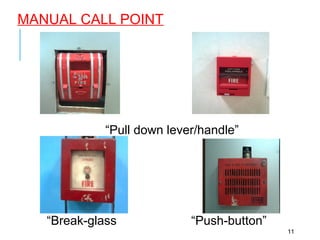
– Recognize a fire condition.
– Raise the fire alarm by activating the nearest manual
call point, if available.
– Evacuate the building by the nearest Exit/ Fire Exit.
– Call the Fire Service
– Attempt to extinguish the fire (if it is still at an incipient
stage) with suitable first-aid fire-fighting equipment
available such as fire extinguisher or water hose reel
without taking unwarranted personal risk.
8
9.
Our Responsibilities ina Fire Situation are:
─Don’t expose yourself to the heat and the by-products
of the fire
─The exit is clear, there is no imminent peril and you
can fight the fire with your back to the exit.
─If your clothing is on fire, STOP, DROP and ROLL on
the ground to extinguish the flames.
If you are within a few feet of a safety shower or fire
blanket, you can use these instead.
9
10.
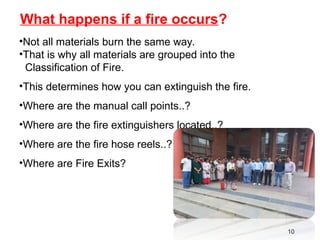
What happens ifa fire occurs?
•Not all materials burn the same way.
•That is why all materials are grouped into the
Classification of Fire.
•This determines how you can extinguish the fire.
•Where are the manual call points..?
•Where are the fire extinguishers located..?
•Where are the fire hose reels..?
•Where are Fire Exits?
10
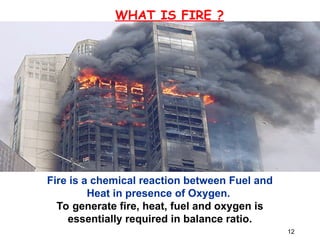
Fire is achemical reaction between Fuel and
Heat in presence of Oxygen.
To generate fire, heat, fuel and oxygen is
essentially required in balance ratio.
WHAT IS FIRE ?
12
13.
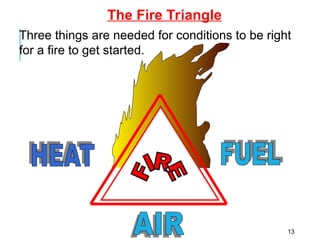
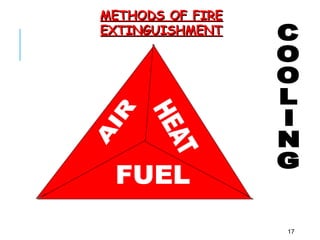
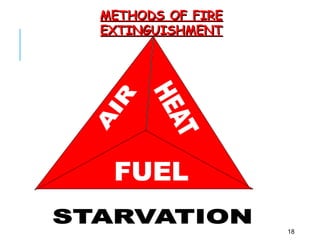
The Fire Triangle
Threethings are needed for conditions to be right
for a fire to get started.
13
14.
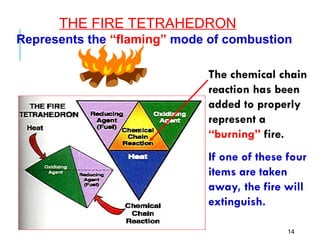
THE FIRE TETRAHEDRON
14
Representsthe “flaming” mode of combustion
The chemical chain
reaction has been
added to properly
represent a
“burning” fire.
If one of these four
items are taken
away, the fire will
extinguish.
15.
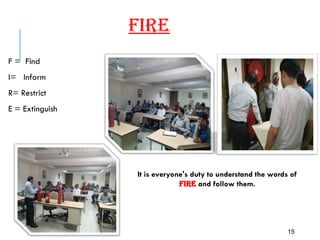
FIRE
F = Find
I=Inform
R= Restrict
E = Extinguish
15
It is everyone's duty to understand the words of
FIRE and follow them.
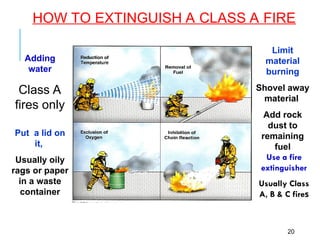
HOW TO EXTINGUISHA CLASS A FIRE
20
Adding
water
Class A
fires only
Use a fire
extinguisher
Usually Class
A, B & C fires
s
Put a lid on
it,
Usually oily
rags or paper
in a waste
container
Limit
material
burning
Shovel away
material
Add rock
dust to
remaining
fuel
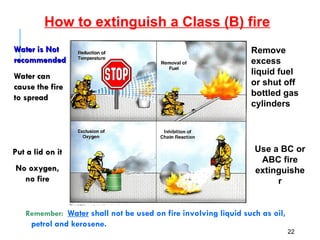
How to extinguisha Class (B) fire
Water is Not
Water is Not
recommended
recommended
Water can
Water can
cause the fire
cause the fire
to spread
to spread
Remove
excess
liquid fuel
or shut off
bottled gas
cylinders
Put a lid on it
Put a lid on it
No oxygen,
No oxygen,
no fire
no fire
Use a BC or
ABC fire
extinguishe
r
Remember: Water shall not be used on fire involving liquid such as oil,
petrol and kerosene.
22
23.
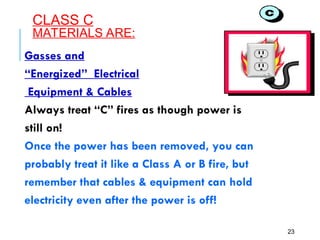
CLASS C
MATERIALS ARE:
23
Gassesand
“Energized” Electrical
Equipment & Cables
Always treat “C” fires as though power is
still on!
Once the power has been removed, you can
probably treat it like a Class A or B fire, but
remember that cables & equipment can hold
electricity even after the power is off!
24.
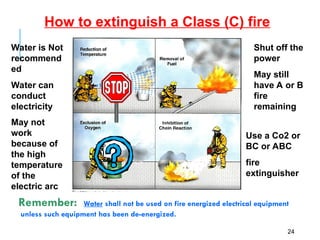
Water is Not
recommend
ed
Watercan
conduct
electricity
May not
work
because of
the high
temperature
of the
electric arc
Shut off the
power
May still
have A or B
fire
remaining
Use a Co2 or
BC or ABC
fire
extinguisher
How to extinguish a Class (C) fire
Remember: Water shall not be used on fire energized electrical equipment
unless such equipment has been de-energized.
24
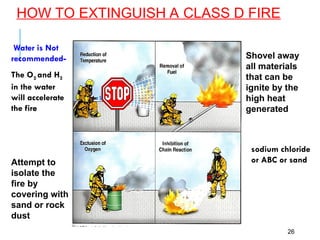
HOW TO EXTINGUISHA CLASS D FIRE
26
Water is Not
recommended-
The O2 and H2
in the water
will accelerate
the fire
e
sodium chloride
or ABC or sand
Shovel away
all materials
that can be
ignite by the
high heat
generated
Attempt to
isolate the
fire by
covering with
sand or rock
dust
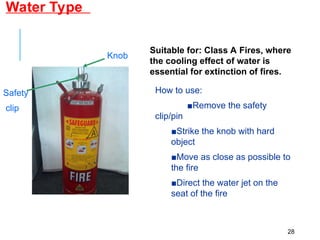
Safety
clip
Knob
Suitable for: ClassA Fires, where
the cooling effect of water is
essential for extinction of fires.
How to use:
■Remove the safety
clip/pin
■Strike the knob with hard
object
■Move as close as possible to
the fire
■Direct the water jet on the
seat of the fire
Water Type
28
29.
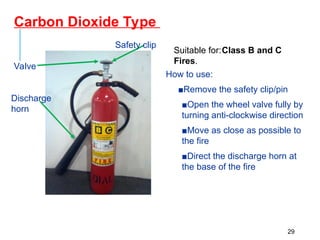
Valve
Safety clip
Discharge
horn
Suitable for:ClassB and C
Fires.
How to use:
■Remove the safety clip/pin
■Open the wheel valve fully by
turning anti-clockwise direction
■Move as close as possible to
the fire
■Direct the discharge horn at
the base of the fire
Carbon Dioxide Type
29
30.
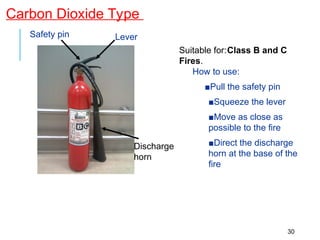
Safety pin Lever
Discharge
horn
Suitablefor:Class B and C
Fires.
How to use:
■Pull the safety pin
■Squeeze the lever
■Move as close as
possible to the fire
■Direct the discharge
horn at the base of the
fire
Carbon Dioxide Type
30
31.
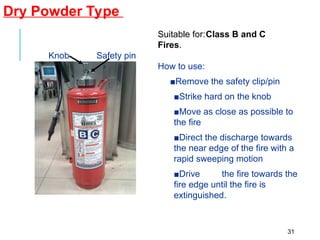
Safety pin
Knob
Suitable for:ClassB and C
Fires.
How to use:
■Remove the safety clip/pin
■Strike hard on the knob
■Move as close as possible to
the fire
■Direct the discharge towards
the near edge of the fire with a
rapid sweeping motion
■Drive the fire towards the
fire edge until the fire is
extinguished.
Dry Powder Type
31
32.
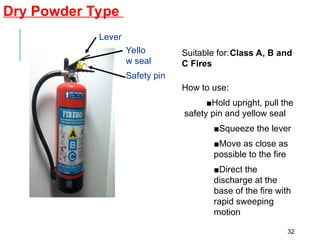
Safety pin
Yello
w seal
Lever
Suitablefor:Class A, B and
C Fires
How to use:
■Hold upright, pull the
safety pin and yellow seal
■Squeeze the lever
■Move as close as
possible to the fire
■Direct the
discharge at the
base of the fire with
rapid sweeping
motion
Dry Powder Type
32
33.
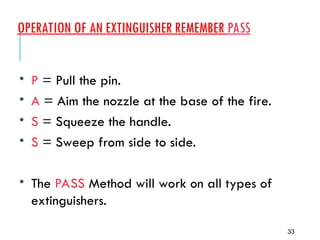
OPERATION OF ANEXTINGUISHER REMEMBER PASS
33
• P = Pull the pin.
• A = Aim the nozzle at the base of the fire.
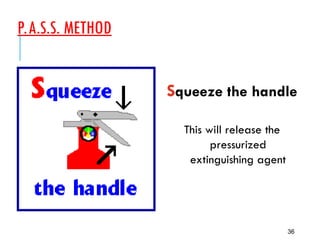
• S = Squeeze the handle.
• S = Sweep from side to side.
• The PASS Method will work on all types of
extinguishers.
34.
P.A.S.S. METHOD
34
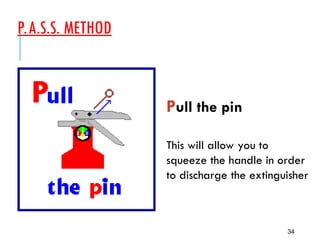
Pull thepin
This will allow you to
squeeze the handle in order
to discharge the extinguisher
35.
P.A.S.S. METHOD
35
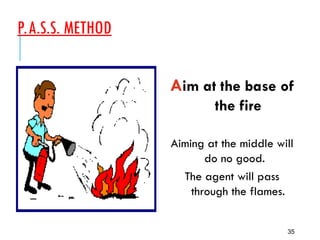
Aim atthe base of
the fire
Aiming at the middle will
do no good.
The agent will pass
through the flames.
P.A.S.S. METHOD
37
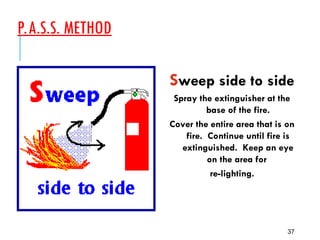
Sweep sideto side
Spray the extinguisher at the
base of the fire.
Cover the entire area that is on
fire. Continue until fire is
extinguished. Keep an eye
on the area for
re-lighting.
38.
SAFETY PRECAUTIONS WHEN
FIGHTINGA FIRE
38
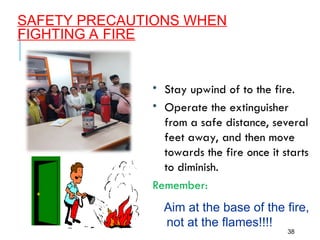
• Stay upwind of to the fire.
• Operate the extinguisher
from a safe distance, several
feet away, and then move
towards the fire once it starts
to diminish.
Remember:
Aim at the base of the fire,
not at the flames!!!!
39.
SOME FINAL THOUGHTS
TRAININGTIPS
RULE OF THUMB;
WE HEAR-WE TEND TO
FORGET
WE SEE- WE REMEMBER
WE DO- WE
UNDERSTAND
THE KEY IS INTERACTIVE-
HANDS ON TRAINING ON A
CONTINUAL BASIS
39
#1 Fire safety refers to precautions that are taken to prevent or reduce the likelihood of a fire that may result in death, injury, or property damage, alert those in a structure to the presence of a fire in the event one occurs, better enable those threatened by a fire to survive, or to reduce the damage caused by a fire.
Threats to fire safety are referred to as fire hazards. A fire hazard may include a situation that increases the likelihood a fire may start or may impede escape in the event a fire occurs.
Fire Prevention and Fire Fighting is everyone’s responsibility. Most of the major fire accidents could have prevented in the initial stage by the right action of the nearest persons.
Some common fire hazards are:
Poor House Keeping
Improper maintenance of electrical equipments.
Overloaded electrical system
Misuse of electrical appliances
Incorrectly installed wiring
Improper use and maintenance of machines
Fuel store areas with high oxygen concentration or insufficient protection
Materials that produce toxic fumes when heated
Objects that block fire exit
Welding/Cutting
Combustibles near or around the hot work
Lit candles left unattended
Smoking
#2 This program removes the fear of fire and gives confidence to you in handling fire emergencies in the initial stage before it is spreading. Upon completion of this learning event the learner will demonstrate knowledge of how to respond a fire emergency.
#3 This program removes the fear of fire and gives confidence to you in handling fire emergencies in the initial stage before it is spreading. Upon completion of this learning event the learner will demonstrate knowledge of how to respond a fire emergency.
#4 Fire safety refers to precautions that are taken to prevent or reduce the likelihood of a fire that may result in death, injury, or property damage, alert those in a structure to the presence of a fire in the event one occurs, better enable those threatened by a fire to survive, or to reduce the damage caused by a fire.
Threats to fire safety are referred to as fire hazards. A fire hazard may include a situation that increases the likelihood a fire may start or may impede escape in the event a fire occurs.
Fire Prevention and Fire Fighting is everyone’s responsibility. Most of the major fire accidents could have prevented in the initial stage by the right action of the nearest persons.
Some common fire hazards are:
Poor House Keeping
Improper maintenance of electrical equipments.
Overloaded electrical system
Misuse of electrical appliances
Incorrectly installed wiring
Improper use and maintenance of machines
Fuel store areas with high oxygen concentration or insufficient protection
Materials that produce toxic fumes when heated
Objects that block fire exit
Welding/Cutting
Combustibles near or around the hot work
Lit candles left unattended
Smoking
#5 Fire safety refers to precautions that are taken to prevent or reduce the likelihood of a fire that may result in death, injury, or property damage, alert those in a structure to the presence of a fire in the event one occurs, better enable those threatened by a fire to survive, or to reduce the damage caused by a fire.
Threats to fire safety are referred to as fire hazards. A fire hazard may include a situation that increases the likelihood a fire may start or may impede escape in the event a fire occurs.
Fire Prevention and Fire Fighting is everyone’s responsibility. Most of the major fire accidents could have prevented in the initial stage by the right action of the nearest persons.
Some common fire hazards are:
Poor House Keeping
Improper maintenance of electrical equipments.
Overloaded electrical system
Misuse of electrical appliances
Incorrectly installed wiring
Improper use and maintenance of machines
Fuel store areas with high oxygen concentration or insufficient protection
Materials that produce toxic fumes when heated
Objects that block fire exit
Welding/Cutting
Combustibles near or around the hot work
Lit candles left unattended
Smoking
#6 Fire safety refers to precautions that are taken to prevent or reduce the likelihood of a fire that may result in death, injury, or property damage, alert those in a structure to the presence of a fire in the event one occurs, better enable those threatened by a fire to survive, or to reduce the damage caused by a fire.
Threats to fire safety are referred to as fire hazards. A fire hazard may include a situation that increases the likelihood a fire may start or may impede escape in the event a fire occurs.
Fire Prevention and Fire Fighting is everyone’s responsibility. Most of the major fire accidents could have prevented in the initial stage by the right action of the nearest persons.
Some common fire hazards are:
Poor House Keeping
Improper maintenance of electrical equipments.
Overloaded electrical system
Misuse of electrical appliances
Incorrectly installed wiring
Improper use and maintenance of machines
Fuel store areas with high oxygen concentration or insufficient protection
Materials that produce toxic fumes when heated
Objects that block fire exit
Welding/Cutting
Combustibles near or around the hot work
Lit candles left unattended
Smoking
#7 Fire safety refers to precautions that are taken to prevent or reduce the likelihood of a fire that may result in death, injury, or property damage, alert those in a structure to the presence of a fire in the event one occurs, better enable those threatened by a fire to survive, or to reduce the damage caused by a fire.
Threats to fire safety are referred to as fire hazards. A fire hazard may include a situation that increases the likelihood a fire may start or may impede escape in the event a fire occurs.
Fire Prevention and Fire Fighting is everyone’s responsibility. Most of the major fire accidents could have prevented in the initial stage by the right action of the nearest persons.
Some common fire hazards are:
Poor House Keeping
Improper maintenance of electrical equipments.
Overloaded electrical system
Misuse of electrical appliances
Incorrectly installed wiring
Improper use and maintenance of machines
Fuel store areas with high oxygen concentration or insufficient protection
Materials that produce toxic fumes when heated
Objects that block fire exit
Welding/Cutting
Combustibles near or around the hot work
Lit candles left unattended
Smoking
#8 Fire safety refers to precautions that are taken to prevent or reduce the likelihood of a fire that may result in death, injury, or property damage, alert those in a structure to the presence of a fire in the event one occurs, better enable those threatened by a fire to survive, or to reduce the damage caused by a fire.
Threats to fire safety are referred to as fire hazards. A fire hazard may include a situation that increases the likelihood a fire may start or may impede escape in the event a fire occurs.
Fire Prevention and Fire Fighting is everyone’s responsibility. Most of the major fire accidents could have prevented in the initial stage by the right action of the nearest persons.
Some common fire hazards are:
Poor House Keeping
Improper maintenance of electrical equipments.
Overloaded electrical system
Misuse of electrical appliances
Incorrectly installed wiring
Improper use and maintenance of machines
Fuel store areas with high oxygen concentration or insufficient protection
Materials that produce toxic fumes when heated
Objects that block fire exit
Welding/Cutting
Combustibles near or around the hot work
Lit candles left unattended
Smoking
#9 Fire safety refers to precautions that are taken to prevent or reduce the likelihood of a fire that may result in death, injury, or property damage, alert those in a structure to the presence of a fire in the event one occurs, better enable those threatened by a fire to survive, or to reduce the damage caused by a fire.
Threats to fire safety are referred to as fire hazards. A fire hazard may include a situation that increases the likelihood a fire may start or may impede escape in the event a fire occurs.
Fire Prevention and Fire Fighting is everyone’s responsibility. Most of the major fire accidents could have prevented in the initial stage by the right action of the nearest persons.
Some common fire hazards are:
Poor House Keeping
Improper maintenance of electrical equipments.
Overloaded electrical system
Misuse of electrical appliances
Incorrectly installed wiring
Improper use and maintenance of machines
Fuel store areas with high oxygen concentration or insufficient protection
Materials that produce toxic fumes when heated
Objects that block fire exit
Welding/Cutting
Combustibles near or around the hot work
Lit candles left unattended
Smoking
#10 Fire safety refers to precautions that are taken to prevent or reduce the likelihood of a fire that may result in death, injury, or property damage, alert those in a structure to the presence of a fire in the event one occurs, better enable those threatened by a fire to survive, or to reduce the damage caused by a fire.
Threats to fire safety are referred to as fire hazards. A fire hazard may include a situation that increases the likelihood a fire may start or may impede escape in the event a fire occurs.
Fire Prevention and Fire Fighting is everyone’s responsibility. Most of the major fire accidents could have prevented in the initial stage by the right action of the nearest persons.
Some common fire hazards are:
Poor House Keeping
Improper maintenance of electrical equipments.
Overloaded electrical system
Misuse of electrical appliances
Incorrectly installed wiring
Improper use and maintenance of machines
Fuel store areas with high oxygen concentration or insufficient protection
Materials that produce toxic fumes when heated
Objects that block fire exit
Welding/Cutting
Combustibles near or around the hot work
Lit candles left unattended
Smoking