DISASTER SITE WORKER SAFETY
Respiratory Protection
1
OBJECTIVES
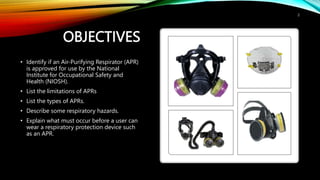
• Identify if an Air-Purifying Respirator (APR)
is approved for use by the National
Institute for Occupational Safety and
Health (NIOSH).
• List the limitations of APRs
• List the types of APRs.
• Describe some respiratory hazards.
• Explain what must occur before a user can
wear a respiratory protection device such
as an APR.
2
RESPIRATORY
Look back at your “Hazard
Recognition & Assessment” work
sheet in Module # 1.
• Identify your Respiratory
requirements.
3
RESPIRATORY HAZARDS
• Dusts
• Mists
• Fumes
• Gases
• Vapors
4
RESPIRATORY PROTECTION
Respiratory Protection
• Respiratory protection is of primary importance
since inhalation is one of the major routes of
exposure to chemical and biological toxicants.
N95 Respirators
• N95 respirator is a respiratory protective device
designed to achieve a very close facial fit and very
efficient filtration of airborne particles. 'N95'
designation means that when subjected to careful
testing, the respirator blocks at least 95% of very
small (0.3 micron) test particles.
RESPIRATORY PROTECTION
Respiratory Protection
• Air Purifying Respiratory protective devices
(APRs) consist of a facepiece connected to an
air-purifying device.
• Air purifying device cartridge or canister must
be carefully selected to match the airborne
hazard present.
• Incorrect selection could result in sickness and
respiratory problems.
NIOSH FILTER
CLASSIFICATIONS
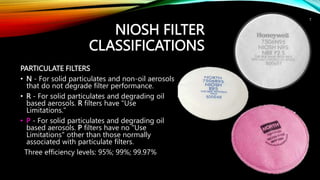
PARTICULATE FILTERS
• N - For solid particulates and non-oil aerosols
that do not degrade filter performance.
• R - For solid particulates and degrading oil
based aerosols. R filters have "Use
Limitations."
• P - For solid particulates and degrading oil
based aerosols. P filters have no "Use
Limitations" other than those normally
associated with particulate filters.
Three efficiency levels: 95%; 99%; 99.97%
7
NIOSH CARTRIDGE
CLASSIFICATIONS
8
RESPIRATORY PROTECTION
Powered Air Purifying Respirator (PAPR)
• The PAPR equipment is battery operated,
consists of a half or full facepiece, breathing
tube, battery-operated blower, and
particulate filters (HEPA only).
• A PAPR uses a blower to pass contaminated
air through a HEPA filter, which removes the
contaminant and supplies purified air to a
facepiece.
RESPIRATOR USE
Workers who are required to use respirators
must be:
• Medically evaluated to determine their ability
to safely wear the respirator
• Fit tested to ensure the respirator will provide
adequate wear-time protection.
• Trained such that they can demonstrate
knowledge of at least why the respirator is
necessary and how improper fit, use, or
maintenance can compromise its protective
effect
• Proper respirator use includes adequate
cleaning and inspection, donning, user seal
checks, and doffing.
10
11
RESPIRATORY
• Inspect
• Donning
• User Seal
• Doffing
• Cleaning / Dispose
12
A C T I V I T Y
PPE
DASHBOAR
D

17011344.ppt

  • 1.
    DISASTER SITE WORKERSAFETY Respiratory Protection 1
  • 2.
    OBJECTIVES • Identify ifan Air-Purifying Respirator (APR) is approved for use by the National Institute for Occupational Safety and Health (NIOSH). • List the limitations of APRs • List the types of APRs. • Describe some respiratory hazards. • Explain what must occur before a user can wear a respiratory protection device such as an APR. 2
  • 3.
    RESPIRATORY Look back atyour “Hazard Recognition & Assessment” work sheet in Module # 1. • Identify your Respiratory requirements. 3
  • 4.
    RESPIRATORY HAZARDS • Dusts •Mists • Fumes • Gases • Vapors 4
  • 5.
    RESPIRATORY PROTECTION Respiratory Protection •Respiratory protection is of primary importance since inhalation is one of the major routes of exposure to chemical and biological toxicants. N95 Respirators • N95 respirator is a respiratory protective device designed to achieve a very close facial fit and very efficient filtration of airborne particles. 'N95' designation means that when subjected to careful testing, the respirator blocks at least 95% of very small (0.3 micron) test particles.
  • 6.
    RESPIRATORY PROTECTION Respiratory Protection •Air Purifying Respiratory protective devices (APRs) consist of a facepiece connected to an air-purifying device. • Air purifying device cartridge or canister must be carefully selected to match the airborne hazard present. • Incorrect selection could result in sickness and respiratory problems.
  • 7.
    NIOSH FILTER CLASSIFICATIONS PARTICULATE FILTERS •N - For solid particulates and non-oil aerosols that do not degrade filter performance. • R - For solid particulates and degrading oil based aerosols. R filters have "Use Limitations." • P - For solid particulates and degrading oil based aerosols. P filters have no "Use Limitations" other than those normally associated with particulate filters. Three efficiency levels: 95%; 99%; 99.97% 7
  • 8.
  • 9.
    RESPIRATORY PROTECTION Powered AirPurifying Respirator (PAPR) • The PAPR equipment is battery operated, consists of a half or full facepiece, breathing tube, battery-operated blower, and particulate filters (HEPA only). • A PAPR uses a blower to pass contaminated air through a HEPA filter, which removes the contaminant and supplies purified air to a facepiece.
  • 10.
    RESPIRATOR USE Workers whoare required to use respirators must be: • Medically evaluated to determine their ability to safely wear the respirator • Fit tested to ensure the respirator will provide adequate wear-time protection. • Trained such that they can demonstrate knowledge of at least why the respirator is necessary and how improper fit, use, or maintenance can compromise its protective effect • Proper respirator use includes adequate cleaning and inspection, donning, user seal checks, and doffing. 10
  • 11.
  • 12.
    RESPIRATORY • Inspect • Donning •User Seal • Doffing • Cleaning / Dispose 12 A C T I V I T Y
  • 13.