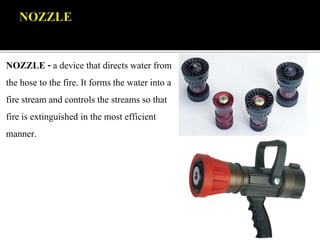
NOZZLE - a device that directs water from
the hose to the fire. It forms the water into a
fire stream and controls the streams so that
fire is extinguished in the most efficient
manner.
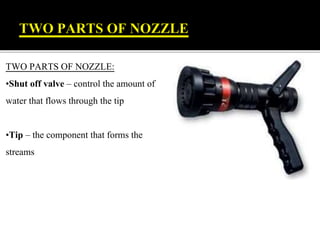
TWO PARTS OF NOZZLE:
•Shut off valve – control the amount of
water that flows through the tip
•Tip – the component that forms the
streams
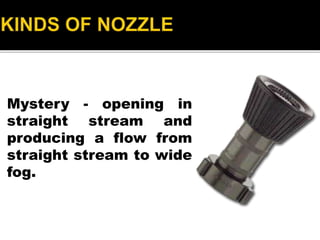
Mystery - opening in
straight stream and
producing a flow from
straight stream to wide
fog.
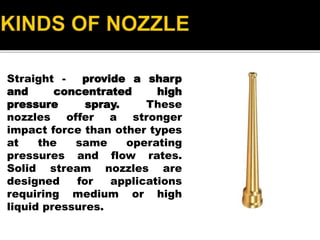
Straight - provide a sharp
and concentrated high
pressure spray. These
nozzles offer a stronger
impact force than other types
at the same operating
pressures and flow rates.
Solid stream nozzles are
designed for applications
requiring medium or high
liquid pressures.
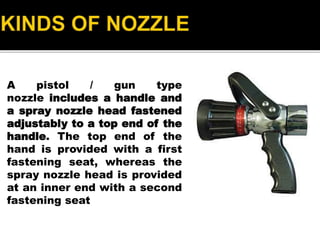
A pistol / gun type
nozzle includes a handle and
a spray nozzle head fastened
adjustably to a top end of the
handle. The top end of the
hand is provided with a first
fastening seat, whereas the
spray nozzle head is provided
at an inner end with a second
fastening seat.
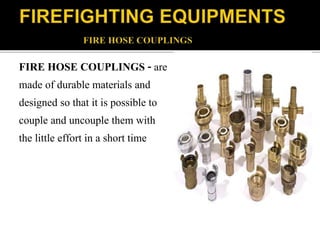
FIRE HOSE COUPLINGS - are
made of durable materials and
designed so that it is possible to
couple and uncouple them with
the little effort in a short time
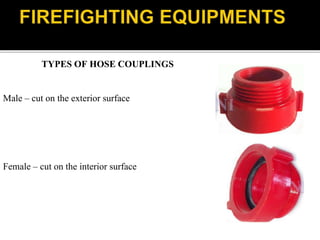
TYPES OF HOSE COUPLINGS
Male – cut on the exterior surface
Female – cut on the interior surface
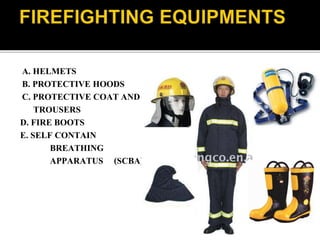
A. HELMETS
B. PROTECTIVE HOODS
C. PROTECTIVE COAT AND
TROUSERS
D. FIRE BOOTS
E. SELF CONTAIN
BREATHING
APPARATUS (SCBA)
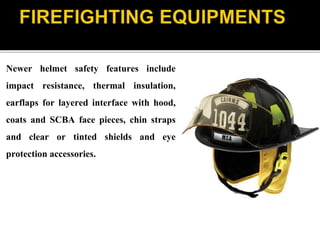
Newer helmet safety features include
impact resistance, thermal insulation,
earflaps for layered interface with hood,
coats and SCBA face pieces, chin straps
and clear or tinted shields and eye
protection accessories.
Protective Hood - is an important interface
that creates an encapsulating link to the
firefighter’s helmet, coat and SCBA face
pieces. It is made of fire-resistive, form
fitting cloth that protects the face, ears,
hair and neck in area not covered by the
helmet, earflaps and coat collar.
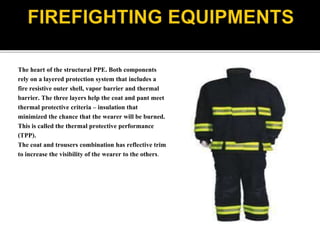
The heart of the structural PPE. Both components
rely on a layered protection system that includes a
fire resistive outer shell, vapor barrier and thermal
barrier. The three layers help the coat and pant meet
thermal protective criteria – insulation that
minimized the chance that the wearer will be burned.
This is called the thermal protective performance
(TPP).
The coat and trousers combination has reflective trim
to increase the visibility of the wearer to the others.
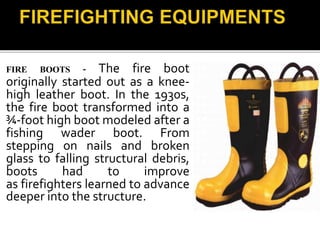
FIRE BOOTS - The fire boot
originally started out as a knee-
high leather boot. In the 1930s,
the fire boot transformed into a
Âľ-foot high boot modeled after a
fishing wader boot. From
stepping on nails and broken
glass to falling structural debris,
boots had to improve
as firefighters learned to advance
deeper into the structure.
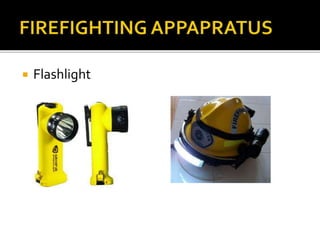
 Flashlight
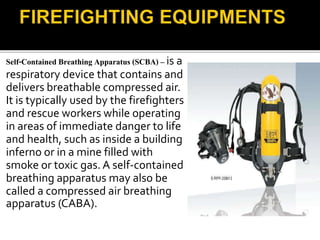
Self-Contained Breathing Apparatus (SCBA) – is a
respiratory device that contains and
delivers breathable compressed air.
It is typically used by the firefighters
and rescue workers while operating
in areas of immediate danger to life
and health, such as inside a building
inferno or in a mine filled with
smoke or toxic gas. A self-contained
breathing apparatus may also be
called a compressed air breathing
apparatus (CABA).
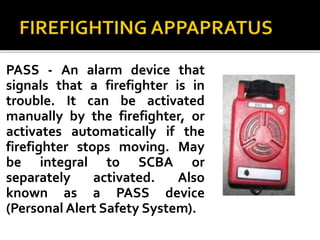
PASS - An alarm device that
signals that a firefighter is in
trouble. It can be activated
manually by the firefighter, or
activates automatically if the
firefighter stops moving. May
be integral to SCBA or
separately activated. Also
known as a PASS device
(Personal Alert Safety System).
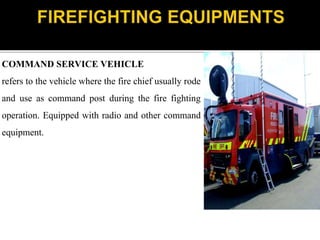
COMMAND SERVICE VEHICLE
refers to the vehicle where the fire chief usually rode
and use as command post during the fire fighting
operation. Equipped with radio and other command
equipment.
PUMPER TRUCK/ FIRE ENGINE - a kind of fire fighting apparatus designed
to use diverse water supply sources as hydrants usually equipped with a water
tank and centrifugal pump. They are effective even at fire where water supply is
limited or non existent.
WATER TANK - this apparatus enables to secure water scarce areas for speedy
fire fighting operations. Usually equipped with 10,000 to 25, 000 liters capacity of
tanks
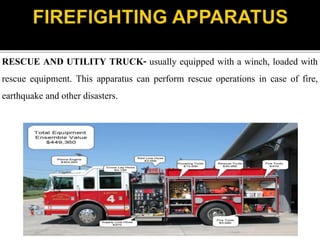
RESCUE AND UTILITY TRUCK- usually equipped with a winch, loaded with
rescue equipment. This apparatus can perform rescue operations in case of fire,
earthquake and other disasters.
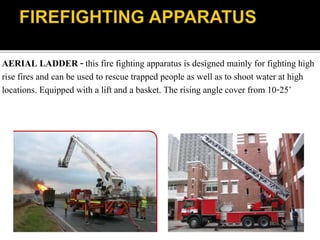
AERIAL LADDER - this fire fighting apparatus is designed mainly for fighting high
rise fires and can be used to rescue trapped people as well as to shoot water at high
locations. Equipped with a lift and a basket. The rising angle cover from 10-25Ëš
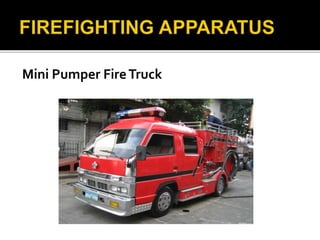
Mini Pumper FireTruck
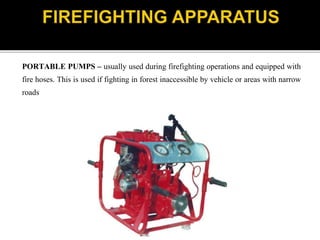
PORTABLE PUMPS – usually used during firefighting operations and equipped with
fire hoses. This is used if fighting in forest inaccessible by vehicle or areas with narrow
roads
STRAIGHT LADDER - non adjustable in length and consist
only of one section. Sometimes it is called “wall ladder” and is
used for quick access to windows and roofs of one and two
storey building (12’, 14’, 16’, 18’)
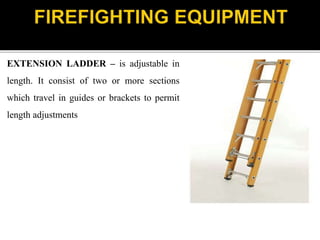
EXTENSION LADDER – is adjustable in
length. It consist of two or more sections
which travel in guides or brackets to permit
length adjustments
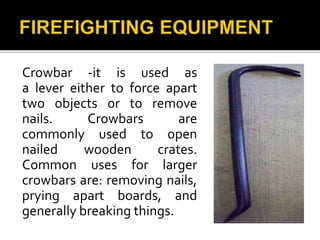
Crowbar -it is used as
a lever either to force apart
two objects or to remove
nails. Crowbars are
commonly used to open
nailed wooden crates.
Common uses for larger
crowbars are: removing nails,
prying apart boards, and
generally breaking things.
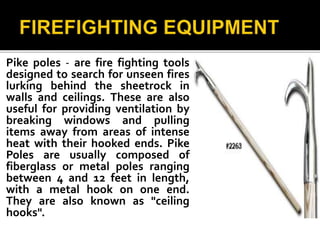
Pike poles - are fire fighting tools
designed to search for unseen fires
lurking behind the sheetrock in
walls and ceilings. These are also
useful for providing ventilation by
breaking windows and pulling
items away from areas of intense
heat with their hooked ends. Pike
Poles are usually composed of
fiberglass or metal poles ranging
between 4 and 12 feet in length,
with a metal hook on one end.
They are also known as "ceiling
hooks".
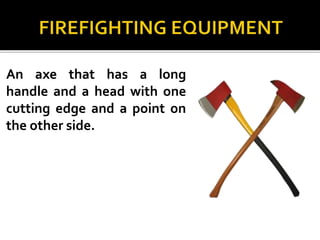
An axe that has a long
handle and a head with one
cutting edge and a point on
the other side.
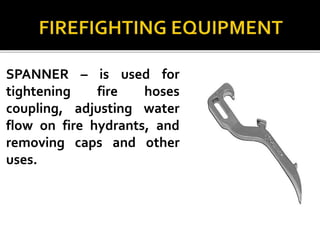
SPANNER – is used for
tightening fire hoses
coupling, adjusting water
flow on fire hydrants, and
removing caps and other
uses.
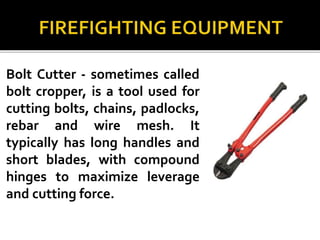
Bolt Cutter - sometimes called
bolt cropper, is a tool used for
cutting bolts, chains, padlocks,
rebar and wire mesh. It
typically has long handles and
short blades, with compound
hinges to maximize leverage
and cutting force.
THANKYOU!
THANKYOU!!!

Fire Fighting Tools & Equipment.pptx

  • 2.
    NOZZLE - adevice that directs water from the hose to the fire. It forms the water into a fire stream and controls the streams so that fire is extinguished in the most efficient manner.
  • 3.
    TWO PARTS OFNOZZLE: •Shut off valve – control the amount of water that flows through the tip •Tip – the component that forms the streams
  • 4.
    Mystery - openingin straight stream and producing a flow from straight stream to wide fog.
  • 5.
    Straight - providea sharp and concentrated high pressure spray. These nozzles offer a stronger impact force than other types at the same operating pressures and flow rates. Solid stream nozzles are designed for applications requiring medium or high liquid pressures.
  • 6.
    A pistol /gun type nozzle includes a handle and a spray nozzle head fastened adjustably to a top end of the handle. The top end of the hand is provided with a first fastening seat, whereas the spray nozzle head is provided at an inner end with a second fastening seat.
  • 7.
    FIRE HOSE COUPLINGS- are made of durable materials and designed so that it is possible to couple and uncouple them with the little effort in a short time
  • 8.
    TYPES OF HOSECOUPLINGS Male – cut on the exterior surface Female – cut on the interior surface
  • 9.
    A. HELMETS B. PROTECTIVEHOODS C. PROTECTIVE COAT AND TROUSERS D. FIRE BOOTS E. SELF CONTAIN BREATHING APPARATUS (SCBA)
  • 10.
    Newer helmet safetyfeatures include impact resistance, thermal insulation, earflaps for layered interface with hood, coats and SCBA face pieces, chin straps and clear or tinted shields and eye protection accessories.
  • 11.
    Protective Hood -is an important interface that creates an encapsulating link to the firefighter’s helmet, coat and SCBA face pieces. It is made of fire-resistive, form fitting cloth that protects the face, ears, hair and neck in area not covered by the helmet, earflaps and coat collar.
  • 12.
    The heart ofthe structural PPE. Both components rely on a layered protection system that includes a fire resistive outer shell, vapor barrier and thermal barrier. The three layers help the coat and pant meet thermal protective criteria – insulation that minimized the chance that the wearer will be burned. This is called the thermal protective performance (TPP). The coat and trousers combination has reflective trim to increase the visibility of the wearer to the others.
  • 13.
    FIRE BOOTS -The fire boot originally started out as a knee- high leather boot. In the 1930s, the fire boot transformed into a Âľ-foot high boot modeled after a fishing wader boot. From stepping on nails and broken glass to falling structural debris, boots had to improve as firefighters learned to advance deeper into the structure.
  • 14.
  • 15.
    Self-Contained Breathing Apparatus(SCBA) – is a respiratory device that contains and delivers breathable compressed air. It is typically used by the firefighters and rescue workers while operating in areas of immediate danger to life and health, such as inside a building inferno or in a mine filled with smoke or toxic gas. A self-contained breathing apparatus may also be called a compressed air breathing apparatus (CABA).
  • 16.
    PASS - Analarm device that signals that a firefighter is in trouble. It can be activated manually by the firefighter, or activates automatically if the firefighter stops moving. May be integral to SCBA or separately activated. Also known as a PASS device (Personal Alert Safety System).
  • 17.
    COMMAND SERVICE VEHICLE refersto the vehicle where the fire chief usually rode and use as command post during the fire fighting operation. Equipped with radio and other command equipment.
  • 18.
    PUMPER TRUCK/ FIREENGINE - a kind of fire fighting apparatus designed to use diverse water supply sources as hydrants usually equipped with a water tank and centrifugal pump. They are effective even at fire where water supply is limited or non existent.
  • 19.
    WATER TANK -this apparatus enables to secure water scarce areas for speedy fire fighting operations. Usually equipped with 10,000 to 25, 000 liters capacity of tanks
  • 20.
    RESCUE AND UTILITYTRUCK- usually equipped with a winch, loaded with rescue equipment. This apparatus can perform rescue operations in case of fire, earthquake and other disasters.
  • 21.
    AERIAL LADDER -this fire fighting apparatus is designed mainly for fighting high rise fires and can be used to rescue trapped people as well as to shoot water at high locations. Equipped with a lift and a basket. The rising angle cover from 10-25Ëš
  • 22.
  • 23.
    PORTABLE PUMPS –usually used during firefighting operations and equipped with fire hoses. This is used if fighting in forest inaccessible by vehicle or areas with narrow roads
  • 24.
    STRAIGHT LADDER -non adjustable in length and consist only of one section. Sometimes it is called “wall ladder” and is used for quick access to windows and roofs of one and two storey building (12’, 14’, 16’, 18’)
  • 25.
    EXTENSION LADDER –is adjustable in length. It consist of two or more sections which travel in guides or brackets to permit length adjustments
  • 26.
    Crowbar -it isused as a lever either to force apart two objects or to remove nails. Crowbars are commonly used to open nailed wooden crates. Common uses for larger crowbars are: removing nails, prying apart boards, and generally breaking things.
  • 27.
    Pike poles -are fire fighting tools designed to search for unseen fires lurking behind the sheetrock in walls and ceilings. These are also useful for providing ventilation by breaking windows and pulling items away from areas of intense heat with their hooked ends. Pike Poles are usually composed of fiberglass or metal poles ranging between 4 and 12 feet in length, with a metal hook on one end. They are also known as "ceiling hooks".
  • 28.
    An axe thathas a long handle and a head with one cutting edge and a point on the other side.
  • 29.
    SPANNER – isused for tightening fire hoses coupling, adjusting water flow on fire hydrants, and removing caps and other uses.
  • 30.
    Bolt Cutter -sometimes called bolt cropper, is a tool used for cutting bolts, chains, padlocks, rebar and wire mesh. It typically has long handles and short blades, with compound hinges to maximize leverage and cutting force.
  • 31.