1
PRESENTATION ON
“FIRE EXTINGUISHERS”
SAFARUL HAQUE
SAFETY ENGR.
2
3
Fire Extinguishers
Everyone should know how to
c o r r e c t l y u s e a p o r t a b l e f i r e
extinguisher. You never know when
you might need to use one to save
your workplace, your home or a life.
4
 Discuss About Fire and Fire Elements.
 Discuss How Fires are Classified.
 Discuss How To Extinguish Different Class Of Fires.
 Discuss How To Use a Fire Extinguisher.
OBJECTIVES
5
WHY WE REQUIRE?
 Fire is One of the Most Common Industrial Accidents.
 More Than 300 Workers Per Year Lose Their Lives Due to
Fire.
 Training Greatly reduces the Probability of Fire
incidents.
ACME FIRE
EXTINGUISHER
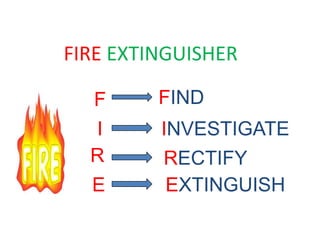
FIRE EXTINGUISHER
F FIND
I INVESTIGATE
R RECTIFY
E EXTINGUISH
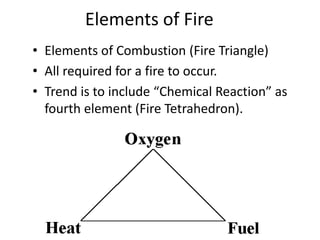
Elements of Fire
• Elements of Combustion (Fire Triangle)
• All required for a fire to occur.
• Trend is to include “Chemical Reaction” as
fourth element (Fire Tetrahedron).
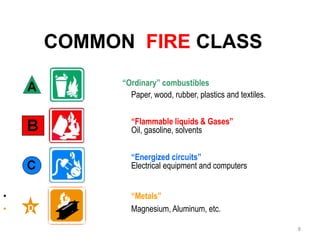
COMMON FIRE CLASS
“Ordinary” combustibles
Paper, wood, rubber, plastics and textiles.
“Flammable liquids & Gases”
Oil, gasoline, solvents
“Energized circuits”
Electrical equipment and computers
• “Metals”
• Magnesium, Aluminum, etc.
8
D
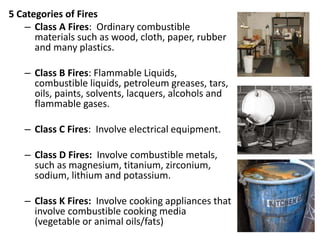
5 Categories of Fires
– Class A Fires: Ordinary combustible
materials such as wood, cloth, paper, rubber
and many plastics.
– Class B Fires: Flammable Liquids,
combustible liquids, petroleum greases, tars,
oils, paints, solvents, lacquers, alcohols and
flammable gases.
– Class C Fires: Involve electrical equipment.
– Class D Fires: Involve combustible metals,
such as magnesium, titanium, zirconium,
sodium, lithium and potassium.
– Class K Fires: Involve cooking appliances that
involve combustible cooking media
(vegetable or animal oils/fats)
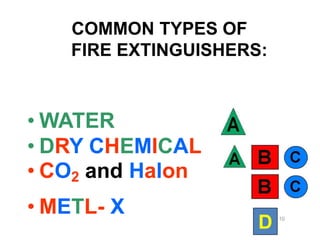
COMMON TYPES OF
FIRE EXTINGUISHERS:
• WATER
• DRY CHEMICAL
• CO2 and Halon
• METL- X 10
D
HOW THEY WORK:
11
• Works by cooling.
• Numerical rating indicates amount of agent,
duration, and range of discharge on test fires.
• Area of Class A fire which a “non-expert” can
extinguish, with proper training
– 1-A is equivalent on Class-A fire to five liters of water.
– 2-A contains has twice as much extinguishing agent.
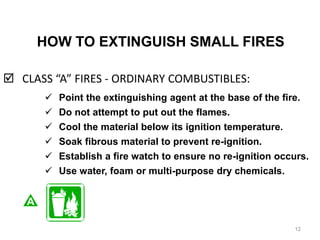
HOW TO EXTINGUISH SMALL FIRES
 CLASS “A” FIRES - ORDINARY COMBUSTIBLES:
12
 Point the extinguishing agent at the base of the fire.
 Do not attempt to put out the flames.
 Cool the material below its ignition temperature.
 Soak fibrous material to prevent re-ignition.
 Establish a fire watch to ensure no re-ignition occurs.
 Use water, foam or multi-purpose dry chemicals.
HOW THEY WORK:
• Works by blanketing the fuel.
13
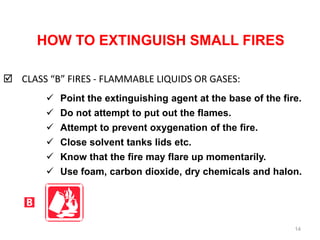
HOW TO EXTINGUISH SMALL FIRES
 CLASS “B” FIRES - FLAMMABLE LIQUIDS OR GASES:
14
Continued
 Point the extinguishing agent at the base of the fire.
 Do not attempt to put out the flames.
 Attempt to prevent oxygenation of the fire.
 Close solvent tanks lids etc.
 Know that the fire may flare up momentarily.
 Use foam, carbon dioxide, dry chemicals and halon.
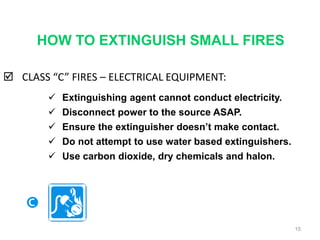
HOW TO EXTINGUISH SMALL FIRES
 CLASS “C” FIRES – ELECTRICAL EQUIPMENT:
15
Continued
 Extinguishing agent cannot conduct electricity.
 Disconnect power to the source ASAP.
 Ensure the extinguisher doesn’t make contact.
 Do not attempt to use water based extinguishers.
 Use carbon dioxide, dry chemicals and halon.
HOW TO EXTINGUISH SMALL FIRES
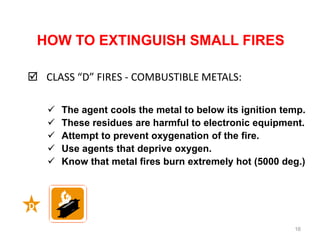
 CLASS “D” FIRES - COMBUSTIBLE METALS:
16
Continued
 The agent cools the metal to below its ignition temp.
 These residues are harmful to electronic equipment.
 Attempt to prevent oxygenation of the fire.
 Use agents that deprive oxygen.
 Know that metal fires burn extremely hot (5000 deg.)
D
6 Types of Fire Extinguishers
1. Fire Extinguishers should be appropriately
matched to work environment.
2. Use the symbols to quickly identify the Type
of Fire Extinguisher.
3. 6 Types of Fire Extinguishers
1. Class A – Wood, Paper, Plastics
2. Class AB – Wood, Paper and Flammable Liquid
3. Class BC (flammable liquid and electrical)
4. Class ABC Multipurpose
5. Class K – Kitchen Fire
6. Class D – Metal Fires
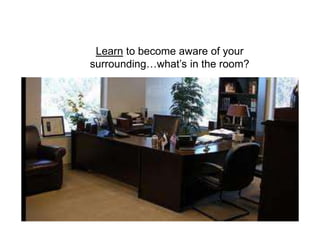
Learn to become aware of your
surrounding…what’s in the room?
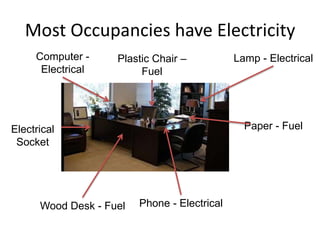
Most Occupancies have Electricity
Computer -
Electrical
Lamp - Electrical
Electrical
Socket
Phone - Electrical
Paper - Fuel
Wood Desk - Fuel
Plastic Chair –
Fuel
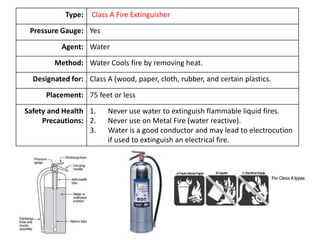
Type: Class A Fire Extinguisher
Pressure Gauge: Yes
Agent: Water
Method: Water Cools fire by removing heat.
Designated for: Class A (wood, paper, cloth, rubber, and certain plastics.
Placement: 75 feet or less
Safety and Health
Precautions:
1. Never use water to extinguish flammable liquid fires.
2. Never use on Metal Fire (water reactive).
3. Water is a good conductor and may lead to electrocution
if used to extinguish an electrical fire.
Type: BC Fire Extinguisher
Pressure Gauge: No (Must be weighed to determine leakage)
Agent: Carbon dioxide is discharged as a white cloud of “snow”
Method: Removes oxygen from fire
Designated for: Class B and C (flammable liquid and electrical) fires only
Placement: 50 feet or less
Health and Safety
Precautions:
1. Carbon Dioxide is a clean, non-contaminating, odorless
gas.
2. After the CO2 dissipates, Class A fire may reignite.
3. Never use CO2 extinguishers in a confined space
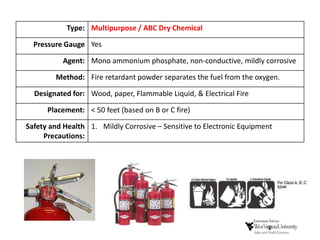
Type: Multipurpose / ABC Dry Chemical
Pressure Gauge Yes
Agent: Mono ammonium phosphate, non-conductive, mildly corrosive
Method: Fire retardant powder separates the fuel from the oxygen.
Designated for: Wood, paper, Flammable Liquid, & Electrical Fire
Placement: < 50 feet (based on B or C fire)
Safety and Health
Precautions:
1. Mildly Corrosive – Sensitive to Electronic Equipment
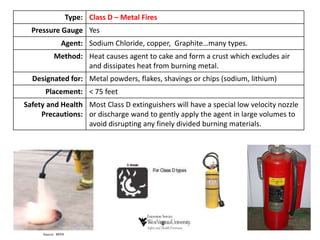
Type: Class D – Metal Fires
Pressure Gauge Yes
Agent: Sodium Chloride, copper, Graphite…many types.
Method: Heat causes agent to cake and form a crust which excludes air
and dissipates heat from burning metal.
Designated for: Metal powders, flakes, shavings or chips (sodium, lithium)
Placement: < 75 feet
Safety and Health
Precautions:
Most Class D extinguishers will have a special low velocity nozzle
or discharge wand to gently apply the agent in large volumes to
avoid disrupting any finely divided burning materials.
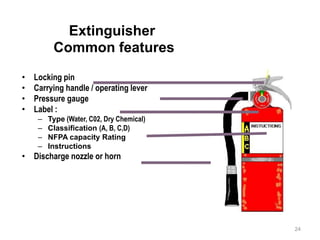
Extinguisher
Common features
• Locking pin
• Carrying handle / operating lever
• Pressure gauge
• Label :
– Type (Water, C02, Dry Chemical)
– Classification (A, B, C,D)
– NFPA capacity Rating
– Instructions
• Discharge nozzle or horn
24
REACT
upon discovery of fire or smoke
Remove persons in immediate danger!
Ensure doors are closed! (confine fire/smoke)
Activate the building alarm !
Call the Fire Department !
Treat ALL fires as DANGEROUS!
– Continue a complete building evacuation
– Do not attempt to fight with a fire if you don’t know how to use fire
extinguisher
25
Use an extinguisher
ONLY if the:
• Fire is NOT spreading (small and contained)
• EXIT IS CLEAR (fight fire with your back to an exit )
• Proper extinguisher is at hand, and...
– You have been trained and know how to use it!
– You use “Buddy System” - have someone back you up!
• Get assistance BEFORE trying to fight a fire!
26
Remember
the PASS
word:
1) Keep your back to a
clear escape route,
2) Stand back 6 to 8 feet
from the fire,
3) Then >>:
27
P.A.S.S.
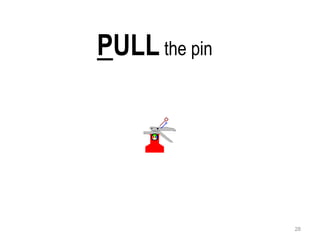
PULL
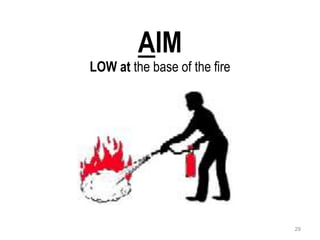
AIM
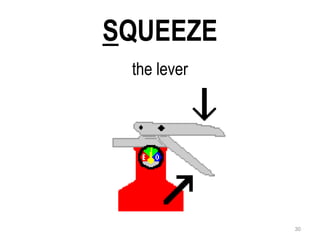
SQUEEZE
SWEEP
PULL the pin
28
AIM
LOW at the base of the fire
29
SQUEEZE
the lever
30
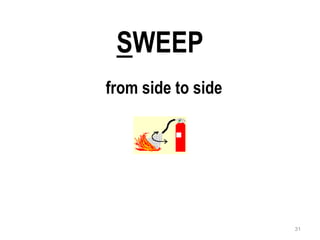
SWEEP
31
from side to side
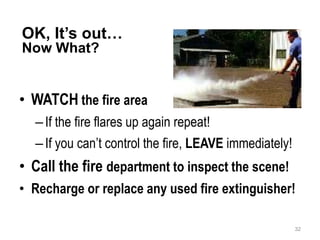
OK, It’s out…
Now What?
• WATCH the fire area
–If the fire flares up again repeat!
–If you can’t control the fire, LEAVE immediately!
• Call the fire department to inspect the scene!
• Recharge or replace any used fire extinguisher!
32
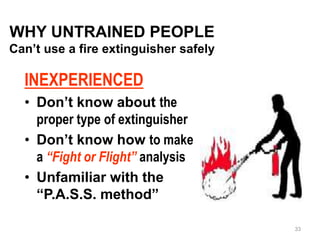
WHY UNTRAINED PEOPLE
Can’t use a fire extinguisher safely
INEXPERIENCED
• Don’t know about the
proper type of extinguisher
• Don’t know how to make
a “Fight or Flight” analysis
• Unfamiliar with the
“P.A.S.S. method”
33
EMPLOYEE RESPONSIBILITIES
 DEPARTMENT AND FIRST LINE SUPERVISORS:
34
 Replace used and damaged fire extinguisher(s).
 Notify Safety Officer of use or damage.
 Monthly check the fire extinguisher validity.
 Ensure installed equipment does not block access.
 Ensure employees are aware of where extinguishers
are located.
 Ensure extinguishers are clean and are free from
obstructions.
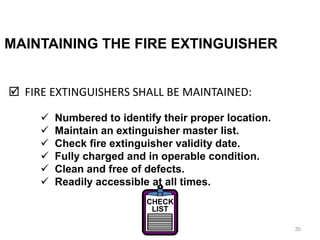
CHECK
LIST
MAINTAINING THE FIRE EXTINGUISHER
 FIRE EXTINGUISHERS SHALL BE MAINTAINED:
35
 Numbered to identify their proper location.
 Maintain an extinguisher master list.
 Check fire extinguisher validity date.
 Fully charged and in operable condition.
 Clean and free of defects.
 Readily accessible at all times.
CHECK
LIST
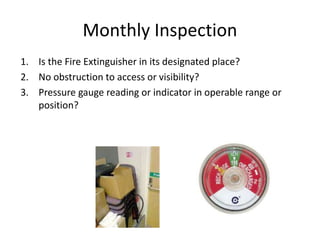
Monthly Inspection
1. Is the Fire Extinguisher in its designated place?
2. No obstruction to access or visibility?
3. Pressure gauge reading or indicator in operable range or
position?
Monthly Visual Inspection
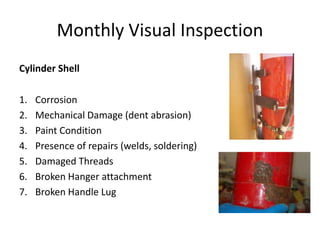
Cylinder Shell
1. Corrosion
2. Mechanical Damage (dent abrasion)
3. Paint Condition
4. Presence of repairs (welds, soldering)
5. Damaged Threads
6. Broken Hanger attachment
7. Broken Handle Lug
Monthly Visual Inspection
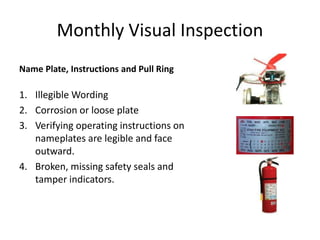
Name Plate, Instructions and Pull Ring
1. Illegible Wording
2. Corrosion or loose plate
3. Verifying operating instructions on
nameplates are legible and face
outward.
4. Broken, missing safety seals and
tamper indicators.
Monthly Visual Inspection
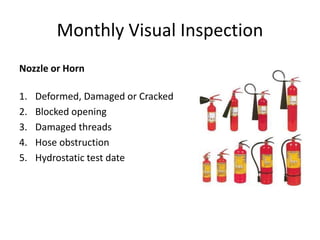
Nozzle or Horn
1. Deformed, Damaged or Cracked
2. Blocked opening
3. Damaged threads
4. Hose obstruction
5. Hydrostatic test date
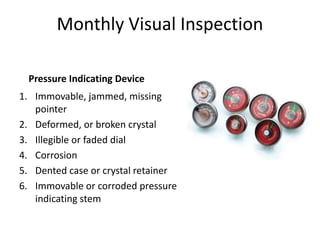
Monthly Visual Inspection
Pressure Indicating Device
1. Immovable, jammed, missing
pointer
2. Deformed, or broken crystal
3. Illegible or faded dial
4. Corrosion
5. Dented case or crystal retainer
6. Immovable or corroded pressure
indicating stem
THANK YOU
41

hse sides Fire Extinguishers Trng.edit.ppt

  • 1.
  • 2.
  • 3.
    3 Fire Extinguishers Everyone shouldknow how to c o r r e c t l y u s e a p o r t a b l e f i r e extinguisher. You never know when you might need to use one to save your workplace, your home or a life.
  • 4.
    4  Discuss AboutFire and Fire Elements.  Discuss How Fires are Classified.  Discuss How To Extinguish Different Class Of Fires.  Discuss How To Use a Fire Extinguisher. OBJECTIVES
  • 5.
    5 WHY WE REQUIRE? Fire is One of the Most Common Industrial Accidents.  More Than 300 Workers Per Year Lose Their Lives Due to Fire.  Training Greatly reduces the Probability of Fire incidents. ACME FIRE EXTINGUISHER
  • 6.
    FIRE EXTINGUISHER F FIND IINVESTIGATE R RECTIFY E EXTINGUISH
  • 7.
    Elements of Fire •Elements of Combustion (Fire Triangle) • All required for a fire to occur. • Trend is to include “Chemical Reaction” as fourth element (Fire Tetrahedron).
  • 8.
    COMMON FIRE CLASS “Ordinary”combustibles Paper, wood, rubber, plastics and textiles. “Flammable liquids & Gases” Oil, gasoline, solvents “Energized circuits” Electrical equipment and computers • “Metals” • Magnesium, Aluminum, etc. 8 D
  • 9.
    5 Categories ofFires – Class A Fires: Ordinary combustible materials such as wood, cloth, paper, rubber and many plastics. – Class B Fires: Flammable Liquids, combustible liquids, petroleum greases, tars, oils, paints, solvents, lacquers, alcohols and flammable gases. – Class C Fires: Involve electrical equipment. – Class D Fires: Involve combustible metals, such as magnesium, titanium, zirconium, sodium, lithium and potassium. – Class K Fires: Involve cooking appliances that involve combustible cooking media (vegetable or animal oils/fats)
  • 10.
    COMMON TYPES OF FIREEXTINGUISHERS: • WATER • DRY CHEMICAL • CO2 and Halon • METL- X 10 D
  • 11.
    HOW THEY WORK: 11 •Works by cooling. • Numerical rating indicates amount of agent, duration, and range of discharge on test fires. • Area of Class A fire which a “non-expert” can extinguish, with proper training – 1-A is equivalent on Class-A fire to five liters of water. – 2-A contains has twice as much extinguishing agent.
  • 12.
    HOW TO EXTINGUISHSMALL FIRES  CLASS “A” FIRES - ORDINARY COMBUSTIBLES: 12  Point the extinguishing agent at the base of the fire.  Do not attempt to put out the flames.  Cool the material below its ignition temperature.  Soak fibrous material to prevent re-ignition.  Establish a fire watch to ensure no re-ignition occurs.  Use water, foam or multi-purpose dry chemicals.
  • 13.
    HOW THEY WORK: •Works by blanketing the fuel. 13
  • 14.
    HOW TO EXTINGUISHSMALL FIRES  CLASS “B” FIRES - FLAMMABLE LIQUIDS OR GASES: 14 Continued  Point the extinguishing agent at the base of the fire.  Do not attempt to put out the flames.  Attempt to prevent oxygenation of the fire.  Close solvent tanks lids etc.  Know that the fire may flare up momentarily.  Use foam, carbon dioxide, dry chemicals and halon.
  • 15.
    HOW TO EXTINGUISHSMALL FIRES  CLASS “C” FIRES – ELECTRICAL EQUIPMENT: 15 Continued  Extinguishing agent cannot conduct electricity.  Disconnect power to the source ASAP.  Ensure the extinguisher doesn’t make contact.  Do not attempt to use water based extinguishers.  Use carbon dioxide, dry chemicals and halon.
  • 16.
    HOW TO EXTINGUISHSMALL FIRES  CLASS “D” FIRES - COMBUSTIBLE METALS: 16 Continued  The agent cools the metal to below its ignition temp.  These residues are harmful to electronic equipment.  Attempt to prevent oxygenation of the fire.  Use agents that deprive oxygen.  Know that metal fires burn extremely hot (5000 deg.) D
  • 17.
    6 Types ofFire Extinguishers 1. Fire Extinguishers should be appropriately matched to work environment. 2. Use the symbols to quickly identify the Type of Fire Extinguisher. 3. 6 Types of Fire Extinguishers 1. Class A – Wood, Paper, Plastics 2. Class AB – Wood, Paper and Flammable Liquid 3. Class BC (flammable liquid and electrical) 4. Class ABC Multipurpose 5. Class K – Kitchen Fire 6. Class D – Metal Fires
  • 18.
    Learn to becomeaware of your surrounding…what’s in the room?
  • 19.
    Most Occupancies haveElectricity Computer - Electrical Lamp - Electrical Electrical Socket Phone - Electrical Paper - Fuel Wood Desk - Fuel Plastic Chair – Fuel
  • 20.
    Type: Class AFire Extinguisher Pressure Gauge: Yes Agent: Water Method: Water Cools fire by removing heat. Designated for: Class A (wood, paper, cloth, rubber, and certain plastics. Placement: 75 feet or less Safety and Health Precautions: 1. Never use water to extinguish flammable liquid fires. 2. Never use on Metal Fire (water reactive). 3. Water is a good conductor and may lead to electrocution if used to extinguish an electrical fire.
  • 21.
    Type: BC FireExtinguisher Pressure Gauge: No (Must be weighed to determine leakage) Agent: Carbon dioxide is discharged as a white cloud of “snow” Method: Removes oxygen from fire Designated for: Class B and C (flammable liquid and electrical) fires only Placement: 50 feet or less Health and Safety Precautions: 1. Carbon Dioxide is a clean, non-contaminating, odorless gas. 2. After the CO2 dissipates, Class A fire may reignite. 3. Never use CO2 extinguishers in a confined space
  • 22.
    Type: Multipurpose /ABC Dry Chemical Pressure Gauge Yes Agent: Mono ammonium phosphate, non-conductive, mildly corrosive Method: Fire retardant powder separates the fuel from the oxygen. Designated for: Wood, paper, Flammable Liquid, & Electrical Fire Placement: < 50 feet (based on B or C fire) Safety and Health Precautions: 1. Mildly Corrosive – Sensitive to Electronic Equipment
  • 23.
    Type: Class D– Metal Fires Pressure Gauge Yes Agent: Sodium Chloride, copper, Graphite…many types. Method: Heat causes agent to cake and form a crust which excludes air and dissipates heat from burning metal. Designated for: Metal powders, flakes, shavings or chips (sodium, lithium) Placement: < 75 feet Safety and Health Precautions: Most Class D extinguishers will have a special low velocity nozzle or discharge wand to gently apply the agent in large volumes to avoid disrupting any finely divided burning materials.
  • 24.
    Extinguisher Common features • Lockingpin • Carrying handle / operating lever • Pressure gauge • Label : – Type (Water, C02, Dry Chemical) – Classification (A, B, C,D) – NFPA capacity Rating – Instructions • Discharge nozzle or horn 24
  • 25.
    REACT upon discovery offire or smoke Remove persons in immediate danger! Ensure doors are closed! (confine fire/smoke) Activate the building alarm ! Call the Fire Department ! Treat ALL fires as DANGEROUS! – Continue a complete building evacuation – Do not attempt to fight with a fire if you don’t know how to use fire extinguisher 25
  • 26.
    Use an extinguisher ONLYif the: • Fire is NOT spreading (small and contained) • EXIT IS CLEAR (fight fire with your back to an exit ) • Proper extinguisher is at hand, and... – You have been trained and know how to use it! – You use “Buddy System” - have someone back you up! • Get assistance BEFORE trying to fight a fire! 26
  • 27.
    Remember the PASS word: 1) Keepyour back to a clear escape route, 2) Stand back 6 to 8 feet from the fire, 3) Then >>: 27 P.A.S.S. PULL AIM SQUEEZE SWEEP
  • 28.
  • 29.
    AIM LOW at thebase of the fire 29
  • 30.
  • 31.
  • 32.
    OK, It’s out… NowWhat? • WATCH the fire area –If the fire flares up again repeat! –If you can’t control the fire, LEAVE immediately! • Call the fire department to inspect the scene! • Recharge or replace any used fire extinguisher! 32
  • 33.
    WHY UNTRAINED PEOPLE Can’tuse a fire extinguisher safely INEXPERIENCED • Don’t know about the proper type of extinguisher • Don’t know how to make a “Fight or Flight” analysis • Unfamiliar with the “P.A.S.S. method” 33
  • 34.
    EMPLOYEE RESPONSIBILITIES  DEPARTMENTAND FIRST LINE SUPERVISORS: 34  Replace used and damaged fire extinguisher(s).  Notify Safety Officer of use or damage.  Monthly check the fire extinguisher validity.  Ensure installed equipment does not block access.  Ensure employees are aware of where extinguishers are located.  Ensure extinguishers are clean and are free from obstructions. CHECK LIST
  • 35.
    MAINTAINING THE FIREEXTINGUISHER  FIRE EXTINGUISHERS SHALL BE MAINTAINED: 35  Numbered to identify their proper location.  Maintain an extinguisher master list.  Check fire extinguisher validity date.  Fully charged and in operable condition.  Clean and free of defects.  Readily accessible at all times. CHECK LIST
  • 36.
    Monthly Inspection 1. Isthe Fire Extinguisher in its designated place? 2. No obstruction to access or visibility? 3. Pressure gauge reading or indicator in operable range or position?
  • 37.
    Monthly Visual Inspection CylinderShell 1. Corrosion 2. Mechanical Damage (dent abrasion) 3. Paint Condition 4. Presence of repairs (welds, soldering) 5. Damaged Threads 6. Broken Hanger attachment 7. Broken Handle Lug
  • 38.
    Monthly Visual Inspection NamePlate, Instructions and Pull Ring 1. Illegible Wording 2. Corrosion or loose plate 3. Verifying operating instructions on nameplates are legible and face outward. 4. Broken, missing safety seals and tamper indicators.
  • 39.
    Monthly Visual Inspection Nozzleor Horn 1. Deformed, Damaged or Cracked 2. Blocked opening 3. Damaged threads 4. Hose obstruction 5. Hydrostatic test date
  • 40.
    Monthly Visual Inspection PressureIndicating Device 1. Immovable, jammed, missing pointer 2. Deformed, or broken crystal 3. Illegible or faded dial 4. Corrosion 5. Dented case or crystal retainer 6. Immovable or corroded pressure indicating stem
  • 41.