B.N.PATIL
1
Fire Protection
 Fire is a chemical reaction involving rapid
oxidation or burning of fuel.
 It needs three elements to occur and these
elements are called as Fire Triangle.
2
Fire Triangle
1.Fuel: Fuel can be any combustible material-
solid, liquid or gas. Most solids and liquids
become a vapor or gas before they will
burn.
2.Oxygen: The air we breathe is about 21
percent oxygen. Fire only needs an
atmosphere with at least 16% percent
oxygen.
3.Heat: Heat is the energy necessary to
increase the temperature of the fuel to a
point where sufficient vapors are given off
for ignition to occur.
3
Principle of Fire Extinguishing
 Fire, or combustion, is a chemical reaction in which
a substance combines with oxygen and heat is
released.
 Fire occurs usually when a source of heat comes in
contact with a combustible material with the
presence of oxygen in an uninhibited chain
reaction; but without a chain of reaction, a deep-
seated, surface glowing fire can be produced.
 Thus, there are three conditions essential for fire:
fuel, oxygen, and heat (or ignition source).
 These three conditions are often represented as the
fire triangle.
 If one of these conditions is missing, fire does not
occur; and if one of them is removed, fire is
extinguished.
4
Fire Prevention
 The two primary hazards associated with flammable
liquids are explosion and fire
 Static Electricity is generated when a fluid flows
through a pipe or from an opening into a tank .Main
hazards are fire and explosion from sparks
containing enough energy to ignite flammable
vapors. Bonding or grounding of flammable liquid
containers is necessary to prevent static electricity
from causing a spark.
 Always provide adequate ventilation to reduce the
potential for ignition of flammable vapors.
 Suitable fire control devices, such as small hoses or
portable fire extinguishers, shall be available at
locations where flammable or combustible liquids are
stored.
5
Fire Prevention
 Safety Cans for Storage and Transfer must be used.
 Carefully read the manufacturer’s label on the
flammable liquid container before storing or using it
 Practice good housekeeping in flammable liquid
storage areas
 Clean up spills immediately, then place the cleanup
rags in a covered metal container
 Only use approved metal safety containers or original
manufacturer’s container to store flammable liquids.
 Keep the containers closed when not in use and
store away from exits or passageways
6
Fire Prevention
 To prevent the accumulation of vapors inside of
storage areas, a continuous mechanical ventilation
system must be in place. Use flammable liquids only
where there is plenty of ventilation.
 Keep flammable liquids away from ignition sources
such as open flames, sparks, smoking, cutting,
welding, etc
 The transfer of large quantities of flammable or
combustible liquids shall be through piping by means
of pumps or water displacement.
 Overexposure to flammable liquids may present
health hazards.
 Flammables should be stored in an approved
cabinet in a cool, well ventilated area to avoid
pressure buildup and vaporization
7
Fire Extinguisher
 Fire extinguisher is an active fire protection
device used to extinguish or control small fire,
often in emergency situation.
 Not all fire extinguishers are the same.
 A fire extinguisher can emit a solid, liquid, or a
gas, depending on the class of the fire.
 Use proper class of fire extinguisher only on
fire it was designed for.
 Know where fire extinguishers are located and
what class they are. Number 1 goal is Safety.
8
Fire Extinguisher
 Fire Are Classified as
1. CLASS A: wood, paper, cloth, rubber and some
plastics.
2. CLASS B: Flammable liquids such as gasoline,
kerosene, paint, paint thinner and diesel
3. CLASS C: Energized electrical equipment, such
as appliances, Switches, panel boxes and
power tools
4. CLASS D: Metals, such as magnesium,
potassium and sodium.
5. Class K – Used to put out kitchen fires or areas
that have a high probability of a grease fire.
9
Types of Fire Extinguishers.
 Water Fire Extinguishers.
 Foam Fire Extinguishers.
 Dry Powder Extinguishers.
 Carbon Dioxide Extinguishers.
 Halotron I Extinguisher.
 Class K Kitchen Fire Extinguishers
10
Water Fire Extinguishers
 Water Fire Extinguishers: Water is the most
common chemical used as a defense on a class A
fire. Most water based extinguishers also have a
chemical to prevent the inside of it from rusting.
 Wetting agents are also added so that the water
sticks to the surface.
 Water extinguishes fires because the water cools
the fire below its ignition point, and large amounts
of water can also deprive the fire of oxygen.
 Water will not work on all types of fires, if water is
sprayed onto burning liquid petroleum will just
spread the flames around more. And water sprayed
on an electric fire will cause the user to get
shocked.
11
Water Fire Extinguishers
 Water
extinguishers are
the most common
fire extinguisher
type for class A fire
risk. Most premises
will require either
water or foam
extinguishers.
 Label Color:
Bright Red
12
Foam Fire Extinguishers
 Foam Fire Extinguishers :Foam fire extinguishers are
usually used to fight class B fires, but can be affective on
class A fires also.
 These extinguishers are mainly water based but have a
foaming agent so that the foam will sit on top of the liquid
depriving it from the needed oxygen.
 Foam extinguishers have a cooling effect on the fuel. On
burning liquids, the foaming agent creates a barrier
between the flame and the fuel, extinguishing the fire
 Common foams are meant to only work on nonpolar
flammable liquids such as petrol, but break down too fast
to work on polar liquids like alcohol. Polar liquids have
another foam called “alcohol foam”.
13
Foam Fire Extinguishers
 Label Colour:
– Cream
 Use for:
– Organic materials such as:
o Paper and cardboard
o Fabrics and textiles
o Wood and coal
Plus:
– Flammable liquids, like paint
and petrol
 Do not use for:
– Kitchen fires
– Fires involving electrical
equipment
– Flammable metals
14
Dry Powder Extinguishers
 Dry powder extinguishers are used for class B and C fires.
 This powder is a mixture of sodium bicarbonate and calcium carbonate
made into a fine powder. It is propelled(FORCED) by carbon dioxide or
nitrogen.
 When this is sprayed onto a fire it interfere with the chemical process of
fire. Along with some cooling and exclusion of oxygen.
 Dry powder extinguishers smother fires by forming a barrier between the
fuel and the source of oxygen.
 These extinguishers are good for knocking down big class B flames but will
not keep the fire suppressed.
 Many times dry powder will be used with foam extinguishers for attacking
large class B fires.
 Standard dry powder extinguishers are also called ‘ABC’ extinguishers
because they tackle class A, B and C fires, however they are not
recommended for use in enclosed spaces. This is because the powder can
be easily inhaled, and also the residue is very difficult to clean up after.
ABC powder extinguishers can also be used on some electrical fires.
Specialist dry powder extinguishers are used for flammable metals.
15
Dry Powder Extinguishers
 These are not used for:
– Fires involving cooking oil, Kitchen fires .
– Combustible materials like paper, wood or textiles
– Flammable metals such as titanium and magnesium
– Flammable liquids, like paint and petrol
Plus:
– Flammable gases, like liquid petroleum gas (LPG)
and acetylene
Plus:
– Fires involving electrical equipment over 1000v
– or in enclosed spaces, such as offices or residential
properties
 Dry Powder extinguishers are used in
– Businesses using flammable gases for chemical
processes
– Premises where welding and flame cutting takes
place
– Liquid petroleum gas (LPG) dispensing plants
– Premises with large, commercial boiler rooms
 Label Colour:
– Blue
16
Carbon Dioxide Extinguishers
 Carbon Dioxide Extinguishers :Co ₂ Works on
class B and C fires by displacing less dense
oxygen.
 This can cause a problem when you are in a
confined area when you also need oxygen. This is
a very toxic chemical when in a high
concentration.
 It is very commonly used on electrical fires
because it being a gas does not leave any residue
harming the equipment.
 CO2 suffocate fires by displacing the oxygen the
fire needs to burn.
17
Carbon Dioxide
Extinguishers CO2 extinguishers are used in:
– Premises with electrical equipment,
such as:
Offices, Kitchens,Construction sites,
Server rooms
 All work vehicles should also carry a
smaller 2kg CO2 extinguisher.
 CO2 extinguishers are predominantly
used for electrical fire risks and are
usually the main fire extinguisher type
provided in computer server rooms. They
also put out Class B fires (flammable
liquids, such as paint and petroleum).
 Label Colour:
– Black
18
Extinguisher Types
19
Halotron I Extinguisher.
 Halotron is a clean, non conductive gaseous agent .
 Ready for instant use and simple to operate. Leaves no residue after
using. Internal pressure in the cylinder can be monitored by pressure
gauge. Trouble and rust free brass valve body with minimal servicing
requirements.
 Halotron I is an EPA approved clean agent which discharges as a
rapidly evaporating liquid, leaving no residue. It effectively extinguishes
Class A, B and C fires .
 Halotron unit is environmentally safe and ideal for protecting delicate
electronic equipment as the clean agent leaves no residue. The
cylinder is manufactured from impact resistant steel and the valve
assembly is metal.
 deal for office computer areas, data storage, telecommunications, high
tech clean rooms, and sensitive electronics
 Chrome plated brass valves.
 Stainless steel handle, lever, hose band, and pull pin
 Color coded labels for instant type recognition
20
Halotron I Extinguisher.
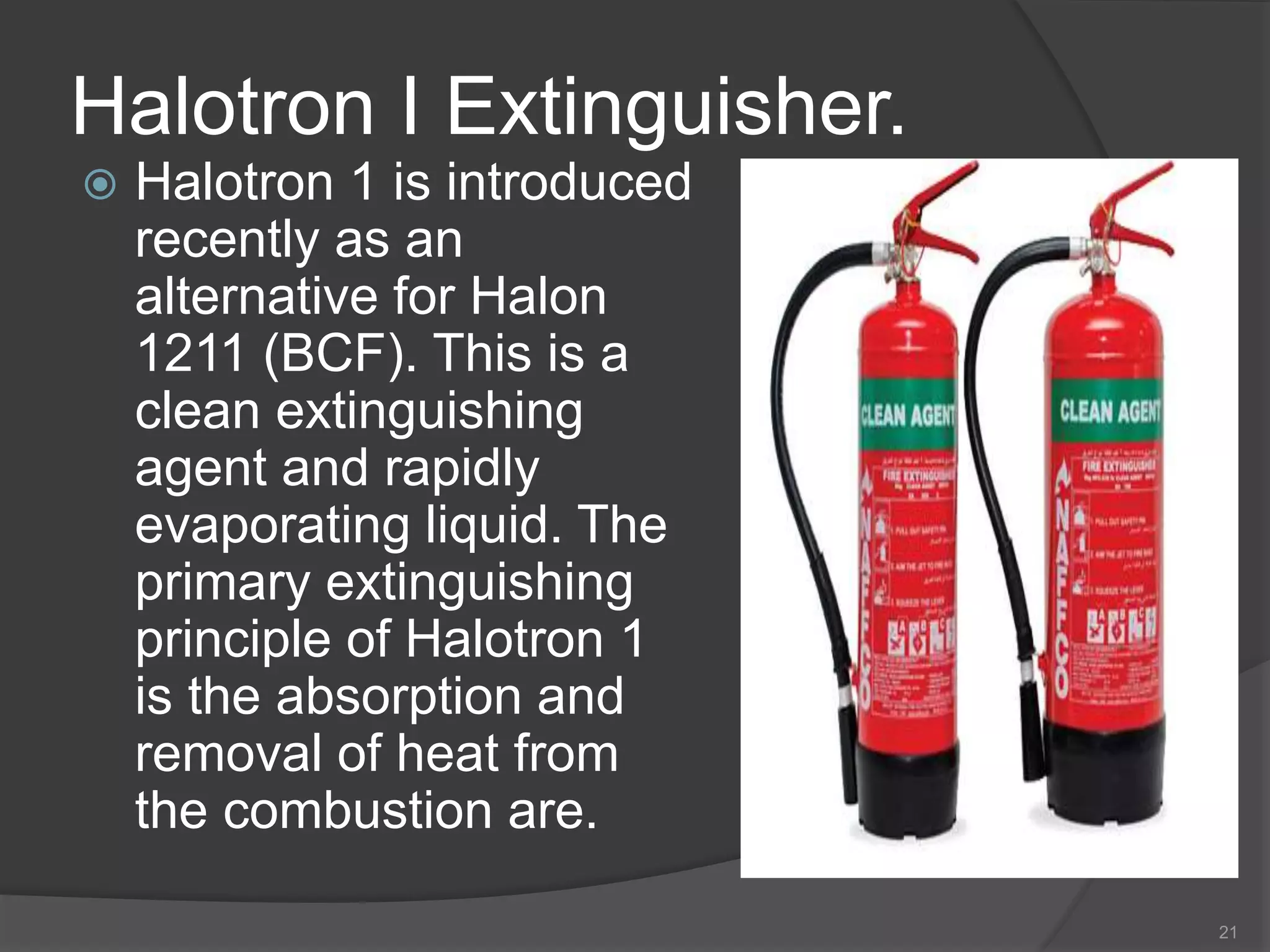
 Halotron 1 is introduced
recently as an
alternative for Halon
1211 (BCF). This is a
clean extinguishing
agent and rapidly
evaporating liquid. The
primary extinguishing
principle of Halotron 1
is the absorption and
removal of heat from
the combustion are.
21
CleanGuard FE-36 Fire
Extinguishers
 CleanGuard FE-36 Fire Extinguishers
Hydrofluorocarbon-236fa OR HFC-236faa. another
clean agent replacement for Halon 1211—does not
leave a residueb. available commercially in
Cleanguard extinguishersc. less toxic than Halon
1211 and Halotron Id. environmentally preferred
alternative to Halon with zero ozone
depletionpotentialSuitable to protect high-value
assets such as computer
rooms,telecommunications facilities, process
control rooms, museums, archives,marine,
hospitals, banks, laboratories and airplanes
22
Wet Chemical Class K Kitchen
Fire Extinguishers.
 Wet Chemical Class K Kitchen Fire
Extinguishers-best restaurant kitchen
appliance hand portable fireextinguisher you
can purchase-tested and approved for the new
class K listing by UL specificallyfor restaurant
kitchen hazards-contains a special potassium
acetate based, low PH agent-The recent trend
to more efficient cooking appliances and useof
unsaturated cooking oils dictates the use of a
hand portablefire extinguisher with greater
firefighting capacity and coolingeffect to
combat these very hot and difficult fires
23
METAL/SAND FIRE
EXTINGUISHERS
 METAL/SAND FIRE EXTINGUISHERS
CLASS D FIRES—FLAMMABLE
METALSA. Sodium Chloride -Works well
on magnesium, sodium, potassium,
sodium-potassium alloys, uranium and
powdered aluminumB. Powdered Copper
Metal-Works well on lithium and lithium
alloys -It is the only known lithium fire
fighting agentC. Graphite-Based Powders-
Works well on lithium fires -Effective on
fires involving high melting metals such as
zirconium and titanium
24
METAL/SAND FIRE
EXTINGUISHERS
 METAL/SAND FIRE EXTINGUISHERS
CLASS D FIRES—FLAMMABLE
METALS Page 2D. Specially designed
sodium bicarbonate based dry agents-
Can suppress fires with most metal
alkyls and pyrophoric liquidsE. Sodium
Carbonate based dry powders- Works
well on sodium, potassium and
sodium/potassium alloys
25
THE FIRE IS OUT—NOW
WHAT?
 Watch the fire area-If the fire re-ignites
repeat the process-If you cannot control
or confine the fire---LEAVE!!!
 Ensure the fire department inspects the
site.
 RECHARGE or REPLACE any fire
extinguisher which has been used.
26
A B C Type Dry Powder
 A B C Type Dry Powder • ABC or Multi-
Purpose extinguishers comprise of a
special fluidized and siliconized mono
ammonium phosphate dry chemical • It
is use for Class A fires and breaks the
chain reaction of Class B fires • Easy
and More Economical to Maintain and
Service • Used in- Homes, Offices,
Buildings, Warehouses, Cinema halls. •
Color Band- Blue • Capacity-1-9kg
27

Fire protection and pevention

  • 1.
  • 2.
    Fire Protection  Fireis a chemical reaction involving rapid oxidation or burning of fuel.  It needs three elements to occur and these elements are called as Fire Triangle. 2
  • 3.
    Fire Triangle 1.Fuel: Fuelcan be any combustible material- solid, liquid or gas. Most solids and liquids become a vapor or gas before they will burn. 2.Oxygen: The air we breathe is about 21 percent oxygen. Fire only needs an atmosphere with at least 16% percent oxygen. 3.Heat: Heat is the energy necessary to increase the temperature of the fuel to a point where sufficient vapors are given off for ignition to occur. 3
  • 4.
    Principle of FireExtinguishing  Fire, or combustion, is a chemical reaction in which a substance combines with oxygen and heat is released.  Fire occurs usually when a source of heat comes in contact with a combustible material with the presence of oxygen in an uninhibited chain reaction; but without a chain of reaction, a deep- seated, surface glowing fire can be produced.  Thus, there are three conditions essential for fire: fuel, oxygen, and heat (or ignition source).  These three conditions are often represented as the fire triangle.  If one of these conditions is missing, fire does not occur; and if one of them is removed, fire is extinguished. 4
  • 5.
    Fire Prevention  Thetwo primary hazards associated with flammable liquids are explosion and fire  Static Electricity is generated when a fluid flows through a pipe or from an opening into a tank .Main hazards are fire and explosion from sparks containing enough energy to ignite flammable vapors. Bonding or grounding of flammable liquid containers is necessary to prevent static electricity from causing a spark.  Always provide adequate ventilation to reduce the potential for ignition of flammable vapors.  Suitable fire control devices, such as small hoses or portable fire extinguishers, shall be available at locations where flammable or combustible liquids are stored. 5
  • 6.
    Fire Prevention  SafetyCans for Storage and Transfer must be used.  Carefully read the manufacturer’s label on the flammable liquid container before storing or using it  Practice good housekeeping in flammable liquid storage areas  Clean up spills immediately, then place the cleanup rags in a covered metal container  Only use approved metal safety containers or original manufacturer’s container to store flammable liquids.  Keep the containers closed when not in use and store away from exits or passageways 6
  • 7.
    Fire Prevention  Toprevent the accumulation of vapors inside of storage areas, a continuous mechanical ventilation system must be in place. Use flammable liquids only where there is plenty of ventilation.  Keep flammable liquids away from ignition sources such as open flames, sparks, smoking, cutting, welding, etc  The transfer of large quantities of flammable or combustible liquids shall be through piping by means of pumps or water displacement.  Overexposure to flammable liquids may present health hazards.  Flammables should be stored in an approved cabinet in a cool, well ventilated area to avoid pressure buildup and vaporization 7
  • 8.
    Fire Extinguisher  Fireextinguisher is an active fire protection device used to extinguish or control small fire, often in emergency situation.  Not all fire extinguishers are the same.  A fire extinguisher can emit a solid, liquid, or a gas, depending on the class of the fire.  Use proper class of fire extinguisher only on fire it was designed for.  Know where fire extinguishers are located and what class they are. Number 1 goal is Safety. 8
  • 9.
    Fire Extinguisher  FireAre Classified as 1. CLASS A: wood, paper, cloth, rubber and some plastics. 2. CLASS B: Flammable liquids such as gasoline, kerosene, paint, paint thinner and diesel 3. CLASS C: Energized electrical equipment, such as appliances, Switches, panel boxes and power tools 4. CLASS D: Metals, such as magnesium, potassium and sodium. 5. Class K – Used to put out kitchen fires or areas that have a high probability of a grease fire. 9
  • 10.
    Types of FireExtinguishers.  Water Fire Extinguishers.  Foam Fire Extinguishers.  Dry Powder Extinguishers.  Carbon Dioxide Extinguishers.  Halotron I Extinguisher.  Class K Kitchen Fire Extinguishers 10
  • 11.
    Water Fire Extinguishers Water Fire Extinguishers: Water is the most common chemical used as a defense on a class A fire. Most water based extinguishers also have a chemical to prevent the inside of it from rusting.  Wetting agents are also added so that the water sticks to the surface.  Water extinguishes fires because the water cools the fire below its ignition point, and large amounts of water can also deprive the fire of oxygen.  Water will not work on all types of fires, if water is sprayed onto burning liquid petroleum will just spread the flames around more. And water sprayed on an electric fire will cause the user to get shocked. 11
  • 12.
    Water Fire Extinguishers Water extinguishers are the most common fire extinguisher type for class A fire risk. Most premises will require either water or foam extinguishers.  Label Color: Bright Red 12
  • 13.
    Foam Fire Extinguishers Foam Fire Extinguishers :Foam fire extinguishers are usually used to fight class B fires, but can be affective on class A fires also.  These extinguishers are mainly water based but have a foaming agent so that the foam will sit on top of the liquid depriving it from the needed oxygen.  Foam extinguishers have a cooling effect on the fuel. On burning liquids, the foaming agent creates a barrier between the flame and the fuel, extinguishing the fire  Common foams are meant to only work on nonpolar flammable liquids such as petrol, but break down too fast to work on polar liquids like alcohol. Polar liquids have another foam called “alcohol foam”. 13
  • 14.
    Foam Fire Extinguishers Label Colour: – Cream  Use for: – Organic materials such as: o Paper and cardboard o Fabrics and textiles o Wood and coal Plus: – Flammable liquids, like paint and petrol  Do not use for: – Kitchen fires – Fires involving electrical equipment – Flammable metals 14
  • 15.
    Dry Powder Extinguishers Dry powder extinguishers are used for class B and C fires.  This powder is a mixture of sodium bicarbonate and calcium carbonate made into a fine powder. It is propelled(FORCED) by carbon dioxide or nitrogen.  When this is sprayed onto a fire it interfere with the chemical process of fire. Along with some cooling and exclusion of oxygen.  Dry powder extinguishers smother fires by forming a barrier between the fuel and the source of oxygen.  These extinguishers are good for knocking down big class B flames but will not keep the fire suppressed.  Many times dry powder will be used with foam extinguishers for attacking large class B fires.  Standard dry powder extinguishers are also called ‘ABC’ extinguishers because they tackle class A, B and C fires, however they are not recommended for use in enclosed spaces. This is because the powder can be easily inhaled, and also the residue is very difficult to clean up after. ABC powder extinguishers can also be used on some electrical fires. Specialist dry powder extinguishers are used for flammable metals. 15
  • 16.
    Dry Powder Extinguishers These are not used for: – Fires involving cooking oil, Kitchen fires . – Combustible materials like paper, wood or textiles – Flammable metals such as titanium and magnesium – Flammable liquids, like paint and petrol Plus: – Flammable gases, like liquid petroleum gas (LPG) and acetylene Plus: – Fires involving electrical equipment over 1000v – or in enclosed spaces, such as offices or residential properties  Dry Powder extinguishers are used in – Businesses using flammable gases for chemical processes – Premises where welding and flame cutting takes place – Liquid petroleum gas (LPG) dispensing plants – Premises with large, commercial boiler rooms  Label Colour: – Blue 16
  • 17.
    Carbon Dioxide Extinguishers Carbon Dioxide Extinguishers :Co ₂ Works on class B and C fires by displacing less dense oxygen.  This can cause a problem when you are in a confined area when you also need oxygen. This is a very toxic chemical when in a high concentration.  It is very commonly used on electrical fires because it being a gas does not leave any residue harming the equipment.  CO2 suffocate fires by displacing the oxygen the fire needs to burn. 17
  • 18.
    Carbon Dioxide Extinguishers CO2extinguishers are used in: – Premises with electrical equipment, such as: Offices, Kitchens,Construction sites, Server rooms  All work vehicles should also carry a smaller 2kg CO2 extinguisher.  CO2 extinguishers are predominantly used for electrical fire risks and are usually the main fire extinguisher type provided in computer server rooms. They also put out Class B fires (flammable liquids, such as paint and petroleum).  Label Colour: – Black 18
  • 19.
  • 20.
    Halotron I Extinguisher. Halotron is a clean, non conductive gaseous agent .  Ready for instant use and simple to operate. Leaves no residue after using. Internal pressure in the cylinder can be monitored by pressure gauge. Trouble and rust free brass valve body with minimal servicing requirements.  Halotron I is an EPA approved clean agent which discharges as a rapidly evaporating liquid, leaving no residue. It effectively extinguishes Class A, B and C fires .  Halotron unit is environmentally safe and ideal for protecting delicate electronic equipment as the clean agent leaves no residue. The cylinder is manufactured from impact resistant steel and the valve assembly is metal.  deal for office computer areas, data storage, telecommunications, high tech clean rooms, and sensitive electronics  Chrome plated brass valves.  Stainless steel handle, lever, hose band, and pull pin  Color coded labels for instant type recognition 20
  • 21.
    Halotron I Extinguisher. Halotron 1 is introduced recently as an alternative for Halon 1211 (BCF). This is a clean extinguishing agent and rapidly evaporating liquid. The primary extinguishing principle of Halotron 1 is the absorption and removal of heat from the combustion are. 21
  • 22.
    CleanGuard FE-36 Fire Extinguishers CleanGuard FE-36 Fire Extinguishers Hydrofluorocarbon-236fa OR HFC-236faa. another clean agent replacement for Halon 1211—does not leave a residueb. available commercially in Cleanguard extinguishersc. less toxic than Halon 1211 and Halotron Id. environmentally preferred alternative to Halon with zero ozone depletionpotentialSuitable to protect high-value assets such as computer rooms,telecommunications facilities, process control rooms, museums, archives,marine, hospitals, banks, laboratories and airplanes 22
  • 23.
    Wet Chemical ClassK Kitchen Fire Extinguishers.  Wet Chemical Class K Kitchen Fire Extinguishers-best restaurant kitchen appliance hand portable fireextinguisher you can purchase-tested and approved for the new class K listing by UL specificallyfor restaurant kitchen hazards-contains a special potassium acetate based, low PH agent-The recent trend to more efficient cooking appliances and useof unsaturated cooking oils dictates the use of a hand portablefire extinguisher with greater firefighting capacity and coolingeffect to combat these very hot and difficult fires 23
  • 24.
    METAL/SAND FIRE EXTINGUISHERS  METAL/SANDFIRE EXTINGUISHERS CLASS D FIRES—FLAMMABLE METALSA. Sodium Chloride -Works well on magnesium, sodium, potassium, sodium-potassium alloys, uranium and powdered aluminumB. Powdered Copper Metal-Works well on lithium and lithium alloys -It is the only known lithium fire fighting agentC. Graphite-Based Powders- Works well on lithium fires -Effective on fires involving high melting metals such as zirconium and titanium 24
  • 25.
    METAL/SAND FIRE EXTINGUISHERS  METAL/SANDFIRE EXTINGUISHERS CLASS D FIRES—FLAMMABLE METALS Page 2D. Specially designed sodium bicarbonate based dry agents- Can suppress fires with most metal alkyls and pyrophoric liquidsE. Sodium Carbonate based dry powders- Works well on sodium, potassium and sodium/potassium alloys 25
  • 26.
    THE FIRE ISOUT—NOW WHAT?  Watch the fire area-If the fire re-ignites repeat the process-If you cannot control or confine the fire---LEAVE!!!  Ensure the fire department inspects the site.  RECHARGE or REPLACE any fire extinguisher which has been used. 26
  • 27.
    A B CType Dry Powder  A B C Type Dry Powder • ABC or Multi- Purpose extinguishers comprise of a special fluidized and siliconized mono ammonium phosphate dry chemical • It is use for Class A fires and breaks the chain reaction of Class B fires • Easy and More Economical to Maintain and Service • Used in- Homes, Offices, Buildings, Warehouses, Cinema halls. • Color Band- Blue • Capacity-1-9kg 27