HSE TRAINING
Electrical Safety
Prepared by Muhammad Izaz
HSE Trainer
Email: muhammadizaz777@yahoo.com
2
Purpose:
To provide employees with safe work practices & procedures to prevent an electrical
accident or injury.
Scope:
Electrical Safety work practices are necessary for employees who work on or near
exposed energized parts or for those who must understand safe practices on the job.
Electricity is integrated in our lives at work and at home. BUT NEVER TAKE IT’S OWER
LIGHTLY!
OSHA devotes an entire section of regulations to this area. Focus is on training for:
- Those who work directly with electricity.
- Those who need “basic” instruction.
ELECTRICAL SAFETY
3
RESPONSIBILITIES
Management:
• Understand how electricity acts & how it should be handled.
• Identify hazards associated with use of electricity.
• Identify causes of electrical accidents.
• Provide protection to prevent electrical hazards.
• Safety procedure development & maintenance.
• Select & provide appropriate Personal Protective Equipment.
• Provide employee training.
• Recordkeeping.
• Review & update of program.
4
RESPONSIBILITIES (Cont.)
Employees:
• Understand the hazards associated with use of
electricity.
• Understand the procedures for electrical safety.
• Use provided Personal Protective Equipment as
required.
• Notify immediate supervisor of any identified hazards
when using electrical equipment or procedures.
HAZARDS OF ELECTRICITY
Hazard means:
Any potential or actual threat to the wellbeing of people, machinery or environment.
Electrical hazard safety means:
Taking precautions to identify and control electrical hazards
The primary hazards of electricity and it’s use are:
• Shock
• Burns
• Arc Blast
• Explosions
• Fires 5
HAZARDS OF ELECTRICITY (Cont.)
• Shock
• Received when part of your body becomes part of the electrical circuit.
• High voltage shock can cause serious injury or death.
• You will get a shock if you touch:
• Both wires of an energized circuit
• One wire of an energized circuit and ground
• Part of machine that is “hot” because it is contacting an energized
wire and the ground.
• Can cause tingling, cardiac arrest and destruction of body parts.
6
HAZARDS OF ELECTRICITY (Cont.)
• BURNS
• Results when a person touches electrical equipment or wiring that is
improperly used or maintained.
• Most often involves injuries to the hands.
• Arc-Blast
• Occurs when high amperage currents jump from one conductor to
another through air.
• Happens when opening or closing of circuits and when static electricity is
discharged.
• Fire can occur if happens in atmosphere with explosive mixture.
7
HAZARDS OF ELECTRICITY (Cont.)
• Explosions
• Occurs when electricity provides ignition source for an explosive mixture in
atmosphere.
• Causes range from overheated conductors or equipment to normal arcing
at switch contacts.
• Fires
• Electricity is the most common cause.
• Defective and/or misused equipment is the major cause.
• Improperly spliced or connected wiring creates “high resistance”
connections creating heat that starts fire.
8
9
ELECTRICAL ACCIDENTS
Causes:
Accidents and injuries with electricity are caused by one or a combination of the following:
• Unsafe equipment and/or installation.
• Unsafe workplaces caused by environmental factors.
• Unsafe work practices.
Preventing:
Protection from electrical hazards is one way to prevent accidents. Methods of control are:
• Insulation
• Electrical protective devices
• Guarding
• Grounding
• PPE
10
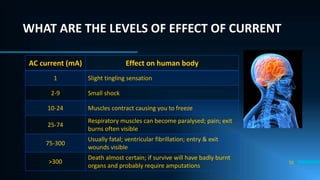
WHAT ARE THE LEVELS OF EFFECT OF CURRENT
AC current (mA) Effect on human body
1 Slight tingling sensation
2-9 Small shock
10-24 Muscles contract causing you to freeze
25-74
Respiratory muscles can become paralysed; pain; exit
burns often visible
75-300
Usually fatal; ventricular fibrillation; entry & exit
wounds visible
>300
Death almost certain; if survive will have badly burnt
organs and probably require amputations
11
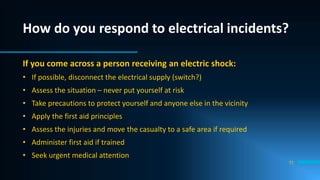
How do you respond to electrical incidents?
If you come across a person receiving an electric shock:
• If possible, disconnect the electrical supply (switch?)
• Assess the situation – never put yourself at risk
• Take precautions to protect yourself and anyone else in the vicinity
• Apply the first aid principles
• Assess the injuries and move the casualty to a safe area if required
• Administer first aid if trained
• Seek urgent medical attention
12
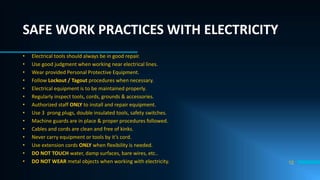
SAFE WORK PRACTICES WITH ELECTRICITY
• Electrical tools should always be in good repair.
• Use good judgment when working near electrical lines.
• Wear provided Personal Protective Equipment.
• Follow Lockout / Tagout procedures when necessary.
• Electrical equipment is to be maintained properly.
• Regularly inspect tools, cords, grounds & accessories.
• Authorized staff ONLY to install and repair equipment.
• Use 3 prong plugs, double insulated tools, safety switches.
• Machine guards are in place & proper procedures followed.
• Cables and cords are clean and free of kinks.
• Never carry equipment or tools by it’s cord.
• Use extension cords ONLY when flexibility is needed.
• DO NOT TOUCH water, damp surfaces, bare wires, etc..
• DO NOT WEAR metal objects when working with electricity.
13
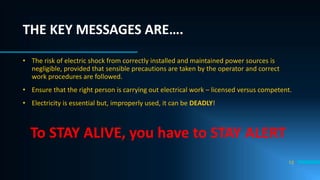
THE KEY MESSAGES ARE….
• The risk of electric shock from correctly installed and maintained power sources is
negligible, provided that sensible precautions are taken by the operator and correct
work procedures are followed.
• Ensure that the right person is carrying out electrical work – licensed versus competent.
• Electricity is essential but, improperly used, it can be DEADLY!
To STAY ALIVE, you have to STAY ALERT
THANK YOU!
Prepared by Muhammad Izaz
HSE Trainer
Email: muhammadizaz777@yahoo.com

Electrical safety

  • 1.
    HSE TRAINING Electrical Safety Preparedby Muhammad Izaz HSE Trainer Email: muhammadizaz777@yahoo.com
  • 2.
    2 Purpose: To provide employeeswith safe work practices & procedures to prevent an electrical accident or injury. Scope: Electrical Safety work practices are necessary for employees who work on or near exposed energized parts or for those who must understand safe practices on the job. Electricity is integrated in our lives at work and at home. BUT NEVER TAKE IT’S OWER LIGHTLY! OSHA devotes an entire section of regulations to this area. Focus is on training for: - Those who work directly with electricity. - Those who need “basic” instruction. ELECTRICAL SAFETY
  • 3.
    3 RESPONSIBILITIES Management: • Understand howelectricity acts & how it should be handled. • Identify hazards associated with use of electricity. • Identify causes of electrical accidents. • Provide protection to prevent electrical hazards. • Safety procedure development & maintenance. • Select & provide appropriate Personal Protective Equipment. • Provide employee training. • Recordkeeping. • Review & update of program.
  • 4.
    4 RESPONSIBILITIES (Cont.) Employees: • Understandthe hazards associated with use of electricity. • Understand the procedures for electrical safety. • Use provided Personal Protective Equipment as required. • Notify immediate supervisor of any identified hazards when using electrical equipment or procedures.
  • 5.
    HAZARDS OF ELECTRICITY Hazardmeans: Any potential or actual threat to the wellbeing of people, machinery or environment. Electrical hazard safety means: Taking precautions to identify and control electrical hazards The primary hazards of electricity and it’s use are: • Shock • Burns • Arc Blast • Explosions • Fires 5
  • 6.
    HAZARDS OF ELECTRICITY(Cont.) • Shock • Received when part of your body becomes part of the electrical circuit. • High voltage shock can cause serious injury or death. • You will get a shock if you touch: • Both wires of an energized circuit • One wire of an energized circuit and ground • Part of machine that is “hot” because it is contacting an energized wire and the ground. • Can cause tingling, cardiac arrest and destruction of body parts. 6
  • 7.
    HAZARDS OF ELECTRICITY(Cont.) • BURNS • Results when a person touches electrical equipment or wiring that is improperly used or maintained. • Most often involves injuries to the hands. • Arc-Blast • Occurs when high amperage currents jump from one conductor to another through air. • Happens when opening or closing of circuits and when static electricity is discharged. • Fire can occur if happens in atmosphere with explosive mixture. 7
  • 8.
    HAZARDS OF ELECTRICITY(Cont.) • Explosions • Occurs when electricity provides ignition source for an explosive mixture in atmosphere. • Causes range from overheated conductors or equipment to normal arcing at switch contacts. • Fires • Electricity is the most common cause. • Defective and/or misused equipment is the major cause. • Improperly spliced or connected wiring creates “high resistance” connections creating heat that starts fire. 8
  • 9.
    9 ELECTRICAL ACCIDENTS Causes: Accidents andinjuries with electricity are caused by one or a combination of the following: • Unsafe equipment and/or installation. • Unsafe workplaces caused by environmental factors. • Unsafe work practices. Preventing: Protection from electrical hazards is one way to prevent accidents. Methods of control are: • Insulation • Electrical protective devices • Guarding • Grounding • PPE
  • 10.
    10 WHAT ARE THELEVELS OF EFFECT OF CURRENT AC current (mA) Effect on human body 1 Slight tingling sensation 2-9 Small shock 10-24 Muscles contract causing you to freeze 25-74 Respiratory muscles can become paralysed; pain; exit burns often visible 75-300 Usually fatal; ventricular fibrillation; entry & exit wounds visible >300 Death almost certain; if survive will have badly burnt organs and probably require amputations
  • 11.
    11 How do yourespond to electrical incidents? If you come across a person receiving an electric shock: • If possible, disconnect the electrical supply (switch?) • Assess the situation – never put yourself at risk • Take precautions to protect yourself and anyone else in the vicinity • Apply the first aid principles • Assess the injuries and move the casualty to a safe area if required • Administer first aid if trained • Seek urgent medical attention
  • 12.
    12 SAFE WORK PRACTICESWITH ELECTRICITY • Electrical tools should always be in good repair. • Use good judgment when working near electrical lines. • Wear provided Personal Protective Equipment. • Follow Lockout / Tagout procedures when necessary. • Electrical equipment is to be maintained properly. • Regularly inspect tools, cords, grounds & accessories. • Authorized staff ONLY to install and repair equipment. • Use 3 prong plugs, double insulated tools, safety switches. • Machine guards are in place & proper procedures followed. • Cables and cords are clean and free of kinks. • Never carry equipment or tools by it’s cord. • Use extension cords ONLY when flexibility is needed. • DO NOT TOUCH water, damp surfaces, bare wires, etc.. • DO NOT WEAR metal objects when working with electricity.
  • 13.
    13 THE KEY MESSAGESARE…. • The risk of electric shock from correctly installed and maintained power sources is negligible, provided that sensible precautions are taken by the operator and correct work procedures are followed. • Ensure that the right person is carrying out electrical work – licensed versus competent. • Electricity is essential but, improperly used, it can be DEADLY! To STAY ALIVE, you have to STAY ALERT
  • 14.
    THANK YOU! Prepared byMuhammad Izaz HSE Trainer Email: muhammadizaz777@yahoo.com