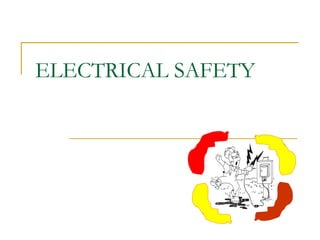
ELECTRICAL SAFETY
Is Your Home……..
 S (afe)
 A (nd)
 F (ree) from
 E (lectrical dangers)?
a SAFE home.
 Electrical cords are in good condition.
• Check electrical cords for frays or nicks indicating
excessive wear.
• Check that plugs fit snuggly into sockets.
 Electrical wall outlets are not overloaded with too
many plugs.
• Check 1:1 ratio: one plug to each socket.
• Check for flickering lights, even after bulbs replaced.
• Check for outlets that emit sparks or smoke. Check that
outlets and the wall immediately surrounding them are
not discolored due to heat buildup.
 Electric appliances are away from water sources.
• Check bathrooms, kitchens, and garages.
 Electrical cords are placed where they will not
become a tripping hazard, but not run under rugs,
where they can overheat to cause a fire.
 Electrical appliances with loose plugs and prongs
are replaced.
 Small appliances are turned off and unplugged after
use.
 Safety caps are placed in outlets to protect young
children.
 Extension cords are not in continuous use.
Identify outdoor electrical safety
hazards
 A number of electrical safety hazards can be found
outdoors. Children don’t always recognize the
dangers. It is important to remind them of the
hazards, making them aware of the warning signs.
 Recognize “Danger—High Voltage” signs
Keep the Electrical Safety Eye on
grown-ups while they are outside
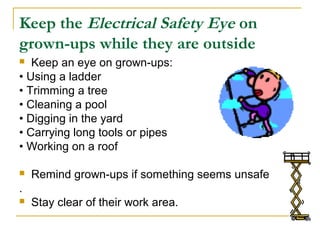
 Keep an eye on grown-ups:
• Using a ladder
• Trimming a tree
• Cleaning a pool
• Digging in the yard
• Carrying long tools or pipes
• Working on a roof
 Remind grown-ups if something seems unsafe
.
 Stay clear of their work area.
What to do if……………
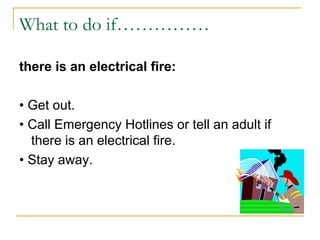
there is an electrical fire:
• Get out.
• Call Emergency Hotlines or tell an adult if
there is an electrical fire.
• Stay away.
What to do if…………
there is someone with electrical shock.
 Do not touch anyone or thing you think might
have been electrically shocked.
 S/he may still be in contact with the electricity.
 Call Emergency Hotlines or tell an adult.
 Keep other people away from the continued
danger.
 Understand that electrical shock may cause
internal injuries. The person needs to be seen by
a doctor, even if you don’t see any burn marks.
What to do if……………..
there are downed power lines.
• Move quickly away even if you do not see
sparks.
• Call Emergency Hotlines
• Stay away from anything that might touch the
wire: a fence, a tree, a building, a car.
• Wait for help.
What to do if…………….
downed power lines are touching your car:
• Stay in the car.
• If people move toward the vehicle, motion for
them to stay away. Have someone Call
Emergency Hotlines for help.
• Stay in the car until help arrives
What to do if……………..
the power goes out.
 Build a kit to help be more comfortable in the event
of a power outage.
Basics might include:
 • Radio, battery powered
 • Flashlights for each member of the household
 • Batteries for each item
 • Canned food and can opener
 • Prepackaged foods
 • Bottled water for drinking and cleaning
 • First aid kit
 • Essential medications
 • Toilet items
 • Books and games to pass the time
LIGHTNING
 Lightning kills nearly 100 people each year in the
United States. It injures hundreds more. It may
travel as far as 40 miles. Each second of the day
it falls somewhere on earth.
 Lightning will strike. However, people may be
protected from most of lightning’s effects by
using common sense during storms.
If caught outdoors unprotected…
 Get in a hard-topped car.
 Spread out and away from others - Don’t stand in a crowd of people.
 Move away from metal objects including bikes, fencing and
machinery.
 Get out of and move away from pools, lakes, and other water
bodies.
 Move away from trees.
 Seek areas of land that are lower than the surrounding landscape.
 If a tingling sensation is felt, or the hair stands on end, lightning may
be about to strike. Immediately crouch low to the ground on the balls
of the feet and cover the ears. Do not lie down, or place your hands
on the ground.
 Return to activities no sooner than 30 minutes after the last sound of
thunder or flash of lightning.
First Aid in Electrical Emergency
Situations
 1. Call Emergency Hotlines for medical and rescue
assistance.
 2. Shut off the electrical current, if safely possible. This could
mean unplugging a cord, removing a fuse from the fuse box,
or turning off a circuit breaker. Often simply turning off the
appliance will not stop the flow of electricity.
 3. If the current can’t be turned off, wait for help to arrive.
Stand back. If there is no help around, a non-conducting
object like a broom or a chair could be used to push the victim
away from the source of the current. It’s best just to wait for
help, however, to avoid adding yourself as another victim.
 4. Once removed from the electrical current, if the victim is
faint, pale, or shows signs of shock, lay him/her with the head
slightly lower that the main part of the body and feet elevated.
Cover the person with a warm blanket and wait for help to
arrive. Provide no food or water.
A FEW MORE SAFETY TIPS…..
 Turn off electric games and equipment when
they are not in use or when you go to bed. It
is safer and also good for the environment!
 Get a grown up to regularly check the plugs,
sockets and cords for signs of scorching or
fraying. If damaged, make sure they get
them repaired.
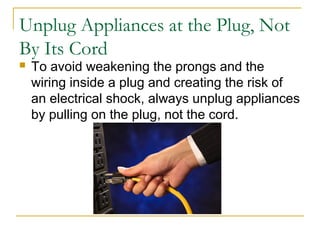
Unplug Appliances at the Plug, Not
By Its Cord
 To avoid weakening the prongs and the
wiring inside a plug and creating the risk of
an electrical shock, always unplug appliances
by pulling on the plug, not the cord.
A FEW MORE SAFETY TIPS…..
 Don’t set things such as towels or paper
plates on top of your electric stove.
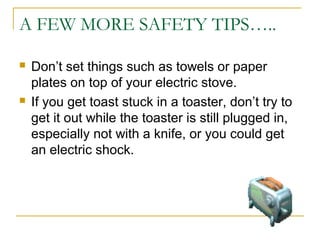
 If you get toast stuck in a toaster, don’t try to
get it out while the toaster is still plugged in,
especially not with a knife, or you could get
an electric shock.
A FEW MORE SAFETY TIPS……
 Never put water, drinks, or other liquids on or
near electrical equipment.
 Liquids and electricity don’t mix. Always dry your
hands before you use any electrical equipment
or you could get an electric shock.
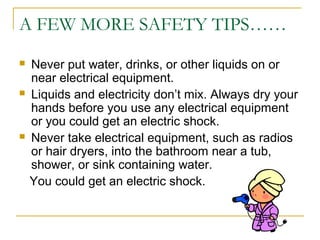
 Never take electrical equipment, such as radios
or hair dryers, into the bathroom near a tub,
shower, or sink containing water.
You could get an electric shock.

Electrical Safety

  • 1.
  • 2.
    Is Your Home…….. S (afe)  A (nd)  F (ree) from  E (lectrical dangers)?
  • 3.
    a SAFE home. Electrical cords are in good condition. • Check electrical cords for frays or nicks indicating excessive wear. • Check that plugs fit snuggly into sockets.  Electrical wall outlets are not overloaded with too many plugs. • Check 1:1 ratio: one plug to each socket. • Check for flickering lights, even after bulbs replaced. • Check for outlets that emit sparks or smoke. Check that outlets and the wall immediately surrounding them are not discolored due to heat buildup.
  • 4.
     Electric appliancesare away from water sources. • Check bathrooms, kitchens, and garages.  Electrical cords are placed where they will not become a tripping hazard, but not run under rugs, where they can overheat to cause a fire.  Electrical appliances with loose plugs and prongs are replaced.  Small appliances are turned off and unplugged after use.  Safety caps are placed in outlets to protect young children.  Extension cords are not in continuous use.
  • 5.
    Identify outdoor electricalsafety hazards  A number of electrical safety hazards can be found outdoors. Children don’t always recognize the dangers. It is important to remind them of the hazards, making them aware of the warning signs.  Recognize “Danger—High Voltage” signs
  • 6.
    Keep the ElectricalSafety Eye on grown-ups while they are outside  Keep an eye on grown-ups: • Using a ladder • Trimming a tree • Cleaning a pool • Digging in the yard • Carrying long tools or pipes • Working on a roof  Remind grown-ups if something seems unsafe .  Stay clear of their work area.
  • 7.
    What to doif…………… there is an electrical fire: • Get out. • Call Emergency Hotlines or tell an adult if there is an electrical fire. • Stay away.
  • 8.
    What to doif………… there is someone with electrical shock.  Do not touch anyone or thing you think might have been electrically shocked.  S/he may still be in contact with the electricity.  Call Emergency Hotlines or tell an adult.  Keep other people away from the continued danger.  Understand that electrical shock may cause internal injuries. The person needs to be seen by a doctor, even if you don’t see any burn marks.
  • 9.
    What to doif…………….. there are downed power lines. • Move quickly away even if you do not see sparks. • Call Emergency Hotlines • Stay away from anything that might touch the wire: a fence, a tree, a building, a car. • Wait for help.
  • 10.
    What to doif……………. downed power lines are touching your car: • Stay in the car. • If people move toward the vehicle, motion for them to stay away. Have someone Call Emergency Hotlines for help. • Stay in the car until help arrives
  • 11.
    What to doif…………….. the power goes out.  Build a kit to help be more comfortable in the event of a power outage. Basics might include:  • Radio, battery powered  • Flashlights for each member of the household  • Batteries for each item  • Canned food and can opener  • Prepackaged foods  • Bottled water for drinking and cleaning  • First aid kit  • Essential medications  • Toilet items  • Books and games to pass the time
  • 12.
    LIGHTNING  Lightning killsnearly 100 people each year in the United States. It injures hundreds more. It may travel as far as 40 miles. Each second of the day it falls somewhere on earth.  Lightning will strike. However, people may be protected from most of lightning’s effects by using common sense during storms.
  • 13.
    If caught outdoorsunprotected…  Get in a hard-topped car.  Spread out and away from others - Don’t stand in a crowd of people.  Move away from metal objects including bikes, fencing and machinery.  Get out of and move away from pools, lakes, and other water bodies.  Move away from trees.  Seek areas of land that are lower than the surrounding landscape.  If a tingling sensation is felt, or the hair stands on end, lightning may be about to strike. Immediately crouch low to the ground on the balls of the feet and cover the ears. Do not lie down, or place your hands on the ground.  Return to activities no sooner than 30 minutes after the last sound of thunder or flash of lightning.
  • 14.
    First Aid inElectrical Emergency Situations  1. Call Emergency Hotlines for medical and rescue assistance.  2. Shut off the electrical current, if safely possible. This could mean unplugging a cord, removing a fuse from the fuse box, or turning off a circuit breaker. Often simply turning off the appliance will not stop the flow of electricity.  3. If the current can’t be turned off, wait for help to arrive. Stand back. If there is no help around, a non-conducting object like a broom or a chair could be used to push the victim away from the source of the current. It’s best just to wait for help, however, to avoid adding yourself as another victim.  4. Once removed from the electrical current, if the victim is faint, pale, or shows signs of shock, lay him/her with the head slightly lower that the main part of the body and feet elevated. Cover the person with a warm blanket and wait for help to arrive. Provide no food or water.
  • 15.
    A FEW MORESAFETY TIPS…..  Turn off electric games and equipment when they are not in use or when you go to bed. It is safer and also good for the environment!  Get a grown up to regularly check the plugs, sockets and cords for signs of scorching or fraying. If damaged, make sure they get them repaired.
  • 16.
    Unplug Appliances atthe Plug, Not By Its Cord  To avoid weakening the prongs and the wiring inside a plug and creating the risk of an electrical shock, always unplug appliances by pulling on the plug, not the cord.
  • 17.
    A FEW MORESAFETY TIPS…..  Don’t set things such as towels or paper plates on top of your electric stove.  If you get toast stuck in a toaster, don’t try to get it out while the toaster is still plugged in, especially not with a knife, or you could get an electric shock.
  • 18.
    A FEW MORESAFETY TIPS……  Never put water, drinks, or other liquids on or near electrical equipment.  Liquids and electricity don’t mix. Always dry your hands before you use any electrical equipment or you could get an electric shock.  Never take electrical equipment, such as radios or hair dryers, into the bathroom near a tub, shower, or sink containing water. You could get an electric shock.