FINITE ELEMENT
METHOD
FINITE ELEMENT METHOD
UNIT 1
INTRODUCTION
Er. Manoj Kumar
LOVELY PROFESSIONAL UNIVERSITY
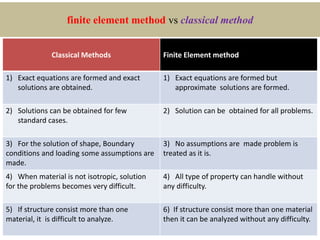
finite element method vs classical method
Classical Methods Finite Element method
1) Exact equations are formed and exact
solutions are obtained.
1) Exact equations are formed but
approximate solutions are formed.
2) Solutions can be obtained for few
standard cases.
2) Solution can be obtained for all problems.
3) For the solution of shape, Boundary
conditions and loading some assumptions are
made.
3) No assumptions are made problem is
treated as it is.
4) When material is not isotropic, solution
for the problems becomes very difficult.
4) All type of property can handle without
any difficulty.
5) If structure consist more than one
material, it is difficult to analyze.
6) If structure consist more than one material
then it can be analyzed without any difficulty.
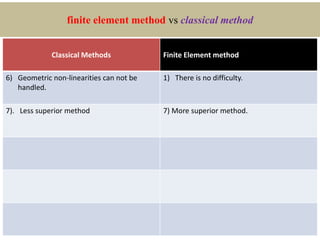
finite element method vs classical method
Classical Methods Finite Element method
6) Geometric non-linearities can not be
handled.
1) There is no difficulty.
7). Less superior method 7) More superior method.
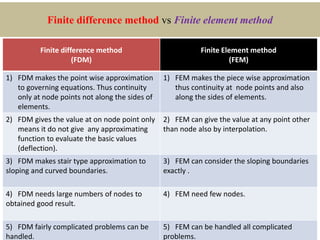
Finite difference method vs Finite element method
Finite difference method
(FDM)
Finite Element method
(FEM)
1) FDM makes the point wise approximation
to governing equations. Thus continuity
only at node points not along the sides of
elements.
1) FEM makes the piece wise approximation
thus continuity at node points and also
along the sides of elements.
2) FDM gives the value at on node point only
means it do not give any approximating
function to evaluate the basic values
(deflection).
2) FEM can give the value at any point other
than node also by interpolation.
3) FDM makes stair type approximation to
sloping and curved boundaries.
3) FEM can consider the sloping boundaries
exactly .
4) FDM needs large numbers of nodes to
obtained good result.
4) FEM need few nodes.
5) FDM fairly complicated problems can be
handled.
5) FEM can be handled all complicated
problems.
Thanks!

Finite element method vs classical method 1

  • 1.
  • 2.
    FINITE ELEMENT METHOD UNIT1 INTRODUCTION Er. Manoj Kumar LOVELY PROFESSIONAL UNIVERSITY
  • 3.
    finite element methodvs classical method Classical Methods Finite Element method 1) Exact equations are formed and exact solutions are obtained. 1) Exact equations are formed but approximate solutions are formed. 2) Solutions can be obtained for few standard cases. 2) Solution can be obtained for all problems. 3) For the solution of shape, Boundary conditions and loading some assumptions are made. 3) No assumptions are made problem is treated as it is. 4) When material is not isotropic, solution for the problems becomes very difficult. 4) All type of property can handle without any difficulty. 5) If structure consist more than one material, it is difficult to analyze. 6) If structure consist more than one material then it can be analyzed without any difficulty.
  • 4.
    finite element methodvs classical method Classical Methods Finite Element method 6) Geometric non-linearities can not be handled. 1) There is no difficulty. 7). Less superior method 7) More superior method.
  • 5.
    Finite difference methodvs Finite element method Finite difference method (FDM) Finite Element method (FEM) 1) FDM makes the point wise approximation to governing equations. Thus continuity only at node points not along the sides of elements. 1) FEM makes the piece wise approximation thus continuity at node points and also along the sides of elements. 2) FDM gives the value at on node point only means it do not give any approximating function to evaluate the basic values (deflection). 2) FEM can give the value at any point other than node also by interpolation. 3) FDM makes stair type approximation to sloping and curved boundaries. 3) FEM can consider the sloping boundaries exactly . 4) FDM needs large numbers of nodes to obtained good result. 4) FEM need few nodes. 5) FDM fairly complicated problems can be handled. 5) FEM can be handled all complicated problems.
  • 6.