DEVELOPMENT OF SENSORLESS BLDC
MOTOR CONTROL USING 3RD
HARMONIC VOLTAGE SIGNAL
Project Guide-
Mr. Naga Chaithanya (TATA MOTORS)
Prof. Ashok Suryawanshi (PCCOE)
Presentation by-
Aishwarya Mandhare(B120333148)
Tejashree Pawar(B120333178)
Vaibhav Raut(B120333189)
Sponsored by TATA MOTORS
ABSTRACT
• Brushless dc (BLDC) motors and their drives are penetrating the market of home
appliances, HVAC industry, and automotive applications in recent years because of their
high efficiency, silent operation, compact form, reliability, and low maintenance.
• Traditionally, BLDC motors are commutated in six-step pattern with commutation
controlled by position sensors. To reduce cost and complexity of the drive system, Sensor-
less drive is preferred.
• Currently BLDC motors are used with sensor control in automotive applications ranging
from radiator fan to the main traction motors. In most of these applications precise control
is not required and hence sensor less method can be applied.
• Radiator fans are one such application where the speed control precision does not play a
huge role but reducing number of components and cost is important
PROJECT OBJECTIVES
• To develop a control method for sensor-less BLDC motor drive
• Software implementation of the selected control method in Simulink.
• Circuit design and development for the sensor-less control method.
• Reduction of cost and complexity of the BLDC motor drive and improvement in
low speed operation.
INTRODUCTION
• Ideal choice for applications requiring high reliability, high efficiency, and high
power-to-volume ratio.
• High performance motor that is capable of providing large amounts of torque over a
vast speed range.
• Permanent magnet synchronous motor, having permanent magnets on the rotor and
trapezoidal shape back EMF.
• Brushes of dc motor are replaced by electronic switches, which supply current to the
motor windings as a function of the rotor position.
• Position sensors can be Hall sensors, resolvers or absolute position sensors which
will increase the cost and the size of the motor.
• In some cases, the reduction in size achieved by eliminating the rotor position sensor
and the encoder may be critical in many applications.
MOTIVATION
• In recent years, pressure on natural resources has grown and this has lead the
manufacturing industry to turn towards increasing the efficiency, robustness,
reliability and performance of products at the same time reducing the overall cost.
• In such environment, brushless DC (BLDC) motors have found a high place in
applications such as air conditioners and refrigerators. This is due to several
advantages they hold over conventionally used DC motors, which include:
• Smaller size
• Higher efficiency
• Long operating life
• Noiseless operation
• Easy maintenance
• Better performance characteristics
LITERATURE SURVEY
Sr. No Title Publisher Methodology Findings
1. 3-Phase BLDC Motor
Control with Hall Sensors
Using 56800/E Digital Signal
Controllers
Free scale
Semiconductor
Application Note
Motor control using
56800/E DSC & hall
effect sensor.
It is less efficient and
implementation is
complicated.
2. Trapezoidal Control of
BLDC Motors Using Hall
Effect
Sensors
Texas Instruments Position sensing and
motor control using
microcontroller.
Less noise immunity, low
SNR.
3. Direct Back EMF Detection
Method for Sensor less
Brushless DC
(BLDC) Motor Drives
Jianwen Shao
Virginia Polytechnic
Institute
BLDC motor control
using the back emf
signal.
More robust, less
maintenance, better noise
immunity.
4. Sensor less Control of BLDC
Motor Drive Fed by Isolated
DC-DC Converter
Sonia Sunny, Rajesh
Asst. Prof, Department
of EEE, Rajiv Gandhi
Institute of Technology
improved topology of
an isolated DC-DC
converter fed sensor
less BLDC drive
HFT (High Frequency
Transformer) provides
Isolation ensuring safe
operation of the motor
drive.
5. BLDC motor drives using
the unknown input observer
to Sensor less Control
Method for Brushless DC
Motors
Tae-Sung Kim, , Dong-
Myung Lee, and Dong-
Seok Hyun Electrical
Engineering from
Dankook University,
Seoul, Korea,
Line-to line back-
EMF estimation.
detect the rotor position
effectively over a full
speed range, especially at
a low speed range
6. Speed Control of BLDC
Motor Using PID Controller
R.G.Rajesh, C.Balaji
PG Student
[Electronics and
Control], Dept. of ICE,
SRM University,
Chennai
PID controlled
brushless direct
current motor drive
using MATLAB /
SIMULINK
MATLAB/Simulink
environment allows that
many dynamic
characteristics such as
voltage ,rotor speed, phase
current and mechanical
torque can be effectively
Considered.
CONSTRUCTION &WORKING
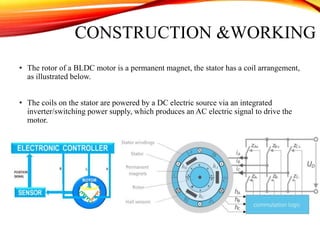
• The rotor of a BLDC motor is a permanent magnet, the stator has a coil arrangement,
as illustrated below.
• The coils on the stator are powered by a DC electric source via an integrated
inverter/switching power supply, which produces an AC electric signal to drive the
motor.
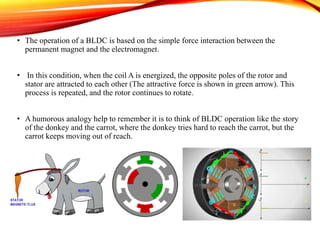
• The operation of a BLDC is based on the simple force interaction between the
permanent magnet and the electromagnet.
• In this condition, when the coil A is energized, the opposite poles of the rotor and
stator are attracted to each other (The attractive force is shown in green arrow). This
process is repeated, and the rotor continues to rotate.
• A humorous analogy help to remember it is to think of BLDC operation like the story
of the donkey and the carrot, where the donkey tries hard to reach the carrot, but the
carrot keeps moving out of reach.
SENSOR-LESS BLDC MOTOR
CONTROL TECHNIQUES
 Two types of Sensorless Control Technique :
1. Position Estimation using motor parameters, terminal voltages and currents.
2. Position Sensing using back EMF.
• Direct Detection
• Indirect Detection
*Our application demands to make use of the back-EMF signal of the motor, hence we
proceed with the second type of control technique.
i. Direct Detection
a.) ZCD (Using virtual neutral point):
• The voltage at the floating terminal is measured w.r.t. the virtual neutral i.e. the centre of
Y wound motor. Simultaneously the PWM signal is superimposed on the neutral voltage
inducing large amount of electrical noise on the sensed signal and attenuation and filtering
is required. Filtering cause delay and a poor SNR consequently tending to have a narrow
speed range and poor start up characteristics.
ii. Indirect Detection
a.) Back EMF integration:
The integration approach has the advantage of reduced switching noise sensitivity.
However, they still have the problem of high common voltage in the neutral. This method is
complicated, costly and has poor low speed operation.
b.) 3rd Harmonic Voltage Detection:
The true back EMF can be detected directly from terminal voltage and virtual
neutral and terminal voltage is compared to the neutral point, then the zero crossing of the
back EMF can be obtained providing very good SNR as well as wide speed range.
3RD HARMONIC VOLTAGE
DETECTION
• This method utilises the third harmonic of the back-EMF signal to determine the
commutation instants of the BLDC motor.
• In a symmetrical three phase Y-connected motor with trapezoidal air gap flux
distribution, summation of the three stator phase voltages results in the elimination
of all poly-phase.
• Third harmonic component keeps a constant phase displacement with the
fundamental air gap voltage for any load and speed, thus only the 3rd harmonic
component is needed for detection of position.
• An appropriate processing of the third harmonic signal allows the estimation of the
rotor flux position and a proper inverter current control.
• In contrast with indirect sensing methods based on the back-EMF signal, the third
harmonic requires only a small amount of filtering.
• As a result, this method is not sensitive to filtering delays, achieving a high
performance for a wide speed range.
• A superior motor starting performance is also achieved because the third harmonic
can be detected at low speeds.
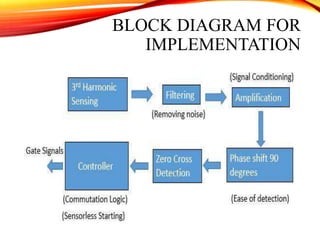
BLOCK DIAGRAM FOR
IMPLEMENTATION
WAVEFORMS &
EXPLANATION
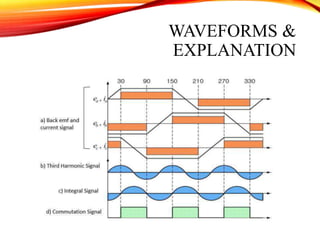
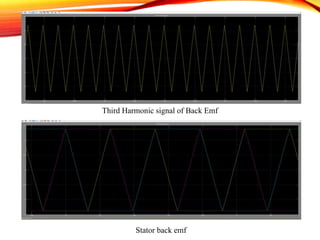
• The back EMF and the third harmonic signal can be seen to have the peaks of the 3rd
harmonic signal represent the commutation points for the current.
• The commutation point is always 30 degrees from the back EMF zero crossing point.
• As the third harmonic of this waveform would complete 1 full cycle in ½ cycle of 3rd
harmonic = 60 degrees of back EMF.
• The peak of the half sine wave (0 to 180 degrees) would coincide with the peak of
third harmonic signal and since these peaks are 60 degrees apart with respect to the
back EMF signal, each of the peaks represents commutation for one of the switches
(which happens 60 degrees apart as well).
• Hence Third Harmonic holds good for our application and therefore we proceed
with it.
EXPLANATION
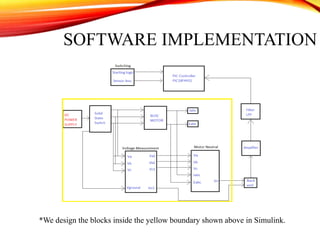
SOFTWARE IMPLEMENTATION
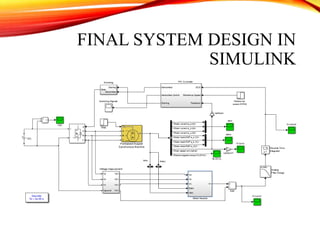
*We design the blocks inside the yellow boundary shown above in Simulink.
• SIMULINK MODEL DEVELOPMENT
The inbuilt motor model for BLDC motor in Simulink is different
from the actual setup in many ways and hence was needed to be
modified. The different modifications to be done in the circuit were:
a. Simulation model of motor neutral and a virtual neutral to extract
third harmonic signal.
b. Developing a commutation logic and a starting strategy model
with switching circuit from starting to commutation
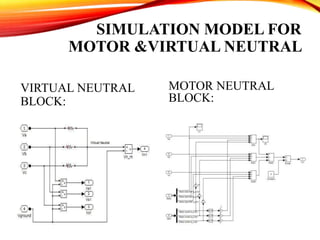
SIMULATION MODEL FOR
MOTOR &VIRTUAL NEUTRAL
VIRTUAL NEUTRAL
BLOCK:
MOTOR NEUTRAL
BLOCK:
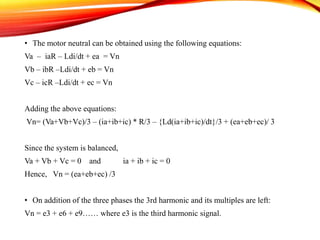
• The motor neutral can be obtained using the following equations:
Va – iaR – Ldi/dt + ea = Vn
Vb – ibR –Ldi/dt + eb = Vn
Vc – icR –Ldi/dt + ec = Vn
Adding the above equations:
Vn= (Va+Vb+Vc)/3 – (ia+ib+ic) * R/3 – {Ld(ia+ib+ic)/dt}/3 + (ea+eb+ec)/ 3
Since the system is balanced,
Va + Vb + Vc = 0 and ia + ib + ic = 0
Hence, Vn = (ea+eb+ec) /3
• On addition of the three phases the 3rd harmonic and its multiples are left:
Vn = e3 + e6 + e9…… where e3 is the third harmonic signal.
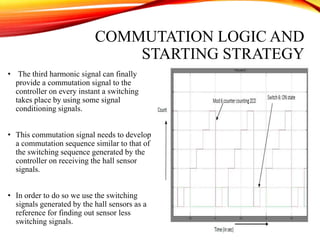
COMMUTATION LOGIC AND
STARTING STRATEGY
• The third harmonic signal can finally
provide a commutation signal to the
controller on every instant a switching
takes place by using some signal
conditioning signals.
• This commutation signal needs to develop
a commutation sequence similar to that of
the switching sequence generated by the
controller on receiving the hall sensor
signals.
• In order to do so we use the switching
signals generated by the hall sensors as a
reference for finding out sensor less
switching signals.
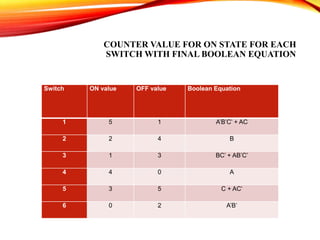
COUNTER VALUE FOR ON STATE FOR EACH
SWITCH WITH FINAL BOOLEAN EQUATION
Switch ON value OFF value Boolean Equation
1 5 1 A’B’C’ + AC
2 2 4 B
3 1 3 BC’ + AB’C’
4 4 0 A
5 3 5 C + AC’
6 0 2 A’B’
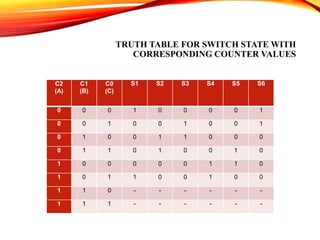
TRUTH TABLE FOR SWITCH STATE WITH
CORRESPONDING COUNTER VALUES
C2
(A)
C1
(B)
C0
(C)
S1 S2 S3 S4 S5 S6
0 0 0 1 0 0 0 0 1
0 0 1 0 0 1 0 0 1
0 1 0 0 1 1 0 0 0
0 1 1 0 1 0 0 1 0
1 0 0 0 0 0 1 1 0
1 0 1 1 0 0 1 0 0
1 1 0 - - - - - -
1 1 1 - - - - - -
FINAL SYSTEM DESIGN IN
SIMULINK
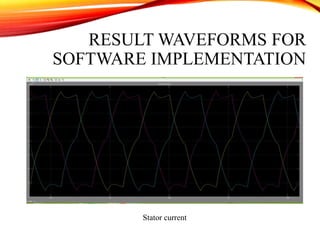
RESULT WAVEFORMS FOR
SOFTWARE IMPLEMENTATION
Stator current
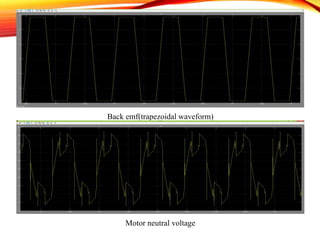
Back emf(trapezoidal waveform)
Motor neutral voltage
Third Harmonic signal of Back Emf
Stator back emf
HARDWARE
IMPLEMENTATION
• After the simulation of circuit in MATLAB Simulink and obtaining satisfactory
waveforms, we proceeded for hardware implementation.
• As seen from the circuit diagram, so far we have completed the development of
the blocks inside of the yellow boundary.
• Now we go ahead with the selection of various components required for the
hardware realization of the complete circuit.
• The selection criteria is broadly based upon the operating conditions along with
typical application oriented components.
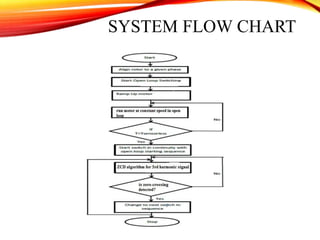
SYSTEM FLOW CHART
HARDWARE CIRCUIT
DESIGN
• Following the flow chart we chalk out steps for hardware circuit
design in OrCAD which is a proprietary software tool suite used
primarily for electronic design automation (EDA).
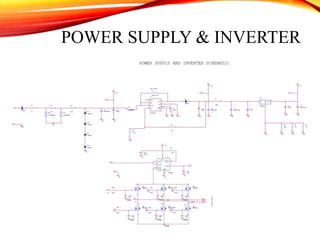
• Step 1: Power Supply and Inverter Circuit
• Step 2: Microcontroller Interfacing
• Step 3: ZCD Circuit (virtual neutral)
• The component selection for the above steps is given further.
COMPONENT SELECTION
CRITERION
• Should withstand automobile environment
• System specifications
• ECU support
• Motor requirements
• Multiple module communication
• Company guidelines
COMPONENTS & DESCRIPTION
• ACS711(Hall Effect Linear Current Sensor with overcurrent
protection <100V)
• IR540 (MOSFET)
• NCP3063 (Step up/down switching regulator)
• LM2931 (Low drop voltage regulator)
• PIC18F2331/4331(Microcontroller)
• IR2130 (3 phase bridge driver)
• 74ALS257 (Multiplexer)
• LM2904 (Dual operation amplifiers)
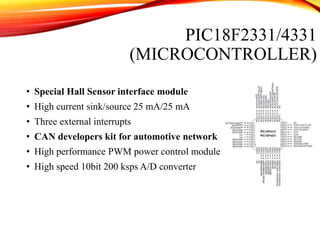
PIC18F2331/4331
(MICROCONTROLLER)
• Special Hall Sensor interface module
• High current sink/source 25 mA/25 mA
• Three external interrupts
• CAN developers kit for automotive network
• High performance PWM power control module
• High speed 10bit 200 ksps A/D converter
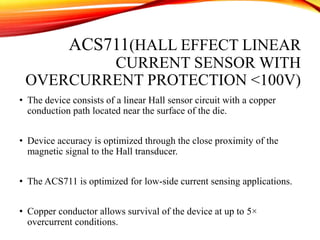
ACS711(HALL EFFECT LINEAR
CURRENT SENSOR WITH
OVERCURRENT PROTECTION <100V)
• The device consists of a linear Hall sensor circuit with a copper
conduction path located near the surface of the die.
• Device accuracy is optimized through the close proximity of the
magnetic signal to the Hall transducer.
• The ACS711 is optimized for low-side current sensing applications.
• Copper conductor allows survival of the device at up to 5×
overcurrent conditions.
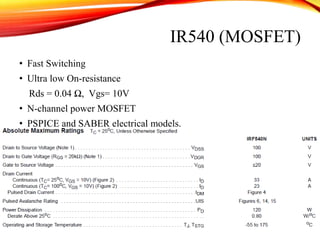
IR540 (MOSFET)
• Fast Switching
• Ultra low On-resistance
Rds = 0.04 Ω, Vgs= 10V
• N-channel power MOSFET
• PSPICE and SABER electrical models.
NCP3063 (STEP UP/DOWN
SWITCHING REGULATOR)
• Step-down, step-up & inverting application with a minimum
number of external components.
• Operation to 40 V Input
• Low Standby Current
• Output Switch Current to 1.5 A
• Output Voltage Adjustable
• Frequency Operation of 150 kHz
• Battery charger applications
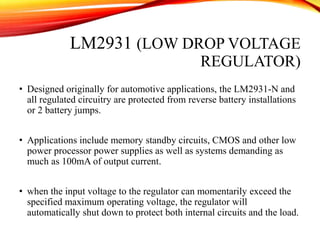
LM2931 (LOW DROP VOLTAGE
REGULATOR)
• Designed originally for automotive applications, the LM2931-N and
all regulated circuitry are protected from reverse battery installations
or 2 battery jumps.
• Applications include memory standby circuits, CMOS and other low
power processor power supplies as well as systems demanding as
much as 100mA of output current.
• when the input voltage to the regulator can momentarily exceed the
specified maximum operating voltage, the regulator will
automatically shut down to protect both internal circuits and the load.
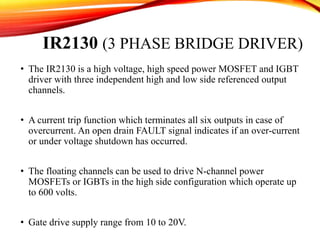
IR2130 (3 PHASE BRIDGE DRIVER)
• The IR2130 is a high voltage, high speed power MOSFET and IGBT
driver with three independent high and low side referenced output
channels.
• A current trip function which terminates all six outputs in case of
overcurrent. An open drain FAULT signal indicates if an over-current
or under voltage shutdown has occurred.
• The floating channels can be used to drive N-channel power
MOSFETs or IGBTs in the high side configuration which operate up
to 600 volts.
• Gate drive supply range from 10 to 20V.
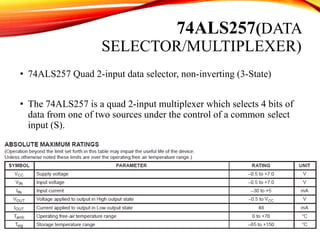
74ALS257(DATA
SELECTOR/MULTIPLEXER)
• 74ALS257 Quad 2-input data selector, non-inverting (3-State)
• The 74ALS257 is a quad 2-input multiplexer which selects 4 bits of
data from one of two sources under the control of a common select
input (S).
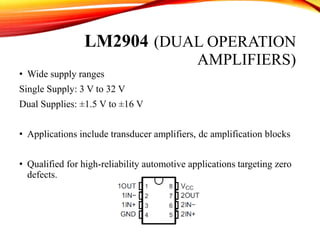
LM2904 (DUAL OPERATION
AMPLIFIERS)
• Wide supply ranges
Single Supply: 3 V to 32 V
Dual Supplies: ±1.5 V to ±16 V
• Applications include transducer amplifiers, dc amplification blocks
• Qualified for high-reliability automotive applications targeting zero
defects.
POWER SUPPLY & INVERTER
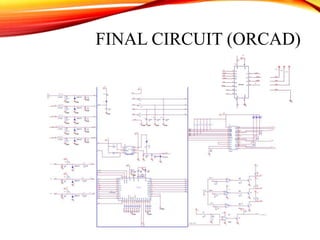
FINAL CIRCUIT (ORCAD)
CONCLUSION
• The selection of methodology for the implementation was successfully done after the
literature survey of various existing methods.
• Software implementation along with feasibility of the methodology (3rd harmonic
voltage sensing) was done successfully in the MATLAB Simulink software.

• Hardware implementation with selection of various components required, on the
basis of selection criteria was done.
• Design of Power supply and inverter circuit was completed in OrCAD software.
• Final circuit design was completed in OrCAD software.
• System circuit was approved by company guide and was given for layout design.
ADVANTAGES
• A comparative study was done among the different back-EMF detection based
strategies to decide on strategy to be used.
• Using the motor in a vehicle makes the noise immunity and robustness a main
issue for our control strategy because of the harsh environment in which it
operates.
• Another criterion is the delay in the commutation sequence to the original sensor
based sequence which can cause a reduced torque output and can highly affect the
dynamic response of system and its control during real time operation.
• Due to a good low speed performance and low noise susceptibility of the third
harmonic voltage sensing method is a good method for our application in radiator
fans.
• The designed system can be used in the following applications effectively:
1. Car radiator fan.
2. Air conditioners and Refrigerators.
3. Under water vehicles.
4. Industrial motors having rotors submerged in oil/liquid.
5. Automatic Fuel Pump:-
A brush type dc fuel pump motor is typically designed to last 6,000 hours. In
certain Fleet vehicles this can be expended in less than 1 year. A brushless dc
motor life span is typically around 15,000 hours, extending the life of the motor by
almost 3 times. Once a Microcontroller is used to perform the brushless
commutation other features can be incorporated into the application. Features such
as electronic return less fuel system Control, fuel level processing, and fuel tank
pressure sensing can be incorporated.
APPLICATIONS
REFERENCES
[1] Speed Control of BLDC Motor Using PID Controller,” International Journal of Advanced Research in
Electrical, Electronics and Instrumentation Engineering Vol. 3, Issue 4, April 2014”
[2] A New Approach to Sensor-Less Control Method for Brushless DC Motors,” International Journal of
Control, Automation, and Systems, vol. 6, no. 4, pp. 477-487, August 2014”
[3] PWM controlled BLDC Motor, ”International Journal of Scientific and Research Publications, Volume 3,
Issue 4, April 2013 1 ISSN 2250-3153”
[4] Sonia Sunny, Rajesh K, “Sensor-Less Control of BLDC Motor Drive Fed by Isolated DC-DC Converter”,
IJAREEIE (International Journal of Advanced Research in Electrical, Electronics and Instrumentation
Engineering) Vol. 2, Special Issue 1, December 2013
[5] Tae-Sung Kim, Dong-Myung Lee, and Dong-Seok Hyun, “BLDC motor drives using the Line-to line back-
EMF estimation” , International Journal of Control, Automation, and Systems, vol. 6, no. 4, pp. 477-487, August
2008
[6] J. Shao, D. Nolan, M. Teissier, and D. Swanson, “A Novel microcontroller based sensor less brushless DC
(BLDC) motor drive for automotive fuel pumps,” IEEE Trans. Ind. Appl., vol. 39, no. 6, pp. 1734–1740, Nov.
/Dec. 2003.
[7] Charlie Elliott Smart Power Solutions, and Steve Bowling Microchip Technology Inc, “Sensor-less BLDC
control using dsPIC30F” Microchip application note AN901 Sept. 2012.
Final_Presentation

Final_Presentation

  • 1.
    DEVELOPMENT OF SENSORLESSBLDC MOTOR CONTROL USING 3RD HARMONIC VOLTAGE SIGNAL Project Guide- Mr. Naga Chaithanya (TATA MOTORS) Prof. Ashok Suryawanshi (PCCOE) Presentation by- Aishwarya Mandhare(B120333148) Tejashree Pawar(B120333178) Vaibhav Raut(B120333189) Sponsored by TATA MOTORS
  • 2.
    ABSTRACT • Brushless dc(BLDC) motors and their drives are penetrating the market of home appliances, HVAC industry, and automotive applications in recent years because of their high efficiency, silent operation, compact form, reliability, and low maintenance. • Traditionally, BLDC motors are commutated in six-step pattern with commutation controlled by position sensors. To reduce cost and complexity of the drive system, Sensor- less drive is preferred. • Currently BLDC motors are used with sensor control in automotive applications ranging from radiator fan to the main traction motors. In most of these applications precise control is not required and hence sensor less method can be applied. • Radiator fans are one such application where the speed control precision does not play a huge role but reducing number of components and cost is important
  • 3.
    PROJECT OBJECTIVES • Todevelop a control method for sensor-less BLDC motor drive • Software implementation of the selected control method in Simulink. • Circuit design and development for the sensor-less control method. • Reduction of cost and complexity of the BLDC motor drive and improvement in low speed operation.
  • 4.
    INTRODUCTION • Ideal choicefor applications requiring high reliability, high efficiency, and high power-to-volume ratio. • High performance motor that is capable of providing large amounts of torque over a vast speed range. • Permanent magnet synchronous motor, having permanent magnets on the rotor and trapezoidal shape back EMF. • Brushes of dc motor are replaced by electronic switches, which supply current to the motor windings as a function of the rotor position. • Position sensors can be Hall sensors, resolvers or absolute position sensors which will increase the cost and the size of the motor. • In some cases, the reduction in size achieved by eliminating the rotor position sensor and the encoder may be critical in many applications.
  • 5.
    MOTIVATION • In recentyears, pressure on natural resources has grown and this has lead the manufacturing industry to turn towards increasing the efficiency, robustness, reliability and performance of products at the same time reducing the overall cost. • In such environment, brushless DC (BLDC) motors have found a high place in applications such as air conditioners and refrigerators. This is due to several advantages they hold over conventionally used DC motors, which include: • Smaller size • Higher efficiency • Long operating life • Noiseless operation • Easy maintenance • Better performance characteristics
  • 6.
    LITERATURE SURVEY Sr. NoTitle Publisher Methodology Findings 1. 3-Phase BLDC Motor Control with Hall Sensors Using 56800/E Digital Signal Controllers Free scale Semiconductor Application Note Motor control using 56800/E DSC & hall effect sensor. It is less efficient and implementation is complicated. 2. Trapezoidal Control of BLDC Motors Using Hall Effect Sensors Texas Instruments Position sensing and motor control using microcontroller. Less noise immunity, low SNR. 3. Direct Back EMF Detection Method for Sensor less Brushless DC (BLDC) Motor Drives Jianwen Shao Virginia Polytechnic Institute BLDC motor control using the back emf signal. More robust, less maintenance, better noise immunity.
  • 7.
    4. Sensor lessControl of BLDC Motor Drive Fed by Isolated DC-DC Converter Sonia Sunny, Rajesh Asst. Prof, Department of EEE, Rajiv Gandhi Institute of Technology improved topology of an isolated DC-DC converter fed sensor less BLDC drive HFT (High Frequency Transformer) provides Isolation ensuring safe operation of the motor drive. 5. BLDC motor drives using the unknown input observer to Sensor less Control Method for Brushless DC Motors Tae-Sung Kim, , Dong- Myung Lee, and Dong- Seok Hyun Electrical Engineering from Dankook University, Seoul, Korea, Line-to line back- EMF estimation. detect the rotor position effectively over a full speed range, especially at a low speed range 6. Speed Control of BLDC Motor Using PID Controller R.G.Rajesh, C.Balaji PG Student [Electronics and Control], Dept. of ICE, SRM University, Chennai PID controlled brushless direct current motor drive using MATLAB / SIMULINK MATLAB/Simulink environment allows that many dynamic characteristics such as voltage ,rotor speed, phase current and mechanical torque can be effectively Considered.
  • 8.
    CONSTRUCTION &WORKING • Therotor of a BLDC motor is a permanent magnet, the stator has a coil arrangement, as illustrated below. • The coils on the stator are powered by a DC electric source via an integrated inverter/switching power supply, which produces an AC electric signal to drive the motor.
  • 9.
    • The operationof a BLDC is based on the simple force interaction between the permanent magnet and the electromagnet. • In this condition, when the coil A is energized, the opposite poles of the rotor and stator are attracted to each other (The attractive force is shown in green arrow). This process is repeated, and the rotor continues to rotate. • A humorous analogy help to remember it is to think of BLDC operation like the story of the donkey and the carrot, where the donkey tries hard to reach the carrot, but the carrot keeps moving out of reach.
  • 10.
    SENSOR-LESS BLDC MOTOR CONTROLTECHNIQUES  Two types of Sensorless Control Technique : 1. Position Estimation using motor parameters, terminal voltages and currents. 2. Position Sensing using back EMF. • Direct Detection • Indirect Detection *Our application demands to make use of the back-EMF signal of the motor, hence we proceed with the second type of control technique.
  • 11.
    i. Direct Detection a.)ZCD (Using virtual neutral point): • The voltage at the floating terminal is measured w.r.t. the virtual neutral i.e. the centre of Y wound motor. Simultaneously the PWM signal is superimposed on the neutral voltage inducing large amount of electrical noise on the sensed signal and attenuation and filtering is required. Filtering cause delay and a poor SNR consequently tending to have a narrow speed range and poor start up characteristics. ii. Indirect Detection a.) Back EMF integration: The integration approach has the advantage of reduced switching noise sensitivity. However, they still have the problem of high common voltage in the neutral. This method is complicated, costly and has poor low speed operation. b.) 3rd Harmonic Voltage Detection: The true back EMF can be detected directly from terminal voltage and virtual neutral and terminal voltage is compared to the neutral point, then the zero crossing of the back EMF can be obtained providing very good SNR as well as wide speed range.
  • 12.
    3RD HARMONIC VOLTAGE DETECTION •This method utilises the third harmonic of the back-EMF signal to determine the commutation instants of the BLDC motor. • In a symmetrical three phase Y-connected motor with trapezoidal air gap flux distribution, summation of the three stator phase voltages results in the elimination of all poly-phase. • Third harmonic component keeps a constant phase displacement with the fundamental air gap voltage for any load and speed, thus only the 3rd harmonic component is needed for detection of position.
  • 13.
    • An appropriateprocessing of the third harmonic signal allows the estimation of the rotor flux position and a proper inverter current control. • In contrast with indirect sensing methods based on the back-EMF signal, the third harmonic requires only a small amount of filtering. • As a result, this method is not sensitive to filtering delays, achieving a high performance for a wide speed range. • A superior motor starting performance is also achieved because the third harmonic can be detected at low speeds.
  • 14.
  • 15.
  • 16.
    • The backEMF and the third harmonic signal can be seen to have the peaks of the 3rd harmonic signal represent the commutation points for the current. • The commutation point is always 30 degrees from the back EMF zero crossing point. • As the third harmonic of this waveform would complete 1 full cycle in ½ cycle of 3rd harmonic = 60 degrees of back EMF. • The peak of the half sine wave (0 to 180 degrees) would coincide with the peak of third harmonic signal and since these peaks are 60 degrees apart with respect to the back EMF signal, each of the peaks represents commutation for one of the switches (which happens 60 degrees apart as well). • Hence Third Harmonic holds good for our application and therefore we proceed with it. EXPLANATION
  • 17.
    SOFTWARE IMPLEMENTATION *We designthe blocks inside the yellow boundary shown above in Simulink.
  • 18.
    • SIMULINK MODELDEVELOPMENT The inbuilt motor model for BLDC motor in Simulink is different from the actual setup in many ways and hence was needed to be modified. The different modifications to be done in the circuit were: a. Simulation model of motor neutral and a virtual neutral to extract third harmonic signal. b. Developing a commutation logic and a starting strategy model with switching circuit from starting to commutation
  • 19.
    SIMULATION MODEL FOR MOTOR&VIRTUAL NEUTRAL VIRTUAL NEUTRAL BLOCK: MOTOR NEUTRAL BLOCK:
  • 20.
    • The motorneutral can be obtained using the following equations: Va – iaR – Ldi/dt + ea = Vn Vb – ibR –Ldi/dt + eb = Vn Vc – icR –Ldi/dt + ec = Vn Adding the above equations: Vn= (Va+Vb+Vc)/3 – (ia+ib+ic) * R/3 – {Ld(ia+ib+ic)/dt}/3 + (ea+eb+ec)/ 3 Since the system is balanced, Va + Vb + Vc = 0 and ia + ib + ic = 0 Hence, Vn = (ea+eb+ec) /3 • On addition of the three phases the 3rd harmonic and its multiples are left: Vn = e3 + e6 + e9…… where e3 is the third harmonic signal.
  • 21.
    COMMUTATION LOGIC AND STARTINGSTRATEGY • The third harmonic signal can finally provide a commutation signal to the controller on every instant a switching takes place by using some signal conditioning signals. • This commutation signal needs to develop a commutation sequence similar to that of the switching sequence generated by the controller on receiving the hall sensor signals. • In order to do so we use the switching signals generated by the hall sensors as a reference for finding out sensor less switching signals.
  • 22.
    COUNTER VALUE FORON STATE FOR EACH SWITCH WITH FINAL BOOLEAN EQUATION Switch ON value OFF value Boolean Equation 1 5 1 A’B’C’ + AC 2 2 4 B 3 1 3 BC’ + AB’C’ 4 4 0 A 5 3 5 C + AC’ 6 0 2 A’B’
  • 23.
    TRUTH TABLE FORSWITCH STATE WITH CORRESPONDING COUNTER VALUES C2 (A) C1 (B) C0 (C) S1 S2 S3 S4 S5 S6 0 0 0 1 0 0 0 0 1 0 0 1 0 0 1 0 0 1 0 1 0 0 1 1 0 0 0 0 1 1 0 1 0 0 1 0 1 0 0 0 0 0 1 1 0 1 0 1 1 0 0 1 0 0 1 1 0 - - - - - - 1 1 1 - - - - - -
  • 24.
  • 25.
    RESULT WAVEFORMS FOR SOFTWAREIMPLEMENTATION Stator current
  • 26.
  • 27.
    Third Harmonic signalof Back Emf Stator back emf
  • 28.
    HARDWARE IMPLEMENTATION • After thesimulation of circuit in MATLAB Simulink and obtaining satisfactory waveforms, we proceeded for hardware implementation. • As seen from the circuit diagram, so far we have completed the development of the blocks inside of the yellow boundary. • Now we go ahead with the selection of various components required for the hardware realization of the complete circuit. • The selection criteria is broadly based upon the operating conditions along with typical application oriented components.
  • 29.
  • 30.
    HARDWARE CIRCUIT DESIGN • Followingthe flow chart we chalk out steps for hardware circuit design in OrCAD which is a proprietary software tool suite used primarily for electronic design automation (EDA). • Step 1: Power Supply and Inverter Circuit • Step 2: Microcontroller Interfacing • Step 3: ZCD Circuit (virtual neutral) • The component selection for the above steps is given further.
  • 31.
    COMPONENT SELECTION CRITERION • Shouldwithstand automobile environment • System specifications • ECU support • Motor requirements • Multiple module communication • Company guidelines
  • 32.
    COMPONENTS & DESCRIPTION •ACS711(Hall Effect Linear Current Sensor with overcurrent protection <100V) • IR540 (MOSFET) • NCP3063 (Step up/down switching regulator) • LM2931 (Low drop voltage regulator) • PIC18F2331/4331(Microcontroller) • IR2130 (3 phase bridge driver) • 74ALS257 (Multiplexer) • LM2904 (Dual operation amplifiers)
  • 33.
    PIC18F2331/4331 (MICROCONTROLLER) • Special HallSensor interface module • High current sink/source 25 mA/25 mA • Three external interrupts • CAN developers kit for automotive network • High performance PWM power control module • High speed 10bit 200 ksps A/D converter
  • 34.
    ACS711(HALL EFFECT LINEAR CURRENTSENSOR WITH OVERCURRENT PROTECTION <100V) • The device consists of a linear Hall sensor circuit with a copper conduction path located near the surface of the die. • Device accuracy is optimized through the close proximity of the magnetic signal to the Hall transducer. • The ACS711 is optimized for low-side current sensing applications. • Copper conductor allows survival of the device at up to 5× overcurrent conditions.
  • 35.
    IR540 (MOSFET) • FastSwitching • Ultra low On-resistance Rds = 0.04 Ω, Vgs= 10V • N-channel power MOSFET • PSPICE and SABER electrical models.
  • 36.
    NCP3063 (STEP UP/DOWN SWITCHINGREGULATOR) • Step-down, step-up & inverting application with a minimum number of external components. • Operation to 40 V Input • Low Standby Current • Output Switch Current to 1.5 A • Output Voltage Adjustable • Frequency Operation of 150 kHz • Battery charger applications
  • 37.
    LM2931 (LOW DROPVOLTAGE REGULATOR) • Designed originally for automotive applications, the LM2931-N and all regulated circuitry are protected from reverse battery installations or 2 battery jumps. • Applications include memory standby circuits, CMOS and other low power processor power supplies as well as systems demanding as much as 100mA of output current. • when the input voltage to the regulator can momentarily exceed the specified maximum operating voltage, the regulator will automatically shut down to protect both internal circuits and the load.
  • 38.
    IR2130 (3 PHASEBRIDGE DRIVER) • The IR2130 is a high voltage, high speed power MOSFET and IGBT driver with three independent high and low side referenced output channels. • A current trip function which terminates all six outputs in case of overcurrent. An open drain FAULT signal indicates if an over-current or under voltage shutdown has occurred. • The floating channels can be used to drive N-channel power MOSFETs or IGBTs in the high side configuration which operate up to 600 volts. • Gate drive supply range from 10 to 20V.
  • 39.
    74ALS257(DATA SELECTOR/MULTIPLEXER) • 74ALS257 Quad2-input data selector, non-inverting (3-State) • The 74ALS257 is a quad 2-input multiplexer which selects 4 bits of data from one of two sources under the control of a common select input (S).
  • 40.
    LM2904 (DUAL OPERATION AMPLIFIERS) •Wide supply ranges Single Supply: 3 V to 32 V Dual Supplies: ±1.5 V to ±16 V • Applications include transducer amplifiers, dc amplification blocks • Qualified for high-reliability automotive applications targeting zero defects.
  • 41.
  • 42.
  • 43.
    CONCLUSION • The selectionof methodology for the implementation was successfully done after the literature survey of various existing methods. • Software implementation along with feasibility of the methodology (3rd harmonic voltage sensing) was done successfully in the MATLAB Simulink software. • Hardware implementation with selection of various components required, on the basis of selection criteria was done. • Design of Power supply and inverter circuit was completed in OrCAD software. • Final circuit design was completed in OrCAD software. • System circuit was approved by company guide and was given for layout design.
  • 44.
    ADVANTAGES • A comparativestudy was done among the different back-EMF detection based strategies to decide on strategy to be used. • Using the motor in a vehicle makes the noise immunity and robustness a main issue for our control strategy because of the harsh environment in which it operates. • Another criterion is the delay in the commutation sequence to the original sensor based sequence which can cause a reduced torque output and can highly affect the dynamic response of system and its control during real time operation. • Due to a good low speed performance and low noise susceptibility of the third harmonic voltage sensing method is a good method for our application in radiator fans.
  • 45.
    • The designedsystem can be used in the following applications effectively: 1. Car radiator fan. 2. Air conditioners and Refrigerators. 3. Under water vehicles. 4. Industrial motors having rotors submerged in oil/liquid. 5. Automatic Fuel Pump:- A brush type dc fuel pump motor is typically designed to last 6,000 hours. In certain Fleet vehicles this can be expended in less than 1 year. A brushless dc motor life span is typically around 15,000 hours, extending the life of the motor by almost 3 times. Once a Microcontroller is used to perform the brushless commutation other features can be incorporated into the application. Features such as electronic return less fuel system Control, fuel level processing, and fuel tank pressure sensing can be incorporated. APPLICATIONS
  • 46.
    REFERENCES [1] Speed Controlof BLDC Motor Using PID Controller,” International Journal of Advanced Research in Electrical, Electronics and Instrumentation Engineering Vol. 3, Issue 4, April 2014” [2] A New Approach to Sensor-Less Control Method for Brushless DC Motors,” International Journal of Control, Automation, and Systems, vol. 6, no. 4, pp. 477-487, August 2014” [3] PWM controlled BLDC Motor, ”International Journal of Scientific and Research Publications, Volume 3, Issue 4, April 2013 1 ISSN 2250-3153” [4] Sonia Sunny, Rajesh K, “Sensor-Less Control of BLDC Motor Drive Fed by Isolated DC-DC Converter”, IJAREEIE (International Journal of Advanced Research in Electrical, Electronics and Instrumentation Engineering) Vol. 2, Special Issue 1, December 2013 [5] Tae-Sung Kim, Dong-Myung Lee, and Dong-Seok Hyun, “BLDC motor drives using the Line-to line back- EMF estimation” , International Journal of Control, Automation, and Systems, vol. 6, no. 4, pp. 477-487, August 2008 [6] J. Shao, D. Nolan, M. Teissier, and D. Swanson, “A Novel microcontroller based sensor less brushless DC (BLDC) motor drive for automotive fuel pumps,” IEEE Trans. Ind. Appl., vol. 39, no. 6, pp. 1734–1740, Nov. /Dec. 2003. [7] Charlie Elliott Smart Power Solutions, and Steve Bowling Microchip Technology Inc, “Sensor-less BLDC control using dsPIC30F” Microchip application note AN901 Sept. 2012.