
HEAT TREATMENT DEFECTS ON
BEARING STEELS
INTERNAL GUIDE :- Mrs MINAL DANI
EXTERNAL GUIDE :- Mr SHASHIKANT JHA
Mr VANRAJ RAJ
RUPAPARAARUN(110130121004)
MAKKA PALAK(110130121047)
MIRAJ PATEL(110130121061)
CONTENTS
• INTRODUCTION
• HEAT TREATMENT PROCESSES
• HEAT TREATMENT DEFECTS IN BEARING
• REMEDIAL MEASURES
• CONCLUSION
• REFERENCES
INTODUCTION
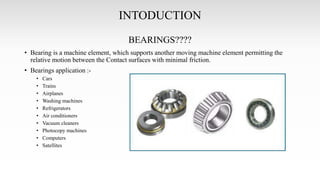
BEARINGS????
• Bearing is a machine element, which supports another moving machine element permitting the
relative motion between the Contact surfaces with minimal friction.
• Bearings application :-
• Cars
• Trains
• Airplanes
• Washing machines
• Refrigerators
• Air conditioners
• Vacuum cleaners
• Photocopy machines
• Computers
• Satellites
INTRODUCTION
BEARING PARTS
BALL BEARING CAGE OUTER RING INNER RING ROLLING ELEMENT
INTRODUCTION
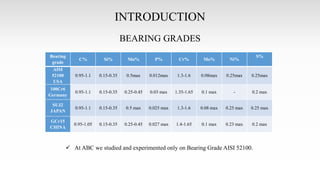
BEARING GRADES
Bearing
grade
C% Si% Mn% P% Cr% Mo% Ni%
S%
AISI
52100
USA
0.95-1.1 0.15-0.35 0.5max 0.012max 1.3-1.6 0.08max 0.25max 0.25max
100Cr6
Germany
0.95-1.1 0.15-0.35 0.25-0.45 0.03 max 1.35-1.65 0.1 max - 0.2 max
SUJ2
JAPAN
0.95-1.1 0.15-0.35 0.5 max 0.025 max 1.3-1.6 0.08 max 0.25 max 0.25 max
GCr15
CHINA
0.95-1.05 0.15-0.35 0.25-0.45 0.027 max 1.4-1.65 0.1 max 0.23 max 0.2 max
 At ABC we studied and experimented only on Bearing Grade AISI 52100.
INTRODUCTION
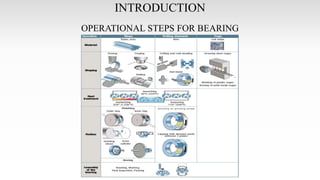
OPERATIONAL STEPS FOR BEARING
INTRODUCTION
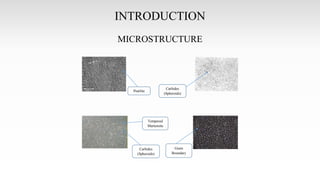
MICROSTRUCTURE
Carbides
(Spheroids)
Pearlite
Carbides
(Spheroids)
Tempered
Martensite
Grain
Boundary
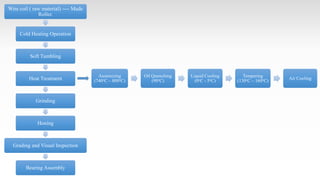
Wire coil ( raw material) ---- Made
Roller.
Cold Heating Operation
Soft Tumbling
Heat Treatment
Grinding
Honing
Grading and Visual Inspection
Bearing Assembly
Austenizing
(740oC – 800oC)
Oil Quenching
(90oC)
Liquid Cooling
(0oC - 5oC)
Tempering
(130oC – 160oC)
Air Cooling
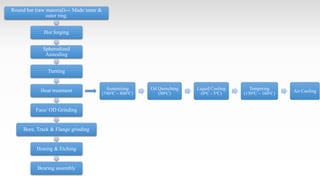
Round bar (raw material)--- Made inner &
outer ring.
Hot forging
Spherodized
Annealing
Turning
Heat treatment
Face/ OD Grinding
Bore, Track & Flange grinding
Honing & Etching
Bearing assembly
Austenizing
(740oC – 800oC)
Oil Quenching
(90oC)
Liquid Cooling
(0oC - 5oC)
Tempering
(130oC – 160oC)
Air Cooling
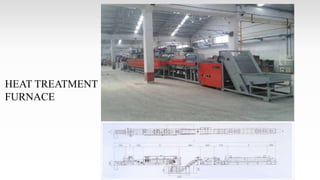
HEAT TREATMENT
FURNACE
HEAT TREATMENT PROCESS
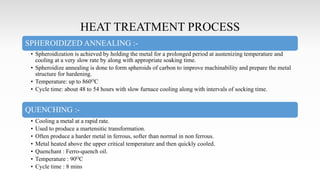
SPHEROIDIZED ANNEALING :-
• Spheroidization is achieved by holding the metal for a prolonged period at austenizing temperature and
cooling at a very slow rate by along with appropriate soaking time.
• Spheroidize annealing is done to form spheroids of carbon to improve machinability and prepare the metal
structure for hardening.
• Temperature: up to 860OC
• Cycle time: about 48 to 54 hours with slow furnace cooling along with intervals of socking time.
QUENCHING :-
• Cooling a metal at a rapid rate.
• Used to produce a martensitic transformation.
• Often produce a harder metal in ferrous, softer than normal in non ferrous.
• Metal heated above the upper critical temperature and then quickly cooled.
• Quenchant : Ferro-quench oil.
• Temperature : 90OC
• Cycle time : 8 mins
HEAT TREATMENT PROCESS (CONT..)
INDUCTION HARDENING :-
• A surface hardening technique.
• Surface of the metal is heated very quickly, using a no-contact method.
• Martensitic transformation at the surface, leaving the underlying metal unchanged after quenching.
• Creates a very hard, wear resistant surface maintaining toughness in the majority of the object.
FLAME HARDENING :-
• Used to harden only a portion of a metal.
• Only a portion of the metal is heated before quenching.
• Often produces an extremely brittle zone between the heated metal and the unheated metal, as cooling at
the edge of this heat affected zone is extremely rapid.
HEAT TREATMENT PROCESS (CONT..)
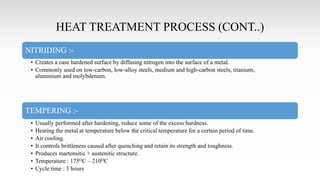
NITRIDING :-
• Creates a case hardened surface by diffusing nitrogen into the surface of a metal.
• Commonly used on low-carbon, low-alloy steels, medium and high-carbon steels, titanium,
aluminium and molybdenum.
TEMPERING :-
• Usually performed after hardening, reduce some of the excess hardness.
• Heating the metal at temperature below the critical temperature for a certain period of time.
• Air cooling.
• It controls brittleness caused after quenching and retain its strength and toughness.
• Produces martensitic + austenitic structure.
• Temperature : 175OC – 210OC
• Cycle time : 3 hours
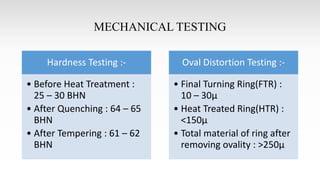
MECHANICAL TESTING
Hardness Testing :-
• Before Heat Treatment :
25 – 30 BHN
• After Quenching : 64 – 65
BHN
• After Tempering : 61 – 62
BHN
Oval Distortion Testing :-
• Final Turning Ring(FTR) :
10 – 30µ
• Heat Treated Ring(HTR) :
<150µ
• Total material of ring after
removing ovality : >250µ
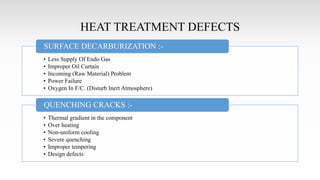
HEAT TREATMENT DEFECTS
• Less Supply Of Endo Gas
• Improper Oil Curtain
• Incoming (Raw Material) Problem
• Power Failure
• Oxygen In F/C. (Disturb Inert Atmosphere)
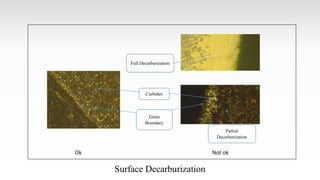
SURFACE DECARBURIZATION :-
• Thermal gradient in the component
• Over heating
• Non-uniform cooling
• Severe quenching
• Improper tempering
• Design defects
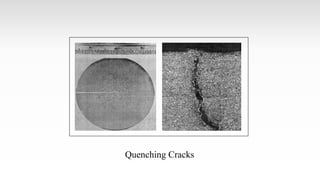
QUENCHING CRACKS :-
Grain
Boundary
Full Decarburization
Partial
Decarburization
Carbides
Ok Not ok
Surface Decarburization
Quenching Cracks
HEAT TREATMENT DEFETS (CONT..)
• Furnace Atmosphere
• Poor Quality Quenching Medium
• Dirty Component Surface
• Defective Initial Microstructure
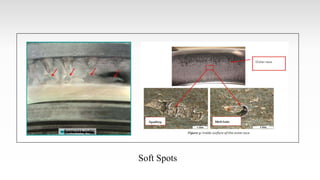
SOFT SPOT :-
• Poor Quality Quenching Medium
• Thermal Gradient before Quenching
• Section Thickness Variation of the Components
• Component’s Shape, Dimensions & Position During Quenching
• Agitation of Quenching Medium
• Initial Microstructure of Material
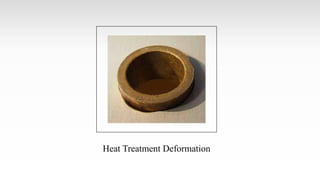
HEAT TREATMENT DEFORMATION :-
Soft Spots
Heat Treatment Deformation
HEAT TREATMENT DEFECTS (CONT..)
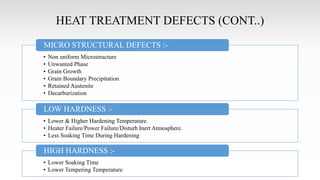
• Non uniform Microstructure
• Unwanted Phase
• Grain Growth
• Grain Boundary Precipitation
• Retained Austenite
• Decarburization
MICRO STRUCTURAL DEFECTS :-
• Lower & Higher Hardening Temperature.
• Heater Failure/Power Failure/Disturb Inert Atmosphere.
• Less Soaking Time During Hardening
LOW HARDNESS :-
• Lower Soaking Time
• Lower Tempering Temperature
HIGH HARDNESS :-
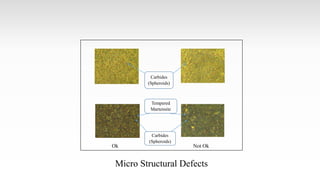
Carbides
(Spheroids)
Carbides
(Spheroids)
Tempered
Martensite
Ok Not Ok
Micro Structural Defects
REMEDIAL MEASURES
Heat Treatment Deformation
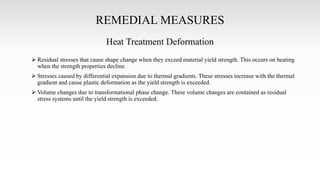
 Residual stresses that cause shape change when they exceed material yield strength. This occurs on heating
when the strength properties decline.
 Stresses caused by differential expansion due to thermal gradients. These stresses increase with the thermal
gradient and cause plastic deformation as the yield strength is exceeded.
 Volume changes due to transformational phase change. These volume changes are contained as residual
stress systems until the yield strength is exceeded.
REMEDIAL MEASURES
OVALITY
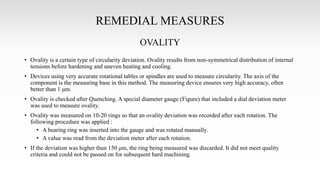
• Ovality is a certain type of circularity deviation. Ovality results from non-symmetrical distribution of internal
tensions before hardening and uneven heating and cooling.
• Devices using very accurate rotational tables or spindles are used to measure circularity. The axis of the
component is the measuring base in this method. The measuring device ensures very high accuracy, often
better than 1 μm.
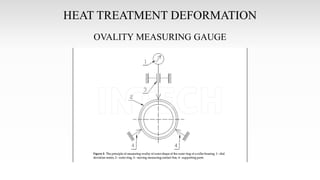
• Ovality is checked after Quenching. A special diameter gauge (Figure) that included a dial deviation meter
was used to measure ovality.
• Ovality was measured on 10-20 rings so that an ovality deviation was recorded after each rotation. The
following procedure was applied :
• A bearing ring was inserted into the gauge and was rotated manually.
• A value was read from the deviation meter after each rotation.
• If the deviation was higher than 150 μm, the ring being measured was discarded. It did not meet quality
criteria and could not be passed on for subsequent hard machining.
HEAT TREATMENT DEFORMATION
OVALITY MEASURING GAUGE
REMEDIAL MEASURE (CONT..)
1. Heat Treatment Deformation:
• Preheating of bearing prior to heat treatment.
• Reduce hardening temperature and slow heating.
• Keeping 5 zone in hardening so that it can achieve required temperature at desired cycle time.
• Rate of cooling after hardening should be less.
• Bolting the ring and re-tempering.
REMEDIAL MEASURES (CONT..)
2. Surface Decarburization :
• By controlling furnace atmosphere, i.e., by generating “Endothermic Gas(Endo Gas)”
and producing it inside furnace and controlling its carbon potential.
• Carbon potential : 0.94% – 0.97%
• This will allow carbon inside bearing to stay in equilibrium with the atmosphere and
there will be no reduction in carbon % from the bearing.
REMEDIAL MEASURES (CONT..)
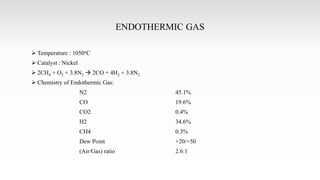
ENDOTHERMIC GAS
Basic Principles:
 To protect the material being processed from surface reaction; i.e., to be chemically inert.
 To allow the surface of the material being processed to change; i.e., to be chemically reactive.
 Endothermic atmosphere is prepared by reacting hydrocarbon gases like methane or propane
and air, in proportion such that there is enough proportion of oxygen to form hydrogen and
carbon monoxide without excess carbon dioxide and water vapors.
ENDOTHERMIC GAS
 Temperature : 1050oC
 Catalyst : Nickel
 2CH4 + O2 + 3.8N2  2CO + 4H2 + 3.8N2
 Chemistry of Endothermic Gas:
N2 45.1%
CO 19.6%
CO2 0.4%
H2 34.6%
CH4 0.3%
Dew Point +20/+50
(Air/Gas) ratio 2.6:1
REMEDIAL MEASURE (CONT..)
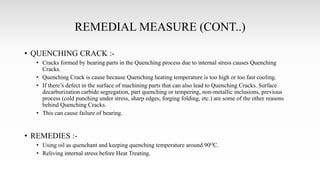
• QUENCHING CRACK :-
• Cracks formed by bearing parts in the Quenching process due to internal stress causes Quenching
Cracks.
• Quenching Crack is cause because Quenching heating temperature is too high or too fast cooling.
• If there’s defect in the surface of machining parts that can also lead to Quenching Cracks. Surface
decarburization carbide segregation, part quenching or tempering, non-metallic inclusions, previous
process (cold punching under stress, sharp edges, forging folding, etc.) are some of the other reasons
behind Quenching Cracks.
• This can cause failure of bearing.
• REMEDIES :-
• Using oil as quenchant and keeping quenching temperature around 90OC.
• Reliving internal stress before Heat Treating.
REMEDIAL MEASURES (CONT..)
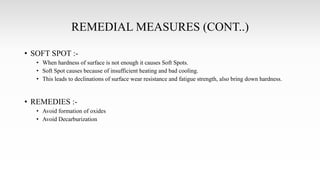
• SOFT SPOT :-
• When hardness of surface is not enough it causes Soft Spots.
• Soft Spot causes because of insufficient heating and bad cooling.
• This leads to declinations of surface wear resistance and fatigue strength, also bring down hardness.
• REMEDIES :-
• Avoid formation of oxides
• Avoid Decarburization
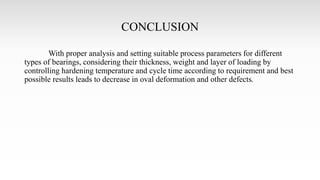
CONCLUSION
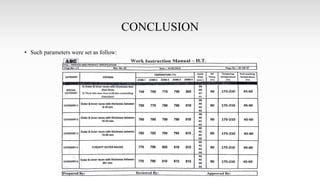
With proper analysis and setting suitable process parameters for different
types of bearings, considering their thickness, weight and layer of loading by
controlling hardening temperature and cycle time according to requirement and best
possible results leads to decrease in oval deformation and other defects.
CONCLUSION
• Such parameters were set as follow:
REFRENCES
• www.abcbearings.com
• www.skf-nsk-bearings.com/news_con_1020.html
• www.brand-bearing.com/news/ykshownews1688.html
• www.nsk.com/services/basicknowledge/introduction.html
• http://snr-ntn.co.uk/INDUSTRY/de/de-de/file.cfm/02-SNR_Bearing_Technology.pdf
• http://thermalscienceapplication.asmedigitalcollection.asme.org/mobile/article.aspx?articleid=1485040
• Web.applied.com/site.cfm/Bearing_Failure_Analysis_operating_Conditions_Typically_Hold_key.cfm
• www.machineparts-blog.com/common-defects-of-bearing-after-heat-treatment/
• www.hellerbearings.com/news-1053.html
• Resources.alibaba.com/topic/800022682/Bearing_heat_treatment_what_are_the_common_quality_defect.htm
l
• www.google.com/paternts/US4023988
REFERENCES (CONT..)
• https://www.passle.net/post/102bwy3/bearing-parts-after-heat-treatment-of-the-common-quality-defects
• www.nmbtc.com/bearings/white-papers/what-is-a-ball-bearing/
• www.oilversteel.com/quench-cracking.htm
• www.intechopen.com/download/pdf/39388 - Deformation Reduction of Bearing Rings by Modification of
Heat Treating by Anton Panda, Jozef Jurko and Iveta Pandová
• www.heat-treat-doctor.com/documents/endothermic%20gas%20generators.pdf
• www.ims.it/ims/ims_spa/cmscontent.nsf/DocumentsByIDWeb/5YWJK7/$File/heat_treatment_defects_TS.pd
f

Heat Treatment Defects and their Remedies

  • 1.
    HEAT TREATMENT DEFECTSON BEARING STEELS INTERNAL GUIDE :- Mrs MINAL DANI EXTERNAL GUIDE :- Mr SHASHIKANT JHA Mr VANRAJ RAJ RUPAPARAARUN(110130121004) MAKKA PALAK(110130121047) MIRAJ PATEL(110130121061)
  • 2.
    CONTENTS • INTRODUCTION • HEATTREATMENT PROCESSES • HEAT TREATMENT DEFECTS IN BEARING • REMEDIAL MEASURES • CONCLUSION • REFERENCES
  • 3.
    INTODUCTION BEARINGS???? • Bearing isa machine element, which supports another moving machine element permitting the relative motion between the Contact surfaces with minimal friction. • Bearings application :- • Cars • Trains • Airplanes • Washing machines • Refrigerators • Air conditioners • Vacuum cleaners • Photocopy machines • Computers • Satellites
  • 4.
    INTRODUCTION BEARING PARTS BALL BEARINGCAGE OUTER RING INNER RING ROLLING ELEMENT
  • 5.
    INTRODUCTION BEARING GRADES Bearing grade C% Si%Mn% P% Cr% Mo% Ni% S% AISI 52100 USA 0.95-1.1 0.15-0.35 0.5max 0.012max 1.3-1.6 0.08max 0.25max 0.25max 100Cr6 Germany 0.95-1.1 0.15-0.35 0.25-0.45 0.03 max 1.35-1.65 0.1 max - 0.2 max SUJ2 JAPAN 0.95-1.1 0.15-0.35 0.5 max 0.025 max 1.3-1.6 0.08 max 0.25 max 0.25 max GCr15 CHINA 0.95-1.05 0.15-0.35 0.25-0.45 0.027 max 1.4-1.65 0.1 max 0.23 max 0.2 max  At ABC we studied and experimented only on Bearing Grade AISI 52100.
  • 6.
  • 7.
  • 8.
    Wire coil (raw material) ---- Made Roller. Cold Heating Operation Soft Tumbling Heat Treatment Grinding Honing Grading and Visual Inspection Bearing Assembly Austenizing (740oC – 800oC) Oil Quenching (90oC) Liquid Cooling (0oC - 5oC) Tempering (130oC – 160oC) Air Cooling
  • 9.
    Round bar (rawmaterial)--- Made inner & outer ring. Hot forging Spherodized Annealing Turning Heat treatment Face/ OD Grinding Bore, Track & Flange grinding Honing & Etching Bearing assembly Austenizing (740oC – 800oC) Oil Quenching (90oC) Liquid Cooling (0oC - 5oC) Tempering (130oC – 160oC) Air Cooling
  • 10.
  • 11.
    HEAT TREATMENT PROCESS SPHEROIDIZEDANNEALING :- • Spheroidization is achieved by holding the metal for a prolonged period at austenizing temperature and cooling at a very slow rate by along with appropriate soaking time. • Spheroidize annealing is done to form spheroids of carbon to improve machinability and prepare the metal structure for hardening. • Temperature: up to 860OC • Cycle time: about 48 to 54 hours with slow furnace cooling along with intervals of socking time. QUENCHING :- • Cooling a metal at a rapid rate. • Used to produce a martensitic transformation. • Often produce a harder metal in ferrous, softer than normal in non ferrous. • Metal heated above the upper critical temperature and then quickly cooled. • Quenchant : Ferro-quench oil. • Temperature : 90OC • Cycle time : 8 mins
  • 12.
    HEAT TREATMENT PROCESS(CONT..) INDUCTION HARDENING :- • A surface hardening technique. • Surface of the metal is heated very quickly, using a no-contact method. • Martensitic transformation at the surface, leaving the underlying metal unchanged after quenching. • Creates a very hard, wear resistant surface maintaining toughness in the majority of the object. FLAME HARDENING :- • Used to harden only a portion of a metal. • Only a portion of the metal is heated before quenching. • Often produces an extremely brittle zone between the heated metal and the unheated metal, as cooling at the edge of this heat affected zone is extremely rapid.
  • 13.
    HEAT TREATMENT PROCESS(CONT..) NITRIDING :- • Creates a case hardened surface by diffusing nitrogen into the surface of a metal. • Commonly used on low-carbon, low-alloy steels, medium and high-carbon steels, titanium, aluminium and molybdenum. TEMPERING :- • Usually performed after hardening, reduce some of the excess hardness. • Heating the metal at temperature below the critical temperature for a certain period of time. • Air cooling. • It controls brittleness caused after quenching and retain its strength and toughness. • Produces martensitic + austenitic structure. • Temperature : 175OC – 210OC • Cycle time : 3 hours
  • 14.
    MECHANICAL TESTING Hardness Testing:- • Before Heat Treatment : 25 – 30 BHN • After Quenching : 64 – 65 BHN • After Tempering : 61 – 62 BHN Oval Distortion Testing :- • Final Turning Ring(FTR) : 10 – 30µ • Heat Treated Ring(HTR) : <150µ • Total material of ring after removing ovality : >250µ
  • 15.
    HEAT TREATMENT DEFECTS •Less Supply Of Endo Gas • Improper Oil Curtain • Incoming (Raw Material) Problem • Power Failure • Oxygen In F/C. (Disturb Inert Atmosphere) SURFACE DECARBURIZATION :- • Thermal gradient in the component • Over heating • Non-uniform cooling • Severe quenching • Improper tempering • Design defects QUENCHING CRACKS :-
  • 16.
  • 17.
  • 18.
    HEAT TREATMENT DEFETS(CONT..) • Furnace Atmosphere • Poor Quality Quenching Medium • Dirty Component Surface • Defective Initial Microstructure SOFT SPOT :- • Poor Quality Quenching Medium • Thermal Gradient before Quenching • Section Thickness Variation of the Components • Component’s Shape, Dimensions & Position During Quenching • Agitation of Quenching Medium • Initial Microstructure of Material HEAT TREATMENT DEFORMATION :-
  • 19.
  • 20.
  • 21.
    HEAT TREATMENT DEFECTS(CONT..) • Non uniform Microstructure • Unwanted Phase • Grain Growth • Grain Boundary Precipitation • Retained Austenite • Decarburization MICRO STRUCTURAL DEFECTS :- • Lower & Higher Hardening Temperature. • Heater Failure/Power Failure/Disturb Inert Atmosphere. • Less Soaking Time During Hardening LOW HARDNESS :- • Lower Soaking Time • Lower Tempering Temperature HIGH HARDNESS :-
  • 22.
  • 23.
    REMEDIAL MEASURES Heat TreatmentDeformation  Residual stresses that cause shape change when they exceed material yield strength. This occurs on heating when the strength properties decline.  Stresses caused by differential expansion due to thermal gradients. These stresses increase with the thermal gradient and cause plastic deformation as the yield strength is exceeded.  Volume changes due to transformational phase change. These volume changes are contained as residual stress systems until the yield strength is exceeded.
  • 24.
    REMEDIAL MEASURES OVALITY • Ovalityis a certain type of circularity deviation. Ovality results from non-symmetrical distribution of internal tensions before hardening and uneven heating and cooling. • Devices using very accurate rotational tables or spindles are used to measure circularity. The axis of the component is the measuring base in this method. The measuring device ensures very high accuracy, often better than 1 μm. • Ovality is checked after Quenching. A special diameter gauge (Figure) that included a dial deviation meter was used to measure ovality. • Ovality was measured on 10-20 rings so that an ovality deviation was recorded after each rotation. The following procedure was applied : • A bearing ring was inserted into the gauge and was rotated manually. • A value was read from the deviation meter after each rotation. • If the deviation was higher than 150 μm, the ring being measured was discarded. It did not meet quality criteria and could not be passed on for subsequent hard machining.
  • 25.
  • 26.
    REMEDIAL MEASURE (CONT..) 1.Heat Treatment Deformation: • Preheating of bearing prior to heat treatment. • Reduce hardening temperature and slow heating. • Keeping 5 zone in hardening so that it can achieve required temperature at desired cycle time. • Rate of cooling after hardening should be less. • Bolting the ring and re-tempering.
  • 27.
    REMEDIAL MEASURES (CONT..) 2.Surface Decarburization : • By controlling furnace atmosphere, i.e., by generating “Endothermic Gas(Endo Gas)” and producing it inside furnace and controlling its carbon potential. • Carbon potential : 0.94% – 0.97% • This will allow carbon inside bearing to stay in equilibrium with the atmosphere and there will be no reduction in carbon % from the bearing.
  • 28.
    REMEDIAL MEASURES (CONT..) ENDOTHERMICGAS Basic Principles:  To protect the material being processed from surface reaction; i.e., to be chemically inert.  To allow the surface of the material being processed to change; i.e., to be chemically reactive.  Endothermic atmosphere is prepared by reacting hydrocarbon gases like methane or propane and air, in proportion such that there is enough proportion of oxygen to form hydrogen and carbon monoxide without excess carbon dioxide and water vapors.
  • 29.
    ENDOTHERMIC GAS  Temperature: 1050oC  Catalyst : Nickel  2CH4 + O2 + 3.8N2  2CO + 4H2 + 3.8N2  Chemistry of Endothermic Gas: N2 45.1% CO 19.6% CO2 0.4% H2 34.6% CH4 0.3% Dew Point +20/+50 (Air/Gas) ratio 2.6:1
  • 30.
    REMEDIAL MEASURE (CONT..) •QUENCHING CRACK :- • Cracks formed by bearing parts in the Quenching process due to internal stress causes Quenching Cracks. • Quenching Crack is cause because Quenching heating temperature is too high or too fast cooling. • If there’s defect in the surface of machining parts that can also lead to Quenching Cracks. Surface decarburization carbide segregation, part quenching or tempering, non-metallic inclusions, previous process (cold punching under stress, sharp edges, forging folding, etc.) are some of the other reasons behind Quenching Cracks. • This can cause failure of bearing. • REMEDIES :- • Using oil as quenchant and keeping quenching temperature around 90OC. • Reliving internal stress before Heat Treating.
  • 31.
    REMEDIAL MEASURES (CONT..) •SOFT SPOT :- • When hardness of surface is not enough it causes Soft Spots. • Soft Spot causes because of insufficient heating and bad cooling. • This leads to declinations of surface wear resistance and fatigue strength, also bring down hardness. • REMEDIES :- • Avoid formation of oxides • Avoid Decarburization
  • 32.
    CONCLUSION With proper analysisand setting suitable process parameters for different types of bearings, considering their thickness, weight and layer of loading by controlling hardening temperature and cycle time according to requirement and best possible results leads to decrease in oval deformation and other defects.
  • 33.
    CONCLUSION • Such parameterswere set as follow:
  • 34.
    REFRENCES • www.abcbearings.com • www.skf-nsk-bearings.com/news_con_1020.html •www.brand-bearing.com/news/ykshownews1688.html • www.nsk.com/services/basicknowledge/introduction.html • http://snr-ntn.co.uk/INDUSTRY/de/de-de/file.cfm/02-SNR_Bearing_Technology.pdf • http://thermalscienceapplication.asmedigitalcollection.asme.org/mobile/article.aspx?articleid=1485040 • Web.applied.com/site.cfm/Bearing_Failure_Analysis_operating_Conditions_Typically_Hold_key.cfm • www.machineparts-blog.com/common-defects-of-bearing-after-heat-treatment/ • www.hellerbearings.com/news-1053.html • Resources.alibaba.com/topic/800022682/Bearing_heat_treatment_what_are_the_common_quality_defect.htm l • www.google.com/paternts/US4023988
  • 35.
    REFERENCES (CONT..) • https://www.passle.net/post/102bwy3/bearing-parts-after-heat-treatment-of-the-common-quality-defects •www.nmbtc.com/bearings/white-papers/what-is-a-ball-bearing/ • www.oilversteel.com/quench-cracking.htm • www.intechopen.com/download/pdf/39388 - Deformation Reduction of Bearing Rings by Modification of Heat Treating by Anton Panda, Jozef Jurko and Iveta Pandová • www.heat-treat-doctor.com/documents/endothermic%20gas%20generators.pdf • www.ims.it/ims/ims_spa/cmscontent.nsf/DocumentsByIDWeb/5YWJK7/$File/heat_treatment_defects_TS.pd f