Sumeet Y Bachhav
TYPESOF HEAT TREATMENT
We have seen that the Heat treatment process involves
mainly three processes. Those are, one is controlled heating,
holding and cooling. By changing Holding time, method of
cooling we can change the mechanical properties of the steel.
We can make the steel softer or harder as we need.
Types of heat treatment processes generally used in
industries.
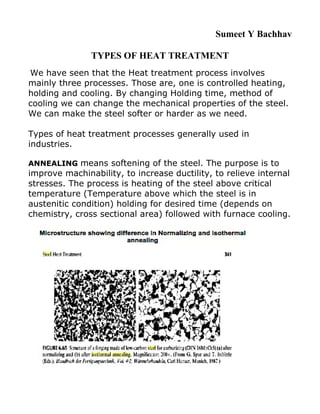
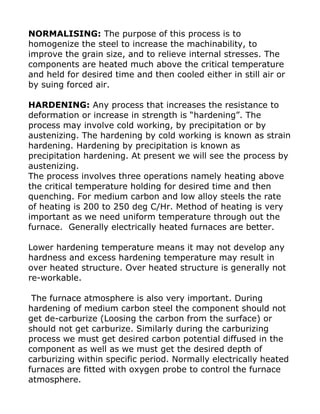
ANNEALING means softening of the steel. The purpose is to
improve machinability, to increase ductility, to relieve internal
stresses. The process is heating of the steel above critical
temperature (Temperature above which the steel is in
austenitic condition) holding for desired time (depends on
chemistry, cross sectional area) followed with furnace cooling.
2.
SPHERODISE ANNEALING: Herewe heat the material
below critical temperature and hold for sufficient long time
and then cool slowly. The purpose is to convert iron carbide in
globular form.
SOLUTION ANNEALING: This process is used to anneal
austenitic grade stainless steel. The parts are heated at
desired temperature, usually at 980 to 1020 deg. C. followed
by quenching in water.
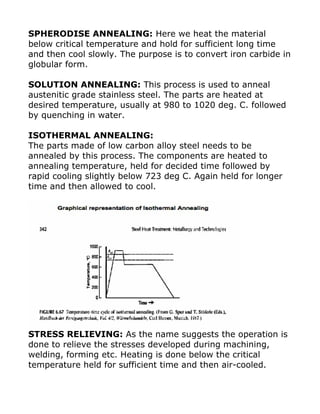
ISOTHERMAL ANNEALING:
The parts made of low carbon alloy steel needs to be
annealed by this process. The components are heated to
annealing temperature, held for decided time followed by
rapid cooling slightly below 723 deg C. Again held for longer
time and then allowed to cool.
STRESS RELIEVING: As the name suggests the operation is
done to relieve the stresses developed during machining,
welding, forming etc. Heating is done below the critical
temperature held for sufficient time and then air-cooled.
3.
NORMALISING: The purposeof this process is to
homogenize the steel to increase the machinability, to
improve the grain size, and to relieve internal stresses. The
components are heated much above the critical temperature
and held for desired time and then cooled either in still air or
by suing forced air.
HARDENING: Any process that increases the resistance to
deformation or increase in strength is “hardening”. The
process may involve cold working, by precipitation or by
austenizing. The hardening by cold working is known as strain
hardening. Hardening by precipitation is known as
precipitation hardening. At present we will see the process by
austenizing.
The process involves three operations namely heating above
the critical temperature holding for desired time and then
quenching. For medium carbon and low alloy steels the rate
of heating is 200 to 250 deg C/Hr. Method of heating is very
important as we need uniform temperature through out the
furnace. Generally electrically heated furnaces are better.
Lower hardening temperature means it may not develop any
hardness and excess hardening temperature may result in
over heated structure. Over heated structure is generally not
re-workable.
The furnace atmosphere is also very important. During
hardening of medium carbon steel the component should not
get de-carburize (Loosing the carbon from the surface) or
should not get carburize. Similarly during the carburizing
process we must get desired carbon potential diffused in the
component as well as we must get the desired depth of
carburizing within specific period. Normally electrically heated
furnaces are fitted with oxygen probe to control the furnace
atmosphere.
4.
The soaking timeis also critical because in case less time
heat shall not penetrate or in case of excess time grain
growth should not take place. The soaking time is calculated
as 1 min per mm of highest thickness, after reaching the
desired temperature.
The tolerance for hardening temperature is normally 20 deg.
C. The temperature loss to still air is to the tune of 10 deg. C
/ sec. Hence the quenching delay is should be as minimum as
possible.
TEMPERING: The purpose of this process is
1. To relieve the stresses developed during quenching
2. To sacrifice some hardness and achieve the desired
toughness
3. To covert the retained austenite in martensite.
5.
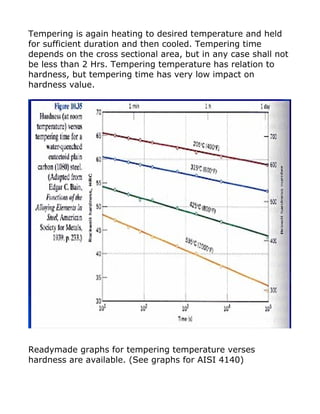
Tempering is againheating to desired temperature and held
for sufficient duration and then cooled. Tempering time
depends on the cross sectional area, but in any case shall not
be less than 2 Hrs. Tempering temperature has relation to
hardness, but tempering time has very low impact on
hardness value.
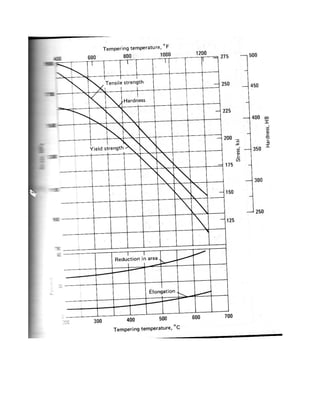
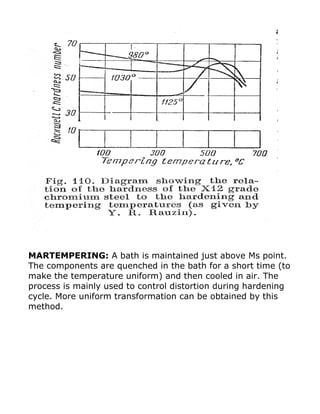
Readymade graphs for tempering temperature verses
hardness are available. (See graphs for AISI 4140)
7.
Tempering process shouldbe done immediately after
quenching. In case of highly alloyed steel such as hot die
steel, die steels, tool steels after quenching we need to
temper the components immediately even without checking
as quench hardness.
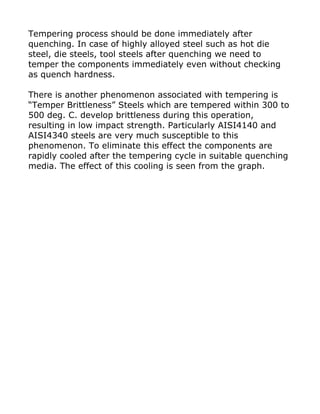
There is another phenomenon associated with tempering is
“Temper Brittleness” Steels which are tempered within 300 to
500 deg. C. develop brittleness during this operation,
resulting in low impact strength. Particularly AISI4140 and
AISI4340 steels are very much susceptible to this
phenomenon. To eliminate this effect the components are
rapidly cooled after the tempering cycle in suitable quenching
media. The effect of this cooling is seen from the graph.
8.
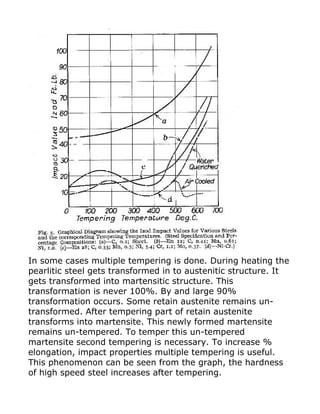
In some casesmultiple tempering is done. During heating the
pearlitic steel gets transformed in to austenitic structure. It
gets transformed into martensitic structure. This
transformation is never 100%. By and large 90%
transformation occurs. Some retain austenite remains un-
transformed. After tempering part of retain austenite
transforms into martensite. This newly formed martensite
remains un-tempered. To temper this un-tempered
martensite second tempering is necessary. To increase %
elongation, impact properties multiple tempering is useful.
This phenomenon can be seen from the graph, the hardness
of high speed steel increases after tempering.
9.
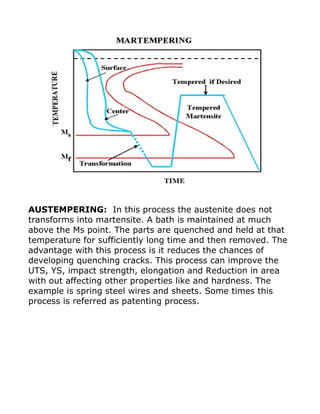
MARTEMPERING: A bathis maintained just above Ms point.
The components are quenched in the bath for a short time (to
make the temperature uniform) and then cooled in air. The
process is mainly used to control distortion during hardening
cycle. More uniform transformation can be obtained by this
method.
10.
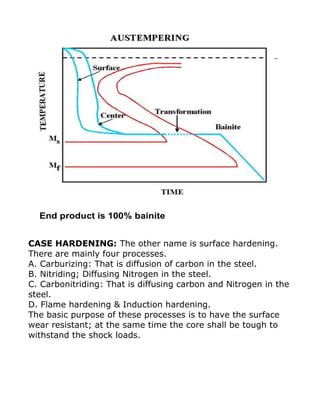
AUSTEMPERING: In thisprocess the austenite does not
transforms into martensite. A bath is maintained at much
above the Ms point. The parts are quenched and held at that
temperature for sufficiently long time and then removed. The
advantage with this process is it reduces the chances of
developing quenching cracks. This process can improve the
UTS, YS, impact strength, elongation and Reduction in area
with out affecting other properties like and hardness. The
example is spring steel wires and sheets. Some times this
process is referred as patenting process.
11.
End product is100% bainite
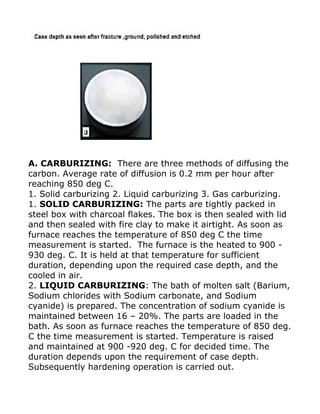
CASE HARDENING: The other name is surface hardening.
There are mainly four processes.
A. Carburizing: That is diffusion of carbon in the steel.
B. Nitriding; Diffusing Nitrogen in the steel.
C. Carbonitriding: That is diffusing carbon and Nitrogen in the
steel.
D. Flame hardening & Induction hardening.
The basic purpose of these processes is to have the surface
wear resistant; at the same time the core shall be tough to
withstand the shock loads.
12.
A. CARBURIZING: Thereare three methods of diffusing the
carbon. Average rate of diffusion is 0.2 mm per hour after
reaching 850 deg C.
1. Solid carburizing 2. Liquid carburizing 3. Gas carburizing.
1. SOLID CARBURIZING: The parts are tightly packed in
steel box with charcoal flakes. The box is then sealed with lid
and then sealed with fire clay to make it airtight. As soon as
furnace reaches the temperature of 850 deg C the time
measurement is started. The furnace is the heated to 900 -
930 deg. C. It is held at that temperature for sufficient
duration, depending upon the required case depth, and the
cooled in air.
2. LIQUID CARBURIZING: The bath of molten salt (Barium,
Sodium chlorides with Sodium carbonate, and Sodium
cyanide) is prepared. The concentration of sodium cyanide is
maintained between 16 – 20%. The parts are loaded in the
bath. As soon as furnace reaches the temperature of 850 deg.
C the time measurement is started. Temperature is raised
and maintained at 900 -920 deg. C for decided time. The
duration depends upon the requirement of case depth.
Subsequently hardening operation is carried out.
13.
3. GAS CARBURIZING:The either the gas (Iso-propane) is
purged in side the furnace, or Mixture of Methanol and any
reach hydrocarbon(Isopropyl alcohol or Acetone) is purged
and cracked inside the furnace. This cracking of gas or
organic chemical generates nascent carbon above 850 deg. C.
As soon as furnace reaches the temperature of 850 deg. C the
time measurement is started. The actual process temperature
is 900 to 920 deg. C. The parts are kept in side the furnace
and gas circulates around the parts. The nascent carbon is
absorbed in steel.
B. NITRIDING: This process is used to produce hardest
surface, to improve the wear resistance. There are two
methods
1. Liquid Nitriding
2. Gas Nitriding.
In case of liquid Nitriding potassium cyanide is used. The
parts are immersed in molten bath of potassium cyanide. The
ratio of cyanide and cyanate is maintained. The parts are held
for sufficient time, depending upon the desired case depth.
This method is rarely used as it involves handling of highly
poisonous chemicals. There are few proprietary processes
developed such as Tufftride done in molten salt at 530 to 560
deg. C. The Sursulf process is done in molten salt at 560 to
580 deg. C.
In case of gas Nitriding process the parts are held in
nitrogenous atmosphere. Nascent nitrogen is generated by
cracking Ammonia gas in side the furnace. This nascent
Nitrogen reacts with the steel and forms the hardest
compound, Ferric Nitride.
In case of Nitriding the temperature is low (550 deg. C).
Quenching is not required. Low case depth is sufficient to
produce higher wear resistant surface. Low temperature and
14.
quenching less processhence there is less distortion during
this treatment.
C. Carbonitriding: Parts are kept in the furnace in presence
of Methane and ammonia (generally 15%) and operating
temperature is 800 to 840 deg C. Parts are directly quenched
to achieve the hardness. This process is used mainly for auto
components.
D. Flame hardening: It is a selective hardening process. The
selected portion of the part is heated by using gas flame and
then quenched in quenching media.
E. Induction hardening: The high frequency, low voltage
current is passed through the coil. The part is kept inside the
coil without touching the coil. Due to induced e.m.f. the eddy
currents are generated within the material. The heating takes
place because the material offers the resistance to flow of
current. By controlling frequency, time for heating and by
proper design of coil we can control the depth of hardening.
There are two methods of Induction hardening 1. Single shot
2. Progressive.
Case Depth
required in mm
Frequency
cycles/sec
Power input.
w/mm2
1 – 2 50000 to 60000 5 to 10
2 – 3 10000 to 15000 10 to 20
PRECIPITATION HARDENING: The materials, which are in
the state of solid solution, at room temperature. This solid
solution is in super saturated condition. Decomposition of this
solid solution increases the strength of the material. So this
decomposition is done by heating the component at decided
heating rate to it’s precipitation temperature, held for
sufficiently long time and allowed to cool at decided rate. This
15.
process is knownas “precipitation hardening”, Example is
17-4 PH steel.
STRAIN HARDENING: Also termed as work hardening.
The material develops the hardness by cold working.
SUB ZERO TREATMENT: It is observed that after heat
treatment 100% transformation of austenite to martensite is
not possible. Some austenite remains un transformed
condition. The disadvantages of this retained austenite are
1. It has low hardness; 2.It is non-magnetic, 3. It transforms
with respect to time hence dimensional changes occurs.
Sub zero treatment is used for transforming this retained
austenite. The parts are kept in a insulated box containing
ice, acetone mixture or dry ice. The temperature of sub zero
treatment varies as per the grade of steel. Example is steel
used for manufacturing measuring instruments SS410 or
SS420.
DE-HYDROGEN EMBRITTLEMENT: This process is used to
remove the Hydrogen atoms, which have penetrated inside
the material during electrolysis, acid cleaning etc.
The process is to heat the components after plating before
passivation to 200 +/- 10 deg. C and held for long time. The
minimum time is 4 Hrs.
DIFFUSION METALLISING: Apart from the surface
hardening processes some times other methods are used to
saturate the surface of the steel with different metals. Most
common are Aluminum, Chromium, & silicon.
Aluminum diffusion is used to increase the scale resistance of
the steel. The steel parts are packed in a box containing
aluminum powder, aluminum oxide and fluxes. The part are
heated to 950deg C and held for sufficient time depending
16.
upon the depthof diffusion required. Such articles are capable
to with stand higher temperatures without oxidation.
Chromium diffusion is used to increase the corrosion
resistance. Silicon is diffused to increase the resistance to
attack of the acids.
CRYOGENIC TREATMENT: This treatment is used mainly for
alloy steels to increase the wear resistance and toughness.
This is achieved by complete martensitic transformation and
uniform precipitation of fine carbides. The process involves
cooling within the temperature range of -120 to -195 Deg. C.
We can see the difference in wear pattern from the figure
below.