Introduction
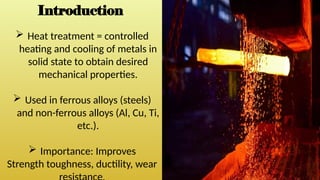
Heat treatment= controlled
heating and cooling of metals in
solid state to obtain desired
mechanical properties.
Used in ferrous alloys (steels)
and non-ferrous alloys (Al, Cu, Ti,
etc.).
Importance: Improves
Strength toughness, ductility, wear
3.
Objectives of Heat
Treatment
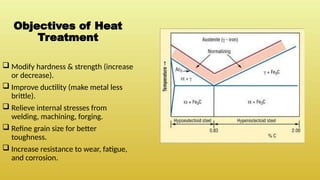
Modify hardness & strength (increase
or decrease).
Improve ductility (make metal less
brittle).
Relieve internal stresses from
welding, machining, forging.
Refine grain size for better
toughness.
Increase resistance to wear, fatigue,
and corrosion.
4.
Basic Heat
Treatment Cycle
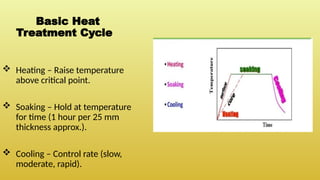
Heating – Raise temperature
above critical point.
Soaking – Hold at temperature
for time (1 hour per 25 mm
thickness approx.).
Cooling – Control rate (slow,
moderate, rapid).
5.
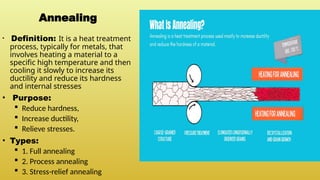
Annealing
• Definition: Itis a heat treatment
process, typically for metals, that
involves heating a material to a
specific high temperature and then
cooling it slowly to increase its
ductility and reduce its hardness
and internal stresses
• Purpose:
Reduce hardness,
Increase ductility,
Relieve stresses.
• Types:
1. Full annealing
2. Process annealing
3. Stress-relief annealing
6.
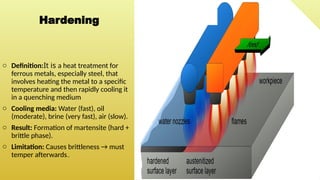
Hardening
o Definition:It isa heat treatment for
ferrous metals, especially steel, that
involves heating the metal to a specific
temperature and then rapidly cooling it
in a quenching medium
o Cooling media: Water (fast), oil
(moderate), brine (very fast), air (slow).
o Result: Formation of martensite (hard +
brittle phase).
o Limitation: Causes brittleness → must
temper afterwards..
7.
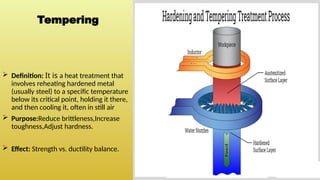
Tempering
Definition: Itis a heat treatment that
involves reheating hardened metal
(usually steel) to a specific temperature
below its critical point, holding it there,
and then cooling it, often in still air
Purpose:Reduce brittleness,Increase
toughness,Adjust hardness.
Effect: Strength vs. ductility balance.
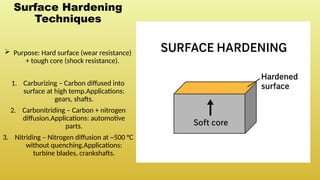
Surface Hardening
Techniques
Purpose:Hard surface (wear resistance)
+ tough core (shock resistance).
1. Carburizing – Carbon diffused into
surface at high temp.Applications:
gears, shafts.
2. Carbonitriding – Carbon + nitrogen
diffusion.Applications: automotive
parts.
3. Nitriding – Nitrogen diffusion at ~500 °C
without quenching.Applications:
turbine blades, crankshafts.
10.
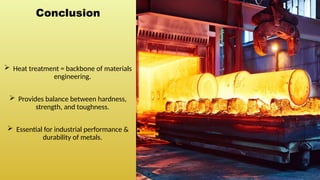
Conclusion
Heat treatment= backbone of materials
engineering.
Provides balance between hardness,
strength, and toughness.
Essential for industrial performance &
durability of metals.
11.
THANK YOU
Presented By:
M.Kranthi kumar(24071A2438)
V. Manikanth (24071A2458)
Y. Hanish (24071A2462)
K. Trishanth(25075A2402)