1. Describes in basic terms, the following heat-treatment
   processes:
   - tempering
   - annealing
   - normalizing
   - hardening
2. Explains, indicates why the processes in the above objectives
   are used
3. States how low-carbon steels can be given a hard case
4. States why low-carbon steels are sometimes given a hard case
5. Describes in basic terms a suitable heat-treatment process for
   common steels, given the properties required
Various types of heat treatment processes are used to
change the following properties or conditions of the
steel:

•   Improve the toughness
•   Increase the hardness
•   Increase the ductility
•   Improve the machinability
•   Refine the grain structure
•   Remove the residual stresses
•   Improve the wear resistance
The Hardening Processes
Steels can be heat treated to high hardness and strength levels. The
reasons for doing this are obvious. Structural components subjected
to high operating stress need the high strength of a hardened
structure. Similarly, tools such as dies, knives, cutting devices, and
forming devices need a hardened structure to resist wear and
deformation.

Quenching
In this process steels which contain sufficient carbon, and perhaps
other alloying elements, are cooled sufficiently rapidly from above
the transformation temperature to produce Martensite.

There is a range of quenching media of varying severity, water or
brine being the most severe, through oil and synthetic products to air
which is the least severe.
Tempering
After quenching the steel is hard, brittle and internally stressed. Before
use, it is usually necessary to reduce these stresses and increase
toughness by 'tempering'. There will also be a reduction in hardness
and the selection of tempering temperature dictates the final
properties.

As a rule of thumb, within the tempering range for a particular steel,
the higher the tempering temperature the lower the final hardness but
the greater the toughness.

Note:
In general terms, if steel is heated until it glows red and is
quenched in clean water immediately, it becomes very hard but
also brittle. This means it is likely to break or snap if put under
great pressure. On the other hand, if the red hot steel is allowed to
cool slowly, the resulting steel will be easier to cut, shape and file
as it will be relatively soft.
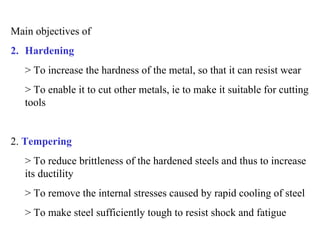
Main objectives of
2. Hardening
   > To increase the hardness of the metal, so that it can resist wear
   > To enable it to cut other metals, ie to make it suitable for cutting
   tools


2. Tempering
   > To reduce brittleness of the hardened steels and thus to increase
   its ductility
   > To remove the internal stresses caused by rapid cooling of steel
   > To make steel sufficiently tough to resist shock and fatigue
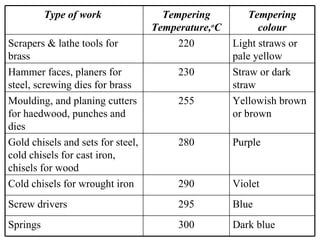
Type of work               Tempering          Tempering
                                   Temperature,oC         colour
Scrapers & lathe tools for              220         Light straws or
brass                                               pale yellow
Hammer faces, planers for               230         Straw or dark
steel, screwing dies for brass                      straw
Moulding, and planing cutters           255         Yellowish brown
for haedwood, punches and                           or brown
dies
Gold chisels and sets for steel,        280         Purple
cold chisels for cast iron,
chisels for wood
Cold chisels for wrought iron           290         Violet
Screw drivers                           295         Blue
Springs                                 300         Dark blue
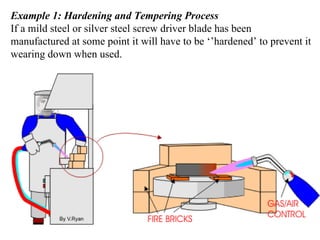
Example 1: Hardening and Tempering Process
If a mild steel or silver steel screw driver blade has been
manufactured at some point it will have to be ‘’hardened’ to prevent it
wearing down when used.
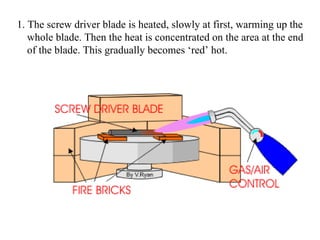
1. The screw driver blade is heated, slowly at first, warming up the
   whole blade. Then the heat is concentrated on the area at the end
   of the blade. This gradually becomes ‘red’ hot.
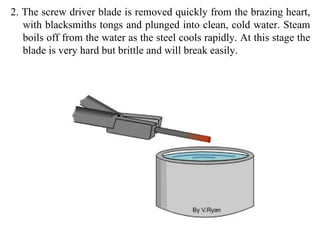
2. The screw driver blade is removed quickly from the brazing heart,
   with blacksmiths tongs and plunged into clean, cold water. Steam
   boils off from the water as the steel cools rapidly. At this stage the
   blade is very hard but brittle and will break easily.
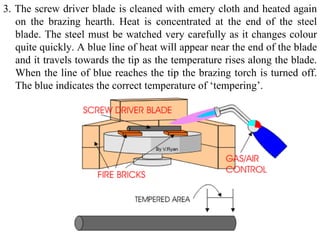
3. The screw driver blade is cleaned with emery cloth and heated again
   on the brazing hearth. Heat is concentrated at the end of the steel
   blade. The steel must be watched very carefully as it changes colour
   quite quickly. A blue line of heat will appear near the end of the blade
   and it travels towards the tip as the temperature rises along the blade.
   When the line of blue reaches the tip the brazing torch is turned off.
   The blue indicates the correct temperature of ‘tempering’.
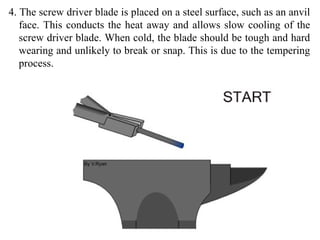
4. The screw driver blade is placed on a steel surface, such as an anvil
   face. This conducts the heat away and allows slow cooling of the
   screw driver blade. When cold, the blade should be tough and hard
   wearing and unlikely to break or snap. This is due to the tempering
   process.
Example 2: Case Hardening of Mild Steel

Case hardening is a simple method of hardening steel. It is less
complex than hardening and tempering.

This techniques is used for steels with a low carbon content.
Carbon is added to the outer surface of the steel, to a depth of
approximately 0.03mm.

One advantage of this method of hardening steel is that the inner
core is left untouched and so still processes properties such as
flexibility and is still relatively soft.
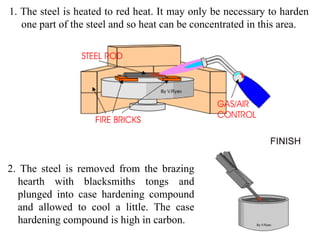
1. The steel is heated to red heat. It may only be necessary to harden
   one part of the steel and so heat can be concentrated in this area.


2. The steel is removed from the brazing
  hearth with blacksmiths tongs and
  plunged into case hardening compound
  and allowed to cool a little. The case
  hardening compound is high in carbon.
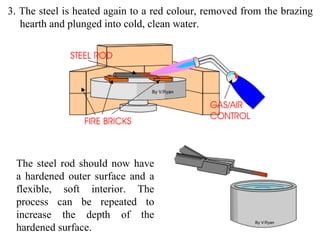
3. The steel is heated again to a red colour, removed from the brazing
   hearth and plunged into cold, clean water.


 The steel rod should now have
 a hardened outer surface and a
 flexible, soft interior. The
 process can be repeated to
 increase the depth of the
 hardened surface.
The Softening Processes
Hardening is reversible. If a hardened tool needs to be remachined, it
may be softened by heat treatment to return it to its machinable
condition. Most steels weld better in their soft state than in their
hardened state; softening may be used to aid weldability.

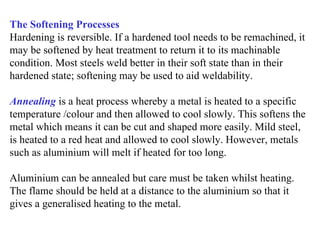
Annealing is a heat process whereby a metal is heated to a specific
temperature /colour and then allowed to cool slowly. This softens the
metal which means it can be cut and shaped more easily. Mild steel,
is heated to a red heat and allowed to cool slowly. However, metals
such as aluminium will melt if heated for too long.

Aluminium can be annealed but care must be taken whilst heating.
The flame should be held at a distance to the aluminium so that it
gives a generalised heating to the metal.
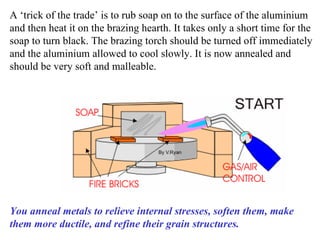
A ‘trick of the trade’ is to rub soap on to the surface of the aluminium
and then heat it on the brazing hearth. It takes only a short time for the
soap to turn black. The brazing torch should be turned off immediately
and the aluminium allowed to cool slowly. It is now annealed and
should be very soft and malleable.


You anneal metals to relieve internal stresses, soften them, make
them more ductile, and refine their grain structures.
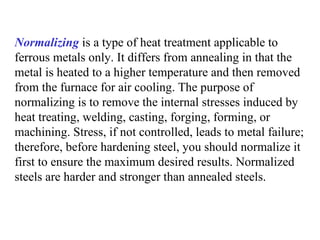
Normalizing is a type of heat treatment applicable to
ferrous metals only. It differs from annealing in that the
metal is heated to a higher temperature and then removed
from the furnace for air cooling. The purpose of
normalizing is to remove the internal stresses induced by
heat treating, welding, casting, forging, forming, or
machining. Stress, if not controlled, leads to metal failure;
therefore, before hardening steel, you should normalize it
first to ensure the maximum desired results. Normalized
steels are harder and stronger than annealed steels.
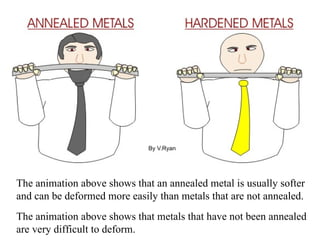
The animation above shows that an annealed metal is usually softer
and can be deformed more easily than metals that are not annealed.
The animation above shows that metals that have not been annealed
are very difficult to deform.
Annealed metals are relatively soft and can be cut and shaped more
easily. They bend easily when pressure is applied. As a rule they are
heated and allowed to cool slowly.


Hardened metals are difficult to cut and shape. They are very
difficult if not impossible to bend. As a rule they are heated and
cooled very quickly by quenching in clean, cold water.
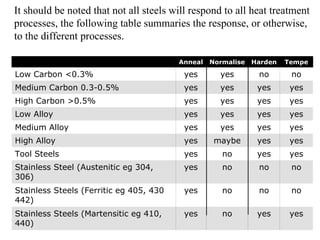
It should be noted that not all steels will respond to all heat treatment
processes, the following table summaries the response, or otherwise,
to the different processes.

                                         Anneal   Normalise   Harden   Tempe
                                                                         r
Low Carbon <0.3%                          yes       yes        no       no
Medium Carbon 0.3-0.5%                    yes       yes        yes      yes
High Carbon >0.5%                         yes       yes        yes      yes
Low Alloy                                 yes       yes        yes      yes
Medium Alloy                              yes       yes        yes      yes
High Alloy                                yes      maybe       yes      yes
Tool Steels                               yes        no        yes      yes
Stainless Steel (Austenitic eg 304,       yes        no        no       no
306)
Stainless Steels (Ferritic eg 405, 430    yes        no        no       no
442)
Stainless Steels (Martensitic eg 410,     yes        no        yes      yes
440)
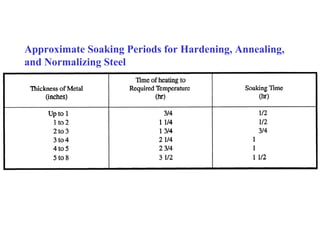
Approximate Soaking Periods for Hardening, Annealing,
and Normalizing Steel
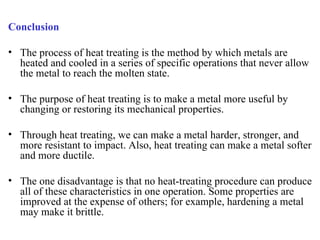
Conclusion

• The process of heat treating is the method by which metals are
  heated and cooled in a series of specific operations that never allow
  the metal to reach the molten state.

• The purpose of heat treating is to make a metal more useful by
  changing or restoring its mechanical properties.

• Through heat treating, we can make a metal harder, stronger, and
  more resistant to impact. Also, heat treating can make a metal softer
  and more ductile.

• The one disadvantage is that no heat-treating procedure can produce
  all of these characteristics in one operation. Some properties are
  improved at the expense of others; for example, hardening a metal
  may make it brittle.
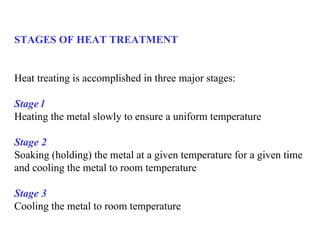
STAGES OF HEAT TREATMENT


Heat treating is accomplished in three major stages:

Stage l
Heating the metal slowly to ensure a uniform temperature

Stage 2
Soaking (holding) the metal at a given temperature for a given time
and cooling the metal to room temperature

Stage 3
Cooling the metal to room temperature

Ms chapter 2

  • 1.
    1. Describes inbasic terms, the following heat-treatment processes: - tempering - annealing - normalizing - hardening 2. Explains, indicates why the processes in the above objectives are used 3. States how low-carbon steels can be given a hard case 4. States why low-carbon steels are sometimes given a hard case 5. Describes in basic terms a suitable heat-treatment process for common steels, given the properties required
  • 2.
    Various types ofheat treatment processes are used to change the following properties or conditions of the steel: • Improve the toughness • Increase the hardness • Increase the ductility • Improve the machinability • Refine the grain structure • Remove the residual stresses • Improve the wear resistance
  • 3.
    The Hardening Processes Steelscan be heat treated to high hardness and strength levels. The reasons for doing this are obvious. Structural components subjected to high operating stress need the high strength of a hardened structure. Similarly, tools such as dies, knives, cutting devices, and forming devices need a hardened structure to resist wear and deformation. Quenching In this process steels which contain sufficient carbon, and perhaps other alloying elements, are cooled sufficiently rapidly from above the transformation temperature to produce Martensite. There is a range of quenching media of varying severity, water or brine being the most severe, through oil and synthetic products to air which is the least severe.
  • 4.
    Tempering After quenching thesteel is hard, brittle and internally stressed. Before use, it is usually necessary to reduce these stresses and increase toughness by 'tempering'. There will also be a reduction in hardness and the selection of tempering temperature dictates the final properties. As a rule of thumb, within the tempering range for a particular steel, the higher the tempering temperature the lower the final hardness but the greater the toughness. Note: In general terms, if steel is heated until it glows red and is quenched in clean water immediately, it becomes very hard but also brittle. This means it is likely to break or snap if put under great pressure. On the other hand, if the red hot steel is allowed to cool slowly, the resulting steel will be easier to cut, shape and file as it will be relatively soft.
  • 5.
    Main objectives of 2.Hardening > To increase the hardness of the metal, so that it can resist wear > To enable it to cut other metals, ie to make it suitable for cutting tools 2. Tempering > To reduce brittleness of the hardened steels and thus to increase its ductility > To remove the internal stresses caused by rapid cooling of steel > To make steel sufficiently tough to resist shock and fatigue
  • 6.
    Type of work Tempering Tempering Temperature,oC colour Scrapers & lathe tools for 220 Light straws or brass pale yellow Hammer faces, planers for 230 Straw or dark steel, screwing dies for brass straw Moulding, and planing cutters 255 Yellowish brown for haedwood, punches and or brown dies Gold chisels and sets for steel, 280 Purple cold chisels for cast iron, chisels for wood Cold chisels for wrought iron 290 Violet Screw drivers 295 Blue Springs 300 Dark blue
  • 7.
    Example 1: Hardeningand Tempering Process If a mild steel or silver steel screw driver blade has been manufactured at some point it will have to be ‘’hardened’ to prevent it wearing down when used.
  • 8.
    1. The screwdriver blade is heated, slowly at first, warming up the whole blade. Then the heat is concentrated on the area at the end of the blade. This gradually becomes ‘red’ hot.
  • 9.
    2. The screwdriver blade is removed quickly from the brazing heart, with blacksmiths tongs and plunged into clean, cold water. Steam boils off from the water as the steel cools rapidly. At this stage the blade is very hard but brittle and will break easily.
  • 10.
    3. The screwdriver blade is cleaned with emery cloth and heated again on the brazing hearth. Heat is concentrated at the end of the steel blade. The steel must be watched very carefully as it changes colour quite quickly. A blue line of heat will appear near the end of the blade and it travels towards the tip as the temperature rises along the blade. When the line of blue reaches the tip the brazing torch is turned off. The blue indicates the correct temperature of ‘tempering’.
  • 11.
    4. The screwdriver blade is placed on a steel surface, such as an anvil face. This conducts the heat away and allows slow cooling of the screw driver blade. When cold, the blade should be tough and hard wearing and unlikely to break or snap. This is due to the tempering process.
  • 12.
    Example 2: CaseHardening of Mild Steel Case hardening is a simple method of hardening steel. It is less complex than hardening and tempering. This techniques is used for steels with a low carbon content. Carbon is added to the outer surface of the steel, to a depth of approximately 0.03mm. One advantage of this method of hardening steel is that the inner core is left untouched and so still processes properties such as flexibility and is still relatively soft.
  • 13.
    1. The steelis heated to red heat. It may only be necessary to harden one part of the steel and so heat can be concentrated in this area. 2. The steel is removed from the brazing hearth with blacksmiths tongs and plunged into case hardening compound and allowed to cool a little. The case hardening compound is high in carbon.
  • 14.
    3. The steelis heated again to a red colour, removed from the brazing hearth and plunged into cold, clean water. The steel rod should now have a hardened outer surface and a flexible, soft interior. The process can be repeated to increase the depth of the hardened surface.
  • 15.
    The Softening Processes Hardeningis reversible. If a hardened tool needs to be remachined, it may be softened by heat treatment to return it to its machinable condition. Most steels weld better in their soft state than in their hardened state; softening may be used to aid weldability. Annealing is a heat process whereby a metal is heated to a specific temperature /colour and then allowed to cool slowly. This softens the metal which means it can be cut and shaped more easily. Mild steel, is heated to a red heat and allowed to cool slowly. However, metals such as aluminium will melt if heated for too long. Aluminium can be annealed but care must be taken whilst heating. The flame should be held at a distance to the aluminium so that it gives a generalised heating to the metal.
  • 16.
    A ‘trick ofthe trade’ is to rub soap on to the surface of the aluminium and then heat it on the brazing hearth. It takes only a short time for the soap to turn black. The brazing torch should be turned off immediately and the aluminium allowed to cool slowly. It is now annealed and should be very soft and malleable. You anneal metals to relieve internal stresses, soften them, make them more ductile, and refine their grain structures.
  • 17.
    Normalizing is atype of heat treatment applicable to ferrous metals only. It differs from annealing in that the metal is heated to a higher temperature and then removed from the furnace for air cooling. The purpose of normalizing is to remove the internal stresses induced by heat treating, welding, casting, forging, forming, or machining. Stress, if not controlled, leads to metal failure; therefore, before hardening steel, you should normalize it first to ensure the maximum desired results. Normalized steels are harder and stronger than annealed steels.
  • 18.
    The animation aboveshows that an annealed metal is usually softer and can be deformed more easily than metals that are not annealed. The animation above shows that metals that have not been annealed are very difficult to deform.
  • 19.
    Annealed metals arerelatively soft and can be cut and shaped more easily. They bend easily when pressure is applied. As a rule they are heated and allowed to cool slowly. Hardened metals are difficult to cut and shape. They are very difficult if not impossible to bend. As a rule they are heated and cooled very quickly by quenching in clean, cold water.
  • 20.
    It should benoted that not all steels will respond to all heat treatment processes, the following table summaries the response, or otherwise, to the different processes. Anneal Normalise Harden Tempe r Low Carbon <0.3% yes yes no no Medium Carbon 0.3-0.5% yes yes yes yes High Carbon >0.5% yes yes yes yes Low Alloy yes yes yes yes Medium Alloy yes yes yes yes High Alloy yes maybe yes yes Tool Steels yes no yes yes Stainless Steel (Austenitic eg 304, yes no no no 306) Stainless Steels (Ferritic eg 405, 430 yes no no no 442) Stainless Steels (Martensitic eg 410, yes no yes yes 440)
  • 21.
    Approximate Soaking Periodsfor Hardening, Annealing, and Normalizing Steel
  • 22.
    Conclusion • The processof heat treating is the method by which metals are heated and cooled in a series of specific operations that never allow the metal to reach the molten state. • The purpose of heat treating is to make a metal more useful by changing or restoring its mechanical properties. • Through heat treating, we can make a metal harder, stronger, and more resistant to impact. Also, heat treating can make a metal softer and more ductile. • The one disadvantage is that no heat-treating procedure can produce all of these characteristics in one operation. Some properties are improved at the expense of others; for example, hardening a metal may make it brittle.
  • 23.
    STAGES OF HEATTREATMENT Heat treating is accomplished in three major stages: Stage l Heating the metal slowly to ensure a uniform temperature Stage 2 Soaking (holding) the metal at a given temperature for a given time and cooling the metal to room temperature Stage 3 Cooling the metal to room temperature