Effective Question and Reacting
Techniques
Report: Frelien G. Doctor
Types of Question according to Purpose
The kind of question we ask varies according to
purpose. Here are some:
For Assessing Cognition
This type of question is used to determine
one’s knowledge in understanding. They
promote high level of thinking. Divergent
questions and open-ended inquiries call for
analysis and evaluation.
Example:
• What is likely to happen if the ozone layer of
the atmosphere continues to deteriorate?
• Why is some sound heard louder when
underwater than out of it?
For Verification
It determines the exactness or accuracy of
the results of an activity or performance.
Example:
 Was the weight of liquid displaced exactly the
same as the weight of object immersed in it?
 Why is lightning seen before thunder is
heard?
For Creative Thinking
It probes into one’s originality.
Example:
How will you present the layers of the earth to
your class? Simulate the eruption of Mt. Mayon.
The question may ask for pupils’ own ideas or
new ways of doing things.
Example:
How can you demonstrate soil-less gardening?
For Evaluating
It elicits responses the include judgments,
value and choice. It also asks personal opinions
about an event, a policy or a person.
Example:
Was your teacher’s slide presentation well
done?
For Productive Thinking
It includes cognitive reasoning. It
analyses facts, recognized pattern or trends
and invokes memory and recall.
Example:
Why was our fourth secretary of the
department of agriculture successful with the
small landowners? How can we apply the Law
of Conservation of Energy?
For Motivating
Before discussing the lesson, a
number of questions about the topic can
serve to arouse their interest and focus
attention. It attempts to put students in the
mood.
Example:
Would you like to know your favorite
flower can remain fresh longer? Did you
ever train a pet?
For Instructing
The question asks for useful
information. It directs, guides and advises
on what and how to do an activity.
Example:
What are the steps in performing an
experiment?
As to level, question can either be low or high
level.
Types of Questions According to
Level/ Answer
Low Level Questions
They include memory questions or
those that require simple recall.
Example:
Define energy. State the first law of
motion.
High Level Question
These question call for a respondent’s
ability to analyze, evaluate and solve
problems.
Example:
 What is the relationship between the
distance of a planet and its period of
revolution?
 Why does temperature rise towards
noontime?
Convergent Questions
They are questions the require a single
predictable answer.
Example are those that call
for:1.defining,2. stating, 3. interpreting 4.
summarizing.
Examples: when does lunar eclipse occur?
Divergent Questions
They require the respondents to think in
“different directions”, to think of alternative
actions or to arrive at own decision. there are
several possible answers.
Example:
Why are you voting for him?
What will happen if you leave it under direct
sunlight for a week?
Class interact is dependent on your
questioning skills.
What skills should you require to generate
interaction among your students?
Questioning Skills
1.Varying types of question. Ask
convergent and evaluative questions.
Convergent questions have only one
acceptable correct answer.
Example:
“what is the process of food manufacture
that takes place in plants called?
2.Asking non-direct questions. Pose the
question first, then call on a student. Don’t
direct your question to just one student. Direct
the question to all.
3. Calling on non-volunteers. Don’t just call on
those who raise their hands.
4. rephrasing. If you sense a question was not
understood, simply it or ask it in another way.
5. Sequencing logically. It is asking related
question from simple to complex one after
another.
6.Requiring abstract thinking. This means going
beyond simple recall questions. Example of
questions that require abstract thinking is “what
meaning can you derive from the data presented
in the graph? What generation can you draw
from the data presented?
7. Asking open-ended questions. This means
asking divergent questions to develop higher-
order- thinking skills.
8.Allowing for sufficient wait time. Wait time
refers to the pause needed by the teacher after
asking a question. This is the time wait when
she waits for answer. A number if things to
consider are:a.)the level of difficulty of the
question, b.)the type of response required, c.)the
background knowledge of the respondents and
d.)the intellectual ability of the respondents.
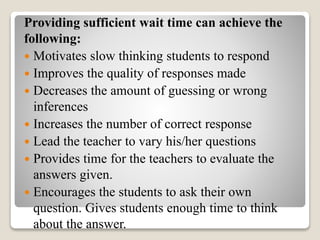
Providing sufficient wait time can achieve the
following:
 Motivates slow thinking students to respond
 Improves the quality of responses made
 Decreases the amount of guessing or wrong
inferences
 Increases the number of correct response
 Lead the teacher to vary his/her questions
 Provides time for the teachers to evaluate the
answers given.
 Encourages the students to ask their own
question. Gives students enough time to think
about the answer.
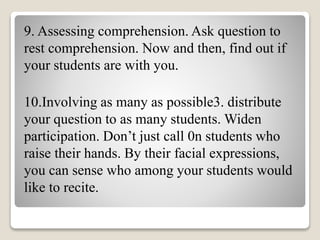
9. Assessing comprehension. Ask question to
rest comprehension. Now and then, find out if
your students are with you.
10.Involving as many as possible3. distribute
your question to as many students. Widen
participation. Don’t just call 0n students who
raise their hands. By their facial expressions,
you can sense who among your students would
like to recite.
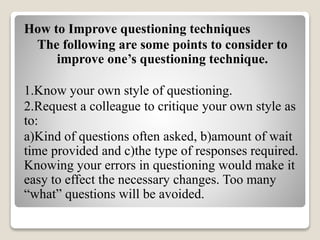
How to Improve questioning techniques
The following are some points to consider to
improve one’s questioning technique.
1.Know your own style of questioning.
2.Request a colleague to critique your own style as
to:
a)Kind of questions often asked, b)amount of wait
time provided and c)the type of responses required.
Knowing your errors in questioning would make it
easy to effect the necessary changes. Too many
“what” questions will be avoided.
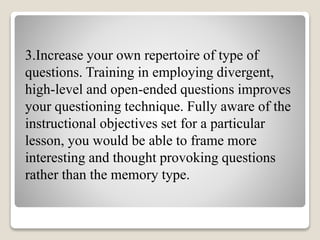
3.Increase your own repertoire of type of
questions. Training in employing divergent,
high-level and open-ended questions improves
your questioning technique. Fully aware of the
instructional objectives set for a particular
lesson, you would be able to frame more
interesting and thought provoking questions
rather than the memory type.
4.Consider the individual abilities and interest
of the students. Experiencing success in giving
correct answers promotes a feeling of
confidence among them. Select the brighter
ones to respond to high-level questions. An
approving nod, a smile or a praise for an answer
given will encourage them to volunteer own
ideas.
5. Spend time reflecting on the type of questions
you ask. Improve on them.
Handling Pupil’s Response
Sometimes we, teachers, take our reaction to
our student’s response for granted. We forget
how crucial this part of teaching is. By the way
we handle our student’s responses, we either
encourage or discourage them from actively
participating in class interaction.
1. Providing feedback on the correctness or
incorrectness of a response
In providing corrective feedback:
 Remember that the reaction "that's wrong’ can put off
or embarrass a learner. Be more tactful.
 Give a hint or break down the question if necessary,
to guide the learner to the correct response.
 Explain the correct answer when the learners cannot
 Initially ask easy questions to enhance the student’s
(particularly a slow one’s)self confidence and to
encourage active participation from everyone.
2.Giving appropriate praise to high quality
responses in giving appropriate praise:
 Match praise to the level of difficulty of the
question answered or to the quality of the
response given.
 Vary acceptance reactions. As someone said,
there are 99 ways of saying “okay”.
 Remember that a slow/insecure learner needs
more praise than a fast/confident one. Be
discreet, lest the faster ones think that praise is
only for the slow learners.
3.Making Follow-up Questions
In making follow- up questions:
 Remember that follow- up questions should
logically relate to the preceding questions
and/or the learners’ response.
 Follow-up questions should be
characteristically developmental and directed
towards a better/ deeper understanding of the
topic being discussed.
 Clearly-stated, short follow-up questions elicit
better responses from the students.
4. Redirecting Questions
 Certain questions deserves to be answered by
more than promote creative or divergent
thinking.
 Some students need a re-formulation of the
question for better understanding. Be sensitive
and accommodating to such need.
5. Following-up a student’s response with
related questions in explaining the question/
answer:
 Slowly repeating or replacing certain words in
a question may be the way to enable a student
to give the correct answer.
 On the other hand, other students may need to
understand better an accepted (learner’s)
response.
Thank you for listening!

effective question and reacting techniques

  • 1.
    Effective Question andReacting Techniques Report: Frelien G. Doctor
  • 2.
    Types of Questionaccording to Purpose The kind of question we ask varies according to purpose. Here are some: For Assessing Cognition This type of question is used to determine one’s knowledge in understanding. They promote high level of thinking. Divergent questions and open-ended inquiries call for analysis and evaluation.
  • 3.
    Example: • What islikely to happen if the ozone layer of the atmosphere continues to deteriorate? • Why is some sound heard louder when underwater than out of it?
  • 4.
    For Verification It determinesthe exactness or accuracy of the results of an activity or performance. Example:  Was the weight of liquid displaced exactly the same as the weight of object immersed in it?  Why is lightning seen before thunder is heard?
  • 5.
    For Creative Thinking Itprobes into one’s originality. Example: How will you present the layers of the earth to your class? Simulate the eruption of Mt. Mayon. The question may ask for pupils’ own ideas or new ways of doing things. Example: How can you demonstrate soil-less gardening?
  • 6.
    For Evaluating It elicitsresponses the include judgments, value and choice. It also asks personal opinions about an event, a policy or a person. Example: Was your teacher’s slide presentation well done?
  • 7.
    For Productive Thinking Itincludes cognitive reasoning. It analyses facts, recognized pattern or trends and invokes memory and recall. Example: Why was our fourth secretary of the department of agriculture successful with the small landowners? How can we apply the Law of Conservation of Energy?
  • 8.
    For Motivating Before discussingthe lesson, a number of questions about the topic can serve to arouse their interest and focus attention. It attempts to put students in the mood. Example: Would you like to know your favorite flower can remain fresh longer? Did you ever train a pet?
  • 9.
    For Instructing The questionasks for useful information. It directs, guides and advises on what and how to do an activity. Example: What are the steps in performing an experiment?
  • 10.
    As to level,question can either be low or high level. Types of Questions According to Level/ Answer
  • 11.
    Low Level Questions Theyinclude memory questions or those that require simple recall. Example: Define energy. State the first law of motion.
  • 12.
    High Level Question Thesequestion call for a respondent’s ability to analyze, evaluate and solve problems. Example:  What is the relationship between the distance of a planet and its period of revolution?  Why does temperature rise towards noontime?
  • 13.
    Convergent Questions They arequestions the require a single predictable answer. Example are those that call for:1.defining,2. stating, 3. interpreting 4. summarizing. Examples: when does lunar eclipse occur?
  • 14.
    Divergent Questions They requirethe respondents to think in “different directions”, to think of alternative actions or to arrive at own decision. there are several possible answers. Example: Why are you voting for him? What will happen if you leave it under direct sunlight for a week?

  • 15.
    Class interact isdependent on your questioning skills. What skills should you require to generate interaction among your students? Questioning Skills
  • 16.
    1.Varying types ofquestion. Ask convergent and evaluative questions. Convergent questions have only one acceptable correct answer. Example: “what is the process of food manufacture that takes place in plants called?
  • 17.
    2.Asking non-direct questions.Pose the question first, then call on a student. Don’t direct your question to just one student. Direct the question to all. 3. Calling on non-volunteers. Don’t just call on those who raise their hands. 4. rephrasing. If you sense a question was not understood, simply it or ask it in another way.
  • 18.
    5. Sequencing logically.It is asking related question from simple to complex one after another. 6.Requiring abstract thinking. This means going beyond simple recall questions. Example of questions that require abstract thinking is “what meaning can you derive from the data presented in the graph? What generation can you draw from the data presented?
  • 19.
    7. Asking open-endedquestions. This means asking divergent questions to develop higher- order- thinking skills. 8.Allowing for sufficient wait time. Wait time refers to the pause needed by the teacher after asking a question. This is the time wait when she waits for answer. A number if things to consider are:a.)the level of difficulty of the question, b.)the type of response required, c.)the background knowledge of the respondents and d.)the intellectual ability of the respondents.
  • 20.
    Providing sufficient waittime can achieve the following:  Motivates slow thinking students to respond  Improves the quality of responses made  Decreases the amount of guessing or wrong inferences  Increases the number of correct response  Lead the teacher to vary his/her questions  Provides time for the teachers to evaluate the answers given.  Encourages the students to ask their own question. Gives students enough time to think about the answer.
  • 21.
    9. Assessing comprehension.Ask question to rest comprehension. Now and then, find out if your students are with you. 10.Involving as many as possible3. distribute your question to as many students. Widen participation. Don’t just call 0n students who raise their hands. By their facial expressions, you can sense who among your students would like to recite.
  • 22.
    How to Improvequestioning techniques The following are some points to consider to improve one’s questioning technique. 1.Know your own style of questioning. 2.Request a colleague to critique your own style as to: a)Kind of questions often asked, b)amount of wait time provided and c)the type of responses required. Knowing your errors in questioning would make it easy to effect the necessary changes. Too many “what” questions will be avoided.
  • 23.
    3.Increase your ownrepertoire of type of questions. Training in employing divergent, high-level and open-ended questions improves your questioning technique. Fully aware of the instructional objectives set for a particular lesson, you would be able to frame more interesting and thought provoking questions rather than the memory type.
  • 24.
    4.Consider the individualabilities and interest of the students. Experiencing success in giving correct answers promotes a feeling of confidence among them. Select the brighter ones to respond to high-level questions. An approving nod, a smile or a praise for an answer given will encourage them to volunteer own ideas. 5. Spend time reflecting on the type of questions you ask. Improve on them.
  • 25.
    Handling Pupil’s Response Sometimeswe, teachers, take our reaction to our student’s response for granted. We forget how crucial this part of teaching is. By the way we handle our student’s responses, we either encourage or discourage them from actively participating in class interaction.
  • 26.
    1. Providing feedbackon the correctness or incorrectness of a response In providing corrective feedback:  Remember that the reaction "that's wrong’ can put off or embarrass a learner. Be more tactful.  Give a hint or break down the question if necessary, to guide the learner to the correct response.  Explain the correct answer when the learners cannot  Initially ask easy questions to enhance the student’s (particularly a slow one’s)self confidence and to encourage active participation from everyone.
  • 27.
    2.Giving appropriate praiseto high quality responses in giving appropriate praise:  Match praise to the level of difficulty of the question answered or to the quality of the response given.  Vary acceptance reactions. As someone said, there are 99 ways of saying “okay”.  Remember that a slow/insecure learner needs more praise than a fast/confident one. Be discreet, lest the faster ones think that praise is only for the slow learners.
  • 28.
    3.Making Follow-up Questions Inmaking follow- up questions:  Remember that follow- up questions should logically relate to the preceding questions and/or the learners’ response.  Follow-up questions should be characteristically developmental and directed towards a better/ deeper understanding of the topic being discussed.
  • 29.
     Clearly-stated, shortfollow-up questions elicit better responses from the students. 4. Redirecting Questions  Certain questions deserves to be answered by more than promote creative or divergent thinking.  Some students need a re-formulation of the question for better understanding. Be sensitive and accommodating to such need.
  • 30.
    5. Following-up astudent’s response with related questions in explaining the question/ answer:  Slowly repeating or replacing certain words in a question may be the way to enable a student to give the correct answer.  On the other hand, other students may need to understand better an accepted (learner’s) response.
  • 31.
    Thank you forlistening!