Deductive Instructional Approaches
1.discuss the nature of deductive
instructional approaches when applied
in the teaching-learning process;
2 .identify the instructional models that
make the development of deductive
lessons possible;
3 .describe the development of
deductive lesson from its
conceptualization to evaluation and
assessment;

4 .discuss the significance of the
deductive reasoning model and
identify the content;
of instruction that will match the
instructional the instructional model
5.Compare and contrast the different
instructional models by applying each
one in the development of selected
lessons
6. Discuss the principles and guidelines
that will facilitate the development of
effective deductive lessons;
7.Develop lessons utilizing the
deductive instructional approaches;
8.Give the similarities and differences
of the inductive and deductive models;
9.Prepare a chart showing the
movement of a deductive lesson;
10.Compare the movement in the
conduct of instruction of the
inductive and deductive lessons.
Deductive Instructional Models
 Deductive

Reasoning Model

-this model proceeds from principles

or generalizations to their application
in specific instances.
Syntax for Deductive Reasoning Model:
1. State a theory or generalization to
be tested

2. Form a hypothesis in the form of a
prediction.
3. Observe or collect data to test the
hypothesis.
4. Analyze and interpret the data to
determine if the prediction is true.
5. Conclude whether the generalization
holds true in the specific context
from which it was taken.
-these are verbal statements at the

beginning of a lesson that preview and
structure new material and link it to
the content students already
understand.
Types of Organizers:


Expository organizers
-these organizers provide a basic
concept at the highest level of
abstraction and perhaps some lesser
concepts.


Comparative organizers
-these organizers are used with
relatively familiar material.
Syntax for the Advance Organizer
Model:
Phase 1: Presentation of Advance
Organizer
Phase 2: Presentation of learning task
or material
Phase 3: Strengthening of the cognitive
organization
PRESENTATION TEACHING MODEL
- this model requires a teacher to
provide students with advance
organizers before presenting new
information and to make special
efforts during and following the
presentation to strengthen and extend
student thinking.
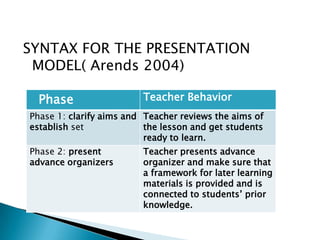
SYNTAX FOR THE PRESENTATION
MODEL( Arends 2004)
Phase

Teacher Behavior

Phase 1: clarify aims and Teacher reviews the aims of
establish set
the lesson and get students
ready to learn.
Phase 2: present
advance organizers

Teacher presents advance
organizer and make sure that
a framework for later learning
materials is provided and is
connected to students’ prior
knowledge.
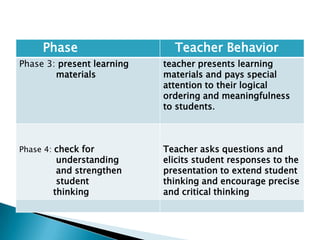
Phase

Teacher Behavior

Phase 3: present learning
materials

teacher presents learning
materials and pays special
attention to their logical
ordering and meaningfulness
to students.

Phase 4: check for

Teacher asks questions and
elicits student responses to the
presentation to extend student
thinking and encourage precise
and critical thinking

understanding
and strengthen
student
thinking
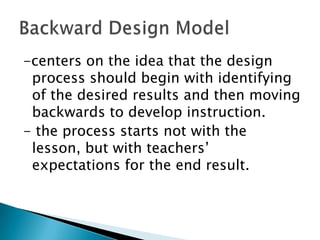
-centers on the idea that the design
process should begin with identifying
of the desired results and then moving
backwards to develop instruction.
- the process starts not with the
lesson, but with teachers’
expectations for the end result.
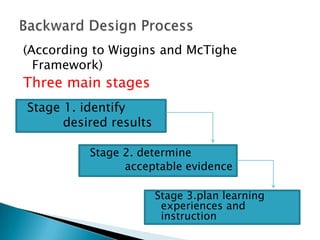
(According to Wiggins and McTighe
Framework)

Three main stages
Stage 1. identify
desired results
Stage 2. determine
acceptable evidence
Stage 3.plan learning
experiences and
instruction
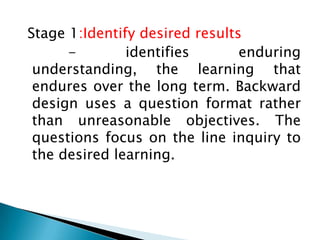
Stage 1:Identify desired results
identifies
enduring
understanding, the learning that
endures over the long term. Backward
design uses a question format rather
than unreasonable objectives. The
questions focus on the line inquiry to
the desired learning.
Stage 2: Determine acceptable
evidence
defines
the
form
of
assessment, which will demonstrate
that students have acquired the
desired
knowledge, understanding, and skill.
Stage 3: Plan learning experience and
instruction
- determines what sequence of
teaching and learning experiences will
equip students to develop and
demonstrate the desired
understanding.
-it is an instructional approach in which
the teacher presents information and
follows it up with question-andanswer sessions.
1.
2.
3.
4.

Identify the main points to be
covered
Select an advance organizer
Use examples to illustrate each point
Summarize the points and refer back
to the organizer
-a lecture is considered formal teacher
talk.
-it encompasses lecturing to and
talking with students .
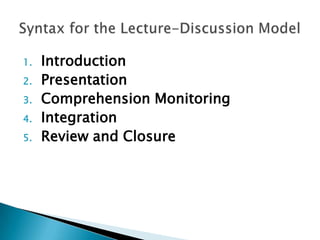
1.
2.
3.
4.
5.

Introduction
Presentation
Comprehension Monitoring
Integration
Review and Closure
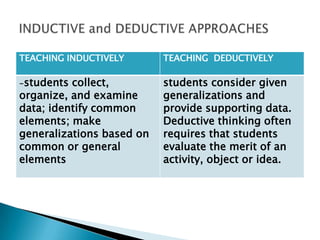
TEACHING INDUCTIVELY

TEACHING DEDUCTIVELY

-students

students consider given
generalizations and
provide supporting data.
Deductive thinking often
requires that students
evaluate the merit of an
activity, object or idea.

collect,
organize, and examine
data; identify common
elements; make
generalizations based on
common or general
elements
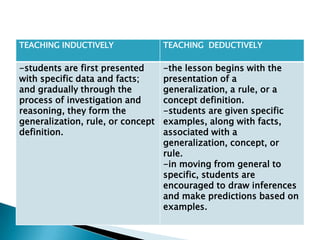
TEACHING INDUCTIVELY

TEACHING DEDUCTIVELY

-students are first presented
with specific data and facts;
and gradually through the
process of investigation and
reasoning, they form the
generalization, rule, or concept
definition.

-the lesson begins with the
presentation of a
generalization, a rule, or a
concept definition.
-students are given specific
examples, along with facts,
associated with a
generalization, concept, or
rule.
-in moving from general to
specific, students are
encouraged to draw inferences
and make predictions based on
examples.
Teaching Inductively

Teaching Deductively

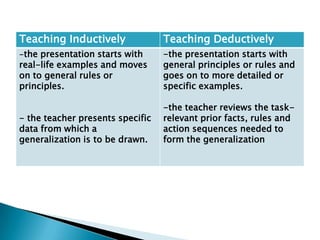
-the presentation starts with

real-life examples and moves
on to general rules or
principles.

-the presentation starts with
general principles or rules and
goes on to more detailed or
specific examples.

- the teacher presents specific
data from which a
generalization is to be drawn.

-the teacher reviews the taskrelevant prior facts, rules and
action sequences needed to
form the generalization
Teaching Inductively

Teaching Deductively

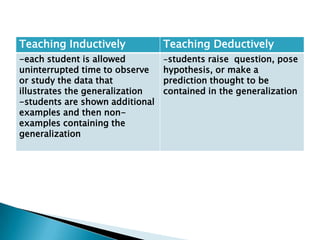
-each student is allowed
uninterrupted time to observe
or study the data that
illustrates the generalization
-students are shown additional
examples and then nonexamples containing the
generalization

-students raise question, pose

hypothesis, or make a
prediction thought to be
contained in the generalization
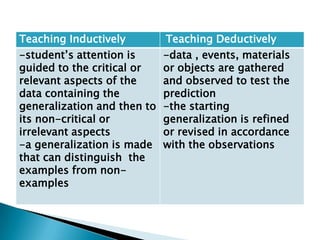
Teaching Inductively
-student’s attention is
guided to the critical or
relevant aspects of the
data containing the
generalization and then to
its non-critical or
irrelevant aspects
-a generalization is made
that can distinguish the
examples from nonexamples

Teaching Deductively
-data , events, materials
or objects are gathered
and observed to test the
prediction
-the starting
generalization is refined
or revised in accordance
with the observations

Deductive instructional approaches

  • 1.
  • 2.
    1.discuss the natureof deductive instructional approaches when applied in the teaching-learning process; 2 .identify the instructional models that make the development of deductive lessons possible;
  • 3.
    3 .describe thedevelopment of deductive lesson from its conceptualization to evaluation and assessment; 4 .discuss the significance of the deductive reasoning model and identify the content;
  • 4.
    of instruction thatwill match the instructional the instructional model 5.Compare and contrast the different instructional models by applying each one in the development of selected lessons
  • 5.
    6. Discuss theprinciples and guidelines that will facilitate the development of effective deductive lessons; 7.Develop lessons utilizing the deductive instructional approaches; 8.Give the similarities and differences of the inductive and deductive models;
  • 6.
    9.Prepare a chartshowing the movement of a deductive lesson; 10.Compare the movement in the conduct of instruction of the inductive and deductive lessons.
  • 8.
    Deductive Instructional Models Deductive Reasoning Model -this model proceeds from principles or generalizations to their application in specific instances.
  • 9.
    Syntax for DeductiveReasoning Model: 1. State a theory or generalization to be tested 2. Form a hypothesis in the form of a prediction. 3. Observe or collect data to test the hypothesis.
  • 10.
    4. Analyze andinterpret the data to determine if the prediction is true. 5. Conclude whether the generalization holds true in the specific context from which it was taken.
  • 11.
    -these are verbalstatements at the beginning of a lesson that preview and structure new material and link it to the content students already understand.
  • 12.
    Types of Organizers:  Expositoryorganizers -these organizers provide a basic concept at the highest level of abstraction and perhaps some lesser concepts.
  • 13.
     Comparative organizers -these organizersare used with relatively familiar material.
  • 14.
    Syntax for theAdvance Organizer Model: Phase 1: Presentation of Advance Organizer Phase 2: Presentation of learning task or material Phase 3: Strengthening of the cognitive organization
  • 16.
    PRESENTATION TEACHING MODEL -this model requires a teacher to provide students with advance organizers before presenting new information and to make special efforts during and following the presentation to strengthen and extend student thinking.
  • 17.
    SYNTAX FOR THEPRESENTATION MODEL( Arends 2004) Phase Teacher Behavior Phase 1: clarify aims and Teacher reviews the aims of establish set the lesson and get students ready to learn. Phase 2: present advance organizers Teacher presents advance organizer and make sure that a framework for later learning materials is provided and is connected to students’ prior knowledge.
  • 18.
    Phase Teacher Behavior Phase 3:present learning materials teacher presents learning materials and pays special attention to their logical ordering and meaningfulness to students. Phase 4: check for Teacher asks questions and elicits student responses to the presentation to extend student thinking and encourage precise and critical thinking understanding and strengthen student thinking
  • 19.
    -centers on theidea that the design process should begin with identifying of the desired results and then moving backwards to develop instruction. - the process starts not with the lesson, but with teachers’ expectations for the end result.
  • 20.
    (According to Wigginsand McTighe Framework) Three main stages Stage 1. identify desired results Stage 2. determine acceptable evidence Stage 3.plan learning experiences and instruction
  • 21.
    Stage 1:Identify desiredresults identifies enduring understanding, the learning that endures over the long term. Backward design uses a question format rather than unreasonable objectives. The questions focus on the line inquiry to the desired learning.
  • 22.
    Stage 2: Determineacceptable evidence defines the form of assessment, which will demonstrate that students have acquired the desired knowledge, understanding, and skill.
  • 23.
    Stage 3: Planlearning experience and instruction - determines what sequence of teaching and learning experiences will equip students to develop and demonstrate the desired understanding.
  • 24.
    -it is aninstructional approach in which the teacher presents information and follows it up with question-andanswer sessions.
  • 25.
    1. 2. 3. 4. Identify the mainpoints to be covered Select an advance organizer Use examples to illustrate each point Summarize the points and refer back to the organizer
  • 26.
    -a lecture isconsidered formal teacher talk. -it encompasses lecturing to and talking with students .
  • 27.
  • 28.
    TEACHING INDUCTIVELY TEACHING DEDUCTIVELY -students studentsconsider given generalizations and provide supporting data. Deductive thinking often requires that students evaluate the merit of an activity, object or idea. collect, organize, and examine data; identify common elements; make generalizations based on common or general elements
  • 29.
    TEACHING INDUCTIVELY TEACHING DEDUCTIVELY -studentsare first presented with specific data and facts; and gradually through the process of investigation and reasoning, they form the generalization, rule, or concept definition. -the lesson begins with the presentation of a generalization, a rule, or a concept definition. -students are given specific examples, along with facts, associated with a generalization, concept, or rule. -in moving from general to specific, students are encouraged to draw inferences and make predictions based on examples.
  • 30.
    Teaching Inductively Teaching Deductively -thepresentation starts with real-life examples and moves on to general rules or principles. -the presentation starts with general principles or rules and goes on to more detailed or specific examples. - the teacher presents specific data from which a generalization is to be drawn. -the teacher reviews the taskrelevant prior facts, rules and action sequences needed to form the generalization
  • 31.
    Teaching Inductively Teaching Deductively -eachstudent is allowed uninterrupted time to observe or study the data that illustrates the generalization -students are shown additional examples and then nonexamples containing the generalization -students raise question, pose hypothesis, or make a prediction thought to be contained in the generalization
  • 32.
    Teaching Inductively -student’s attentionis guided to the critical or relevant aspects of the data containing the generalization and then to its non-critical or irrelevant aspects -a generalization is made that can distinguish the examples from nonexamples Teaching Deductively -data , events, materials or objects are gathered and observed to test the prediction -the starting generalization is refined or revised in accordance with the observations