Introduction to FastFourier
Transform (FFT)
Unlocking the Power of Frequency
Domain
Presented by: [Your Name] | [Date]
2.
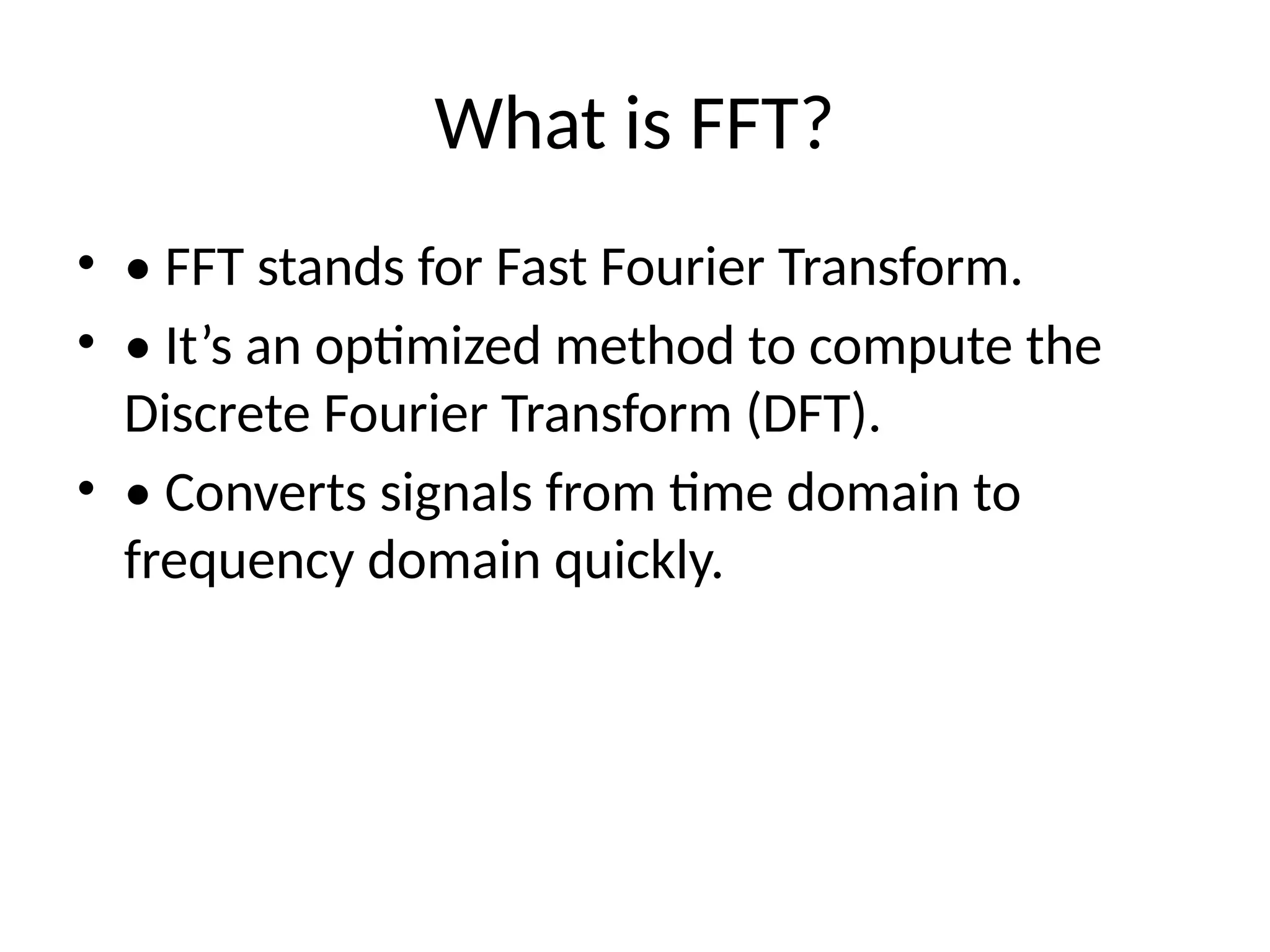
What is FFT?
•• FFT stands for Fast Fourier Transform.
• • It’s an optimized method to compute the
Discrete Fourier Transform (DFT).
• • Converts signals from time domain to
frequency domain quickly.
3.
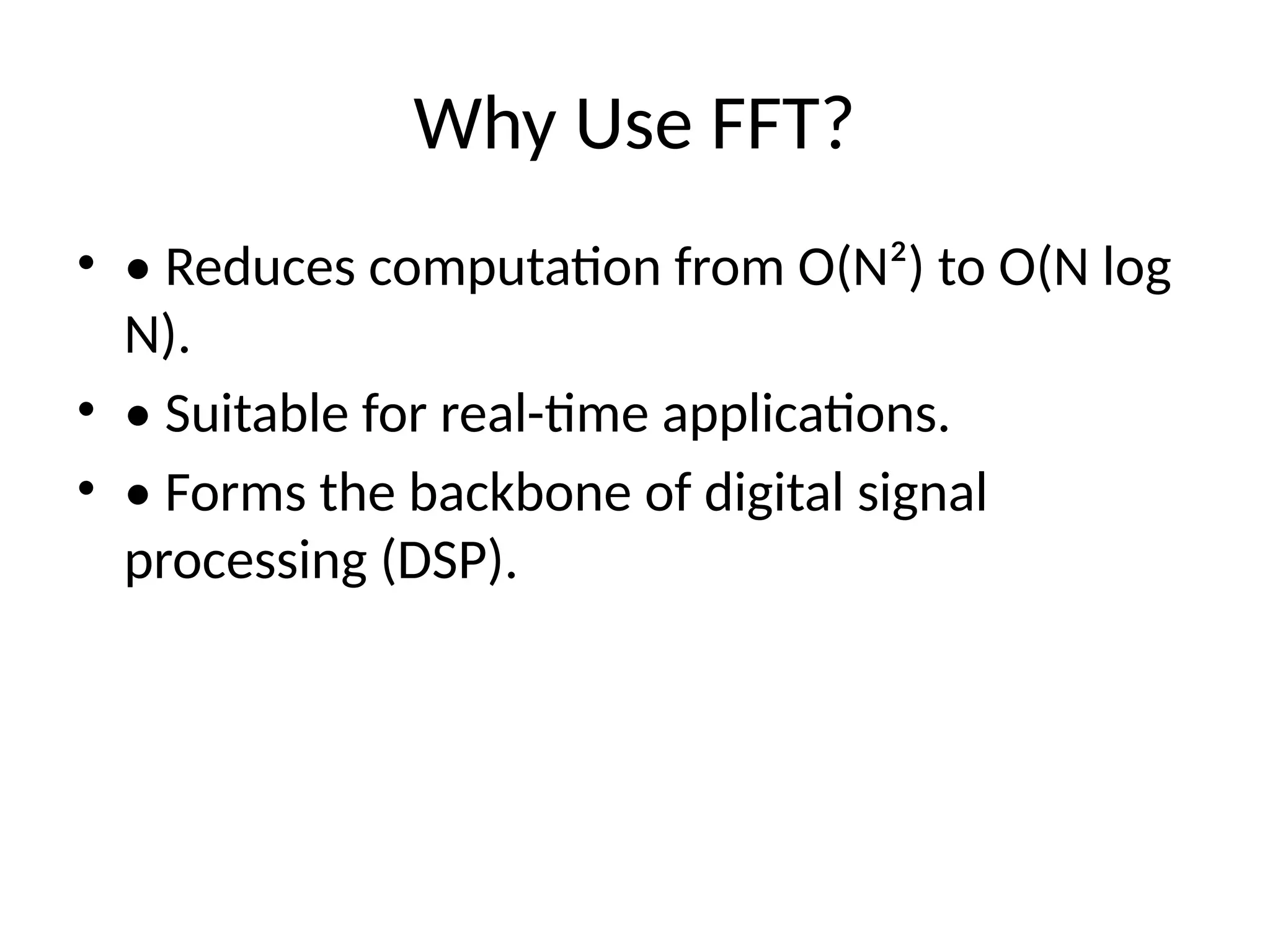
Why Use FFT?
•• Reduces computation from O(N²) to O(N log
N).
• • Suitable for real-time applications.
• • Forms the backbone of digital signal
processing (DSP).
4.
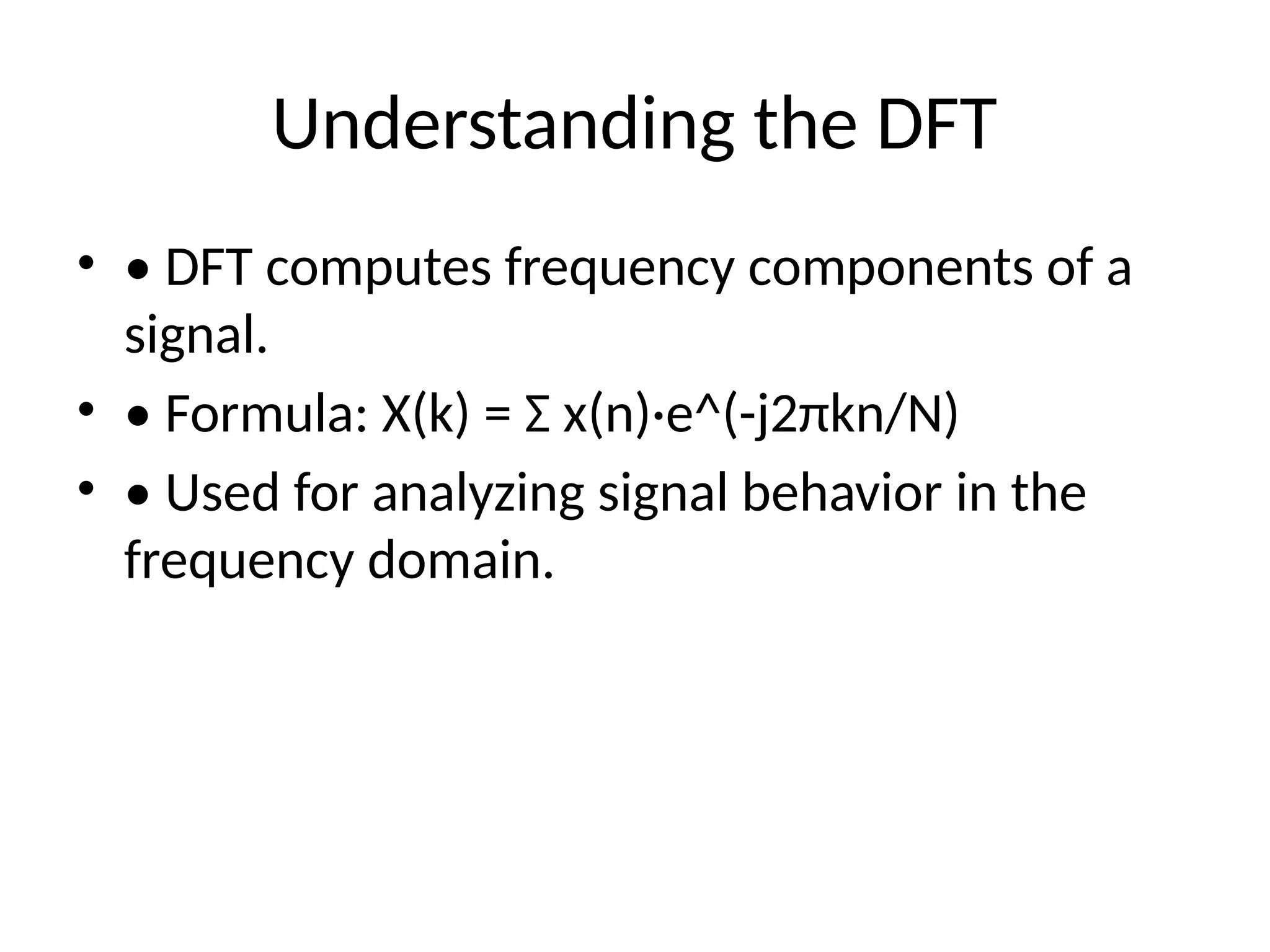
Understanding the DFT
•• DFT computes frequency components of a
signal.
• • Formula: X(k) = Σ x(n)·e^(-j2πkn/N)
• • Used for analyzing signal behavior in the
frequency domain.
5.
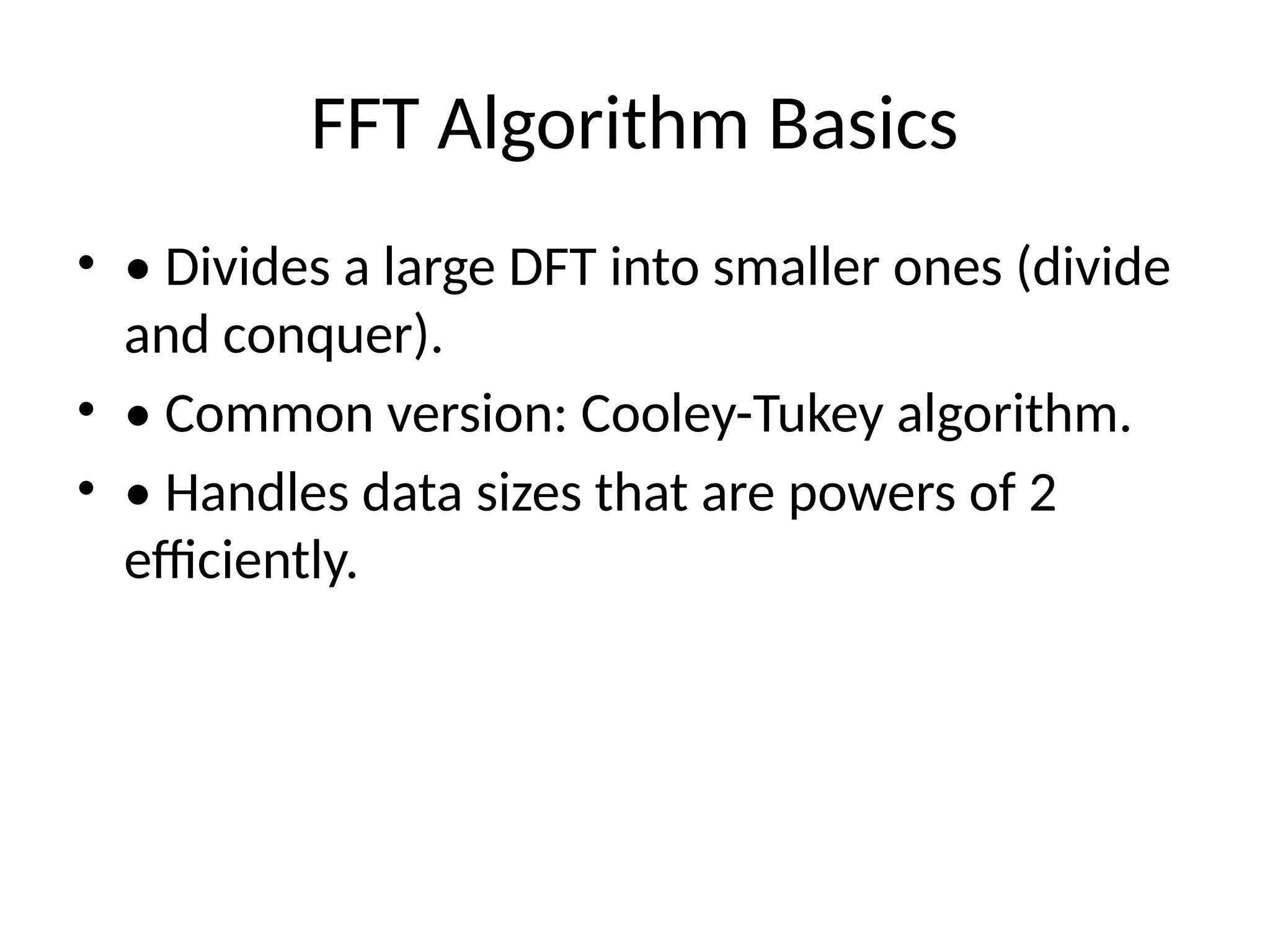
FFT Algorithm Basics
•• Divides a large DFT into smaller ones (divide
and conquer).
• • Common version: Cooley-Tukey algorithm.
• • Handles data sizes that are powers of 2
efficiently.
6.
Applications: Audio Processing
•• Visualize and edit sound frequencies (e.g.,
EQ tools).
• • Remove noise by filtering unwanted
frequency bands.
• • Core to audio compression formats like MP3.
7.
Applications: Image Analysis
•• Frequency filtering for blurring or
sharpening.
• • JPEG compression uses frequency transform
(DCT variant).
• • Detect patterns and textures in images.
8.
Other Real-World Uses
•• Telecommunications: OFDM in 5G/4G.
• • Medical imaging: MRI and CT scan data
processing.
• • Radar & Seismology: Signal detection and
interpretation.
9.
Conclusion
• • FFTis a fast and efficient way to analyze
signals.
• • Crucial in countless real-world technologies.
• • Knowing FFT opens the door to advanced
DSP tasks.
![Introduction to Fast Fourier
Transform (FFT)
Unlocking the Power of Frequency
Domain
Presented by: [Your Name] | [Date]](https://image.slidesharecdn.com/revisedfftintroductionandapplications-250530061600-54cfe2d4/75/Revised_FFT_Introduction_and_Applications-pptx-1-2048.jpg)


![Moho Pro 14.4 Crack for MacOS Works Until 2050 [Latest] pptx](https://cdn.slidesharecdn.com/ss_thumbnails/softwareoverview-251207192639-797289c4-thumbnail.jpg?width=640&height=640&fit=bounds)


![CleanMyMac X v5.2.8 Crack for MacOS Full Version [Latest] pptx](https://cdn.slidesharecdn.com/ss_thumbnails/softwareoverview-251207194121-a81f0142-thumbnail.jpg?width=640&height=640&fit=bounds)


![iStat Menus 7.20 Crack for MacOS 2026 Full Version [Latest] pptx](https://cdn.slidesharecdn.com/ss_thumbnails/softwareoverview-251207191544-22b737dc-thumbnail.jpg?width=640&height=640&fit=bounds)