THROMBO-PROPHYLAXIS
IN
OBSTETRICS
SUJOY DASGUPTA
MBBS (Gold Medalist, Hons),
MS (OBGY- Gold Medalist), DNB (OBGY)
Senior Resident, Deptt of Gynaecological Oncology,
Chittaranjan National cancer Institute (CNCI), Kolkata
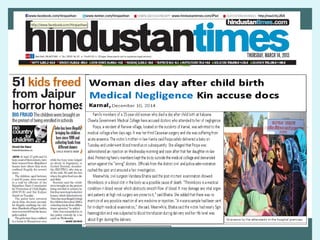
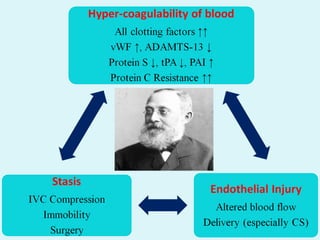
Venous Thromboembolism (VTE)
• Incidence- 2.3 per 1000 pregnancy
• Risk increases 4-6 fold in pregnancy
• Risk increases further in puerperium (especially the 1st
week)
• Overall case fatality rate- 3.5%
• The mortality rate of PE is 11% within an hour of presentation
and a further 30% among survivors if not recognized.
• Often no time for diagnosis and treatment
• Globally- 3% of maternal deaths (WHO, 2014)
Prevention- THROMBO-PROPHYLAXIS
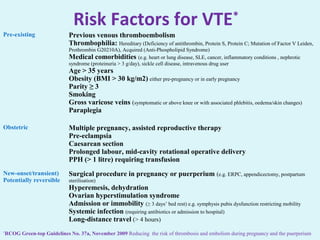
Risk Factors for VTE*
Pre-existing Previous venous thromboembolism
Thrombophilia: Hereditary (Deficiency of antithrombin, Protein S, Protein C; Mutation of Factor V Leiden,
Prothrombin G20210A), Acquired (Anti-Phospholipid Syndrome)
Medical comorbidities (e.g. heart or lung disease, SLE, cancer, inflammatory conditions , nephrotic
syndrome (proteinuria > 3 g/day), sickle cell disease, intravenous drug user
Age > 35 years
Obesity (BMI > 30 kg/m2) either pre-pregnancy or in early pregnancy
Parity ≥ 3
Smoking
Gross varicose veins (symptomatic or above knee or with associated phlebitis, oedema/skin changes)
Paraplegia
Obstetric Multiple pregnancy, assisted reproductive therapy
Pre-eclampsia
Caesarean section
Prolonged labour, mid-cavity rotational operative delivery
PPH (> 1 litre) requiring transfusion
New-onset/transient)
Potentially reversible
Surgical procedure in pregnancy or puerperium (e.g. ERPC, appendicectomy, postpartum
sterilisation)
Hyperemesis, dehydration
Ovarian hyperstimulation syndrome
Admission or immobility (≥ 3 days’ bed rest) e.g. symphysis pubis dysfunction restricting mobility
Systemic infection (requiring antibiotics or admission to hospital)
Long-distance travel (> 4 hours)
*
RCOG Green-top Guidelines No. 37a, November 2009 Reducing the risk of thrombosis and embolism during pregnancy and the puerperium
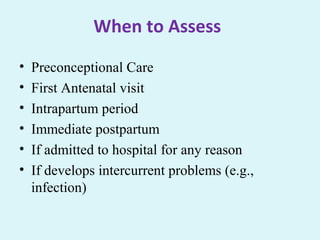
When to Assess
• Preconceptional Care
• First Antenatal visit
• Intrapartum period
• Immediate postpartum
• If admitted to hospital for any reason
• If develops intercurrent problems (e.g.,
infection)
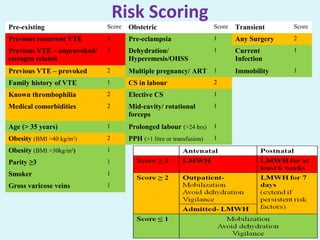
Risk Scoring
Pre-existing Score Obstetric Score Transient Score
Previous recurrent VTE 3 Pre-eclampsia 1 Any Surgery 2
Previous VTE – unprovoked/
estrogen related
3 Dehydration/
Hyperemesis/OHSS
1 Current
Infection
1
Previous VTE – provoked 2 Multiple pregnancy/ ART 1 Immobility 1
Family history of VTE 1 CS in labour 2
Known thrombophilia 2 Elective CS 1
Medical comorbidities 2 Mid-cavity/ rotational
forceps
1
Age (> 35 years) 1 Prolonged labour (>24 hrs) 1
Obesity (BMI >40 kg/m2
) 2 PPH (>1 litre or transfusion) 1
Obesity (BMI >30kg/m2
) 1
Parity ≥3 1
Smoker 1
Gross varicose veins 1
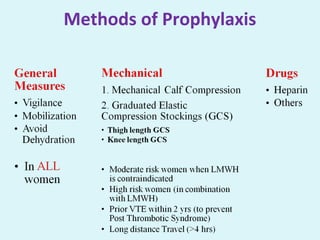
Methods of Prophylaxis
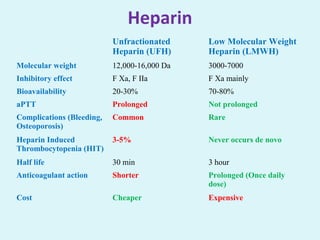
Heparin
Unfractionated
Heparin (UFH)
Low Molecular Weight
Heparin (LMWH)
Molecular weight 12,000-16,000 Da 3000-7000
Inhibitory effect F Xa, F IIa F Xa mainly
Bioavailability 20-30% 70-80%
aPTT Prolonged Not prolonged
Complications (Bleeding,
Osteoporosis)
Common Rare
Heparin Induced
Thrombocytopenia (HIT)
3-5% Never occurs de novo
Half life 30 min 3 hour
Anticoagulant action Shorter Prolonged (Once daily
dose)
Cost Cheaper Expensive
Prophylactic Dose Calculation
Weight (Kg) Enoxaparin Dalteparin Tinzaparin
(75 U/kg/day)
<50 20 mg OD 2500 U OD 3500 U OD
50-90 40 mg OD 5000 U OD 4500 U OD
91-130 60 mg OD*
7500 U OD*
7000 U OD*
131-170 80 mg OD*
10,000 U OD*
9000 U OD*
>170 0.6 mg/kg/day*
75 U/kg/day*
75 U/kg/day*
*
May be given in two divided doses
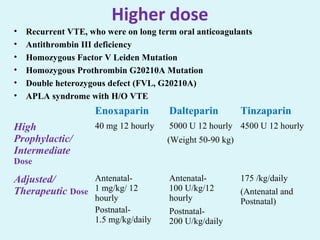
Higher dose
• Recurrent VTE, who were on long term oral anticoagulants
• Antithrombin III deficiency
• Homozygous Factor V Leiden Mutation
• Homozygous Prothrombin G20210A Mutation
• Double heterozygous defect (FVL, G20210A)
• APLA syndrome with H/O VTE
Enoxaparin Dalteparin Tinzaparin
High
Prophylactic/
Intermediate
Dose
40 mg 12 hourly 5000 U 12 hourly 4500 U 12 hourly
(Weight 50-90 kg)
Adjusted/
Therapeutic Dose
Antenatal-
1 mg/kg/ 12
hourly
Postnatal-
1.5 mg/kg/daily
Antenatal-
100 U/kg/12
hourly
Postnatal-
200 U/kg/daily
175 /kg/daily
(Antenatal and
Postnatal)
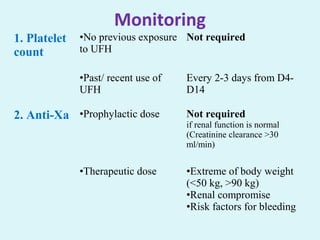
Monitoring
1. Platelet
count
•No previous exposure
to UFH
Not required
•Past/ recent use of
UFH
Every 2-3 days from D4-
D14
2. Anti-Xa •Prophylactic dose Not required
if renal function is normal
(Creatinine clearance >30
ml/min)
•Therapeutic dose •Extreme of body weight
(<50 kg, >90 kg)
•Renal compromise
•Risk factors for bleeding
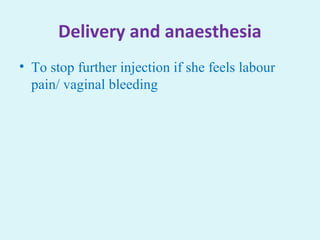
Delivery and anaesthesia
• To stop further injection if she feels labour
pain/ vaginal bleeding
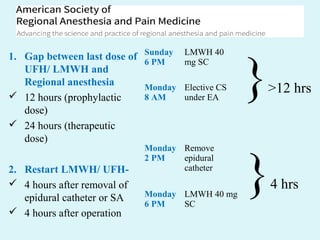
1. Gap between last dose of
UFH/ LMWH and
Regional anesthesia
 12 hours (prophylactic
dose)
 24 hours (therapeutic
dose)
2. Restart LMWH/ UFH-
 4 hours after removal of
epidural catheter or SA
 4 hours after operation
Sunday
6 PM
LMWH 40
mg SC
}>12 hrsMonday
8 AM
Elective CS
under EA
Monday
2 PM
Remove
epidural
catheter
}4 hrs
Monday
6 PM
LMWH 40 mg
SC
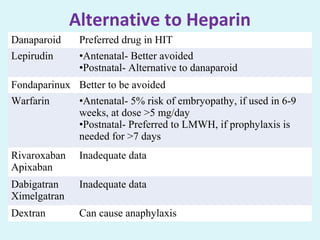
Alternative to Heparin
Danaparoid Preferred drug in HIT
Lepirudin •Antenatal- Better avoided
•Postnatal- Alternative to danaparoid
Fondaparinux Better to be avoided
Warfarin •Antenatal- 5% risk of embryopathy, if used in 6-9
weeks, at dose >5 mg/day
•Postnatal- Preferred to LMWH, if prophylaxis is
needed for >7 days
Rivaroxaban
Apixaban
Inadequate data
Dabigatran
Ximelgatran
Inadequate data
Dextran Can cause anaphylaxis
Special Cases
Thrombophilia and Thrombosis
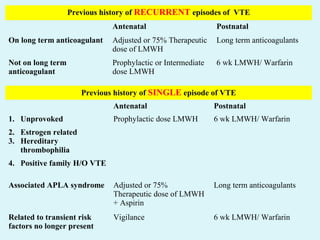
Previous history of RECURRENT episodes of VTE
Antenatal Postnatal
On long term anticoagulant Adjusted or 75% Therapeutic
dose of LMWH
Long term anticoagulants
Not on long term
anticoagulant
Prophylactic or Intermediate
dose LMWH
6 wk LMWH/ Warfarin
Previous history of SINGLE episode of VTE
Antenatal Postnatal
1. Unprovoked
2. Estrogen related
3. Hereditary
thrombophilia
4. Positive family H/O VTE
Prophylactic dose LMWH 6 wk LMWH/ Warfarin
Associated APLA syndrome Adjusted or 75%
Therapeutic dose of LMWH
+ Aspirin
Long term anticoagulants
Related to transient risk
factors no longer present
Vigilance 6 wk LMWH/ Warfarin
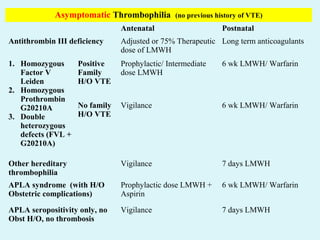
Asymptomatic Thrombophilia (no previous history of VTE)
Antenatal Postnatal
Antithrombin III deficiency Adjusted or 75% Therapeutic
dose of LMWH
Long term anticoagulants
1. Homozygous
Factor V
Leiden
2. Homozygous
Prothrombin
G20210A
3. Double
heterozygous
defects (FVL +
G20210A)
Positive
Family
H/O VTE
Prophylactic/ Intermediate
dose LMWH
6 wk LMWH/ Warfarin
No family
H/O VTE
Vigilance 6 wk LMWH/ Warfarin
Other hereditary
thrombophilia
Vigilance 7 days LMWH
APLA syndrome (with H/O
Obstetric complications)
Prophylactic dose LMWH +
Aspirin
6 wk LMWH/ Warfarin
APLA seropositivity only, no
Obst H/O, no thrombosis
Vigilance 7 days LMWH
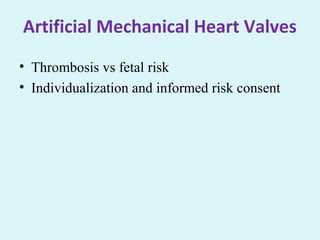
Artificial Mechanical Heart Valves
• Thrombosis vs fetal risk
• Individualization and informed risk consent
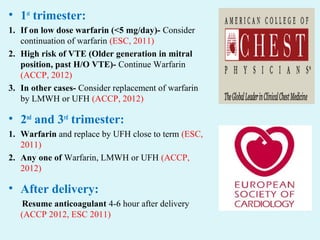
• 1st
trimester:
1. If on low dose warfarin (<5 mg/day)- Consider
continuation of warfarin (ESC, 2011)
2. High risk of VTE (Older generation in mitral
position, past H/O VTE)- Continue Warfarin
(ACCP, 2012)
3. In other cases- Consider replacement of warfarin
by LMWH or UFH (ACCP, 2012)
• 2nd
and 3rd
trimester:
1. Warfarin and replace by UFH close to term (ESC,
2011)
2. Any one of Warfarin, LMWH or UFH (ACCP,
2012)
• After delivery:
Resume anticoagulant 4-6 hour after delivery
(ACCP 2012, ESC 2011)
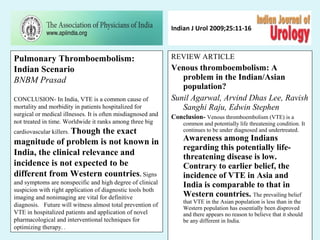
INDIAN SCENARIO
Indian J Urol 2009;25:11-16
REVIEW ARTICLE
Venous thromboembolism: A
problem in the Indian/Asian
population?
Sunil Agarwal, Arvind Dhas Lee, Ravish
Sanghi Raju, Edwin Stephen
Conclusion- Venous thromboembolism (VTE) is a
common and potentially life threatening condition. It
continues to be under diagnosed and undertreated.
Awareness among Indians
regarding this potentially life-
threatening disease is low.
Contrary to earlier belief, the
incidence of VTE in Asia and
India is comparable to that in
Western countries. The prevailing belief
that VTE in the Asian population is less than in the
Western population has essentially been disproved
and there appears no reason to believe that it should
be any different in India.
Pulmonary Thromboembolism:
Indian Scenario
BNBM Prasad
CONCLUSION- In India, VTE is a common cause of
mortality and morbidity in patients hospitalized for
surgical or medical illnesses. It is often misdiagnosed and
not treated in time. Worldwide it ranks among three big
cardiovascular killers. Though the exact
magnitude of problem is not known in
India, the clinical relevance and
incidence is not expected to be
different from Western countries. Signs
and symptoms are nonspecific and high degree of clinical
suspicion with right application of diagnostic tools both
imaging and nonimaging are vital for definitive
diagnosis. pFuture will witness almost total prevention of
VTE in hospitalized patients and application of novel
pharmacological and interventional techniques for
optimizing therapy. .
International Journal of Biological & Medical Research
Journal homepage: www.biomedscidirect.com
Original Article
Maternal Mortality at a Tertiary Care Teaching Hospital of Rural India: A
Retrospective Study
Vidyadhar B. Bangal, Purushottam A. Giri, Ruchika Garg
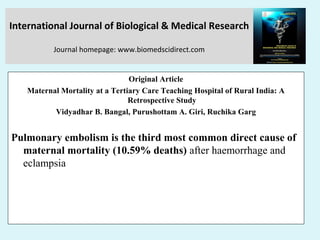
Pulmonary embolism is the third most common direct cause of
maternal mortality (10.59% deaths) after haemorrhage and
eclampsia
Original Article
Deep venous thrombosis in the
antenatal period in a large
cohort of pregnancies from
western India
Sonal Vora, Kaniaksha Ghosh,
Shrimati Shettv, Vinita Salvi, and
Purnima Santoskar
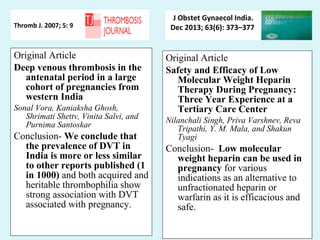
Conclusion- We conclude that
the prevalence of DVT in
India is more or less similar
to other reports published (1
in 1000) and both acquired and
heritable thrombophilia show
strong association with DVT
associated with pregnancy.
Thromb J. 2007; 5: 9
J Obstet Gynaecol India.
Dec 2013; 63(6): 373–377
Original Article
Safety and Efficacy of Low
Molecular Weight Heparin
Therapy During Pregnancy:
Three Year Experience at a
Tertiary Care Center
Nilanchali Singh, Priva Varshnev, Reva
Tripathi, Y. M. Mala, and Shakun
Tyagi
Conclusion- Low molecular
weight heparin can be used in
pregnancy for various
indications as an alternative to
unfractionated heparin or
warfarin as it is efficacious and
safe.
Conclusion
• Pregnancy itself is a
thrombogenic condition
• Every woman should be
assessed for risk factors
• Decision for
thromboprophylaxis should be
individualized
• LMWH is the drug of choice
• Threshold for recommending
thromboprophylaxis should be
lower because the risk is higher
and the duration is shorter
THANK YOU

Thromboprophylaxis in Obstetrics

  • 1.
    THROMBO-PROPHYLAXIS IN OBSTETRICS SUJOY DASGUPTA MBBS (GoldMedalist, Hons), MS (OBGY- Gold Medalist), DNB (OBGY) Senior Resident, Deptt of Gynaecological Oncology, Chittaranjan National cancer Institute (CNCI), Kolkata
  • 3.
    Venous Thromboembolism (VTE) •Incidence- 2.3 per 1000 pregnancy • Risk increases 4-6 fold in pregnancy • Risk increases further in puerperium (especially the 1st week) • Overall case fatality rate- 3.5% • The mortality rate of PE is 11% within an hour of presentation and a further 30% among survivors if not recognized. • Often no time for diagnosis and treatment • Globally- 3% of maternal deaths (WHO, 2014) Prevention- THROMBO-PROPHYLAXIS
  • 5.
    Risk Factors forVTE* Pre-existing Previous venous thromboembolism Thrombophilia: Hereditary (Deficiency of antithrombin, Protein S, Protein C; Mutation of Factor V Leiden, Prothrombin G20210A), Acquired (Anti-Phospholipid Syndrome) Medical comorbidities (e.g. heart or lung disease, SLE, cancer, inflammatory conditions , nephrotic syndrome (proteinuria > 3 g/day), sickle cell disease, intravenous drug user Age > 35 years Obesity (BMI > 30 kg/m2) either pre-pregnancy or in early pregnancy Parity ≥ 3 Smoking Gross varicose veins (symptomatic or above knee or with associated phlebitis, oedema/skin changes) Paraplegia Obstetric Multiple pregnancy, assisted reproductive therapy Pre-eclampsia Caesarean section Prolonged labour, mid-cavity rotational operative delivery PPH (> 1 litre) requiring transfusion New-onset/transient) Potentially reversible Surgical procedure in pregnancy or puerperium (e.g. ERPC, appendicectomy, postpartum sterilisation) Hyperemesis, dehydration Ovarian hyperstimulation syndrome Admission or immobility (≥ 3 days’ bed rest) e.g. symphysis pubis dysfunction restricting mobility Systemic infection (requiring antibiotics or admission to hospital) Long-distance travel (> 4 hours) * RCOG Green-top Guidelines No. 37a, November 2009 Reducing the risk of thrombosis and embolism during pregnancy and the puerperium
  • 6.
    When to Assess •Preconceptional Care • First Antenatal visit • Intrapartum period • Immediate postpartum • If admitted to hospital for any reason • If develops intercurrent problems (e.g., infection)
  • 7.
    Risk Scoring Pre-existing ScoreObstetric Score Transient Score Previous recurrent VTE 3 Pre-eclampsia 1 Any Surgery 2 Previous VTE – unprovoked/ estrogen related 3 Dehydration/ Hyperemesis/OHSS 1 Current Infection 1 Previous VTE – provoked 2 Multiple pregnancy/ ART 1 Immobility 1 Family history of VTE 1 CS in labour 2 Known thrombophilia 2 Elective CS 1 Medical comorbidities 2 Mid-cavity/ rotational forceps 1 Age (> 35 years) 1 Prolonged labour (>24 hrs) 1 Obesity (BMI >40 kg/m2 ) 2 PPH (>1 litre or transfusion) 1 Obesity (BMI >30kg/m2 ) 1 Parity ≥3 1 Smoker 1 Gross varicose veins 1
  • 8.
  • 9.
    Heparin Unfractionated Heparin (UFH) Low MolecularWeight Heparin (LMWH) Molecular weight 12,000-16,000 Da 3000-7000 Inhibitory effect F Xa, F IIa F Xa mainly Bioavailability 20-30% 70-80% aPTT Prolonged Not prolonged Complications (Bleeding, Osteoporosis) Common Rare Heparin Induced Thrombocytopenia (HIT) 3-5% Never occurs de novo Half life 30 min 3 hour Anticoagulant action Shorter Prolonged (Once daily dose) Cost Cheaper Expensive
  • 10.
    Prophylactic Dose Calculation Weight(Kg) Enoxaparin Dalteparin Tinzaparin (75 U/kg/day) <50 20 mg OD 2500 U OD 3500 U OD 50-90 40 mg OD 5000 U OD 4500 U OD 91-130 60 mg OD* 7500 U OD* 7000 U OD* 131-170 80 mg OD* 10,000 U OD* 9000 U OD* >170 0.6 mg/kg/day* 75 U/kg/day* 75 U/kg/day* * May be given in two divided doses
  • 11.
    Higher dose • RecurrentVTE, who were on long term oral anticoagulants • Antithrombin III deficiency • Homozygous Factor V Leiden Mutation • Homozygous Prothrombin G20210A Mutation • Double heterozygous defect (FVL, G20210A) • APLA syndrome with H/O VTE Enoxaparin Dalteparin Tinzaparin High Prophylactic/ Intermediate Dose 40 mg 12 hourly 5000 U 12 hourly 4500 U 12 hourly (Weight 50-90 kg) Adjusted/ Therapeutic Dose Antenatal- 1 mg/kg/ 12 hourly Postnatal- 1.5 mg/kg/daily Antenatal- 100 U/kg/12 hourly Postnatal- 200 U/kg/daily 175 /kg/daily (Antenatal and Postnatal)
  • 12.
    Monitoring 1. Platelet count •No previousexposure to UFH Not required •Past/ recent use of UFH Every 2-3 days from D4- D14 2. Anti-Xa •Prophylactic dose Not required if renal function is normal (Creatinine clearance >30 ml/min) •Therapeutic dose •Extreme of body weight (<50 kg, >90 kg) •Renal compromise •Risk factors for bleeding
  • 13.
    Delivery and anaesthesia •To stop further injection if she feels labour pain/ vaginal bleeding
  • 14.
    1. Gap betweenlast dose of UFH/ LMWH and Regional anesthesia  12 hours (prophylactic dose)  24 hours (therapeutic dose) 2. Restart LMWH/ UFH-  4 hours after removal of epidural catheter or SA  4 hours after operation Sunday 6 PM LMWH 40 mg SC }>12 hrsMonday 8 AM Elective CS under EA Monday 2 PM Remove epidural catheter }4 hrs Monday 6 PM LMWH 40 mg SC
  • 15.
    Alternative to Heparin DanaparoidPreferred drug in HIT Lepirudin •Antenatal- Better avoided •Postnatal- Alternative to danaparoid Fondaparinux Better to be avoided Warfarin •Antenatal- 5% risk of embryopathy, if used in 6-9 weeks, at dose >5 mg/day •Postnatal- Preferred to LMWH, if prophylaxis is needed for >7 days Rivaroxaban Apixaban Inadequate data Dabigatran Ximelgatran Inadequate data Dextran Can cause anaphylaxis
  • 16.
  • 17.
  • 18.
    Previous history ofRECURRENT episodes of VTE Antenatal Postnatal On long term anticoagulant Adjusted or 75% Therapeutic dose of LMWH Long term anticoagulants Not on long term anticoagulant Prophylactic or Intermediate dose LMWH 6 wk LMWH/ Warfarin Previous history of SINGLE episode of VTE Antenatal Postnatal 1. Unprovoked 2. Estrogen related 3. Hereditary thrombophilia 4. Positive family H/O VTE Prophylactic dose LMWH 6 wk LMWH/ Warfarin Associated APLA syndrome Adjusted or 75% Therapeutic dose of LMWH + Aspirin Long term anticoagulants Related to transient risk factors no longer present Vigilance 6 wk LMWH/ Warfarin
  • 19.
    Asymptomatic Thrombophilia (noprevious history of VTE) Antenatal Postnatal Antithrombin III deficiency Adjusted or 75% Therapeutic dose of LMWH Long term anticoagulants 1. Homozygous Factor V Leiden 2. Homozygous Prothrombin G20210A 3. Double heterozygous defects (FVL + G20210A) Positive Family H/O VTE Prophylactic/ Intermediate dose LMWH 6 wk LMWH/ Warfarin No family H/O VTE Vigilance 6 wk LMWH/ Warfarin Other hereditary thrombophilia Vigilance 7 days LMWH APLA syndrome (with H/O Obstetric complications) Prophylactic dose LMWH + Aspirin 6 wk LMWH/ Warfarin APLA seropositivity only, no Obst H/O, no thrombosis Vigilance 7 days LMWH
  • 20.
    Artificial Mechanical HeartValves • Thrombosis vs fetal risk • Individualization and informed risk consent
  • 21.
    • 1st trimester: 1. Ifon low dose warfarin (<5 mg/day)- Consider continuation of warfarin (ESC, 2011) 2. High risk of VTE (Older generation in mitral position, past H/O VTE)- Continue Warfarin (ACCP, 2012) 3. In other cases- Consider replacement of warfarin by LMWH or UFH (ACCP, 2012) • 2nd and 3rd trimester: 1. Warfarin and replace by UFH close to term (ESC, 2011) 2. Any one of Warfarin, LMWH or UFH (ACCP, 2012) • After delivery: Resume anticoagulant 4-6 hour after delivery (ACCP 2012, ESC 2011)
  • 22.
  • 23.
    Indian J Urol2009;25:11-16 REVIEW ARTICLE Venous thromboembolism: A problem in the Indian/Asian population? Sunil Agarwal, Arvind Dhas Lee, Ravish Sanghi Raju, Edwin Stephen Conclusion- Venous thromboembolism (VTE) is a common and potentially life threatening condition. It continues to be under diagnosed and undertreated. Awareness among Indians regarding this potentially life- threatening disease is low. Contrary to earlier belief, the incidence of VTE in Asia and India is comparable to that in Western countries. The prevailing belief that VTE in the Asian population is less than in the Western population has essentially been disproved and there appears no reason to believe that it should be any different in India. Pulmonary Thromboembolism: Indian Scenario BNBM Prasad CONCLUSION- In India, VTE is a common cause of mortality and morbidity in patients hospitalized for surgical or medical illnesses. It is often misdiagnosed and not treated in time. Worldwide it ranks among three big cardiovascular killers. Though the exact magnitude of problem is not known in India, the clinical relevance and incidence is not expected to be different from Western countries. Signs and symptoms are nonspecific and high degree of clinical suspicion with right application of diagnostic tools both imaging and nonimaging are vital for definitive diagnosis. pFuture will witness almost total prevention of VTE in hospitalized patients and application of novel pharmacological and interventional techniques for optimizing therapy. .
  • 24.
    International Journal ofBiological & Medical Research Journal homepage: www.biomedscidirect.com Original Article Maternal Mortality at a Tertiary Care Teaching Hospital of Rural India: A Retrospective Study Vidyadhar B. Bangal, Purushottam A. Giri, Ruchika Garg Pulmonary embolism is the third most common direct cause of maternal mortality (10.59% deaths) after haemorrhage and eclampsia
  • 25.
    Original Article Deep venousthrombosis in the antenatal period in a large cohort of pregnancies from western India Sonal Vora, Kaniaksha Ghosh, Shrimati Shettv, Vinita Salvi, and Purnima Santoskar Conclusion- We conclude that the prevalence of DVT in India is more or less similar to other reports published (1 in 1000) and both acquired and heritable thrombophilia show strong association with DVT associated with pregnancy. Thromb J. 2007; 5: 9 J Obstet Gynaecol India. Dec 2013; 63(6): 373–377 Original Article Safety and Efficacy of Low Molecular Weight Heparin Therapy During Pregnancy: Three Year Experience at a Tertiary Care Center Nilanchali Singh, Priva Varshnev, Reva Tripathi, Y. M. Mala, and Shakun Tyagi Conclusion- Low molecular weight heparin can be used in pregnancy for various indications as an alternative to unfractionated heparin or warfarin as it is efficacious and safe.
  • 26.
    Conclusion • Pregnancy itselfis a thrombogenic condition • Every woman should be assessed for risk factors • Decision for thromboprophylaxis should be individualized • LMWH is the drug of choice • Threshold for recommending thromboprophylaxis should be lower because the risk is higher and the duration is shorter
  • 27.