Placental
Development
( for undergraduates)
Sona P.S.
Assistant Professor,
Govt. College of Nursing , Trivandrum
Placental Development
• 3 weeks after fertilisation -Small projections appear on
the trophoblastic layer of the blastocyst , proliferate to
form chorionic villi
• Abundant in decidua basalis called chorionic frontosum &
develops into placenta
• The villi under decidua capsularis are less abundant and
atrophy to form chorionic leave which later form chorion
Placental Development
• Chorionic villi erode the walls of maternal blood vessels
and opens up to form a pool of maternal blood(sinuses)
• Few villi attach deeply into decidua(anchoring villi)
• Placental circulation establishes by 17th day
• Placenta completely develops and functions by 10th week
after gestation
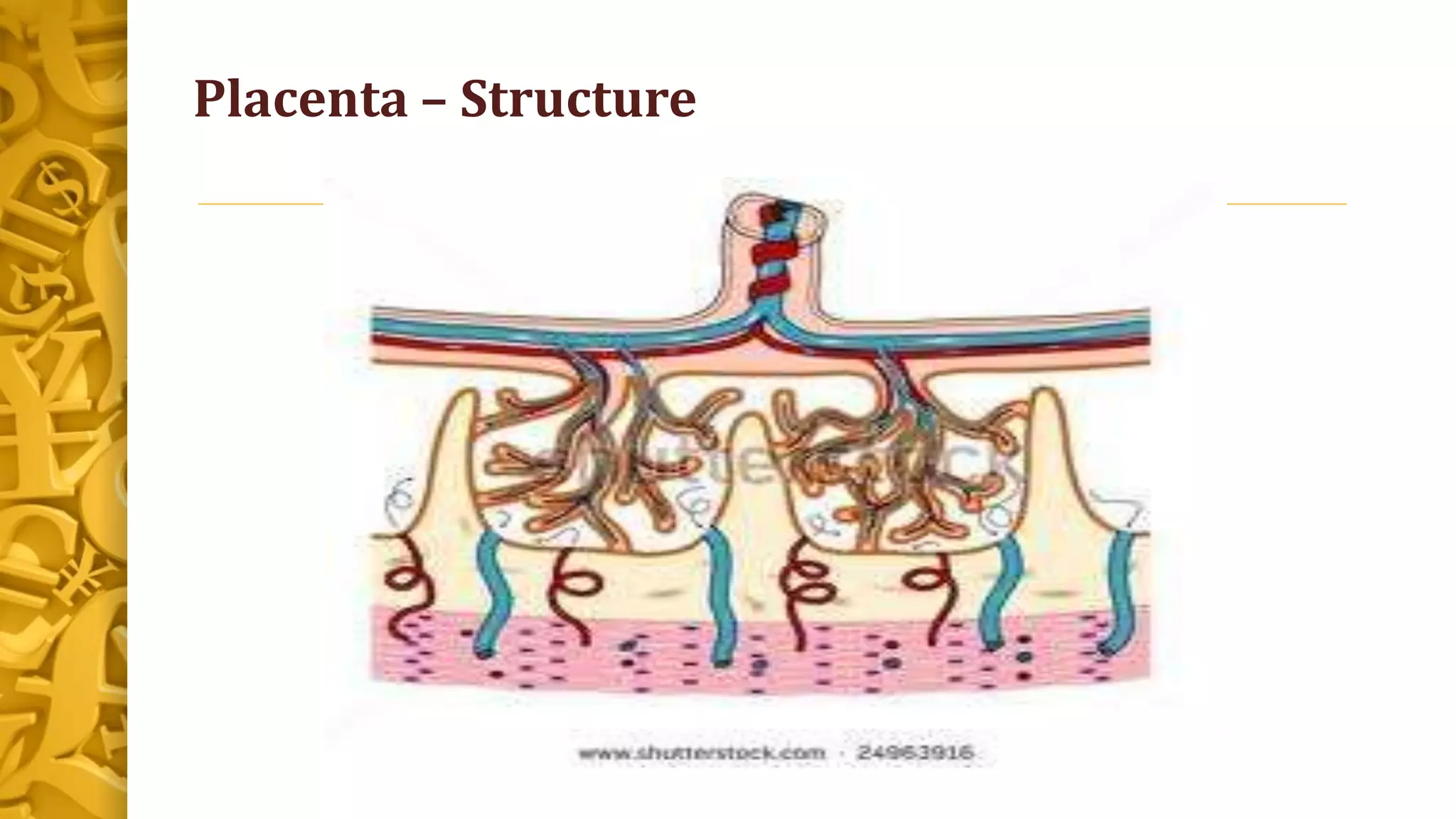
Placenta – Structure
Cotyledon of Placenta
• Each villus and its branches form the
cotyledon
• 15-30 lobes(average 20)
•Discoid shape
•Average weight 500 gm (200 – 800 gm)
•1/6 of baby’s weight at term
•Average diameter 20 cm and thickness 2.5 cm
•Maternal and fetal surfaces
•Maternal surface rough and granular
•Fetal surface smooth, shiny and transparent
•Umbilical cord- attached to fetal surface
Mature Placenta
Functions of placenta
• Respiration
• Nutrition
• Storage –stores vitamins, iron and glucose
• Excretion – CO2, bilirubin from RBC, urea and uric acid
• Protection – barrier function, transfer antibodies, shock absorber
for the fetus
• Endocrine-hCG, progesterone, HPL
Mechanism of Transfer
• Diffusion – water, oxygen, CO2, urea and simple amines
• Active transport –transfer of Iron and ascorbic acid from mother
• Phagocytosis by chorionic villi- immunoglobulins
Placental development

Placental development

  • 1.
    Placental Development ( for undergraduates) SonaP.S. Assistant Professor, Govt. College of Nursing , Trivandrum
  • 2.
    Placental Development • 3weeks after fertilisation -Small projections appear on the trophoblastic layer of the blastocyst , proliferate to form chorionic villi • Abundant in decidua basalis called chorionic frontosum & develops into placenta • The villi under decidua capsularis are less abundant and atrophy to form chorionic leave which later form chorion
  • 3.
    Placental Development • Chorionicvilli erode the walls of maternal blood vessels and opens up to form a pool of maternal blood(sinuses) • Few villi attach deeply into decidua(anchoring villi) • Placental circulation establishes by 17th day • Placenta completely develops and functions by 10th week after gestation
  • 4.
  • 6.
    Cotyledon of Placenta •Each villus and its branches form the cotyledon • 15-30 lobes(average 20)
  • 8.
    •Discoid shape •Average weight500 gm (200 – 800 gm) •1/6 of baby’s weight at term •Average diameter 20 cm and thickness 2.5 cm •Maternal and fetal surfaces •Maternal surface rough and granular •Fetal surface smooth, shiny and transparent •Umbilical cord- attached to fetal surface Mature Placenta
  • 10.
    Functions of placenta •Respiration • Nutrition • Storage –stores vitamins, iron and glucose • Excretion – CO2, bilirubin from RBC, urea and uric acid • Protection – barrier function, transfer antibodies, shock absorber for the fetus • Endocrine-hCG, progesterone, HPL
  • 11.
    Mechanism of Transfer •Diffusion – water, oxygen, CO2, urea and simple amines • Active transport –transfer of Iron and ascorbic acid from mother • Phagocytosis by chorionic villi- immunoglobulins