Menstrual Cycle
Objectives:
-Explain the process of menstrual
cycle.
-Describe the menstrual cycle.
Menstruation is a periodic vaginal
discharge in humans and other mammals,
consisting of blood and cells shed from the
endometrial, or lining of the uterus.
Menstrual Cycle
Menstruation accompanies a woman's
childbearing years, that begins between
the ages of 10 and 16, at puberty, and most
often ceasing between the ages of 45 and
50, at menopause.
Menstrual Cycle
Menstruation is part of the process that
prepares a woman for pregnancy.
Menstrual Cycle
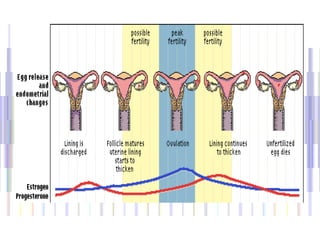
Each month the lining of the uterus
thickens; if pregnancy does not occur, this
lining breaks down and is discharged
through the vagina.
Menstrual Cycle
In most women the menstrual cycle is
about 28 days, but it can vary considerably
even from one month to another.
Menstrual Cycle
The cycle is initiated by hormones in the
blood that stimulate the ovaries (the two
female organs that produce ova, or eggs).
Menstrual Cycle
The hormones cause an egg in one of the
two ovaries to mature (to become capable
of being fertilized and develop into a fetus).
Menstrual Cycle
The ovaries also produce hormones of
their own, primarily estrogen, which cause
the endometrium to thicken.
Menstrual Cycle
The egg passes through the fallopian tube
to the uterus. If the egg unites with a sperm
on its way to the uterus, fertilization occurs
and pregnancy ensues.
Menstrual Cycle
If fertilization does not occur, the lining of the
uterus does not receive the hormones it
needs to continue the thickening process.
Thus, the uterine lining breaks down and is
discharged from the body during
menstruation.
Menstrual Cycle
Many women experience premenstrual
discomfort. Tenderness of the breasts and
a tendency to retain fluid (bloat) are
common one to seven days before each
period.
Menstrual Cycle
Some women also experience a condition
called premenstrual syndrome which is
characterized by headaches, irritability,
nervousness, fatigue, crying spells, and
depression with no apparent cause.
Menstrual Cycle
A few women also experience menstrual
cramps (dysmenorrhea) during the first day
or two of the period.
Menstrual Cycle
References:
The world of Science 5
Into the Future; Science and Health 5
BEC Handbook in Science 5
Encarta 2009

Menstrual cycle

  • 1.
    Menstrual Cycle Objectives: -Explain theprocess of menstrual cycle. -Describe the menstrual cycle.
  • 2.
    Menstruation is aperiodic vaginal discharge in humans and other mammals, consisting of blood and cells shed from the endometrial, or lining of the uterus. Menstrual Cycle
  • 3.
    Menstruation accompanies awoman's childbearing years, that begins between the ages of 10 and 16, at puberty, and most often ceasing between the ages of 45 and 50, at menopause. Menstrual Cycle
  • 4.
    Menstruation is partof the process that prepares a woman for pregnancy. Menstrual Cycle
  • 5.
    Each month thelining of the uterus thickens; if pregnancy does not occur, this lining breaks down and is discharged through the vagina. Menstrual Cycle
  • 6.
    In most womenthe menstrual cycle is about 28 days, but it can vary considerably even from one month to another. Menstrual Cycle
  • 7.
    The cycle isinitiated by hormones in the blood that stimulate the ovaries (the two female organs that produce ova, or eggs). Menstrual Cycle
  • 8.
    The hormones causean egg in one of the two ovaries to mature (to become capable of being fertilized and develop into a fetus). Menstrual Cycle
  • 9.
    The ovaries alsoproduce hormones of their own, primarily estrogen, which cause the endometrium to thicken. Menstrual Cycle
  • 10.
    The egg passesthrough the fallopian tube to the uterus. If the egg unites with a sperm on its way to the uterus, fertilization occurs and pregnancy ensues. Menstrual Cycle
  • 11.
    If fertilization doesnot occur, the lining of the uterus does not receive the hormones it needs to continue the thickening process. Thus, the uterine lining breaks down and is discharged from the body during menstruation. Menstrual Cycle
  • 12.
    Many women experiencepremenstrual discomfort. Tenderness of the breasts and a tendency to retain fluid (bloat) are common one to seven days before each period. Menstrual Cycle
  • 13.
    Some women alsoexperience a condition called premenstrual syndrome which is characterized by headaches, irritability, nervousness, fatigue, crying spells, and depression with no apparent cause. Menstrual Cycle
  • 14.
    A few womenalso experience menstrual cramps (dysmenorrhea) during the first day or two of the period. Menstrual Cycle
  • 16.
    References: The world ofScience 5 Into the Future; Science and Health 5 BEC Handbook in Science 5 Encarta 2009