Presented by: Hina Amir
 Introduction
 Fermentation
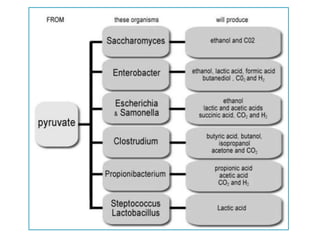
 Products
 Industrial scale
 Types
 Advantages
 Disadvantages
 Summary
Contents
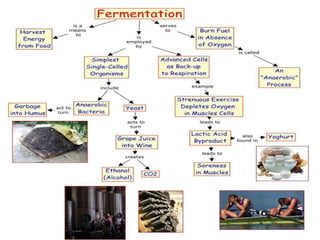
• FERMENTATION TECHNOLOGY
microorganisms, grown on a large scale, to produce
valuable commercial products or to carry out important
chemical transformations.
• FERMENTATION
Pasteur’s “life without air”,
Latin word fervere, to boil
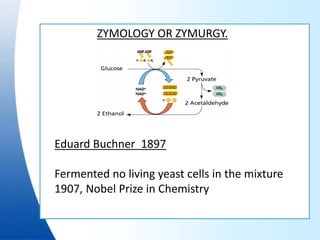
ZYMOLOGY OR ZYMURGY.
Eduard Buchner 1897
Fermented no living yeast cells in the mixture
1907, Nobel Prize in Chemistry
6
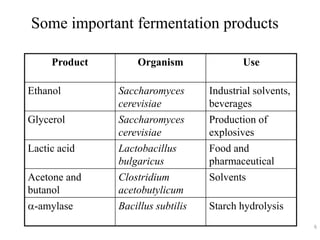
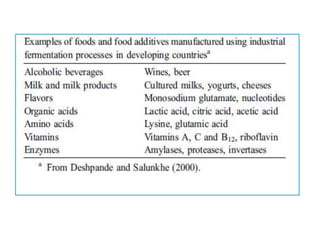
Some important fermentation products
Product Organism Use
Ethanol Saccharomyces
cerevisiae
Industrial solvents,
beverages
Glycerol Saccharomyces
cerevisiae
Production of
explosives
Lactic acid Lactobacillus
bulgaricus
Food and
pharmaceutical
Acetone and
butanol
Clostridium
acetobutylicum
Solvents
-amylase Bacillus subtilis Starch hydrolysis
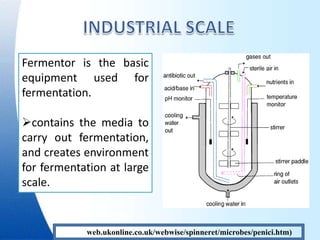
Fermentor is the basic
equipment used for
fermentation.
contains the media to
carry out fermentation,
and creates environment
for fermentation at large
scale.
http://web.ukonline.co.uk/webwise/spinneret/microbes/penici.htm)
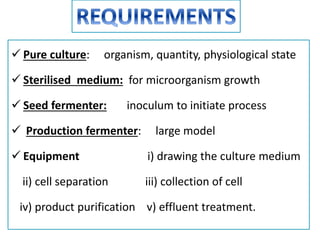
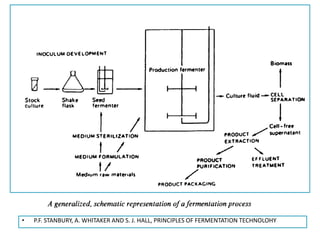
 Pure culture: organism, quantity, physiological state
 Sterilised medium: for microorganism growth
 Seed fermenter: inoculum to initiate process
 Production fermenter: large model
 Equipment i) drawing the culture medium
ii) cell separation iii) collection of cell
iv) product purification v) effluent treatment.
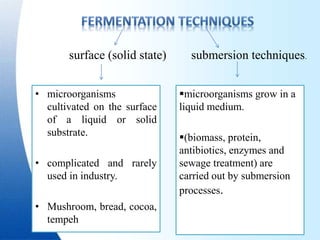
surface (solid state) submersion techniques.
• microorganisms
cultivated on the surface
of a liquid or solid
substrate.
• complicated and rarely
used in industry.
• Mushroom, bread, cocoa,
tempeh
microorganisms grow in a
liquid medium.
(biomass, protein,
antibiotics, enzymes and
sewage treatment) are
carried out by submersion
processes.
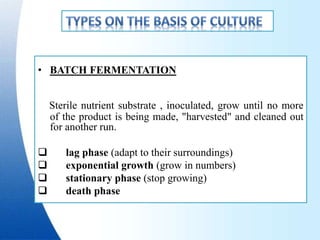
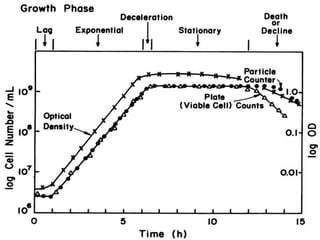
• BATCH FERMENTATION
Sterile nutrient substrate , inoculated, grow until no more
of the product is being made, "harvested" and cleaned out
for another run.
 lag phase (adapt to their surroundings)
 exponential growth (grow in numbers)
 stationary phase (stop growing)
 death phase
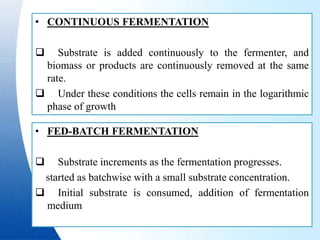
• CONTINUOUS FERMENTATION
 Substrate is added continuously to the fermenter, and
biomass or products are continuously removed at the same
rate.
 Under these conditions the cells remain in the logarithmic
phase of growth
• FED-BATCH FERMENTATION
 Substrate increments as the fermentation progresses.
started as batchwise with a small substrate concentration.
 Initial substrate is consumed, addition of fermentation
medium
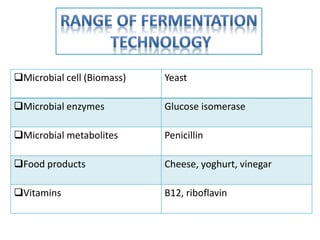
Microbial cell (Biomass) Yeast
Microbial enzymes Glucose isomerase
Microbial metabolites Penicillin
Food products Cheese, yoghurt, vinegar
Vitamins B12, riboflavin
• P.F. STANBURY, A. WHITAKER AND S. J. HALL, PRINCIPLES OF FERMENTATION TECHNOLOHY
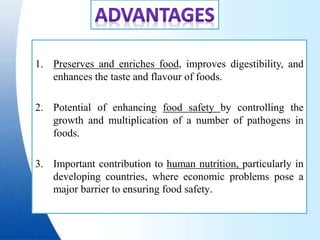
1. Preserves and enriches food, improves digestibility, and
enhances the taste and flavour of foods.
2. Potential of enhancing food safety by controlling the
growth and multiplication of a number of pathogens in
foods.
3. Important contribution to human nutrition, particularly in
developing countries, where economic problems pose a
major barrier to ensuring food safety.
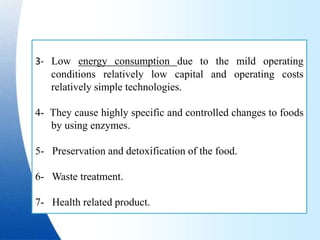
3- Low energy consumption due to the mild operating
conditions relatively low capital and operating costs
relatively simple technologies.
4- They cause highly specific and controlled changes to foods
by using enzymes.
5- Preservation and detoxification of the food.
6- Waste treatment.
7- Health related product.
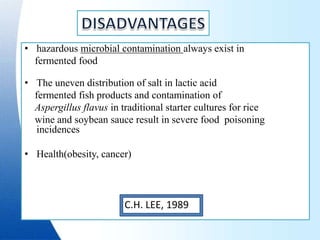
• hazardous microbial contamination always exist in
fermented food
• The uneven distribution of salt in lactic acid
fermented fish products and contamination of
Aspergillus flavus in traditional starter cultures for rice
wine and soybean sauce result in severe food poisoning
incidences
• Health(obesity, cancer)
C.H. LEE, 1989
References
• Stanbury, P.F., A. Whitaker, and S. J. Hall, (2000) Principles of
Fermentation Technology, 2nd ed., Butterworth Heinemann, Oxford.
• Shuler, M. L. and F. Kargi., (2002). Bioprocess Engineering Basic
Concepts, 2nd ed., Prentice Hall, Upper Saddle River, NJ,
• Lee, C.H., (1989) Fish fermentation technology, Korean J. Applied
Microbiology and Bioengineering, 17(6), 645-654
• Daniel I. C., et al., (1979)“Fermentation and Enzyme Technology,”
John Wiley, New York .
• Willey, J. M. Shrewood, L. M. (2008) Microbiology .7th ed. Mc Graw
Hill.,1067-1069
22

FERMENTATION TECHNOLOGY

  • 1.
  • 2.
     Introduction  Fermentation Products  Industrial scale  Types  Advantages  Disadvantages  Summary Contents
  • 3.
    • FERMENTATION TECHNOLOGY microorganisms,grown on a large scale, to produce valuable commercial products or to carry out important chemical transformations. • FERMENTATION Pasteur’s “life without air”, Latin word fervere, to boil
  • 4.
    ZYMOLOGY OR ZYMURGY. EduardBuchner 1897 Fermented no living yeast cells in the mixture 1907, Nobel Prize in Chemistry
  • 6.
    6 Some important fermentationproducts Product Organism Use Ethanol Saccharomyces cerevisiae Industrial solvents, beverages Glycerol Saccharomyces cerevisiae Production of explosives Lactic acid Lactobacillus bulgaricus Food and pharmaceutical Acetone and butanol Clostridium acetobutylicum Solvents -amylase Bacillus subtilis Starch hydrolysis
  • 7.
    Fermentor is thebasic equipment used for fermentation. contains the media to carry out fermentation, and creates environment for fermentation at large scale. http://web.ukonline.co.uk/webwise/spinneret/microbes/penici.htm)
  • 8.
     Pure culture:organism, quantity, physiological state  Sterilised medium: for microorganism growth  Seed fermenter: inoculum to initiate process  Production fermenter: large model  Equipment i) drawing the culture medium ii) cell separation iii) collection of cell iv) product purification v) effluent treatment.
  • 9.
    surface (solid state)submersion techniques. • microorganisms cultivated on the surface of a liquid or solid substrate. • complicated and rarely used in industry. • Mushroom, bread, cocoa, tempeh microorganisms grow in a liquid medium. (biomass, protein, antibiotics, enzymes and sewage treatment) are carried out by submersion processes.
  • 10.
    • BATCH FERMENTATION Sterilenutrient substrate , inoculated, grow until no more of the product is being made, "harvested" and cleaned out for another run.  lag phase (adapt to their surroundings)  exponential growth (grow in numbers)  stationary phase (stop growing)  death phase
  • 12.
    • CONTINUOUS FERMENTATION Substrate is added continuously to the fermenter, and biomass or products are continuously removed at the same rate.  Under these conditions the cells remain in the logarithmic phase of growth • FED-BATCH FERMENTATION  Substrate increments as the fermentation progresses. started as batchwise with a small substrate concentration.  Initial substrate is consumed, addition of fermentation medium
  • 13.
    Microbial cell (Biomass)Yeast Microbial enzymes Glucose isomerase Microbial metabolites Penicillin Food products Cheese, yoghurt, vinegar Vitamins B12, riboflavin
  • 15.
    • P.F. STANBURY,A. WHITAKER AND S. J. HALL, PRINCIPLES OF FERMENTATION TECHNOLOHY
  • 16.
    1. Preserves andenriches food, improves digestibility, and enhances the taste and flavour of foods. 2. Potential of enhancing food safety by controlling the growth and multiplication of a number of pathogens in foods. 3. Important contribution to human nutrition, particularly in developing countries, where economic problems pose a major barrier to ensuring food safety.
  • 17.
    3- Low energyconsumption due to the mild operating conditions relatively low capital and operating costs relatively simple technologies. 4- They cause highly specific and controlled changes to foods by using enzymes. 5- Preservation and detoxification of the food. 6- Waste treatment. 7- Health related product.
  • 19.
    • hazardous microbialcontamination always exist in fermented food • The uneven distribution of salt in lactic acid fermented fish products and contamination of Aspergillus flavus in traditional starter cultures for rice wine and soybean sauce result in severe food poisoning incidences • Health(obesity, cancer) C.H. LEE, 1989
  • 21.
    References • Stanbury, P.F.,A. Whitaker, and S. J. Hall, (2000) Principles of Fermentation Technology, 2nd ed., Butterworth Heinemann, Oxford. • Shuler, M. L. and F. Kargi., (2002). Bioprocess Engineering Basic Concepts, 2nd ed., Prentice Hall, Upper Saddle River, NJ, • Lee, C.H., (1989) Fish fermentation technology, Korean J. Applied Microbiology and Bioengineering, 17(6), 645-654 • Daniel I. C., et al., (1979)“Fermentation and Enzyme Technology,” John Wiley, New York . • Willey, J. M. Shrewood, L. M. (2008) Microbiology .7th ed. Mc Graw Hill.,1067-1069
  • 22.