S. SUNYOGITA
PRINCIPLES OF LITERARY
CRITICISM
APPROACHES
APPROACHES
• One of the function of literary criticism is to
provide a link between the work of art and
the readers
• In that process he has evolved a few
theories.
“Approaches”
TYPES OF APPROACHES
Approach: a way of dealing with a situation
• Psychological
• Moralistic
• Archetypal
• Formalistic
• Sociological
APPROACHES
• Approach: a way of dealing with a situation
• Psychological: psychological insight
• Moralistic : Moral application to literature
• Archetypal: Social pattern common
• Formalistic: Analyzing literary work
• Sociological: Social Milieu
MORALISTIC CRITIC
• when a critic judges a work of art with ethical
standards his approach is termed moralistic
• Morality is being one of the principal issues in life
• To a moralistic critic, the content is more important than
the form of a work of art
• His business is to detect the moral aspect society in the
right place
• He is content if it educates, instructs or direct the society
in the right path
• Moralist discuss topic under “ethical appleal”
MORALISTIC CRITIC
• To the function of the literature is to first teach moral
values and them to delight
• The function of the moralist is to exhort, to a moralist a
work of art without didactic purpose is inconceviable.
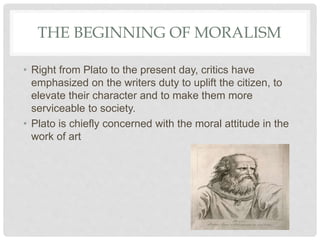
THE BEGINNING OF MORALISM
• Right from Plato to the present day, critics have
emphasized on the writers duty to uplift the citizen, to
elevate their character and to make them more
serviceable to society.
• Plato is chiefly concerned with the moral attitude in the
work of art
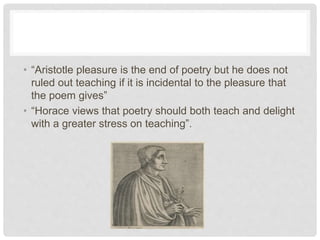
• “Aristotle pleasure is the end of poetry but he does not
ruled out teaching if it is incidental to the pleasure that
the poem gives”
• “Horace views that poetry should both teach and delight
with a greater stress on teaching”.
RENAISSANCE PERIOD
• The Renaissance writers stressed the moral value in the
work of art
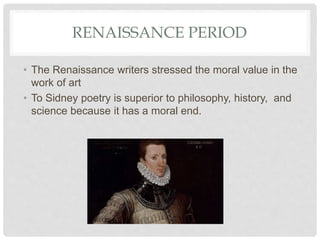
• To Sidney poetry is superior to philosophy, history, and
science because it has a moral end.
NEO CLASSICAL PERIOD
• The moralism continues in the neo classical period also
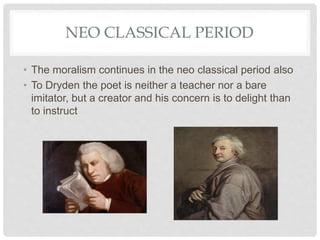
• To Dryden the poet is neither a teacher nor a bare
imitator, but a creator and his concern is to delight than
to instruct
• Alexander pope- a
staunch moralist
stressed the
importance of the
morals aspects in a
work of art
• Dr. Johson the great
champion of the 18th
century liked to judge
a work of art by its
moral content. He
praised Milton’s
“Paradise lost”
because it is a moral
poem
ROMANTIC PERIOD
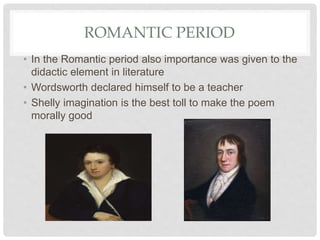
• In the Romantic period also importance was given to the
didactic element in literature
• Wordsworth declared himself to be a teacher
• Shelly imagination is the best toll to make the poem
morally good
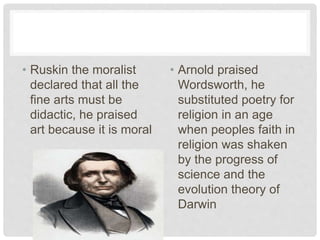
• Ruskin the moralist
declared that all the
fine arts must be
didactic, he praised
art because it is moral
• Arnold praised
Wordsworth, he
substituted poetry for
religion in an age
when peoples faith in
religion was shaken
by the progress of
science and the
evolution theory of
Darwin
TWENTIETH CENTURY
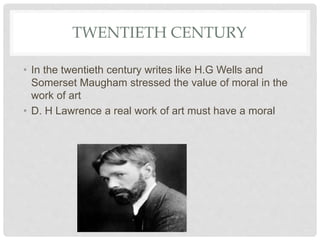
• In the twentieth century writes like H.G Wells and
Somerset Maugham stressed the value of moral in the
work of art
• D. H Lawrence a real work of art must have a moral
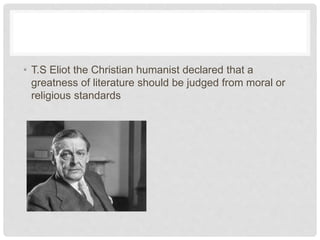
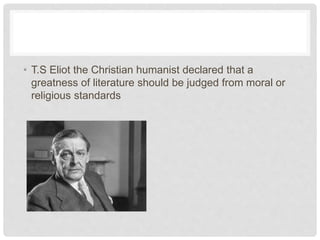
• T.S Eliot the Christian humanist declared that a
greatness of literature should be judged from moral or
religious standards
• T.S Eliot the Christian humanist declared that a
greatness of literature should be judged from moral or
religious standards
THE NEO- HUMANIST
• Neo humanist are a group of writes in the twentieth
century, whose main intrest in literature lies in literature
as criticism of life.
• Moral evaluation has been chiefly expressed by these
Neo- Humanist.
• The oppose Naturalism and Romanticism
• Irving Babbitt was the chief prophet of neo humanism
NEO- HUMANIST
• Norman Foerester
• Harry Hayden Clark
• G.R Eliot
• Robert shafer
• Gorham Muson

Moralistic approach

  • 1.
    S. SUNYOGITA PRINCIPLES OFLITERARY CRITICISM APPROACHES
  • 2.
    APPROACHES • One ofthe function of literary criticism is to provide a link between the work of art and the readers • In that process he has evolved a few theories. “Approaches”
  • 3.
    TYPES OF APPROACHES Approach:a way of dealing with a situation • Psychological • Moralistic • Archetypal • Formalistic • Sociological
  • 4.
    APPROACHES • Approach: away of dealing with a situation • Psychological: psychological insight • Moralistic : Moral application to literature • Archetypal: Social pattern common • Formalistic: Analyzing literary work • Sociological: Social Milieu
  • 5.
    MORALISTIC CRITIC • whena critic judges a work of art with ethical standards his approach is termed moralistic • Morality is being one of the principal issues in life • To a moralistic critic, the content is more important than the form of a work of art • His business is to detect the moral aspect society in the right place • He is content if it educates, instructs or direct the society in the right path • Moralist discuss topic under “ethical appleal”
  • 6.
    MORALISTIC CRITIC • Tothe function of the literature is to first teach moral values and them to delight • The function of the moralist is to exhort, to a moralist a work of art without didactic purpose is inconceviable.
  • 7.
    THE BEGINNING OFMORALISM • Right from Plato to the present day, critics have emphasized on the writers duty to uplift the citizen, to elevate their character and to make them more serviceable to society. • Plato is chiefly concerned with the moral attitude in the work of art
  • 8.
    • “Aristotle pleasureis the end of poetry but he does not ruled out teaching if it is incidental to the pleasure that the poem gives” • “Horace views that poetry should both teach and delight with a greater stress on teaching”.
  • 9.
    RENAISSANCE PERIOD • TheRenaissance writers stressed the moral value in the work of art • To Sidney poetry is superior to philosophy, history, and science because it has a moral end.
  • 10.
    NEO CLASSICAL PERIOD •The moralism continues in the neo classical period also • To Dryden the poet is neither a teacher nor a bare imitator, but a creator and his concern is to delight than to instruct
  • 11.
    • Alexander pope-a staunch moralist stressed the importance of the morals aspects in a work of art • Dr. Johson the great champion of the 18th century liked to judge a work of art by its moral content. He praised Milton’s “Paradise lost” because it is a moral poem
  • 12.
    ROMANTIC PERIOD • Inthe Romantic period also importance was given to the didactic element in literature • Wordsworth declared himself to be a teacher • Shelly imagination is the best toll to make the poem morally good
  • 13.
    • Ruskin themoralist declared that all the fine arts must be didactic, he praised art because it is moral • Arnold praised Wordsworth, he substituted poetry for religion in an age when peoples faith in religion was shaken by the progress of science and the evolution theory of Darwin
  • 14.
    TWENTIETH CENTURY • Inthe twentieth century writes like H.G Wells and Somerset Maugham stressed the value of moral in the work of art • D. H Lawrence a real work of art must have a moral
  • 15.
    • T.S Eliotthe Christian humanist declared that a greatness of literature should be judged from moral or religious standards
  • 16.
    • T.S Eliotthe Christian humanist declared that a greatness of literature should be judged from moral or religious standards
  • 17.
    THE NEO- HUMANIST •Neo humanist are a group of writes in the twentieth century, whose main intrest in literature lies in literature as criticism of life. • Moral evaluation has been chiefly expressed by these Neo- Humanist. • The oppose Naturalism and Romanticism • Irving Babbitt was the chief prophet of neo humanism
  • 18.
    NEO- HUMANIST • NormanFoerester • Harry Hayden Clark • G.R Eliot • Robert shafer • Gorham Muson