COMMUNICATION 
Communication is not merely the transmission of messages or 
messages itself. It is the mutual exchange of understanding of 
between speaker and reciver .communication is the art of, transmitting 
information, ideas and attitudes from one person to another 
.communication is a process of meaning full interaction among 
human beings. 
 Personal process 
 Occurs between people 
 Involves change in behaviour. 
 Means to influence others. 
 Expression of thought and emotions through words and actions. 
 Tools for controlling and motivating people. 
 It is a social and emotional process. 
FEATURES OF COMMUNICATION: 
 Two –way communication. 
 Information sharing and understanding. 
 Verbal and non-verbal. 
 Circular flow. 
 Goal oriented. 
 Continuous process. 
 Pervasive activity.
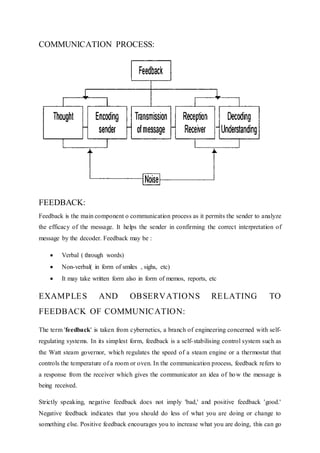
COMMUNICATION PROCESS: 
FEEDBACK: 
Feedback is the main component o communication process as it permits the sender to analyze 
the efficacy of the message. It helps the sender in confirming the correct interpretation of 
message by the decoder. Feedback may be : 
 Verbal ( through words) 
 Non-verbal( in form of smiles , sighs, etc) 
 It may take written form also in form of memos, reports, etc 
EXAMPLES AND OBSERVATIONS RELATING TO 
FEEDBACK OF COMMUNICATION: 
The term 'feedback' is taken from cybernetics, a branch of engineering concerned with self-regulating 
systems. In its simplest form, feedback is a self- stabilising control system such as 
the Watt steam governor, which regulates the speed of a steam engine or a thermostat that 
controls the temperature of a room or oven. In the communication process, feedback refers to 
a response from the receiver which gives the communicator an idea of how the message is 
being received. 
Strictly speaking, negative feedback does not imply 'bad,' and positive feedback 'good.' 
Negative feedback indicates that you should do less of what you are doing or change to 
something else. Positive feedback encourages you to increase what you are doing, this can go
out of control (over excitement at a party, fighting or having a row). If you are crying, 
feedback from those around may cause you to dry your eyes and put on a brave face (if 
feedback is negative) or weep unashamedly (if feedback is positive). 
Useful feedback on Writing: 
"The most useful feedback you can give someone (or receive yourself) is neither vague 
encouragement ('Good start! Keep at it!') nor scorching criticism ('Sloppy method!'), but 
rather an honest assessment of how the text reads. In other words, 'Rewrite 
your introduction because I don't like it' is not nearly as helpful as 'You start off saying you 
want to look at trends in functionalistic interior design, but you seem to spend most of your 
time talking about the use of colour among the Bauhaus designers.' This gives the author not 
only insight into what is confusing the reader, but also several options for fixing it: She can 
rewrite the introduction either to focus on Bauhaus designers or to better explain the link 
between functionalistic interior design and Bauhaus designers, or she can restructure the 
paper to talk about other aspects of functionalistic interior design." 
Feedback on Public Speaking: 
Public speaking presents different opportunities for feedback, or listener response to a 
message, than does dyadic, small group, or mass communication. Partners 
in conversation continually respond to one another in back-and-forth fashion; in small 
groups, participants expect interruptions for purposes of clarification or redirection. However, 
because the receiver of the message in mass communication is physically removed from the 
messenger, feedback is delayed until after the event, as in TV ratings. 
Public speaking offers a middle ground between low and high levels of feedback. Public 
speaking does not permit the constant exchange of information between listener and speaker 
that happens in conversation, but audiences can and do provide ample verbal and nonverbal 
cues to what they are thinking and feeling. Facial expressions, vocalizations (including 
laughter or disapproving noises), gestures, applause, and a range of body movements all 
signal the audience's response to the speaker.
Feedback in Conversations: 
Here is an example- 
Ira Wells: Mrs. Schmidt asked me to move out. That place next door to you, is that still 
empty? 
Margo Sperling: I don't know, Ira. I don't think I could take it. I mean you just never say 
anything, for God's sake. It's not fair, because I have to keep up my side of 
the conversation and your side of the conversation. Yeah, that's it: you just never say 
anything, for God's sake. I want some feedback from you. I want to know what you think 
about things and what you think about me. 
TYPES OF FEEDBACK ON COMMUNICATION: 
The Four Types of Feedback 
Negative feedback or corrective comments about past behaviour. These are things that didn’t 
go well. 
Positive feedback or affirming comments about past behaviour. These are things that went 
well and need to be repeated. 
Negative feed forward or corrective comments about future behaviour. These are things that 
don’t need to be repeated next time. 
Positive feed forward or affirming comments about future behaviour. These are things that 
would improve performance in the future. 
The distinction that is largely missing for most people is the focus on the future or 
feed forward. 
As begin to understand the power of balancing both positive and negative input with 
observations about the past (which can’t be changed) and advice for the future (which can be 
changed), you have a new paradigm for the feedback and coaching process. 
Here are five balancing strategies to help you use these four types of feedback in a way to 
help the other person receive and use your insights to improve performance. 
Five Balancing Strategies 
 Make sure you use them all. Which means you must understand the importance of 
each, and have insights in each area to share. The starting point must always be 
usefulness. Your challenge is to look for examples in all four areas, not make 
something up or be overly generic.
 Ask the other person his/her opinion, first. Ask questions about all four areas. Do it 
without it being an interrogation – ask something like “How do you think it went?” 
Or, more specifically, “What did you think went well?” “What do you wish you had 
done differently?” Then ask about the future with questions like, “K nowing what 
you know now, what would you do differently next time?” “What will you avoid 
next time? “What do you plan to make sure you do next time?” 
 Tie it all together. Connect the dots for people between past performance and how 
that relates to the future. This may require generalizing out an idea or behavior. 
Tying together past and future can help keep people from being defensive or 
spending their energy trying to justify the past – which can’t be changed anyway. 
 More ‘and,’ less ‘but.’ When you tie ideas together, do it with “and” not “but.” 
“But” erases everything said prior to using the word “but.” “And” is inclusive and 
draws people forward emotionally. 
 Focus on the future. While you want the feedback to be balanced, the overall focus 
needs to be on the future. Remember no one can change the past – its value in a 
feedback situation is for context, consequences and concrete examples, not for 
dwelling, hand-wringing or excessive blame. Always end the conversation talking 
about the future, including their thoughts (see suggestion above about asking their 
opinion) early and often. Doing this will give you the best shot at an action plan of 
which the other person will feel ownership. 
Hopefully this gives you a bigger view of what balanced feedback can be… and how your 
feedback can be more successful in helping others create even better results. 
THE IMPACT OF FEEDBACK ON COMMUNICATION: 
Purpose: 
The objective of this activity is to allow the student to explore the impact that non-verbal 
feedback has on the communication process and how they can change it to accommodate for 
the lack of feedback to effectively communicate.
Overview: 
During class discussion you have developed the definition of human communication to 
include the component parts. The addition of feedback to the model makes human 
communication a process and no longer a spectator sport where communication is something 
that is done to a person. In this activity, the students will conclude that feedback improves 
the quality of the communication event, increases the accuracy of the information exchanged, 
and the overall communication is more enjoyable when all participants have an opportunity 
to contribute. The trade off is that feedback requires time.In this activity a volunteer student 
describes similar pictures to the student audience under three distinct feedback situations: no 
feedback; only non- verbal, visual feedback from the audience; and full verbal and non-verbal 
feedback. 
Time: 
The activity can be conducted within one class period including the activity and Class 
discussion. 
Skills Required: 
 Listening skills 
 Descriptive articulation 
 Verbal to pictorial translation 
 Empathy 
 Materials and Tools: 
 Three pictures of similar content complexity. The pictures should be simple enough 
that the students could draw them from a verbal description, but with enough 
ambiguity to require careful word choice to describe the content of the pictures. The 
pictures must be able to be concealed from the student audience until the end of the 
activity. 
 Clock or stopwatch to time the communication events. 
 Individual paper and drawing instrument to draw the pictures as they are described. 
Preparation: 
Before the activity begins, instruct the class on the rules that must be followed for the activity 
to be meaningful and successful. 
 Do not attempt to cheat by peaking at the pictures being described. 
 Do not look on your neighbour’s drawing. 
 In the first drawing, do not speak, giggle, ask questions, or verbally react to what the 
speaker is saying. 
 In the second drawing, you may use your normal facial expressions as the speaker is 
describing the picture to you. The speaker is encouraged to look at the audience as 
the description continues. No verbal feedback or cues can be given as before. 
 In the third drawing, students may ask clarifying questions as needed while the 
speaker is describing the picture. 
 There are no set time limits.
Background: 
What to do and how to do it: 
 Ask for a student volunteer to describe the drawings. 
 The speaker keeps the drawings concealed from the student audience. 
 With his/her back to the student audience, the speaker describes the picture while the 
audience attempts to recreate the picture being described. The audience is advised 
that they must remain quiet during the speaker’s comments. The speaker announces 
when she/he is completed with describing the picture and the teacher notes the total 
elapsed time. 
 Next, while the speaker is facing the audience, the second picture is described. The 
audience is advised that they must remain quiet, but eye contact and facial expressions 
are allowed. Again the speaker announces when he/she have finished the 
descriptions. 
 Finally, the audience is encouraged to ask as many questions as they want during the 
last picture description. The speaker should try to answer as many questions and 
provide clarifying details as asked. A final notation of the time required completes 
the data collection for the activity. 
 At the end of the activity, reveal to the students the actual pictures. 
Data analysis: 
The analysis of the data is primarily anecdotal. Interpretat ion of feelings and impressions is 
the desired outcome. 
Activity questions: The teacher leads a class discussion about the activity. First note on the 
board the time required for each picture descriptions. The elapsed time will most likely 
increase significantly from the first to the last picture. 
 Ask the students to share their drawings. 
 Ask the students which drawings that they feel they were able to complete more 
accurately. 
 Ask the speaker how they felt about each description, which did they find the hardest 
to do, which did they feel best about etc. 
 Ask the audience which description they felt more comfortable with. Which did they 
like the most, which they liked the least. 
 Ask the students to draw some conclusions about the time data collected. Generally 
the students will feel more comfortable, and have a more positive feeling about 
Importance of Feedback in Business Communication: 
Improving Internal Relationships: 
 When you regularly solicit input from staff members about your organization's 
internal communication efforts, they feel they have stake in the process and that their 
opinions are valued. They also are given the opportunity to become part of the 
solution for improving communication systems. In addition, you will gain insight into 
what your staffers need from you in terms of internal communications. Use surveys or
focus groups to find out how well you share company information. Communicate 
daily with employees and ask for ideas on how to improve the system for sharing 
ideas and concerns. 
Successful Interaction with Consumers: 
 Invite customers to share their thoughts on your current communication strategies and 
ask for input about how they prefer to be contacted. For example, give customers an 
option of receiving daily, weekly or monthly updates from your organization. Poll 
clients about whether they prefer email, text messaging or social media, or if they 
prefer snail mail, personal phone calls or cell phone ca lls. Gathering and using this 
information effectively will help ensure customers see your communications as 
valuable and helpful rather than as an intrusive nuisance. 
Improving Customer Service: 
 Communicating effectively with clients and consumers helps retain business, increase 
loyalty and build rapport with your client base. Customers who feel they can easily 
reach you are more likely to be satisfied with your service than those who must wait 
on hold or navigate a maze of web pages or telephone options. Consumers who 
believe information is forthcoming may also be more likely to view your company in 
a positive light than those who feel communications are limited or hazy. 
How to Do It: 
 Include a feature on your website or social media accounts that invite consumers to 
give you feedback about a wide range of subjects, including products, services and 
communication mediums. Allow your employees the same option for expressing their 
opinions on the way communications are handled internally. When you make changes 
based on input from staffers or customers, publicize it to let people know you’re 
listening to their concerns and responding proactively. 
IMPROVE FEEDBACK ON COMMUNICATION: 
Feedback rules : 
To improve communication feedback is needed. Often people are not aware of the way 
they communicate. Giving and receiving feedback can help to gain insight. It means that 
people who communicate inform each other about the effects of the other person’s 
behaviour. It’s almost impossible to learn without feedback of another person. Only when 
people are told what the effect is of their behaviour, they have clues to change their 
behaviour (if necessary). 
It isn’t always easy to give feedback in a correct way. In this text you will find some 
guidelines how to give feedback in a constructive way.
To make feedback effective a few rules are given: 
 Take your time to think about what you want to say. Writing down (short description) 
an incident for yourself helps in giving good feedback. 
 Give feedback in ‘I-messages’. “I think that….”. Avoid the use of descriptions in 
which you start with “You...” such remarks can easily be perceived as accusing or 
judgmental which makes the feedback loose its purpose. 
 Limit the feedback to what has happened in the contact with this person. 
 Describe your own feeling as an extra to the feedback. 
 Describe the effect of the behaviour on you. 
Content of feedback: 
Feedback is more effective if it is more explicit. It is more functional if it is directly linked to 
observable behaviour. There are several criteria for good feedback. 
Feedback is effective when: 
1. It is linked to observed and demonstrable behavior and not to the person. 
2. It is descriptive: this means NOT an interpretation or a judgment about the behaviour. 
The point is to describe what you observed, and how you perceive this and what kind 
of reaction it evoked in you. Remember, this description is always subjective. Try to 
avoid judging. 
3. It is specific and not general, aimed at concrete, specific and clearly defined 
behaviour. 
4. It follows directly to the behaviour. 
5. It helps the receiver to do something with it. Giving advice, which is networkable, is 
not helping. 
6. It is given on the right moment (when the receiver is receptable for it). 
7. It is formulated in such a way, that it is inviting to the receiver to react on the 
feedback. 
A few extra advices concerning feedback: 
1. What went well? (Positive feedback) “I think it was good that you gave me the 
opportunity to finish my sentence, before you…..”. 
2. What can be improved? (Constructive criticism) “It was a pity that you didn’t see that 
I had some problems with that question”. 
3. How can you improve? Try to give an alternative. “It would have been better if you 
had explained why you asked that question”. 
4. Is it clear? Check if the other person understands what you’re trying to explain. If the 
goal of your feedback is not understood the learning ineffective.
CONCLUSION OF FEEDBACK OF COMMUNICATION: 
As we know that communication is an important process, and its effectiveness and 
assertiveness depends on many factors. The most important one is the return message, the 
response; by obtaining it we understand how the message was comprehended, and it helps us 
to proceed in the same way or change something in our communication, with the intention to 
achieve the goal, i.e. the effectiveness of feedback helps us to understand whether the 
communication that we made in the first place was constructive. An efficient feedback 
provides information about what was done, an evaluation and guidance on how the 
performance can be improved. The key to a successful programme is evaluation. It provides 
any formative feedback guiding us to the future realisation of the programme. It also provides 
summative data that clearly demonstrate if the programme is accomplishing its stated goals 
and objectives. Without an efficient evaluation, the programme staff may fail to document 
some important impacts that the programme has on its participants. Evaluation relates to the 
information regarding the reaction to a product, and this is why it is so important to 
understand the customers’ opinion. Finally, we can always find something or someway to 
improve our communication and achieve better results. The final goal of the feedback is 
indeed to improve the performance, not just to measure it. There are many ways to gain the 
return message, and it is not important which way we choose as long as it is successful. An 
effective communication provides effective feedback, and when we get it, we can understand 
if the goals we are moving towards are the real aims we wanted to achieve. Starting an 
effective communication is the root, the base of the communication that we are building. And 
we are always looking for a way to build it in a better and more efficient way.

FeedBACK OF COMMUNICATION

  • 1.
    COMMUNICATION Communication isnot merely the transmission of messages or messages itself. It is the mutual exchange of understanding of between speaker and reciver .communication is the art of, transmitting information, ideas and attitudes from one person to another .communication is a process of meaning full interaction among human beings.  Personal process  Occurs between people  Involves change in behaviour.  Means to influence others.  Expression of thought and emotions through words and actions.  Tools for controlling and motivating people.  It is a social and emotional process. FEATURES OF COMMUNICATION:  Two –way communication.  Information sharing and understanding.  Verbal and non-verbal.  Circular flow.  Goal oriented.  Continuous process.  Pervasive activity.
  • 2.
    COMMUNICATION PROCESS: FEEDBACK: Feedback is the main component o communication process as it permits the sender to analyze the efficacy of the message. It helps the sender in confirming the correct interpretation of message by the decoder. Feedback may be :  Verbal ( through words)  Non-verbal( in form of smiles , sighs, etc)  It may take written form also in form of memos, reports, etc EXAMPLES AND OBSERVATIONS RELATING TO FEEDBACK OF COMMUNICATION: The term 'feedback' is taken from cybernetics, a branch of engineering concerned with self-regulating systems. In its simplest form, feedback is a self- stabilising control system such as the Watt steam governor, which regulates the speed of a steam engine or a thermostat that controls the temperature of a room or oven. In the communication process, feedback refers to a response from the receiver which gives the communicator an idea of how the message is being received. Strictly speaking, negative feedback does not imply 'bad,' and positive feedback 'good.' Negative feedback indicates that you should do less of what you are doing or change to something else. Positive feedback encourages you to increase what you are doing, this can go
  • 3.
    out of control(over excitement at a party, fighting or having a row). If you are crying, feedback from those around may cause you to dry your eyes and put on a brave face (if feedback is negative) or weep unashamedly (if feedback is positive). Useful feedback on Writing: "The most useful feedback you can give someone (or receive yourself) is neither vague encouragement ('Good start! Keep at it!') nor scorching criticism ('Sloppy method!'), but rather an honest assessment of how the text reads. In other words, 'Rewrite your introduction because I don't like it' is not nearly as helpful as 'You start off saying you want to look at trends in functionalistic interior design, but you seem to spend most of your time talking about the use of colour among the Bauhaus designers.' This gives the author not only insight into what is confusing the reader, but also several options for fixing it: She can rewrite the introduction either to focus on Bauhaus designers or to better explain the link between functionalistic interior design and Bauhaus designers, or she can restructure the paper to talk about other aspects of functionalistic interior design." Feedback on Public Speaking: Public speaking presents different opportunities for feedback, or listener response to a message, than does dyadic, small group, or mass communication. Partners in conversation continually respond to one another in back-and-forth fashion; in small groups, participants expect interruptions for purposes of clarification or redirection. However, because the receiver of the message in mass communication is physically removed from the messenger, feedback is delayed until after the event, as in TV ratings. Public speaking offers a middle ground between low and high levels of feedback. Public speaking does not permit the constant exchange of information between listener and speaker that happens in conversation, but audiences can and do provide ample verbal and nonverbal cues to what they are thinking and feeling. Facial expressions, vocalizations (including laughter or disapproving noises), gestures, applause, and a range of body movements all signal the audience's response to the speaker.
  • 4.
    Feedback in Conversations: Here is an example- Ira Wells: Mrs. Schmidt asked me to move out. That place next door to you, is that still empty? Margo Sperling: I don't know, Ira. I don't think I could take it. I mean you just never say anything, for God's sake. It's not fair, because I have to keep up my side of the conversation and your side of the conversation. Yeah, that's it: you just never say anything, for God's sake. I want some feedback from you. I want to know what you think about things and what you think about me. TYPES OF FEEDBACK ON COMMUNICATION: The Four Types of Feedback Negative feedback or corrective comments about past behaviour. These are things that didn’t go well. Positive feedback or affirming comments about past behaviour. These are things that went well and need to be repeated. Negative feed forward or corrective comments about future behaviour. These are things that don’t need to be repeated next time. Positive feed forward or affirming comments about future behaviour. These are things that would improve performance in the future. The distinction that is largely missing for most people is the focus on the future or feed forward. As begin to understand the power of balancing both positive and negative input with observations about the past (which can’t be changed) and advice for the future (which can be changed), you have a new paradigm for the feedback and coaching process. Here are five balancing strategies to help you use these four types of feedback in a way to help the other person receive and use your insights to improve performance. Five Balancing Strategies  Make sure you use them all. Which means you must understand the importance of each, and have insights in each area to share. The starting point must always be usefulness. Your challenge is to look for examples in all four areas, not make something up or be overly generic.
  • 5.
     Ask theother person his/her opinion, first. Ask questions about all four areas. Do it without it being an interrogation – ask something like “How do you think it went?” Or, more specifically, “What did you think went well?” “What do you wish you had done differently?” Then ask about the future with questions like, “K nowing what you know now, what would you do differently next time?” “What will you avoid next time? “What do you plan to make sure you do next time?”  Tie it all together. Connect the dots for people between past performance and how that relates to the future. This may require generalizing out an idea or behavior. Tying together past and future can help keep people from being defensive or spending their energy trying to justify the past – which can’t be changed anyway.  More ‘and,’ less ‘but.’ When you tie ideas together, do it with “and” not “but.” “But” erases everything said prior to using the word “but.” “And” is inclusive and draws people forward emotionally.  Focus on the future. While you want the feedback to be balanced, the overall focus needs to be on the future. Remember no one can change the past – its value in a feedback situation is for context, consequences and concrete examples, not for dwelling, hand-wringing or excessive blame. Always end the conversation talking about the future, including their thoughts (see suggestion above about asking their opinion) early and often. Doing this will give you the best shot at an action plan of which the other person will feel ownership. Hopefully this gives you a bigger view of what balanced feedback can be… and how your feedback can be more successful in helping others create even better results. THE IMPACT OF FEEDBACK ON COMMUNICATION: Purpose: The objective of this activity is to allow the student to explore the impact that non-verbal feedback has on the communication process and how they can change it to accommodate for the lack of feedback to effectively communicate.
  • 6.
    Overview: During classdiscussion you have developed the definition of human communication to include the component parts. The addition of feedback to the model makes human communication a process and no longer a spectator sport where communication is something that is done to a person. In this activity, the students will conclude that feedback improves the quality of the communication event, increases the accuracy of the information exchanged, and the overall communication is more enjoyable when all participants have an opportunity to contribute. The trade off is that feedback requires time.In this activity a volunteer student describes similar pictures to the student audience under three distinct feedback situations: no feedback; only non- verbal, visual feedback from the audience; and full verbal and non-verbal feedback. Time: The activity can be conducted within one class period including the activity and Class discussion. Skills Required:  Listening skills  Descriptive articulation  Verbal to pictorial translation  Empathy  Materials and Tools:  Three pictures of similar content complexity. The pictures should be simple enough that the students could draw them from a verbal description, but with enough ambiguity to require careful word choice to describe the content of the pictures. The pictures must be able to be concealed from the student audience until the end of the activity.  Clock or stopwatch to time the communication events.  Individual paper and drawing instrument to draw the pictures as they are described. Preparation: Before the activity begins, instruct the class on the rules that must be followed for the activity to be meaningful and successful.  Do not attempt to cheat by peaking at the pictures being described.  Do not look on your neighbour’s drawing.  In the first drawing, do not speak, giggle, ask questions, or verbally react to what the speaker is saying.  In the second drawing, you may use your normal facial expressions as the speaker is describing the picture to you. The speaker is encouraged to look at the audience as the description continues. No verbal feedback or cues can be given as before.  In the third drawing, students may ask clarifying questions as needed while the speaker is describing the picture.  There are no set time limits.
  • 7.
    Background: What todo and how to do it:  Ask for a student volunteer to describe the drawings.  The speaker keeps the drawings concealed from the student audience.  With his/her back to the student audience, the speaker describes the picture while the audience attempts to recreate the picture being described. The audience is advised that they must remain quiet during the speaker’s comments. The speaker announces when she/he is completed with describing the picture and the teacher notes the total elapsed time.  Next, while the speaker is facing the audience, the second picture is described. The audience is advised that they must remain quiet, but eye contact and facial expressions are allowed. Again the speaker announces when he/she have finished the descriptions.  Finally, the audience is encouraged to ask as many questions as they want during the last picture description. The speaker should try to answer as many questions and provide clarifying details as asked. A final notation of the time required completes the data collection for the activity.  At the end of the activity, reveal to the students the actual pictures. Data analysis: The analysis of the data is primarily anecdotal. Interpretat ion of feelings and impressions is the desired outcome. Activity questions: The teacher leads a class discussion about the activity. First note on the board the time required for each picture descriptions. The elapsed time will most likely increase significantly from the first to the last picture.  Ask the students to share their drawings.  Ask the students which drawings that they feel they were able to complete more accurately.  Ask the speaker how they felt about each description, which did they find the hardest to do, which did they feel best about etc.  Ask the audience which description they felt more comfortable with. Which did they like the most, which they liked the least.  Ask the students to draw some conclusions about the time data collected. Generally the students will feel more comfortable, and have a more positive feeling about Importance of Feedback in Business Communication: Improving Internal Relationships:  When you regularly solicit input from staff members about your organization's internal communication efforts, they feel they have stake in the process and that their opinions are valued. They also are given the opportunity to become part of the solution for improving communication systems. In addition, you will gain insight into what your staffers need from you in terms of internal communications. Use surveys or
  • 8.
    focus groups tofind out how well you share company information. Communicate daily with employees and ask for ideas on how to improve the system for sharing ideas and concerns. Successful Interaction with Consumers:  Invite customers to share their thoughts on your current communication strategies and ask for input about how they prefer to be contacted. For example, give customers an option of receiving daily, weekly or monthly updates from your organization. Poll clients about whether they prefer email, text messaging or social media, or if they prefer snail mail, personal phone calls or cell phone ca lls. Gathering and using this information effectively will help ensure customers see your communications as valuable and helpful rather than as an intrusive nuisance. Improving Customer Service:  Communicating effectively with clients and consumers helps retain business, increase loyalty and build rapport with your client base. Customers who feel they can easily reach you are more likely to be satisfied with your service than those who must wait on hold or navigate a maze of web pages or telephone options. Consumers who believe information is forthcoming may also be more likely to view your company in a positive light than those who feel communications are limited or hazy. How to Do It:  Include a feature on your website or social media accounts that invite consumers to give you feedback about a wide range of subjects, including products, services and communication mediums. Allow your employees the same option for expressing their opinions on the way communications are handled internally. When you make changes based on input from staffers or customers, publicize it to let people know you’re listening to their concerns and responding proactively. IMPROVE FEEDBACK ON COMMUNICATION: Feedback rules : To improve communication feedback is needed. Often people are not aware of the way they communicate. Giving and receiving feedback can help to gain insight. It means that people who communicate inform each other about the effects of the other person’s behaviour. It’s almost impossible to learn without feedback of another person. Only when people are told what the effect is of their behaviour, they have clues to change their behaviour (if necessary). It isn’t always easy to give feedback in a correct way. In this text you will find some guidelines how to give feedback in a constructive way.
  • 9.
    To make feedbackeffective a few rules are given:  Take your time to think about what you want to say. Writing down (short description) an incident for yourself helps in giving good feedback.  Give feedback in ‘I-messages’. “I think that….”. Avoid the use of descriptions in which you start with “You...” such remarks can easily be perceived as accusing or judgmental which makes the feedback loose its purpose.  Limit the feedback to what has happened in the contact with this person.  Describe your own feeling as an extra to the feedback.  Describe the effect of the behaviour on you. Content of feedback: Feedback is more effective if it is more explicit. It is more functional if it is directly linked to observable behaviour. There are several criteria for good feedback. Feedback is effective when: 1. It is linked to observed and demonstrable behavior and not to the person. 2. It is descriptive: this means NOT an interpretation or a judgment about the behaviour. The point is to describe what you observed, and how you perceive this and what kind of reaction it evoked in you. Remember, this description is always subjective. Try to avoid judging. 3. It is specific and not general, aimed at concrete, specific and clearly defined behaviour. 4. It follows directly to the behaviour. 5. It helps the receiver to do something with it. Giving advice, which is networkable, is not helping. 6. It is given on the right moment (when the receiver is receptable for it). 7. It is formulated in such a way, that it is inviting to the receiver to react on the feedback. A few extra advices concerning feedback: 1. What went well? (Positive feedback) “I think it was good that you gave me the opportunity to finish my sentence, before you…..”. 2. What can be improved? (Constructive criticism) “It was a pity that you didn’t see that I had some problems with that question”. 3. How can you improve? Try to give an alternative. “It would have been better if you had explained why you asked that question”. 4. Is it clear? Check if the other person understands what you’re trying to explain. If the goal of your feedback is not understood the learning ineffective.
  • 10.
    CONCLUSION OF FEEDBACKOF COMMUNICATION: As we know that communication is an important process, and its effectiveness and assertiveness depends on many factors. The most important one is the return message, the response; by obtaining it we understand how the message was comprehended, and it helps us to proceed in the same way or change something in our communication, with the intention to achieve the goal, i.e. the effectiveness of feedback helps us to understand whether the communication that we made in the first place was constructive. An efficient feedback provides information about what was done, an evaluation and guidance on how the performance can be improved. The key to a successful programme is evaluation. It provides any formative feedback guiding us to the future realisation of the programme. It also provides summative data that clearly demonstrate if the programme is accomplishing its stated goals and objectives. Without an efficient evaluation, the programme staff may fail to document some important impacts that the programme has on its participants. Evaluation relates to the information regarding the reaction to a product, and this is why it is so important to understand the customers’ opinion. Finally, we can always find something or someway to improve our communication and achieve better results. The final goal of the feedback is indeed to improve the performance, not just to measure it. There are many ways to gain the return message, and it is not important which way we choose as long as it is successful. An effective communication provides effective feedback, and when we get it, we can understand if the goals we are moving towards are the real aims we wanted to achieve. Starting an effective communication is the root, the base of the communication that we are building. And we are always looking for a way to build it in a better and more efficient way.