Developing students’
feedback literacy
David Carless
ASEM Forum: Assessment and
Learning cultures
Bali, March 10th
2015
The University of Hong Kong
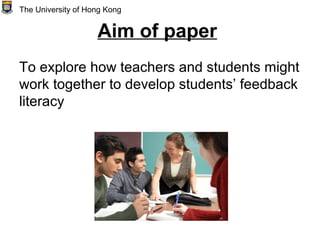
Aim of paper
To explore how teachers and students might
work together to develop students’ feedback
literacy
The University of Hong Kong
Overview
1. Feedback: importance and challenges
2. The nature of feedback literacy
3. Strategies for developing feedback
literacy
The University of Hong Kong
SELECTED FEEDBACK ISSUES
AND CHALLENGES
The University of Hong Kong
Four Levels of feedback
a) Task b) Process c) S-R d) Person
+ High effect sizes, feedback on process,
self-regulation (S-R)
- Low effect sizes, feedback on person
(Hattie & Timperley, 2007)
The University of Hong Kong
Feedback purposes
Both students and staff have confusions
over purposes of feedback and what it can
achieve (Price et al., 2010)
The University of Hong Kong
Students’ perspectives
Need to understand students’ perspectives
(Orsmond & Merry, 2011); particularly those
of lower achieving students (Orsmond &
Merry, 2013)
The University of Hong Kong
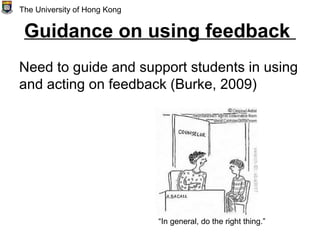
Guidance on using feedback
Need to guide and support students in using
and acting on feedback (Burke, 2009)
The University of Hong Kong
“In general, do the right thing.”
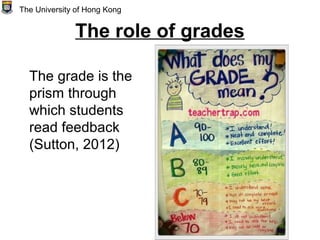
The role of grades
The grade is the
prism through
which students
read feedback
(Sutton, 2012)
The University of Hong Kong
THE NATURE OF FEEDBACK
LITERACY
The University of Hong Kong
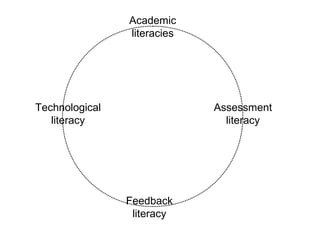
Academic
literacies
Technological
literacy
Assessment
literacy
Feedback
literacy
Scoping feedback literacy
Epistemological dimension (acquiring
academic knowledge)
Ontological dimension (investment of
identity in academic work)
Practical dimension (reading, thinking about,
using feedback)
(Sutton, 2012)
The University of Hong Kong
Aspects of feedback literacy
• Understanding standards and experience
in making judgments
• Understanding feedback purposes and
processes
• Capacity to generate and use feedback
(Carless, 2015)
The University of Hong Kong
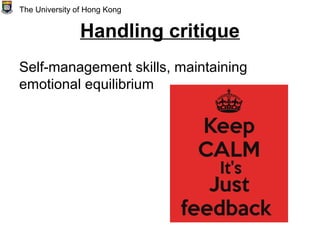
Handling critique
Self-management skills, maintaining
emotional equilibrium
The University of Hong Kong
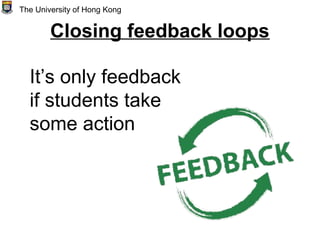
Closing feedback loops
It’s only feedback
if students take
some action
The University of Hong Kong
STRATEGIES FOR DEVELOPING
STUDENT FEEDBACK LITERACY
The University of Hong Kong
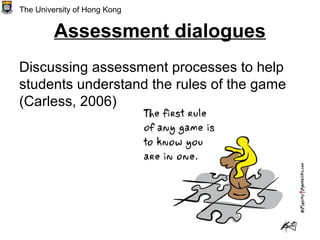
Assessment dialogues
Discussing assessment processes to help
students understand the rules of the game
(Carless, 2006)
The University of Hong Kong
Peer feedback
Often more plentiful and accessible
Students often gain more from providing
than receiving peer feedback (Nicol et al.,
2014)
The University of Hong Kong
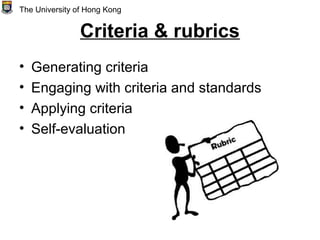
Criteria & rubrics
• Generating criteria
• Engaging with criteria and standards
• Applying criteria
• Self-evaluation
The University of Hong Kong
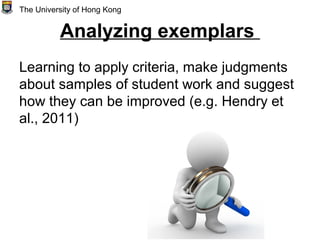
Analyzing exemplars
Learning to apply criteria, make judgments
about samples of student work and suggest
how they can be improved (e.g. Hendry et
al., 2011)
The University of Hong Kong
Final thoughts
The University of Hong Kong
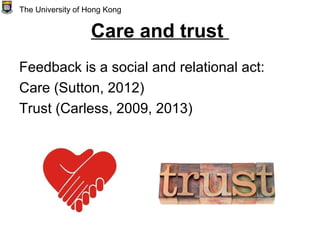
Care and trust
Feedback is a social and relational act:
Care (Sutton, 2012)
Trust (Carless, 2009, 2013)
The University of Hong Kong
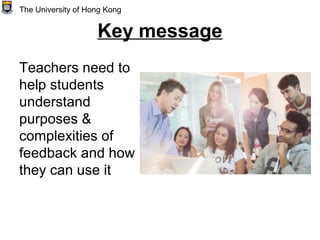
Key message
Teachers need to
help students
understand
purposes &
complexities of
feedback and how
they can use it
The University of Hong Kong
Policy implication
Need for further development in the
assessment (for learning) literacy of
university teachers (cf. Price et al., 2012)
The University of Hong Kong
THANK YOU
The University of Hong Kong

Developing students' feedback through literacy