Mistakes andMistakes and
FeedbackFeedback
Yessenia Perez
Dayana Cobo
Jovana Díaz
Adriana Oliveros
Luis Silva
Students Make MistakesStudents Make Mistakes
 According to Julian Edge (1989) we can divide Mistakes into
three categories:
 Slips.
 Errors.
 Attempts.
 L1 “interferences”.
 Developmental errors.
Assessing StudentsAssessing Students
PerformancePerformance
 Teachers assessing students:
 Explicit – Implicit
 Praise – Blame
 Praise – Junkies
 Comments
 Mark and Grades
 Reports
 Students Assessing Themselves:
 Do you think that’s right?
Feedback During OralFeedback During Oral
WorkWork
 Accuracy and Fluency:
 “The immediate and constant correction of all errors is not necessarily
an effective way of helping course participants improve their English”
 “The best answer to the question of when to intervene in learner talk is:
as late as possible” (Lynch 1997: 324)
 “Correction is a highly personal business and draws, more than many
other classroom interactions, on the rapport between teacher and
students” “Different students have different preferences” (Philip
Harmer)
 Expression
 Hinting
 Reformulating
 Feedback during accuracy work:
 Repeating
 Echoing
 Statement and question
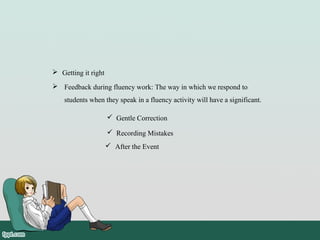
 Feedback during fluency work: The way in which we respond to
students when they speak in a fluency activity will have a significant.
 Getting it right
 Gentle Correction
 Recording Mistakes
 After the Event
Written FeedbackWritten Feedback
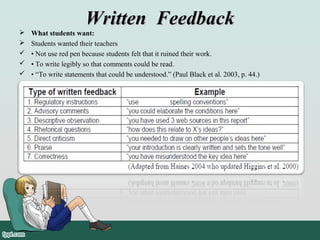
 What students want:
 Students wanted their teachers
 • Not use red pen because students felt that it ruined their work.
 • To write legibly so that comments could be read.
 • “To write statements that could be understood.” (Paul Black et al. 2003, p. 44.)
Feedback SandwichFeedback Sandwich
 People seem to cope better with the Good News first, then the Bad News and finally ending
with more
 Good News. One way to do this is to use the “feedback sandwich [that] has three features:
 • First strengths are identified (praise).
 • Weaknesses (development needs) are identified.
 • Options for improvement are explored. End on a positive note.” (Haines, 2004, p. 20)
Consider These Facets OfConsider These Facets Of
FeedbackFeedback
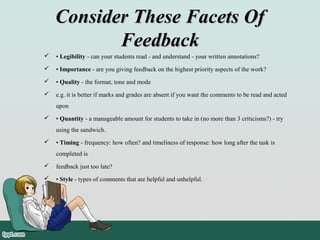
 • Legibility - can your students read - and understand - your written annotations?
 • Importance - are you giving feedback on the highest priority aspects of the work?
 • Quality - the format, tone and mode
 e.g. it is better if marks and grades are absent if you want the comments to be read and acted
upon
 • Quantity - a manageable amount for students to take in (no more than 3 criticisms?) - try
using the sandwich.
 • Timing - frequency: how often? and timeliness of response: how long after the task is
completed is
 feedback just too late?
 • Style - types of comments that are helpful and unhelpful.
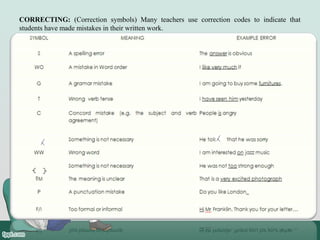
CORRECTING: (Correction symbols) Many teachers use correction codes to indicate that
students have made mistakes in their written work.
• I live in a house in Izmit. It isn't old or modern; it is a normal
Turkish house. It is near the sea; it takes about ten minutes to
go to the seaside. In the house, there are two bedrooms, one
living room and two other rooms that we use as dining rooms.
Naturally, we have a kitchen, a bathroom, a toilet, and a little
garden. My parents spend their time growing vegetables and
fruit there.
Mistakes and feedback

Mistakes and feedback

  • 1.
    Mistakes andMistakes and FeedbackFeedback YesseniaPerez Dayana Cobo Jovana Díaz Adriana Oliveros Luis Silva
  • 2.
    Students Make MistakesStudentsMake Mistakes  According to Julian Edge (1989) we can divide Mistakes into three categories:  Slips.  Errors.  Attempts.  L1 “interferences”.  Developmental errors.
  • 3.
    Assessing StudentsAssessing Students PerformancePerformance Teachers assessing students:  Explicit – Implicit  Praise – Blame  Praise – Junkies  Comments  Mark and Grades  Reports  Students Assessing Themselves:  Do you think that’s right?
  • 4.
    Feedback During OralFeedbackDuring Oral WorkWork  Accuracy and Fluency:  “The immediate and constant correction of all errors is not necessarily an effective way of helping course participants improve their English”  “The best answer to the question of when to intervene in learner talk is: as late as possible” (Lynch 1997: 324)  “Correction is a highly personal business and draws, more than many other classroom interactions, on the rapport between teacher and students” “Different students have different preferences” (Philip Harmer)  Expression  Hinting  Reformulating  Feedback during accuracy work:  Repeating  Echoing  Statement and question
  • 5.
     Feedback duringfluency work: The way in which we respond to students when they speak in a fluency activity will have a significant.  Getting it right  Gentle Correction  Recording Mistakes  After the Event
  • 6.
    Written FeedbackWritten Feedback What students want:  Students wanted their teachers  • Not use red pen because students felt that it ruined their work.  • To write legibly so that comments could be read.  • “To write statements that could be understood.” (Paul Black et al. 2003, p. 44.)
  • 7.
    Feedback SandwichFeedback Sandwich People seem to cope better with the Good News first, then the Bad News and finally ending with more  Good News. One way to do this is to use the “feedback sandwich [that] has three features:  • First strengths are identified (praise).  • Weaknesses (development needs) are identified.  • Options for improvement are explored. End on a positive note.” (Haines, 2004, p. 20)
  • 8.
    Consider These FacetsOfConsider These Facets Of FeedbackFeedback  • Legibility - can your students read - and understand - your written annotations?  • Importance - are you giving feedback on the highest priority aspects of the work?  • Quality - the format, tone and mode  e.g. it is better if marks and grades are absent if you want the comments to be read and acted upon  • Quantity - a manageable amount for students to take in (no more than 3 criticisms?) - try using the sandwich.  • Timing - frequency: how often? and timeliness of response: how long after the task is completed is  feedback just too late?  • Style - types of comments that are helpful and unhelpful.
  • 9.
    CORRECTING: (Correction symbols)Many teachers use correction codes to indicate that students have made mistakes in their written work.
  • 10.
    • I livein a house in Izmit. It isn't old or modern; it is a normal Turkish house. It is near the sea; it takes about ten minutes to go to the seaside. In the house, there are two bedrooms, one living room and two other rooms that we use as dining rooms. Naturally, we have a kitchen, a bathroom, a toilet, and a little garden. My parents spend their time growing vegetables and fruit there.