1
Your presenter is:
Alison Sigmon, M.Ed., LPC, PMP
Want to manage change effectively?
Start with yourself
What’s on tap for our time together today…
2
 Change is all around us revisited
 Managing through & leveraging emotions
 Self-awareness & managing projects
 Practicing with intention makes creates insights for more effective
management
 Wrap it up!
Agenda
It’s a challenge for some people to find good business reasons for paying
attention to emotions, but emotions are a key piece of data in a collection of
information that can make or break your project.
Managing projects effectively doesn’t start with getting stakeholder buy-in. It
starts with you. Before you can assess and tune into the emotions of others
on your project, you must be aware and tuned into your own emotions first.
We’ll take a look at how you can leverage your emotions and the emotions of
others to successfully deliver projects.
3
Project change –
Revisited
Impact on you and others
4
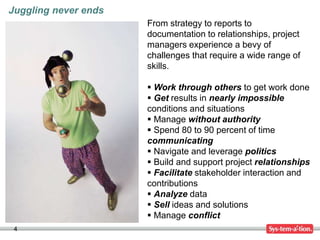
From strategy to reports to
documentation to relationships, project
managers experience a bevy of
challenges that require a wide range of
skills.
 Work through others to get work done
 Get results in nearly impossible
conditions and situations
 Manage without authority
 Spend 80 to 90 percent of time
communicating
 Navigate and leverage politics
 Build and support project relationships
 Facilitate stakeholder interaction and
contributions
 Analyze data
 Sell ideas and solutions
 Manage conflict
Juggling never ends
5
Things can get REALLY complicated!
And when you throw change into the mix…
6
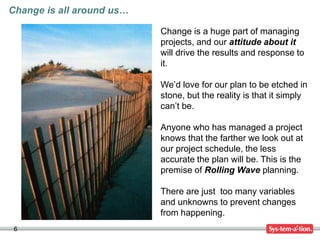
Change is a huge part of managing
projects, and our attitude about it
will drive the results and response to
it.
We’d love for our plan to be etched in
stone, but the reality is that it simply
can’t be.
Anyone who has managed a project
knows that the farther we look out at
our project schedule, the less
accurate the plan will be. This is the
premise of Rolling Wave planning.
There are just too many variables
and unknowns to prevent changes
from happening.
Change is all around us…
7
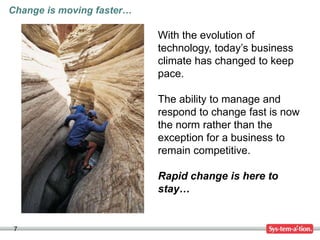
With the evolution of
technology, today’s business
climate has changed to keep
pace.
The ability to manage and
respond to change fast is now
the norm rather than the
exception for a business to
remain competitive.
Rapid change is here to
stay…
Change is moving faster…
8
Change helps companies respond to shifting trends, but
in the project trenches change can be experienced as a
disturbance to our way of seeing and doing things.
Stakeholder tolerance for change varies. It’s important to
be able to envision and communicate the possibilities
of the big picture while managing the emotions that
surround the upheaval of change.
Let’s take a look at how change may be viewed.
Change requires balance…
9
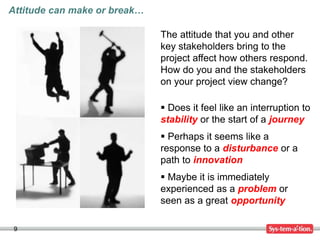
The attitude that you and other
key stakeholders bring to the
project affect how others respond.
How do you and the stakeholders
on your project view change?
 Does it feel like an interruption to
stability or the start of a journey
 Perhaps it seems like a
response to a disturbance or a
path to innovation
 Maybe it is immediately
experienced as a problem or
seen as a great opportunity
Attitude can make or break…
10
Thriving on change is
fundamental to success
as a project manager.
Understanding the nature
of change allows us to
work with it instead of
against it.
One key to working with it
is awareness of the
change process and the
emotional response that
accompanies it.
Leveraging change to lessen stress…
11
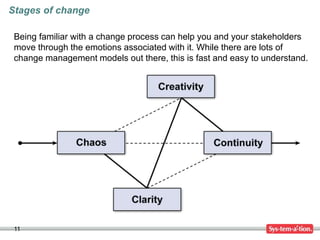
Stages of change
Being familiar with a change process can help you and your stakeholders
move through the emotions associated with it. While there are lots of
change management models out there, this is fast and easy to understand.
12
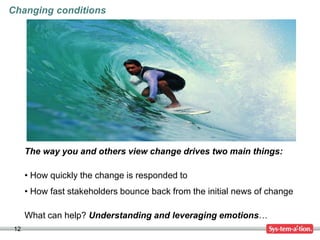
Changing conditions
The way you and others view change drives two main things:
• How quickly the change is responded to
• How fast stakeholders bounce back from the initial news of change
What can help? Understanding and leveraging emotions…
13
Managing through
& leveraging
emotions
Understanding the value
14
Struggle in the corporate world
Getting “emotional” is the warm, fuzzy area
of business that causes our eyes to roll
back in our head.
What’s the irony?
It’s emotional connection that typically
motivates others to band together to get
project work done.
Research supports the value of using
emotions to lead others, but finding the
project relevance of emotional
awareness is challenging when “there is a
job to be done.”
In our haste to keep moving fast, emotions
tend to get overlooked although they are
great source of information about the
health of the project and changes that occur
throughout.
Fuzzy becomes ironic
15
Emotions: Mining for gold
Emotions offer a ton of information
about others, ourselves, and the project.
They help us with the following:
• Alerts us to what needs attention
• Brings attention to stakeholders who
have concerns
• Communicates level of investment in
the project
• Clues us in on any confusion & issues
It’s emotional awareness that enables a
project manager to “read” people, to
discern their interests and concerns,
and to respond their needs.
However…before you can “read” others,
you have to get a handle on yourself. A
little self-awareness can go a very
long way…
16
Self-awareness
and managing
projects
Know thyself
17
Emotional self-awareness is another
way source of information about
what’s happening inside you and
around you.
We tend to discount emotions at work
as being of little or no value for a
variety of reasons – pace, experience,
culture, etc.
Understanding emotions and
managing them appropriately is
complicated – emotions are seen as
private.
As a result, they are often overlooked
as a source of information in projects.
The irony is that people experience
emotions about projects everyday
whether they realize it or not. And
guess what…others are watching!
Value of self-awareness
18
Getting a handle on ourselves
Private? Get real. There are some project
managers who will claim they remain
unchanged under stress. Of course,
something does change. It helps you, the
team, and the project to acknowledge your
contribution to situations.
Don’t just sit there. Manage emotions.
As soon as we become aware of how we
are feeling, we have the opportunity to
manage it. People avoid others who are
chronically angry, stressed out, and fearful.
Emotional self-awareness gives us
information to manage our feelings.
Take care. Stay healthy. When we fail to
deal with our emotions, problems can
start to show up physically. Headaches,
stomachaches, fatigue, and other
symptoms can be caused by our emotions.
19
Feelings impact everyone, and people don’t stop having feelings
when they get to work.
Our emotional brain responds far faster than our logical self – 100
milliseconds as compared to 3.6 seconds for the rational brain.
This is why we can respond to situations seemingly without thinking.
While this can be helpful in a crisis situation, the reality is sometimes
we’re reacting without enough information, responding to our
anxious feeling, etc.
Science is showing that 40 to 50 percent of the time we are correct in
our assumptions about a situation, but you know what that means…
Responding without awareness
20
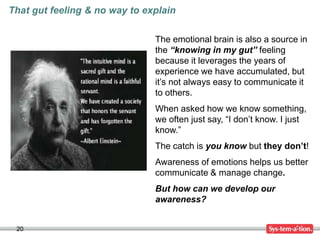
That gut feeling & no way to explain
The emotional brain is also a source in
the “knowing in my gut” feeling
because it leverages the years of
experience we have accumulated, but
it’s not always easy to communicate it
to others.
When asked how we know something,
we often just say, “I don’t know. I just
know.”
The catch is you know but they don’t!
Awareness of emotions helps us better
communicate & manage change.
But how can we develop our
awareness?
21
A little self-awareness goes a long way
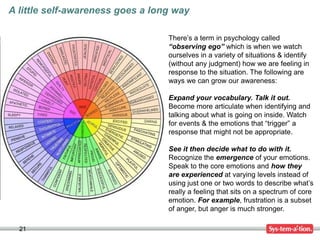
There’s a term in psychology called
“observing ego” which is when we watch
ourselves in a variety of situations & identify
(without any judgment) how we are feeling in
response to the situation. The following are
ways we can grow our awareness:
Expand your vocabulary. Talk it out.
Become more articulate when identifying and
talking about what is going on inside. Watch
for events & the emotions that “trigger” a
response that might not be appropriate.
See it then decide what to do with it.
Recognize the emergence of your emotions.
Speak to the core emotions and how they
are experienced at varying levels instead of
using just one or two words to describe what’s
really a feeling that sits on a spectrum of core
emotion. For example, frustration is a subset
of anger, but anger is much stronger.
22
Address the plumbing
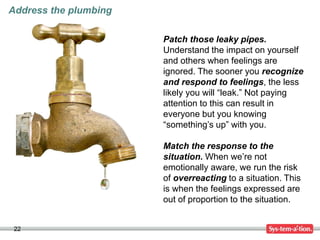
Patch those leaky pipes.
Understand the impact on yourself
and others when feelings are
ignored. The sooner you recognize
and respond to feelings, the less
likely you will “leak.” Not paying
attention to this can result in
everyone but you knowing
“something’s up” with you.
Match the response to the
situation. When we’re not
emotionally aware, we run the risk
of overreacting to a situation. This
is when the feelings expressed are
out of proportion to the situation.
23
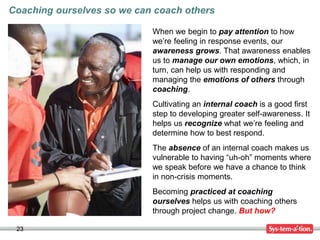
Coaching ourselves so we can coach others
When we begin to pay attention to how
we’re feeling in response events, our
awareness grows. That awareness enables
us to manage our own emotions, which, in
turn, can help us with responding and
managing the emotions of others through
coaching.
Cultivating an internal coach is a good first
step to developing greater self-awareness. It
helps us recognize what we’re feeling and
determine how to best respond.
The absence of an internal coach makes us
vulnerable to having “uh-oh” moments where
we speak before we have a chance to think
in non-crisis moments.
Becoming practiced at coaching
ourselves helps us with coaching others
through project change. But how?
24
Developing an internal coach – overview
Break it down then take a 30,000 ft view of it.
After an event, recognize what the event was, how
you felt about it, and what, if anything, you would do
differently if it happened again. Consider if you’ve
had the same response to a similar event in the
past. Is this a trigger point for you? Do you need to
change something or put something in place so you
don’t respond the same way again?
Ask for what you need. We can’t address what
we’re not aware of so seek feedback. Getting the
perspective of others on how we behave might feel
painful sometimes, but it gives us a chance to
address blind spots all of us have for our behavior.
Track it. Another way to gain insight into your
behavior and feelings is to journal. Don’t stop at text
– use numbers, charts, draw pictures. It’s also a
place for tackling something that might be nagging
you. Sometimes just writing about something can
help you work through it and let it go.
25
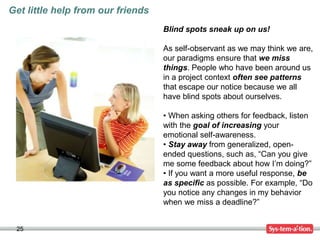
Get little help from our friends
Blind spots sneak up on us!
As self-observant as we may think we are,
our paradigms ensure that we miss
things. People who have been around us
in a project context often see patterns
that escape our notice because we all
have blind spots about ourselves.
• When asking others for feedback, listen
with the goal of increasing your
emotional self-awareness.
• Stay away from generalized, open-
ended questions, such as, “Can you give
me some feedback about how I’m doing?”
• If you want a more useful response, be
as specific as possible. For example, “Do
you notice any changes in my behavior
when we miss a deadline?”
26
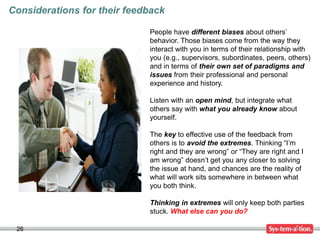
Considerations for their feedback
People have different biases about others’
behavior. Those biases come from the way they
interact with you in terms of their relationship with
you (e.g., supervisors, subordinates, peers, others)
and in terms of their own set of paradigms and
issues from their professional and personal
experience and history.
Listen with an open mind, but integrate what
others say with what you already know about
yourself.
The key to effective use of the feedback from
others is to avoid the extremes. Thinking “I’m
right and they are wrong” or “They are right and I
am wrong” doesn’t get you any closer to solving
the issue at hand, and chances are the reality of
what will work sits somewhere in between what
you both think.
Thinking in extremes will only keep both parties
stuck. What else can you do?
27
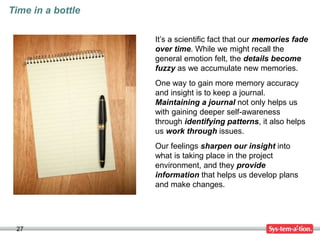
Time in a bottle
It’s a scientific fact that our memories fade
over time. While we might recall the
general emotion felt, the details become
fuzzy as we accumulate new memories.
One way to gain more memory accuracy
and insight is to keep a journal.
Maintaining a journal not only helps us
with gaining deeper self-awareness
through identifying patterns, it also helps
us work through issues.
Our feelings sharpen our insight into
what is taking place in the project
environment, and they provide
information that helps us develop plans
and make changes.
28
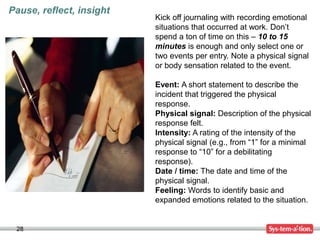
Pause, reflect, insight
Kick off journaling with recording emotional
situations that occurred at work. Don’t
spend a ton of time on this – 10 to 15
minutes is enough and only select one or
two events per entry. Note a physical signal
or body sensation related to the event.
Event: A short statement to describe the
incident that triggered the physical
response.
Physical signal: Description of the physical
response felt.
Intensity: A rating of the intensity of the
physical signal (e.g., from “1” for a minimal
response to “10” for a debilitating
response).
Date / time: The date and time of the
physical signal.
Feeling: Words to identify basic and
expanded emotions related to the situation.
29
Closing thoughts on self-
awareness & emotions
Survival of the fittest
30
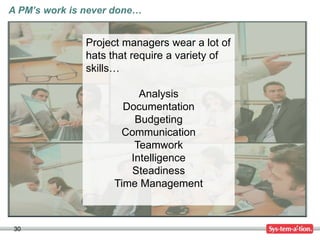
A PM’s work is never done…
Project managers wear a lot of
hats that require a variety of
skills…
Analysis
Documentation
Budgeting
Communication
Teamwork
Intelligence
Steadiness
Time Management
31
Awareness of your emotions and the emotions of your
stakeholders are ways to keep a handle on the many things
you do day in and day out to make your project a success,
but it starts with intention and practice.
Practicing process makes perfect (well, almost )
Wrap up…
32
Questions???
What we discussed
It’s a challenge for some people to find good business reasons for paying
attention to emotions, but emotions are a key piece of data in a collection of
information that can make or break your project.
Managing projects effectively doesn’t start with getting stakeholder buy-in. It
starts with you. Before you can assess and tune into the emotions of others
on your project, you must be aware and tuned into your own emotions first.
We’ll take a look at how you can leverage your emotions and the emotions of
others to successfully deliver projects.
 Change is all around us revisited
 Managing through & leveraging emotions
 Self-awareness & managing projects
 Practicing with intention makes creates insights for more effective
management
 Wrap it up!
Thank you!
www.systemation.com
Alison Sigmon, M.Ed, LPC, PMP
asigmon@systemation.com
Twitter @alisonsigmon
www.slideshare.net/ahsigmon
www.mindscraping.com
33

Managing Change Starts With You

  • 1.
    1 Your presenter is: AlisonSigmon, M.Ed., LPC, PMP Want to manage change effectively? Start with yourself
  • 2.
    What’s on tapfor our time together today… 2  Change is all around us revisited  Managing through & leveraging emotions  Self-awareness & managing projects  Practicing with intention makes creates insights for more effective management  Wrap it up! Agenda It’s a challenge for some people to find good business reasons for paying attention to emotions, but emotions are a key piece of data in a collection of information that can make or break your project. Managing projects effectively doesn’t start with getting stakeholder buy-in. It starts with you. Before you can assess and tune into the emotions of others on your project, you must be aware and tuned into your own emotions first. We’ll take a look at how you can leverage your emotions and the emotions of others to successfully deliver projects.
  • 3.
  • 4.
    4 From strategy toreports to documentation to relationships, project managers experience a bevy of challenges that require a wide range of skills.  Work through others to get work done  Get results in nearly impossible conditions and situations  Manage without authority  Spend 80 to 90 percent of time communicating  Navigate and leverage politics  Build and support project relationships  Facilitate stakeholder interaction and contributions  Analyze data  Sell ideas and solutions  Manage conflict Juggling never ends
  • 5.
    5 Things can getREALLY complicated! And when you throw change into the mix…
  • 6.
    6 Change is ahuge part of managing projects, and our attitude about it will drive the results and response to it. We’d love for our plan to be etched in stone, but the reality is that it simply can’t be. Anyone who has managed a project knows that the farther we look out at our project schedule, the less accurate the plan will be. This is the premise of Rolling Wave planning. There are just too many variables and unknowns to prevent changes from happening. Change is all around us…
  • 7.
    7 With the evolutionof technology, today’s business climate has changed to keep pace. The ability to manage and respond to change fast is now the norm rather than the exception for a business to remain competitive. Rapid change is here to stay… Change is moving faster…
  • 8.
    8 Change helps companiesrespond to shifting trends, but in the project trenches change can be experienced as a disturbance to our way of seeing and doing things. Stakeholder tolerance for change varies. It’s important to be able to envision and communicate the possibilities of the big picture while managing the emotions that surround the upheaval of change. Let’s take a look at how change may be viewed. Change requires balance…
  • 9.
    9 The attitude thatyou and other key stakeholders bring to the project affect how others respond. How do you and the stakeholders on your project view change?  Does it feel like an interruption to stability or the start of a journey  Perhaps it seems like a response to a disturbance or a path to innovation  Maybe it is immediately experienced as a problem or seen as a great opportunity Attitude can make or break…
  • 10.
    10 Thriving on changeis fundamental to success as a project manager. Understanding the nature of change allows us to work with it instead of against it. One key to working with it is awareness of the change process and the emotional response that accompanies it. Leveraging change to lessen stress…
  • 11.
    11 Stages of change Beingfamiliar with a change process can help you and your stakeholders move through the emotions associated with it. While there are lots of change management models out there, this is fast and easy to understand.
  • 12.
    12 Changing conditions The wayyou and others view change drives two main things: • How quickly the change is responded to • How fast stakeholders bounce back from the initial news of change What can help? Understanding and leveraging emotions…
  • 13.
  • 14.
    14 Struggle in thecorporate world Getting “emotional” is the warm, fuzzy area of business that causes our eyes to roll back in our head. What’s the irony? It’s emotional connection that typically motivates others to band together to get project work done. Research supports the value of using emotions to lead others, but finding the project relevance of emotional awareness is challenging when “there is a job to be done.” In our haste to keep moving fast, emotions tend to get overlooked although they are great source of information about the health of the project and changes that occur throughout. Fuzzy becomes ironic
  • 15.
    15 Emotions: Mining forgold Emotions offer a ton of information about others, ourselves, and the project. They help us with the following: • Alerts us to what needs attention • Brings attention to stakeholders who have concerns • Communicates level of investment in the project • Clues us in on any confusion & issues It’s emotional awareness that enables a project manager to “read” people, to discern their interests and concerns, and to respond their needs. However…before you can “read” others, you have to get a handle on yourself. A little self-awareness can go a very long way…
  • 16.
  • 17.
    17 Emotional self-awareness isanother way source of information about what’s happening inside you and around you. We tend to discount emotions at work as being of little or no value for a variety of reasons – pace, experience, culture, etc. Understanding emotions and managing them appropriately is complicated – emotions are seen as private. As a result, they are often overlooked as a source of information in projects. The irony is that people experience emotions about projects everyday whether they realize it or not. And guess what…others are watching! Value of self-awareness
  • 18.
    18 Getting a handleon ourselves Private? Get real. There are some project managers who will claim they remain unchanged under stress. Of course, something does change. It helps you, the team, and the project to acknowledge your contribution to situations. Don’t just sit there. Manage emotions. As soon as we become aware of how we are feeling, we have the opportunity to manage it. People avoid others who are chronically angry, stressed out, and fearful. Emotional self-awareness gives us information to manage our feelings. Take care. Stay healthy. When we fail to deal with our emotions, problems can start to show up physically. Headaches, stomachaches, fatigue, and other symptoms can be caused by our emotions.
  • 19.
    19 Feelings impact everyone,and people don’t stop having feelings when they get to work. Our emotional brain responds far faster than our logical self – 100 milliseconds as compared to 3.6 seconds for the rational brain. This is why we can respond to situations seemingly without thinking. While this can be helpful in a crisis situation, the reality is sometimes we’re reacting without enough information, responding to our anxious feeling, etc. Science is showing that 40 to 50 percent of the time we are correct in our assumptions about a situation, but you know what that means… Responding without awareness
  • 20.
    20 That gut feeling& no way to explain The emotional brain is also a source in the “knowing in my gut” feeling because it leverages the years of experience we have accumulated, but it’s not always easy to communicate it to others. When asked how we know something, we often just say, “I don’t know. I just know.” The catch is you know but they don’t! Awareness of emotions helps us better communicate & manage change. But how can we develop our awareness?
  • 21.
    21 A little self-awarenessgoes a long way There’s a term in psychology called “observing ego” which is when we watch ourselves in a variety of situations & identify (without any judgment) how we are feeling in response to the situation. The following are ways we can grow our awareness: Expand your vocabulary. Talk it out. Become more articulate when identifying and talking about what is going on inside. Watch for events & the emotions that “trigger” a response that might not be appropriate. See it then decide what to do with it. Recognize the emergence of your emotions. Speak to the core emotions and how they are experienced at varying levels instead of using just one or two words to describe what’s really a feeling that sits on a spectrum of core emotion. For example, frustration is a subset of anger, but anger is much stronger.
  • 22.
    22 Address the plumbing Patchthose leaky pipes. Understand the impact on yourself and others when feelings are ignored. The sooner you recognize and respond to feelings, the less likely you will “leak.” Not paying attention to this can result in everyone but you knowing “something’s up” with you. Match the response to the situation. When we’re not emotionally aware, we run the risk of overreacting to a situation. This is when the feelings expressed are out of proportion to the situation.
  • 23.
    23 Coaching ourselves sowe can coach others When we begin to pay attention to how we’re feeling in response events, our awareness grows. That awareness enables us to manage our own emotions, which, in turn, can help us with responding and managing the emotions of others through coaching. Cultivating an internal coach is a good first step to developing greater self-awareness. It helps us recognize what we’re feeling and determine how to best respond. The absence of an internal coach makes us vulnerable to having “uh-oh” moments where we speak before we have a chance to think in non-crisis moments. Becoming practiced at coaching ourselves helps us with coaching others through project change. But how?
  • 24.
    24 Developing an internalcoach – overview Break it down then take a 30,000 ft view of it. After an event, recognize what the event was, how you felt about it, and what, if anything, you would do differently if it happened again. Consider if you’ve had the same response to a similar event in the past. Is this a trigger point for you? Do you need to change something or put something in place so you don’t respond the same way again? Ask for what you need. We can’t address what we’re not aware of so seek feedback. Getting the perspective of others on how we behave might feel painful sometimes, but it gives us a chance to address blind spots all of us have for our behavior. Track it. Another way to gain insight into your behavior and feelings is to journal. Don’t stop at text – use numbers, charts, draw pictures. It’s also a place for tackling something that might be nagging you. Sometimes just writing about something can help you work through it and let it go.
  • 25.
    25 Get little helpfrom our friends Blind spots sneak up on us! As self-observant as we may think we are, our paradigms ensure that we miss things. People who have been around us in a project context often see patterns that escape our notice because we all have blind spots about ourselves. • When asking others for feedback, listen with the goal of increasing your emotional self-awareness. • Stay away from generalized, open- ended questions, such as, “Can you give me some feedback about how I’m doing?” • If you want a more useful response, be as specific as possible. For example, “Do you notice any changes in my behavior when we miss a deadline?”
  • 26.
    26 Considerations for theirfeedback People have different biases about others’ behavior. Those biases come from the way they interact with you in terms of their relationship with you (e.g., supervisors, subordinates, peers, others) and in terms of their own set of paradigms and issues from their professional and personal experience and history. Listen with an open mind, but integrate what others say with what you already know about yourself. The key to effective use of the feedback from others is to avoid the extremes. Thinking “I’m right and they are wrong” or “They are right and I am wrong” doesn’t get you any closer to solving the issue at hand, and chances are the reality of what will work sits somewhere in between what you both think. Thinking in extremes will only keep both parties stuck. What else can you do?
  • 27.
    27 Time in abottle It’s a scientific fact that our memories fade over time. While we might recall the general emotion felt, the details become fuzzy as we accumulate new memories. One way to gain more memory accuracy and insight is to keep a journal. Maintaining a journal not only helps us with gaining deeper self-awareness through identifying patterns, it also helps us work through issues. Our feelings sharpen our insight into what is taking place in the project environment, and they provide information that helps us develop plans and make changes.
  • 28.
    28 Pause, reflect, insight Kickoff journaling with recording emotional situations that occurred at work. Don’t spend a ton of time on this – 10 to 15 minutes is enough and only select one or two events per entry. Note a physical signal or body sensation related to the event. Event: A short statement to describe the incident that triggered the physical response. Physical signal: Description of the physical response felt. Intensity: A rating of the intensity of the physical signal (e.g., from “1” for a minimal response to “10” for a debilitating response). Date / time: The date and time of the physical signal. Feeling: Words to identify basic and expanded emotions related to the situation.
  • 29.
    29 Closing thoughts onself- awareness & emotions Survival of the fittest
  • 30.
    30 A PM’s workis never done… Project managers wear a lot of hats that require a variety of skills… Analysis Documentation Budgeting Communication Teamwork Intelligence Steadiness Time Management
  • 31.
    31 Awareness of youremotions and the emotions of your stakeholders are ways to keep a handle on the many things you do day in and day out to make your project a success, but it starts with intention and practice. Practicing process makes perfect (well, almost )
  • 32.
    Wrap up… 32 Questions??? What wediscussed It’s a challenge for some people to find good business reasons for paying attention to emotions, but emotions are a key piece of data in a collection of information that can make or break your project. Managing projects effectively doesn’t start with getting stakeholder buy-in. It starts with you. Before you can assess and tune into the emotions of others on your project, you must be aware and tuned into your own emotions first. We’ll take a look at how you can leverage your emotions and the emotions of others to successfully deliver projects.  Change is all around us revisited  Managing through & leveraging emotions  Self-awareness & managing projects  Practicing with intention makes creates insights for more effective management  Wrap it up!
  • 33.
    Thank you! www.systemation.com Alison Sigmon,M.Ed, LPC, PMP asigmon@systemation.com Twitter @alisonsigmon www.slideshare.net/ahsigmon www.mindscraping.com 33

Editor's Notes