PEER AND TEACHER FEEDBACK
ON STUDENT WRITING:
WHAT, HOW AND WHEN?
                          Richard Hodson
                             Joel Hensley
               University of Nagasaki, Siebold
                               Nagasaki JALT
                             21 January 2012
Background
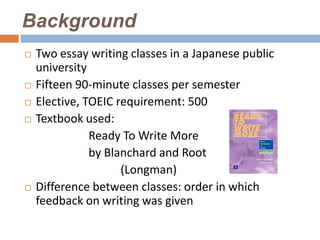
   Two essay writing classes in a Japanese public
    university
   Fifteen 90-minute classes per semester
   Elective, TOEIC requirement: 500
   Textbook used:
               Ready To Write More
               by Blanchard and Root
                     (Longman)
   Difference between classes: order in which
    feedback on writing was given
Class schedule
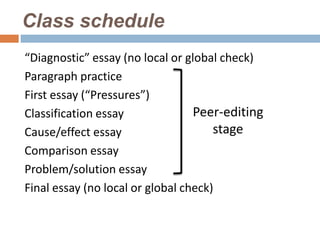
“Diagnostic” essay (no local or global check)
Paragraph practice
First essay (“Pressures”)
Classification essay              Peer-editing
Cause/effect essay                    stage
Comparison essay
Problem/solution essay
Final essay (no local or global check)
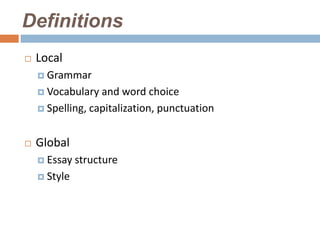
Definitions
   Local
     Grammar

     Vocabulary  and word choice
     Spelling, capitalization, punctuation


   Global
     Essay   structure
     Style
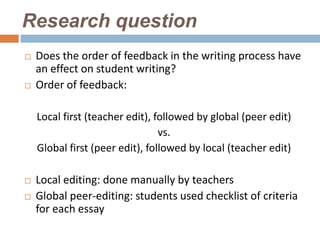
Research question
   Does the order of feedback in the writing process have
    an effect on student writing?
   Order of feedback:

    Local first (teacher edit), followed by global (peer edit)
                                 vs.
    Global first (peer edit), followed by local (teacher edit)

   Local editing: done manually by teachers
   Global peer-editing: students used checklist of criteria
    for each essay
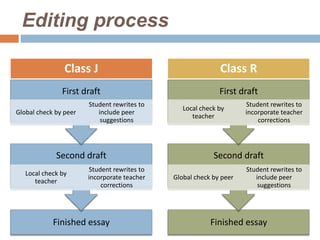
Editing process

                Class J                                     Class R
               First draft                                  First draft
                       Student rewrites to                          Student rewrites to
                                                Local check by
Global check by peer      include peer                              incorporate teacher
                                                   teacher
                           suggestions                                  corrections


             Second draft                                 Second draft
                       Student rewrites to                          Student rewrites to
   Local check by
                       incorporate teacher   Global check by peer      include peer
      teacher
                           corrections                                  suggestions


            Finished essay                               Finished essay
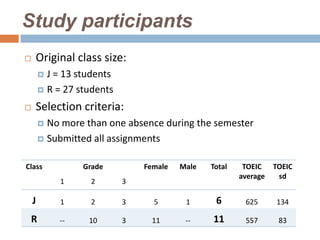
Study participants
   Original class size:
         J = 13 students
         R = 27 students

   Selection criteria:
         No more than one absence during the semester
         Submitted all assignments


Class             Grade         Female   Male   Total    TOEIC    TOEIC
                                                        average    sd
             1      2       3

    J        1      2       3     5       1      6       625      134

 R           --    10       3    11       --    11       557       83
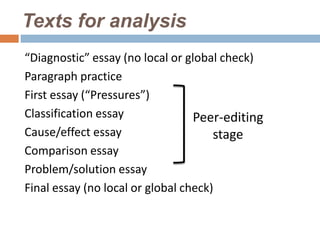
Texts for analysis
“Diagnostic” essay (no local or global check)
Paragraph practice
First essay (“Pressures”)
Classification essay              Peer-editing
Cause/effect essay                    stage
Comparison essay
Problem/solution essay
Final essay (no local or global check)
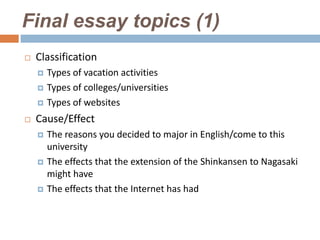
Final essay topics (1)
   Classification
       Types of vacation activities
       Types of colleges/universities
       Types of websites
   Cause/Effect
       The reasons you decided to major in English/come to this
        university
       The effects that the extension of the Shinkansen to Nagasaki
        might have
       The effects that the Internet has had
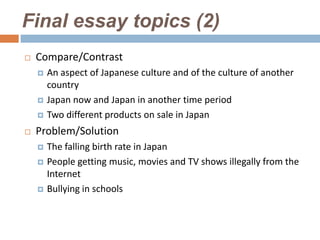
Final essay topics (2)
   Compare/Contrast
       An aspect of Japanese culture and of the culture of another
        country
       Japan now and Japan in another time period
       Two different products on sale in Japan
   Problem/Solution
       The falling birth rate in Japan
       People getting music, movies and TV shows illegally from the
        Internet
       Bullying in schools
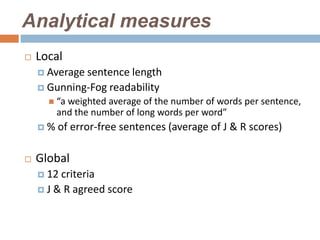
Analytical measures
   Local
     Average sentence length
     Gunning-Fog   readability
       “a weighted average of the number of words per sentence,
         and the number of long words per word”
    %   of error-free sentences (average of J & R scores)

   Global
     12 criteria
     J & R agreed score
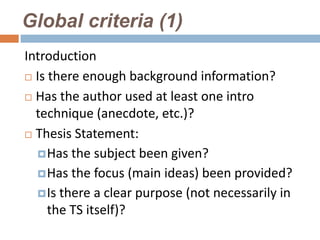
Global criteria (1)
Introduction
 Is there enough background information?

 Has the author used at least one intro

  technique (anecdote, etc.)?
 Thesis Statement:

   Has the subject been given?
   Has the focus (main ideas) been provided?
   Is there a clear purpose (not necessarily in
     the TS itself)?
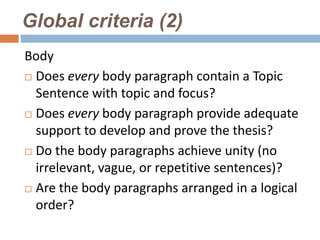
Global criteria (2)
Body
 Does every body paragraph contain a Topic

  Sentence with topic and focus?
 Does every body paragraph provide adequate
  support to develop and prove the thesis?
 Do the body paragraphs achieve unity (no

  irrelevant, vague, or repetitive sentences)?
 Are the body paragraphs arranged in a logical
  order?
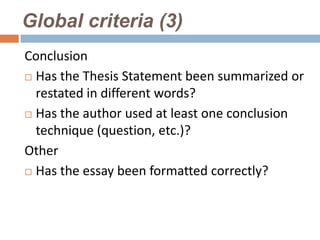
Global criteria (3)
Conclusion
 Has the Thesis Statement been summarized or

  restated in different words?
 Has the author used at least one conclusion
  technique (question, etc.)?
Other
 Has the essay been formatted correctly?
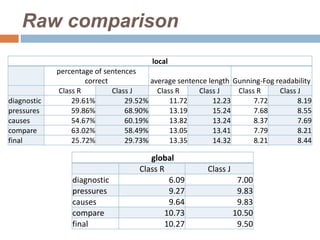
Raw comparison
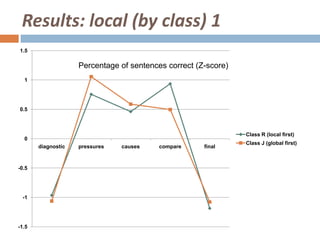
                                        local
             percentage of sentences
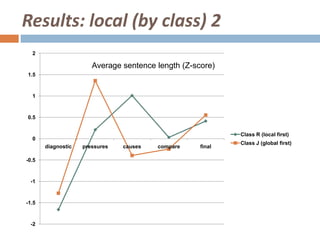
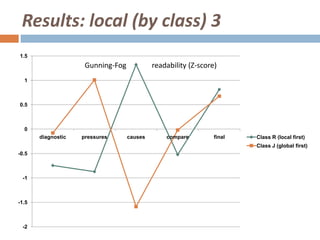
                     correct            average sentence length Gunning-Fog readability
             Class R         Class J      Class R     Class J    Class R     Class J
diagnostic       29.61%          29.52%       11.72       12.23       7.72         8.19
pressures        59.86%          68.90%       13.19       15.24       7.68         8.55
causes           54.67%          60.19%       13.82       13.24       8.37         7.69
compare          63.02%          58.49%       13.05       13.41       7.79         8.21
final            25.72%          29.73%       13.35       14.32       8.21         8.44

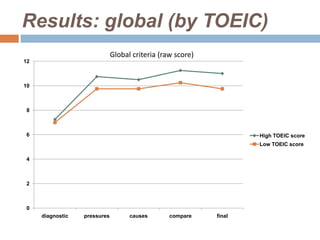
                                        global
                                     Class R            Class J
                 diagnostic                  6.09                  7.00
                 pressures                   9.27                  9.83
                 causes                      9.64                  9.83
                 compare                    10.73                 10.50
                 final                      10.27                  9.50
Results: local (by class) 1
1.5

                    Percentage of sentences correct (Z-score)
  1


0.5


                                                                Class R (local first)
  0
                                                                Class J (global first)
       diagnostic   pressures   causes    compare     final


-0.5


 -1


-1.5
Results: local (by class) 2
  2

                       Average sentence length (Z-score)
1.5


  1


0.5


                                                            Class R (local first)
  0
                                                            Class J (global first)
       diagnostic   pressures   causes   compare    final

-0.5


 -1


-1.5


 -2
Results: local (by class) 3
1.5
                     Gunning-Fog            readability (Z-score)
  1


0.5


  0
       diagnostic   pressures      causes       compare         final   Class R (local first)
                                                                        Class J (global first)
-0.5


 -1


-1.5


 -2
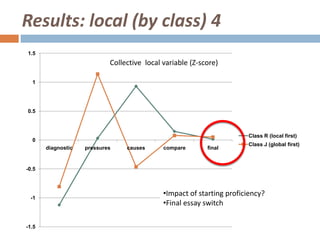
Results: local (by class) 4
1.5
                            Collective local variable (Z-score)

  1


0.5


                                                                       Class R (local first)
  0
                                                                       Class J (global first)
       diagnostic   pressures    causes      compare       final


-0.5


 -1
                                             •Impact of starting proficiency?
                                             •Final essay switch

-1.5
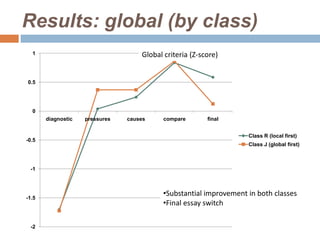
Results: global (by class)
  1                                 Global criteria (Z-score)


0.5


  0
       diagnostic   pressures   causes     compare       final


                                                                    Class R (local first)
-0.5
                                                                    Class J (global first)


 -1


-1.5
                                           •Substantial improvement in both classes
                                           •Final essay switch

 -2
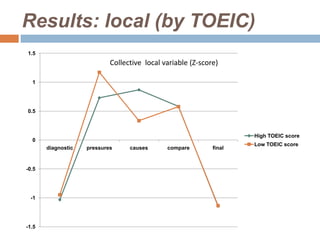
Results: local (by TOEIC)
1.5
                            Collective local variable (Z-score)

  1


0.5


                                                                     High TOEIC score
  0
                                                                     Low TOEIC score
       diagnostic   pressures     causes      compare        final


-0.5


 -1


-1.5
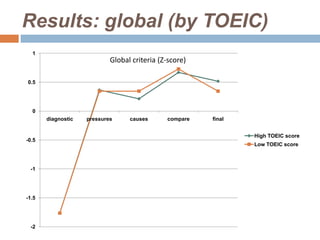
Results: global (by TOEIC)
  1
                            Global criteria (Z-score)

0.5


  0
       diagnostic   pressures     causes      compare   final


                                                                High TOEIC score
-0.5
                                                                Low TOEIC score


 -1


-1.5


 -2
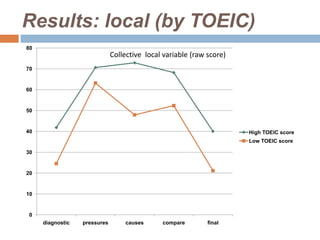
Results: local (by TOEIC)
80
                              Collective local variable (raw score)
70


60


50


40                                                                    High TOEIC score
                                                                      Low TOEIC score

30


20


10


 0
     diagnostic   pressures       causes      compare        final
Results: global (by TOEIC)
                              Global criteria (raw score)
12


10


 8


 6                                                                  High TOEIC score
                                                                    Low TOEIC score

 4


 2


 0
     diagnostic   pressures         causes       compare    final
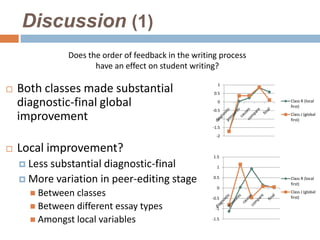
Discussion (1)
              Does the order of feedback in the writing process
                     have an effect on student writing?

   Both classes made substantial                       1
                                                      0.5

    diagnostic-final global                             0
                                                     -0.5
                                                                  Class R (local
                                                                  first)

    improvement                                        -1
                                                                  Class J (global
                                                                  first)
                                                     -1.5
                                                       -2


   Local improvement?
                                                      1.5

     Less
         substantial diagnostic-final                  1


     More variation in peer-editing stage            0.5         Class R (local
                                                                  first)
                                                       0
       Between classes                              -0.5
                                                                  Class J (global
                                                                  first)

       Between different essay types                  -1

       Amongst local variables                      -1.5
Discussion (2)
   Class J outperformed Class R in global criteria
    during peer-editing stage
   Class R outperformed Class J in local criteria during
    peer-editing stage

                     Hypothesis
During the peer-editing stage, classes showed
greater improvement in the area focused on first
[global/local].
Discussion(3)
   Class R outperformed Class J globally in final essay
   Class J outperformed Class R locally in final essay on
    2/3 of criteria analyzed

                       Hypothesis
During the peer-editing stage, focusing on global
feedback first allowed students to make more immediate
improvement on global criteria. However, in post-peer-
editing [final essay], students focused more on the
last/most recent feedback stage [local/global] when
completing their essay independently.
Limitations of study
   Sample size
     17 students
     85 essays (36,636 words)

   Analytical measures
     Three local variables only
     Inter-rater reliability issues

   Nature and efficiency of feedback
     Teacher (local)
     Peers (global)
     Extent of student adoption/use of feedback
         During the semester
         When writing final essay
Future research possibilities
   Further analysis of existing sample
     Include more
                 texts
     Improve number & accuracy of local variables


   Continue existing study with larger sample

   Analyze nature, quality, and extent of adoption and
    efficiency of feedback
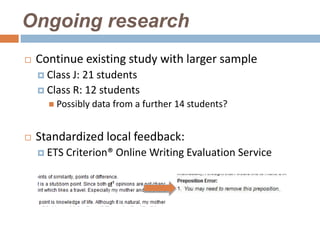
Ongoing research
   Continue existing study with larger sample
     Class J: 21 students
     Class R: 12 students
       Possibly data   from a further 14 students?


   Standardized local feedback:
     ETS   Criterion® Online Writing Evaluation Service
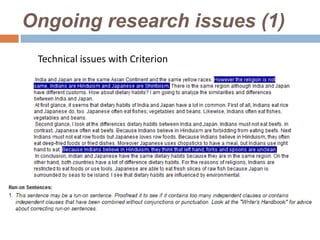
Ongoing research issues (1)
 Technical issues with Criterion
Ongoing research issues (2)
   Data-gathering v. pedagogy
     Difficultto replicate experimental conditions in
      dynamic classrooms
     Possible need to change final essay may invalidate
      comparison between groups?
   Broader question:
     Does   our working hypothesis suggest a change to
      pedagogical practice?
     If so, should classroom practice be changed, at the risk
      of invalidating further research?
Any suggestions or
questions?
               hodson@sun.ac.jp
              jhensley@sun.ac.jp

Hodson & Hensley - Writing Feedback | 20 Jan 2012

  • 1.
    PEER AND TEACHERFEEDBACK ON STUDENT WRITING: WHAT, HOW AND WHEN? Richard Hodson Joel Hensley University of Nagasaki, Siebold Nagasaki JALT 21 January 2012
  • 2.
    Background  Two essay writing classes in a Japanese public university  Fifteen 90-minute classes per semester  Elective, TOEIC requirement: 500  Textbook used: Ready To Write More by Blanchard and Root (Longman)  Difference between classes: order in which feedback on writing was given
  • 3.
    Class schedule “Diagnostic” essay(no local or global check) Paragraph practice First essay (“Pressures”) Classification essay Peer-editing Cause/effect essay stage Comparison essay Problem/solution essay Final essay (no local or global check)
  • 4.
    Definitions  Local  Grammar  Vocabulary and word choice  Spelling, capitalization, punctuation  Global  Essay structure  Style
  • 5.
    Research question  Does the order of feedback in the writing process have an effect on student writing?  Order of feedback: Local first (teacher edit), followed by global (peer edit) vs. Global first (peer edit), followed by local (teacher edit)  Local editing: done manually by teachers  Global peer-editing: students used checklist of criteria for each essay
  • 6.
    Editing process Class J Class R First draft First draft Student rewrites to Student rewrites to Local check by Global check by peer include peer incorporate teacher teacher suggestions corrections Second draft Second draft Student rewrites to Student rewrites to Local check by incorporate teacher Global check by peer include peer teacher corrections suggestions Finished essay Finished essay
  • 7.
    Study participants  Original class size:  J = 13 students  R = 27 students  Selection criteria:  No more than one absence during the semester  Submitted all assignments Class Grade Female Male Total TOEIC TOEIC average sd 1 2 3 J 1 2 3 5 1 6 625 134 R -- 10 3 11 -- 11 557 83
  • 8.
    Texts for analysis “Diagnostic”essay (no local or global check) Paragraph practice First essay (“Pressures”) Classification essay Peer-editing Cause/effect essay stage Comparison essay Problem/solution essay Final essay (no local or global check)
  • 9.
    Final essay topics(1)  Classification  Types of vacation activities  Types of colleges/universities  Types of websites  Cause/Effect  The reasons you decided to major in English/come to this university  The effects that the extension of the Shinkansen to Nagasaki might have  The effects that the Internet has had
  • 10.
    Final essay topics(2)  Compare/Contrast  An aspect of Japanese culture and of the culture of another country  Japan now and Japan in another time period  Two different products on sale in Japan  Problem/Solution  The falling birth rate in Japan  People getting music, movies and TV shows illegally from the Internet  Bullying in schools
  • 11.
    Analytical measures  Local  Average sentence length  Gunning-Fog readability  “a weighted average of the number of words per sentence, and the number of long words per word” % of error-free sentences (average of J & R scores)  Global  12 criteria  J & R agreed score
  • 12.
    Global criteria (1) Introduction Is there enough background information?  Has the author used at least one intro technique (anecdote, etc.)?  Thesis Statement:  Has the subject been given?  Has the focus (main ideas) been provided?  Is there a clear purpose (not necessarily in the TS itself)?
  • 13.
    Global criteria (2) Body Does every body paragraph contain a Topic Sentence with topic and focus?  Does every body paragraph provide adequate support to develop and prove the thesis?  Do the body paragraphs achieve unity (no irrelevant, vague, or repetitive sentences)?  Are the body paragraphs arranged in a logical order?
  • 14.
    Global criteria (3) Conclusion Has the Thesis Statement been summarized or restated in different words?  Has the author used at least one conclusion technique (question, etc.)? Other  Has the essay been formatted correctly?
  • 15.
    Raw comparison local percentage of sentences correct average sentence length Gunning-Fog readability Class R Class J Class R Class J Class R Class J diagnostic 29.61% 29.52% 11.72 12.23 7.72 8.19 pressures 59.86% 68.90% 13.19 15.24 7.68 8.55 causes 54.67% 60.19% 13.82 13.24 8.37 7.69 compare 63.02% 58.49% 13.05 13.41 7.79 8.21 final 25.72% 29.73% 13.35 14.32 8.21 8.44 global Class R Class J diagnostic 6.09 7.00 pressures 9.27 9.83 causes 9.64 9.83 compare 10.73 10.50 final 10.27 9.50
  • 16.
    Results: local (byclass) 1 1.5 Percentage of sentences correct (Z-score) 1 0.5 Class R (local first) 0 Class J (global first) diagnostic pressures causes compare final -0.5 -1 -1.5
  • 17.
    Results: local (byclass) 2 2 Average sentence length (Z-score) 1.5 1 0.5 Class R (local first) 0 Class J (global first) diagnostic pressures causes compare final -0.5 -1 -1.5 -2
  • 18.
    Results: local (byclass) 3 1.5 Gunning-Fog readability (Z-score) 1 0.5 0 diagnostic pressures causes compare final Class R (local first) Class J (global first) -0.5 -1 -1.5 -2
  • 19.
    Results: local (byclass) 4 1.5 Collective local variable (Z-score) 1 0.5 Class R (local first) 0 Class J (global first) diagnostic pressures causes compare final -0.5 -1 •Impact of starting proficiency? •Final essay switch -1.5
  • 20.
    Results: global (byclass) 1 Global criteria (Z-score) 0.5 0 diagnostic pressures causes compare final Class R (local first) -0.5 Class J (global first) -1 -1.5 •Substantial improvement in both classes •Final essay switch -2
  • 21.
    Results: local (byTOEIC) 1.5 Collective local variable (Z-score) 1 0.5 High TOEIC score 0 Low TOEIC score diagnostic pressures causes compare final -0.5 -1 -1.5
  • 22.
    Results: global (byTOEIC) 1 Global criteria (Z-score) 0.5 0 diagnostic pressures causes compare final High TOEIC score -0.5 Low TOEIC score -1 -1.5 -2
  • 23.
    Results: local (byTOEIC) 80 Collective local variable (raw score) 70 60 50 40 High TOEIC score Low TOEIC score 30 20 10 0 diagnostic pressures causes compare final
  • 24.
    Results: global (byTOEIC) Global criteria (raw score) 12 10 8 6 High TOEIC score Low TOEIC score 4 2 0 diagnostic pressures causes compare final
  • 25.
    Discussion (1) Does the order of feedback in the writing process have an effect on student writing?  Both classes made substantial 1 0.5 diagnostic-final global 0 -0.5 Class R (local first) improvement -1 Class J (global first) -1.5 -2  Local improvement? 1.5  Less substantial diagnostic-final 1  More variation in peer-editing stage 0.5 Class R (local first) 0  Between classes -0.5 Class J (global first)  Between different essay types -1  Amongst local variables -1.5
  • 26.
    Discussion (2)  Class J outperformed Class R in global criteria during peer-editing stage  Class R outperformed Class J in local criteria during peer-editing stage Hypothesis During the peer-editing stage, classes showed greater improvement in the area focused on first [global/local].
  • 27.
    Discussion(3)  Class R outperformed Class J globally in final essay  Class J outperformed Class R locally in final essay on 2/3 of criteria analyzed Hypothesis During the peer-editing stage, focusing on global feedback first allowed students to make more immediate improvement on global criteria. However, in post-peer- editing [final essay], students focused more on the last/most recent feedback stage [local/global] when completing their essay independently.
  • 28.
    Limitations of study  Sample size  17 students  85 essays (36,636 words)  Analytical measures  Three local variables only  Inter-rater reliability issues  Nature and efficiency of feedback  Teacher (local)  Peers (global)  Extent of student adoption/use of feedback  During the semester  When writing final essay
  • 29.
    Future research possibilities  Further analysis of existing sample  Include more texts  Improve number & accuracy of local variables  Continue existing study with larger sample  Analyze nature, quality, and extent of adoption and efficiency of feedback
  • 30.
    Ongoing research  Continue existing study with larger sample  Class J: 21 students  Class R: 12 students  Possibly data from a further 14 students?  Standardized local feedback:  ETS Criterion® Online Writing Evaluation Service
  • 31.
    Ongoing research issues(1) Technical issues with Criterion
  • 32.
    Ongoing research issues(2)  Data-gathering v. pedagogy  Difficultto replicate experimental conditions in dynamic classrooms  Possible need to change final essay may invalidate comparison between groups?  Broader question:  Does our working hypothesis suggest a change to pedagogical practice?  If so, should classroom practice be changed, at the risk of invalidating further research?
  • 33.
    Any suggestions or questions? hodson@sun.ac.jp jhensley@sun.ac.jp