NCERT CLASS X
SUBJECT – DEMOCRATIC POLITICS
PRESENTED BY MAHENDRA KUMAR
MAHENDRA PAREEK1
federalism
What is federalism?
MAHENDRA PAREEK2
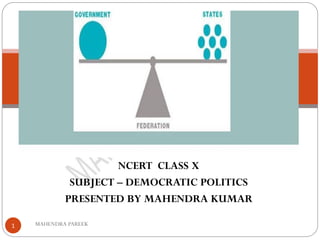
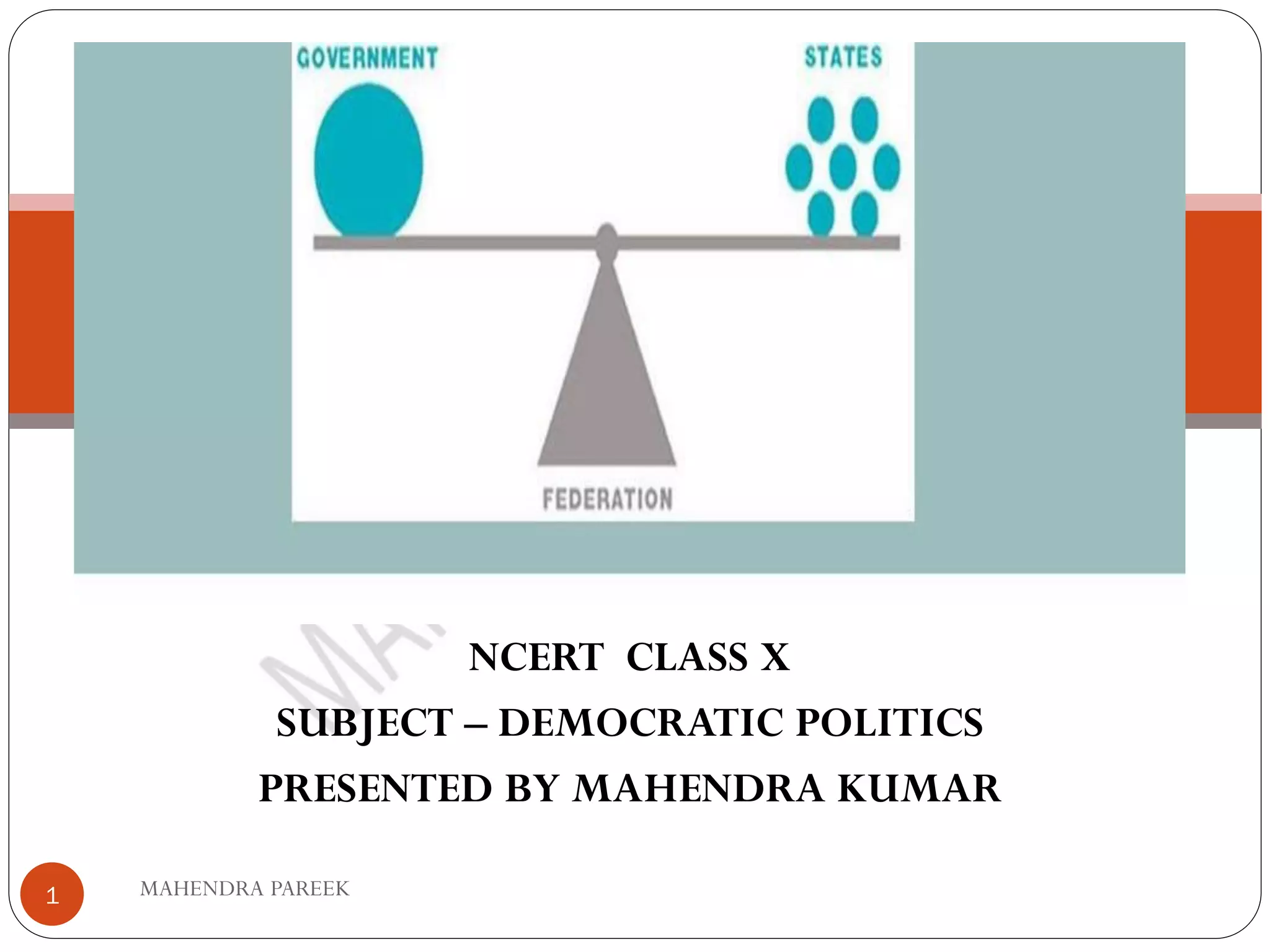
 Definition - Federalism is a system of government in which
the power is divided between a central authority (CENTRAL
GOVT – for whole India ) and various constituent units
(RESPECTIVE 28 STATES )of the country.
 CG is usually responsible for a few subjects of common
national interest. SG look after much of the day-to-day
administration of their state
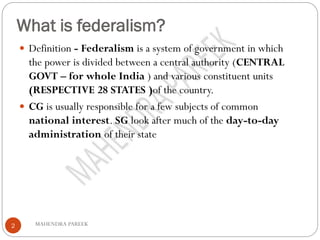
Difference
Unitary federal
MAHENDRA PAREEK3
 One level of government
 Subunits (states) are
subordinate of central
government
 Central government can
pass orders to state
governments.
 Examples: China, Japan,
U.K, France
 Two or more level of
governments
 State govts have their own
independent powers
 Central government
cannot pass orders to
state govt.To do
something.
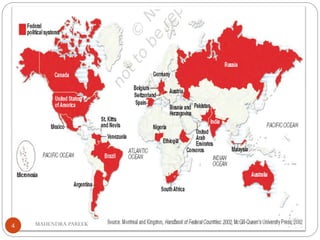
 Example-USA, Brazil,
Belgium India, Canada,
Germany
MAHENDRA PAREEK4
Key features of federalism
MAHENDRA PAREEK5
❖ There are two or more levels (or tiers) of government
❖ Different tiers of government govern the same citizens.
❖ Each tier (CG/SG/LG) has its own JURISDICTION in
specific matters of legislation, taxation and administration.
❖ This jurisdiction is specified in our constitution.
constitutionally guaranteed existence and authority of each
tier (CG/SG/LG)
Key features of federalism
MAHENDRA PAREEK6
❖Sources of revenue for each level of government are clearly
specified to ensure its financial autonomy.
❖Supreme court acts as interpreter of constitution and settled the
disputes between CG/SG, SG/SG, CG/INDIVIDUAL AND
SG/INDIVIDUAL.
❖ The federal system thus has dual objectives: to safeguard and
promote unity of the country, while at the same time
accommodate regional diversity (INDIA & BELGIUM).
❖ An ideal federal system has both aspects : mutual trust and
agreement to live together.
Types of Federation
MAHENDRA PAREEK7
COMINGTOGETHER
 Independent states come
together to form a bigger unit
of federation.
 Constituents states usually
have equal powers
 Examples: Sri Lanka, France,
Spain, Italy
HOLDINGTOGETHER
 A country divides its own
territory into several sub-
units
 Central govt. is stronger than
state governments.
 The USA, India, Canada,
Brazil, Belgium
What makes India a federal country?
MAHENDRA PAREEK8
 The Constitution declared India as a Union of States.
 The word federation is not used in constitution.
 the Indian Union is based on the principles of federalism.
 The Constitution originally provided for a two-tier (CG/SG)
system of government.
 A third tier of federalism was added in the form of Panchayats
and Municipalities.
What makes India a federal country? Contd…
MAHENDRA PAREEK9
 Constitution clearly provided a threefold distribution of
legislative powers between the (UG and SG).
 Union List - Union Government alone can make laws
relating to national importance subjects.
 Defence , foreign affairs, banking, communications, currency.
 State List - SG alone can make laws relating to state and local
importance subjects.
 Police, trade, commerce, agriculture and irrigation.
What makes India a federal country?
MAHENDRA PAREEK10
 Concurrent List –
 Both the Union as well as the State Governments can make laws
on the subjects of common interest to both the Union
Government as well as the State Governments. If conflict, law
made by the Union Government will prevail
 Subjects -education, forest, trade unions, marriage, adoption and
succession.
 Residuary power –
 Union Government has the power to make laws
 Includes subjects that do not fall in any of the three lists. Ex-
computer software
What makes India a federal country?
MAHENDRA PAREEK11
 Different state, special status. Small area-Uts govern by UG.
 Change in this arrangement (federalism) constitution
amendment – passed by Parliament with 2/3 majority +
passed by more than half of the states
 INDEPENDENT JUDICIARY -
 SC interpret the constitution .
 SC settle the disputes between UG & SG
 Sc is the apex body of judiciary .
What makes India a federal country?
MAHENDRA PAREEK12
 Financial power of UG & SG –
 Power to raise resources by levying taxes in order to carry on the
government and the responsibilities assigned to each of them.
MAHENDRA PAREEK13
MAHENDRA PAREEK14
MAHENDRA PAREEK15
How is federalism practised?
MAHENDRA PAREEK16
 Linguistic States –
 Many new states have been created on federal principles after
independence.
 Some states were created on the basis of languages spoken by
people. AP-1953-Telugu.
 Some States were created to recognise differences based on
culture, ethnicity or geography. Nagaland, UK and Jharkhand.
MAHENDRA PAREEK17
 Language policy –
 No national language .
 Hindi (Mother tongue of 40% ) was identified as the official
language.
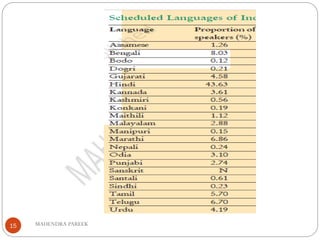
 There are 22 (Hindi + 21 languages)recognised as Scheduled
Languages by the Constitution
 According to the Constitution, the use of English for official
purposes was to stop in 1965 ( after 15 yrs from 1950)
 Non Hindi states opposed it . Continued...
 Promotion of Hindi by UG.
Centre-State relations
MAHENDRA PAREEK18
 Same party UG instruct SG – No disputes.
 Different party – UG try to control SG undermined the spirit of
federalism.
 All this changed significantly after 1990.
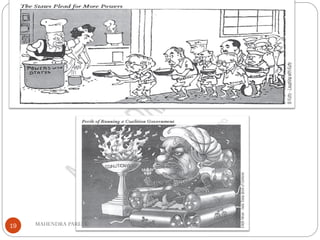
 COALITION GOVERNMENTS - major national parties had to
enter into an alliance with many parties including several
regional parties to form a government at the Centre.
 This led to a new culture of power sharing and respect for the
autonomy of State Governments
 Thus, federal power sharing is more effective today
MAHENDRA PAREEK19
Decentralisation in India
MAHENDRA PAREEK20
 India is vast (size & population) and culturally diverse So its rationale
to decentralise the power
 When power is taken away from Central and State governments and
given to local govt, it is called decentralisation.
 The basic idea behind decentralisation
- Local problem – local solution
- Better understanding where and how to spend money.
 One of principle of democracy is local self-government.
Decentralisation in India
MAHENDRA PAREEK21
Before 1992 –
❖Panchayats in villages and municipalities in urban areas were directly
under the control of state governments.
❖ Elections were not held regularly.
❖ Local governments did not have any powers or resources of their
own..
Decentralisation in India
MAHENDRA PAREEK22
After amendment of 1992 –
 To hold Regular elections to local government bodies become
constitutionally mandatory.
 Reserved seats for SC,ST AND OBCs.
 one-third (1/3) of all positions are reserved for women.
 State Election Commission has been created in each State to conduct
Panchayat and municipal elections
 The SGs are required to share some powers and revenue with local
government bodies.The nature of sharing varies from State to State.
RURAL LOCAL GOVT- PANCHAYATI RAJ
MAHENDRA PAREEK23
 Gram Panchayat (ग्राम पंचायत) –
 Consists ward members (Panch पंच) and the sarpanch (सरपंच).
 Decision-making body for village.
 Elected by Gram Sabha.
Gram Sabha (ग्राम सभा )(Permanent Body)
 formed by voters of a village .
 It elects ward members and the Sarpanch of the Gram panchayat.
 It meets twice or thrice to approve annual budget.
RURAL LOCAL GOVT- PANCHAYATI RAJ
MAHENDRA PAREEK24
 Block Level - Panchayat samiti (पंचायत सममतत )
 Group of a few panchayats formed panchayat samiti
 Its members are indirectly elected by the panchayat members .
 District Level- Zila Parishad (जिला परिषद् )
 Panchayat Samitis constitutes Zila Parishad.
 District MPs, MLAs and officials are some other members.
 Zila Parishad Chairman (जिला प्रमुख ) or President is a
political head.
RURAL LOCAL GOVT- PANCHAYATI RAJ
MAHENDRA PAREEK25
 Block Level - Panchayat samiti (पंचायत सममतत )
 Group of a few panchayats formed panchayat samiti
 Its members are indirectly elected by the panchayat members .
 District Level- Zila Parishad (जिला परिषद् )
 Panchayat Samitis constitutes Zila Parishad.
 District MPs, MLAs and officials are some other members.
 Zila Parishad Chairman (जिला प्रमुख ) or President is a
political head.
URBAN LOCAL GOVT
MAHENDRA PAREEK26
 Municipalities –
 Municipalities are set up in towns.
 Chaired by a political head is called Municipal Chairman
 Controlled by elected bodies consisting of people’s representatives
 Municipal Corporations –
 Municipal Corporations are set up in BIG CITIES.
 Chaired by a political head is called Mayor
 Controlled by elected bodies consisting of people’s representatives.
MAHENDRA PAREEK27
 There are now about 36 lakh elected representatives in the
Panchayats and municipalities etc all over the country.
 This number is bigger than the population of many countries
in the world
VOTE OF THANKS
MAHENDRA PAREEK28
 1 NCERT BOOKS
 2 INTERNERT AND GOOGLE
 3 ENCYCLOPEDIA BRITANNICA
 OUR PRINCIPAL
 4 MYVIEWERS

Federalism sanghwad

  • 1.
    NCERT CLASS X SUBJECT– DEMOCRATIC POLITICS PRESENTED BY MAHENDRA KUMAR MAHENDRA PAREEK1 federalism
  • 2.
    What is federalism? MAHENDRAPAREEK2  Definition - Federalism is a system of government in which the power is divided between a central authority (CENTRAL GOVT – for whole India ) and various constituent units (RESPECTIVE 28 STATES )of the country.  CG is usually responsible for a few subjects of common national interest. SG look after much of the day-to-day administration of their state
  • 3.
    Difference Unitary federal MAHENDRA PAREEK3 One level of government  Subunits (states) are subordinate of central government  Central government can pass orders to state governments.  Examples: China, Japan, U.K, France  Two or more level of governments  State govts have their own independent powers  Central government cannot pass orders to state govt.To do something.  Example-USA, Brazil, Belgium India, Canada, Germany
  • 4.
  • 5.
    Key features offederalism MAHENDRA PAREEK5 ❖ There are two or more levels (or tiers) of government ❖ Different tiers of government govern the same citizens. ❖ Each tier (CG/SG/LG) has its own JURISDICTION in specific matters of legislation, taxation and administration. ❖ This jurisdiction is specified in our constitution. constitutionally guaranteed existence and authority of each tier (CG/SG/LG)
  • 6.
    Key features offederalism MAHENDRA PAREEK6 ❖Sources of revenue for each level of government are clearly specified to ensure its financial autonomy. ❖Supreme court acts as interpreter of constitution and settled the disputes between CG/SG, SG/SG, CG/INDIVIDUAL AND SG/INDIVIDUAL. ❖ The federal system thus has dual objectives: to safeguard and promote unity of the country, while at the same time accommodate regional diversity (INDIA & BELGIUM). ❖ An ideal federal system has both aspects : mutual trust and agreement to live together.
  • 7.
    Types of Federation MAHENDRAPAREEK7 COMINGTOGETHER  Independent states come together to form a bigger unit of federation.  Constituents states usually have equal powers  Examples: Sri Lanka, France, Spain, Italy HOLDINGTOGETHER  A country divides its own territory into several sub- units  Central govt. is stronger than state governments.  The USA, India, Canada, Brazil, Belgium
  • 8.
    What makes Indiaa federal country? MAHENDRA PAREEK8  The Constitution declared India as a Union of States.  The word federation is not used in constitution.  the Indian Union is based on the principles of federalism.  The Constitution originally provided for a two-tier (CG/SG) system of government.  A third tier of federalism was added in the form of Panchayats and Municipalities.
  • 9.
    What makes Indiaa federal country? Contd… MAHENDRA PAREEK9  Constitution clearly provided a threefold distribution of legislative powers between the (UG and SG).  Union List - Union Government alone can make laws relating to national importance subjects.  Defence , foreign affairs, banking, communications, currency.  State List - SG alone can make laws relating to state and local importance subjects.  Police, trade, commerce, agriculture and irrigation.
  • 10.
    What makes Indiaa federal country? MAHENDRA PAREEK10  Concurrent List –  Both the Union as well as the State Governments can make laws on the subjects of common interest to both the Union Government as well as the State Governments. If conflict, law made by the Union Government will prevail  Subjects -education, forest, trade unions, marriage, adoption and succession.  Residuary power –  Union Government has the power to make laws  Includes subjects that do not fall in any of the three lists. Ex- computer software
  • 11.
    What makes Indiaa federal country? MAHENDRA PAREEK11  Different state, special status. Small area-Uts govern by UG.  Change in this arrangement (federalism) constitution amendment – passed by Parliament with 2/3 majority + passed by more than half of the states  INDEPENDENT JUDICIARY -  SC interpret the constitution .  SC settle the disputes between UG & SG  Sc is the apex body of judiciary .
  • 12.
    What makes Indiaa federal country? MAHENDRA PAREEK12  Financial power of UG & SG –  Power to raise resources by levying taxes in order to carry on the government and the responsibilities assigned to each of them.
  • 13.
  • 14.
  • 15.
  • 16.
    How is federalismpractised? MAHENDRA PAREEK16  Linguistic States –  Many new states have been created on federal principles after independence.  Some states were created on the basis of languages spoken by people. AP-1953-Telugu.  Some States were created to recognise differences based on culture, ethnicity or geography. Nagaland, UK and Jharkhand.
  • 17.
    MAHENDRA PAREEK17  Languagepolicy –  No national language .  Hindi (Mother tongue of 40% ) was identified as the official language.  There are 22 (Hindi + 21 languages)recognised as Scheduled Languages by the Constitution  According to the Constitution, the use of English for official purposes was to stop in 1965 ( after 15 yrs from 1950)  Non Hindi states opposed it . Continued...  Promotion of Hindi by UG.
  • 18.
    Centre-State relations MAHENDRA PAREEK18 Same party UG instruct SG – No disputes.  Different party – UG try to control SG undermined the spirit of federalism.  All this changed significantly after 1990.  COALITION GOVERNMENTS - major national parties had to enter into an alliance with many parties including several regional parties to form a government at the Centre.  This led to a new culture of power sharing and respect for the autonomy of State Governments  Thus, federal power sharing is more effective today
  • 19.
  • 20.
    Decentralisation in India MAHENDRAPAREEK20  India is vast (size & population) and culturally diverse So its rationale to decentralise the power  When power is taken away from Central and State governments and given to local govt, it is called decentralisation.  The basic idea behind decentralisation - Local problem – local solution - Better understanding where and how to spend money.  One of principle of democracy is local self-government.
  • 21.
    Decentralisation in India MAHENDRAPAREEK21 Before 1992 – ❖Panchayats in villages and municipalities in urban areas were directly under the control of state governments. ❖ Elections were not held regularly. ❖ Local governments did not have any powers or resources of their own..
  • 22.
    Decentralisation in India MAHENDRAPAREEK22 After amendment of 1992 –  To hold Regular elections to local government bodies become constitutionally mandatory.  Reserved seats for SC,ST AND OBCs.  one-third (1/3) of all positions are reserved for women.  State Election Commission has been created in each State to conduct Panchayat and municipal elections  The SGs are required to share some powers and revenue with local government bodies.The nature of sharing varies from State to State.
  • 23.
    RURAL LOCAL GOVT-PANCHAYATI RAJ MAHENDRA PAREEK23  Gram Panchayat (ग्राम पंचायत) –  Consists ward members (Panch पंच) and the sarpanch (सरपंच).  Decision-making body for village.  Elected by Gram Sabha. Gram Sabha (ग्राम सभा )(Permanent Body)  formed by voters of a village .  It elects ward members and the Sarpanch of the Gram panchayat.  It meets twice or thrice to approve annual budget.
  • 24.
    RURAL LOCAL GOVT-PANCHAYATI RAJ MAHENDRA PAREEK24  Block Level - Panchayat samiti (पंचायत सममतत )  Group of a few panchayats formed panchayat samiti  Its members are indirectly elected by the panchayat members .  District Level- Zila Parishad (जिला परिषद् )  Panchayat Samitis constitutes Zila Parishad.  District MPs, MLAs and officials are some other members.  Zila Parishad Chairman (जिला प्रमुख ) or President is a political head.
  • 25.
    RURAL LOCAL GOVT-PANCHAYATI RAJ MAHENDRA PAREEK25  Block Level - Panchayat samiti (पंचायत सममतत )  Group of a few panchayats formed panchayat samiti  Its members are indirectly elected by the panchayat members .  District Level- Zila Parishad (जिला परिषद् )  Panchayat Samitis constitutes Zila Parishad.  District MPs, MLAs and officials are some other members.  Zila Parishad Chairman (जिला प्रमुख ) or President is a political head.
  • 26.
    URBAN LOCAL GOVT MAHENDRAPAREEK26  Municipalities –  Municipalities are set up in towns.  Chaired by a political head is called Municipal Chairman  Controlled by elected bodies consisting of people’s representatives  Municipal Corporations –  Municipal Corporations are set up in BIG CITIES.  Chaired by a political head is called Mayor  Controlled by elected bodies consisting of people’s representatives.
  • 27.
    MAHENDRA PAREEK27  Thereare now about 36 lakh elected representatives in the Panchayats and municipalities etc all over the country.  This number is bigger than the population of many countries in the world
  • 28.
    VOTE OF THANKS MAHENDRAPAREEK28  1 NCERT BOOKS  2 INTERNERT AND GOOGLE  3 ENCYCLOPEDIA BRITANNICA  OUR PRINCIPAL  4 MYVIEWERS