Parliamentary Committees
in India
-Ayushi Rai (PPG)
-Sujata Bahot (PPG)
-Trina Das (DS)
Parliamentary committees
. Why are Parliamentary Committees needed?
• Increases efficiency and expertise of Parliament.
• Review proposed laws , oversee activities of the
executive branch and scrutinize government
expenditure.
• Forum to build consensus across party lines.
• Help develop expertise in subjects.
• Enables consultation with independent experts and
stakeholders.
1- Financial
Committees
2-Departmentally
Related Standing
Committees
3- Other Standing
Committees
1- Standing Committees 2- Ad-Hoc Committees
Parliamentary Committees
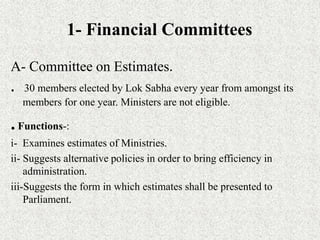
1- Financial Committees
A- Committee on Estimates.
. 30 members elected by Lok Sabha every year from amongst its
members for one year. Ministers are not eligible.
.Functions-:
i- Examines estimates of Ministries.
ii- Suggests alternative policies in order to bring efficiency in
administration.
iii-Suggests the form in which estimates shall be presented to
Parliament.
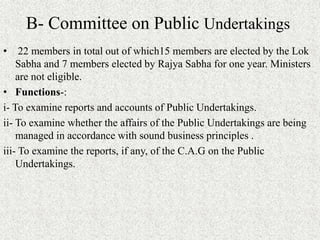
B- Committee on Public Undertakings
• 22 members in total out of which15 members are elected by the Lok
Sabha and 7 members elected by Rajya Sabha for one year. Ministers
are not eligible.
• Functions-:
i- To examine reports and accounts of Public Undertakings.
ii- To examine whether the affairs of the Public Undertakings are being
managed in accordance with sound business principles .
iii- To examine the reports, if any, of the C.A.G on the Public
Undertakings.
C- Committee on Public Accounts
• 22 members out of which 15 members are elected by Lok
Sabha and 7 by Rajya Sabha for one year. Ministers are not
eligible.
• Chairperson is an opposition member.
• Functions-:
i- To ascertain whether the money granted by the Parliament has
been spent by Government “within the scope of demand”.
ii- Only concerned with the execution of the policy laid down by
the Parliament and its results.
2- Departmentally Related
Committees
. Introduced in 1993 . There are 24 DRCs .
• 31 members, 21 from Lok Sabha and 10 from Rajya Sabha. Seats are
allocated on the basis of the strength of the parties in the House.
• Committees such as Home Affairs, Finance and External Affairs are
customarily chaired by a member of opposition.
• Main function is to ensure the oversight over each ministry.
3- Other Standing Committees
• Each house has a set of these Committees, to inquire into other
matters related to Parliament and day to day business of the
house.
• Lok Sabha has 16 committees and Rajya Sabha has 12.
• Number of members varies from 7 to 26,some with fixed term
and some without fixed term.
• A minister is not eligible to be a member of Committees on
Women Empowerment, Government Assurances, Petitions,
Subordinate Legislation and Welfare of SCs/STs.
• Joint Committees include members from both the houses.
Such Committees have about 15 members and are formed for
one term of the Lok Sabha.
• Examples-: Business Advisory Committee, Committee on
Petitions, Subordinate Legislations and Government
Asuurances etc.
Ad-Hoc Committees
• Appointed for a specific purpose and cease to exist after the
completion of the task. Examples-: Joint Committee to examine
pricing of telecom licenses and spectrum.
• Committees on Ethics, MPLADS and Provision of Computers to Lok
Sabha members, Joint Committee on Waqf , Railway Convention,
Fertilisers Pricing etc.
• Except for Joint Committee on Waqf , the committees operate in Lok
Sabha.
• Members are from both the houses and varies between 10 and 30.
National Commission to Review the
Working of the Constitution
(NCRWC)
In 2002, the NCRWC pointed out some shortcomings of the
committees:
• low attendance of MPs at meetings
• Too many ministries under a committee
• Norms not followed by most political parties while nominating
MPs to committees
• The constitution of DRSCs for a year leaves very little time for
specialisations.
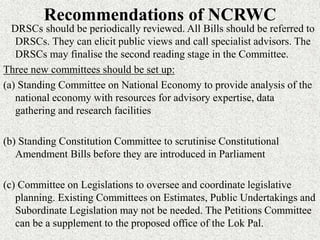
Recommendations of NCRWC
DRSCs should be periodically reviewed. All Bills should be referred to
DRSCs. They can elicit public views and call specialist advisors. The
DRSCs may finalise the second reading stage in the Committee.
Three new committees should be set up:
(a) Standing Committee on National Economy to provide analysis of the
national economy with resources for advisory expertise, data
gathering and research facilities
(b) Standing Constitution Committee to scrutinise Constitutional
Amendment Bills before they are introduced in Parliament
(c) Committee on Legislations to oversee and coordinate legislative
planning. Existing Committees on Estimates, Public Undertakings and
Subordinate Legislation may not be needed. The Petitions Committee
can be a supplement to the proposed office of the Lok Pal.
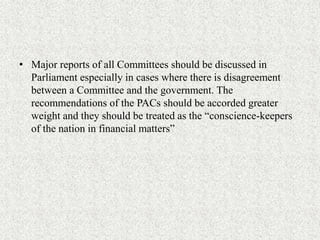
• Major reports of all Committees should be discussed in
Parliament especially in cases where there is disagreement
between a Committee and the government. The
recommendations of the PACs should be accorded greater
weight and they should be treated as the “conscience-keepers
of the nation in financial matters”
Metrics to measure the
effectiveness of the committees
The effectiveness of the committees
can be evaluated :
1. quantitatively
2. qualitatively
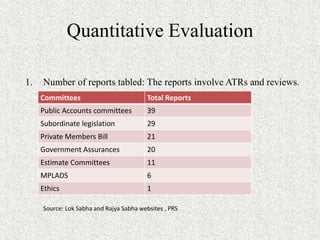
Quantitative Evaluation
1. Number of reports tabled: The reports involve ATRs and reviews.
Source: Lok Sabha and Rajya Sabha websites , PRS
Committees Total Reports
Public Accounts committees 39
Subordinate legislation 29
Private Members Bill 21
Government Assurances 20
Estimate Committees 11
MPLADS 6
Ethics 1
2. Time Taken to Submit Reports:
For example: DRSC’s get two to three months to submit the report
and in case the report isn’t submitted in the stipulated time
extension is given.
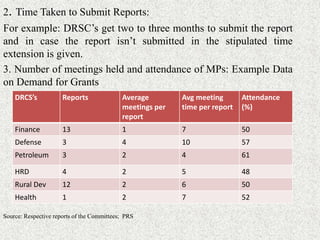
3. Number of meetings held and attendance of MPs: Example Data
on Demand for Grants
Source: Respective reports of the Committees; PRS
DRCS’s Reports Average
meetings per
report
Avg meeting
time per report
Attendance
(%)
Finance 13 1 7 50
Defense 3 4 10 57
Petroleum 3 2 4 61
HRD 4 2 5 48
Rural Dev 12 2 6 50
Health 1 2 7 52
• For instance :
1. For the Nuclear Liability Bill the committees met 13 times.
2. The committees met only twice for bills such as the Anti
Hijacking Bill (2010) and Juvenile Justice Bill (2010)
• Though the number of meeting conducted by these
committees is measurable but the quality of work is difficult
to judge.
• The PAC with the composition of 22 MPs had an average
attendance of 11 MPs in its meetings.
Qualitative Evaluation
• Studying the quality of recommendation proposed by the
committees.
• Level of knowledge of MPs.
• Quality of discussions in the committees.
• Acceptance of committee Recommendations : The impact of
the committee in influencing a policy can be measured by the
proportion of recommendations that are accepted and
implemented.
For example: The subordinate legislation committee made 28
recommendation with an acceptance rate of 93% whereas DRSC
on HRD made 608 recommendations but the acceptance of the
recommendations is only 7%.
THANK YOU ! 

Parliamentary committees

  • 1.
    Parliamentary Committees in India -AyushiRai (PPG) -Sujata Bahot (PPG) -Trina Das (DS)
  • 2.
    Parliamentary committees . Whyare Parliamentary Committees needed? • Increases efficiency and expertise of Parliament. • Review proposed laws , oversee activities of the executive branch and scrutinize government expenditure. • Forum to build consensus across party lines. • Help develop expertise in subjects. • Enables consultation with independent experts and stakeholders.
  • 3.
    1- Financial Committees 2-Departmentally Related Standing Committees 3-Other Standing Committees 1- Standing Committees 2- Ad-Hoc Committees Parliamentary Committees
  • 4.
    1- Financial Committees A-Committee on Estimates. . 30 members elected by Lok Sabha every year from amongst its members for one year. Ministers are not eligible. .Functions-: i- Examines estimates of Ministries. ii- Suggests alternative policies in order to bring efficiency in administration. iii-Suggests the form in which estimates shall be presented to Parliament.
  • 5.
    B- Committee onPublic Undertakings • 22 members in total out of which15 members are elected by the Lok Sabha and 7 members elected by Rajya Sabha for one year. Ministers are not eligible. • Functions-: i- To examine reports and accounts of Public Undertakings. ii- To examine whether the affairs of the Public Undertakings are being managed in accordance with sound business principles . iii- To examine the reports, if any, of the C.A.G on the Public Undertakings.
  • 6.
    C- Committee onPublic Accounts • 22 members out of which 15 members are elected by Lok Sabha and 7 by Rajya Sabha for one year. Ministers are not eligible. • Chairperson is an opposition member. • Functions-: i- To ascertain whether the money granted by the Parliament has been spent by Government “within the scope of demand”. ii- Only concerned with the execution of the policy laid down by the Parliament and its results.
  • 7.
    2- Departmentally Related Committees .Introduced in 1993 . There are 24 DRCs . • 31 members, 21 from Lok Sabha and 10 from Rajya Sabha. Seats are allocated on the basis of the strength of the parties in the House. • Committees such as Home Affairs, Finance and External Affairs are customarily chaired by a member of opposition. • Main function is to ensure the oversight over each ministry.
  • 8.
    3- Other StandingCommittees • Each house has a set of these Committees, to inquire into other matters related to Parliament and day to day business of the house. • Lok Sabha has 16 committees and Rajya Sabha has 12. • Number of members varies from 7 to 26,some with fixed term and some without fixed term. • A minister is not eligible to be a member of Committees on Women Empowerment, Government Assurances, Petitions, Subordinate Legislation and Welfare of SCs/STs. • Joint Committees include members from both the houses. Such Committees have about 15 members and are formed for one term of the Lok Sabha. • Examples-: Business Advisory Committee, Committee on Petitions, Subordinate Legislations and Government Asuurances etc.
  • 9.
    Ad-Hoc Committees • Appointedfor a specific purpose and cease to exist after the completion of the task. Examples-: Joint Committee to examine pricing of telecom licenses and spectrum. • Committees on Ethics, MPLADS and Provision of Computers to Lok Sabha members, Joint Committee on Waqf , Railway Convention, Fertilisers Pricing etc. • Except for Joint Committee on Waqf , the committees operate in Lok Sabha. • Members are from both the houses and varies between 10 and 30.
  • 10.
    National Commission toReview the Working of the Constitution (NCRWC) In 2002, the NCRWC pointed out some shortcomings of the committees: • low attendance of MPs at meetings • Too many ministries under a committee • Norms not followed by most political parties while nominating MPs to committees • The constitution of DRSCs for a year leaves very little time for specialisations.
  • 11.
    Recommendations of NCRWC DRSCsshould be periodically reviewed. All Bills should be referred to DRSCs. They can elicit public views and call specialist advisors. The DRSCs may finalise the second reading stage in the Committee. Three new committees should be set up: (a) Standing Committee on National Economy to provide analysis of the national economy with resources for advisory expertise, data gathering and research facilities (b) Standing Constitution Committee to scrutinise Constitutional Amendment Bills before they are introduced in Parliament (c) Committee on Legislations to oversee and coordinate legislative planning. Existing Committees on Estimates, Public Undertakings and Subordinate Legislation may not be needed. The Petitions Committee can be a supplement to the proposed office of the Lok Pal.
  • 12.
    • Major reportsof all Committees should be discussed in Parliament especially in cases where there is disagreement between a Committee and the government. The recommendations of the PACs should be accorded greater weight and they should be treated as the “conscience-keepers of the nation in financial matters”
  • 13.
    Metrics to measurethe effectiveness of the committees The effectiveness of the committees can be evaluated : 1. quantitatively 2. qualitatively
  • 14.
    Quantitative Evaluation 1. Numberof reports tabled: The reports involve ATRs and reviews. Source: Lok Sabha and Rajya Sabha websites , PRS Committees Total Reports Public Accounts committees 39 Subordinate legislation 29 Private Members Bill 21 Government Assurances 20 Estimate Committees 11 MPLADS 6 Ethics 1
  • 15.
    2. Time Takento Submit Reports: For example: DRSC’s get two to three months to submit the report and in case the report isn’t submitted in the stipulated time extension is given. 3. Number of meetings held and attendance of MPs: Example Data on Demand for Grants Source: Respective reports of the Committees; PRS DRCS’s Reports Average meetings per report Avg meeting time per report Attendance (%) Finance 13 1 7 50 Defense 3 4 10 57 Petroleum 3 2 4 61 HRD 4 2 5 48 Rural Dev 12 2 6 50 Health 1 2 7 52
  • 16.
    • For instance: 1. For the Nuclear Liability Bill the committees met 13 times. 2. The committees met only twice for bills such as the Anti Hijacking Bill (2010) and Juvenile Justice Bill (2010) • Though the number of meeting conducted by these committees is measurable but the quality of work is difficult to judge. • The PAC with the composition of 22 MPs had an average attendance of 11 MPs in its meetings.
  • 17.
    Qualitative Evaluation • Studyingthe quality of recommendation proposed by the committees. • Level of knowledge of MPs. • Quality of discussions in the committees. • Acceptance of committee Recommendations : The impact of the committee in influencing a policy can be measured by the proportion of recommendations that are accepted and implemented. For example: The subordinate legislation committee made 28 recommendation with an acceptance rate of 93% whereas DRSC on HRD made 608 recommendations but the acceptance of the recommendations is only 7%.
  • 18.