FEDERALISM
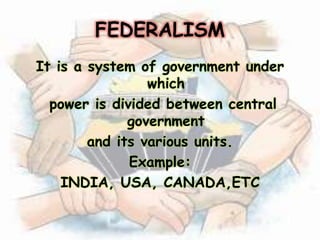
It is a system of government under
which
power is divided between central
government
and its various units.
Example:
INDIA, USA, CANADA,ETC
CHARACTERSTICS OF
FEDERAL GOVERNMENT
• Two or more levels of government.
– It consist of central authority, state
authority and as well as its various units.
• Supremacy of the judiciary.
– Judiciary is above all the other organs.
• Separate jurisdiction
– In federal government the different
tiers of government governs same citizen.
• Specification of the jurisdiction.
– The authority and existence of each tier
of government is safeguarded.
• Rigid constitution .
– The constitution can be only changed
through consent of both levels of
government.
• Specification of source of the income
.
– Source of income is divided among the
levels.
• Dual objective.
– It has two motives ,
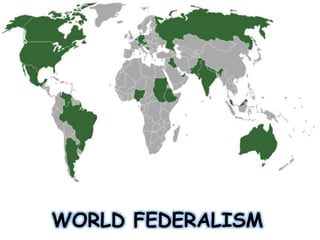
WORLD FEDERALISM
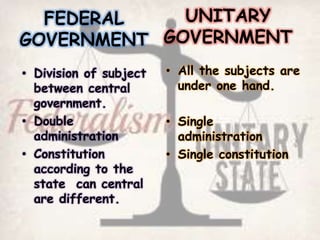
FEDERAL
GOVERNMENT
UNITARY
GOVERNMENT
• All the subjects are
under one hand.
• Single
administration
• Single constitution
• Division of subject
between central
government.
• Double
administration
• Constitution
according to the
state can central
are different.
KINDS OF FEDERATION
• Coming together government
– In this type of government the state and
central has equal powers.
• Examples: USA, AUSTRALIA.
• Holding together government
– In this type of government the state and
center has powers shared among different
levels
• Examples: INDIA, BELGUIM.
WHAT MAKES India A
FEDERAL COUNTRY?
• Division of power
– Union list includes subjects of national
importance like defense banking etc.
– State list includes subjects like police
commerce etc
– Concurrent lust includes the common
subjects of both state and central
government
– Residuary power includes the power to
legislature for the subject not mentioned
in other list
• Three tier system
– India has three tier system :
• Union government
• State government
• Local self government
• Not equal powers to all administrations
– India has hold together form of government
• Consent of both levels of the
government
– In India the bill has to be passed through
the both houses of the parliament.
• Jurisdiction
– In India we have supreme court high court
and low court.
• Source of income
– In India the state and the central have
separate source of income
HOW IS FEDERALISM
PRACTICED?
• Linguistic state
– States are made according to the culture of
a area
• Language policy
– In India there are many languages are given
the recognition but only english is the
official language.
• State central relation
– Many steps are taken to improve the
relation between the state and the center
like forming coalition parties and many more.
DECENTRALISATION IN
India
It means taking away powers from state and
central government and giving it to local
government
Advantages
• Locals have better knowledge
– Issues can be best settled at the local level
• Direct participation
– Inculcate the habit of the democratic
participation.
• Foundation of democracy
– It is like a school for the leaders
• Reduction of burden over state and central
government
– In this way the state and central government
Major step taken towards
decentralisation was in 1992.
• Regular elections
– It is mandatory to have elections
• Reservation of seats
– Seats are reserved for ST SC
• State election commission
– An independent body has been set up
• Source of revenue
– The state has to share the source of
income with the local government
Local governments
• Gram sabha
– The village assembly, it consist of every
person in a village above 18 years old.
Meetings must be held twice in a year
• The village panchayat
– Consist of panchayat sarpanch and several
other wards
There are many other bodies like block
samiti, zila parshid and in the urban
areas we have municipal corporation,
municipalities, mayor, etc.
Federalism

Federalism

  • 2.
    FEDERALISM It is asystem of government under which power is divided between central government and its various units. Example: INDIA, USA, CANADA,ETC
  • 3.
    CHARACTERSTICS OF FEDERAL GOVERNMENT •Two or more levels of government. – It consist of central authority, state authority and as well as its various units. • Supremacy of the judiciary. – Judiciary is above all the other organs. • Separate jurisdiction – In federal government the different tiers of government governs same citizen.
  • 4.
    • Specification ofthe jurisdiction. – The authority and existence of each tier of government is safeguarded. • Rigid constitution . – The constitution can be only changed through consent of both levels of government. • Specification of source of the income . – Source of income is divided among the levels. • Dual objective. – It has two motives ,
  • 5.
  • 6.
    FEDERAL GOVERNMENT UNITARY GOVERNMENT • All thesubjects are under one hand. • Single administration • Single constitution • Division of subject between central government. • Double administration • Constitution according to the state can central are different.
  • 7.
    KINDS OF FEDERATION •Coming together government – In this type of government the state and central has equal powers. • Examples: USA, AUSTRALIA. • Holding together government – In this type of government the state and center has powers shared among different levels • Examples: INDIA, BELGUIM.
  • 8.
    WHAT MAKES IndiaA FEDERAL COUNTRY? • Division of power – Union list includes subjects of national importance like defense banking etc. – State list includes subjects like police commerce etc – Concurrent lust includes the common subjects of both state and central government – Residuary power includes the power to legislature for the subject not mentioned in other list
  • 9.
    • Three tiersystem – India has three tier system : • Union government • State government • Local self government • Not equal powers to all administrations – India has hold together form of government • Consent of both levels of the government – In India the bill has to be passed through the both houses of the parliament. • Jurisdiction – In India we have supreme court high court and low court. • Source of income – In India the state and the central have separate source of income
  • 10.
    HOW IS FEDERALISM PRACTICED? •Linguistic state – States are made according to the culture of a area • Language policy – In India there are many languages are given the recognition but only english is the official language. • State central relation – Many steps are taken to improve the relation between the state and the center like forming coalition parties and many more.
  • 11.
    DECENTRALISATION IN India It meanstaking away powers from state and central government and giving it to local government Advantages • Locals have better knowledge – Issues can be best settled at the local level • Direct participation – Inculcate the habit of the democratic participation. • Foundation of democracy – It is like a school for the leaders • Reduction of burden over state and central government – In this way the state and central government
  • 12.
    Major step takentowards decentralisation was in 1992. • Regular elections – It is mandatory to have elections • Reservation of seats – Seats are reserved for ST SC • State election commission – An independent body has been set up • Source of revenue – The state has to share the source of income with the local government
  • 13.
    Local governments • Gramsabha – The village assembly, it consist of every person in a village above 18 years old. Meetings must be held twice in a year • The village panchayat – Consist of panchayat sarpanch and several other wards There are many other bodies like block samiti, zila parshid and in the urban areas we have municipal corporation, municipalities, mayor, etc.