CLASSVIII NCERT CHAPTER 3
SUBJECT – S.SC. (HISTORY)
PRESENTED BY – MAHENDRA KUMAR
महेंद्र पारीक1
Ruling The Countryside
The Company Becomes the Diwan
महेंद्र पारीक2
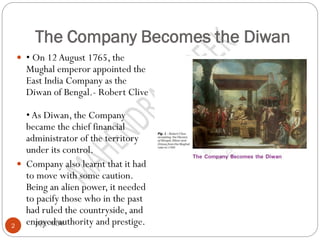
 • On 12 August 1765, the
Mughal emperor appointed the
East India Company as the
Diwan of Bengal.- Robert Clive
•As Diwan, the Company
became the chief financial
administrator of the territory
under its control.
 Company also learnt that it had
to move with some caution.
Being an alien power, it needed
to pacify those who in the past
had ruled the countryside, and
enjoyed authority and prestige.
Revenue for the Company
महेंद्र पारीक3
 The Company had become the Diwan, but it still saw itself
primarily as a trader
 The company made effort was to increase the revenue as much as
it could and buy fine cotton and silk cloth as cheaply as possible.
 Within five years the value of goods bought by the Company in
Bengal doubled.
 Now the revenue collected in Bengal could finance the purchase of
goods for export.(Before Diwani – trade _Gold, now –revenue)
 Bengal economy was facing a deep crisis because artisans were
deserting villages since they were being forced to sell their goods
to the Company at low prices.
 Agricultural cultivation showed signs of collapse.
 In 1770 a terrible famine killed ten million people in Bengal.
The need to improve agriculture
महेंद्र पारीक4
 Company officials felt that investment in
land had to be encouraged and agriculture
had to be improved.
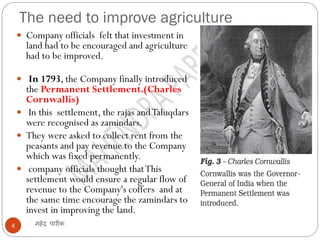
 In 1793, the Company finally introduced
the Permanent Settlement.(Charles
Cornwallis)
 In this settlement, the rajas andTaluqdars
were recognised as zamindars.
 They were asked to collect rent from the
peasants and pay revenue to the Company
which was fixed permanently.
 company officials thought thatThis
settlement would ensure a regular flow of
revenue to the Company's coffers and at
the same time encourage the zamindars to
invest in improving the land.
The problem
महेंद्र पारीक5
 Company officials soon discovered thaThe zamindars were not
investing in improving the quality of land.
 The revenue fixed was too high for the zamindars. that the
zamindars found it difficult to pay
 As long as the zamindars could earn by giving out their land to
tenants, they were not interested in improving the land
 In the villages, the cultivator found the system extremely
oppressiveThe rent he paid to the zamindar was high and his
right on the land was insecure. when he failed to pay the rent he
was evicted from the land
A new system is devised
महेंद्र पारीक6
 By the early 19th century, Company officials were convinced
that the system of revenue had to be changed again to meet the
growing expenses.
 Mahalwari settlement (in north India – U.P.)
 Holt Mackenzie devised the new system which came into effect
in 1822. He felt that the village was an important social
institution in north Indian society and needed to be preserved
•The collectors went from village to village to estimate the land
revenue that each village (mahal) had to pay.
• The charge of collecting the revenue and paying it to
the Company was given to the village headman, rather
than the zamindar.
•This system came to be known as the mahalwari settlement.
The Munro system in South India
महेंद्र पारीक7
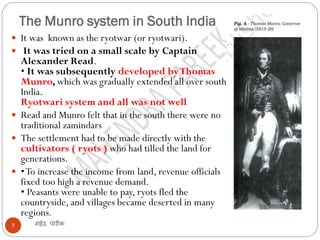
 It was known as the ryotwar (or ryotwari).
 It was tried on a small scale by Captain
Alexander Read.
• It was subsequently developed byThomas
Munro, which was gradually extended all over south
India.
Ryotwari system and all was not well
 Read and Munro felt that in the south there were no
traditional zamindars
 The settlement had to be made directly with the
cultivators ( ryots ) who had tilled the land for
generations.
 •To increase the income from land, revenue officials
fixed too high a revenue demand.
• Peasants were unable to pay, ryots fled the
countryside, and villages became deserted in many
regions.
Crops for Europe
महेंद्र पारीक8
 The British persuaded or forced cultivators in various parts of India
to produce other commercial crops:
→ jute in Bengal
→ tea in Assam
→ sugarcane in the United Provinces (now Uttar Pradesh)
→ wheat in Punjab
→ cotton in Maharashtra and Punjab
→ rice in Madras.
 How was this done ?
•The British used a variety of methods for increasing cultivation of
crops that they needed.
• One such crop was Indigo, which had a great worldwide demand.
Use of indigo in kalamkari (Andhra
P)and Morris Print
महेंद्र पारीक9
Why the demand for Indian indigo?
महेंद्र पारीक10
 By the thirteenth century, Indian indigo was being used by cloth
manufacturers in Italy, France and Britain to dye cloth.
 the price of indigo was very high and it was not available easily
 European cloth manufacturers, therefore, had to depend on another
plant calledWoad to make violet and blue dyes which were pale
and dull.
 So cloth dyers, however, preferred indigo as a dye.
 The French began cultivating indigo in St Domingue in the Caribbean
islands, the Portuguese in Brazil, the English in Jamaica, and the Spanish
inVenezuela.
 Between 1783 and 1789 the production of indigo in the world fell by
half.
 Cloth dyers in Britain started looking for new sources of
indigo supply.
Britain turns to India for indigo
महेंद्र पारीक11
 The Company in India looked for ways to expand the area under
indigo cultivation.
 In 1788 only about 30 per cent of the indigo imported into Britain
was from India.
 By 1810, 95 percent of the indigo imported into Britain was from
India.
 Many Company officials left their jobs and numerous Scotsmen and
Englishmen came to India and became planters attracted by the
prospect of high profits.
महेंद्र पारीक12
 How was indigo cultivated?
 There were two main systems of indigo cultivation – nij
and ryoti.
 Within the system of nij cultivation, the planter produced indigo in
lands that he directly controlled.
 The problem with nij cultivation
•The planters found it difficult to expand the area under nij
cultivation.
• Indigo could be cultivated only on fertile lands which were all
already densely populated.
•A large plantation required large number of labour at a time
when peasants were usually busy with their rice cultivation.
• It also required many ploughs and bullocks.(2 ploughs per Bigha)
•Till the late nineteenth century, planters were therefore reluctant
to expand the area under nij cultivation.25% nij Rest under ryots
महेंद्र पारीक13
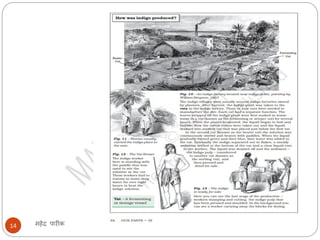
 Indigo on the land of ryots
 Under the ryoti system, the planters pressurised the village
headmen to sign the contract on behalf of the ryots.
 Those who signed the contract got cash advances from the planters
at low rates of interest to produce indigo.
 But the ryot to had to cultivate indigo on at least 25 percent of the
area under his holding.
 When the crop was delivered to the planter after the harvest, a new
loan was given to the ryot, and the cycle started all over again.
 The price provided to the peasants for the indigo they produced was
very low and the cycle of loans never ended.
 Indigo also exhaust the soil rapidly. After an indigo harvest the land
could not be sown with rice.
महेंद्र पारीक14
The “Blue Rebellion” and After
महेंद्र पारीक15
 In March 1859 thousands of ryots in Bengal refused to grow
indigo.As the rebellion spread, ryots refused to pay rents to the
planters, and attacked indigo
 Those who worked for the planters were socially boycotted, and
the gomasthas – agents of planters – who came to collect rent
were beaten up.
 Why did the indigo peasants decide that they would no
longer remain silent?What gave them the power to
rebel? Clearly, the indigo system was intensely
oppressive
 In 1859, the indigo ryots felt that they had the support of the local
zamindars and village headmen in their rebellion against the
planters
The “Blue Rebellion” and After
महेंद्र पारीक16
 zamindars were unhappy with the increasing power of the planters
and angry at being forced by the planters to give them land on
long leases.
 After the Revolt of 1857 the British government was particularly
worried about the possibility of another popular rebellion.
 Lieutenant Governor toured the region in the winter of 1859.The
ryots saw the tour as a sign of government sympathy for their
plight.
 When in Barasat, the magistrateAshley Eden issued a notice
stating that ryots would not be compelled to accept indigo
contracts, word went around that QueenVictoria had declared
that indigo need not be sown.
The “Blue Rebellion” and After
महेंद्र पारीक17
 As the rebellion spread, intellectuals from Calcutta rushed to the
indigo districts.They wrote of the misery of the ryots, the tyranny
of the planters, and the horrors of the indigo system.
 Govt set up the Indigo Commission to enquire into the system of
indigo production.The Commission held the planters guilty, and
criticised them for the coercive methods they used with indigo
cultivators.The Commission asked the ryots to fulfil their existing
contracts but also told them that they could refuse to produce
indigo in future.
 When Mahatma Gandhi returned from SouthAfrica, a peasant
from Bihar persuaded him to visit Champaran and see the plight of
the indigo cultivators there. Mahatma Gandhi’s visit in 1917
marked the beginning of the Champaran movement against the
indigo planters.
VOTE OF THANKS
महेंद्र पारीक18
ALMIGHTY GOD
NCERT
INTERNET
ENCYCLOPEDIA BRITANNICA
OUR PRINCIPAL
MYVIEWERS

3 ruling the countryside

  • 1.
    CLASSVIII NCERT CHAPTER3 SUBJECT – S.SC. (HISTORY) PRESENTED BY – MAHENDRA KUMAR महेंद्र पारीक1 Ruling The Countryside
  • 2.
    The Company Becomesthe Diwan महेंद्र पारीक2  • On 12 August 1765, the Mughal emperor appointed the East India Company as the Diwan of Bengal.- Robert Clive •As Diwan, the Company became the chief financial administrator of the territory under its control.  Company also learnt that it had to move with some caution. Being an alien power, it needed to pacify those who in the past had ruled the countryside, and enjoyed authority and prestige.
  • 3.
    Revenue for theCompany महेंद्र पारीक3  The Company had become the Diwan, but it still saw itself primarily as a trader  The company made effort was to increase the revenue as much as it could and buy fine cotton and silk cloth as cheaply as possible.  Within five years the value of goods bought by the Company in Bengal doubled.  Now the revenue collected in Bengal could finance the purchase of goods for export.(Before Diwani – trade _Gold, now –revenue)  Bengal economy was facing a deep crisis because artisans were deserting villages since they were being forced to sell their goods to the Company at low prices.  Agricultural cultivation showed signs of collapse.  In 1770 a terrible famine killed ten million people in Bengal.
  • 4.
    The need toimprove agriculture महेंद्र पारीक4  Company officials felt that investment in land had to be encouraged and agriculture had to be improved.  In 1793, the Company finally introduced the Permanent Settlement.(Charles Cornwallis)  In this settlement, the rajas andTaluqdars were recognised as zamindars.  They were asked to collect rent from the peasants and pay revenue to the Company which was fixed permanently.  company officials thought thatThis settlement would ensure a regular flow of revenue to the Company's coffers and at the same time encourage the zamindars to invest in improving the land.
  • 5.
    The problem महेंद्र पारीक5 Company officials soon discovered thaThe zamindars were not investing in improving the quality of land.  The revenue fixed was too high for the zamindars. that the zamindars found it difficult to pay  As long as the zamindars could earn by giving out their land to tenants, they were not interested in improving the land  In the villages, the cultivator found the system extremely oppressiveThe rent he paid to the zamindar was high and his right on the land was insecure. when he failed to pay the rent he was evicted from the land
  • 6.
    A new systemis devised महेंद्र पारीक6  By the early 19th century, Company officials were convinced that the system of revenue had to be changed again to meet the growing expenses.  Mahalwari settlement (in north India – U.P.)  Holt Mackenzie devised the new system which came into effect in 1822. He felt that the village was an important social institution in north Indian society and needed to be preserved •The collectors went from village to village to estimate the land revenue that each village (mahal) had to pay. • The charge of collecting the revenue and paying it to the Company was given to the village headman, rather than the zamindar. •This system came to be known as the mahalwari settlement.
  • 7.
    The Munro systemin South India महेंद्र पारीक7  It was known as the ryotwar (or ryotwari).  It was tried on a small scale by Captain Alexander Read. • It was subsequently developed byThomas Munro, which was gradually extended all over south India. Ryotwari system and all was not well  Read and Munro felt that in the south there were no traditional zamindars  The settlement had to be made directly with the cultivators ( ryots ) who had tilled the land for generations.  •To increase the income from land, revenue officials fixed too high a revenue demand. • Peasants were unable to pay, ryots fled the countryside, and villages became deserted in many regions.
  • 8.
    Crops for Europe महेंद्रपारीक8  The British persuaded or forced cultivators in various parts of India to produce other commercial crops: → jute in Bengal → tea in Assam → sugarcane in the United Provinces (now Uttar Pradesh) → wheat in Punjab → cotton in Maharashtra and Punjab → rice in Madras.  How was this done ? •The British used a variety of methods for increasing cultivation of crops that they needed. • One such crop was Indigo, which had a great worldwide demand.
  • 9.
    Use of indigoin kalamkari (Andhra P)and Morris Print महेंद्र पारीक9
  • 10.
    Why the demandfor Indian indigo? महेंद्र पारीक10  By the thirteenth century, Indian indigo was being used by cloth manufacturers in Italy, France and Britain to dye cloth.  the price of indigo was very high and it was not available easily  European cloth manufacturers, therefore, had to depend on another plant calledWoad to make violet and blue dyes which were pale and dull.  So cloth dyers, however, preferred indigo as a dye.  The French began cultivating indigo in St Domingue in the Caribbean islands, the Portuguese in Brazil, the English in Jamaica, and the Spanish inVenezuela.  Between 1783 and 1789 the production of indigo in the world fell by half.  Cloth dyers in Britain started looking for new sources of indigo supply.
  • 11.
    Britain turns toIndia for indigo महेंद्र पारीक11  The Company in India looked for ways to expand the area under indigo cultivation.  In 1788 only about 30 per cent of the indigo imported into Britain was from India.  By 1810, 95 percent of the indigo imported into Britain was from India.  Many Company officials left their jobs and numerous Scotsmen and Englishmen came to India and became planters attracted by the prospect of high profits.
  • 12.
    महेंद्र पारीक12  Howwas indigo cultivated?  There were two main systems of indigo cultivation – nij and ryoti.  Within the system of nij cultivation, the planter produced indigo in lands that he directly controlled.  The problem with nij cultivation •The planters found it difficult to expand the area under nij cultivation. • Indigo could be cultivated only on fertile lands which were all already densely populated. •A large plantation required large number of labour at a time when peasants were usually busy with their rice cultivation. • It also required many ploughs and bullocks.(2 ploughs per Bigha) •Till the late nineteenth century, planters were therefore reluctant to expand the area under nij cultivation.25% nij Rest under ryots
  • 13.
    महेंद्र पारीक13  Indigoon the land of ryots  Under the ryoti system, the planters pressurised the village headmen to sign the contract on behalf of the ryots.  Those who signed the contract got cash advances from the planters at low rates of interest to produce indigo.  But the ryot to had to cultivate indigo on at least 25 percent of the area under his holding.  When the crop was delivered to the planter after the harvest, a new loan was given to the ryot, and the cycle started all over again.  The price provided to the peasants for the indigo they produced was very low and the cycle of loans never ended.  Indigo also exhaust the soil rapidly. After an indigo harvest the land could not be sown with rice.
  • 14.
  • 15.
    The “Blue Rebellion”and After महेंद्र पारीक15  In March 1859 thousands of ryots in Bengal refused to grow indigo.As the rebellion spread, ryots refused to pay rents to the planters, and attacked indigo  Those who worked for the planters were socially boycotted, and the gomasthas – agents of planters – who came to collect rent were beaten up.  Why did the indigo peasants decide that they would no longer remain silent?What gave them the power to rebel? Clearly, the indigo system was intensely oppressive  In 1859, the indigo ryots felt that they had the support of the local zamindars and village headmen in their rebellion against the planters
  • 16.
    The “Blue Rebellion”and After महेंद्र पारीक16  zamindars were unhappy with the increasing power of the planters and angry at being forced by the planters to give them land on long leases.  After the Revolt of 1857 the British government was particularly worried about the possibility of another popular rebellion.  Lieutenant Governor toured the region in the winter of 1859.The ryots saw the tour as a sign of government sympathy for their plight.  When in Barasat, the magistrateAshley Eden issued a notice stating that ryots would not be compelled to accept indigo contracts, word went around that QueenVictoria had declared that indigo need not be sown.
  • 17.
    The “Blue Rebellion”and After महेंद्र पारीक17  As the rebellion spread, intellectuals from Calcutta rushed to the indigo districts.They wrote of the misery of the ryots, the tyranny of the planters, and the horrors of the indigo system.  Govt set up the Indigo Commission to enquire into the system of indigo production.The Commission held the planters guilty, and criticised them for the coercive methods they used with indigo cultivators.The Commission asked the ryots to fulfil their existing contracts but also told them that they could refuse to produce indigo in future.  When Mahatma Gandhi returned from SouthAfrica, a peasant from Bihar persuaded him to visit Champaran and see the plight of the indigo cultivators there. Mahatma Gandhi’s visit in 1917 marked the beginning of the Champaran movement against the indigo planters.
  • 18.
    VOTE OF THANKS महेंद्रपारीक18 ALMIGHTY GOD NCERT INTERNET ENCYCLOPEDIA BRITANNICA OUR PRINCIPAL MYVIEWERS