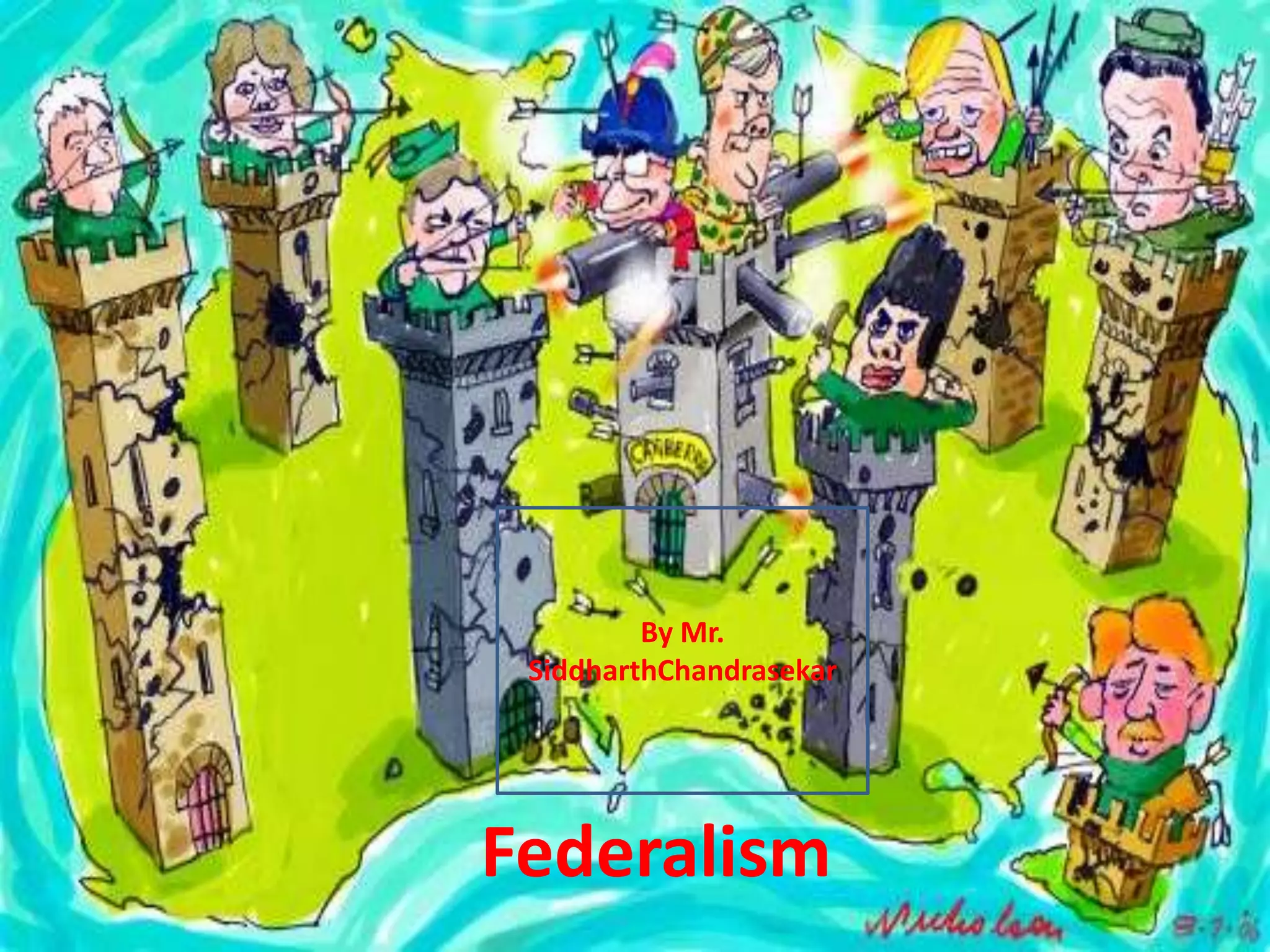
FederalismBy Mr. SiddharthChandrasekar
DefinitionIt is a system of govt. in which power is divided between a central authority and various constituent units of the country.
2 Levels of  Government…Government for the entire country Governments at the level of provinces/states.Both enjoy power independent of the other.State Government has power of its own and not answerable to the centre.Example : USA
Unitary Government…Only one level of Government.Sub units subordinated.Centre can pass orders to the local Government.Example : United Kingdom
Features of Federalism…Has two /more levels of Govt.Each level has its own Power or jurisdiction.Jurisdiction is specified by the constitution.and there is constitutional guarantee of authority.Constitutional provisions can be changed only with the consent of both levels of Govt.Court interprets the constitution and powers of different levels of Govt. . Supreme court is the umpire if disputes arise with different levels of Govt.Sources of revenue are clearly specified.
Objectives of Federalism…To safeguard /promote the unity of the country.To accommodate regional diversity.
Two Crucial Aspects of An Ideal FederalismGovernments at different levels should agree to some rules of power sharing.Trust and agreement to live together must be there.
Difference Between...
What has made India a Federal Country ?Constitution has declared India as a Union of States.Three tier Federalism-Union, State and Panchayat.Three fold distribution of legislative powers under Union list, State list and Concurrent list.All states in the Indian Union do not have identical powers. Eg. Union territories.Changes in power sharing has to be passed by two thirds majority in the parliament.In case of any dispute regarding division of power, the apex court will take decision.
How does India practice power sharing?By creating linguistic states. Which has made administration easier.-New states have been created since 1947.No language has been given the status of national language by the Constitution.Restructuring of power sharing between Centre and State. Rise of regional political parties and coalition government has led to a new culture of power sharing.Three fold distribution of legislative powers.
Residuary Powers…Are subjects which do not fall under these three lists.Union government alone has the power to make laws. Eg. Computer software.
Linguistic State...Many new states have been formed, boundaries have been changed, people of common language have been brought together, state s created on the basis of culture, ethnicity and geography has made the country united and administration made easy.Example NAGALAND, UTTARAKHAND AND JARKHAND.
Language PolicyNo language has been given the status of National language.Central government can’t impose Hindi on non-Hindi speaking states .22 languages have been recognised as scheduled languages.Centre agrees to use English along with Hindi. By this flexibility is shown.
Centre State relation...Central Government cannot undermine the powers of state or dismiss them.Coalition Government - power sharing is more effective today.
What brought about the real success of Federalism in India?Nature of democratic politics.Respect for democratic politics.Desire for living together.
What undermines the spirit of Federalism?Centre misusing the Constitution to dismiss the  State Government that was controlled by rival parties.Coalition Governments led to a new culture of power sharing and respect for the autonomy of State Governments.
Decentralisation…When power is taken away from Central and State Governments and given to Local Governments.Whys?Vastness of States in size and population.Internally diverse.Need for power sharing.
Basic idea behind Decentralisation…Solving large number of problems and issues at local level.People have better knowledge of problems in localities.Better ideas on where to spend money and how to manage things efficiently.Peoples participation in decision making.To realize one important principle of democracy Local Government.
1992 Act…brought in effective Decentralisation.Steps taken for this by the Constitution are :It is mandatory to hold regular elections to local governments.Reservation of seats for SC,ST and BCS.1/3SEATS RESERVED FOR WOMEN.State election commission conducts elections.State government share some power and revenue with local bodies.
Panchayatiraj – Local Self Government(Rural)
Local Government(Urban)
Difficulties faced by Local Governments...Elections to Gram Sabhas are not held  REGULARLY.Most of the State Governments are not transferring powers and resources.

Federalism

  • 1.
  • 2.
    DefinitionIt is asystem of govt. in which power is divided between a central authority and various constituent units of the country.
  • 3.
    2 Levels of Government…Government for the entire country Governments at the level of provinces/states.Both enjoy power independent of the other.State Government has power of its own and not answerable to the centre.Example : USA
  • 4.
    Unitary Government…Only onelevel of Government.Sub units subordinated.Centre can pass orders to the local Government.Example : United Kingdom
  • 5.
    Features of Federalism…Hastwo /more levels of Govt.Each level has its own Power or jurisdiction.Jurisdiction is specified by the constitution.and there is constitutional guarantee of authority.Constitutional provisions can be changed only with the consent of both levels of Govt.Court interprets the constitution and powers of different levels of Govt. . Supreme court is the umpire if disputes arise with different levels of Govt.Sources of revenue are clearly specified.
  • 6.
    Objectives of Federalism…Tosafeguard /promote the unity of the country.To accommodate regional diversity.
  • 7.
    Two Crucial Aspectsof An Ideal FederalismGovernments at different levels should agree to some rules of power sharing.Trust and agreement to live together must be there.
  • 8.
  • 9.
    What has madeIndia a Federal Country ?Constitution has declared India as a Union of States.Three tier Federalism-Union, State and Panchayat.Three fold distribution of legislative powers under Union list, State list and Concurrent list.All states in the Indian Union do not have identical powers. Eg. Union territories.Changes in power sharing has to be passed by two thirds majority in the parliament.In case of any dispute regarding division of power, the apex court will take decision.
  • 11.
    How does Indiapractice power sharing?By creating linguistic states. Which has made administration easier.-New states have been created since 1947.No language has been given the status of national language by the Constitution.Restructuring of power sharing between Centre and State. Rise of regional political parties and coalition government has led to a new culture of power sharing.Three fold distribution of legislative powers.
  • 12.
    Residuary Powers…Are subjectswhich do not fall under these three lists.Union government alone has the power to make laws. Eg. Computer software.
  • 13.
    Linguistic State...Many newstates have been formed, boundaries have been changed, people of common language have been brought together, state s created on the basis of culture, ethnicity and geography has made the country united and administration made easy.Example NAGALAND, UTTARAKHAND AND JARKHAND.
  • 14.
    Language PolicyNo languagehas been given the status of National language.Central government can’t impose Hindi on non-Hindi speaking states .22 languages have been recognised as scheduled languages.Centre agrees to use English along with Hindi. By this flexibility is shown.
  • 15.
    Centre State relation...CentralGovernment cannot undermine the powers of state or dismiss them.Coalition Government - power sharing is more effective today.
  • 16.
    What brought aboutthe real success of Federalism in India?Nature of democratic politics.Respect for democratic politics.Desire for living together.
  • 17.
    What undermines thespirit of Federalism?Centre misusing the Constitution to dismiss the State Government that was controlled by rival parties.Coalition Governments led to a new culture of power sharing and respect for the autonomy of State Governments.
  • 18.
    Decentralisation…When power istaken away from Central and State Governments and given to Local Governments.Whys?Vastness of States in size and population.Internally diverse.Need for power sharing.
  • 19.
    Basic idea behindDecentralisation…Solving large number of problems and issues at local level.People have better knowledge of problems in localities.Better ideas on where to spend money and how to manage things efficiently.Peoples participation in decision making.To realize one important principle of democracy Local Government.
  • 20.
    1992 Act…brought ineffective Decentralisation.Steps taken for this by the Constitution are :It is mandatory to hold regular elections to local governments.Reservation of seats for SC,ST and BCS.1/3SEATS RESERVED FOR WOMEN.State election commission conducts elections.State government share some power and revenue with local bodies.
  • 21.
    Panchayatiraj – LocalSelf Government(Rural)
  • 22.
  • 23.
    Difficulties faced byLocal Governments...Elections to Gram Sabhas are not held REGULARLY.Most of the State Governments are not transferring powers and resources.