FEDERALISM
Class : 10
Political Science, Chapter : 2
By Tsering Chokeyi
Teacher
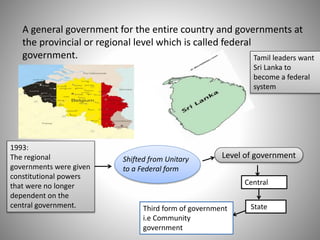
A general government for the entire country and governments at
the provincial or regional level which is called federal
government.
1993:
The regional
governments were given
constitutional powers
that were no longer
dependent on the
central government.
Shifted from Unitary
to a Federal form
Tamil leaders want
Sri Lanka to
become a federal
system
Level of government
Central
State
Third form of government
i.e Community
government
It is a system of government
in which the power is divided
between a central authority
and various constituent unit
of a country. Federalism has two level of
government
1. Government for the entire
country: responsible for a few
subjects of common national
interest.
2. Government at the level of
provinces or states : look after
day to day administering of their
state.
Both these levels of
government enjoy their
power independent of
the other.
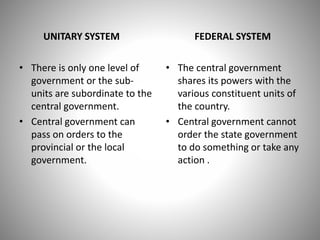
UNITARY SYSTEM
• There is only one level of
government or the sub-
units are subordinate to the
central government.
• Central government can
pass on orders to the
provincial or the local
government.
FEDERAL SYSTEM
• The central government
shares its powers with the
various constituent units of
the country.
• Central government cannot
order the state government
to do something or take any
action .
The Key Features of Federalism
Two or more levels of government.
Different levels of government govern the
same citizens, where each level has its own
jurisdiction in specific matters of legislation,
taxation and administration.
Existence and authority of each level of
government is constitutionally governed.
The fundamental provisions of the
Constitution cannot be unilaterally changed.
Such changes require the consent of both the
levels of government.
Courts have the power to interpret the
Constitution. The highest court acts as the
umpire if any dispute arises between different
levels of governments.
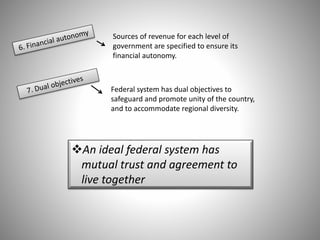
Sources of revenue for each level of
government are specified to ensure its
financial autonomy.
Federal system has dual objectives to
safeguard and promote unity of the country,
and to accommodate regional diversity.
An ideal federal system has
mutual trust and agreement to
live together
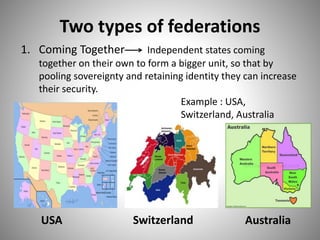
Two types of federations
1. Coming Together Independent states coming
together on their own to form a bigger unit, so that by
pooling sovereignty and retaining identity they can increase
their security.
Example : USA,
Switzerland, Australia
USA Switzerland Australia
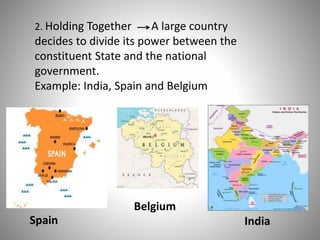
2. Holding Together A large country
decides to divide its power between the
constituent State and the national
government.
Example: India, Spain and Belgium
Spain
Belgium
India
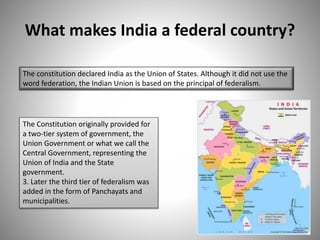
What makes India a federal country?
The Constitution originally provided for
a two-tier system of government, the
Union Government or what we call the
Central Government, representing the
Union of India and the State
government.
3. Later the third tier of federalism was
added in the form of Panchayats and
municipalities.
The constitution declared India as the Union of States. Although it did not use the
word federation, the Indian Union is based on the principal of federalism.
The Constitution contains three lists:
1. Union List : It includes areas of national importance like defence,
foreign affairs, currency, banking, and communications. The union
government holds the powers to make laws on the regions mentioned in
the union list.
2. State List : It includes areas of state-level and local importance like
agriculture, trade, commerce, irrigation, and police. The state
government alone has the power to make laws regarding the subjects on
this list.
3. Concurrent List : It includes subjects that are of common interest to
both the central and state governments. It includes trade unions, forest,
education, marriage, succession, and adoption. Both the centre and state
can make laws on these subjects. If there is a conflict, the laws made by
the centre will prevail.
The constitution clearly
provided a threefold
disttribution of legislative
powers
 Residuary Subjects :All those subjects which do not fall in in any of the list
and came up after the constitution was made.
For example: Computer Software
Only central government can make laws on them.
 Holding together: No equal power to its constituent units.
• All States in the Indian Union do not have identical powers.
• Some states enjoys special status.
 Concept of Union Territory:
• Units of the Indian Union which enjoy very little power.
• These are areas which are too small to become an independent state but
which could not be merged with any of the existing states.
• These territories do not have the powers of a state.
• The Central government has special powers in running these areas..
Example: Chandigarh, Lakshadweep and Delhi
 Power Sharing Arrangement:
• Power between the union government and the state government is basic
to the structure of the constitution.
• The parliament cannot on its own change this arrangement.
• If need any changes it has to be first passed by both the Houses of
Parliament with at least two-thirds majority.
• Then it has to be ratified by the legislatures of at least half of the total
states.
 Juditiary oversees the implementation of constitutional provisions
and procedures.
 The Union and the State gov.t power to raise resources by levying
taxes in order to carry on the government and the responsibilities
assigned to each of them.
How is federalism practiced?
• The real success of federalism in India can be attributed to
the nature of democratic politics.
• This ensured that the spirit of federalism, respect for
diversity and the desire for living together became a shared
ideal of India.
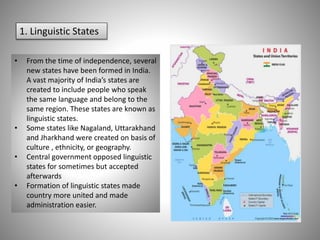
1. Linguistic States
• From the time of independence, several
new states have been formed in India.
A vast majority of India’s states are
created to include people who speak
the same language and belong to the
same region. These states are known as
linguistic states.
• Some states like Nagaland, Uttarakhand
and Jharkhand were created on basis of
culture , ethnicity, or geography.
• Central government opposed linguistic
states for sometimes but accepted
afterwards
• Formation of linguistic states made
country more united and made
administration easier.
2. Language Policy
• Constitution did not give the status of national language to any one language
• Hindi was identified as official language
• Besides Hindi, 21 languages are recognized by the constitutions as Scheduled
Languages.
• Though Hindi is recognized as the official language by the union government,
states have their official language.
• Candidates can give government exams in regional state languages
• Government works takes place in respective language
Hindi or English
• Leaders adopted a very cautious attitude in spreading the use of Hindi
• In 1965: use of English for official purpose was stopped by constitution.
• Many non Hindi speaking states demanded that the use of English continue.
• In Tamil Nadu, this movement took a violent form.
• The Central Government responded by agreeing to continue the use of English
along with Hindi for official purposes.
• The flexibility shown by Indian political leaders helped our country avoid the
kind of situation that Sri Lanka finds itself in.
3. Central –State relations
• Restructuring the Centre-State
relations is one more way in which
federalism has been strengthened
in practice.
• Before 1989 or Situation during
Congress monopoly: for major part
of the country, same party was in
power in both centre and state.
• As a result state governments were
not in position to enjoy their rights
as autonomous federal units.
• Constitution was misuse to dismiss
the state gov.t that were controlled
by rival parties.
• This undermined the spirit of
federalism.
• After 1989 pattern has shifted to
multi-party coalition government at
the centre.
• as a result a new culture of power
sharing and respect for the
autonomy of state government has
developed
• It can be said that now the
federalism is more developed in
India
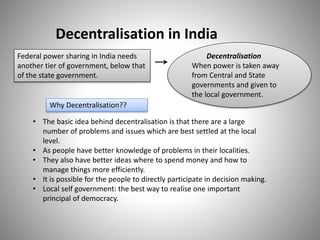
Decentralisation in India
Federal power sharing in India needs
another tier of government, below that
of the state government.
• The basic idea behind decentralisation is that there are a large
number of problems and issues which are best settled at the local
level.
• As people have better knowledge of problems in their localities.
• They also have better ideas where to spend money and how to
manage things more efficiently.
• It is possible for the people to directly participate in decision making.
• Local self government: the best way to realise one important
principal of democracy.
Decentralisation
When power is taken away
from Central and State
governments and given to
the local government.
Why Decentralisation??
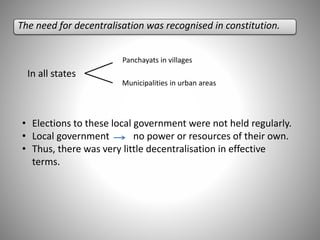
The need for decentralisation was recognised in constitution.
In all states
Panchayats in villages
Municipalities in urban areas
• Elections to these local government were not held regularly.
• Local government no power or resources of their own.
• Thus, there was very little decentralisation in effective
terms.
A major steps taken towards decentralisation in 1992
• Constitutional Amendment ( 73rd and 74th ) to make the third -tier of
democracy more powerful and effective.
• It is constitutionally mandatory to hold regular elections to local
government bodies.
• Seats are reserved in the elected bodies and the executive heads of these
institutions for the Scheduled Castes, Scheduled Tribes and Other
Backward Classes.
• At least one-third of all positions are reserved for women.
• An independent institution called the State Election Commission has been
created in each State to conduct panchayat and municipal elections.
• The State governments are required to share some powers and revenue
with local government bodies. The nature of sharing varies from State to
State.
Structure of the New Panchayat Raj institutions
• Each village or group of villages has a Gram Panchayat. Panch, President or
Sarpanch are directly elected by all the adult population of the village and is
the decision-making body.
• The Panchayat works under the supervision of Gram Sabha, with all the voters
as its members. The local structure goes up to the district level—a group of
Gram Panchayats form a Panchayat Samiti or Block or Mandal. All the
Panchayat Samitis or Mandals together constitute the Zilla Parishad which
consists of elected members.
• Lok Sabha members, Local MLAs and officers are also members of the Zilla
Parishad. Its Chairperson is the political head of the Parishad.
• Municipalities are set up in towns.
• Big cities are constituted into Municipal Corporations.
• Both are controlled by elected bodies consisting of people’s
representatives.
• Municipal chairperson is the political head of the Municipality.
• The head of Municipal Corporation is an officer called the Mayor.
This new system of local government is the largest
experiment in democracy conducted anywhere in the world.
Constitutional status for local government has helped to
deepen democracy in our country. It has also increased
women’s representation and voice in our democracy.
federalism-210924161907.pdf

federalism-210924161907.pdf

  • 1.
    FEDERALISM Class : 10 PoliticalScience, Chapter : 2 By Tsering Chokeyi Teacher
  • 2.
    A general governmentfor the entire country and governments at the provincial or regional level which is called federal government. 1993: The regional governments were given constitutional powers that were no longer dependent on the central government. Shifted from Unitary to a Federal form Tamil leaders want Sri Lanka to become a federal system Level of government Central State Third form of government i.e Community government
  • 3.
    It is asystem of government in which the power is divided between a central authority and various constituent unit of a country. Federalism has two level of government 1. Government for the entire country: responsible for a few subjects of common national interest. 2. Government at the level of provinces or states : look after day to day administering of their state. Both these levels of government enjoy their power independent of the other.
  • 4.
    UNITARY SYSTEM • Thereis only one level of government or the sub- units are subordinate to the central government. • Central government can pass on orders to the provincial or the local government. FEDERAL SYSTEM • The central government shares its powers with the various constituent units of the country. • Central government cannot order the state government to do something or take any action .
  • 5.
    The Key Featuresof Federalism Two or more levels of government. Different levels of government govern the same citizens, where each level has its own jurisdiction in specific matters of legislation, taxation and administration. Existence and authority of each level of government is constitutionally governed. The fundamental provisions of the Constitution cannot be unilaterally changed. Such changes require the consent of both the levels of government. Courts have the power to interpret the Constitution. The highest court acts as the umpire if any dispute arises between different levels of governments.
  • 6.
    Sources of revenuefor each level of government are specified to ensure its financial autonomy. Federal system has dual objectives to safeguard and promote unity of the country, and to accommodate regional diversity. An ideal federal system has mutual trust and agreement to live together
  • 7.
    Two types offederations 1. Coming Together Independent states coming together on their own to form a bigger unit, so that by pooling sovereignty and retaining identity they can increase their security. Example : USA, Switzerland, Australia USA Switzerland Australia
  • 8.
    2. Holding TogetherA large country decides to divide its power between the constituent State and the national government. Example: India, Spain and Belgium Spain Belgium India
  • 9.
    What makes Indiaa federal country? The Constitution originally provided for a two-tier system of government, the Union Government or what we call the Central Government, representing the Union of India and the State government. 3. Later the third tier of federalism was added in the form of Panchayats and municipalities. The constitution declared India as the Union of States. Although it did not use the word federation, the Indian Union is based on the principal of federalism.
  • 10.
    The Constitution containsthree lists: 1. Union List : It includes areas of national importance like defence, foreign affairs, currency, banking, and communications. The union government holds the powers to make laws on the regions mentioned in the union list. 2. State List : It includes areas of state-level and local importance like agriculture, trade, commerce, irrigation, and police. The state government alone has the power to make laws regarding the subjects on this list. 3. Concurrent List : It includes subjects that are of common interest to both the central and state governments. It includes trade unions, forest, education, marriage, succession, and adoption. Both the centre and state can make laws on these subjects. If there is a conflict, the laws made by the centre will prevail. The constitution clearly provided a threefold disttribution of legislative powers
  • 11.
     Residuary Subjects:All those subjects which do not fall in in any of the list and came up after the constitution was made. For example: Computer Software Only central government can make laws on them.  Holding together: No equal power to its constituent units. • All States in the Indian Union do not have identical powers. • Some states enjoys special status.  Concept of Union Territory: • Units of the Indian Union which enjoy very little power. • These are areas which are too small to become an independent state but which could not be merged with any of the existing states. • These territories do not have the powers of a state. • The Central government has special powers in running these areas.. Example: Chandigarh, Lakshadweep and Delhi
  • 12.
     Power SharingArrangement: • Power between the union government and the state government is basic to the structure of the constitution. • The parliament cannot on its own change this arrangement. • If need any changes it has to be first passed by both the Houses of Parliament with at least two-thirds majority. • Then it has to be ratified by the legislatures of at least half of the total states.  Juditiary oversees the implementation of constitutional provisions and procedures.  The Union and the State gov.t power to raise resources by levying taxes in order to carry on the government and the responsibilities assigned to each of them.
  • 13.
    How is federalismpracticed? • The real success of federalism in India can be attributed to the nature of democratic politics. • This ensured that the spirit of federalism, respect for diversity and the desire for living together became a shared ideal of India.
  • 14.
    1. Linguistic States •From the time of independence, several new states have been formed in India. A vast majority of India’s states are created to include people who speak the same language and belong to the same region. These states are known as linguistic states. • Some states like Nagaland, Uttarakhand and Jharkhand were created on basis of culture , ethnicity, or geography. • Central government opposed linguistic states for sometimes but accepted afterwards • Formation of linguistic states made country more united and made administration easier.
  • 15.
    2. Language Policy •Constitution did not give the status of national language to any one language • Hindi was identified as official language • Besides Hindi, 21 languages are recognized by the constitutions as Scheduled Languages. • Though Hindi is recognized as the official language by the union government, states have their official language. • Candidates can give government exams in regional state languages • Government works takes place in respective language Hindi or English • Leaders adopted a very cautious attitude in spreading the use of Hindi • In 1965: use of English for official purpose was stopped by constitution. • Many non Hindi speaking states demanded that the use of English continue. • In Tamil Nadu, this movement took a violent form. • The Central Government responded by agreeing to continue the use of English along with Hindi for official purposes. • The flexibility shown by Indian political leaders helped our country avoid the kind of situation that Sri Lanka finds itself in.
  • 16.
    3. Central –Staterelations • Restructuring the Centre-State relations is one more way in which federalism has been strengthened in practice. • Before 1989 or Situation during Congress monopoly: for major part of the country, same party was in power in both centre and state. • As a result state governments were not in position to enjoy their rights as autonomous federal units. • Constitution was misuse to dismiss the state gov.t that were controlled by rival parties. • This undermined the spirit of federalism. • After 1989 pattern has shifted to multi-party coalition government at the centre. • as a result a new culture of power sharing and respect for the autonomy of state government has developed • It can be said that now the federalism is more developed in India
  • 17.
    Decentralisation in India Federalpower sharing in India needs another tier of government, below that of the state government. • The basic idea behind decentralisation is that there are a large number of problems and issues which are best settled at the local level. • As people have better knowledge of problems in their localities. • They also have better ideas where to spend money and how to manage things more efficiently. • It is possible for the people to directly participate in decision making. • Local self government: the best way to realise one important principal of democracy. Decentralisation When power is taken away from Central and State governments and given to the local government. Why Decentralisation??
  • 18.
    The need fordecentralisation was recognised in constitution. In all states Panchayats in villages Municipalities in urban areas • Elections to these local government were not held regularly. • Local government no power or resources of their own. • Thus, there was very little decentralisation in effective terms.
  • 19.
    A major stepstaken towards decentralisation in 1992 • Constitutional Amendment ( 73rd and 74th ) to make the third -tier of democracy more powerful and effective. • It is constitutionally mandatory to hold regular elections to local government bodies. • Seats are reserved in the elected bodies and the executive heads of these institutions for the Scheduled Castes, Scheduled Tribes and Other Backward Classes. • At least one-third of all positions are reserved for women. • An independent institution called the State Election Commission has been created in each State to conduct panchayat and municipal elections. • The State governments are required to share some powers and revenue with local government bodies. The nature of sharing varies from State to State.
  • 20.
    Structure of theNew Panchayat Raj institutions • Each village or group of villages has a Gram Panchayat. Panch, President or Sarpanch are directly elected by all the adult population of the village and is the decision-making body. • The Panchayat works under the supervision of Gram Sabha, with all the voters as its members. The local structure goes up to the district level—a group of Gram Panchayats form a Panchayat Samiti or Block or Mandal. All the Panchayat Samitis or Mandals together constitute the Zilla Parishad which consists of elected members. • Lok Sabha members, Local MLAs and officers are also members of the Zilla Parishad. Its Chairperson is the political head of the Parishad.
  • 21.
    • Municipalities areset up in towns. • Big cities are constituted into Municipal Corporations. • Both are controlled by elected bodies consisting of people’s representatives. • Municipal chairperson is the political head of the Municipality. • The head of Municipal Corporation is an officer called the Mayor. This new system of local government is the largest experiment in democracy conducted anywhere in the world. Constitutional status for local government has helped to deepen democracy in our country. It has also increased women’s representation and voice in our democracy.