F
e
d
e
r
a
l
i
s
m
13
Chapter
2
Federalism
Overview
In the previous chapter, we noted that vertical division of power among
different levels of government is one of the major forms of power-sharing
in modern democracies. In this chapter, we focus on this form of power-
sharing. It is most commonly referred to as federalism. We begin by
describing federalism in general terms. The rest of the chapter tries to
understand the theory and practice of federalism in India. A discussion
of the federal constitutional provisions is followed by an analysis of the
policies and politics that has strengthened federalism in practice. Towards
the end of the chapter, we turn to the local government, a new and third
tier of Indian federalism.
Chapter 2.indd 13 08-04-2022 12:30:48
Rationalised 2023-24
14
D
e
m
o
c
r
a
t
i
c
P
o
l
i
t
i
c
s
What is federalism?
I am confused.
What do we
call the Indian
government? Is it
Union, Federal or
Central?
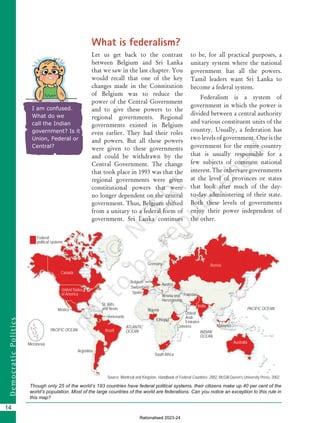
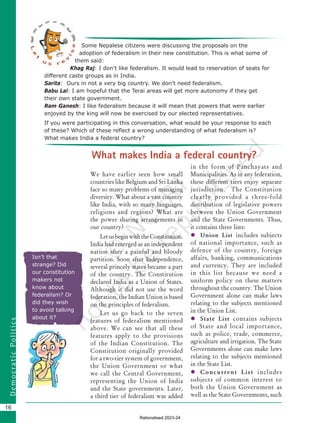
Though only 25 of the world’s 193 countries have federal political systems, their citizens make up 40 per cent of the
world’s population. Most of the large countries of the world are federations. Can you notice an exception to this rule in
this map?
Source: Montreal and Kingston, Handbook of Federal Countries: 2002, McGill-Queen’s University Press, 2002.
Federal
political systems
Canada
United States
of America
Mexico
Pacific Ocean
Micronesia
Argentina
Venezuela
Atlantic
Ocean
Brazil
St. Kitts
and Nevis
Belgium
Switzerland
Spain
Nigeria
Ethiopia
Comoros
Bosnia and
Herzegovina
Austria
Pakistan
Russia
India
Malaysia
Australia
Indian
Ocean
South Africa
Pacific Ocean
United
Arab
Emirates
Germany
Let us get back to the contrast
between Belgium and Sri Lanka
that we saw in the last chapter. You
would recall that one of the key
changes made in the Constitution
of Belgium was to reduce the
power of the Central Government
and to give these powers to the
regional governments. Regional
governments existed in Belgium
even earlier. They had their roles
and powers. But all these powers
were given to these governments
and could be withdrawn by the
Central Government. The change
that took place in 1993 was that the
regional governments were given
constitutional powers that were
no longer dependent on the central
government. Thus, Belgium shifted
from a unitary to a federal form of
government. Sri Lanka continues
to be, for all practical purposes, a
unitary system where the national
government has all the powers.
Tamil leaders want Sri Lanka to
become a federal system.
Federalism is a system of
government in which the power is
divided between a central authority
and various constituent units of the
country. Usually, a federation has
two levels of government. One is the
government for the entire country
that is usually responsible for a
few subjects of common national
interest.The othersaregovernments
at the level of provinces or states
that look after much of the day-
to-day administering of their state.
Both these levels of governments
enjoy their power independent of
the other.
Chapter 2.indd 14 08-04-2022 12:30:50
Rationalised 2023-24
F
e
d
e
r
a
l
i
s
m
15
7 The federal system thus has dual
objectives: to safeguard and promote
unity of the country, while at the
same time accommodate regional
diversity. Therefore, two aspects
are crucial for the institutions and
practice of federalism. Governments
at different levels should agree to
some rules of power-sharing. They
should also trust that each would
abide by its part of the agreement.
An ideal federal system has both
aspects : mutual trust and agreement
to live together.
The exact balance of power
between the central and the state
government varies from one
federation to another. This balance
depends mainly on the historical
context in which the federation was
formed.Therearetwokindsofroutes
through which federations have been
formed. The first route involves
independent States coming together
on their own to form a bigger unit,
so that by pooling sovereignty and
retaining identity, they can increase
their security. This type of ‘coming
together’ federations include the
USA, Switzerland and Australia. In
this first category of federations, all
the constituent States usually have
equal power and are strong vis-à-vis
the federal government.
The second route is where a
large country decides to divide its
power between the constituent
States and the national government.
India, Spain and Belgium are
examples of this kind of ‘holding
together’ federations. In this second
category, the Central Government
tends to be more powerful vis-à-
vis the States. Very often different
constituent units of the federation
have unequal powers. Some units
are granted special powers.
If federalism
works only in
big countries,
why did Belgium
adopt it?
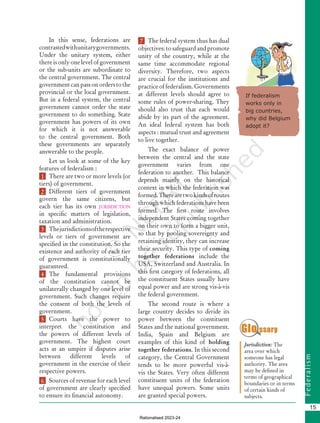
Jurisdiction: The
area over which
someone has legal
authority. The area
may be defined in
terms of geographical
boundaries or in terms
of certain kinds of
subjects.
In this sense, federations are
contrastedwithunitarygovernments.
Under the unitary system, either
there is only one level of government
or the sub-units are subordinate to
the central government. The central
government can pass on orders to the
provincial or the local government.
But in a federal system, the central
government cannot order the state
government to do something. State
government has powers of its own
for which it is not answerable
to the central government. Both
these governments are separately
answerable to the people.
Let us look at some of the key
features of federalism :
1 There are two or more levels (or
tiers) of government.
2 Different tiers of government
govern the same citizens, but
each tier has its own jurisdiction
in specific matters of legislation,
taxation and administration.
3 Thejurisdictionsoftherespective
levels or tiers of government are
specified in the constitution. So the
existence and authority of each tier
of government is constitutionally
guaranteed.
4 The fundamental provisions
of the constitution cannot be
unilaterally changed by one level of
government. Such changes require
the consent of both the levels of
government.
5 Courts have the power to
interpret the constitution and
the powers of different levels of
government. The highest court
acts as an umpire if disputes arise
between different levels of
government in the exercise of their
respective powers.
6 Sources of revenue for each level
of government are clearly specified
to ensure its financial autonomy.
Chapter 2.indd 15 08-04-2022 12:30:50
Rationalised 2023-24
16
D
e
m
o
c
r
a
t
i
c
P
o
l
i
t
i
c
s
Isn’t that
strange? Did
our constitution
makers not
know about
federalism? Or
did they wish
to avoid talking
about it?
Some Nepalese citizens were discussing the proposals on the
adoption of federalism in their new constitution. This is what some of
them said:
Khag Raj: I don’t like federalism. It would lead to reservation of seats for
different caste groups as in India.
Sarita: Ours in not a very big country. We don’t need federalism.
Babu Lal: I am hopeful that the Terai areas will get more autonomy if they get
their own state government.
Ram Ganesh: I like federalism because it will mean that powers that were earlier
enjoyed by the king will now be exercised by our elected representatives.
If you were participating in this conversation, what would be your response to each
of these? Which of these reflect a wrong understanding of what federalism is?
What makes India a federal country?
We have earlier seen how small
countries like Belgium and Sri Lanka
face so many problems of managing
diversity. What about a vast country
like India, with so many languages,
religions and regions? What are
the power sharing arrangements in
our country?
LetusbeginwiththeConstitution.
India had emerged as an independent
nation after a painful and bloody
partition. Soon after Independence,
several princely states became a part
of the country. The Constitution
declared India as a Union of States.
Although it did not use the word
federation, the Indian Union is based
on the principles of federalism.
Let us go back to the seven
features of federalism mentioned
above. We can see that all these
features apply to the provisions
of the Indian Constitution. The
Constitution originally provided
for a two-tier system of government,
the Union Government or what
we call the Central Government,
representing the Union of India
and the State governments. Later,
a third tier of federalism was added
in the form of Panchayats and
Municipalities. As in any federation,
these different tiers enjoy separate
jurisdiction. The Constitution
clearly provided a three-fold
distribution of legislative powers
between the Union Government
and the State Governments. Thus,
it contains three lists:
 Union List includes subjects
of national importance, such as
defence of the country, foreign
affairs, banking, communications
and currency. They are included
in this list because we need a
uniform policy on these matters
throughout the country. The Union
Government alone can make laws
relating to the subjects mentioned
in the Union List.
 State List contains subjects
of State and local importance,
such as police, trade, commerce,
agriculture and irrigation. The State
Governments alone can make laws
relating to the subjects mentioned
in the State List.
 Concurrent List includes
subjects of common interest to
both the Union Government as
well as the State Governments, such
What makes India a federal country?
Chapter 2.indd 16 08-04-2022 12:30:52
Rationalised 2023-24
F
e
d
e
r
a
l
i
s
m
17
as education, forest, trade unions,
marriage, adoption and succession.
Both the Union as well as the State
Governments can make laws on
the subjects mentioned in this list.
If their laws conflict with each
other, the law made by the Union
Government will prevail.
What about subjects that do not
fallinanyofthethreelists?Orsubjects
like computer software that came up
after the constitution was made?
According to our constitution, the
Union Government has the power to
legislate on these ‘residuary’ subjects.
We noted above that most
federations that are formed by
‘holding together’ do not give equal
power to its constituent units. Thus,
all States in the Indian Union do not
have identical powers. Some States
enjoy a special status. States such
as Assam, Nagaland, Arunachal
Pradesh and Mizoram enjoy special
powers under certain provisions of
the Constitution of India (Article
371) due to their peculiar social
and historical circumstances. These
special powers are especially enjoyed
in relation to the protection of
land rights of indigenous peoples,
their culture and also preferential
employment in government services.
Indians who are not permanent
residents of this State cannot buy
land or house here. Similar special
provisions exist for some other States
of India as well.
Listen to one national and one regional news bulletin broadcast by All India
Radio daily for one week. Make a list of news items related to government
policies or decisions by classifying these into the following categories:
 News items that relate only to the Central Government,
 News items that relate only to your or any other State Government,
 News items about the relationship between the Central and State Governments.
There are some units of the
Indian Union which enjoy very little
power. These are areas which are
too small to become an independent
State but which could not be merged
with any of the existing States.
These areas, like Chandigarh, or
Lakshadweep or the capital city of
Delhi, are called Union Territories.
These territories do not have the
powers of a State. The Central
Government has special powers in
running these areas.
This sharing of power between
the Union Government and the State
Governments is basic to the structure
of the Constitution. It is not easy to
make changes to this power sharing
arrangement. The Parliament cannot
on its own change this arrangement.
Any change to it has to be first passed
by both the Houses of Parliament
with at least two-thirds majority.
Then it has to be ratified by the
legislatures of at least half of the
total States.
The judiciary plays an important
roleinoverseeingtheimplementation
of constitutional provisions and
procedures. In case of any dispute
about the division of powers, the
High Courts and the Supreme Court
make a decision. The Union and
State Governments have the power
to raise resources by levying taxes in
order to carry on the government
and the responsibilities assigned to
each of them.
If agriculture and
commerce are
state subjects,
why do we have
ministers of
agriculture and
commerce in the
Union cabinet?
Chapter 2.indd 17 08-04-2022 12:30:53
Rationalised 2023-24
18
D
e
m
o
c
r
a
t
i
c
P
o
l
i
t
i
c
s
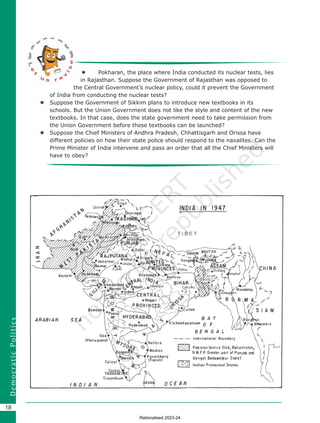
 Pokharan, the place where India conducted its nuclear tests, lies
in Rajasthan. Suppose the Government of Rajasthan was opposed to
the Central Government’s nuclear policy, could it prevent the Government
of India from conducting the nuclear tests?
 Suppose the Government of Sikkim plans to introduce new textbooks in its
schools. But the Union Government does not like the style and content of the new
textbooks. In that case, does the state government need to take permission from
the Union Government before these textbooks can be launched?
 Suppose the Chief Ministers of Andhra Pradesh, Chhattisgarh and Orissa have
different policies on how their state police should respond to the naxalites. Can the
Prime Minister of India intervene and pass an order that all the Chief Ministers will
have to obey?
Chapter 2.indd 18 08-04-2022 12:30:55
Rationalised 2023-24
F
e
d
e
r
a
l
i
s
m
19
Constitutional provisions are
necessary for the success of federalism
but these are not sufficient. If the
federal experiment has succeeded
in India, it is not merely because of
the clearly laid out constitutional
provisions. The real success of
federalism in India can be attributed
to the nature of democratic politics
in our country. This ensured that
the spirit of federalism, respect
for diversity and desire for living
together became shared ideals in our
country. Let us look at some of the
major ways in which this happened.
Linguistic States
The creation of linguistic States
was the first and a major test for
democratic politics in our country.
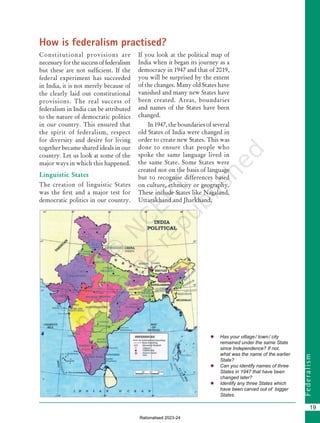
If you look at the political map of
India when it began its journey as a
democracy in 1947 and that of 2019,
you will be surprised by the extent
of the changes. Many old States have
vanished and many new States have
been created. Areas, boundaries
and names of the States have been
changed.
In 1947, the boundaries of several
old States of India were changed in
order to create new States. This was
done to ensure that people who
spoke the same language lived in
the same State. Some States were
created not on the basis of language
but to recognise differences based
on culture, ethnicity or geography.
These include States like Nagaland,
Uttarakhand and Jharkhand.
 Has your village/ town/ city
remained under the same State
since Independence? If not,
what was the name of the earlier
State?
 Can you identify names of three
States in 1947 that have been
changed later?
 Identify any three States which
have been carved out of bigger
States.
How is federalism practised?
Chapter 2.indd 19 08-04-2022 12:31:02
Rationalised 2023-24
20
D
e
m
o
c
r
a
t
i
c
P
o
l
i
t
i
c
s
When the demand for the
formation of States on the basis of
language was raised, some national
leaders feared that it would lead to
the disintegration of the country.
The Central Government resisted
linguistic States for some time.
But the experience has shown that
the formation of linguistic States
has actually made the country
more united. It has also made
administration easier.
Language policy
A second test for Indian federation is
thelanguagepolicy.OurConstitution
did not give the status of national
language to any one language. Hindi
was identified as the official language.
But Hindi is the mother tongue of
only about 40 per cent of Indians.
Therefore,thereweremanysafeguards
to protect other languages. Besides
Hindi, there are 21 other languages
recognised as Scheduled Languages
by the Constitution. A candidate in
an examination conducted for the
Central Government positions may
opt to take the examination in any
of these languages. States too have
their own official languages. Much
of the government work takes
place in the official language of the
concerned State.
Unlike Sri Lanka, the leaders
of our country adopted a very
cautious attitude in spreading the
use of Hindi. According to the
Constitution, the use of English
for official purposes was to stop in
1965. However, many non-Hindi
speaking States demanded that the
use of English continue. In Tamil
Nadu, this movement took a violent
form. The Central Government
responded by agreeing to continue
the use of English along with Hindi
for official purposes. Many critics
think that this solution favoured the
English-speaking elite. Promotion
of Hindi continues to be the official
policy of the Government of India.
Promotion does not mean that the
Central Government can impose
Hindi on States where people speak
a different language. The flexibility
shown by Indian political leaders
helped our country avoid the kind of
situation that Sri Lanka finds itself in.
Centre-State relations
Restructuring the Centre-State
relations is one more way in which
federalism has been strengthened
in practice. How the constitutional
arrangements for sharing power
work in reality depends to a large
extent on how the ruling parties and
leaders follow these arrangements.
For a long time, the same party
ruled both at the Centre and in most
of the States. This meant that the
State Governments did not exercise
their rights as autonomous federal
units. As and when the ruling party
at the State level was different, the
parties that ruled at the Centre tried
to undermine the power of the
States. In those days, the Central
Government would often misuse
the Constitution to dismiss the State
Governments that were controlled
by rival parties. This undermined
the spirit of federalism.
All this changed significantly
after 1990. This period saw the
rise of regional political parties in
many States of the country. This
was also the beginning of the era
of coalition governments at the
Centre. Since no single party got a
clear majority in the Lok Sabha, the
major national parties had to enter
into an alliance with many parties
including several regional parties to
form a government at the Centre.
Coalition government:
A government formed
by the coming together
of at least two political
parties. Usually
partners in a coalition
form a political alliance
and adopt a common
programme.
Why Hindi?
Why not
Bangla or
Telugu?
Chapter 2.indd 20 08-04-2022 12:31:03
Rationalised 2023-24
F
e
d
e
r
a
l
i
s
m
21
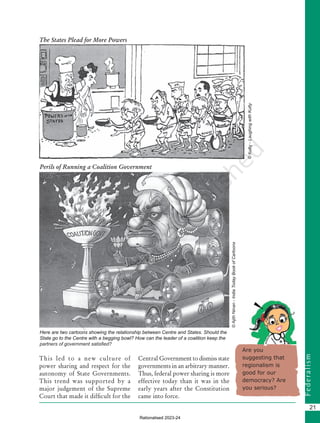
Here are two cartoons showing the relationship between Centre and States. Should the
State go to the Centre with a begging bowl? How can the leader of a coalition keep the
partners of government satisfied?
Are you
suggesting that
regionalism is
good for our
democracy? Are
you serious?
The States Plead for More Powers
©
Kutty
-
Laughing
with
Kutty
©
Ajith
Ninan
-
India
Today
Book
of
Cartoons
Perils of Running a Coalition Government
This led to a new culture of
power sharing and respect for the
autonomy of State Governments.
This trend was supported by a
major judgement of the Supreme
Court that made it difficult for the
Central Government to dismiss state
governments in an arbitrary manner.
Thus, federal power sharing is more
effective today than it was in the
early years after the Constitution
came into force.
Chapter 2.indd 21 08-04-2022 12:31:05
Rationalised 2023-24
22
D
e
m
o
c
r
a
t
i
c
P
o
l
i
t
i
c
s
Linguistic diversity of India
How many languages do we have
in India? The answer depends
on how one counts it. The latest
information that we have is from
the Census of India held in 2011.
This census recorded more than
1300 distinct languages which
people mentioned as their mother
tongues. These languages were
grouped together under some
major languages. For example,
languages like Bhojpuri, Magadhi,
Bundelkhandi, Chhattisgarhi,
Rajasthani and many others were
grouped together under ‘Hindi’.
Even after this grouping,
the Census found 121 major
languages. Of these, 22
languages are now included in
the Eighth Schedule of the Indian
Constitution and are therefore
called ‘Scheduled Languages’.
Others are called
‘non-Scheduled Languages’. In
terms of languages, India is
perhaps the most diverse country
in the world.
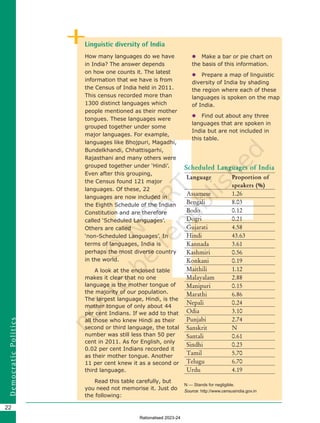
A look at the enclosed table
makes it clear that no one
language is the mother tongue of
the majority of our population.
The largest language, Hindi, is the
mother tongue of only about 44
per cent Indians. If we add to that
all those who knew Hindi as their
second or third language, the total
number was still less than 50 per
cent in 2011. As for English, only
0.02 per cent Indians recorded it
as their mother tongue. Another
11 per cent knew it as a second or
third language.
Read this table carefully, but
you need not memorise it. Just do
the following:
 Make a bar or pie chart on
the basis of this information.
 Prepare a map of linguistic
diversity of India by shading
the region where each of these
languages is spoken on the map
of India.
 Find out about any three
languages that are spoken in
India but are not included in
this table.
Scheduled Languages of India
Language Proportion of
speakers (%)
Assamese 1.26
Bengali 8.03
Bodo 0.12
Dogri 0.21
Gujarati 4.58
Hindi 43.63
Kannada 3.61
Kashmiri 0.56
Konkani 0.19
Maithili 1.12
Malayalam 2.88
Manipuri 0.15
Marathi 6.86
Nepali 0.24
Odia 3.10
Punjabi 2.74
Sanskrit N
Santali 0.61
Sindhi 0.23
Tamil 5.70
Telugu 6.70
Urdu 4.19
N — Stands for negligible.
Source: http://www.censusindia.gov.in
+
Chapter 2.indd 22 08-04-2022 12:31:05
Rationalised 2023-24
F
e
d
e
r
a
l
i
s
m
23
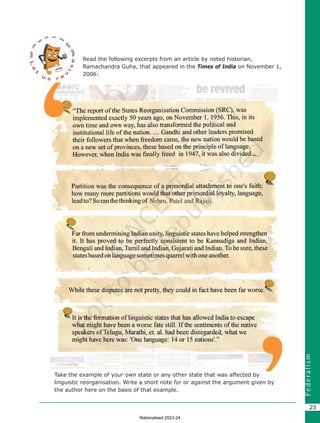
Read the following excerpts from an article by noted historian,
Ramachandra Guha, that appeared in the Times of India on November 1,
2006:
Take the example of your own state or any other state that was affected by
linguistic reorganisation. Write a short note for or against the argument given by
the author here on the basis of that example.
‘ ‘
Chapter 2.indd 23 08-04-2022 12:31:16
Rationalised 2023-24
24
D
e
m
o
c
r
a
t
i
c
P
o
l
i
t
i
c
s
We noted above that federal
governments have two or more
tiers of governments. We have
so far discussed the two-tiers of
government in our country. But
a vast country like India cannot
be run only through these
two-tiers. States in India are as large as
independent countries of Europe. In
terms of population, Uttar Pradesh
is bigger than Russia, Maharashtra
is about as big as Germany. Many
of these States are internally very
diverse. There is thus a need for
power sharing within these States.
Federal power sharing in India needs
another tier of government, below
that of the State governments. This
is the rationale for decentralisation
of power. Thus, resulted a third-
tier of government, called local
government.
When power is taken away from
Central and State governments and
given to local government, it is called
decentralisation.Thebasicideabehind
decentralisationisthattherearealarge
number of problems and issues which
arebestsettledatthelocallevel.People
have better knowledge of problems
in their localities. They also have
better ideas on where to spend money
and how to manage things more
efficiently. Besides, at the local level
it is possible for the people to directly
participate in decision making. This
helpstoinculcateahabitofdemocratic
participation.Localgovernmentisthe
best way to realise one important
principle of democracy, namely local
self-government.
The need for decentralisation
was recognised in our Constitution.
Since then, there have been
several attempts to decentralise
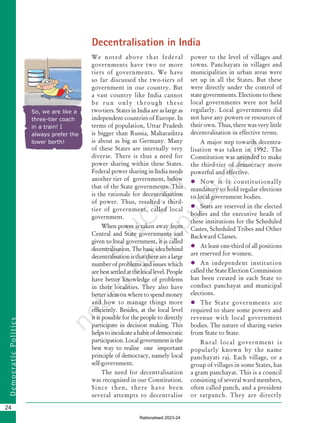
So, we are like a
three-tier coach
in a train! I
always prefer the
lower berth!
power to the level of villages and
towns. Panchayats in villages and
municipalities in urban areas were
set up in all the States. But these
were directly under the control of
state governments. Elections to these
local governments were not held
regularly. Local governments did
not have any powers or resources of
their own. Thus, there was very little
decentralisation in effective terms.
A major step towards decentra-
lisation was taken in 1992. The
Constitution was amended to make
the third-tier of democracy more
powerful and effective.
 Now it is constitutionally
mandatory to hold regular elections
to local government bodies.
 Seats are reserved in the elected
bodies and the executive heads of
these institutions for the Scheduled
Castes, Scheduled Tribes and Other
Backward Classes.
 At least one-third of all positions
are reserved for women.
 An independent institution
called the State Election Commission
has been created in each State to
conduct panchayat and municipal
elections.
 The State governments are
required to share some powers and
revenue with local government
bodies. The nature of sharing varies
from State to State.
Rural local government is
popularly known by the name
panchayati raj. Each village, or a
group of villages in some States, has
a gram panchayat. This is a council
consisting of several ward members,
often called panch, and a president
or sarpanch. They are directly
Decentralisation in India
Chapter 2.indd 24 08-04-2022 12:31:16
Rationalised 2023-24
F
e
d
e
r
a
l
i
s
m
25
elected by all the adult population
living in that ward or village. It is
the decision-making body for the
entire village. The panchayat works
under the overall supervision of the
gram sabha. All the voters in the
village are its members. It has to
meet at least twice or thrice in a year
to approve the annual budget of the
gram panchayat and to review the
performance of the gram panchayat.
The local government structure
goes right up to the district level. A
few gram panchayats are grouped
together to form what is usually
called a panchayat samiti or block
or mandal. The members of this
representative body are elected by all
the panchyat members in that area.
All the panchayat samitis or mandals
in a district together constitute
the zilla (district) parishad. Most
members of the zilla parishad are
elected. Members of the Lok Sabha
and MLAs of that district and some
other officials of other district level
bodies are also its members. Zilla
parishad chairperson is the political
head of the zilla parishad.
Similarly, local government
bodies exist for urban areas as
well. Municipalities are set up in
towns. Big cities are constituted
into municipal corporations. Both
municipalities and municipal
corporations are controlled
by elected bodies consisting of
people’s representatives. Municipal
chairperson is the political head of
the municipality. In a municipal
corporation, such an officer is called
the mayor.
Prime Minister
runs the country.
Chief Minister
runs the state.
Logically, then, the
chairperson of Zilla
Parishad should
run the district.
Why does the
D.M. or Collector
administer the
district?
What do these newspaper clippings have to say about efforts of decentralisation in India?
Chapter 2.indd 25 08-04-2022 12:31:18
Rationalised 2023-24
26
D
e
m
o
c
r
a
t
i
c
P
o
l
i
t
i
c
s
This new system of local
government is the largest experiment
in democracy conducted anywhere
in the world. There are now about
36 lakh elected representatives in
the panchayats and municipalities
etc., all over the country. This
number is bigger than the population
of many countries in the world.
Constitutional status for local
government has helped to deepen
democracy in our country. It has also
increased women’s representation
and voice in our democracy. At
the same time, there are many
difficulties. While elections are
held regularly and enthusiastically,
gram sabhas are not held regularly.
Most state governments have not
transferred significant powers to the
local governments. Nor have they
given adequate resources. We are
thus still a long way from realising
the ideal of self-government.
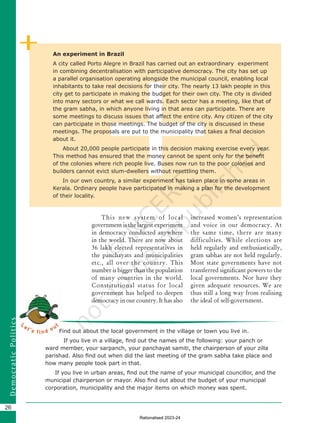
Find out about the local government in the village or town you live in.
If you live in a village, find out the names of the following: your panch or
ward member, your sarpanch, your panchayat samiti, the chairperson of your zilla
parishad. Also find out when did the last meeting of the gram sabha take place and
how many people took part in that.
If you live in urban areas, find out the name of your municipal councillor, and the
municipal chairperson or mayor. Also find out about the budget of your municipal
corporation, municipality and the major items on which money was spent.
+ An experiment in Brazil
A city called Porto Alegre in Brazil has carried out an extraordinary experiment
in combining decentralisation with participative democracy. The city has set up
a parallel organisation operating alongside the municipal council, enabling local
inhabitants to take real decisions for their city. The nearly 13 lakh people in this
city get to participate in making the budget for their own city. The city is divided
into many sectors or what we call wards. Each sector has a meeting, like that of
the gram sabha, in which anyone living in that area can participate. There are
some meetings to discuss issues that affect the entire city. Any citizen of the city
can participate in those meetings. The budget of the city is discussed in these
meetings. The proposals are put to the municipality that takes a final decision
about it.
About 20,000 people participate in this decision making exercise every year.
This method has ensured that the money cannot be spent only for the benefit
of the colonies where rich people live. Buses now run to the poor colonies and
builders cannot evict slum-dwellers without resettling them.
In our own country, a similar experiment has taken place in some areas in
Kerala. Ordinary people have participated in making a plan for the development
of their locality.
Chapter 2.indd 26 08-04-2022 12:31:19
Rationalised 2023-24
F
e
d
e
r
a
l
i
s
m
27
Exercises
1. Locate the following States on a blank outline political map of India:
Manipur, Sikkim, Chhattisgarh and Goa.
2. Identify and shade three federal countries (other than India) on a
blank outline political map of the world.
3. Point out one feature in the practice of federalism in India that is
similar to and one feature that is different from that of Belgium.
4. What is the main difference between a federal form of government
and a unitary one? Explain with an example.
5. State any two differences between the local government before and
after the Constitutional amendment in 1992.
6. Fill in the blanks:
Since the United States is a ­­­­­­­­­­­­­­­­­­­­___________________ type of
federation, all the constituent States have equal powers and States
are ______________vis-à-vis the federal government. But India is a
_____________________ type of federation and some States have
more power than others. In India, the ____________ government
has more powers.
7. Here are three reactions to the language policy followed in India.
Give an argument and an example to support any of these positions.
		
Sangeeta: The policy of accommodation has strengthened
national unity.
		
Arman: Language-based States have divided us by making
everyone conscious of their language.
		
Harish: This policy has only helped to consolidate the
dominance of English over all other languages.
8. The distinguishing feature of a federal government is:
(a) National government gives some powers to the provincial
governments.
(b) Power is distributed among the legislature, executive and
judiciary.
(c) Elected officials exercise supreme power in the government.
(d) Governmental power is divided between different levels of
government.
9. A few subjects in various Lists of the Indian Constitution are given
here. Group them under the Union, State and Concurrent Lists as
provided in the table below.
A. Defence; B. Police; C. Agriculture; D. Education;
E. Banking; F. Forests; G. Communications; H. Trade; I. Marriages
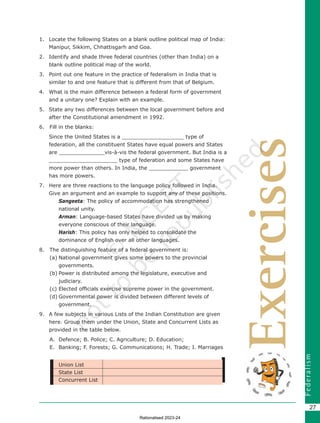
Union List
State List
Concurrent List
Chapter 2.indd 27 08-04-2022 12:31:20
Rationalised 2023-24
28
D
e
m
o
c
r
a
t
i
c
P
o
l
i
t
i
c
s
1 2 3 4
(a) D A B C
(b) B C D A
(c) A C D B
(d) C D A B
Exercises
10. Examine the following pairs that give the level of government in India
and the powers of the government at that level to make laws on the
subjects mentioned against each. Which of the following pairs is not
correctly matched?
11. Match List I with List II and select the correct answer using 		
the codes given below the lists:
List I List II
1. Union of India A. Prime Minister
2. State B. Sarpanch
3. Municipal Corporation C. Governor
4. Gram Panchayat D. Mayor
12. Consider the following two statements.
A. In a federation, the powers of the federal and provincial
governments are clearly demarcated.
B. India is a federation because the powers of the Union and State
Governments are specified in the Constitution and they have
exclusive jurisdiction on their respective subjects.
C. Sri Lanka is a federation because the country is divided into
provinces.
D. India is no longer a federation because some powers of the States
have been devolved to the local government bodies.
Which of the statements given above are correct?
(a) A, B and C (b) A, C and D (c) A and B only (d) B and C only
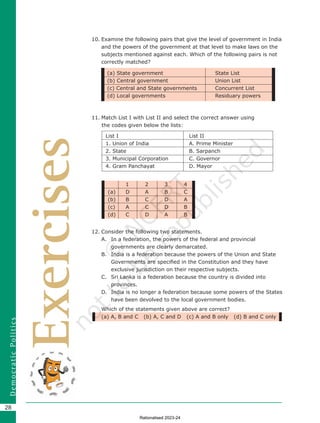
(a) State government State List
(b) Central government Union List
(c) Central and State governments Concurrent List
(d) Local governments Residuary powers
Chapter 2.indd 28 08-04-2022 12:31:21
Rationalised 2023-24

Federalism CBSE class 10. Simplified Critical Points

  • 1.
    F e d e r a l i s m 13 Chapter 2 Federalism Overview In the previouschapter, we noted that vertical division of power among different levels of government is one of the major forms of power-sharing in modern democracies. In this chapter, we focus on this form of power- sharing. It is most commonly referred to as federalism. We begin by describing federalism in general terms. The rest of the chapter tries to understand the theory and practice of federalism in India. A discussion of the federal constitutional provisions is followed by an analysis of the policies and politics that has strengthened federalism in practice. Towards the end of the chapter, we turn to the local government, a new and third tier of Indian federalism. Chapter 2.indd 13 08-04-2022 12:30:48 Rationalised 2023-24
  • 2.
    14 D e m o c r a t i c P o l i t i c s What is federalism? Iam confused. What do we call the Indian government? Is it Union, Federal or Central? Though only 25 of the world’s 193 countries have federal political systems, their citizens make up 40 per cent of the world’s population. Most of the large countries of the world are federations. Can you notice an exception to this rule in this map? Source: Montreal and Kingston, Handbook of Federal Countries: 2002, McGill-Queen’s University Press, 2002. Federal political systems Canada United States of America Mexico Pacific Ocean Micronesia Argentina Venezuela Atlantic Ocean Brazil St. Kitts and Nevis Belgium Switzerland Spain Nigeria Ethiopia Comoros Bosnia and Herzegovina Austria Pakistan Russia India Malaysia Australia Indian Ocean South Africa Pacific Ocean United Arab Emirates Germany Let us get back to the contrast between Belgium and Sri Lanka that we saw in the last chapter. You would recall that one of the key changes made in the Constitution of Belgium was to reduce the power of the Central Government and to give these powers to the regional governments. Regional governments existed in Belgium even earlier. They had their roles and powers. But all these powers were given to these governments and could be withdrawn by the Central Government. The change that took place in 1993 was that the regional governments were given constitutional powers that were no longer dependent on the central government. Thus, Belgium shifted from a unitary to a federal form of government. Sri Lanka continues to be, for all practical purposes, a unitary system where the national government has all the powers. Tamil leaders want Sri Lanka to become a federal system. Federalism is a system of government in which the power is divided between a central authority and various constituent units of the country. Usually, a federation has two levels of government. One is the government for the entire country that is usually responsible for a few subjects of common national interest.The othersaregovernments at the level of provinces or states that look after much of the day- to-day administering of their state. Both these levels of governments enjoy their power independent of the other. Chapter 2.indd 14 08-04-2022 12:30:50 Rationalised 2023-24
  • 3.
    F e d e r a l i s m 15 7 The federalsystem thus has dual objectives: to safeguard and promote unity of the country, while at the same time accommodate regional diversity. Therefore, two aspects are crucial for the institutions and practice of federalism. Governments at different levels should agree to some rules of power-sharing. They should also trust that each would abide by its part of the agreement. An ideal federal system has both aspects : mutual trust and agreement to live together. The exact balance of power between the central and the state government varies from one federation to another. This balance depends mainly on the historical context in which the federation was formed.Therearetwokindsofroutes through which federations have been formed. The first route involves independent States coming together on their own to form a bigger unit, so that by pooling sovereignty and retaining identity, they can increase their security. This type of ‘coming together’ federations include the USA, Switzerland and Australia. In this first category of federations, all the constituent States usually have equal power and are strong vis-à-vis the federal government. The second route is where a large country decides to divide its power between the constituent States and the national government. India, Spain and Belgium are examples of this kind of ‘holding together’ federations. In this second category, the Central Government tends to be more powerful vis-à- vis the States. Very often different constituent units of the federation have unequal powers. Some units are granted special powers. If federalism works only in big countries, why did Belgium adopt it? Jurisdiction: The area over which someone has legal authority. The area may be defined in terms of geographical boundaries or in terms of certain kinds of subjects. In this sense, federations are contrastedwithunitarygovernments. Under the unitary system, either there is only one level of government or the sub-units are subordinate to the central government. The central government can pass on orders to the provincial or the local government. But in a federal system, the central government cannot order the state government to do something. State government has powers of its own for which it is not answerable to the central government. Both these governments are separately answerable to the people. Let us look at some of the key features of federalism : 1 There are two or more levels (or tiers) of government. 2 Different tiers of government govern the same citizens, but each tier has its own jurisdiction in specific matters of legislation, taxation and administration. 3 Thejurisdictionsoftherespective levels or tiers of government are specified in the constitution. So the existence and authority of each tier of government is constitutionally guaranteed. 4 The fundamental provisions of the constitution cannot be unilaterally changed by one level of government. Such changes require the consent of both the levels of government. 5 Courts have the power to interpret the constitution and the powers of different levels of government. The highest court acts as an umpire if disputes arise between different levels of government in the exercise of their respective powers. 6 Sources of revenue for each level of government are clearly specified to ensure its financial autonomy. Chapter 2.indd 15 08-04-2022 12:30:50 Rationalised 2023-24
  • 4.
    16 D e m o c r a t i c P o l i t i c s Isn’t that strange? Did ourconstitution makers not know about federalism? Or did they wish to avoid talking about it? Some Nepalese citizens were discussing the proposals on the adoption of federalism in their new constitution. This is what some of them said: Khag Raj: I don’t like federalism. It would lead to reservation of seats for different caste groups as in India. Sarita: Ours in not a very big country. We don’t need federalism. Babu Lal: I am hopeful that the Terai areas will get more autonomy if they get their own state government. Ram Ganesh: I like federalism because it will mean that powers that were earlier enjoyed by the king will now be exercised by our elected representatives. If you were participating in this conversation, what would be your response to each of these? Which of these reflect a wrong understanding of what federalism is? What makes India a federal country? We have earlier seen how small countries like Belgium and Sri Lanka face so many problems of managing diversity. What about a vast country like India, with so many languages, religions and regions? What are the power sharing arrangements in our country? LetusbeginwiththeConstitution. India had emerged as an independent nation after a painful and bloody partition. Soon after Independence, several princely states became a part of the country. The Constitution declared India as a Union of States. Although it did not use the word federation, the Indian Union is based on the principles of federalism. Let us go back to the seven features of federalism mentioned above. We can see that all these features apply to the provisions of the Indian Constitution. The Constitution originally provided for a two-tier system of government, the Union Government or what we call the Central Government, representing the Union of India and the State governments. Later, a third tier of federalism was added in the form of Panchayats and Municipalities. As in any federation, these different tiers enjoy separate jurisdiction. The Constitution clearly provided a three-fold distribution of legislative powers between the Union Government and the State Governments. Thus, it contains three lists:  Union List includes subjects of national importance, such as defence of the country, foreign affairs, banking, communications and currency. They are included in this list because we need a uniform policy on these matters throughout the country. The Union Government alone can make laws relating to the subjects mentioned in the Union List.  State List contains subjects of State and local importance, such as police, trade, commerce, agriculture and irrigation. The State Governments alone can make laws relating to the subjects mentioned in the State List.  Concurrent List includes subjects of common interest to both the Union Government as well as the State Governments, such What makes India a federal country? Chapter 2.indd 16 08-04-2022 12:30:52 Rationalised 2023-24
  • 5.
    F e d e r a l i s m 17 as education, forest,trade unions, marriage, adoption and succession. Both the Union as well as the State Governments can make laws on the subjects mentioned in this list. If their laws conflict with each other, the law made by the Union Government will prevail. What about subjects that do not fallinanyofthethreelists?Orsubjects like computer software that came up after the constitution was made? According to our constitution, the Union Government has the power to legislate on these ‘residuary’ subjects. We noted above that most federations that are formed by ‘holding together’ do not give equal power to its constituent units. Thus, all States in the Indian Union do not have identical powers. Some States enjoy a special status. States such as Assam, Nagaland, Arunachal Pradesh and Mizoram enjoy special powers under certain provisions of the Constitution of India (Article 371) due to their peculiar social and historical circumstances. These special powers are especially enjoyed in relation to the protection of land rights of indigenous peoples, their culture and also preferential employment in government services. Indians who are not permanent residents of this State cannot buy land or house here. Similar special provisions exist for some other States of India as well. Listen to one national and one regional news bulletin broadcast by All India Radio daily for one week. Make a list of news items related to government policies or decisions by classifying these into the following categories:  News items that relate only to the Central Government,  News items that relate only to your or any other State Government,  News items about the relationship between the Central and State Governments. There are some units of the Indian Union which enjoy very little power. These are areas which are too small to become an independent State but which could not be merged with any of the existing States. These areas, like Chandigarh, or Lakshadweep or the capital city of Delhi, are called Union Territories. These territories do not have the powers of a State. The Central Government has special powers in running these areas. This sharing of power between the Union Government and the State Governments is basic to the structure of the Constitution. It is not easy to make changes to this power sharing arrangement. The Parliament cannot on its own change this arrangement. Any change to it has to be first passed by both the Houses of Parliament with at least two-thirds majority. Then it has to be ratified by the legislatures of at least half of the total States. The judiciary plays an important roleinoverseeingtheimplementation of constitutional provisions and procedures. In case of any dispute about the division of powers, the High Courts and the Supreme Court make a decision. The Union and State Governments have the power to raise resources by levying taxes in order to carry on the government and the responsibilities assigned to each of them. If agriculture and commerce are state subjects, why do we have ministers of agriculture and commerce in the Union cabinet? Chapter 2.indd 17 08-04-2022 12:30:53 Rationalised 2023-24
  • 6.
    18 D e m o c r a t i c P o l i t i c s  Pokharan, theplace where India conducted its nuclear tests, lies in Rajasthan. Suppose the Government of Rajasthan was opposed to the Central Government’s nuclear policy, could it prevent the Government of India from conducting the nuclear tests?  Suppose the Government of Sikkim plans to introduce new textbooks in its schools. But the Union Government does not like the style and content of the new textbooks. In that case, does the state government need to take permission from the Union Government before these textbooks can be launched?  Suppose the Chief Ministers of Andhra Pradesh, Chhattisgarh and Orissa have different policies on how their state police should respond to the naxalites. Can the Prime Minister of India intervene and pass an order that all the Chief Ministers will have to obey? Chapter 2.indd 18 08-04-2022 12:30:55 Rationalised 2023-24
  • 7.
    F e d e r a l i s m 19 Constitutional provisions are necessaryfor the success of federalism but these are not sufficient. If the federal experiment has succeeded in India, it is not merely because of the clearly laid out constitutional provisions. The real success of federalism in India can be attributed to the nature of democratic politics in our country. This ensured that the spirit of federalism, respect for diversity and desire for living together became shared ideals in our country. Let us look at some of the major ways in which this happened. Linguistic States The creation of linguistic States was the first and a major test for democratic politics in our country. If you look at the political map of India when it began its journey as a democracy in 1947 and that of 2019, you will be surprised by the extent of the changes. Many old States have vanished and many new States have been created. Areas, boundaries and names of the States have been changed. In 1947, the boundaries of several old States of India were changed in order to create new States. This was done to ensure that people who spoke the same language lived in the same State. Some States were created not on the basis of language but to recognise differences based on culture, ethnicity or geography. These include States like Nagaland, Uttarakhand and Jharkhand.  Has your village/ town/ city remained under the same State since Independence? If not, what was the name of the earlier State?  Can you identify names of three States in 1947 that have been changed later?  Identify any three States which have been carved out of bigger States. How is federalism practised? Chapter 2.indd 19 08-04-2022 12:31:02 Rationalised 2023-24
  • 8.
    20 D e m o c r a t i c P o l i t i c s When the demandfor the formation of States on the basis of language was raised, some national leaders feared that it would lead to the disintegration of the country. The Central Government resisted linguistic States for some time. But the experience has shown that the formation of linguistic States has actually made the country more united. It has also made administration easier. Language policy A second test for Indian federation is thelanguagepolicy.OurConstitution did not give the status of national language to any one language. Hindi was identified as the official language. But Hindi is the mother tongue of only about 40 per cent of Indians. Therefore,thereweremanysafeguards to protect other languages. Besides Hindi, there are 21 other languages recognised as Scheduled Languages by the Constitution. A candidate in an examination conducted for the Central Government positions may opt to take the examination in any of these languages. States too have their own official languages. Much of the government work takes place in the official language of the concerned State. Unlike Sri Lanka, the leaders of our country adopted a very cautious attitude in spreading the use of Hindi. According to the Constitution, the use of English for official purposes was to stop in 1965. However, many non-Hindi speaking States demanded that the use of English continue. In Tamil Nadu, this movement took a violent form. The Central Government responded by agreeing to continue the use of English along with Hindi for official purposes. Many critics think that this solution favoured the English-speaking elite. Promotion of Hindi continues to be the official policy of the Government of India. Promotion does not mean that the Central Government can impose Hindi on States where people speak a different language. The flexibility shown by Indian political leaders helped our country avoid the kind of situation that Sri Lanka finds itself in. Centre-State relations Restructuring the Centre-State relations is one more way in which federalism has been strengthened in practice. How the constitutional arrangements for sharing power work in reality depends to a large extent on how the ruling parties and leaders follow these arrangements. For a long time, the same party ruled both at the Centre and in most of the States. This meant that the State Governments did not exercise their rights as autonomous federal units. As and when the ruling party at the State level was different, the parties that ruled at the Centre tried to undermine the power of the States. In those days, the Central Government would often misuse the Constitution to dismiss the State Governments that were controlled by rival parties. This undermined the spirit of federalism. All this changed significantly after 1990. This period saw the rise of regional political parties in many States of the country. This was also the beginning of the era of coalition governments at the Centre. Since no single party got a clear majority in the Lok Sabha, the major national parties had to enter into an alliance with many parties including several regional parties to form a government at the Centre. Coalition government: A government formed by the coming together of at least two political parties. Usually partners in a coalition form a political alliance and adopt a common programme. Why Hindi? Why not Bangla or Telugu? Chapter 2.indd 20 08-04-2022 12:31:03 Rationalised 2023-24
  • 9.
    F e d e r a l i s m 21 Here are twocartoons showing the relationship between Centre and States. Should the State go to the Centre with a begging bowl? How can the leader of a coalition keep the partners of government satisfied? Are you suggesting that regionalism is good for our democracy? Are you serious? The States Plead for More Powers © Kutty - Laughing with Kutty © Ajith Ninan - India Today Book of Cartoons Perils of Running a Coalition Government This led to a new culture of power sharing and respect for the autonomy of State Governments. This trend was supported by a major judgement of the Supreme Court that made it difficult for the Central Government to dismiss state governments in an arbitrary manner. Thus, federal power sharing is more effective today than it was in the early years after the Constitution came into force. Chapter 2.indd 21 08-04-2022 12:31:05 Rationalised 2023-24
  • 10.
    22 D e m o c r a t i c P o l i t i c s Linguistic diversity ofIndia How many languages do we have in India? The answer depends on how one counts it. The latest information that we have is from the Census of India held in 2011. This census recorded more than 1300 distinct languages which people mentioned as their mother tongues. These languages were grouped together under some major languages. For example, languages like Bhojpuri, Magadhi, Bundelkhandi, Chhattisgarhi, Rajasthani and many others were grouped together under ‘Hindi’. Even after this grouping, the Census found 121 major languages. Of these, 22 languages are now included in the Eighth Schedule of the Indian Constitution and are therefore called ‘Scheduled Languages’. Others are called ‘non-Scheduled Languages’. In terms of languages, India is perhaps the most diverse country in the world. A look at the enclosed table makes it clear that no one language is the mother tongue of the majority of our population. The largest language, Hindi, is the mother tongue of only about 44 per cent Indians. If we add to that all those who knew Hindi as their second or third language, the total number was still less than 50 per cent in 2011. As for English, only 0.02 per cent Indians recorded it as their mother tongue. Another 11 per cent knew it as a second or third language. Read this table carefully, but you need not memorise it. Just do the following:  Make a bar or pie chart on the basis of this information.  Prepare a map of linguistic diversity of India by shading the region where each of these languages is spoken on the map of India.  Find out about any three languages that are spoken in India but are not included in this table. Scheduled Languages of India Language Proportion of speakers (%) Assamese 1.26 Bengali 8.03 Bodo 0.12 Dogri 0.21 Gujarati 4.58 Hindi 43.63 Kannada 3.61 Kashmiri 0.56 Konkani 0.19 Maithili 1.12 Malayalam 2.88 Manipuri 0.15 Marathi 6.86 Nepali 0.24 Odia 3.10 Punjabi 2.74 Sanskrit N Santali 0.61 Sindhi 0.23 Tamil 5.70 Telugu 6.70 Urdu 4.19 N — Stands for negligible. Source: http://www.censusindia.gov.in + Chapter 2.indd 22 08-04-2022 12:31:05 Rationalised 2023-24
  • 11.
    F e d e r a l i s m 23 Read the followingexcerpts from an article by noted historian, Ramachandra Guha, that appeared in the Times of India on November 1, 2006: Take the example of your own state or any other state that was affected by linguistic reorganisation. Write a short note for or against the argument given by the author here on the basis of that example. ‘ ‘ Chapter 2.indd 23 08-04-2022 12:31:16 Rationalised 2023-24
  • 12.
    24 D e m o c r a t i c P o l i t i c s We noted abovethat federal governments have two or more tiers of governments. We have so far discussed the two-tiers of government in our country. But a vast country like India cannot be run only through these two-tiers. States in India are as large as independent countries of Europe. In terms of population, Uttar Pradesh is bigger than Russia, Maharashtra is about as big as Germany. Many of these States are internally very diverse. There is thus a need for power sharing within these States. Federal power sharing in India needs another tier of government, below that of the State governments. This is the rationale for decentralisation of power. Thus, resulted a third- tier of government, called local government. When power is taken away from Central and State governments and given to local government, it is called decentralisation.Thebasicideabehind decentralisationisthattherearealarge number of problems and issues which arebestsettledatthelocallevel.People have better knowledge of problems in their localities. They also have better ideas on where to spend money and how to manage things more efficiently. Besides, at the local level it is possible for the people to directly participate in decision making. This helpstoinculcateahabitofdemocratic participation.Localgovernmentisthe best way to realise one important principle of democracy, namely local self-government. The need for decentralisation was recognised in our Constitution. Since then, there have been several attempts to decentralise So, we are like a three-tier coach in a train! I always prefer the lower berth! power to the level of villages and towns. Panchayats in villages and municipalities in urban areas were set up in all the States. But these were directly under the control of state governments. Elections to these local governments were not held regularly. Local governments did not have any powers or resources of their own. Thus, there was very little decentralisation in effective terms. A major step towards decentra- lisation was taken in 1992. The Constitution was amended to make the third-tier of democracy more powerful and effective.  Now it is constitutionally mandatory to hold regular elections to local government bodies.  Seats are reserved in the elected bodies and the executive heads of these institutions for the Scheduled Castes, Scheduled Tribes and Other Backward Classes.  At least one-third of all positions are reserved for women.  An independent institution called the State Election Commission has been created in each State to conduct panchayat and municipal elections.  The State governments are required to share some powers and revenue with local government bodies. The nature of sharing varies from State to State. Rural local government is popularly known by the name panchayati raj. Each village, or a group of villages in some States, has a gram panchayat. This is a council consisting of several ward members, often called panch, and a president or sarpanch. They are directly Decentralisation in India Chapter 2.indd 24 08-04-2022 12:31:16 Rationalised 2023-24
  • 13.
    F e d e r a l i s m 25 elected by allthe adult population living in that ward or village. It is the decision-making body for the entire village. The panchayat works under the overall supervision of the gram sabha. All the voters in the village are its members. It has to meet at least twice or thrice in a year to approve the annual budget of the gram panchayat and to review the performance of the gram panchayat. The local government structure goes right up to the district level. A few gram panchayats are grouped together to form what is usually called a panchayat samiti or block or mandal. The members of this representative body are elected by all the panchyat members in that area. All the panchayat samitis or mandals in a district together constitute the zilla (district) parishad. Most members of the zilla parishad are elected. Members of the Lok Sabha and MLAs of that district and some other officials of other district level bodies are also its members. Zilla parishad chairperson is the political head of the zilla parishad. Similarly, local government bodies exist for urban areas as well. Municipalities are set up in towns. Big cities are constituted into municipal corporations. Both municipalities and municipal corporations are controlled by elected bodies consisting of people’s representatives. Municipal chairperson is the political head of the municipality. In a municipal corporation, such an officer is called the mayor. Prime Minister runs the country. Chief Minister runs the state. Logically, then, the chairperson of Zilla Parishad should run the district. Why does the D.M. or Collector administer the district? What do these newspaper clippings have to say about efforts of decentralisation in India? Chapter 2.indd 25 08-04-2022 12:31:18 Rationalised 2023-24
  • 14.
    26 D e m o c r a t i c P o l i t i c s This new systemof local government is the largest experiment in democracy conducted anywhere in the world. There are now about 36 lakh elected representatives in the panchayats and municipalities etc., all over the country. This number is bigger than the population of many countries in the world. Constitutional status for local government has helped to deepen democracy in our country. It has also increased women’s representation and voice in our democracy. At the same time, there are many difficulties. While elections are held regularly and enthusiastically, gram sabhas are not held regularly. Most state governments have not transferred significant powers to the local governments. Nor have they given adequate resources. We are thus still a long way from realising the ideal of self-government. Find out about the local government in the village or town you live in. If you live in a village, find out the names of the following: your panch or ward member, your sarpanch, your panchayat samiti, the chairperson of your zilla parishad. Also find out when did the last meeting of the gram sabha take place and how many people took part in that. If you live in urban areas, find out the name of your municipal councillor, and the municipal chairperson or mayor. Also find out about the budget of your municipal corporation, municipality and the major items on which money was spent. + An experiment in Brazil A city called Porto Alegre in Brazil has carried out an extraordinary experiment in combining decentralisation with participative democracy. The city has set up a parallel organisation operating alongside the municipal council, enabling local inhabitants to take real decisions for their city. The nearly 13 lakh people in this city get to participate in making the budget for their own city. The city is divided into many sectors or what we call wards. Each sector has a meeting, like that of the gram sabha, in which anyone living in that area can participate. There are some meetings to discuss issues that affect the entire city. Any citizen of the city can participate in those meetings. The budget of the city is discussed in these meetings. The proposals are put to the municipality that takes a final decision about it. About 20,000 people participate in this decision making exercise every year. This method has ensured that the money cannot be spent only for the benefit of the colonies where rich people live. Buses now run to the poor colonies and builders cannot evict slum-dwellers without resettling them. In our own country, a similar experiment has taken place in some areas in Kerala. Ordinary people have participated in making a plan for the development of their locality. Chapter 2.indd 26 08-04-2022 12:31:19 Rationalised 2023-24
  • 15.
    F e d e r a l i s m 27 Exercises 1. Locate thefollowing States on a blank outline political map of India: Manipur, Sikkim, Chhattisgarh and Goa. 2. Identify and shade three federal countries (other than India) on a blank outline political map of the world. 3. Point out one feature in the practice of federalism in India that is similar to and one feature that is different from that of Belgium. 4. What is the main difference between a federal form of government and a unitary one? Explain with an example. 5. State any two differences between the local government before and after the Constitutional amendment in 1992. 6. Fill in the blanks: Since the United States is a ­­­­­­­­­­­­­­­­­­­­___________________ type of federation, all the constituent States have equal powers and States are ______________vis-à-vis the federal government. But India is a _____________________ type of federation and some States have more power than others. In India, the ____________ government has more powers. 7. Here are three reactions to the language policy followed in India. Give an argument and an example to support any of these positions. Sangeeta: The policy of accommodation has strengthened national unity. Arman: Language-based States have divided us by making everyone conscious of their language. Harish: This policy has only helped to consolidate the dominance of English over all other languages. 8. The distinguishing feature of a federal government is: (a) National government gives some powers to the provincial governments. (b) Power is distributed among the legislature, executive and judiciary. (c) Elected officials exercise supreme power in the government. (d) Governmental power is divided between different levels of government. 9. A few subjects in various Lists of the Indian Constitution are given here. Group them under the Union, State and Concurrent Lists as provided in the table below. A. Defence; B. Police; C. Agriculture; D. Education; E. Banking; F. Forests; G. Communications; H. Trade; I. Marriages Union List State List Concurrent List Chapter 2.indd 27 08-04-2022 12:31:20 Rationalised 2023-24
  • 16.
    28 D e m o c r a t i c P o l i t i c s 1 2 34 (a) D A B C (b) B C D A (c) A C D B (d) C D A B Exercises 10. Examine the following pairs that give the level of government in India and the powers of the government at that level to make laws on the subjects mentioned against each. Which of the following pairs is not correctly matched? 11. Match List I with List II and select the correct answer using the codes given below the lists: List I List II 1. Union of India A. Prime Minister 2. State B. Sarpanch 3. Municipal Corporation C. Governor 4. Gram Panchayat D. Mayor 12. Consider the following two statements. A. In a federation, the powers of the federal and provincial governments are clearly demarcated. B. India is a federation because the powers of the Union and State Governments are specified in the Constitution and they have exclusive jurisdiction on their respective subjects. C. Sri Lanka is a federation because the country is divided into provinces. D. India is no longer a federation because some powers of the States have been devolved to the local government bodies. Which of the statements given above are correct? (a) A, B and C (b) A, C and D (c) A and B only (d) B and C only (a) State government State List (b) Central government Union List (c) Central and State governments Concurrent List (d) Local governments Residuary powers Chapter 2.indd 28 08-04-2022 12:31:21 Rationalised 2023-24