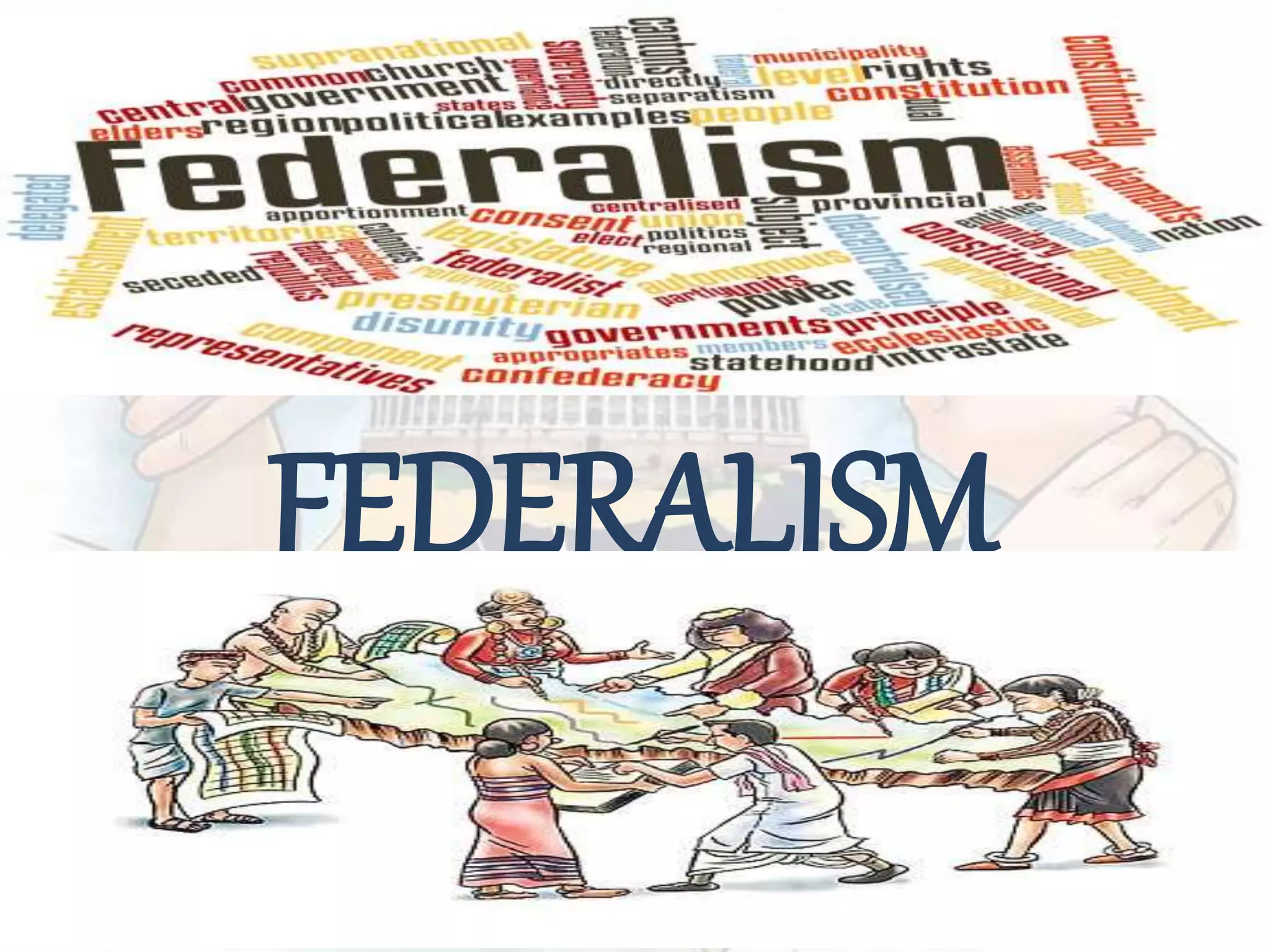


FEDERALISM
What is federalism ?
• A principle of government that defines the rel
ationship between the central government at
the national level and itsconstituent units at
the regional, state, or local levels. Under this
principle of government, power and authorit
y is allocatedbetween the national and local
governmental units, such that each unit is del
egated a sphere of power and authority only
itcan exercise, while other powers must be sh
ared.
Levels of government in federation
• Usually a federation has two levels of
government :
* Government for the entire country that
is usually responsible for a few
subjects of common national interest.
* Government at the level of provinces or
states that look after much of the day-
to-day administering of their state.
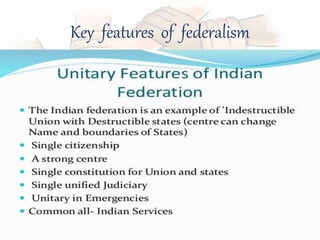
Key features of federalism
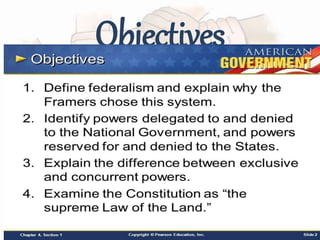
Objectives
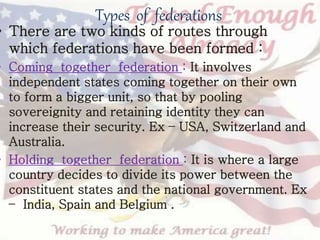
Types of federations
• There are two kinds of routes through
which federations have been formed :
• Coming together federation : It involves
independent states coming together on their own
to form a bigger unit, so that by pooling
sovereignity and retaining identity they can
increase their security. Ex – USA, Switzerland and
Australia.
• Holding together federation : It is where a large
country decides to divide its power between the
constituent states and the national government. Ex
– India, Spain and Belgium .
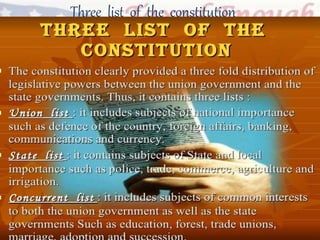
Three list of the constitution
The constitution clearly provided a three fold distribution
of legislative powers between the union government and
he state governments. Thus, it contains three lists :
Union list : it includes subjects of national importance
such as defence of the country, foreign affairs, banking,
communications and currency.
State list : it contains subjects of State and local
mportance such as police, trade, commerce, agriculture
and irrigation.
Concurrent list : it includes subjects of common interests
o both the union government as well as the state
governments Such as education, forest, trade unions,
marriage, adoption and succession.
Centre-state relations
• Restructuring the centre-staterelations is one more way in
which federalismhas been strengthened in practice.
• All this changed significantly after 1990. This period saw the
rise of regional political parties in many States of the country.
This was also the beginning of the era of coalition
government.
Third tier of government
• Federal power sharing in India needs another tier of government, belowthat of the
stategovernments. And it is calledas the local government.
• local government : It is the third-tier of government whichis
based on decentralizationof power.
• Ex - Urbangovernment : municipality
Rural government : panchayati raj government
Amending the constitution
• The constitutionwas amendedto makethe third-tier of government more
powerful and effective.
• Now it is constitutionally mandatory to hold regular elections to local
governmentbodies.
• Seats are reservedin the elected bodies and the executive heads of these
institutions for the SCs, STs and OBCs.
SUBMIT TO
mr jasjeet singh

FEDERALISM

  • 1.
  • 2.
    What is federalism? • A principle of government that defines the rel ationship between the central government at the national level and itsconstituent units at the regional, state, or local levels. Under this principle of government, power and authorit y is allocatedbetween the national and local governmental units, such that each unit is del egated a sphere of power and authority only itcan exercise, while other powers must be sh ared.
  • 3.
    Levels of governmentin federation • Usually a federation has two levels of government : * Government for the entire country that is usually responsible for a few subjects of common national interest. * Government at the level of provinces or states that look after much of the day- to-day administering of their state.
  • 4.
    Key features offederalism
  • 5.
  • 6.
    Types of federations •There are two kinds of routes through which federations have been formed : • Coming together federation : It involves independent states coming together on their own to form a bigger unit, so that by pooling sovereignity and retaining identity they can increase their security. Ex – USA, Switzerland and Australia. • Holding together federation : It is where a large country decides to divide its power between the constituent states and the national government. Ex – India, Spain and Belgium .
  • 7.
    Three list ofthe constitution The constitution clearly provided a three fold distribution of legislative powers between the union government and he state governments. Thus, it contains three lists : Union list : it includes subjects of national importance such as defence of the country, foreign affairs, banking, communications and currency. State list : it contains subjects of State and local mportance such as police, trade, commerce, agriculture and irrigation. Concurrent list : it includes subjects of common interests o both the union government as well as the state governments Such as education, forest, trade unions, marriage, adoption and succession.
  • 8.
    Centre-state relations • Restructuringthe centre-staterelations is one more way in which federalismhas been strengthened in practice. • All this changed significantly after 1990. This period saw the rise of regional political parties in many States of the country. This was also the beginning of the era of coalition government.
  • 9.
    Third tier ofgovernment • Federal power sharing in India needs another tier of government, belowthat of the stategovernments. And it is calledas the local government. • local government : It is the third-tier of government whichis based on decentralizationof power. • Ex - Urbangovernment : municipality Rural government : panchayati raj government
  • 10.
    Amending the constitution •The constitutionwas amendedto makethe third-tier of government more powerful and effective. • Now it is constitutionally mandatory to hold regular elections to local governmentbodies. • Seats are reservedin the elected bodies and the executive heads of these institutions for the SCs, STs and OBCs.
  • 11.