Prepared by- Deepali Jain
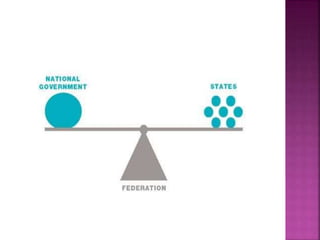
Itisa systemofgovernmentwhere power is
shared between central government and
individualstatesorprovinces
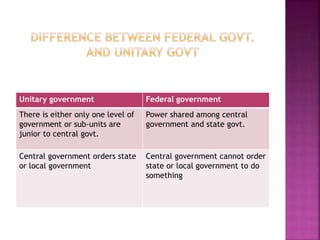
Unitary government Federal government
There is either only one level of
government or sub-units are
junior to central govt.
Power shared among central
government and state govt.
Central government orders state
or local government
Central government cannot order
state or local government to do
something
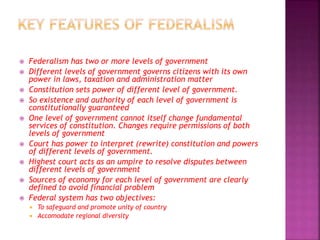
 Federalism has two or more levels of government
 Different levels of government governs citizens with its own
power in laws, taxation and administration matter
 Constitution sets power of different level of government.
 So existence and authority of each level of government is
constitutionally guaranteed
 One level of government cannot itself change fundamental
services of constitution. Changes require permissions of both
levels of government
 Court has power to interpret (rewrite) constitution and powers
of different levels of government.
 Highest court acts as an umpire to resolve disputes between
different levels of government
 Sources of economy for each level of government are clearly
defined to avoid financial problem
 Federal system has two objectives:
 To safeguard and promote unity of country
 Accomodate regional diversity
 Coming together federation
Holding together federation
 All independent states come together to form
bigger unit.
 All constituent states have equal power and
strong relation to federal government
 This type of federation exists in USA,
Switzerland and Australia
 Large country divide its power between States
and national government
 Central government is more powerful than
States
 This type of federation exists in India, Spain
and Belgium
 India is Union of States. Indian union is based
on principles of federalism
 Indian constitution provided three-tier
system of governments- Union or Central
government, State governments, Panchayats
and Municipalities
 All these separate tiers enjoy separate
jurisdictions( powers)
 Constitution clearly defined distribution of
powers between govt.
Union List
 It includes defence, foreign affairs, banking,
communications and currency
 Uniform policy applied on these matters
throughout country
 Union government make laws for matters in
union list
State List
 It includes police, trade, commerce, agriculture, and
irrigation
 State government make laws for matters in state list
Concurrent List
 It includes education, forests, trade unions, marriage,
adoption and succession
 Both Union as well as State government make laws for
matters in concurrent list
 Union government is preferred over State government
during law conflicts
 Linguistic States
 First and major test for democratic politics in India
was Creation of linguistic states
 Many old states have vanished and new states have
been created
 Areas, boundary and names of the states have been
changed to ensure that people speaking same
language lived in same state
 Some states like Nagaland, Uttarakhand and
Jharkhand were created on basis of culture,
ethnicity, or geography
 Central government opposed linguistic states for
sometimes but accepted afterwards
 Formation of linguistic state made country- More
united, Easier administration
 Language Policy
 Second test for federation is language policy
 No language entitled as national language by
constitution
 Hindi was identified as official language
 Hindi is mother tongue of only 40% Indians
 Besides Hindi, there exists 21 other languages
 Candidates can give government exams in regional
state languages
 Much government work takes place in respective
state language
 Flexibility of Indian political leaders helped country
avoid situations that other countries faced
 Centre-State relations
 Restructuring of Centre-State relations made
federalism strong
 Sharing of power depends on ruling parties and
leaders
 Central government misuse constitution to
dismiss State governments. All these destroying
federalism
 In year 1990, many regional political parties
formed in States of country
 Transfer of power from Central or State
government to local government is called
Decentralisation
 This is the reason for decentralisation
(transfer of power from Centre to authority)
of power
 In 1992, Constitution was changed to make third
tier of government more powerful
 It is mandatory to hold regular elections to local
government bodies
 Seats are reserved for Scheduled Caste,
Scheduled Tribes and Other Backward Classes
 At Least one-third of all positions are reserved
for women
 State Election Commission has been formed to
conduct panchayat and municipal elections
 State government shares more power and
revenue with local government bodies
Thank You

Federalism 1

  • 1.
  • 2.
    Itisa systemofgovernmentwhere poweris shared between central government and individualstatesorprovinces
  • 4.
    Unitary government Federalgovernment There is either only one level of government or sub-units are junior to central govt. Power shared among central government and state govt. Central government orders state or local government Central government cannot order state or local government to do something
  • 5.
     Federalism hastwo or more levels of government  Different levels of government governs citizens with its own power in laws, taxation and administration matter  Constitution sets power of different level of government.  So existence and authority of each level of government is constitutionally guaranteed  One level of government cannot itself change fundamental services of constitution. Changes require permissions of both levels of government  Court has power to interpret (rewrite) constitution and powers of different levels of government.  Highest court acts as an umpire to resolve disputes between different levels of government  Sources of economy for each level of government are clearly defined to avoid financial problem  Federal system has two objectives:  To safeguard and promote unity of country  Accomodate regional diversity
  • 6.
     Coming togetherfederation Holding together federation
  • 7.
     All independentstates come together to form bigger unit.  All constituent states have equal power and strong relation to federal government  This type of federation exists in USA, Switzerland and Australia
  • 8.
     Large countrydivide its power between States and national government  Central government is more powerful than States  This type of federation exists in India, Spain and Belgium
  • 9.
     India isUnion of States. Indian union is based on principles of federalism  Indian constitution provided three-tier system of governments- Union or Central government, State governments, Panchayats and Municipalities  All these separate tiers enjoy separate jurisdictions( powers)  Constitution clearly defined distribution of powers between govt.
  • 10.
    Union List  Itincludes defence, foreign affairs, banking, communications and currency  Uniform policy applied on these matters throughout country  Union government make laws for matters in union list
  • 11.
    State List  Itincludes police, trade, commerce, agriculture, and irrigation  State government make laws for matters in state list Concurrent List  It includes education, forests, trade unions, marriage, adoption and succession  Both Union as well as State government make laws for matters in concurrent list  Union government is preferred over State government during law conflicts
  • 12.
     Linguistic States First and major test for democratic politics in India was Creation of linguistic states  Many old states have vanished and new states have been created  Areas, boundary and names of the states have been changed to ensure that people speaking same language lived in same state  Some states like Nagaland, Uttarakhand and Jharkhand were created on basis of culture, ethnicity, or geography  Central government opposed linguistic states for sometimes but accepted afterwards  Formation of linguistic state made country- More united, Easier administration
  • 13.
     Language Policy Second test for federation is language policy  No language entitled as national language by constitution  Hindi was identified as official language  Hindi is mother tongue of only 40% Indians  Besides Hindi, there exists 21 other languages  Candidates can give government exams in regional state languages  Much government work takes place in respective state language  Flexibility of Indian political leaders helped country avoid situations that other countries faced
  • 14.
     Centre-State relations Restructuring of Centre-State relations made federalism strong  Sharing of power depends on ruling parties and leaders  Central government misuse constitution to dismiss State governments. All these destroying federalism  In year 1990, many regional political parties formed in States of country
  • 15.
     Transfer ofpower from Central or State government to local government is called Decentralisation  This is the reason for decentralisation (transfer of power from Centre to authority) of power
  • 16.
     In 1992,Constitution was changed to make third tier of government more powerful  It is mandatory to hold regular elections to local government bodies  Seats are reserved for Scheduled Caste, Scheduled Tribes and Other Backward Classes  At Least one-third of all positions are reserved for women  State Election Commission has been formed to conduct panchayat and municipal elections  State government shares more power and revenue with local government bodies
  • 17.